Bonding layer and process
Pith reviewed 2026-05-15 16:30 UTC · model grok-4.3
The pith
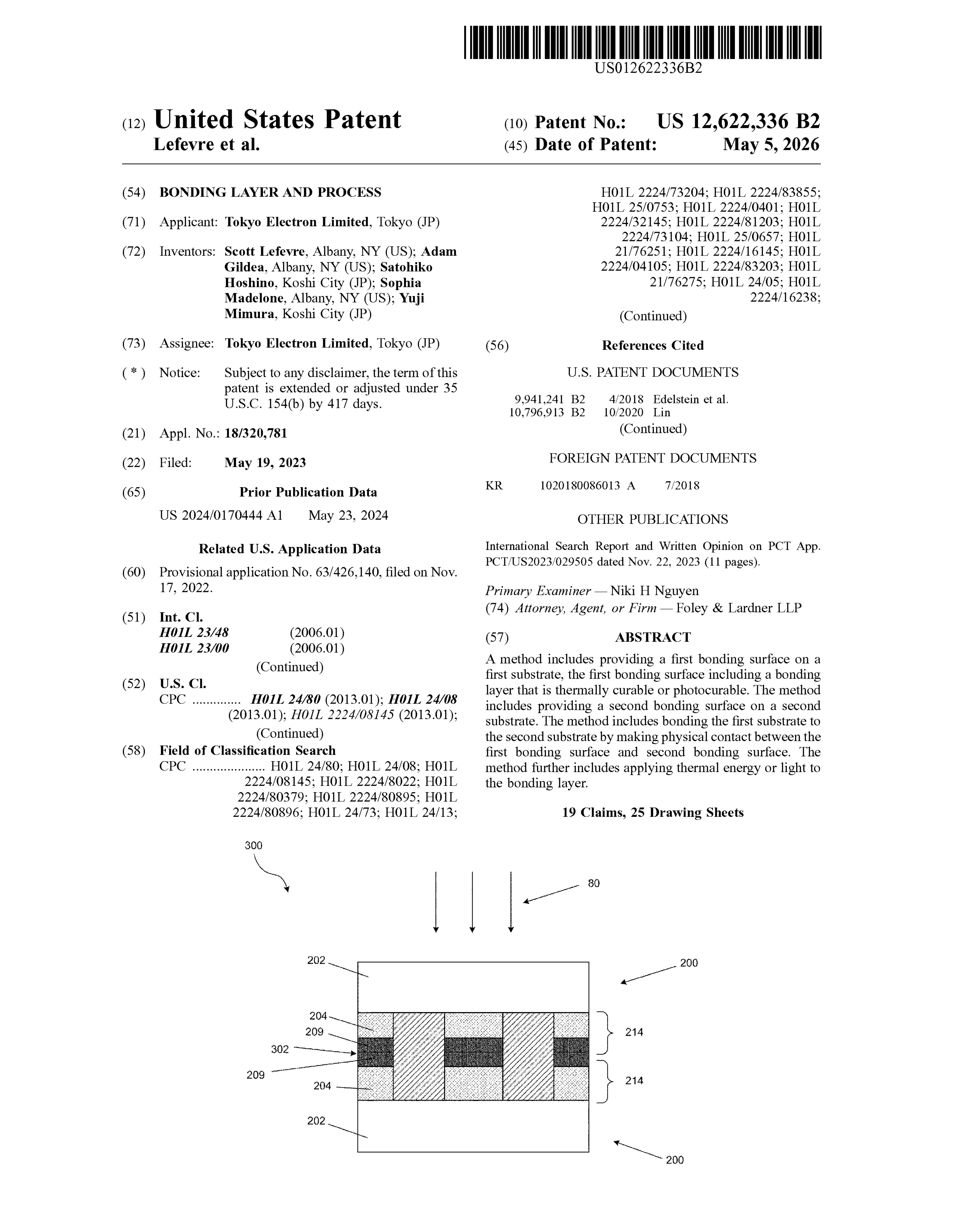
A curable bonding layer forms covalent attachments to both substrates when heat or light is applied after contact.
A machine-rendered reading of the paper's core claim, the machinery that carries it, and where it could break.
Core claim
Contacting the coated first substrate with the second substrate and then applying thermal energy or light causes the bonding layer to form covalent bonds simultaneously with both surfaces, locking the substrates together.
What carries the argument
Thermally curable or photocurable bonding layer that reacts at both interfaces upon energy input to produce covalent attachments.
Load-bearing premise
A material for the bonding layer can be formulated so that curing produces reliable covalent bonds to both substrates without voids, damage, or incomplete reaction.
What would settle it
Cross-sectional spectroscopy or peel-strength testing after curing that shows either absent covalent signatures at one interface or delamination under expected load.
Figures
read the original abstract
1 . A method, comprising: providing a first bonding surface on a first substrate, the first bonding surface including a bonding layer that is thermally curable or photocurable; providing a second bonding surface on a second substrate; bonding the first substrate to the second substrate by making physical contact between the first bonding surface and the second bonding surface; and applying thermal energy or light to the bonding layer, wherein applying the thermal energy or the light covalently bonds the bonding layer to the first substrate at the first bonding surface and to the second substrate at the second bonding surface, respectively.
Editorial analysis
A structured set of objections, weighed in public.
Referee Report
Summary. The manuscript (US patent 12622336) claims a four-step bonding method: providing a first substrate with a thermally or photocurable bonding layer on its bonding surface, providing a second substrate, bringing the surfaces into physical contact, and applying thermal energy or light so that the bonding layer forms covalent bonds to both substrates.
Significance. If the claim holds, the result restates a conventional curing-based adhesive process already standard in microelectronics and materials assembly; it adds no new data, material specifications, performance metrics, or mechanistic insight beyond the generic assertion of covalent bonding.
minor comments (1)
- The single claim provides no material class, thickness range, curing temperature/time, wavelength, or substrate examples, rendering the disclosure non-enabling for anyone skilled in the art without additional information.
Simulated Author's Rebuttal
We thank the referee for the review and the recommendation to accept. Below we respond to the points raised regarding the scope and significance of the claimed process.
read point-by-point responses
-
Referee: If the claim holds, the result restates a conventional curing-based adhesive process already standard in microelectronics and materials assembly; it adds no new data, material specifications, performance metrics, or mechanistic insight beyond the generic assertion of covalent bonding.
Authors: The submitted document is a patent claim rather than an experimental paper. The four-step sequence (provision of a curable layer on one substrate, contact with a second substrate, and activation to form covalent bonds to both surfaces) defines the protected process. While the underlying chemistry of thermal or photocuring is established, the claim is directed to the specific method of achieving simultaneous covalent attachment after physical contact, which is the inventive subject matter for patent purposes. No performance data or material formulations are required to support the claim as filed. revision: no
Circularity Check
No circularity; straightforward process claim
full rationale
The patent text consists solely of a method claim describing substrate preparation, physical contact, and thermal/photocuring to form covalent bonds. No equations, fitted parameters, predictions, derivations, ansatzes, or self-citations appear anywhere in the provided abstract or full-text description. The central statement is a direct procedural assertion whose validity rests on the existence of known curable materials, not on any internal reduction to its own inputs.
discussion (0)
Sign in with ORCID, Apple, or X to comment. Anyone can read and Pith papers without signing in.