REVIEW 3 major objections 5 minor 1 cited by
The Wolf-Rayet Content of the Galaxies of the Local Group and Beyond
T0 review · 3 major / 5 minor · reviewed 2026-08-14 · deepseek-v4-flash
Pith's one-line read With complete galaxy-wide surveys of Wolf-Rayet stars in the Local Group, the observed WC/WN ratio now agrees with modern single-star and binary stellar evolution models, resolving a long-standing high-metallicity discrepancy.
desk verdict A solid, honest review from the group that built the extragalactic WR census; the M31/M33 completeness assumption is the soft spot, but it doesn't sink the synthesis. read the letter →
The pith
A machine-rendered reading of the paper's core claim, the machinery that carries it, and where it could break.
The reading
What carries the argument
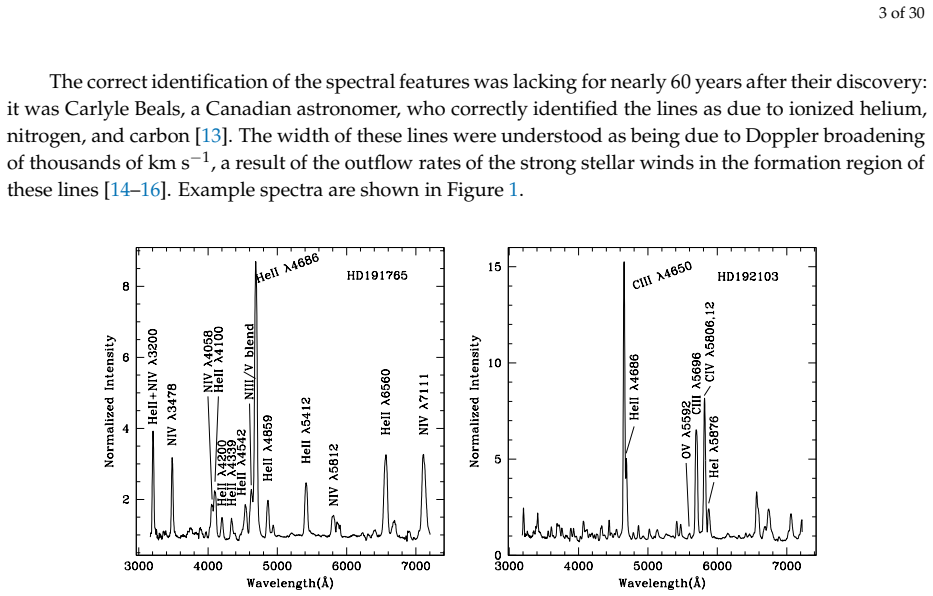
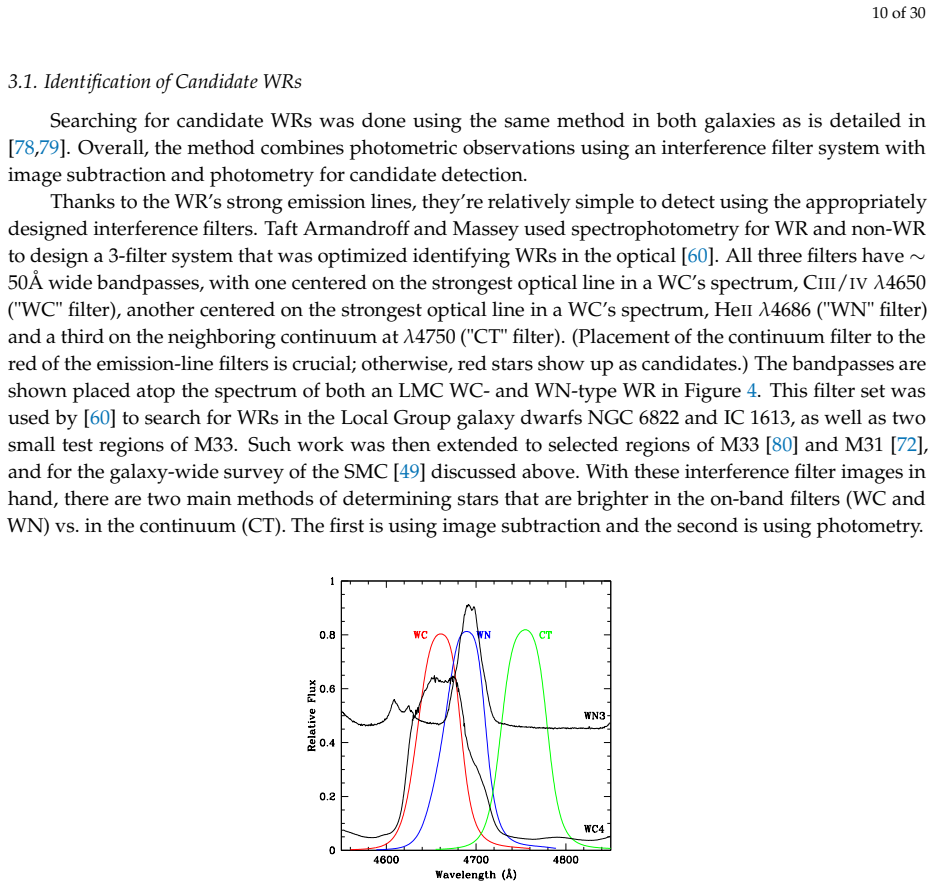
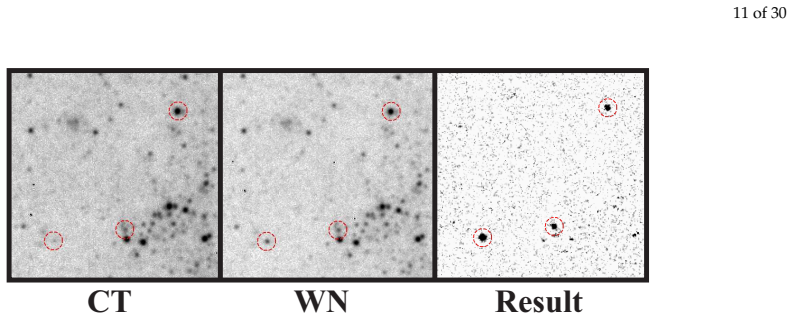
The central object is the WC/WN ratio—the number of carbon-rich to nitrogen-rich Wolf-Rayet stars in a galaxy—measured as a function of metallicity. The observational machinery that makes the measurement trustworthy is a three-filter interference system: one filter centered on the WC's strongest line (C III/IV 4650), one on the WN's strongest line (He II 4686), and a continuum filter at 4750, with candidates identified by image subtraction and confirmed by crowded-field photometry and spectroscopy. This combination removes the historical bias against WNs, whose lines are up to four times weaker than those of WCs. The comparison machinery is the pair of evolutionary model grids—Geneva single-star models with rotation and BPASS2.2.1 binary models—whose predicted WC/WN ratios as a function of metallicity are weighed against the complete Local Group samples.
What would settle it
A concrete check is a deep near-infrared narrow-band survey of M31's full disk, ideally from space, which would be far less affected by extinction than the optical survey. If it reveals enough previously missed Wolf-Rayet stars—especially WNs—to move M31's WC/WN ratio outside the band of Geneva and BPASS predictions at $\log(\mathrm{O/H}) + 12 = 8.9$ by more than the stated 0.11 uncertainty, the completeness claim and the model agreement would be falsified.
Extended reading notes
Core claim
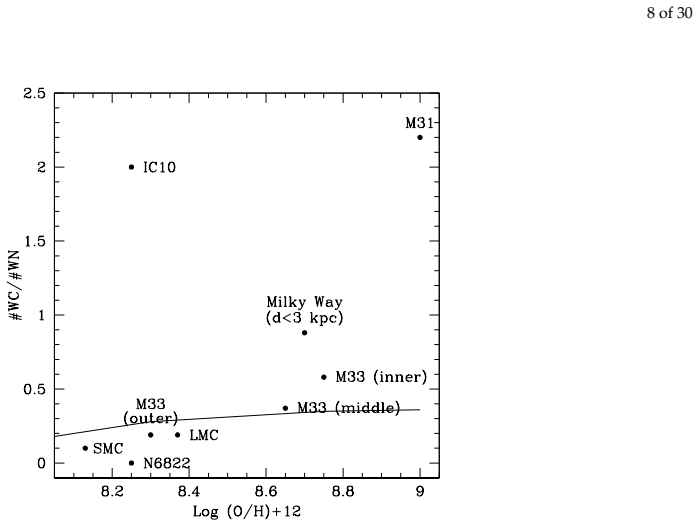
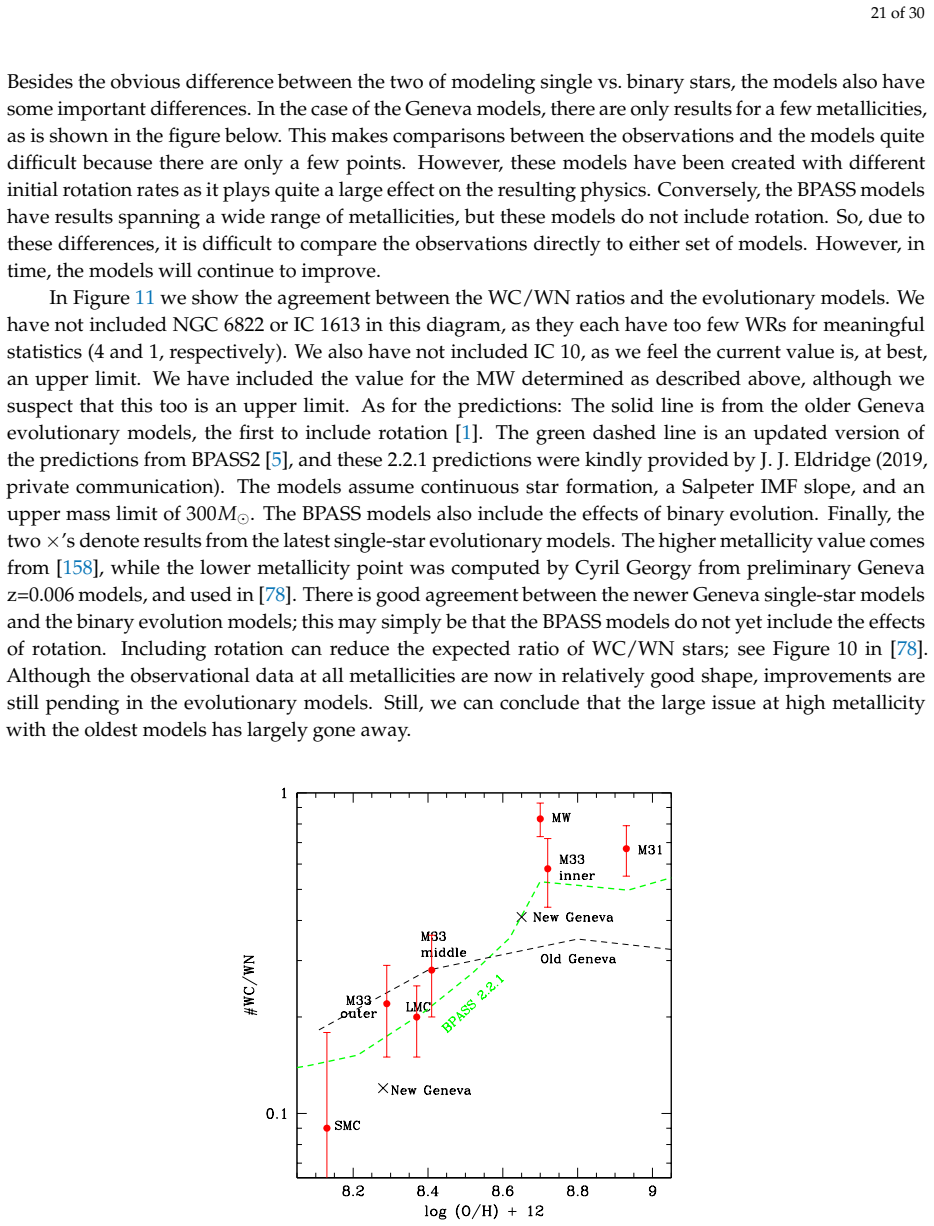
The discovery is that the previously reported excess of WC stars relative to WN stars at high metallicity—most glaringly in M31 and M33—was a selection effect, not a failure of stellar evolution theory. WN stars are far harder to detect than WC stars because their strongest optical emission line is up to four times weaker, so a galaxy-wide census that is complete for WCs can be badly incomplete for WNs. Once galaxy-wide interference-filter surveys with image subtraction and crowded-field photometry were completed for M33 (206 WRs, complete to about 5 percent) and M31 (154 WRs, complete to about 5 percent), the WC/WN ratio in M31 dropped from 2.2 to 0.67 and in M33 to 0.58 in the inner region, 0.28 in the middle, and 0.22 in the outer. Comparing the updated Local Group values—SMC 0.09, LMC 0.23, M33 inner 0.58, M31 0.67—against the latest Geneva rotating single-star models and the BPASS2.2.1 binary models shows reasonable agreement across the whole metallicity range, from 0.25 solar in the SMC to 1.7 solar in M31. The authors conclude that the large issue at high metallicity with the oldest models has largely gone away.
Load-bearing premise
The M31 and M33 Wolf-Rayet catalogs are complete to within about 5 percent, so no substantial population of Wolf-Rayet stars is hidden by crowding or by extinction on the far side of M31's disk.
Editorial extensions
If this is right
- The observed WC/WN ratios across the Local Group (SMC 0.09, LMC 0.23, M33 inner 0.58, M31 0.67) now fall within the scatter of the newer Geneva and BPASS model predictions, so the ratio can be used as a genuine test of massive-star mass-loss physics.
- The historical steep rise of WC/WN with metallicity is confirmed, but the high-metallicity values are much lower than photographic-era estimates implied; M31's true galaxy-wide ratio is 0.67, not 2.2.
- Surveys that claim completeness must correct for the WN detection bias or they will overestimate WC/WN; the paper's demonstrated remedy is image subtraction combined with crowded-field photometry across a three-filter system.
- Because the models now agree with observations at both low and high metallicity, population synthesis predictions that depend on WR content—such as ionizing flux and supernova progenitor types—can be made with more confidence.
- The presence of oxygen-rich WO stars in low-metallicity environments like the SMC and IC 1613 remains an indicator that binary evolution contributes to WR formation, since single-star winds are too weak there.
Reading between the lines
- A direct test of the completeness assumption would be a deep near-infrared survey, ideally from space, of the far side of M31's disk: if a substantial population of reddened WRs exists there, the true WC/WN ratio at the highest metallicity would change and the claimed model agreement could weaken.
- The same filter-subtraction technique could be pushed to galaxies just beyond the Local Group, such as NGC 300, to test whether the WC/WN-metallicity relation continues to hold as completeness is approached at intermediate distances.
- The WN3/O3 stars discovered in the LMC suggest a new evolutionary phase that current single-star and binary grids do not explicitly include; if they are common, they could affect WR counts and the WC/WN comparison at LMC metallicity.
- An implicit consequence is that the same data set can separately constrain metallicity-dependent mass-loss rates in single-star models and binary-stripping rates in BPASS, with the SMC and IC 1613 WO stars acting as natural discriminators between the two channels.
Editorial analysis
A structured set of objections, weighed in public.
Referee Report
Summary. This review synthesizes the current observational census of Wolf-Rayet stars in the Milky Way, Magellanic Clouds, M31, M33, and more distant systems, and compares the WC/WN ratio as a function of metallicity with Geneva single-star and BPASS binary stellar evolution models. The authors describe the historical development of WR searches and the interference-filter/image-subtraction technique that they have used to complete galaxy-wide surveys. Their central conclusion, presented in Section 7 and Figure 11, is that the previously noted disagreement between models and observations at high metallicity has largely disappeared once the new M31 and M33 samples are included, and that the data now agree reasonably with newer Geneva single-star models and BPASS2.2.1 binary predictions. The paper also reviews WR binarity, physical parameter determination with PoWR/CMFGEN, and prospects for studies beyond the Local Group.
Significance. If the underlying completeness estimates are correct, the paper resolves a long-standing discrepancy and provides a clean observational constraint on single versus binary channels for WR formation. The review is useful as a consolidated reference, and it is appropriately careful in labeling the Milky Way and IC 10 values as upper limits. The quantitative extinction estimate for M31 in Section 3.3 is a welcome, falsifiable argument, and the review is explicit about the remaining uncertainties in IC 10 and the Milky Way. However, the central high-metallicity comparison inherits its force entirely from the ~5% completeness claims for M31 and M33, and the review itself does not document the supporting recovery simulations; the main figure also relies on an unpublished model curve. These are transparency issues that affect how strongly the conclusion can be stated, although they are not instances of circular reasoning because the underlying surveys are independently refereed observational results.
major comments (3)
- [Sections 3.2, 3.3, and 7 (Figure 11)] The conclusion that the high-metallicity discrepancy has gone away rests on the assertion that the M31 and M33 samples are complete to about 5%. This review does not present the recovery simulations or completeness analysis behind that estimate, and the only directly contradictory object, the reddened WN/C star in M31 (Shara et al. 2016), is addressed only by indirect arguments: the blue-plume width in the M31 CMD and the estimated ~1.4 mag of V-band extinction through the inclined disk. The manuscript itself concedes that 'a handful of heavily reddened WRs may certainly have been missed.' Because WN stars have weaker detection lines than WC stars (Section 2.3), a modest WN incompleteness would change the M31 and M33 WC/WN ratios by more than the quoted sqrt(N) errors and would shift the comparison in Figure 11. Please state explicitly the basis of the 5% figure, ideally reproducing the injection/recovery tests from Neugent & Massey (2011) and Neugent et al. (2012) for both WN and WC stars, and quantify how an assumed 10-20% WN incompleteness would affect the high-metallicity conclusion.
- [Sections 2.2.1, 3.4, and Table 3] The number of LMC WRs is internally inconsistent: Section 2.2.1 cites the final census as 154 WRs, Section 3.4 says the new study brought the total to 152, and Table 3 sums to 152 (28 WC/WO plus 124 WN). Please reconcile these numbers and adjust the LMC row of Table 3 and the corresponding WC/WN ratio if needed.
- [Section 7 and Figure 11] The BPASS2.2.1 predictions used in the central comparison are said to have been provided by J. J. Eldridge (private communication). Since Figure 11 is the centerpiece of the paper's main conclusion, the review should include a table of the model values or a published reference so that the comparison can be reproduced by readers. A short appendix with the model points would remove a reproducibility gap in the otherwise clearly presented observational data.
minor comments (5)
- [Section 3.1] The WN filter is described as centered on the strongest optical line in a WC's spectrum; this should be the WN's strongest line, He II lambda 4686.
- [Section 2.3] The line identified as 'H II lambda 4686' should be 'He II lambda 4686'.
- [Section 2.1] The phrase 'has has come about' contains a duplicated word and should be corrected.
- [Section 4.1] The phrase 'for a more on this subject' is missing a noun; it should read 'for more on this subject.'
- [Section 7 and Figure 11] The Milky Way point is described in the text as an upper limit, but Figure 11 plots it with the same symbol as the Local Group measurements; an arrow or open symbol would make the upper-limit status clear.
Circularity Check
No circularity: the WC/WN ratios are observed quantities compared against independent external evolutionary models, and the authors' own surveys are falsifiable input data rather than fitted predictions.
full rationale
The paper's central claim (Section 7, Figure 11) is that the observed WC/WN ratios in the Local Group now agree reasonably with the newer Geneva single-star models and with BPASS2.2.1 binary models. The model curves are external to the paper: the Geneva predictions are from Meynet & Maeder (2005) and Georgy et al. (2012), and the BPASS2.2.1 predictions were supplied by J. J. Eldridge. None of these model parameters are fitted to the WC/WN data in this review, so the comparison is not a fitted input renamed as a prediction. The observed ratios (Table 3) come from the authors' earlier survey papers (Neugent & Massey 2011; Neugent et al. 2012; Neugent et al. 2018), but those papers are independent observational catalogs that are externally falsifiable; subsequent work by other groups (e.g., Shara et al. 2016) can and did test the claimed completeness. The completeness assumption is indeed load-bearing, but it is an observational premise, not a circular derivation: Section 3.3 explicitly confronts the Shara et al. challenge and concedes that 'a handful of heavily reddened WRs may certainly have been missed' while arguing indirectly that no opaque wall exists. That is a correctness/fragility concern, not a circularity concern. No equation in the paper defines a predicted ratio in terms of the observed ratio, no uniqueness theorem is imported from the authors' prior work to force a choice, and no known empirical pattern is merely renamed. The self-citations are appropriate for a review of the authors' own survey program and do not carry the logical weight of the model comparison.
Assumptions & free parameters
assumptions (5)
- domain assumption The WC/WN ratio, measured as a function of metallicity, is a valid diagnostic of massive star evolution and of the relative roles of single and binary channels.
- domain assumption Stellar wind mass-loss rates increase with metallicity, so high-metallicity environments produce more WC stars relative to WN stars.
- domain assumption The WR surveys of M31 and M33 are complete to within about 5%.
- domain assumption The metallicities adopted for each galaxy (Table 3) are accurate and on a consistent scale.
- domain assumption The BPASS2.2.1 and Geneva model predictions used in Figure 11 are computed with the stated assumptions (continuous star formation, Salpeter IMF, 300 solar mass upper limit) and are correctly applicable to the observed galaxies.
Cite this review
Pith. "Pith review of The Wolf-Rayet Content of the Galaxies of the Local Group and Beyond." pith.science (2026). https://pith.science/paper/TV2FEIID
@misc{pith2026190806238,
  author       = {Pith},
  title        = {Pith review of: The Wolf-Rayet Content of the Galaxies of the Local Group and Beyond},
  year         = {2026},
  howpublished = {\url{https://pith.science/paper/TV2FEIID}},
  note         = {Machine review of arXiv:1908.06238}
}
read the original abstract
Wolf-Rayet stars (WRs) represent the end of a massive star's life as it is about to turn into a supernova. Obtaining complete samples of such stars across a large range of metallicities poses observational challenges, but presents us with an exacting way to test current stellar evolutionary theories. A technique we have developed and refined involves interference filter imaging combined with image subtraction and crowded-field photometry. This helps us address one of the most controversial topics in current massive star research: the relative importance of binarity in the evolution of massive stars and formation of WRs. Here we discuss the current state of the field, including how the observed WR populations match with the predictions of both single and binary star evolutionary models. We end with what we believe are the most important next steps in WR research.
Figures

Figures from the paper (8 more)



Forward citations
Cited by 1 Pith paper
-
Unveiling and Characterising Ubiquitous Nitrogen Enhancement in $6 \leq z \leq 10$ Galaxies with JWST Spectroscopy
Stacked JWST/NIRSpec spectra of 135 z=6-10 galaxies show supersolar N/O that is highest after a star-formation lull, consistent with delayed AGB enrichment and pristine gas inflows.
Reference graph
Works this paper leans on
-
[2]
blinking by eye,
New Era of Discoveries As discussed above, as of 2005, the observed WC/WN ratio was q uite poorly aligned with the theoretical predictions at higher metallicities. Thus, M3 1 and M33 were two ideal regions to study . M31 has the highest metallicity of the Local Group galaxies at lo g(O/H) + 12 = 8.9 [ 12,76]. M33 has a strong metallicity gradient going fr...
2005
-
[3]
The strongest emission feature in WCs is nearly 4 × stronger than the strongest line in WNs, making WNs much more difficult to detect than WCs of similar brightness [ 75]. (More accurately , this is an issue of line fluxes; see treat ments in [ 73] and [38].) Thus, while a galaxy (or catalog such as BAT99) might be co mplete for WC-type stars, there might b...
-
[4]
gold standards
Wolf-Rayets Beyond the Local Group 4.1. Individual WR Populations WR stars have been found in a number of more distant galaxies. NGC 300 is a spiral galaxy in the Sculptor Group (1.9 Mpc) [ 97], the nearest galaxy group outside the Local Group. Broad WR features were found in the spectra of several of NGC300’s H II regions in the 1980s [ 57,98]. Eighteen ...
-
[5]
close" is a debatable one, bu t we use here a
Binarity One of the most heavily debated questions in massive star res earch is the issue of binarity . Observations have shown that a significant but still contest ed fraction of massive stars are found in binary systems. Studies of un-evolved massive stars typica lly find an observed binary fraction of 30-35% for O-type stars in relatively short period (l...
1981
-
[6]
Keeping the model’s luminosity near, but below , the Eddington limit can make modeling WRs quite a challenge
Physical Parameters As is characteristic of stars approaching the Eddington Lim it, a WR’s spectrum is heavily influenced by strong stellar winds and high mass-loss rates [ 143]. Keeping the model’s luminosity near, but below , the Eddington limit can make modeling WRs quite a challenge. Additionally , the stars’ high surface temperatures mean that the ass...
2014
-
[7]
Currently we have complete samples of the WR populations for the Magellanic Clouds, M31, and M33
Comparisons to Evolutionary Models As discussed in the Introduction, comparing the observed WC /WN ratio with evolutionary model predictions is one of the most important reasons to search fo r WRs. Currently we have complete samples of the WR populations for the Magellanic Clouds, M31, and M33 . The galaxy’s metallicities and WC/WN ratios are shown in T a...
2019
-
[8]
Summary and the Future of WRs WRs are the bare stellar cores of massive stars, and the last s tage in a massive star’s lifetime before they turn into supernovae. Observing a complete set of both t he nitrogen and carbon rich WRs within a galaxy allows for important comparisons between the obser ved WC/WN ratio and that predicted by the evolutionary models...
-
[9]
The numbers of red s upergiants and WR stars in galaxies - an extremely sensitive indicator of chemical composition
Maeder, A.; Lequeux, J.; Azzopardi, M. The numbers of red s upergiants and WR stars in galaxies - an extremely sensitive indicator of chemical composition. Astron. Astrophys. 1980, 90, L17–L20
1980
Show all 163 references
-
[10]
On the relationship between Of and WR stars
Conti, P .S. On the relationship between Of and WR stars. Memoires of the Societe Royale des Sciences de Liege 1975, 9, 193–212
1975
-
[11]
Massive Star Populations in Nearb y Galaxies
Maeder, A.; Conti, P .S. Massive Star Populations in Nearb y Galaxies. Annu. Rev. Astron. Astrophys. 1994, 32, 227–275. doi:10.1146/annurev .astro.32.1.227
1994 doi
-
[12]
Wolf-Rayet Stars in the Magellanic Clouds
Moffat, A.F.J.; Niemela, V .S.; Marraco, H.G. Wolf-Rayet Stars in the Magellanic Clouds. VI. Spectroscopic Orbits of WC Binaries and Implications for W-R Evolution. Astrophys. J. 1990, 348, 232. doi:10.1086/168232
1990 doi
-
[13]
Binary Population and Spectral Synthesis V ersion 2.1: Constructi on, Observational V erification, and New Results
Eldridge, J.J.; Stanway, E.R.; Xiao, L.; McClelland , L.A .S.; Taylor, G.; Ng, M.; Greis, S.M.L.; Bray, J.C. Binary Population and Spectral Synthesis V ersion 2.1: Constructi on, Observational V erification, and New Results. Publ. Astron. Soc. Australia 2017, 34, e058, [arXiv:a...
2017 arXiv
-
[14]
M.G.; Robert, C.; Kune, D.F.; de Mello, D.F.; Devost, D.; Heckman, T.M
Leitherer, C.; Schaerer, D.; Goldader, J.D.; Delgado, R. M.G.; Robert, C.; Kune, D.F.; de Mello, D.F.; Devost, D.; Heckman, T.M. Starburst99: Synthesis Models for Galaxies w ith Active Star Formation. Astrophy. J. Suppl. Ser. 1999, 123, 3–40, [astro-ph/9902334]. doi:10.1086/313233
1999 arXiv
-
[15]
The Host Galaxy of GRB 060505 : Host ISM Properties
Levesque, E.M.; Kewley, L.J. The Host Galaxy of GRB 060505 : Host ISM Properties. Astrophy. J. Lett. 2007, 667, L121–L124, [0708.0833]. doi:10.1086/522117
2007 arXiv
-
[16]
Massive-star evoluti on at high metallicity
Meynet, G.; Mowlavi, N.; Maeder, A. Massive-star evoluti on at high metallicity. The Metal-Rich Universe; Israelian, G.; Meynet, G., Eds., 2008, p. 341
2008
-
[17]
A revised spectral classification system and a new catalogue for galactic Wolf-Rayet stars
Smith, L.F. A revised spectral classification system and a new catalogue for galactic Wolf-Rayet stars. Mon. Notices Royal Astron. Soc. 1968, 138, 109. doi:10.1093/mnras/138.1.109
1968 doi
-
[18]
A UBVR CCD Survey of the Magellanic Clouds
Massey, P . A UBVR CCD Survey of the Magellanic Clouds. Astrophy. J. Suppl. Ser. 2002, 141, 81–122, [astro-ph/0110531]. doi:10.1086/338286
2002 arXiv
-
[19]
Abundances of the Heavy Elem ents in the Magellanic Clouds
Russell, S.C.; Dopita, M.A. Abundances of the Heavy Elem ents in the Magellanic Clouds. II. H II Regions and Supernova Remnants. Astrophy. J. Suppl. Ser. 1990, 74, 93. doi:10.1086/191494
1990 doi
-
[20]
T he Metallicity Profile of M31 from Spectroscopy of Hundreds of H II Regions and PNe
Sanders, N.E.; Caldwell, N.; McDowell, J.; Harding, P . T he Metallicity Profile of M31 from Spectroscopy of Hundreds of H II Regions and PNe. Astrophys. J. 2012, 758, 133, [arXiv:astro-ph.CO/1209.2251]. doi:10.1088/0004-637X/758/2/133
2012 arXiv
-
[21]
The Wolf-Rayet stars
Beals, C.S. The Wolf-Rayet stars. Publications of the Dominion Astrophysical Observatory Victoria 1930, 4, 271–301
1930
-
[22]
On the nature of Wolf-Rayet emission
Beals, C.S. On the nature of Wolf-Rayet emission. Mon. Notices Royal Astron. Soc. 1929, 90, 202–212. doi:10.1093/mnras/90.2.202
1929 doi
-
[23]
The subsonic structure o f radiatively driven winds of early-type stars
Cassinelli, J.P .; Hartmann, L. The subsonic structure o f radiatively driven winds of early-type stars. Astrophys. J. 1975, 202, 718–732. doi:10.1086/154025
1975 doi
-
[24]
Mass loss and evolution of O-type stars; Proceedings of the S ymposium, Vancouver Island, British Columbia, Canada, June 5-9, 1978 , V ol
Conti, P .S.; De Loore, C.W.H., Eds. Mass loss and evolution of O-type stars; Proceedings of the S ymposium, Vancouver Island, British Columbia, Canada, June 5-9, 1978 , V ol. 83,IAU Symposium, 1979
1978
-
[25]
New Galactic Wolf-Rayet stars, and ca ndidates
van der Hucht, K.A. New Galactic Wolf-Rayet stars, and ca ndidates. An annex to The VIIth Catalogue of Galactic Wolf-Rayet Stars. Astron. Astrophys. 2006, 458, 453–459, [arXiv:astro-ph/astro-ph/0609008]. doi:10.1051/0004-6361:20065819
2006 arXiv
-
[26]
The Sixth Catalogue of Galactic Wolf-Rayet Stars - Their Past and Present
van der Hucht, K.A.; Conti, P .S.; Lundstrom, I.; Stenhol m, B. The Sixth Catalogue of Galactic Wolf-Rayet Stars - Their Past and Present. Space Science Rev. 1981, 28, 227–306. doi:10.1007/BF00173260
1981 doi
-
[28]
Quantitative classification of WC and WO stars
Crowther, P .A.; De Marco, O.; Barlow, M.J. Quantitative classification of WC and WO stars. Mon. Notices Royal Astron. Soc. 1998, 296, 367–378. doi:10.1046/j.1365-8711.1998.01360.x
1998
-
[29]
A radial veloc ity study of three WN stars and an O3f star in the Carina Nebula
Conti, P .S.; Niemela, V .S.; Walborn, N.R. A radial veloc ity study of three WN stars and an O3f star in the Carina Nebula. Astrophys. J. 1979, 228, 206–219. doi:10.1086/156837
1979 doi
-
[30]
Spectroscopic studies of Wolf-Rayet stars with absorption lines
Massey, P .L. Spectroscopic studies of Wolf-Rayet stars with absorption lines. PhD thesis, University of Colorado, 1980
1980
-
[31]
A T reatise on Astronomical Spectroscopy; Boston: Ginn, 1894
Scheiner, J.; Frost, E.B. A T reatise on Astronomical Spectroscopy; Boston: Ginn, 1894
-
[32]
The Wolf-Rayet stars
Campbell, W.W. The Wolf-Rayet stars. Astronomy and Astro-Physics (formerly The Sidereal Messen ger) 1894, 13, 448–476
-
[33]
Wolf-Rayet stars and pl anetary nebulae in the Large Magellanic Cloud
Westerlund, B.E.; Rodgers, A.W. Wolf-Rayet stars and pl anetary nebulae in the Large Magellanic Cloud. The Observatory 1959, 79, 132–134
1959
-
[34]
Searching for hidden Wolf-Rayet stars in the Galactic plane - 15 new Wolf-Rayet st ars
Hadfield, L.J.; van Dyk, S.D.; Morris, P .W.; Smith, J.D.; Marston, A.P .; Peterson, D.E. Searching for hidden Wolf-Rayet stars in the Galactic plane - 15 new Wolf-Rayet st ars. Mon. Notices Royal Astron. Soc. 2007, 376, 248–262, [arXiv:astro-ph/astro-ph/0612574]. doi:10.1111/j...
2007 arXiv
-
[35]
Red Eyes on Wo lf-Rayet Stars: 60 New Discoveries via Infrared Color Selection
Mauerhan, J.C.; Van Dyk, S.D.; Morris, P .W. Red Eyes on Wo lf-Rayet Stars: 60 New Discoveries via Infrared Color Selection. Astron. J. 2011, 142, 40, [arXiv:astro-ph.GA/1105.5134]. doi:10.1088/0004-6256/142/2/40
2011 arXiv
-
[36]
12 New Galact ic Wolf-Rayet Stars Identified via 2MASS + Spitzer/GLIMPSE
Mauerhan, J.C.; Van Dyk, S.D.; Morris, P .W. 12 New Galact ic Wolf-Rayet Stars Identified via 2MASS + Spitzer/GLIMPSE. Publ. Astron. Soc. Pac. 2009, 121, 591, [arXiv:astro-ph.GA/0905.2443]. doi:10.1086/603544. 24 of 30
2009 arXiv
-
[37]
Characterizing Wolf-Rayet Stars in the Near- and Mid-infrared
Faherty, J.K.; Shara, M.M.; Zurek, D.; Kanarek, G.; Moff at, A.F.J. Characterizing Wolf-Rayet Stars in the Near- and Mid-infrared. Astron. J. 2014, 147, 115, [arXiv:astro-ph.SR/1401.7030]. doi:10.1088/0004-6256/147/5/115
2014 arXiv
-
[38]
A deep near-infrared spe ctroscopic survey of the Scutum-Crux arm for Wolf-Rayet stars
Rosslowe, C.K.; Crowther, P .A. A deep near-infrared spe ctroscopic survey of the Scutum-Crux arm for Wolf-Rayet stars. Mon. Notices Royal Astron. Soc. 2018, 473, 2853–2870, [arXiv:astro-ph.SR/1708.03582]. doi:10.1093/mnras/stx2103
2018 arXiv
-
[39]
A Near-Infrared Survey of the Inner Galact ic Plane for Wolf-Rayet Stars
Shara, M.M.; Moffat, A.F.J.; Gerke, J.; Zurek, D.; Stano nik, K.; Doyon, R.; Artigau, E.; Drissen, L.; Villar-Sbaffi, A. A Near-Infrared Survey of the Inner Galact ic Plane for Wolf-Rayet Stars. I. Methods and First Results: 41 New WR Stars. Astron. J. 2009, 138, 402–420, [arXi...
2009 arXiv
-
[40]
A Near-infrared Survey of the Inner Galactic Plane for Wolf-R ayet Stars
Shara, M.M.; Faherty , J.K.; Zurek, D.; Moffat, A.F.J.; G erke, J.; Doyon, R.; Artigau, E.; Drissen, L. A Near-infrared Survey of the Inner Galactic Plane for Wolf-R ayet Stars. II. Going Fainter: 71 More New W-R Stars. Astron. J. 2012, 143, 149, [arXiv:astro-ph.GA/1106.2196]....
2012 arXiv
-
[41]
The 30 Doradus nebula
Melnick, J. The 30 Doradus nebula. I. Spectral classifica tion of 69 stars in the central cluster. Astron. Astrophys. 1985, 153, 235–244
1985
-
[42]
Lar ge Magellanic Cloud
de Vacuouleurs, G.; Buscombe, W.; Gascoigne, S.C.B. Lar ge Magellanic Cloud. Australia J. Science (Suppl.) 1954, 17, 1–1
1954
-
[43]
The Magel lanic Clouds - spectroscopy and photometry of bright stars
Feast, M.W.; Thackeray, A.D.; Wesselink, A.J. The Magel lanic Clouds - spectroscopy and photometry of bright stars. The Observatory 1958, 78, 156–165
1958
-
[44]
New Wolf-Rayet stars in th e Large Magellanic Cloud
Azzopardi, M.; Breysacher, J. New Wolf-Rayet stars in th e Large Magellanic Cloud. Astron. Astrophys. 1979, 75, 243–246
1979
-
[45]
Spectral Classification of Wolf-Rayet St ars in the Large Magellanic Cloud
Breysacher, J. Spectral Classification of Wolf-Rayet St ars in the Large Magellanic Cloud. Astron. Astrophys. Suppl. Ser. 1981, 43, 203
1981
-
[46]
A Modern Search fo r Wolf-Rayet Stars in the Magellanic Clouds
Neugent, K.F.; Massey, P .; Morrell, N. A Modern Search fo r Wolf-Rayet Stars in the Magellanic Clouds. IV . A Final Census. Astrophys. J. 2018, 863, 181, [arXiv:astro-ph.SR/1807.01209]. doi:10.3847/1538-4357/aad17d
2018 arXiv
-
[47]
The fourth cat alogue of Population I Wolf-Rayet stars in the Large Magellanic Cloud
Breysacher, J.; Azzopardi, M.; Testor, G. The fourth cat alogue of Population I Wolf-Rayet stars in the Large Magellanic Cloud. Astron. Astrophys. Suppl. Ser. 1999, 137, 117–145. doi:10.1051/aas:1999240
1999 doi
-
[48]
The Intermediate Stellar Mass Population in R136 Determined from Hubble Space Telesc ope Planetary Camera 2 Images
Hunter, D.A.; Shaya, E.J.; Holtzman, J.A.; Light, R.M.; O’Neil, Earl J., J.; Lynds, R. The Intermediate Stellar Mass Population in R136 Determined from Hubble Space Telesc ope Planetary Camera 2 Images. Astrophys. J. 1995, 448, 179. doi:10.1086/175950
1995 doi
-
[49]
A Search for Wolf-Rayet Stars in t he Small Magellanic Cloud
Massey, P .; Duffy, A.S. A Search for Wolf-Rayet Stars in t he Small Magellanic Cloud. Astrophys. J. 2001, 550, 713–723, [arXiv:astro-ph/astro-ph/0010420]. doi:10.1086/319818. 25 of 30
2001 arXiv
-
[50]
Star Formation in R136: A Cluste r of O3 Stars Revealed by Hubble Space Telescope Spectroscopy
Massey, P .; Hunter, D.A. Star Formation in R136: A Cluste r of O3 Stars Revealed by Hubble Space Telescope Spectroscopy. Astrophys. J. 1998, 493, 180–194. doi:10.1086/305126
1998 doi
-
[51]
The Dense Galactic Starburst NGC 3603
Drissen, L.; Moffat, A.F.J.; Walborn, N.R.; Shara, M.M. The Dense Galactic Starburst NGC 3603. I. HST/FOS Spectroscopy of Individual Stars in the Core and the source o f Ionization and Kinetic Energy. Astron. J. 1995, 110, 2235. doi:10.1086/117684
1995 doi
-
[52]
On the Evolutionary P hase and Mass Loss of the Wolf-Rayet–like Stars in R136a
de Koter, A.; Heap, S.R.; Hubeny, I. On the Evolutionary P hase and Mass Loss of the Wolf-Rayet–like Stars in R136a. Astrophys. J. 1997, 477, 792. doi:10.1086/303736
1997 doi
-
[53]
Massive stars in the galaxies of the Local Grou p
Massey, P . Massive stars in the galaxies of the Local Grou p. New Astron. Rev. 2013, 57, 14–27, [arXiv:astro-ph.SR/1305.5914]. doi:10.1016/j.newar.2013.05.002
2013 arXiv
-
[54]
Wolf-Rayet stars in th e Small Magellanic Cloud
Breysacher, J.; Westerlund, B.E. Wolf-Rayet stars in th e Small Magellanic Cloud. Astron. Astrophys. 1978, 67, 261–265
1978
-
[55]
A search for new Wolf-Raye t stars in the Small Magellanic Cloud
Azzopardi, M.; Breysacher, J. A search for new Wolf-Raye t stars in the Small Magellanic Cloud. Astron. Astrophys. 1979, 75, 120–126
1979
-
[56]
A new Wolf-R ayet star in the Small Magellanic Cloud
Morgan, D.H.; Vassiliadis, E.; Dopita, M.A. A new Wolf-R ayet star in the Small Magellanic Cloud. Mon. Notices Royal Astron. Soc. 1991, 251, 51P . doi:10.1093/mnras/251.1.51P
1991 doi
-
[57]
Search for Wolf-Ra yet features in the spectra of giant HII regions
Dodorico, S.; Rosa, M.; Wampler, E.J. Search for Wolf-Ra yet features in the spectra of giant HII regions. I. Observations in NGC 300, NGC 604, NGC 5457 and He 2-10. Astron. Astrophys. Suppl. Ser. 1983, 53, 97–108
1983
-
[58]
The Discovery of a 12th Wolf-Rayet Star in the Small Magellanic Cloud
Massey, P .; Olsen, K.A.G.; Parker, J.W. The Discovery of a 12th Wolf-Rayet Star in the Small Magellanic Cloud. Publ. Astron. Soc. Pac. 2003, 115, 1265–1268, [arXiv:astro-ph/astro-ph/0308237]. doi:10.1086/379024
2003 arXiv
-
[59]
Spectroscopic St udies of Wolf-Rayet Stars
Conti, P .S.; Massey, P .; Garmany , C.D. Spectroscopic St udies of Wolf-Rayet Stars. V . Optical Spectrophotometry of the Emission Lines in Small Magellani c Cloud Stars. Astrophys. J. 1989, 341, 113. doi:10.1086/167476
1989 doi
-
[60]
Wolf-Rayet Stars in M33
Wray, J.D.; Corso, G.J. Wolf-Rayet Stars in M33. Astrophys. J. 1972, 172, 577. doi:10.1086/151375
1972 doi
-
[61]
Observations o f three Wolf-Rayet stars in M33
Boksenberg, A.; Willis, A.J.; Searle, L. Observations o f three Wolf-Rayet stars in M33. Mon. Notices Royal Astron. Soc. 1977, 180, 15P–19. doi:10.1093/mnras/180.1.15P
1977 doi
-
[62]
A GRISM search of Me ssier 33 for emission-line objects
Bohannan, B.; Conti, P .S.; Massey, P . A GRISM search of Me ssier 33 for emission-line objects. Astron. J. 1985, 90, 600–605. doi:10.1086/113766
1985 doi
-
[63]
Wolf-rayet stars and giant HII re gions in M 33 : casual associations or meaningful relationships ? Astrophys
Conti, P .S.; Massey, P . Wolf-rayet stars and giant HII re gions in M 33 : casual associations or meaningful relationships ? Astrophys. J. 1981, 249, 471–480. doi:10.1086/159307
1981 doi
-
[64]
Wolf-Rayet stars in extragalacti c H II regions
Rosa, M.; Dodorico, S. Wolf-Rayet stars in extragalacti c H II regions. II - NGC604 - A giant H II region dominated by many Wolf-Rayet stars. Astron. Astrophys. 1982, 108, 339–343
1982
-
[65]
Poor C ousin
Massey, P .; Armandroff, T.E.; Conti, P .S. IC 10: A “Poor C ousin” Rich in Wolf-Rayet Stars. Astron. J. 1992, 103, 1159. doi:10.1086/116134
1992 doi
-
[66]
Wolf-rayet stars in M 33
Massey, P .; Conti, P .S. Wolf-rayet stars in M 33. Astrophys. J. 1983, 273, 576–589. doi:10.1086/161393
1983 doi
-
[67]
The Spectra of Extra-Galactic Wolf-Rayet Stars
Massey, P .; Conti, P .S.; Armandroff, T.E. The Spectra of Extra-Galactic Wolf-Rayet Stars. Astron. J. 1987, 94, 1538. doi:10.1086/114586
1987 doi
-
[68]
Wolf-Rayet stars in NGC 682 2 and IC 1613
Armandroff, T.E.; Massey, P . Wolf-Rayet stars in NGC 682 2 and IC 1613. Astrophys. J. 1985, 291, 685–692. doi:10.1086/163107
1985 doi
-
[69]
Wolf-Rayet stars in extragalact ic HII regions: discovery of a peculiar WR in IC 1613/#3
D’Odorico, S.; Rosa, M. Wolf-Rayet stars in extragalact ic HII regions: discovery of a peculiar WR in IC 1613/#3. Astron. Astrophys. 1982, 105, 410–412
1982
-
[70]
Data on an unusual Wolf-Rayet star in the nearby Galaxy IC 1613
Davidson, K.; Kinman, T.D. Data on an unusual Wolf-Rayet star in the nearby Galaxy IC 1613. Publ. Astron. Soc. Pac. 1982, 94, 634–639. doi:10.1086/131034
1982 doi
-
[71]
Discovery of a Wolf-Rayet star in NGC 6822
Westerlund, B.E.; Azzopardi, M.; Breysacher, J.; Leque ux, J. Discovery of a Wolf-Rayet star in NGC 6822. Astron. Astrophys. 1983, 123, 159–161
1983
-
[72]
Wolf-Rayet Stars in Local G roup Galaxies: Numbers and Spectral Properties
Armandroff, T.E.; Massey, P . Wolf-Rayet Stars in Local G roup Galaxies: Numbers and Spectral Properties. Astron. J. 1991, 102, 927. doi:10.1086/115924
1991 doi
-
[74]
The Massive Star Content, R eddening, and Distance of the Nearby Irregular Galaxy IC 10
Massey, P .; Armandroff, T.E. The Massive Star Content, R eddening, and Distance of the Nearby Irregular Galaxy IC 10. Astron. J. 1995, 109, 2470. doi:10.1086/117465
1995 doi
-
[75]
The nature of the nuclear sources in M82 and NGC 253
Rieke, G.H.; Lebofsky, M.J.; Thompson, R.I.; Low, F.J.; Tokunaga, A.T. The nature of the nuclear sources in M82 and NGC 253. Astrophys. J. 1980, 238, 24–40. doi:10.1086/157954
1980 doi
-
[76]
Wolf-Rayet Stars in IC 10: Probing the Nearest Starburst
Massey, P .; Holmes, S. Wolf-Rayet Stars in IC 10: Probing the Nearest Starburst. Astrophys. J. 2002, 580, L35–L38, [arXiv:astro-ph/astro-ph/0210119]. doi:10.1086/345405
2002 arXiv
-
[77]
Revealing the ne bular properties and Wolf-Rayet population of IC10 with Gemini/GMOS
Tehrani, K.; Crowther, P .A.; Archer, I. Revealing the ne bular properties and Wolf-Rayet population of IC10 with Gemini/GMOS. Mon. Notices Royal Astron. Soc. 2017, 472, 4618–4633, [arXiv:astro-ph.GA/1708.03634]. doi:10.1093/mnras/stx2124
2017 arXiv
-
[78]
Wolf-Rayet stars in the Loca l Group galaxies M 31 and NGC 6822
Moffat, A.F.J.; Shara, M.M. Wolf-Rayet stars in the Loca l Group galaxies M 31 and NGC 6822. Astrophys. J. 1983, 273, 544–561. doi:10.1086/161391
1983 doi
-
[79]
Wolf-Rayet Stars in the Andr omeda Galaxy
Moffat, A.F.J.; Shara, M.M. Wolf-Rayet Stars in the Andr omeda Galaxy. Astrophys. J. 1987, 320, 266. doi:10.1086/165538
1987 doi
-
[80]
Massive stars in M31
Massey, P .; Armandroff, T.E.; Conti, P .S. Massive stars in M31. Astron. J. 1986, 92, 1303–1333. doi:10.1086/114264
1986 doi
-
[81]
A M odern Search for Wolf-Rayet Stars in the Magellanic Clouds: First Results
Massey, P .; Neugent, K.F.; Morrell, N.; Hillier, D.J. A M odern Search for Wolf-Rayet Stars in the Magellanic Clouds: First Results. Astrophys. J. 2014, 788, 83, [arXiv:astro-ph.SR/1404.7441]. doi:10.1088/0004-637X/788/1/83
2014 arXiv
-
[82]
Stellar evolution with rotation
Meynet, G.; Maeder, A. Stellar evolution with rotation. XI. Wolf-Rayet star populations at different metallicities. Astron. Astrophys. 2005, 429, 581–598, [arXiv:astro-ph/astro-ph/0408319]. doi:10.1051/0004-6361:20047106
2005 arXiv
-
[83]
Spectroscopic studies of Wolf-R ayet stars
Conti, P .S.; Massey, P . Spectroscopic studies of Wolf-R ayet stars. IV - Optical spectrophotometry of the emission lines in galactic and large Magellanic Cloud stars. Astrophys. J. 1989, 337, 251–271. doi:10.1086/167101
1989 doi
-
[84]
H II Regions and the Abundance Properties of Spiral Galaxies
Zaritsky, D.; Kennicutt, Robert C., J.; Huchra, J.P . H II Regions and the Abundance Properties of Spiral Galaxies. Astrophys. J. 1994, 420, 87. doi:10.1086/173544
1994 doi
-
[85]
Chemical abundances of Planetary Nebulae in M 33
Magrini, L.; Perinotto, M.; Mampaso, A.; Corradi, R.L.M . Chemical abundances of Planetary Nebulae in M 33. Astron. Astrophys. 2004, 426, 779–786, [arXiv:astro-ph/astro-ph/0406642]. doi:10.1051/0004-6361:20041103
2004 arXiv
-
[86]
The Wolf-Rayet Con tent of M31
Neugent, K.F.; Massey, P .; Georgy, C. The Wolf-Rayet Con tent of M31. Astrophys. J. 2012, 759, 11, [arXiv:astro-ph.SR/1209.1177]. doi:10.1088/0004-637X/759/1/11
2012 arXiv
-
[87]
The Wolf-Rayet Content of M33
Neugent, K.F.; Massey, P . The Wolf-Rayet Content of M33. Astrophys. J. 2011, 733, 123, [1103.5549]. doi:10.1088/0004-637X/733/2/123
2011 arXiv
-
[88]
Conti Scenario
Massey, P .; Johnson, O. Evolved Massive Stars in the Loca l Group. II. A New Survey for Wolf-Rayet Stars in M33 and Its Implications for Massive Star Evolution: Eviden ce of the “Conti Scenario” in Action. Astrophys. J. 1998, 505, 793–827. doi:10.1086/306199
1998 doi
-
[89]
The first transition Wolf-Rayet WN/C star in M31
Shara, M.M.; Mikołajewska, J.; Caldwell, N.; Iłkiewicz , K.; Drozd, K.; Zurek, D. The first transition Wolf-Rayet WN/C star in M31. Mon. Notices Royal Astron. Soc. 2016, 455, 3453–3457, [arXiv:astro-ph.SR/1510.03374]. doi:10.1093/mnras/stv2455
2016 arXiv
-
[90]
The Exceptionally Luminous Type Ia Supernova 2007if
Yuan, F.; Quimby, R.M.; Wheeler, J.C.; Vinkó, J.; Chatzo poulos, E.; Akerlof, C.W.; Kulkarni, S.; Miller, J.M.; McKay, T.A.; Aharonian, F. The Exceptionally Luminous Type Ia Supernova 2007if. Astrophys. J. 2010, 715, 1338–1343, [1004.3329]. doi:10.1088/0004-637X/715/2/1338
2010 arXiv
-
[91]
Astronomical Image Subtraction by Cross-Convolution
Yuan, F.; Akerlof, C.W. Astronomical Image Subtraction by Cross-Convolution. Astrophys. J. 2008, 677, 808–812, [0801.0336]. doi:10.1086/529040
2008 arXiv
-
[92]
T he Deep Lens Survey Transient Search
Becker, A.C.; Wittman, D.M.; Boeshaar, P .C.; Clocchiat ti, A.; Dell’Antonio, I.P .; Frail, D.A.; Halpern, J.; Margoniner, V .E.; Norman, D.; Tyson, J.A.; Schommer, R.A. T he Deep Lens Survey Transient Search. I. Short Timescale and Astrometric Variability . Astrophys. J. 2004...
2004 arXiv
-
[93]
DAOPHOT: A Computer Program for Crowded-F ield Stellar Photometry
Stetson, P .B. DAOPHOT: A Computer Program for Crowded-F ield Stellar Photometry. Publ. Astron. Soc. Pac. 1987, 99, 191. doi:10.1086/131977
1987 doi
-
[94]
Future devel opment of the DAOPHOT crowded-field photometry package
Stetson, P .B.; Davis, L.E.; Crabtree, D.R. Future devel opment of the DAOPHOT crowded-field photometry package. CCDs in astronomy; Jacoby, G.H., Ed., 1990, V ol. 8, Astronomical Society of the Pacific Conference Series , pp. 289–304
1990
-
[95]
The distribution of Wolf-Rayet stars in the G alaxy
Smith, L.F. The distribution of Wolf-Rayet stars in the G alaxy. Mon. Notices Royal Astron. Soc. 1968, 141, 317. doi:10.1093/mnras/141.3.317
1968 doi
-
[96]
Stellar Associations in the Andromeda N ebula
van den Bergh, S. Stellar Associations in the Andromeda N ebula. Astrophy. J. Suppl. Ser. 1964, 9, 65. doi:10.1086/190097
1964 doi
-
[97]
The Araucaria Project: The Distance to NGC 300 from the Red Giant Branch Tip Using HST ACS Imaging
Rizzi, L.; Bresolin, F.; Kudritzki, R.P .; Gieren, W.; Pi etrzy ´ nski, G. The Araucaria Project: The Distance to NGC 300 from the Red Giant Branch Tip Using HST ACS Imaging. Astrophys. J. 2006, 638, 766–771, [astro-ph/0510298]. doi:10.1086/498705
2006 arXiv
-
[98]
A Survey of Local Group Galaxies Currently Forming Stars
Massey, P .; Olsen, K.A.G.; Hodge, P .W.; Jacoby, G.H.; Mc Neill, R.T.; Smith, R.C.; Strong, S.B. A Survey of Local Group Galaxies Currently Forming Stars. II. UBVRI Photomet ry of Stars in Seven Dwarfs and a Comparison of the Entire Sample. Astron. J. 2007, 133, 2393–2417, [a...
2007 arXiv
-
[99]
The galactic extinction of e xtragalactic objects
de Vaucouleurs, G.; Buta, R. The galactic extinction of e xtragalactic objects. I - The csc B law and the extinction coefficient. Astron. J. 1983, 88, 939–961. doi:10.1086/113380
1983 doi
-
[100]
The Discovery of a Rare WO-type Wolf-Rayet Star in the Large Magellanic Cloud
Neugent, K.F.; Massey, P .; Morrell, N. The Discovery of a Rare WO-type Wolf-Rayet Star in the Large Magellanic Cloud. Astron. J. 2012, 144, 162, [arXiv:astro-ph.SR/1210.0062]. doi:10.1088/0004-6256/144/6/162. 27 of 30
2012 arXiv
-
[101]
A Modern Search fo r Wolf-Rayet Stars in the Magellanic Clouds
Massey, P .; Neugent, K.F.; Morrell, N. A Modern Search fo r Wolf-Rayet Stars in the Magellanic Clouds. II. A Second Year of Discoveries. Astrophys. J. 2015, 807, 81, [arXiv:astro-ph.SR/1505.06265]. doi:10.1088/0004-637X/807/1/81
2015 arXiv
-
[102]
A Modern Search fo r Wolf-Rayet Stars in the Magellanic Clouds
Massey, P .; Neugent, K.F.; Morrell, N. A Modern Search fo r Wolf-Rayet Stars in the Magellanic Clouds. III. A Third Year of Discoveries. ArXiv e-prints 2017, [arXiv:astro-ph.SR/1701.07815]
2017 arXiv
-
[103]
Th e Evolution and Physical Parameters of WN3/O3s: A New Type of Wolf-Rayet Star
Neugent, K.F.; Massey, P .; Hillier, D.J.; Morrell, N. Th e Evolution and Physical Parameters of WN3/O3s: A New Type of Wolf-Rayet Star. Astrophys. J. 2017, 841, 20, [arXiv:astro-ph.SR/1704.05497]. doi:10.3847/1538-4357/aa6e51
2017 arXiv
-
[104]
Estimating Distance from Parallaxes
Bailer-Jones, C.A.L.; Rybizki, J.; Fouesneau, M.; Mant elet, G.; Andrae, R. Estimating Distance from Parallaxes. IV . Distances to 1.33 Billion Stars in Gaia Data Release 2. Astron. J. 2018, 156, 58, [arXiv:astro-ph.SR/1804.10121]. doi:10.3847/1538-3881/aacb21
2018 arXiv
-
[105]
Sakai, S.; Akiyama, S
Kennicutt, Robert C., J.; Lee, J.C.; Funes, J.G.; J., S. ; Sakai, S.; Akiyama, S. An H α Imaging Survey of Galaxies in the Local 11 Mpc V olume. Astrophy. J. Suppl. Ser. 2008, 178, 247–279, [arXiv:astro-ph/0807.2035]. doi:10.1086/590058
2008 arXiv
-
[106]
H II regions in NGC 300
Deharveng, L.; Caplan, J.; Lequeux, J.; Azzopardi, M.; B reysacher, J.; Tarenghi, M.; Westerlund, B. H II regions in NGC 300. Astron. Astrophys. Suppl. Ser. 1988, 73, 407–423
1988
-
[107]
New Wolf-Rayet stars near the nucl eus of NGC 300
Schild, H.; Testor, G. New Wolf-Rayet stars near the nucl eus of NGC 300. Astron. Astrophys. 1991, 243, 115–117
1991
-
[108]
Ten little Wolf-Rayet stars in NG C 300
Schild, H.; Testor, G. Ten little Wolf-Rayet stars in NG C 300. Astron. Astrophys. 1992, 266, 145–149
1992
-
[109]
Wolf-Rayet stars detected in five associations of NGC
Breysacher, J.; Azzopardi, M.; Testor, G.; Muratorio, G. Wolf-Rayet stars detected in five associations of NGC
-
[110]
The Wolf-Rayet population of the nearby barred spiral galaxy NGC 5068 uncovered by the V ery Large Telescope and Gemini
Bibby, J.L.; Crowther, P .A. The Wolf-Rayet population of the nearby barred spiral galaxy NGC 5068 uncovered by the V ery Large Telescope and Gemini. Mon. Notices Royal Astron. Soc. 2012, 420, 3091–3107, [arXiv:astro-ph.SR/1111.0958]. doi:10.1111/j.1365-2966.2011.20220.x
2012 arXiv
-
[111]
Pietrzy ´ nski, G
Bresolin, F.; Kudritzki, R.P .; Najarro, F.; Gieren, W. ; Pietrzy ´ nski, G. Discovery and Quantitative Spectral Analysis of an Ofpe/WN9 (WN11) Star in the Sculptor Spiral Ga laxy NGC 300. Astrophys. J. 2002, 577, L107–L110, [arXiv:astro-ph/astro-ph/0208287]. doi:10.1086/344241
2002 arXiv
-
[112]
A large Wolf-Rayet population in NGC 300 uncovered by VLT-FORS2
Schild, H.; Crowther, P .A.; Abbott, J.B.; Schmutz, W. A large Wolf-Rayet population in NGC 300 uncovered by VLT-FORS2. Astron. Astrophys. 2003, 397, 859–870, [astro-ph/0209259]. doi:10.1051/0004-6361:20021555
2003 arXiv
-
[113]
On the optical counterpart of NGC 300 X-1 and the global Wolf-Rayet content of NGC 300
Crowther, P .A.; Carpano, S.; Hadfield, L.J.; Pollock, A .M.T. On the optical counterpart of NGC 300 X-1 and the global Wolf-Rayet content of NGC 300. Astron. Astrophys. 2007, 469, L31–L34, [arXiv:astro-ph/0705.1544]. doi:10.1051/0004-6361:20077677
2007 arXiv
-
[114]
The first optical spectra of Wolf-Rayet stars in M101 revealed with Gemini/GM OS
Pledger, J.L.; Shara, M.M.; Wilde, M.; Crowther, P .A.; Long, K.S.; Zurek, D.; Moffat, A.F.J. The first optical spectra of Wolf-Rayet stars in M101 revealed with Gemini/GM OS. Mon. Notices Royal Astron. Soc. 2018, 473, 148–164, [arXiv:astro-ph.GA/1705.01161]. doi:10.1093/mnras/stx2190
2018 arXiv
-
[115]
On the massive star content of the nearby dwarf irregular Wolf-Rayet galaxy IC 4662
Crowther, P .A.; Bibby, J.L. On the massive star content of the nearby dwarf irregular Wolf-Rayet galaxy IC 4662. Astron. Astrophys. 2009, 499, 455–464, [arXiv:astro-ph.CO/0903.2288]. doi:10.1051/0004-6361/200911758
2009 arXiv
-
[116]
A V ery Large Telescope imag ing and spectroscopic survey of the Wolf-Rayet population in NGC7793
Bibby, J.L.; Crowther, P .A. A V ery Large Telescope imag ing and spectroscopic survey of the Wolf-Rayet population in NGC7793. Mon. Notices Royal Astron. Soc. 2010, 405, 2737–2753, [arXiv:astro-ph.SR/1004.1549]. doi:10.1111/j.1365-2966.2010.16659.x
2010 arXiv
-
[117]
A survey of the Wolf-Raye t population of the barred, spiral galaxy NGC 1313
Hadfield, L.J.; Crowther, P .A. A survey of the Wolf-Raye t population of the barred, spiral galaxy NGC 1313. Mon. Notices Royal Astron. Soc. 2007, 381, 418–432, [arXiv:astro-ph/0708.2039]. doi:10.1111/j.1365-2966.2007.12284.x
2007 arXiv
-
[118]
A spectroscopic search for the non-nuclear Wolf-Rayet population of the metal-rich spiral galaxy M 83
Hadfield, L.J.; Crowther, P .A.; Schild, H.; Schmutz, W. A spectroscopic search for the non-nuclear Wolf-Rayet population of the metal-rich spiral galaxy M 83. Astron. Astrophys. 2005, 439, 265–277, [arXiv:astro-ph/astro-ph/0506343]. doi:10.1051/0004-6361:20042262
2005 arXiv
-
[119]
P ossible binary progenitors for the Type Ib supernova iPTF13bvn
Eldridge, J.J.; Fraser, M.; Maund, J.R.; Smartt, S.J. P ossible binary progenitors for the Type Ib supernova iPTF13bvn. Mon. Notices Royal Astron. Soc. 2015, 446, 2689–2695, [arXiv:astro-ph.SR/1408.4142]. doi:10.1093/mnras/stu2197
2015 arXiv
-
[120]
Location of WR sta rs in NGC 6744
Bibby, J.; Crowther, P .; Sandford, E. Location of WR sta rs in NGC 6744. Massive Stars: From alpha to Omega, 2013, p. 140. 28 of 30
2013
-
[121]
The Distribution of Massive Stars in M101
Bibby, J.; Shara, M.; Zurek, D.; Crowther, P .A.; Moffat , A.F.J.; Drissen, L.; Wilde, M. The Distribution of Massive Stars in M101. Wolf-Rayet Stars: Proceedings of an I nternational Workshop held in Potsdam, 2015, p. 355
2015
-
[122]
The Vast Population of Wolf-Rayet and Red Supergiant Stars in M101
Shara, M.M.; Bibby, J.L.; Zurek, D.; Crowther, P .A.; Mo ffat, A.F.J.; Drissen, L. The Vast Population of Wolf-Rayet and Red Supergiant Stars in M101. I. Motivation a nd First Results. Astron. J. 2013, 146, 162, [arXiv:astro-ph.SR/1302.6631]. doi:10.1088/0004-6256/146/6/162
2013 arXiv
-
[123]
Massive star formati on in Wolf-Rayet galaxies
López-Sánchez, Á.R.; Esteban, C. Massive star formati on in Wolf-Rayet galaxies. III. Analysis of the O and WR populations. Astron. Astrophys. 2010, 516, A104, [arXiv:astro-ph.CO/1004.0051]. doi:10.1051/0004-6361/200913434
2010 arXiv
-
[124]
The Wolf-Rayet star population in the dwarf galaxy NGC 625
Monreal-Ibero, A.; Walsh, J.R.; Iglesias-Páramo, J.; Sandin, C.; Relaño, M.; Pérez-Montero, E.; Vílchez, J. The Wolf-Rayet star population in the dwarf galaxy NGC 625 . Astron. Astrophys. 2017, 603, A130, [arXiv:astro-ph.GA/1704.05934]. doi:10.1051/0004-6361/201730663
2017 arXiv
-
[125]
Wolf-Rayet stars beyond 1 Mpc: wh y we want to find them and how to do it
Testor, G.; Schild, H. Wolf-Rayet stars beyond 1 Mpc: wh y we want to find them and how to do it. The Messenger 1993, 72, 31–34
1993
-
[126]
VLT/FORS Surveys of Wolf -Rayet Stars beyond the Local Group: Type Ib/c Supernova Progenitors? The Messenger 2007, 129, 53–57
Crowther, P .A.; Hadfield, L.J. VLT/FORS Surveys of Wolf -Rayet Stars beyond the Local Group: Type Ib/c Supernova Progenitors? The Messenger 2007, 129, 53–57
2007
-
[127]
Bibby, J.L.; Shara, M.M.; Crowther, P .A.; Moffat, A.F. J. Searching for Wolf-Rayet Stars Beyond the Local Group. Proceedings of a Scientific Meeting in Honor of Anthon y F. J. Moffat; Drissen, L.; Robert, C.; St-Louis, N.; Moffat, A.F.J., Eds., 2012, V ol. 465, Astronomical So...
2012
-
[128]
Binaries in Massive Star Formation
Gies, D.R. Binaries in Massive Star Formation. Massive Star Formation: Observations Confront Theory; Beuther, H.; Linz, H.; Henning, T., Eds., 2008, V ol. 387, Astronomical Society of the Pacific Conference Series , p. 93
2008
-
[129]
The progenitors of core-collapse supernova e
Fraser, M. The progenitors of core-collapse supernova e. The Lives and Death-Throes of Massive Stars; Eldridge, J.J.; Bray, J.C.; McClelland, L.A.S.; Xiao, L., E ds., 2017, V ol. 329, IAU Symposium , pp. 32–38. doi:10.1017/S1743921317002885
2017 doi
-
[130]
The dwarf emissio n galaxy He 2-10
Allen, D.A.; Wright, A.E.; Goss, W.M. The dwarf emissio n galaxy He 2-10. Mon. Notices Royal Astron. Soc. 1976, 177, 91. doi:10.1093/mnras/177.1.91
1976 doi
-
[131]
Observations of Wolf-rayet stars in the emission-line galaxy Tololo 3
Kunth, D.; Sargent, W.L.W. Observations of Wolf-rayet stars in the emission-line galaxy Tololo 3. Astron. Astrophys. 1981, 101, L5–L8
1981
-
[133]
Sokal, K.R.; Johnson, K.E.; Indebetouw, R.; Reines, A. E. An Emerging Wolf-Rayet Massive Star Cluster in NGC 4449. Astron. J. 2015, 149, 115, [arXiv:astro-ph.GA/1501.05313]. doi:10.1088/0004-6256/149/3/115
2015 arXiv
-
[134]
The Prevalence and Impact of Wolf-Rayet Stars in Emerging Massive Star Clusters
Sokal, K.R.; Johnson, K.E.; Indebetouw , R.; Massey, P . The Prevalence and Impact of Wolf-Rayet Stars in Emerging Massive Star Clusters. Astrophys. J. 2016, 826, 194, [arXiv:astro-ph.GA/1605.08044]. doi:10.3847/0004-637X/826/2/194
2016 arXiv
-
[135]
Spectroscopic s tudies of O type stars
Garmany, C.D.; Conti, P .S.; Massey, P . Spectroscopic s tudies of O type stars. IX. Binary frequency . Astrophys. J. 1980, 242, 1063–1076. doi:10.1086/158537
1980 doi
-
[136]
The VLT -FLAMES Tarantula Survey
Sana, H.; de Koter, A.; de Mink, S.E.; Dunstall, P .R.; Ev ans, C.J.; Hénault-Brunet, V .; Maíz Apellániz, J.; Ramírez-Agudelo, O.H.; Taylor, W.D.; Walborn, N.R. The VLT -FLAMES Tarantula Survey . VIII. Multiplicity properties of the O-type star population. Astron. Astophys. 2...
2013 arXiv
-
[137]
Spectral classification of O2-3.5 If*/WN5-7 stars
Crowther, P .A.; Walborn, N.R. Spectral classification of O2-3.5 If*/WN5-7 stars. Mon. Notices Royal Astron. Soc. 2011, 416, 1311–1323, [arXiv:astro-ph.SR/1105.4757]. doi:10.1111/j.1365-2966.2011.19129.x
2011 arXiv
-
[138]
Binary Interaction Dominates the E volution of Massive Stars
Sana, H.; de Mink, S.E.; de Koter, A.; Langer, N.; Evans, C.J.; Gieles, M.; Gosset, E.; Izzard, R.G.; Le Bouquin, J.B.; Schneider, F.R.N. Binary Interaction Dominates the E volution of Massive Stars. Science 2012, 337, 444, [arXiv:astro-ph.SR/1207.6397]. doi:10.1126/science.12...
2012 arXiv
-
[139]
Spectroscopic s tudies of Wolf-rayet stars with absorption lines
Massey, P .; Conti, P .S.; Niemela, V .S. Spectroscopic s tudies of Wolf-rayet stars with absorption lines. VII.HD 156327 and HD 192641 and the question of WR duplicity . Astrophys. J. 1981, 246, 145–152. doi:10.1086/158907
1981 doi
-
[140]
The VIIth catalogue of galactic Wolf -Rayet stars
van der Hucht, K.A. The VIIth catalogue of galactic Wolf -Rayet stars. New Astron. Rev. 2001, 45, 135–232. doi:10.1016/S1387-6473(00)00112-3
2001 doi
-
[141]
On the nature of WO stars: a quantitative analys is of the WO3 star DR1 in IC 1613
Tramper, F.; Gräfener, G.; Hartoog, O.E.; Sana, H.; de K oter, A.; Vink, J.S.; Ellerbroek, L.E.; Langer, N.; Garcia, M.; Kaper, L. On the nature of WO stars: a quantitative analys is of the WO3 star DR1 in IC 1613. Astron. Astrophys. 2013, 559, A72, [arXiv:astro-ph.SR/1310.284...
2013 arXiv
-
[142]
Wolf-Raye t binaries in the Magellanic Clouds and implications for massive-star evolution - II
Foellmi, C.; Moffat, A.F.J.; Guerrero, M.A. Wolf-Raye t binaries in the Magellanic Clouds and implications for massive-star evolution - II. Large Magellanic Cloud. Mon. Notices Royal Astron. Soc. 2003, 338, 1025–1056. doi:10.1046/j.1365-8711.2003.06161.x
2003
-
[143]
The Close Binary Frequency of Wolf-Rayet Stars as a Function of Metallicity in M31 and M33
Neugent, K.F.; Massey, P . The Close Binary Frequency of Wolf-Rayet Stars as a Function of Metallicity in M31 and M33. Astrophys. J. 2014, 789, 10, [arXiv:astro-ph.SR/1405.1810]. doi:10.1088/0004-637X/789/1/10
2014 arXiv
-
[144]
Collidi ng Winds from Early-Type Stars in Binary Systems
Stevens, I.R.; Blondin, J.M.; Pollock, A.M.T. Collidi ng Winds from Early-Type Stars in Binary Systems. Astrophys. J. 1992, 386, 265. doi:10.1086/171013
1992 doi
-
[145]
X-ray emission from interacting wind massive binaries: A review of 15 years of progress
Rauw, G.; Nazé, Y . X-ray emission from interacting wind massive binaries: A review of 15 years of progress. Advances in Space Research 2016, 58, 761–781, [arXiv:astro-ph.SR/1509.06480]. doi:10.1016/j.asr.2015.09.026
2016 arXiv
-
[146]
Physical Properties of Wolf-Rayet Star s
Crowther, P .A. Physical Properties of Wolf-Rayet Star s. Annu. Rev. Astron. Astrophys. 2007, 45, 177–219, [astro-ph/0610356]. doi:10.1146/annurev .astro.45.051806.110615
2007 arXiv
-
[147]
Weighing Melnick 34: the most massive binary system known
Tehrani, K.A.; Crowther, P .A.; Bestenlehner, J.M.; Li ttlefair, S.P .; Pollock, A.M.T.; Parker, R.J.; Schnurr, O. Weighing Melnick 34: the most massive binary system known. Mon. Notices Royal Astron. Soc. 2019, 484, 2692–2710, [arXiv:astro-ph.SR/1901.04769]. doi:10.1093/mnras/stz147
2019 arXiv
-
[148]
Garofali, K.; Levesque, E.M.; Massey, P .; Williams, B. F. The First Candidate Colliding-Wind Binary in M33. arXiv e-prints 2019, p. arXiv:1906.03274, [arXiv:astro-ph.HE/1906.03274]
2019 arXiv
-
[149]
The WO 4 + 04 V binary Sk 188 in the SMC
Moffat, A.F.J.; Breysachar, J.; Seggewiss, W. The WO 4 + 04 V binary Sk 188 in the SMC. Wolf-Rayet stars: Progenitors of supernovae?, 1983, p. 23
1983
-
[150]
The Wolf-Rayet stars in the Large Magellanic Cl oud
Hainich, R.; Rühling, U.; Todt, H.; Oskinova, L.M.; Lie rmann, A.; Gräfener, G.; Foellmi, C.; Schnurr, O.; Hamann, W.R. The Wolf-Rayet stars in the Large Magellanic Cl oud. A comprehensive analysis of the WN class. Astron. Astrophys. 2014, 565, A27, [arXiv:astro-ph.SR/1401.547...
2014 arXiv
-
[151]
A spectrophotometric study of HII regions in chemically young galaxies
Talent, D.L. A spectrophotometric study of HII regions in chemically young galaxies. PhD thesis, Rice University , 1980
1980
-
[152]
The Ed dington factor as the key to understand the winds of the most massive stars
Gräfener, G.; Vink, J.S.; de Koter, A.; Langer, N. The Ed dington factor as the key to understand the winds of the most massive stars. Evidence for a Γ -dependence of Wolf-Rayet type mass loss. Astron. Astrophys. 2011, 535, A56, [arXiv:astro-ph.SR/1106.5361]. doi:10.1051/0004-...
2011 arXiv
-
[153]
Line-blanke ted model atmospheres for WR stars
Gräfener, G.; Koesterke, L.; Hamann, W.R. Line-blanke ted model atmospheres for WR stars. Astron. Astrophys. 2002, 387, 244–257. doi:10.1051/0004-6361:20020269
2002 doi
-
[154]
The Treatment of Non-LTE Li ne Blanketing in Spherically Expanding Outflows
Hillier, D.J.; Miller, D.L. The Treatment of Non-LTE Li ne Blanketing in Spherically Expanding Outflows. Astrophys. J. 1998, 496, 407–427. doi:10.1086/305350
1998 doi
-
[155]
Understanding Stellar Evolution ; Bristol: IOP , 2017
Lamers, H.J.G.L.M.; Levesque, E.M. Understanding Stellar Evolution ; Bristol: IOP , 2017. doi:10.1088/978-0-7503-1278-3
2017 doi
-
[156]
Spectrum formation in Wolf-Rayet stars
Hillier, D.J. Spectrum formation in Wolf-Rayet stars. Wolf-Rayet Stars: Proceedings of an International Workshop held in Potsdam; Hamann, W.R.; Sander, A.; Todt, H. , Eds., 2015, pp. 65–70
2015
-
[157]
Recent advances in non-LTE stellar atmo sphere models
Sander, A.A.C. Recent advances in non-LTE stellar atmo sphere models. The Lives and Death-Throes of Massive Stars; Eldridge, J.J.; Bray, J.C.; McClelland, L.A .S.; Xiao, L., Eds., 2017, V ol. 329, IAU Symposium, pp. 215–222, [arXiv:astro-ph.SR/1702.04798]. doi:10.1017/S1743921...
2017 arXiv
-
[158]
The Wolf -Rayet stars in M 31
Sander, A.; Todt, H.; Hainich, R.; Hamann, W.R. The Wolf -Rayet stars in M 31. I. Analysis of the late-type WN stars. Astron. Astrophys. 2014, 563, A89, [arXiv:astro-ph.SR/1402.2282]. doi:10.1051/0004-6361/201323240
2014 arXiv
-
[160]
The Wolf-Rayet binaries of t he nitrogen sequence in the Large Magellanic Cloud: spectroscopy , orbital analysis, formation, and evo lution
Shenar, T.; Sablowski, D.P .; Hainich, R.; Todt, H.; Mof fat, A.F.J.; Oskinova, L.M.; Ramachandran, V .; Sana, H.; Sander, A.A.C.; Schnurr, O. The Wolf-Rayet binaries of t he nitrogen sequence in the Large Magellanic Cloud: spectroscopy , orbital analysis, formation, and evo l...
2019 arXiv
-
[161]
Wolf-Rayet stars in the Small Magellanic Cloud
Hainich, R.; Pasemann, D.; Todt, H.; Shenar, T.; Sander , A.; Hamann, W.R. Wolf-Rayet stars in the Small Magellanic Cloud. I. Analysis of the single WN stars. Astron. Astrophys. 2015, 581, A21, [arXiv:astro-ph.SR/1507.04000]. doi:10.1051/0004-6361/201526241
2015 arXiv
-
[162]
Wolf-Rayet stars in the Small Magell anic Cloud
Shenar, T.; Hainich, R.; Todt, H.; Sander, A.; Hamann, W .R.; Moffat, A.F.J.; Eldridge, J.J.; Pablo, H.; Oskinova, L.M.; Richardson, N.D. Wolf-Rayet stars in the Small Magell anic Cloud. II. Analysis of the binaries. Astron. Astrophys. 2016, 591, A22, [arXiv:astro-ph.SR/1604.0...
2016 arXiv
-
[163]
A Bak e-off between CMFGEN and FASTWIND: Modeling the Physical Properties of SMC and LMC O-type Stars
Massey, P .; Neugent, K.F.; Hillier, D.J.; Puls, J. A Bak e-off between CMFGEN and FASTWIND: Modeling the Physical Properties of SMC and LMC O-type Stars. Astrophys. J. 2013, 768, 6, [arXiv:astro-ph.SR/1303.5469]. doi:10.1088/0004-637X/768/1/6
2013 arXiv
-
[165]
The effect of m assive binaries on stellar populations and supernova progenitors
Eldridge, J.J.; Izzard, R.G.; Tout, C.A. The effect of m assive binaries on stellar populations and supernova progenitors. Mon. Notices Royal Astron. Soc. 2008, 384, 1109–1118, [arXiv:astro-ph/0711.3079]. doi:10.1111/j.1365-2966.2007.12738.x
2008 arXiv
-
[166]
BP ASS predictions for bi nary black hole mergers
Eldridge, J.J.; Stanway, E.R. BP ASS predictions for bi nary black hole mergers. Mon. Notices Royal Astron. Soc. 2016, 462, 3302–3313, [arXiv:astro-ph.HE/1602.03790]. doi:10.1093/mnras/stw1772
2016 arXiv
-
[167]
Grids of stellar models with rotation
Georgy, C.; Ekström, S.; Meynet, G.; Massey, P .; Levesq ue, E.M.; Hirschi, R.; Eggenberger, P .; Maeder, A. Grids of stellar models with rotation. II. WR populations and supe rnovae/GRB progenitors at Z = 0.014. Astron. Astrophys. 2012, 542, A29, [arXiv:astro-ph.SR/1203.5243]...
2012 arXiv
-
[300]
Astorphys
Astron. Astorphys. 1997, 326, 976–981
1997
-
[604]
One can never prove any star is not a binary
It is not nearly as bright as Mk 34, but it still shows X-ra y emission as discovered by Chandra [139]. While searching for X-ray emission is not the most prominent way of detecting WR binaries, it is more frequently being used as a method of determining binarity . As one of o...
Reviewed August 14, 2026 · model on record in the stance chip above.
Discussion (0). Continue with ORCID to comment.