REVIEW 3 major objections 5 minor 2 cited by
Velocity evolution of broad-lined type-Ic supernovae with and without gamma-ray bursts
T0 review · 3 major / 5 minor · reviewed 2026-08-12 · deepseek-v4-flash
Pith's one-line read The paper argues that GRB-supernovae and ordinary broad-lined type Ic supernovae have indistinguishable expansion velocities and velocity evolution, so an optical velocity curve cannot reveal whether a jet was launched.
desk verdict The largest, most careful Ic-BL velocity study to date, whose sample-level null result is credible, but whose population-level conclusion outruns the statistics. read the letter →
The pith
A machine-rendered reading of the paper's core claim, the machinery that carries it, and where it could break.
The reading
What carries the argument
Three pieces of machinery carry the argument. Velocities are measured from the wavelength of minimum flux in the blended Fe II (5169 Å) and Si II (6355 Å) absorption features, located by a cubic spline fit to Savitzky-Golay smoothed spectra, with uncertainties propagated through one thousand Monte-Carlo noise realisations per spectrum. The velocity evolution is then parameterised as a single power law \$v = a\,t^{b}\$ or as a smoothly broken power law with break time \$t_b\$, slopes \$\alpha_1\$ and \$\alpha_2\$, and a smoothness parameter \$s\$, with MCMC marginalisation of the parameters and an F-test that requires three-$\sigma$ improvement before a broken law is accepted. Population comparisons are deliberately restricted to the Gold subsample, whose explosion times are known to within three days, so that the fitted slopes and epoch velocities are not corrupted by \$t_0\$ uncertainty; the two populations are then compared with two-sample Kolmogorov-Smirnov tests.
What would settle it
Build a brightness-unbiased, volume-limited sample of nearby type Ic-BL supernovae with densely sampled pre-peak light curves and late-time radio follow-up, and compare the fifteen-day Fe II velocities of the radio-quiet subclass with those of GRB-supernovae: a statistically significant velocity deficit for the radio-quiet events would overturn the common-population conclusion, whereas continued overlap would confirm it.
Extended reading notes
Core claim
The paper's central claim is that the presence of a GRB jet leaves no imprint on the photospheric expansion of a type Ic-BL supernova. For the Fe II feature, the median gold-sample decay index is \$-0.27^{+0.04}_{-0.27}\$ for GRB-supernovae and \$-0.30^{+0.09}_{-0.25}\$ for ordinary type Ic-BL supernovae; for Si II the medians are \$-0.4^{+0.2}_{-0.3}\$ and \$-0.6^{+0.3}_{-0.2}\$. At fifteen days the median Fe II velocity is \$\sim 21\,000\$ km s\${}^{-1}\$ in both populations, and two-sample Kolmogorov-Smirnov tests cannot reject a common parent distribution for the decay indices (Fe II p=0.85, Si II p=0.39) or for the day-15 velocities (Fe II p=0.89, Si II p=0.46). The authors also find that broken power-law evolution is common for Si II and always shallow-steep, while Fe II breaks are mostly steep-shallow, and that the engine-driven supernovae SN2016coi and PTF12gzk follow the same Si II velocity pattern as GRB060218-SN2006aj with a break near eighteen days — a possible sign of a two-component ejecta structure such as a jet or cocoon in some ordinary events. They conclude that neither the velocities nor their evolution can distinguish the classes, and that GRB-supernovae and ordinary type Ic-BL supernovae are likely drawn from the same underlying population of events.
Load-bearing premise
The central result rests on the assumption that the ordinary type Ic-BL supernovae in the sample stand in for genuinely jet-free explosions, even though they were collected by brightness-limited surveys that may favour bright, nickel-rich events seen along the jet direction; if that selection bias is strong, the measured overlap with GRB-supernovae could be an artefact of how the sample was gathered rather than a sign that the two classes are the same.
Editorial extensions
If this is right
- Expansion velocity is unusable as a jet discriminator: neither the Fe II nor the Si II velocity at fifteen days separates GRB-supernovae from ordinary type Ic-BL supernovae, so optical spectroscopy alone cannot reveal a hidden jet.
- Because the Fe II and Si II decay indices overlap across type Ic, type Ic-BL, and GRB-supernovae, the deceleration rate of the ejecta appears intrinsic to stripped-envelope explosions rather than a signature of jet energy injection.
- Broken power-law decline appears in both classes at similar rates, and the resemblance of SN2016coi and PTF12gzk to GRB060218-SN2006aj suggests that some ordinary type Ic-BL supernovae do harbour a second ejecta component, plausibly a jet or a cocoon.
- Discriminating jet-bearing from jet-free events will have to rely on late-time radio and X-ray observations rather than on optical velocities, as the paper explicitly concludes.
Reading between the lines
- If the brightness-limited surveys that found most of the ordinary events preferentially picked up nickel-rich, pole-on explosions, the reported velocity overlap could be a selection effect: a genuinely jet-free subset might still expand more slowly, and the common-population conclusion would then be overstated.
- A clean test would split ordinary type Ic-BL supernovae by late-time radio detection: if radio-bright events (hidden jets) show systematically higher velocities than radio-quiet events, the two underlying populations are not actually the same.
- The growing Fe II minus Si II velocity difference after roughly day 20 hints that the Fe II 5169 Å minimum is not a clean photospheric tracer once line de-blending sets in, which would add a systematic uncertainty to any cross-class comparison built on this line.
Signed reviews
Editorial analysis
A structured set of objections, weighed in public.
Referee Report
Summary. The manuscript compiles the largest spectroscopic sample to date of type Ic-BL supernovae with and without associated GRBs: 61 ordinary type Ic-BL SNe and 13 GRB-SNe, comprising 875 spectra. It measures Fe II 5169 Å and Si II 6355 Å expansion velocities using a spline-fitting Monte Carlo method, fits the velocity evolution with power-law (Eq. 1) and broken power-law (Eq. 2) models, and compares the two populations using decay indices and velocities at t0+15 days, restricted to a Gold sample with well-constrained explosion times. The main result is that the two populations show overlapping velocities and statistically indistinguishable decay indices, leading the authors to conclude that GRB-SNe and ordinary Ic-BL SNe are drawn from the same underlying population of events.
Significance. The dataset is the largest of its kind and the methodology is generally careful: the Monte Carlo spline procedure, the Gold/Silver/Bronze quality tiers, the explicit t0-robustness study in Appendix D, and the literature cross-checks in Appendix E are genuine strengths. If the null result survives a treatment of selection effects, it would be an important constraint on jet-ejecta coupling and on the interpretation of Ic-BL SNe as engine-driven events. However, the headline population-equality claim currently rests on small Gold subsamples and on a survey-selected 'ordinary' sample that the manuscript itself acknowledges may be biased toward jet-bearing events. The significance of the central conclusion is therefore conditional on addressing these caveats.
major comments (3)
- [Sect. 2.2, Sect. 2.3, Tables 3 and 6] The central population-equality claim is weakened by sample selection. The manuscript notes in Sect. 2.2 that ordinary Ic-BL SNe are drawn from magnitude-limited surveys such as ZTF BTS (m_peak <= 18.5 mag) and that this may bias the sample toward bright, nickel-rich, polar-viewed events that could harbour jets, while Sect. 2.3 notes the very different redshift ranges of the two discovery channels (z <~ 0.2 vs z <~ 0.6). If the 'ordinary' sample preferentially includes jet-bearing SNe, a genuine velocity difference between truly jet-free and jet-bearing populations could be masked, producing the null results in Table 6. The sample also places known engine-driven SNe in the ordinary group (e.g., SN2009bb, SN2012ap, PTF12gzk, SN2016coi). The paper does not quantify or correct for this selection effect, so the abstract conclusion that the two groups are drawn from the same underlying population is stronger than the data currently support.
- [Tables 3 and 6] The KS tests use Gold sample sizes of only 5-6 GRB-SNe and 11-13 ordinary Ic-BL SNe. With such small samples, failure to reject the null at the chosen p<0.01 threshold is weak evidence for population equality; p-values of 0.85, 0.39, 0.89, and 0.46 are as consistent with low statistical power as with a genuinely common underlying distribution. A power analysis or a statement of the minimum detectable velocity difference would be needed to support the abstract claim that the two populations are indistinguishable. The manuscript acknowledges the small numbers in passing, but the conclusions do not carry this caveat with sufficient weight.
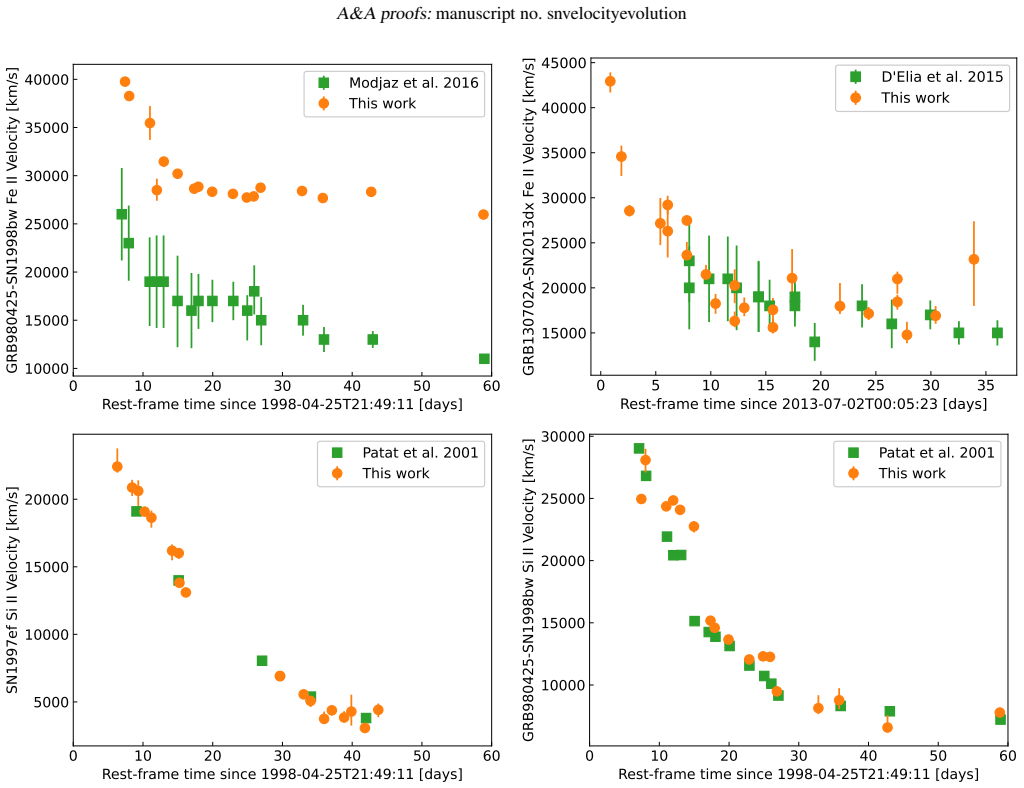
- [Sect. 4.2, Sect. 4.4, Sect. 5.1] The quantitative statistical comparisons are not model-independent. The 15-day velocities and decay indices used in the KS tests are computed from the same power-law and broken power-law fits that define them, so the two population comparisons inherit the assumptions of the fitted model. In addition, Sect. 5.1 reports a ~12000 km/s difference between the spline-minimum Fe II velocity and the Modjaz et al. template-matching velocity for SN1998bw, illustrating that the Fe II measurements are sensitive to line blending. The raw velocity plots (left panels of Figs. 7 and 8) do show overlap, which is reassuring, but the quantitative p-values alone are not a model-independent demonstration of population equality.
minor comments (5)
- [Sect. 4.2.2, Fig. 12] The sentence 'as a result of these issues, SN2002ap was assigned to the Gold sample' appears to be a typo; the object shown in Fig. 12 and discussed in that paragraph is SN2009bb, not SN2002ap.
- [Sect. 4.6 and Sect. 5.1] Two different figures are both numbered Figure 25: the Fe II minus Si II velocity difference plot and the literature comparison plot. The latter should be renumbered to avoid confusion.
- [Sect. 4.2.2, Table 3] The text states a p-value of 0.21 for the Si II decay-index KS test, while Table 3 lists 0.39 for the same test; the discrepancy should be reconciled.
- [Sect. 4.4.2] The sentence 'it is certain that these velocities are accurate' appears to be a typo; the surrounding discussion indicates the intended meaning is that the velocities from the Bronze sample are not reliable.
- [Sect. 5.4] The phrase 'and references therin' should read 'and references therein'.
Circularity Check
No significant circularity: the velocity measurements and power-law fits are independent of the population labels, and the self-citations are methodological or data-source references, not load-bearing premises.
full rationale
The paper's derivation chain is self-contained: spectra are measured with a spline method to obtain Fe II and Si II velocities, the velocity evolution is parameterised with single and broken power-laws, and the two populations are then compared via KS tests on the fitted decay indices and on the fit-evaluated velocities at t0+15 days. These fitted quantities are the objects of the population comparison, not inputs that define the populations; the two groups are defined solely by the presence or absence of an associated GRB, which is external to the fitting procedure. The central claim of velocity overlap is also directly visible in the left panels of Figs. 7 and 8, i.e. in the measured velocities themselves, and the fits are benchmarked against literature values in Sect. 5.1 and Appendix E. The self-citations (Finneran & Martin-Carrillo 2024 for smoothing window and knot density; Finneran et al. 2025 for the GRBSN webtool) are methodological tuning choices and a data repository, respectively; neither supplies a theoretical premise that forces the conclusion, and no uniqueness theorem is imported from the authors' prior work. The acknowledged magnitude-limited selection bias of the ordinary Ic-BL sample (Sect. 2.2) is a representativeness concern that could affect the astrophysical interpretation, but it is not a circular reduction of the derivation to its own inputs. Therefore no circular step meets the evidentiary standard required here.
Assumptions & free parameters
free parameters (5)
- Power-law normalization a and index b (Eq. 1) =
Per SN; Fe II index median about -0.30 and Si II about -0.6 for Gold Ic-BL SNe
- Broken power-law parameters A, tb, alpha1, alpha2 (Eq. 2) =
Per SN; tb around 15 to 25 days for the five Fe II and six Si II broken-law SNe
- Smoothness parameter s in Eq. 2 =
s = +/-20 for most SNe, +/-5 for a few (SN2002ap, SN2009bb)
- Savitzky-Golay filter window length =
2-5% of spectrum length in resolution elements
- Spline knot density =
About 10% of resolution elements within the fitted feature
assumptions (5)
- domain assumption During the photospheric phase used here (t < 60 days rest frame), the ejecta are in homologous expansion and line minima trace the expansion velocity.
- domain assumption The minimum-flux wavelength of the blended Fe II feature (with 5169 A adopted as rest wavelength) traces the same line blend in both populations.
- domain assumption Host-galaxy and Milky Way reddening do not shift the measured velocity minima.
- domain assumption Explosion epochs for non-GRB SNe estimated from sparse light curves are reliable enough to compare velocity evolution.
- domain assumption Online archives (WISeREP, GRBSN) provide sufficiently complete spectroscopy, and the visual double-redshift-check catches mis-calibrated spectra.
Cite this review
Pith. "Pith review of Velocity evolution of broad-lined type-Ic supernovae with and without gamma-ray bursts." pith.science (2026). https://pith.science/paper/2ZEJYVW3
@misc{pith2026241111503,
  author       = {Pith},
  title        = {Pith review of: Velocity evolution of broad-lined type-Ic supernovae with and without gamma-ray bursts},
  year         = {2026},
  howpublished = {\url{https://pith.science/paper/2ZEJYVW3}},
  note         = {Machine review of arXiv:2411.11503}
}
read the original abstract
More than 60 broad-lined type Ic (Ic-BL) supernovae (SNe) are associated with a long gamma-ray burst (GRB). However, many type Ic-BL SNe exhibit no sign of an associated GRB. On average, the expansion velocities of GRB-associated type Ic-BL SNe (GRB-SNe) are greater than those of type Ic-BL SNe without an associated GRB. This work presents the largest spectroscopic sample of type Ic-BL SNe with and without GRBs to date, consisting of 61 ordinary type Ic-BL SNe and 13 GRB-SNe. The goal of this work is to compare the evolution of SN expansion velocities in cases where an ultra-relativistic jet has been launched (GRB-SNe) and cases where no GRB jet is inferred from observations (ordinary type Ic-BL SNe), to search for possible jet influences. To do this we measured the expansion velocities of the Fe II and Si II features observed in the spectra of type Ic-BL SNe using a spline fitting method and fitted the velocity evolution with single and broken power-laws. In each analysis we compared two populations: ordinary type Ic-BL SNe and GRB-SNe. We find that the expansion velocities of the Fe II and Si II features are similar between these populations, in contrast with previous studies. The Fe II and Si II power-law indices indicate that GRB-SNe decline at similar rates to ordinary type Ic-BL supernovae. Broken power-law evolution appears to be more common for the Si II feature. This observation may hint at a two-component ejecta model, such as a GRB jet or a cocoon. Neither the velocities nor their evolution can be used to distinguish between ordinary type Ic-BL SNe and GRB-SNe. Velocities consistent with broken power-law evolution may indicate the presence of a GRB jet in some of these ordinary type Ic-BL SNe, but this is likely not as robust as late-time radio surveys. These results suggest that GRB-SNe and ordinary type Ic-BL SNe are drawn from the same underlying population of events.
Figures


Figures from the paper (21 more)


Forward citations
Cited by 2 Pith papers
-
Measuring the expansion velocities of broad-line Ic supernovae: An investigation of neglected sources of error in two popular methods
Spline and template fitting velocity methods for Ic-BL supernovae have similar precision once smoothing and phase errors are included, with a proposed red-continuum bias explaining most discrepancies.
-
Rapid follow-up observations of infant supernovae with the Gran Telescopio Canarias
A GTC rapid-response program obtained spectra of 10 supernovae, only two of which were truly within 48h of first light, and forced photometry shows that survey nondetection limits systematically bias estimated explosi...
Reference graph
Works this paper leans on
-
[1]
, " * write output.state after.block = add.period write newline
ENTRY address archiveprefix author booktitle chapter edition editor howpublished institution eprint journal key month note number organization pages publisher school series title type volume year label extra.label sort.label short.list INTEGERS output.state before.all mid.sentence after.sentence after.block FUNCTION init.state.consts #0 'before.all := #1 ...
-
[2]
write newline
" write newline "" before.all 'output.state := FUNCTION n.dashify 't := "" t empty not t #1 #1 substring "-" = t #1 #2 substring "--" = not "--" * t #2 global.max substring 't := t #1 #1 substring "-" = "-" * t #2 global.max substring 't := while if t #1 #1 substring * t #2 global.max substring 't := if while FUNCTION word.in bbl.in " " * FUNCTION format....
-
[3]
2024, , 962, 68
Anand , S., Barnes , J., Yang , S., et al. 2024, , 962, 68
2024
-
[4]
& Schwartz , M
Arbour , R. & Schwartz , M. 1998, , 7065, 1
1998
-
[5]
2002, , 7845, 1
Armstrong , M. 2002, , 7845, 1
2002
-
[6]
Arnett , W. D. 1982, , 253, 785
1982
-
[7]
C., Liu , Y., et al
Barnes , J., Duffell , P. C., Liu , Y., et al. 2018, , 860, 38
2018
-
[8]
C., Kulkarni , S
Bellm , E. C., Kulkarni , S. R., Graham , M. J., et al. 2019, , 131, 018002
2019
Show all 152 references
-
[9]
V., et al
Ben-Ami , S., Gal-Yam , A., Filippenko , A. V., et al. 2012, , 760, L33
2012
-
[10]
& Tonry , J
Blondin , S. & Tonry , J. L. 2007, , 666, 1024
2007
-
[11]
2002, , 566, 1005
Branch , D., Benetti , S., Kasen , D., et al. 2002, , 566, 1005
2002
-
[12]
S., Horesh , A., van der Horst , A
Bright , J. S., Horesh , A., van der Horst , A. J., et al. 2019, , 486, 2721
2019
-
[13]
2012, , 753, 67
Bufano , F., Pian , E., Sollerman , J., et al. 2012, , 753, 67
2012
-
[14]
2017, Advances in Astronomy, 2017, 8929054
Cano , Z., Wang , S.-Q., Dai , Z.-G., & Wu , X.-F. 2017, Advances in Astronomy, 2017, 8929054
2017
-
[15]
A., Clayton , G
Cardelli , J. A., Clayton , G. C., & Mathis , J. S. 1989, , 345, 245
1989
-
[16]
2015, , 805, 187
Chakraborti , S., Soderberg , A., Chomiuk , L., et al. 2015, , 805, 187
2015
-
[17]
W., Inserra , C., Fraser , M., et al
Chen , T. W., Inserra , C., Fraser , M., et al. 2018, , 867, L31
2018
-
[18]
J., Tucker , B
Childress , M. J., Tucker , B. E., Yuan , F., et al. 2016, , 33, e055
2016
-
[19]
2013, , 767, 162
Chornock , R., Berger , E., Rest , A., et al. 2013, , 767, 162
2013
-
[20]
R., et al
Corsi , A., Gal-Yam , A., Kulkarni , S. R., et al. 2016, , 830, 42
2016
-
[21]
Corsi , A., Ho , A. Y. Q., Cenko , S. B., et al. 2023, , 953, 179
2023
-
[22]
& Lazzati , D
Corsi , A. & Lazzati , D. 2021, , 92, 101614
2021
-
[23]
O., Frail , D
Corsi , A., Ofek , E. O., Frail , D. A., et al. 2011, , 741, 76
2011
-
[24]
O., Gal-Yam , A., et al
Corsi , A., Ofek , E. O., Gal-Yam , A., et al. 2014, , 782, 42
2014
-
[25]
O., Gal-Yam , A., et al
Corsi , A., Ofek , E. O., Gal-Yam , A., et al. 2012, , 747, L5
2012
-
[26]
Crowther , P. A. 2007, , 45, 177
2007
-
[27]
& Mochkovitch , R
Daigne , F. & Mochkovitch , R. 1998, , 296, 275
1998
-
[28]
2020, Transient Name Server Discovery Report, 2020-3604, 1
De , K. 2020, Transient Name Server Discovery Report, 2020-3604, 1
2020
-
[29]
M., Tzanidakis , A., et al
De , K., Kasliwal , M. M., Tzanidakis , A., et al. 2020, , 905, 58
2020
-
[30]
M., Riddle , R., et al
Dekany , R., Smith , R. M., Riddle , R., et al. 2020, , 132, 038001
2020
-
[31]
2018, , 619, A66
D'Elia , V., Campana , S., D'A \` , A., et al. 2018, , 619, A66
2018
-
[32]
2015, , 577, A116
D'Elia , V., Pian , E., Melandri , A., et al. 2015, , 577, A116
2015
-
[33]
2006, , 444, 1050
Della Valle , M., Chincarini , G., Panagia , N., et al. 2006, , 444, 1050
2006
-
[34]
R., Soderberg , A
Drout , M. R., Soderberg , A. M., Gal-Yam , A., et al. 2011, , 741, 97
2011
-
[35]
Filippenko , A. V. 1997, , 35, 309
1997
-
[36]
2025, Astronomy and Computing, 52, 100954
Finneran , G., Cotter , L., & Martin-Carrillo , A. 2025, Astronomy and Computing, 52, 100954
2025
-
[37]
& Martin-Carrillo , A
Finneran , G. & Martin-Carrillo , A. 2024, arXiv e-prints, arXiv:2411.12574
2024 arXiv
-
[38]
J., Papenkova , M
Foley , R. J., Papenkova , M. S., Swift , B. J., et al. 2003, , 115, 1220
2003
-
[39]
W., Lang , D., & Goodman , J
Foreman-Mackey , D., Hogg , D. W., Lang , D., & Goodman , J. 2013, , 125, 306
2013
-
[40]
A., Sharma , Y., et al
Fremling , C., Miller , A. A., Sharma , Y., et al. 2020, , 895, 32
2020
-
[41]
Fynbo , J. P. U., Watson , D., Th \"o ne , C. C., et al. 2006, , 444, 1047
2006
-
[42]
2017, in Handbook of Supernovae, ed
Gal-Yam , A. 2017, in Handbook of Supernovae, ed. A. W. Alsabti & P. Murdin , 195
2017
-
[43]
B., Price , P
Gal-Yam , A., Fox , D. B., Price , P. A., et al. 2006, , 444, 1053
2006
-
[44]
O., & Shemmer , O
Gal-Yam , A., Ofek , E. O., & Shemmer , O. 2002, , 332, L73
2002
-
[45]
J., Vreeswijk , P
Galama , T. J., Vreeswijk , P. M., van Paradijs , J., et al. 1998, , 395, 670
1998
-
[46]
K., et al
Gangopadhyay , A., Misra , K., Sahu , D. K., et al. 2020, , 497, 3770
2020
-
[47]
K., & Hosseinzadeh , G
Gomez , S., Berger , E., Nicholl , M., Blanchard , P. K., & Hosseinzadeh , G. 2022, , 941, 107
2022
-
[48]
A., Kann , D
Greiner , J., Mazzali , P. A., Kann , D. A., et al. 2015, , 523, 189
2015
-
[49]
Griffith , C., Li , W., & Filippenko , A. V. 2008, Central Bureau Electronic Telegrams, 1469, 1
2008
-
[50]
2017, Transient Name Server Classification Report, 2017-474, 1
Gutierrez , C., Cartier , R., & Yaron , O. 2017, Transient Name Server Classification Report, 2017-474, 1
2017
-
[51]
A., et al
Hamuy , M., Deng , J., Mazzali , P. A., et al. 2009, , 703, 1612
2009
-
[52]
Ho , A. Y. Q., Kulkarni , S. R., Perley , D. A., et al. 2020, , 902, 86
2020
-
[53]
Hodges , J. L. 1958, Arkiv for Matematik, 3, 469
1958
-
[54]
R., Corsi , A., et al
Horesh , A., Kulkarni , S. R., Corsi , A., et al. 2013, , 778, 63
2013
-
[55]
M., Tyson , J
Ivezi \'c , Z ., Kahn , S. M., Tyson , J. A., et al. 2019, , 873, 111
2019
-
[56]
2020, , 639, L11
Izzo , L., Auchettl , K., Hjorth , J., et al. 2020, , 639, L11
2020
-
[57]
2019, , 565, 324
Izzo , L., de Ugarte Postigo , A., Maeda , K., et al. 2019, , 565, 324
2019
-
[58]
D., Salvaterra , R., et al
Japelj , J., Vergani , S. D., Salvaterra , R., et al. 2018, , 617, A105
2018
-
[59]
2004, , 56, 61
Kosugi , G., Mizumoto , Y., Kawai , N., et al. 2004, , 56, 61
2004
-
[60]
A., Fishman , G
Kouveliotou , C., Meegan , C. A., Fishman , G. J., et al. 1993, , 413, L101
1993
-
[61]
J., et al
Kuncarayakti , H., Maeda , K., Ashall , C. J., et al. 2018, , 854, L14
2018
-
[62]
& Li , W
Lee , E. & Li , W. 2005, , 8570, 1
2005
-
[63]
& Li , W
Lee , N. & Li , W. 2007, Central Bureau Electronic Telegrams, 807, 1
2007
-
[64]
J., Gompertz , B
Levan , A. J., Gompertz , B. P., Salafia , O. S., et al. 2024, , 626, 737
2024
-
[65]
2023, , 952, L39
Li , L., Zhong , S.-Q., & Dai , Z.-G. 2023, , 952, L39
2023
-
[66]
2018, , 868, L24
Liu , L.-D., Zhang , B., Wang , L.-J., & Dai , Z.-G. 2018, , 868, L24
2018
-
[67]
B., & Graur , O
Liu , Y.-Q., Modjaz , M., Bianco , F. B., & Graur , O. 2016, , 827, 90
2016
-
[68]
2015, Research in Astronomy and Astrophysics, 15, 225
Liu , Z., Zhao , X.-L., Huang , F., et al. 2015, Research in Astronomy and Astrophysics, 15, 225
2015
-
[69]
D., Bersier , D., James , P
Lyman , J. D., Bersier , D., James , P. A., et al. 2016, , 457, 328
2016
-
[70]
MacFadyen , A. I. & Woosley , S. E. 1999, , 524, 262
1999
-
[71]
S., Matthews , D
Margutti , R., Bright , J. S., Matthews , D. J., et al. 2023, , 954, L45
2023
-
[72]
M., et al
Margutti , R., Milisavljevic , D., Soderberg , A. M., et al. 2014, , 797, 107
2014
-
[73]
2014, , 567, A84
Martin-Carrillo , A., Hanlon , L., Topinka , M., et al. 2014, , 567, A84
2014
-
[74]
V., Li , W., Leonard , D
Matheson , T., Filippenko , A. V., Li , W., Leonard , D. C., & Shields , J. C. 2001, , 121, 1648
2001
-
[75]
M., Stanek , K
Matheson , T., Garnavich , P. M., Stanek , K. Z., et al. 2003, , 599, 394
2003
-
[76]
A., Deng , J., Hamuy , M., & Nomoto , K
Mazzali , P. A., Deng , J., Hamuy , M., & Nomoto , K. 2009, , 703, 1624
2009
-
[77]
A., Deng , J., Maeda , K., et al
Mazzali , P. A., Deng , J., Maeda , K., et al. 2004, , 614, 858
2004
-
[78]
A., Deng , J., Maeda , K., et al
Mazzali , P. A., Deng , J., Maeda , K., et al. 2002, , 572, L61
2002
-
[79]
A., Iwamoto , K., & Nomoto , K
Mazzali , P. A., Iwamoto , K., & Nomoto , K. 2000, , 545, 407
2000
-
[80]
A., Walker , E
Mazzali , P. A., Walker , E. S., Pian , E., et al. 2013, , 432, 2463
2013
-
[81]
2012, , 547, A82
Melandri , A., Pian , E., Ferrero , P., et al. 2012, , 547, A82
2012
-
[82]
& Rees , M
M \'e sz \'a ros , P. & Rees , M. J. 1997, , 476, 232
1997
-
[83]
J., & Wijers , R
M \'e sz \'a ros , P., Rees , M. J., & Wijers , R. A. M. J. 1998, , 499, 301
1998
-
[84]
J., Xu , D., Stevens , J., et al
Micha owskI , M. J., Xu , D., Stevens , J., et al. 2018, , 616, A169
2018
-
[85]
T., et al
Milisavljevic , D., Margutti , R., Parrent , J. T., et al. 2015, , 799, 51
2015
-
[86]
P., et al
Modjaz , M., Blondin , S., Kirshner , R. P., et al. 2014, , 147, 99
2014
-
[87]
P., et al
Modjaz , M., Kewley , L., Kirshner , R. P., et al. 2008, , 135, 1136
2008
-
[88]
Q., Bianco , F
Modjaz , M., Liu , Y. Q., Bianco , F. B., & Graur , O. 2016, , 832, 108
2016
-
[89]
Z., Garnavich , P
Modjaz , M., Stanek , K. Z., Garnavich , P. M., et al. 2006, , 645, L21
2006
-
[90]
R., de Koter , A., Vink , J
Mokiem , M. R., de Koter , A., Vink , J. S., et al. 2007, , 473, 603
2007
-
[91]
J., Suzuki , A., Takiwaki , T., Pan , Y.-C., & Blinnikov , S
Moriya , T. J., Suzuki , A., Takiwaki , T., Pan , Y.-C., & Blinnikov , S. I. 2020, , 497, 1619
2020
-
[92]
M \"u ller-Bravo , T. E. 2023, temuller/wiserep\_api: First Official Release!
2023
-
[93]
& Piran , T
Nakar , E. & Piran , T. 2017, , 834, 28
2017
-
[94]
T., Milisavljevic , D., Soderberg , A
Parrent , J. T., Milisavljevic , D., Soderberg , A. M., & Parthasarathy , M. 2016, , 820, 75
2016
-
[95]
2001, , 555, 900
Patat , F., Cappellaro , E., Danziger , J., et al. 2001, , 555, 900
2001
-
[96]
A., et al
Pian , E., Amati , L., Antonelli , L. A., et al. 1999, , 138, 463
1999
-
[97]
A., Masetti , N., et al
Pian , E., Mazzali , P. A., Masetti , N., et al. 2006, , 442, 1011
2006
-
[98]
2017, , 466, 1848
Pian , E., Tomasella , L., Cappellaro , E., et al. 2017, , 466, 1848
2017
-
[99]
2011, , 728, 14
Pignata , G., Stritzinger , M., Soderberg , A., et al. 2011, , 728, 14
2011
-
[100]
2014, The Astronomer's Telegram, 6094, 1
Polshaw , J., Benitez , S., Taubenberger , S., et al. 2014, The Astronomer's Telegram, 6094, 1
2014
-
[101]
J., Ashall , C., James , P
Prentice , S. J., Ashall , C., James , P. A., et al. 2019, , 485, 1559
2019
-
[102]
J., Ashall , C., Mazzali , P
Prentice , S. J., Ashall , C., Mazzali , P. A., et al. 2018, , 478, 4162
2018
-
[103]
J., Mazzali , P
Prentice , S. J., Mazzali , P. A., Pian , E., et al. 2016, , 458, 2973
2016
-
[104]
A., Bensch , K., Modjaz , M., et al
Pritchard , T. A., Bensch , K., Modjaz , M., et al. 2021, , 915, 121
2021
-
[105]
M., Nugent , P., et al
Quimby , R., Kasliwal , M. M., Nugent , P., et al. 2009, Central Bureau Electronic Telegrams, 1783, 1
2009
-
[106]
M., De Cia , A., Gal-Yam , A., et al
Quimby , R. M., De Cia , A., Gal-Yam , A., et al. 2018, , 855, 2
2018
-
[107]
Ramirez-Ruiz , E., Celotti , A., & Rees , M. J. 2002, , 337, 1349
2002
-
[108]
C., Gompertz , B
Rastinejad , J. C., Gompertz , B. P., Levan , A. J., et al. 2022, , 612, 223
2022
-
[109]
Rees , M. J. & Meszaros , P. 1994, , 430, L93
1994
-
[110]
R., et al
Rho , J., Evans , A., Geballe , T. R., et al. 2021, , 908, 232
2021
-
[111]
Rhoads , J. E. 1997, , 487, L1
1997
-
[112]
M., et al
Roy , R., Sollerman , J., Silverman , J. M., et al. 2016, , 596, A67
2016
-
[113]
2020, , 896, 166
Ryan , G., van Eerten , H., Piro , L., & Troja , E. 2020, , 896, 166
2020
-
[114]
K., Anupama , G
Sahu , D. K., Anupama , G. C., Chakradhari , N. K., et al. 2018, , 475, 2591
2018
-
[115]
K., Tanaka , M., Anupama , G
Sahu , D. K., Tanaka , M., Anupama , G. C., Gurugubelli , U. K., & Nomoto , K. 2009, , 697, 676
2009
-
[116]
E., Soderberg , A
Sanders , N. E., Soderberg , A. M., Levesque , E. M., et al. 2012 a , , 758, 132
2012
-
[117]
E., Soderberg , A
Sanders , N. E., Soderberg , A. M., Valenti , S., et al. 2012 b , , 756, 184
2012
-
[118]
& Golay , M
Savitzky , A. & Golay , M. J. E. 1964, Analytical Chemistry, 36, 1627
1964
-
[119]
2021, , 255, 29
Schulze , S., Yaron , O., Sollerman , J., et al. 2021, , 255, 29
2021
-
[120]
C., & Kasen , D
Shankar , S., M \"o sta , P., Barnes , J., Duffell , P. C., & Kasen , D. 2021, , 508, 5390
2021
-
[121]
2024, , 969, 32
Shi , D.-W., Wang , S.-Q., Gan , W.-P., & Liang , E.-W. 2024, , 969, 32
2024
-
[122]
V., Silverman , J
Shivvers , I., Filippenko , A. V., Silverman , J. M., et al. 2019, , 482, 1545
2019
-
[123]
M., Kong , J
Silverman , J. M., Kong , J. J., & Filippenko , A. V. 2012, , 425, 1819
2012
-
[124]
2014, , 52, 487
Smith , N. 2014, , 52, 487
2014
-
[125]
M., Nakar , E., Berger , E., & Kulkarni , S
Soderberg , A. M., Nakar , E., Berger , E., & Kulkarni , S. R. 2006, , 638, 930
2006
-
[126]
S., Fatkhullin , T
Sonbas , E., Moskvitin , A. S., Fatkhullin , T. A., et al. 2008, Astrophysical Bulletin, 63, 228
2008
-
[127]
Sparre , M., Sollerman , J., Fynbo , J. P. U., et al. 2011, , 735, L24
2011
-
[128]
P., Yang , S., Anand , S., et al
Srinivasaragavan , G. P., Yang , S., Anand , S., et al. 2024, arXiv e-prints, arXiv:2408.14586
2024 arXiv
-
[129]
D., Holmbo , S., Morrell , N., et al
Stritzinger , M. D., Holmbo , S., Morrell , N., et al. 2023, , 675, A82
2023
-
[130]
2019, , 621, A71
Taddia , F., Sollerman , J., Fremling , C., et al. 2019, , 621, A71
2019
-
[131]
2015, , 574, A60
Taddia , F., Sollerman , J., Leloudas , G., et al. 2015, , 574, A60
2015
-
[132]
D., Bersten , M., et al
Taddia , F., Stritzinger , M. D., Bersten , M., et al. 2018, , 609, A136
2018
-
[133]
2018, , 615, A136
Tanga , M., Kr \"u hler , T., Schady , P., et al. 2018, , 615, A136
2018
-
[134]
2019, , 883, 147
Terreran , G., Margutti , R., Bersier , D., et al. 2019, , 883, 147
2019
-
[135]
2017, Transient Name Server Discovery Report, 2017-440, 1
Tonry , J., Stalder , B., Denneau , L., et al. 2017, Transient Name Server Discovery Report, 2017-440, 1
2017
-
[136]
2018 a , Transient Name Server Discovery Report, 2018-727, 1
Tonry , J., Stalder , B., Denneau , L., et al. 2018 a , Transient Name Server Discovery Report, 2018-727, 1
2018
-
[137]
2018 b , Transient Name Server Discovery Report, 2018-1384, 1
Tonry , J., Stalder , B., Denneau , L., et al. 2018 b , Transient Name Server Discovery Report, 2018-1384, 1
2018
-
[138]
2018 c , Transient Name Server Discovery Report, 2018-1390, 1
Tonry , J., Stalder , B., Denneau , L., et al. 2018 c , Transient Name Server Discovery Report, 2018-1390, 1
2018
-
[139]
2018 d , Transient Name Server Discovery Report, 2018-1429, 1
Tonry , J., Stalder , B., Denneau , L., et al. 2018 d , Transient Name Server Discovery Report, 2018-1429, 1
2018
-
[140]
L., O'Connor , B., et al
Troja , E., Fryer , C. L., O'Connor , B., et al. 2022, , 612, 228
2022
-
[141]
2008, , 383, 1485
Valenti , S., Benetti , S., Cappellaro , E., et al. 2008, , 383, 1485
2008
-
[142]
E., et al
Virtanen, P., Gommers, R., Oliphant, T. E., et al. 2020, Nature Methods, 17, 261
2020
-
[143]
A., Pruzhinskaya , M
Volnova , A. A., Pruzhinskaya , M. V., Pozanenko , A. S., et al. 2017, , 467, 3500
2017
-
[144]
S., Mazzali , P
Walker , E. S., Mazzali , P. A., Pian , E., et al. 2014, , 442, 2768
2014
-
[145]
P., Xu , D., et al
Wang , J., Zhu , Z. P., Xu , D., et al. 2018, , 867, 147
2018
-
[146]
2019, , 877, 20
Wang , S.-Q., Cano , Z., Li , L., et al. 2019, , 877, 20
2019
-
[147]
Woosley , S. E. 1993, , 405, 273
1993
-
[148]
2013, The Astronomer's Telegram, 5663, 1
Wyrzykowski , L., Udalski , A., Kozlowski , S., & Soszynski , I. 2013, The Astronomer's Telegram, 5663, 1
2013
-
[149]
2024, , 626, 742
Yang , Y.-H., Troja , E., O'Connor , B., et al. 2024, , 626, 742
2024
-
[150]
& Gal-Yam , A
Yaron , O. & Gal-Yam , A. 2012, , 124, 668
2012
-
[151]
V., Mauerhan , J., et al
Zheng , W., Filippenko , A. V., Mauerhan , J., et al. 2017, , 841, 64
2017
-
[152]
E., de Jaeger , T., et al
Zheng , W., Stahl , B. E., de Jaeger , T., et al. 2022, , 512, 3195
2022
Reviewed August 12, 2026 · model on record in the stance chip above.
Discussion (0). Continue with ORCID to comment.