REVIEW 5 minor 2 cited by
Eigenvalues of the Neumann magnetic Laplacian in the unit disk
T0 review · 0 major / 5 minor · reviewed 2026-08-12 · deepseek-v4-flash
Pith's one-line read The lowest eigenvalue of the magnetic Laplacian in a disk is governed by a strictly ordered sequence of crossings with an exact formula and explicit asymptotics.
desk verdict Solid, careful proof of the Saint-James formula for the Neumann magnetic Laplacian on the disk, with new interlacing and asymptotic results; deserves serious refereeing. read the letter →
The pith
A machine-rendered reading of the paper's core claim, the machinery that carries it, and where it could break.
The reading
What carries the argument
The load-bearing object is the sequence of crossing points $\beta_n$ satisfying $\lambda(n,\beta_n)=\lambda(n+1,\beta_n)$, together with the Saint-James identity, an exact algebraic relation that holds at each such point. The proof of the identity uses the Kummer-function representation of the eigenfunctions and their recursion relations, expressing the intersection condition as the vanishing of a $2\times2$ determinant. For the asymptotics, the central mechanism is the uniform high-order expansion of the boundary model operator $h(\delta,\beta)$ as a sum $\Theta_0 + \lambda_1 \beta^{-1/2} + \lambda_2(\delta)\beta^{-1} + \cdots$ with polynomial coefficients $\lambda_j(\delta)$; inserting this expansion into the exact crossing identity produces the full series for $\beta_n$ and the derivative formulas.
What would settle it
Compute the crossing points $\beta_n$ numerically to high precision for $n$ up to, say, $10^4$ by solving the implicit equation $\Phi(\nu,n)=0$ given in Section 6, and compare $\beta_n - 2n - \xi_1 n^{1/2} - \kappa_0$ with the predicted $O(n^{-1/2})$ decay; if the leading coefficient of $n^{1/2}$ differs from $-2^{3/2}\xi_0$, or if any $\eta^*_n$ exceeds the De Gennes constant $\Theta_0 \approx 0.590106$, the paper's main asymptotic and conjectural claims would be falsified.
Extended reading notes
Core claim
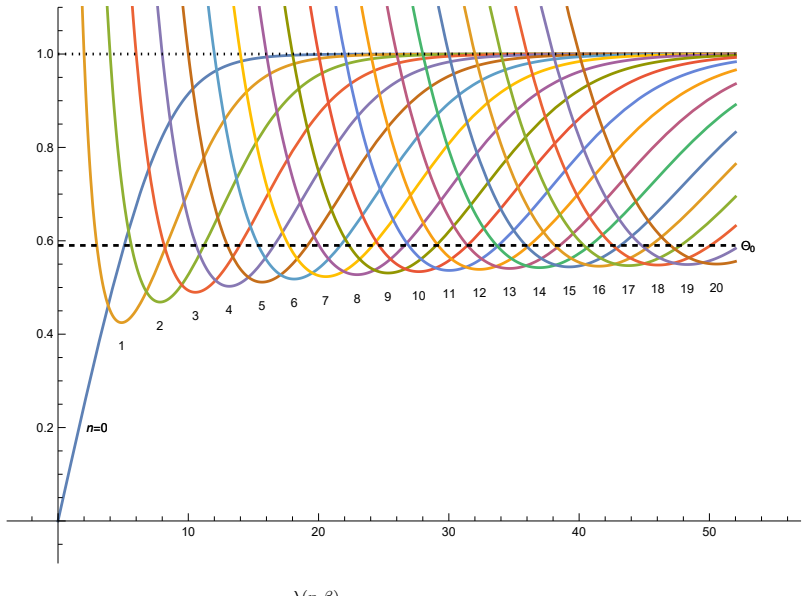
The central claim is that the infimum $\lambda(\beta) = \inf_{n\in\mathbb{N}}\lambda(n,\beta)$ is realized by exactly one branch $n$ on each interval between successive crossings, with unique, strictly increasing crossing points $\beta_n$ (Theorem 1.2). At every crossing the exact Saint-James identity $\beta = 2\eta + 2n + 1 + \sqrt{(2\eta+1)^2 + 8n\eta}$ holds (Theorem 1.1). In the large-field limit the crossings have the explicit expansion $\beta_n = 2n - 2^{3/2}\xi_0\, n^{1/2} + (1 - 2\delta_0 + 2\xi_0^2) + O(n^{-1/2})$, where $\xi_0$ is the minimizer of the De Gennes model and $\delta_0 = \frac12\Theta_0^{-1/2} C_1$ is a computable constant (Theorem 4.9). Consequently the paper obtains the asymptotics of $\lambda(\beta_n)$ and of the one-sided derivatives of $\lambda$ at $\beta_n$, which converge to distinct positive limits $\Theta_0 \mp \frac{3}{2}C_1|\xi_0|$.
Load-bearing premise
The arbitrary-order asymptotic expansion of the model operator $h(\delta,\beta)$, stated as Proposition 4.3, is assumed to hold uniformly for $\delta$ in bounded sets, so that the crossing-point expansions of Theorems 4.7 and 4.9 rest on it.
Editorial extensions
If this is right
- On each interval $[\beta_{n-1},\beta_n]$, the lowest eigenvalue is exactly $\lambda(n,\beta)$, so the crossings give a complete staircase description of the low-lying spectrum.
- The asymptotic expansion $\beta_n = 2n + \xi_1 n^{1/2} + \kappa_0 + O(n^{-1/2})$ implies the crossings are asymptotically spaced by 2, with $\beta_{n+1}-\beta_n$ eventually decreasing.
- The one-sided derivatives at $\beta_n$ converge to $\Theta_0 \pm \frac32 C_1|\xi_0|$, so the right derivative stays positive in the large-$n$ limit, supporting strong diamagnetism.
- If the sequence $\eta^*_n = \eta(n,\beta_n)$ is increasing (Conjecture 1.4), then $\lambda(\beta) < \Theta_0\beta$ for all $\beta>0$ (Conjecture 1.3).
Reading between the lines
- The same crossing analysis may extend to other radially symmetric planar domains or to balls in higher dimensions, where analogous exact identities could be derived from the special-function representation of eigenfunctions.
- The newly computed constant $\delta_0$ makes it possible in principle to generate the higher coefficients $\hat\kappa_j$ in the $\beta_n$ expansion explicitly, a step the paper does not carry out.
- A direct high-precision computation of $\eta^*_n$ for much larger $n$ (e.g., up to $10^5$) would test Conjecture 1.4 more stringently than the tabulated range $n\le 400$.
Editorial analysis
A structured set of objections, weighed in public.
Referee Report
Summary. The paper studies the lowest eigenvalue λ(β) of the Neumann magnetic Laplacian in the unit disk. Using the Fourier decomposition and Sturm–Liouville theory, the authors prove a formula due to Saint-James expressing the intersection point β of the eigenvalue curves for angular momenta n and n+1 in terms of the common eigenvalue. They combine this formula with the asymptotic analysis of Fournais–Helffer to prove uniqueness and monotonicity of the crossing points, to describe λ(β) through an ordered sequence of crossings, and to derive complete asymptotic expansions for the crossing points β_n and for the left and right derivatives of λ at those points. A new identity for the constant δ0 is obtained, and extensive numerical computations are presented as evidence for the conjectures concerning the De Gennes constant and strong diamagnetism.
Significance. The paper gives a complete qualitative description of the low-lying spectrum of the Neumann magnetic Laplacian in the disk, with explicit constants in the leading asymptotic terms. The derivation of the Saint-James formula via a two-by-two determinant is clean, and its combination with the independent asymptotics of Fournais–Helffer yields new results such as δ0 = (1/2)Θ0^{-1/2}C1 and the expansion β_n = 2n + ξ1 n^{1/2} + κ0 + O(n^{-1/2}). The numerical results are consistent with the proven asymptotics and provide falsifiable predictions. The proofs are detailed, and the paper is a valuable contribution to the spectral theory of magnetic Laplacians.
minor comments (5)
- [Table 3] Table 3 appears to list values of β_n rather than η*_n: the entries coincide with the numbers β_n^{(1)} in Table 1, while the definition of ε_n refers to η*_n; the column header or the definition of ε_n should be corrected.
- [Proof of Theorem 4.7, after Eq. (4.30)] The sentence following Eq. (4.30) cites Eq. (4.27) as an input for Eq. (4.31); Eq. (4.31) follows directly from (4.1) and (4.30), so the reference to (4.27) appears to be a typo.
- [Eq. (4.24)] The remainder term in Eq. (4.24) is written as O(β^{-(N+1)/2}) after multiplication by β; to be consistent with (4.20), the remainder inside the parentheses should be O(β^{-(N+3)/2}) or the index N should be shifted.
- [Proposition 4.3] Proposition 4.3 states an arbitrary-order expansion with only a proof sketch; since the main asymptotic results rely on this expansion, a precise citation of the exact statement in Fournais–Persson [17] would be helpful to the reader.
- [Section 4.3, proof of Theorem 4.9] The induction step for the higher-order coefficients κ_j is stated as 'by recursion' without details; making the recursion explicit would improve readability, although the procedure is standard.
Circularity Check
No significant circularity: the Saint-James formula is proven from the exact eigenvalue equations in Section 3.4, and Theorem 4.9 follows from consistency between that formula and published Fournais-Helffer expansions; no fitted parameter is renamed as a prediction (minor arithmetic slip in Remark 4.8 noted, not circular).
full rationale
The derivation chain is self-contained at every link. Theorem 1.1 (the Saint-James formula) is proven in Section 3.4 by rewriting the two exact eigenvalue equations (3.5) and (3.6), which express the Neumann condition (g_n,β)'(β^{1/2}) = 0 for the two angular modes, as a singular 2x2 linear system in X = M(ν,n+1,x) and Y = M(ν,n+2,x), and then setting the determinant to zero; equation (3.14) is thus a consequence of the paper's own eigenvalue equations, not an input. Theorem 1.2 then follows from Theorem 1.1 together with the published Dauge-Helffer monotonicity results [8,9]; the sign computations in Proposition 3.9 use only (3.12) and the bound β* > 2(n+1). Section 4 rests on the model-operator expansion (4.20), taken from the published, peer-reviewed works [13,17]; those results are externally falsifiable, state assumptions that do not include the crossing theorems proved here, and are further supported in Proposition 4.3 by an in-paper quasimode construction (ψ_N built from rapidly decaying u_j) giving the uniform O(β^{-(N+1)/2}) remainder for δ in bounded sets - this is the flagged weakest assumption, and it is adequately supported. The new content of Theorem 4.7, δ(n,β_n) = δ0 - 1/2 + O(β_n^{-1/2}), is derived by comparing the two equal expansions (4.24) and (4.26) at the crossing and using Δδ = 1 from (4.1); no fitting is involved. Theorem 4.9 and the identity δ0 = (1/2)Θ0^{-1/2}C1 (Remark 4.8) are obtained by inserting the expansions into the exact Saint-James formula (3.15) and matching coefficients: the β^{1/2} terms cancel since Θ0^{1/2} = -ξ0, and matching the constant terms yields δ0 = C1/(2Θ0^{1/2}) as a genuine consistency condition. No fitted parameter is renamed as a prediction; C1, ξ0, Θ0, δ0 enter as inputs from prior work. Two flags that are not circularity: first, Remark 4.8 quotes '~0.0975', which is inconsistent with its own formula and C1 ~ 0.254 (which give ≈ 0.1653), and Table 1 data (δ(400,β_400) ≈ -0.34 versus δ0 - 1/2) supports δ0 ≈ 0.165; this is an arithmetic slip. Second, the Section 6 agreement between two numerical methods is an internal consistency check because both derive from the same exact equations, so it does not independently confirm the (already proven) formula. Self-citation is heavy (Helffer in [8,9,12,13,14,17,20,21]) but load-bearing citations are real, published evidence and do not presuppose the target conclusions.
Assumptions & free parameters
assumptions (4)
- standard math Sturm-Liouville eigenvalue variation theorems of Dauge-Helffer ([8,9]) for boundary value problems with variable interval length.
- domain assumption Uniform high-order asymptotic expansion of the model operator eigenvalues e_{δ,β} (Proposition 4.3) from Fournais-Helffer [13] and Fournais-Persson [17].
- standard math Kummer function identities and representation formulas from DLMF Chapter 13, including the derivative formula ∂_z M(a,b,z)=a/b M(a+1,b+1,z).
- domain assumption Numerical values of universal constants Θ0≈0.590106, C1≈0.254, ξ0≈-0.768, taken from prior literature ([5],[13],[27]).
Cite this review
Pith. "Pith review of Eigenvalues of the Neumann magnetic Laplacian in the unit disk." pith.science (2026). https://pith.science/paper/X5425KJW
@misc{pith2026241111721,
  author       = {Pith},
  title        = {Pith review of: Eigenvalues of the Neumann magnetic Laplacian in the unit disk},
  year         = {2026},
  howpublished = {\url{https://pith.science/paper/X5425KJW}},
  note         = {Machine review of arXiv:2411.11721}
}
abstract
In this paper, we study the first eigenvalue of the magnetic Laplacian with Neumann boundary conditions in the unit disk $\mathbb D$ in $\mathbb R^2$. There is a rather complete asymptotic analysis when the constant magnetic field tends to $+\infty$ and some inequalities seem to hold for any value of this magnetic field, leading to rather simple conjectures. Our goal is to explore these questions by revisiting a classical picture of the physicist D. Saint-James theoretically and numerically. On the way, we revisit the asymptotic analysis in light of the asymptotics obtained by Fournais-Helffer, that we can improve by combining them with a formula stated by Saint-James.
Figures


Forward citations
Cited by 2 Pith papers
-
On the magnetic Dirichlet to Neumann operator on the disk -- strong diamagnetism and strong magnetic field limit--
For the unit disk with a constant magnetic field of strength 2b, the ground state energy of the magnetic Dirichlet-to-Neumann operator satisfies λ_DN(b)=α√b-(α²+2)/6+O(b^{-1/2}) with α=0.76495..., the unique negative ...
-
Three-dimensional magnetic Schr\"odinger operator with the potential supported in a tube
For a 3D magnetic Schrödinger operator with potential on a locally deformed tube, the paper proves essential spectrum stability and gives an insufficiently supported sufficient condition for the absence of discrete spectrum.
Reference graph
Works this paper leans on
-
[13]
S. Fournais and B. Helffer. On the third critical field in Ginzburg-Landau theory. Comm. Math. Phys. 266, no. 1, 153–196 (2006)
work page 2006
-
[17]
S. Fournais and M. Persson. Strong diamagnetism for the ball in three dimensions. Asymptotic analysis, Vol. 72, Issue 1–2, 77–123 (2011)
work page 2011
- [1]
-
[2]
M. Baur and T. Weidl. Eigenvalues of the magnetic Dirichlet Laplacian with constant magnetic field on disks in the strong field limit. Anal. Math. Phys. 15, art. 9 (2025)
work page 2025
-
[3]
A. Bernoff and P. Sternberg. Onset of superconductivity in decreasing fields for general domains. J. Math. Phys. 39, 1272–1284 (1998)
work page 1998
-
[4]
C. Bolley and B. Helffer. An application of semi-classical analysis to the asymptotic study of the supercooling field of a superconducting material. Annales de l’I.H.P. Physique th´ eorique 58 (2), 189–233 (1993)
work page 1993
-
[5]
V. Bonnaillie. Analyse math´ ematique de la supraconductivit´ e dans un domaine ` a coins : m´ ethodes semi-classiques et num´ eriques. Th` ese de Doctorat, Universit´ e Paris 11 (2003). https://theses.hal.science/tel-00005430
work page 2003
-
[6]
B. Colbois, C. L´ ena, L. Provenzano and A. Savo. Geometric bounds for the magnetic Neumann eigenvalues in the plane. Journal de Math´ ematiques Pures et Appliqu´ ees 179, 454–497 (2023)
work page 2023
Show all 30 references
-
[7]
Colbois, C
B. Colbois, C. L´ ena, L. Provenzano and A. Savo. A reverse Faber-Krahn inequality for the magnetic Laplacian. Journal de Math´ ematiques Pures et Appliqu´ ees 192, 103632 (2024). 31
2024
-
[8]
Dauge and B
M. Dauge and B. Helffer. Eigenvalues Variation. I. Neumann Problem for Sturm- Liouville Operators. Journal of Differential Equations 104 (2), 243–262 (1993)
1993
-
[9]
Dauge and B
M. Dauge and B. Helffer. Eigenvalues Variation. II. Multidimensional Problems. Journal of Differential Equations 104 (2), 263–297 (1993)
1993
-
[10]
de Gennes
P.-G. de Gennes. Boundary effects in superconductors. Rev. Mod. Phys. 36, 225 (1964)
1964
-
[11]
NIST Digital Library of Mathematical Functions , Release 1.2.0 of 2024-03-15. F. W. J. Olver, A. B. Olde Daalhuis, D. W. Lozier, B. I. Schneider, R. F. Boisvert, C. W. Clark, B. R. Miller, B. V. Saunders, H. S. Cohl, and M. A. McClain, eds. NIST (2024). https://dlmf.nist.gov/
2024
-
[12]
Fournais and B
S. Fournais and B. Helffer. Accurate eigenvalue asymptotics for the magnetic Neumann Laplacian. Ann. Inst. Fourier 56 (1), 1–67 (2006)
2006
-
[14]
Fournais and B
S. Fournais and B. Helffer. Strong diamagnetism for general domains and applications. Annales de l’Institut Fourier, Tome 57, no. 7, 2389–2400 (2007)
2007
-
[15]
Fournais and B
S. Fournais and B. Helffer. Spectral Methods in Surface Superconductivity. Progress in Nonlinear Differential Equations and Their Applications, Vol. 77, Birkh¨ auser (2010)
2010
-
[16]
Fournais and B
S. Fournais and B. Helffer. Inequalities for the lowest magnetic Neumann eigenvalue. Letters in Mathematical Physics, Volume 109, pages 1683–1700 (2019)
2019
-
[18]
Fournais and M
S. Fournais and M. Persson Sundqvist. Lack of diamagnetism and the Little–Parks effect. Commun. Math. Phys. 337, 191–224 (2015)
2015
-
[19]
Fournais and M
S. Fournais and M. Persson Sundqvist. Calculations for the disc. Unpublished (2017). Personal communication
2017
-
[20]
Helffer and A
B. Helffer and A. Morame. Magnetic bottles in connection with superconductivity. J. Funct. Anal. 185 (2), 604–680 (2001)
2001
-
[21]
Helffer and A
B. Helffer and A. Morame. Magnetic bottles for the Neumann problem: curvature effects in the case of dimension 3 (general case). Ann. Sci. ´Ec. Norm. Sup´ er. (4) 37 (1), 105–170 (2004)
2004
-
[22]
Helffer and M
B. Helffer and M. Persson Sundqvist. On nodal domains in Euclidean balls. Proc. Amer. Math. Soc. 144, no. 11, 4777–4791 (2016). 32
2016
-
[23]
Kachmar, V
A. Kachmar, V. Lotoreichik and M. Sundqvist. On the Laplace operator with a weak magnetic field in exterior domains. Anal. Math. Phys. 15, art. 5 (2025)
2025
-
[24]
Kachmar and G
A. Kachmar and G. Miranda. The magnetic Laplacian on the disc for strong magnetic fields. J. Math. Anal. Appl. 546 (2), 129261 (2025)
2025
-
[25]
Lu and X.B
K. Lu and X.B. Pan. Eigenvalue problems of Ginzburg-Landau operator in bounded domains. J. Math. Phys. 40 (6), 2647–2670 (1999)
1999
-
[26]
Magnus, F
W. Magnus, F. Oberhettinger and R.P. Soni. Formulas and theorems for the special functions of mathematical physics, 3rd enlarged ed., Grundlehren der Mathematischen Wissenschaften, Volume 52, Springer (1966)
1966
-
[27]
Persson Sundqvist
M. Persson Sundqvist. Magnetic model operators. A short review and something new. Lecture at conference in honour of the 70th birthday of Bernard Helffer. April 2019
2019
-
[28]
Saint-James
D. Saint-James. Etude du champ critique HC3 dans une g´ eom´ etrie cylindrique. Physics Letters 15 (1), 13–15 (1965)
1965
-
[29]
Saint-James and P-G
D. Saint-James and P-G. de Gennes. Onset of superconductivity in decreasing fields. Physics Letters 7 (5), 306–308 (1963)
1963
-
[30]
Soojin Son
S. Soojin Son. Spectral problems on triangles and discs: extremizers and ground states. PhD thesis, University of Illinois Urbana-Champaign (2014). https://www.ideals. illinois.edu/items/49400. 33
2014
Reviewed August 12, 2026 · model on record in the stance chip above.
Discussion (0). Continue with ORCID to comment.