REVIEW 4 major objections 4 minor 2 cited by
Multi-Wavelength Analysis of AT 2023sva: a Luminous Orphan Afterglow With Evidence for a Structured Jet
T0 review · 4 major / 4 minor · reviewed 2026-08-10 · deepseek-v4-flash
Pith's one-line read AT 2023sva, a fast-fading optical transient with no detected GRB, is best explained as an off-axis structured jet.
desk verdict Solid observational paper on a new orphan afterglow, but the structured jet claim is weaker than the abstract suggests. read the letter →
The pith
A machine-rendered reading of the paper's core claim, the machinery that carries it, and where it could break.
The reading
What carries the argument
The load-bearing object is the jet's angular energy profile, $E(\theta)$, which determines how the afterglow looks from a given viewing angle. The paper compares three profiles—top-hat, Gaussian, and power-law, with the power-law given by $E(\theta)=E_{\mathrm{K,iso}}[1+(\theta/(b\theta_c))^2]^{-b/2}$—inside a synchrotron afterglow model that assumes a constant-density surrounding medium. The second mechanism is interstellar scintillation, used as an angular-size ruler: strong scintillation at the Fresnel scale sets an upper limit on the source's physical size and hence its bulk Lorentz factor, independently confirming the preferred model's image size.
What would settle it
Re-fit the same multi-wavelength data with a wind-like circumstellar density profile (or a model that includes jet spreading and synchrotron self-absorption) and check whether a tophat jet becomes as good or better than the power-law structured jet; if it does, the evidence for structure evaporates.
Extended reading notes
Core claim
On its own terms, the paper establishes that the multi-wavelength light curve of AT 2023sva—optical $gri$ photometry, a 15.5 GHz radio light curve, and an X-ray upper limit—is best reproduced by a power-law structured jet rather than a top-hat or Gaussian structured jet, using Bayesian model comparison. The best-fit jet has a shallow angular energy profile with power-law index $b\approx 1.0$, a core half-opening angle $\theta_c=0.06\pm0.02$ rad, and is observed at $\theta_v=0.07\pm0.02$ rad, just outside the core. The same best-fit model predicts an image angular size of about $1.95\,\mu$arcsec at 72 days and 15.5 GHz, matching the independent constraint from interstellar scintillation, which the paper uses as a consistency check. The absence of a GRB counterpart is then attributed primarily to the off-axis viewing geometry suppressing prompt gamma-ray emission, with low radiative efficiency ($\lesssim4\!-\!11\%$) and a moderately relativistic outflow as allowed alternatives.
Load-bearing premise
The model comparison assumes the afterglow lives in a constant-density medium and that one of three simple jet shapes describes its light; if the medium is wind-like or the jet physics is more complex, the inferred structured jet and viewing angle could change.
Editorial extensions
If this is right
- AT 2023sva joins a small set of orphan afterglows whose jet structure can be inferred, and its shallow power-law index resembles that inferred for one of the most extreme GRBs ever seen.
- The absence of a gamma-ray counterpart does not by itself mean the explosion lacked a relativistic jet; here the jet is likely present but oriented so its core missed us.
- Optical surveys searching for orphan afterglows should incorporate structured-jet light curves, not only tophat jets, or they will miss events like this.
- Radio scintillation can serve as a population-level diagnostic: orphan afterglows in this sample have statistically smaller source sizes than classical GRBs.
- The derived gamma-ray radiative efficiency is low ($\lesssim4\!-\!11\%$), consistent with off-axis structured viewing or an intrinsically inefficient prompt phase.
Reading between the lines
- If structured jets with shallow profiles are common, the rate of jet-producing stellar deaths may be undercounted by missions that rely on prompt gamma-ray detection.
- The scintillation size difference could be used as a cheap classification tool for future wide-field optical discoveries: small radio sizes at roughly 70 days would flag structured or off-axis jets.
- A decisive test is to catch the rising part of the afterglow with high-cadence early light curves; the structured-jet model makes specific predictions for the rise slope that a low-Lorentz-factor fireball would not match.
- The same modeling approach applied to future soft X-ray transient discoveries could resolve whether off-axis structured jets or intrinsically inefficient bursts dominate the orphan population.
Signed reviews
Editorial analysis
A structured set of objections, weighed in public.
Referee Report
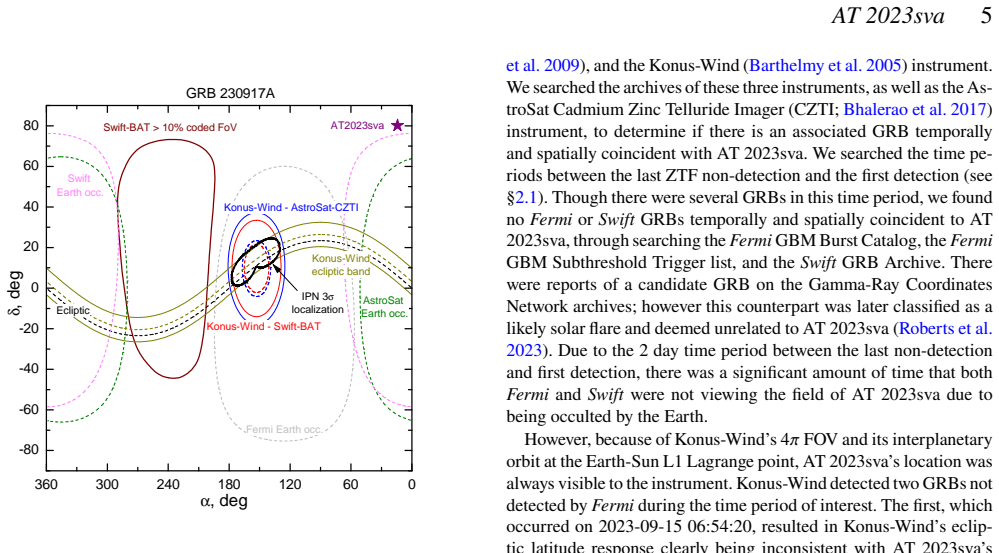
Summary. The paper presents multi-wavelength observations of AT 2023sva (ZTF23abelseb), an optically discovered, fast-fading, luminous transient at z = 2.28 with no detected GRB counterpart to E_gamma,iso < 1.6e52 erg. The authors analyze optical, X-ray, and radio data, identify interstellar scintillation in the radio SED at 72 days, and use it to place upper limits on the source angular size and bulk Lorentz factor. They compare ISS-based source-size upper limits for orphan afterglows and classical GRBs, and then use redback/afterglowpy Bayesian fits to three jet-structure models (tophat, Gaussian, power-law) in a constant-density ISM. The preferred model is a shallow power-law structured jet viewed slightly off-axis, with median parameters theta_v = 0.07 +/- 0.02 and theta_c = 0.06 +/- 0.02, which the authors propose as the likely explanation for the missing GRB prompt emission. The paper explicitly acknowledges in Sections 4.1 and 5 that the inference is conditional on the constant-density ISM assumption and that a wind medium cannot be ruled out.
Significance. The observational characterization of AT 2023sva is valuable: it adds a well-observed orphan afterglow with a secure redshift, extensive radio coverage, a GRB upper limit from a careful archival search, and public photometry/flux tables that will be useful for future modeling. The ISS source-size analysis is a genuine multi-epoch dataset and the comparison with other events is interesting. If the structured-jet inference were robust, the source would be a significant addition to the small sample of orphan afterglows and would strengthen the analogy with structured jets inferred for GRB 221009A. However, the model-selection evidence is mixed rather than 'clear', the claimed off-axis geometry is not statistically significant from the reported posteriors, and the wind-medium alternative is never fit despite being favored by the authors' own tophat closure-relation test. The paper's central claim is therefore plausible but currently conditional on several untested choices, and the abstract and Section 4.1 overstate the strength of the evidence.
major comments (4)
- [Section 4.1, Table 5] The model-selection and geometry claims are not supported as strongly as stated. The BIC difference is only BIC_tophat - BIC_powerlaw = -75.23 - (-77.63) = 2.4, which is conventionally 'positive' but not strong evidence, while the Bayes-factor difference (Delta ln Z about 9) is strong; the paper does not reconcile these two metrics or show that the evidence ratio is robust to the prior choices. More importantly, the conclusion that the line of sight lies 'just outside' the core rests on the medians theta_v = 0.07 +/- 0.02 and theta_c = 0.06 +/- 0.02; these posteriors imply theta_v - theta_c is consistent with zero at roughly 0.01 +/- 0.03. Please report the posterior distribution of theta_v - theta_c (or the fraction of posterior samples with theta_v > theta_c), and temper the wording in the abstract and Section 4.1 accordingly.
- [Sections 3.3, 4.1, and 5] The wind-medium alternative is acknowledged but never tested, and it is directly relevant to the central claim. Under a tophat jet, the closure relations in Section 3.3 give alpha = 1.63 +/- 0.15 for a wind and alpha = 1.13 +/- 0.15 for ISM, while the measured alpha = 1.64 +/- 0.02 favors wind. All Bayesian fits, however, assume a constant-density ISM because afterglowpy does not include a wind profile. Since the structured-jet preference is conditioned on this environmental assumption, the conclusion is not robust as stated. Please fit wind-profile versions of at least the tophat and power-law models with an independent code, or, if this is not feasible, explicitly frame the structured-jet claim as conditional in the abstract and move the wind caveat from Section 5 into the main interpretation.
- [Section 4.1, closure relations] The closure-relation check is presented as 'further evidence' but is partly a self-consistency check. The parameters p, b, theta_v, and theta_c used in Eqs. (4)-(5) were obtained from a fit to the same optical light curve that defines the observed alpha = 1.64 +/- 0.02, so the comparison of predicted and observed alpha is not an independent confirmation. Similarly, the source-size comparison with the ISS constraint uses the afterglow model that was fit to the 15.5 GHz radio light curve. Please relabel this as a posterior-predictive or consistency check, or provide a genuinely independent validation such as a fit to the X-ray and radio SEDs only, followed by a prediction of the optical decay.
- [Section 3.5, Figure 8] The claim that orphan afterglows have statistically smaller source sizes than classical GRBs is based on an Anderson-Darling test applied to quantities that are all upper limits, not measured sizes. Treating censored upper limits as point values can produce spurious separation if the limits are not homogeneous in rest-frame time, frequency, or sensitivity. Please use a survival-analysis method that handles upper limits explicitly, or state clearly that the statistical comparison is preliminary and sensitive to censoring.
minor comments (4)
- [Table 1] The first ZTF r-band detection appears as three rows at MJD 60204.40175 and two rows at MJD 60204.42189 with slightly different magnitudes; please confirm whether these are independent measurements and provide unique exposure identifiers, or remove the accidental duplicate rows.
- [Section 2.2.4 and Table 2] The text says AMI-LA observed AT 2023sva over 12 epochs spanning 1 to 60 days post-discovery, but Table 2 lists nine epochs ending at MJD 60240.61, which is about 36 days after the first detection; please reconcile the number of epochs and the time span.
- [Section 3.5] The text cites 'GRB 907508' in the list of classical GRBs with ISS source-size constraints; this appears to be a typo for GRB 970508, which is labeled correctly in Figure 8.
- [Appendix A] The appendix states 'Here we show the corner plots for the modeling described in §9,' but the modeling is described in Section 4.1; please correct the cross-reference.
Circularity Check
Two 'confirmations' in §4.1 reuse the same fitted data, but the core BIC model selection is self-contained.
-
fitted input called prediction
[§4.1 Multiwavelength Modeling, closure-relation check (Eqs. 4–5, paragraph after Table 5)]
"Utilizing the best-fit values from the modeling, we find 𝜃eff = 0.044 and 𝑔 = 0.72. Applying the closure relations, we find 𝛼∼ 1.4 for 𝜈m < 𝜈 < 𝜈c and 𝛼∼ 1.7 for 𝜈m < 𝜈c < 𝜈. In §3.1, we found 𝛼 = 1.64± 0.02, which matches well with the 𝜈m < 𝜈c < 𝜈 case – and from the simulated spectra in Figure 11, we know that the optical bands lie in this regime. This gives further evidence favoring the power-law structured jet model."
The observed 𝛼 quoted from §3.1 is not an independent measurement: §3.1 sets 𝑡0 equal to the best-fit explosion time derived in §4.1 ('We set 𝑡0 equal to the best-fit time of explosion derived in §4.1, of 𝑡0 = 60204.09 MJD'), and the same optical light curve was used in the §4.1 fit that produced the best-fit 𝑝, 𝑏, 𝜃v, and 𝜃c. The 'predicted' 𝛼 is therefore obtained from parameters already adjusted to the same data that defined 𝛼; the agreement is a self-consistency restatement, not an independent confirmation, and is presented as 'further evidence favoring the power-law structured jet model.'
-
fitted input called prediction
[§4.1 Multiwavelength Modeling, source-size comparison after Table 5]
"We then compute the angular size of the best-fit power-law afterglow model’s image on the sky, as a function of frequency and time, to compare it to the size derived from the ISS of the observed LC described in §3.5. We find that at 73 days at 15.5 GHz, the source has an angular size of 𝜃≈ 1.95 𝜇arcseconds. This is consistent with the ISS analysis (§3.5), where we determined that AT 2023sva’s angular size needed to be comparable or smaller than the Fresnel scale (2 𝜇arcsec). This gives us an independent confirmation that our modeling results match well with the radio observations."
The 'independent confirmation' is drawn from the same data the fit used: §4.1 explicitly fits 'the 15.5 GHz radio LC,' and the ISS size bound in §3.5 comes from strong scintillation seen in the 15.5 GHz (and lower-frequency) VLA SED at 72 days. The model is normalized to that same 15.5 GHz band, so consistency between the model image size at 15.5 GHz and the ISS size derived from the same band is a check of internal self-consistency, not an independent verification of the model.
full rationale
The core inference of a preferred power-law structured jet is obtained by a legitimate Bayesian model comparison within afterglowpy/redback (log Z and BIC values; ΔBIC = 2.4), using the observed optical, X-ray upper limit, and 15.5 GHz radio light curve. That selection does not reduce to a fit of its own conclusion: the three jet models are distinct functional forms with independent parameters, and the posteriors for θv and θc are free outputs. However, two supporting arguments in §4.1 are presented as independent confirmations but reuse the same data. The closure-relation check computes α from best-fit parameters that were fit to the same optical light curve that defines α = 1.64 ± 0.02 (with t0 itself taken from the §4.1 fit), so the 'match' is a self-consistency check, not a new prediction. The source-size check compares the model's 15.5 GHz image size to an ISS-derived size limit obtained from the same 15.5 GHz (and lower-frequency) band that the §4.1 fit included, again making the 'independent confirmation' partially circular. The acknowledged omission of wind-profile models (§4.1, §5) is a model-robustness limitation, not a circularity; the closure relations in §3.3 actually favor a wind environment for a tophat jet (α = 1.63 ± 0.15 vs α = 1.13 ± 0.15 for ISM), and this weakens the structured-jet identification but does not make the derivation circular. Overall, the central model selection has independent content, but the two 'further evidence'/'independent confirmation' passages overstate self-consistency as independent validation.
Assumptions & free parameters
free parameters (12)
- t0 (explosion time) =
60204.09 MJD
- θv (viewing angle) =
0.07 ± 0.02 rad
- log10(EK,iso/erg) =
53.33 +0.27 -0.21
- θc (core half-opening angle) =
0.06 ± 0.02 rad
- θw (wing truncation angle) =
6.81 +0.79 -1.01 × θc
- log10(n0/cm^-3) =
1.40 +0.40 -0.74
- p (electron spectral index) =
2.85 ± 0.09
- b (jet angular energy index) =
0.99 +0.36 -0.24
- log10(ε_e) =
-0.53 +0.18 -0.28
- log10(ε_B) =
-3.18 +0.45 -0.26
- ξ_N (fraction of accelerated electrons) =
0.70 +0.19 -0.27
- E(B-V)_host (host extinction) =
0.09 ± 0.01 mag
assumptions (5)
- domain assumption Flat ΛCDM cosmology with Ωm=0.315, H0=67.4 km/s/Mpc
- domain assumption Synchrotron afterglow theory (external shock model)
- domain assumption Walker (1998) Galactic scattering model
- domain assumption Constant density ISM for afterglowpy modeling
- domain assumption Band function spectrum for gamma-ray upper limit
Cite this review
Pith. "Pith review of Multi-Wavelength Analysis of AT 2023sva: a Luminous Orphan Afterglow With Evidence for a Structured Jet." pith.science (2026). https://pith.science/paper/ADTV5LTB
@misc{pith2026250103337,
  author       = {Pith},
  title        = {Pith review of: Multi-Wavelength Analysis of AT 2023sva: a Luminous Orphan Afterglow With Evidence for a Structured Jet},
  year         = {2026},
  howpublished = {\url{https://pith.science/paper/ADTV5LTB}},
  note         = {Machine review of arXiv:2501.03337}
}
abstract
We present multi-wavelength analysis of ZTF23abelseb (AT 2023sva), an optically discovered fast-fading ($\Delta m_r = 2.2$ mag in $\Delta t = 0.74 $ days), luminous ($M_r \sim -30.0$ mag) and red ($g-r = 0.50$ mag) transient at $z = 2.28$ with accompanying luminous radio emission. AT 2023sva does not possess a $\gamma$-ray burst (GRB) counterpart to an isotropic equivalent energy limit of $E_{\rm{\gamma, \, iso}} < 1.6 \times 10^{52}$ erg, determined through searching $\gamma$-ray satellite archives between the last non-detection and first detection, making it the sixth example of an optically-discovered afterglow with a redshift measurement and no detected GRB counterpart. We analyze AT 2023sva's optical, radio, and X-ray observations to characterize the source. From radio analyses, we find the clear presence of strong interstellar scintillation (ISS) 72 days after the initial explosion, allowing us to place constraints on the source's angular size and bulk Lorentz factor. When comparing the source sizes derived from ISS of orphan events to those of the classical GRB population, we find orphan events have statistically smaller source sizes. We also utilize Bayesian techniques to model the multi-wavelength afterglow. Within this framework, we find evidence that AT 2023sva possesses a shallow power-law structured jet viewed slightly off-axis ($\theta_{\rm{v}} = 0.07 \pm 0.02$) just outside of the jet's core opening angle ($\theta_{\rm{c}} = 0.06 \pm 0.02$). We determine this is likely the reason for the lack of a detected GRB counterpart, but also investigate other scenarios. AT 2023sva's evidence for possessing a structured jet stresses the importance of broadening orphan afterglow search strategies to a diverse range of GRB jet angular energy profiles, to maximize the return of future optical surveys.
Figures


Figures from the paper (11 more)


Forward citations
Cited by 2 Pith papers
-
AT2019ijn: a fast-rising, slow-decaying blue optical transient with exceptionally bright radio emission
AT2019ijn combines LFBOT-like fast optical rise and blue color with slow decay and radio luminosity peaking late at 2e31 erg/s/Hz, best fit as an off-axis jetted IMBH TDE.
-
The GRBSN webtool: An open-source repository for gamma-ray burst-supernova associations
The GRBSN webtool is an open-source repository hosting the most complete multiwavelength dataset of 61 GRB-supernova associations, with interactive plots, search and download features.
Reference graph
Works this paper leans on
-
[1]
Abazajian K. N., et al., 2009, @doi [ ] 10.1088/0067-0049/182/2/543 , https://ui.adsabs.harvard.edu/abs/2009ApJS..182..543A 182, 543
-
[2]
Abbott B. P., et al., 2017, @doi [ ] 10.1103/PhysRevLett.119.161101 , https://ui.adsabs.harvard.edu/abs/2017PhRvL.119p1101A 119, 161101
-
[3]
Alexander K. D., et al., 2019, @doi [ ] 10.3847/1538-4357/aaf19d , https://ui.adsabs.harvard.edu/abs/2019ApJ...870...67A 870, 67
-
[4]
Anderson G. E., et al., 2023, @doi [ ] 10.1093/mnras/stad1635 , https://ui.adsabs.harvard.edu/abs/2023MNRAS.523.4992A 523, 4992
-
[5]
Andreoni I., et al., 2021, @doi [ ] 10.3847/1538-4357/ac0bc7 , https://ui.adsabs.harvard.edu/abs/2021ApJ...918...63A 918, 63
-
[6]
Andreoni I., et al., 2022, @doi [ ] 10.1038/s41586-022-05465-8 , https://ui.adsabs.harvard.edu/abs/2022Natur.612..430A 612, 430
-
[7]
Ashton G., et al., 2019, @doi [ ] 10.3847/1538-4365/ab06fc , https://ui.adsabs.harvard.edu/abs/2019ApJS..241...27A 241, 27
-
[8]
Barthelmy S. D., et al., 2005, @doi [ ] 10.1007/s11214-005-5096-3 , https://ui.adsabs.harvard.edu/abs/2005SSRv..120..143B 120, 143
Show all 152 references
-
[9]
C., et al., 2019, @doi [ ] 10.1088/1538-3873/ab0c2a , https://ui.adsabs.harvard.edu/abs/2019PASP..131f8003B 131, 068003
Bellm E. C., et al., 2019, @doi [ ] 10.1088/1538-3873/ab0c2a , https://ui.adsabs.harvard.edu/abs/2019PASP..131f8003B 131, 068003
2019 doi
-
[10]
Beniamini P., Nakar E., 2019, @doi [ ] 10.1093/mnras/sty3110 , https://ui.adsabs.harvard.edu/abs/2019MNRAS.482.5430B 482, 5430
2019 doi
-
[11]
B., Petropoulou M., Giannios D., 2020, @doi [ ] 10.3847/2041-8213/ab9223 , https://ui.adsabs.harvard.edu/abs/2020ApJ...895L..33B 895, L33
Beniamini P., Duran R. B., Petropoulou M., Giannios D., 2020, @doi [ ] 10.3847/2041-8213/ab9223 , https://ui.adsabs.harvard.edu/abs/2020ApJ...895L..33B 895, L33
2020 doi
-
[12]
Berger E., et al., 2003, @doi [ ] 10.1038/nature01998 , https://ui.adsabs.harvard.edu/abs/2003Natur.426..154B 426, 154
2003 doi
-
[13]
Bhalerao V., et al., 2017, @doi [Journal of Astrophysics and Astronomy] 10.1007/s12036-017-9447-8 , https://ui.adsabs.harvard.edu/abs/2017JApA...38...31B 38, 31
2017 doi
-
[14]
Blagorodnova N., et al., 2018, @doi [ ] 10.1088/1538-3873/aaa53f , https://ui.adsabs.harvard.edu/abs/2018PASP..130c5003B 130, 035003
2018 doi
-
[15]
K., et al., 2024, @doi [Nature Astronomy] 10.1038/s41550-024-02237-4 , https://ui.adsabs.harvard.edu/abs/2024NatAs...8..774B 8, 774
Blanchard P. K., et al., 2024, @doi [Nature Astronomy] 10.1038/s41550-024-02237-4 , https://ui.adsabs.harvard.edu/abs/2024NatAs...8..774B 8, 774
2024 doi
-
[16]
S., et al., 2024, @doi [arXiv e-prints] 10.48550/arXiv.2409.19055 , https://ui.adsabs.harvard.edu/abs/2024arXiv240919055B p
Bright J. S., et al., 2024, @doi [arXiv e-prints] 10.48550/arXiv.2409.19055 , https://ui.adsabs.harvard.edu/abs/2024arXiv240919055B p. arXiv:2409.19055
2024 doi
-
[17]
Burns E., et al., 2023, @doi [ ] 10.3847/2041-8213/acc39c , https://ui.adsabs.harvard.edu/abs/2023ApJ...946L..31B 946, L31
2023 doi
-
[18]
N., et al., 2005, @doi [ ] 10.1007/s11214-005-5097-2 , https://ui.adsabs.harvard.edu/abs/2005SSRv..120..165B 120, 165
Burrows D. N., et al., 2005, @doi [ ] 10.1007/s11214-005-5097-2 , https://ui.adsabs.harvard.edu/abs/2005SSRv..120..165B 120, 165
2005 doi
-
[19]
Cano Z., Wang S.-Q., Dai Z.-G., Wu X.-F., 2017, @doi [Advances in Astronomy] 10.1155/2017/8929054 , https://ui.adsabs.harvard.edu/abs/2017AdAst2017E...5C 2017, 8929054
2017 doi
-
[20]
A., Clayton G
Cardelli J. A., Clayton G. C., Mathis J. S., 1989, @doi [ ] 10.1086/167900 , https://ui.adsabs.harvard.edu/abs/1989ApJ...345..245C 345, 245
1989 doi
-
[21]
B., et al., 2013, @doi [ ] 10.1088/0004-637X/769/2/130 , https://ui.adsabs.harvard.edu/abs/2013ApJ...769..130C 769, 130
Cenko S. B., et al., 2013, @doi [ ] 10.1088/0004-637X/769/2/130 , https://ui.adsabs.harvard.edu/abs/2013ApJ...769..130C 769, 130
2013 doi
-
[22]
B., et al., 2015, @doi [ ] 10.1088/2041-8205/803/2/L24 , https://ui.adsabs.harvard.edu/abs/2015ApJ...803L..24C 803, L24
Cenko S. B., et al., 2015, @doi [ ] 10.1088/2041-8205/803/2/L24 , https://ui.adsabs.harvard.edu/abs/2015ApJ...803L..24C 803, L24
2015 doi
-
[23]
F., eds, Society of Photo-Optical Instrumentation Engineers (SPIE) Conference Series Vol
Cepa J., et al., 2000, in Iye M., Moorwood A. F., eds, Society of Photo-Optical Instrumentation Engineers (SPIE) Conference Series Vol. 4008, Optical and IR Telescope Instrumentation and Detectors. pp 623--631, @doi 10.1117/12.395520
2000 doi
-
[24]
A., 2012, @doi [ ] 10.1088/0004-637X/746/2/156 , https://ui.adsabs.harvard.edu/abs/2012ApJ...746..156C 746, 156
Chandra P., Frail D. A., 2012, @doi [ ] 10.1088/0004-637X/746/2/156 , https://ui.adsabs.harvard.edu/abs/2012ApJ...746..156C 746, 156
2012 doi
-
[25]
Chandra P., et al., 2008, @doi [ ] 10.1086/589807 , https://ui.adsabs.harvard.edu/abs/2008ApJ...683..924C 683, 924
2008 doi
-
[26]
W., et al., 2023, @doi [ ] 10.3847/1538-4365/acdee1 , https://ui.adsabs.harvard.edu/abs/2023ApJS..267...31C 267, 31
Coughlin M. W., et al., 2023, @doi [ ] 10.3847/1538-4365/acdee1 , https://ui.adsabs.harvard.edu/abs/2023ApJS..267...31C 267, 31
2023 doi
-
[27]
Cunningham V., et al., 2020, @doi [ ] 10.3847/1538-4357/abc2cd , https://ui.adsabs.harvard.edu/abs/2020ApJ...904..166C 904, 166
2020 doi
-
[28]
A., Evans P
Curran P. A., Evans P. A., de Pasquale M., Page M. J., van der Horst A. J., 2010, @doi [ ] 10.1088/2041-8205/716/2/L135 , https://ui.adsabs.harvard.edu/abs/2010ApJ...716L.135C 716, L135
2010 doi
-
[29]
De Pasquale M., et al., 2016, @doi [ ] 10.1093/mnras/stw170410.48550/arXiv.1602.04158 , https://ui.adsabs.harvard.edu/abs/2016MNRAS.462.1111D 462, 1111
2016
-
[30]
Dekany R., et al., 2020, @doi [ ] 10.1088/1538-3873/ab4ca2 , https://ui.adsabs.harvard.edu/abs/2020PASP..132c8001D 132, 038001
2020 doi
-
[31]
D., Chiang J., B \"o ttcher M., 1999, @doi [ ] 10.1086/306871 , https://ui.adsabs.harvard.edu/abs/1999ApJ...513..656D 513, 656
Dermer C. D., Chiang J., B \"o ttcher M., 1999, @doi [ ] 10.1086/306871 , https://ui.adsabs.harvard.edu/abs/1999ApJ...513..656D 513, 656
1999 doi
- [32]
-
[33]
A., Waxman E., Kulkarni S
Frail D. A., Waxman E., Kulkarni S. R., 2000, @doi [ ] 10.1086/309024 , https://ui.adsabs.harvard.edu/abs/2000ApJ...537..191F 537, 191
2000 doi
-
[34]
Frederiks D., et al., 2023, @doi [ ] 10.3847/2041-8213/acd1eb , https://ui.adsabs.harvard.edu/abs/2023ApJ...949L...7F 949, L7
2023 doi
-
[35]
Freeburn J., et al., 2024, @doi [ ] 10.1093/mnras/stae1489 , https://ui.adsabs.harvard.edu/abs/2024MNRAS.531.4836F 531, 4836
2024 doi
-
[36]
Fremling C., et al., 2016, @doi [ ] 10.1051/0004-6361/201628275 , https://ui.adsabs.harvard.edu/abs/2016A&A...593A..68F 593, A68
2016 doi
-
[37]
J., et al., 1998, @doi [ ] 10.1038/27150 , https://ui.adsabs.harvard.edu/abs/1998Natur.395..670G 395, 670
Galama T. J., et al., 1998, @doi [ ] 10.1038/27150 , https://ui.adsabs.harvard.edu/abs/1998Natur.395..670G 395, 670
1998 doi
-
[38]
J., Frail D
Galama T. J., Frail D. A., Sari R., Berger E., Taylor G. B., Kulkarni S. R., 2003, @doi [ ] 10.1086/346083 , https://ui.adsabs.harvard.edu/abs/2003ApJ...585..899G 585, 899
2003 doi
-
[39]
Gehrels N., et al., 2004, @doi [ ] 10.1086/422091 , 611, 1005
2004 doi
-
[40]
Ghirlanda G., Salvaterra R., 2022, @doi [ ] 10.3847/1538-4357/ac6e43 , https://ui.adsabs.harvard.edu/abs/2022ApJ...932...10G 932, 10
2022 doi
-
[41]
Ghirlanda G., et al., 2018, @doi [ ] 10.1051/0004-6361/201731598 , https://ui.adsabs.harvard.edu/abs/2018A&A...609A.112G 609, A112
2018 doi
-
[42]
Gill R., Granot J., 2023, @doi [ ] 10.1093/mnrasl/slad075 , https://ui.adsabs.harvard.edu/abs/2023MNRAS.524L..78G 524, L78
2023 doi
-
[43]
Gill R., Granot J., Kumar P., 2020, @doi [ ] 10.1093/mnras/stz2976 , https://ui.adsabs.harvard.edu/abs/2020MNRAS.491.3343G 491, 3343
2020 doi
-
[44]
P., Fruchter A
Gompertz B. P., Fruchter A. S., Pe'er A., 2018, @doi [ ] 10.3847/1538-4357/aadba8 , https://ui.adsabs.harvard.edu/abs/2018ApJ...866..162G 866, 162
2018 doi
-
[45]
Gottlieb O., Nakar E., Piran T., 2018, @doi [ ] 10.1093/mnras/stx2357 , https://ui.adsabs.harvard.edu/abs/2018MNRAS.473..576G 473, 576
2018 doi
-
[46]
Gottlieb O., Nakar E., Bromberg O., 2021, @doi [ ] 10.1093/mnras/staa350110.48550/arXiv.2006.02466 , https://ui.adsabs.harvard.edu/abs/2021MNRAS.500.3511G 500, 3511
2021
-
[47]
Gottlieb O., Liska M., Tchekhovskoy A., Bromberg O., Lalakos A., Giannios D., M \"o sta P., 2022, @doi [ ] 10.3847/2041-8213/ac753010.48550/arXiv.2204.12501 , https://ui.adsabs.harvard.edu/abs/2022ApJ...933L...9G 933, L9
2022
-
[48]
J., et al., 2019, @doi [ ] 10.1088/1538-3873/ab006c , https://ui.adsabs.harvard.edu/abs/2019PASP..131g8001G 131, 078001
Graham M. J., et al., 2019, @doi [ ] 10.1088/1538-3873/ab006c , https://ui.adsabs.harvard.edu/abs/2019PASP..131g8001G 131, 078001
2019 doi
- [49]
-
[50]
Granot J., Sari R., 2002, @doi [ ] 10.1086/338966 , https://ui.adsabs.harvard.edu/abs/2002ApJ...568..820G 568, 820
2002 doi
-
[51]
J., 2014, @doi [ ] 10.1017/pasa.2013.44 , https://ui.adsabs.harvard.edu/abs/2014PASA...31....8G 31, e008
Granot J., van der Horst A. J., 2014, @doi [ ] 10.1017/pasa.2013.44 , https://ui.adsabs.harvard.edu/abs/2014PASA...31....8G 31, e008
2014 doi
-
[52]
W., 2003, in Heck A., ed., Astrophysics and Space Science Library Vol
Greisen E. W., 2003, in Heck A., ed., Astrophysics and Space Science Library Vol. 285, Information Handling in Astronomy - Historical Vistas. p. 109, @doi 10.1007/0-306-48080-8_7
2003 doi
-
[53]
Gupta R., et al., 2022, @doi [Journal of Astrophysics and Astronomy] 10.1007/s12036-021-09794-4 , https://ui.adsabs.harvard.edu/abs/2022JApA...43...11G 43, 11
2022 doi
-
[54]
Hickish J., et al., 2018, @doi [ ] 10.1093/mnras/sty074 , 475, 5677
2018 doi
-
[55]
Hjorth J., 2013, @doi [Philosophical Transactions of the Royal Society of London Series A] 10.1098/rsta.2012.0275 , https://ui.adsabs.harvard.edu/abs/2013RSPTA.37120275H 371, 20120275
2013
-
[56]
Hjorth J., et al., 2003, @doi [ ] 10.1038/nature01750 , https://ui.adsabs.harvard.edu/abs/2003Natur.423..847H 423, 847
2003 doi
-
[57]
Ho A. Y. Q., et al., 2020, @doi [ ] 10.3847/1538-4357/abc34d , https://ui.adsabs.harvard.edu/abs/2020ApJ...905...98H 905, 98
2020 doi
-
[58]
Ho A. Y. Q., et al., 2022, @doi [ ] 10.3847/1538-4357/ac8bd0 , https://ui.adsabs.harvard.edu/abs/2022ApJ...938...85H 938, 85
2022 doi
-
[59]
Horne K., 1986, @doi [ ] 10.1086/131801 , https://ui.adsabs.harvard.edu/abs/1986PASP...98..609H 98, 609
1986 doi
-
[60]
D., et al., 2021, @doi [ ] 10.1051/0004-6361/202039349 , https://ui.adsabs.harvard.edu/abs/2021A&A...646A..50H 646, A50
Hu Y. D., et al., 2021, @doi [ ] 10.1051/0004-6361/202039349 , https://ui.adsabs.harvard.edu/abs/2021A&A...646A..50H 646, A50
2021 doi
-
[61]
Huang Y.-J., et al., 2020, @doi [ ] 10.3847/1538-4357/ab8f9a , https://ui.adsabs.harvard.edu/abs/2020ApJ...897...69H 897, 69
2020 doi
-
[62]
Ivezi \'c Z ., et al., 2019, @doi [ ] 10.3847/1538-4357/ab042c , https://ui.adsabs.harvard.edu/abs/2019ApJ...873..111I 873, 111
2019 doi
-
[63]
F., Hawley S
Kowalski A. F., Hawley S. L., Wisniewski J. P., Osten R. A., Hilton E. J., Holtzman J. A., Schmidt S. J., Davenport J. R. A., 2013, @doi [ ] 10.1088/0067-0049/207/1/15 , https://ui.adsabs.harvard.edu/abs/2013ApJS..207...15K 207, 15
2013 doi
-
[64]
Kumar P., 1999, @doi [ ] 10.1086/312265 , https://ui.adsabs.harvard.edu/abs/1999ApJ...523L.113K 523, L113
1999 doi
-
[65]
B., Gupta R., Aryan A., Ror A
Kumar A., Pandey S. B., Gupta R., Aryan A., Ror A. K., Sharma S., Brahme N., 2022a, @doi [ ] 10.1016/j.newast.2022.101889 , https://ui.adsabs.harvard.edu/abs/2022NewA...9701889K 97, 101889
2022
-
[66]
Kumar H., et al., 2022b, @doi [ ] 10.3847/1538-3881/ac7bea , https://ui.adsabs.harvard.edu/abs/2022AJ....164...90K 164, 90
-
[67]
LHAASO Collaboration et al., 2023, @doi [Science] 10.1126/science.adg9328 , https://ui.adsabs.harvard.edu/abs/2023Sci...380.1390L 380, 1390
2023 doi
-
[68]
P., Kobayashi S., 2016, @doi [ ] 10.3847/0004-637X/829/2/112 , https://ui.adsabs.harvard.edu/abs/2016ApJ...829..112L 829, 112
Lamb G. P., Kobayashi S., 2016, @doi [ ] 10.3847/0004-637X/829/2/112 , https://ui.adsabs.harvard.edu/abs/2016ApJ...829..112L 829, 112
2016 doi
-
[70]
P., Kobayashi S., 2017b, @doi [ ] 10.1093/mnras/stx2345 , https://ui.adsabs.harvard.edu/abs/2017MNRAS.472.4953L 472, 4953
Lamb G. P., Kobayashi S., 2017b, @doi [ ] 10.1093/mnras/stx2345 , https://ui.adsabs.harvard.edu/abs/2017MNRAS.472.4953L 472, 4953
-
[72]
P., Tanaka M., Kobayashi S., 2018b, @doi [ ] 10.1093/mnras/sty484 , https://ui.adsabs.harvard.edu/abs/2018MNRAS.476.4435L 476, 4435
Lamb G. P., Tanaka M., Kobayashi S., 2018b, @doi [ ] 10.1093/mnras/sty484 , https://ui.adsabs.harvard.edu/abs/2018MNRAS.476.4435L 476, 4435
-
[73]
J., Lopez-Camara D., Cantiello M., Ciolfi R., Giacomazzo B., Workman J
Lazzati D., Perna R., Morsony B. J., Lopez-Camara D., Cantiello M., Ciolfi R., Giacomazzo B., Workman J. C., 2018, @doi [ ] 10.1103/PhysRevLett.120.241103 , https://ui.adsabs.harvard.edu/abs/2018PhRvL.120x1103L 120, 241103
2018 doi
-
[74]
Lesage S., et al., 2023, @doi [ ] 10.3847/2041-8213/ace5b4 , https://ui.adsabs.harvard.edu/abs/2023ApJ...952L..42L 952, L42
2023 doi
-
[75]
L., et al., 2024, arXiv e-prints, https://ui.adsabs.harvard.edu/abs/2024arXiv241107973L p
Li M. L., et al., 2024, arXiv e-prints, https://ui.adsabs.harvard.edu/abs/2024arXiv241107973L p. arXiv:2411.07973
2024 arXiv
-
[76]
Lipunov V., et al., 2022, @doi [ ] 10.1093/mnras/stac1906 , https://ui.adsabs.harvard.edu/abs/2022MNRAS.516.4980L 516, 4980
2022 doi
-
[77]
I., Woosley S
MacFadyen A. I., Woosley S. E., 1999, @doi [ ] 10.1086/307790 , https://ui.adsabs.harvard.edu/abs/1999ApJ...524..262M 524, 262
1999 doi
-
[78]
Margutti R., et al., 2018, @doi [ ] 10.3847/2041-8213/aab2ad , https://ui.adsabs.harvard.edu/abs/2018ApJ...856L..18M 856, L18
2018 doi
-
[79]
J., et al., 2019, @doi [ ] 10.1088/1538-3873/aae8ac , https://ui.adsabs.harvard.edu/abs/2019PASP..131a8003M 131, 018003
Masci F. J., et al., 2019, @doi [ ] 10.1088/1538-3873/aae8ac , https://ui.adsabs.harvard.edu/abs/2019PASP..131a8003M 131, 018003
2019 doi
-
[80]
Matsumoto T., Nakar E., Piran T., 2019, @doi [ ] 10.1093/mnras/stz923 , https://ui.adsabs.harvard.edu/abs/2019MNRAS.486.1563M 486, 1563
2019 doi
-
[81]
P., Waters B., Schiebel D., Young W., Golap K., 2007, in Shaw R
McMullin J. P., Waters B., Schiebel D., Young W., Golap K., 2007, in Shaw R. A., Hill F., Bell D. J., eds, Astronomical Society of the Pacific Conference Series Vol. 376, Astronomical Data Analysis Software and Systems XVI. p. 127
2007
-
[82]
Meegan C., et al., 2009, @doi [ ] 10.1088/0004-637X/702/1/791 , https://ui.adsabs.harvard.edu/abs/2009ApJ...702..791M 702, 791
2009 doi
-
[83]
Melandri A., et al., 2019, @doi [ ] 10.1093/mnras/stz2900 , https://ui.adsabs.harvard.edu/abs/2019MNRAS.490.5366M 490, 5366
2019 doi
-
[84]
J., Wijers R
M \'e sz \'a ros P., Rees M. J., Wijers R. A. M. J., 1998, @doi [ ] 10.1086/305635 , https://ui.adsabs.harvard.edu/abs/1998ApJ...499..301M 499, 301
1998 doi
-
[85]
Mészáros P., 2006, @doi [Reports on Progress in Physics] 10.1088/0034-4885/69/8/r01 , 69, 2259–2321
2006 doi
-
[86]
Nakar E., Piran T., 2003, @doi [ ] 10.1016/S1384-1076(02)00202-6 , https://ui.adsabs.harvard.edu/abs/2003NewA....8..141N 8, 141
2003 doi
-
[87]
Nakar E., Piran T., 2017, @doi [ ] 10.3847/1538-4357/834/1/28 , https://ui.adsabs.harvard.edu/abs/2017ApJ...834...28N 834, 28
2017 doi
-
[88]
K., Waratkar G., Vibhute A., Bhalerao V., Bhattacharya D., Rao A
Navaneeth P. K., Waratkar G., Vibhute A., Bhalerao V., Bhattacharya D., Rao A. R., Vadawale S., AstroSat CZTI Collaboration 2023, GRB Coordinates Network, https://ui.adsabs.harvard.edu/abs/2023GCN.34725....1N 34725
2023
-
[89]
J., et al., 2017, @doi [ ] 10.1093/mnras/stx044 , https://ui.adsabs.harvard.edu/abs/2017MNRAS.467..155N 467, 155
Nayana A. J., et al., 2017, @doi [ ] 10.1093/mnras/stx044 , https://ui.adsabs.harvard.edu/abs/2017MNRAS.467..155N 467, 155
2017 doi
-
[90]
S., Pe'er A., 2009, @doi [ ] 10.1088/0004-637X/701/1/824 , https://ui.adsabs.harvard.edu/abs/2009ApJ...701..824N 701, 824
Nysewander M., Fruchter A. S., Pe'er A., 2009, @doi [ ] 10.1088/0004-637X/701/1/824 , https://ui.adsabs.harvard.edu/abs/2009ApJ...701..824N 701, 824
2009 doi
-
[91]
O'Connor B., et al., 2023, @doi [Science Advances] 10.1126/sciadv.adi1405 , https://ui.adsabs.harvard.edu/abs/2023SciA....9I1405O 9, eadi1405
2023 doi
-
[92]
O'Connor B., Beniamini P., Gill R., 2024, @doi [ ] 10.1093/mnras/stae1941 , https://ui.adsabs.harvard.edu/abs/2024MNRAS.533.1629O 533, 1629
2024 doi
-
[93]
Paczy \'n ski B., 1998, @doi [ ] 10.1086/311148 , https://ui.adsabs.harvard.edu/abs/1998ApJ...494L..45P 494, L45
1998 doi
-
[94]
Panaitescu A., Kumar P., 2000, @doi [ ] 10.1086/317090 , https://ui.adsabs.harvard.edu/abs/2000ApJ...543...66P 543, 66
2000 doi
-
[95]
Panaitescu A., Kumar P., 2001, @doi [ ] 10.1086/324061 , https://ui.adsabs.harvard.edu/abs/2001ApJ...560L..49P 560, L49
2001 doi
-
[96]
T., et al., 2019, @doi [ ] 10.1088/1538-3873/aae904 , https://ui.adsabs.harvard.edu/abs/2019PASP..131a8001P 131, 018001
Patterson M. T., et al., 2019, @doi [ ] 10.1088/1538-3873/aae904 , https://ui.adsabs.harvard.edu/abs/2019PASP..131a8001P 131, 018001
2019 doi
-
[97]
A., Chandler C
Perley R. A., Chandler C. J., Butler B. J., Wrobel J. M., 2011, @doi [ ] 10.1088/2041-8205/739/1/L1 , https://ui.adsabs.harvard.edu/abs/2011ApJ...739L...1P 739, L1
2011 doi
-
[98]
A., et al., 2014, @doi [ ] 10.1088/0004-637X/781/1/37 , https://ui.adsabs.harvard.edu/abs/2014ApJ...781...37P 781, 37
Perley D. A., et al., 2014, @doi [ ] 10.1088/0004-637X/781/1/37 , https://ui.adsabs.harvard.edu/abs/2014ApJ...781...37P 781, 37
2014 doi
- [99]
-
[100]
C., et al., 2013, @doi [ ] 10.1093/mnras/sts589 , https://ui.adsabs.harvard.edu/abs/2013MNRAS.429.3330P 429, 3330
Perrott Y. C., et al., 2013, @doi [ ] 10.1093/mnras/sts589 , https://ui.adsabs.harvard.edu/abs/2013MNRAS.429.3330P 429, 3330
2013 doi
-
[101]
M., Taylor G
Pihlstr \"o m Y. M., Taylor G. B., Granot J., Doeleman S., 2007, @doi [ ] 10.1086/518955 , https://ui.adsabs.harvard.edu/abs/2007ApJ...664..411P 664, 411
2007 doi
-
[102]
Planck Collaboration et al., 2020, @doi [ ] 10.1051/0004-6361/201833910 , https://ui.adsabs.harvard.edu/abs/2020A&A...641A...6P 641, A6
2020 doi
-
[103]
E., 1997, @doi [ ] 10.1086/310876 , https://ui.adsabs.harvard.edu/abs/1997ApJ...487L...1R 487, L1
Rhoads J. E., 1997, @doi [ ] 10.1086/310876 , https://ui.adsabs.harvard.edu/abs/1997ApJ...487L...1R 487, L1
1997 doi
-
[104]
J., Fender R., Aguilera-Dena D
Rhodes L., van der Horst A. J., Fender R., Aguilera-Dena D. R., Bright J. S., Vergani S., Williams D. R. A., 2022, @doi [ ] 10.1093/mnras/stac1057 , https://ui.adsabs.harvard.edu/abs/2022MNRAS.513.1895R 513, 1895
2022 doi
-
[105]
Rhodes L., et al., 2024, @doi [ ] 10.1093/mnras/stae2050 , https://ui.adsabs.harvard.edu/abs/2024MNRAS.533.4435R 533, 4435
2024 doi
-
[106]
Rigault M., et al., 2019, @doi [ ] 10.1051/0004-6361/201935344 , https://ui.adsabs.harvard.edu/abs/2019A&A...627A.115R 627, A115
2019 doi
-
[107]
J., Bala S., Meegan C., Fermi GBM Team 2023, GRB Coordinates Network, https://ui.adsabs.harvard.edu/abs/2023GCN.34748....1R 34748
Roberts O. J., Bala S., Meegan C., Fermi GBM Team 2023, GRB Coordinates Network, https://ui.adsabs.harvard.edu/abs/2023GCN.34748....1R 34748
2023
-
[109]
Rossi A., et al., 2022, @doi [ ] 10.3847/1538-4357/ac60a2 , https://ui.adsabs.harvard.edu/abs/2022ApJ...932....1R 932, 1
2022 doi
- [110]
- [111]
-
[112]
S., Ghisellini G., Pescalli A., Ghirlanda G., Nappo F., 2015, @doi [ ] 10.1093/mnras/stv766 , https://ui.adsabs.harvard.edu/abs/2015MNRAS.450.3549S 450, 3549
Salafia O. S., Ghisellini G., Pescalli A., Ghirlanda G., Nappo F., 2015, @doi [ ] 10.1093/mnras/stv766 , https://ui.adsabs.harvard.edu/abs/2015MNRAS.450.3549S 450, 3549
2015 doi
-
[113]
Saraogi D., et al., 2024, @doi [ ] 10.1093/mnras/stae435 , https://ui.adsabs.harvard.edu/abs/2024MNRAS.530.1386S 530, 1386
2024 doi
-
[114]
Sari R., Piran T., Narayan R., 1998, @doi [ ] 10.1086/311269 , https://ui.adsabs.harvard.edu/abs/1998ApJ...497L..17S 497, L17
1998 doi
-
[115]
P., 1999, @doi [ ] 10.1086/312109 , https://ui.adsabs.harvard.edu/abs/1999ApJ...519L..17S 519, L17
Sari R., Piran T., Halpern J. P., 1999, @doi [ ] 10.1086/312109 , https://ui.adsabs.harvard.edu/abs/1999ApJ...519L..17S 519, L17
1999 doi
- [116]
-
[117]
D., Lamb G
Sarin N., Hamburg R., Burns E., Ashton G., Lasky P. D., Lamb G. P., 2022, @doi [ ] 10.1093/mnras/stac601 , https://ui.adsabs.harvard.edu/abs/2022MNRAS.512.1391S 512, 1391
2022 doi
-
[118]
Sarin N., et al., 2024, @doi [ ] 10.1093/mnras/stae1238 , https://ui.adsabs.harvard.edu/abs/2024MNRAS.531.1203S 531, 1203
2024 doi
-
[119]
Sato Y., Obayashi K., Yamazaki R., Murase K., Ohira Y., 2021, @doi [ ] 10.1093/mnras/stab1273 , https://ui.adsabs.harvard.edu/abs/2021MNRAS.504.5647S 504, 5647
2021 doi
-
[120]
Sato Y., Murase K., Ohira Y., Yamazaki R., 2023, @doi [ ] 10.1093/mnrasl/slad038 , https://ui.adsabs.harvard.edu/abs/2023MNRAS.522L..56S 522, L56
2023 doi
-
[121]
Schady P., et al., 2012, @doi [ ] 10.1051/0004-6361/201117414 , https://ui.adsabs.harvard.edu/abs/2012A&A...537A..15S 537, A15
2012 doi
-
[122]
F., Finkbeiner D
Schlafly E. F., Finkbeiner D. P., 2011, @doi [ ] 10.1088/0004-637X/737/2/103 , https://ui.adsabs.harvard.edu/abs/2011ApJ...737..103S 737, 103
2011 doi
-
[123]
Schulze S., et al., 2011, @doi [ ] 10.1051/0004-6361/201015581 , https://ui.adsabs.harvard.edu/abs/2011A&A...526A..23S 526, A23
2011 doi
-
[124]
Sharma Y., et al., 2021, @doi [Journal of Astrophysics and Astronomy] 10.1007/s12036-021-09714-6 , https://ui.adsabs.harvard.edu/abs/2021JApA...42...73S 42, 73
2021 doi
-
[125]
S., 2020, @doi [ ] 10.1093/mnras/staa278 , https://ui.adsabs.harvard.edu/abs/2020MNRAS.493.3132S 493, 3132
Speagle J. S., 2020, @doi [ ] 10.1093/mnras/staa278 , https://ui.adsabs.harvard.edu/abs/2020MNRAS.493.3132S 493, 3132
2020 doi
-
[126]
P., et al., 2023, @doi [ ] 10.3847/2041-8213/accf97 , https://ui.adsabs.harvard.edu/abs/2023ApJ...949L..39S 949, L39
Srinivasaragavan G. P., et al., 2023, @doi [ ] 10.3847/2041-8213/accf97 , https://ui.adsabs.harvard.edu/abs/2023ApJ...949L..39S 949, L39
2023 doi
-
[127]
P., et al., 2024, @doi [ ] 10.3847/2041-8213/ad16e7 , https://ui.adsabs.harvard.edu/abs/2024ApJ...960L..18S 960, L18
Srinivasaragavan G. P., et al., 2024, @doi [ ] 10.3847/2041-8213/ad16e7 , https://ui.adsabs.harvard.edu/abs/2024ApJ...960L..18S 960, L18
2024 doi
- [128]
-
[129]
Stalder B., et al., 2017, @doi [ ] 10.3847/1538-4357/aa95c1 , https://ui.adsabs.harvard.edu/abs/2017ApJ...850..149S 850, 149
2017 doi
-
[130]
arXiv:2410.02315
Sun H., et al., 2024, @doi [arXiv e-prints] 10.48550/arXiv.2410.02315 , https://ui.adsabs.harvard.edu/abs/2024arXiv241002315S p. arXiv:2410.02315
2024 doi
-
[131]
B., Frail D
Taylor G. B., Frail D. A., Berger E., Kulkarni S. R., 2004, @doi [ ] 10.1086/422554 , https://ui.adsabs.harvard.edu/abs/2004ApJ...609L...1T 609, L1
2004 doi
-
[132]
B., Momjian E., Pihlstr \"o m Y., Ghosh T., Salter C., 2005, @doi [ ] 10.1086/428346 , https://ui.adsabs.harvard.edu/abs/2005ApJ...622..986T 622, 986
Taylor G. B., Momjian E., Pihlstr \"o m Y., Ghosh T., Salter C., 2005, @doi [ ] 10.1086/428346 , https://ui.adsabs.harvard.edu/abs/2005ApJ...622..986T 622, 986
2005 doi
-
[133]
Troja E., et al., 2018, @doi [ ] 10.1093/mnrasl/sly061 , https://ui.adsabs.harvard.edu/abs/2018MNRAS.478L..18T 478, L18
2018 doi
-
[134]
Troja E., et al., 2019, @doi [ ] 10.1093/mnras/stz2248 , https://ui.adsabs.harvard.edu/abs/2019MNRAS.489.1919T 489, 1919
2019 doi
-
[135]
Tsvetkova A., et al., 2021, @doi [ ] 10.3847/1538-4357/abd569 , https://ui.adsabs.harvard.edu/abs/2021ApJ...908...83T 908, 83
2021 doi
-
[136]
L., Li M
Vail J. L., Li M. L., Wise J., Perley D. A., Ho A. Y. Q., Burns E., Coughlin M., 2023, GRB Coordinates Network, https://ui.adsabs.harvard.edu/abs/2023GCN.34730....1V 34730
2023
-
[137]
A., 1998, @doi [ ] 10.1046/j.1365-8711.1998.01238.x10.1111/j.1365-8711.1998.01238.x , https://ui.adsabs.harvard.edu/abs/1998MNRAS.294..307W 294, 307
Walker M. A., 1998, @doi [ ] 10.1046/j.1365-8711.1998.01238.x10.1111/j.1365-8711.1998.01238.x , https://ui.adsabs.harvard.edu/abs/1998MNRAS.294..307W 294, 307
1998
-
[138]
A., 2001, @doi [ ] 10.1046/j.1365-8711.2001.04104.x , https://ui.adsabs.harvard.edu/abs/2001MNRAS.321..176W 321, 176
Walker M. A., 2001, @doi [ ] 10.1046/j.1365-8711.2001.04104.x , https://ui.adsabs.harvard.edu/abs/2001MNRAS.321..176W 321, 176
2001
-
[139]
Wang X.-G., et al., 2015, @doi [ ] 10.1088/0067-0049/219/1/9 , https://ui.adsabs.harvard.edu/abs/2015ApJS..219....9W 219, 9
2015 doi
- [140]
-
[141]
Xie X., MacFadyen A., 2019, @doi [ ] 10.3847/1538-4357/ab2912 , https://ui.adsabs.harvard.edu/abs/2019ApJ...880..135X 880, 135
2019 doi
-
[142]
Xu F., Huang Y.-F., Geng J.-J., 2023, @doi [ ] 10.1051/0004-6361/202346674 , https://ui.adsabs.harvard.edu/abs/2023A&A...679A.103X 679, A103
2023 doi
-
[143]
Ye X.-M., Wei D.-M., Zhu Y.-M., Jin Z.-P., 2024, @doi [Research in Astronomy and Astrophysics] 10.1088/1674-4527/ad2b39 , https://ui.adsabs.harvard.edu/abs/2024RAA....24d5011Y 24, 045011
2024 doi
-
[144]
Yuan W., Zhang C., Chen Y., Ling Z., 2022, in Bambi C., Sangangelo A., eds, , Handbook of X-ray and Gamma-ray Astrophysics. p. 86, @doi 10.1007/978-981-16-4544-0_151-1
2022 doi
-
[145]
O., Gal-Yam A., 2016, @doi [ApJ] 10.3847/0004-637x/830/1/27 , 830, 27
Zackay B., Ofek E. O., Gal-Yam A., 2016, @doi [ApJ] 10.3847/0004-637x/830/1/27 , 830, 27
2016 doi
-
[146]
Zwart J. T. L., et al., 2008, @doi [ ] 10.1111/j.1365-2966.2008.13953.x , https://ui.adsabs.harvard.edu/abs/2008MNRAS.391.1545Z 391, 1545
2008
-
[147]
de Ugarte Postigo A., et al., 2012, @doi [ ] 10.1051/0004-6361/201219894 , https://ui.adsabs.harvard.edu/abs/2012A&A...548A..11D 548, A11
2012 doi
-
[148]
B., Agui Fernandez J
de Ugarte Postigo A., Malesani D. B., Agui Fernandez J. F., Thoene C. C., Geier S., 2023, GRB Coordinates Network, https://ui.adsabs.harvard.edu/abs/2023GCN.34740....1D 34740
2023
- [149]
-
[150]
G., 2001, @doi [ ] 10.1086/323894 , https://ui.adsabs.harvard.edu/abs/2001PASP..113.1420V 113, 1420
van Dokkum P. G., 2001, @doi [ ] 10.1086/323894 , https://ui.adsabs.harvard.edu/abs/2001PASP..113.1420V 113, 1420
2001 doi
-
[151]
van Paradijs J., Kouveliotou C., Wijers R. A. M. J., 2000, @doi [ ] 10.1146/annurev.astro.38.1.379 , https://ui.adsabs.harvard.edu/abs/2000ARA&A..38..379V 38, 379
2000 doi
-
[152]
J., et al., 2014, @doi [ ] 10.1093/mnras/stu1664 , https://ui.adsabs.harvard.edu/abs/2014MNRAS.444.3151V 444, 3151
van der Horst A. J., et al., 2014, @doi [ ] 10.1093/mnras/stu1664 , https://ui.adsabs.harvard.edu/abs/2014MNRAS.444.3151V 444, 3151
2014 doi
-
[153]
van der Walt S., Crellin-Quick A., Bloom J., 2019, @doi [The Journal of Open Source Software] 10.21105/joss.01247 , https://ui.adsabs.harvard.edu/abs/2019JOSS....4.1247V 4, 1247
2019 doi
-
[154]
write newline
" write newline "" before.all 'output.state := FUNCTION fin.entry write newline FUNCTION new.block output.state before.all = 'skip after.block 'output.state := if FUNCTION new.sentence output.state after.block = 'skip output.state before.all = 'skip after.sentence 'output.stat...
-
[155]
write newline
" write newline "" before.all 'output.state := FUNCTION fin.entry write newline FUNCTION new.block output.state before.all = 'skip after.block 'output.state := if FUNCTION new.sentence output.state after.block = 'skip output.state before.all = 'skip after.sentence 'output.stat...
Reviewed August 10, 2026 · model on record in the stance chip above.
Discussion (0). Continue with ORCID to comment.