REVIEW 3 major objections 5 minor 1 cited by
Disturbance-Aware Adaptive Compensation in Hybrid Force-Position Locomotion Policy for Legged Robots
T0 review · 3 major / 5 minor · reviewed 2026-08-07 · deepseek-v4-flash
Pith's one-line read A two-stage policy that adds feedforward torque and estimated-force compensation lets a quadruped carry a payload larger than its own weight.
desk verdict Solid real-robot payload result and a clean two-stage RL framework, but the CoM-only disturbance model is untested against torque disturbances and the evaluation is thinner than the 'first demonstration' claim. read the letter →
The pith
A machine-rendered reading of the paper's core claim, the machinery that carries it, and where it could break.
The reading
What carries the argument
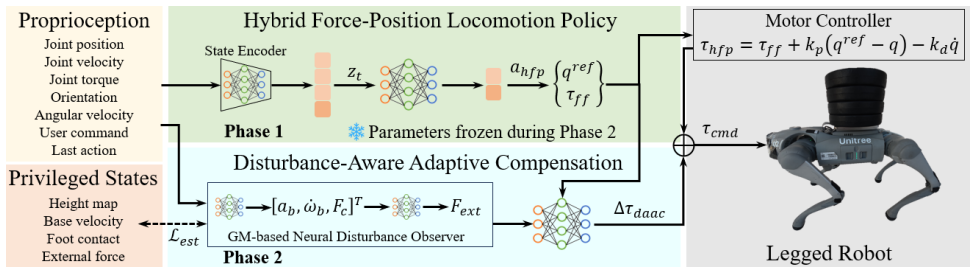
The load-bearing object is the hybrid force-position action space combined with the DAAC compensation loop. The hybrid action lets the policy assign position tracking to swing legs and feedforward force support to stance legs, which is why joint position tracking error stays small under load. The second load-bearing piece is the DAAC: a generalized-momentum-based neural disturbance observer (generalized momentum being the mass-weighted velocity state used in classical disturbance observers) estimates $F_{ext}$, and a small policy maps that estimate plus proprioception to $\Delta\tau_{daac}$. The final torque identity $\tau_{cmd}=\tau_{hfp}+\Delta\tau_{daac}$ is what carries the argument: compensation acts directly in torque space, so the robot can react to a disturbance before a position error develops.
What would settle it
Mount a weight so its center of gravity is horizontally offset from the robot's center of mass, creating a known steady torque while the force magnitude stays constant, and measure lateral tracking error; if error increases as the offset grows, the center-of-mass force assumption fails.
Extended reading notes
Core claim
The authors' central claim is that a locomotion policy should act in both position space and force space at once. Their action is $a_{hfp}=[q^{ref}, \tau^{ff}]$, and the joint command is $\tau_{hfp} = \tau^{ff} + K_p(q^{ref}-q) - K_d \dot{q}$, so feedforward torque carries gravity compensation and disturbance response while position tracking shapes the gait. On top of this, a generalized-momentum-based neural observer estimates the external disturbance force $F_{ext}$ from proprioceptive history, and a separately trained compensation policy outputs $\Delta\tau_{daac}$; the final command is $\tau_{cmd}=\tau_{hfp}+\Delta\tau_{daac}$. With this combination the authors report that the real robot follows velocity commands while carrying 20 kg, a payload larger than its own body, and that this is the first learning-based demonstration of such payload capacity. They also report faster recovery from lateral impacts and smaller tracking errors under pulling disturbances than the position-action baseline.
Load-bearing premise
The argument assumes every external disturbance can be represented as a single force acting at the robot's center of mass, so any torque produced by an off-center hit or offset load is simply ignored.
Editorial extensions
If this is right
- Existing position-action policies can be upgraded by freezing them and training the DAAC on top, as the paper does for its baseline, without retraining the base policy.
- The same policy transfers to different PD gains on the real robot, suggesting that feedforward torque reduces dependence on actuator model accuracy.
- A robot using this method can maintain commanded speed under payloads up to roughly its own body weight, with an explicit force estimate available for monitoring.
- Because the compensation is generated from an explicit disturbance estimate, the resulting foot forces can be mapped through the Jacobian and checked against the applied disturbance, making the behavior more interpretable than unstructured robust policies.
Reading between the lines
- Beyond the paper, the most natural stress test is to break the center-of-mass force assumption: add an off-center load that creates a steady torque and measure whether tracking error grows with the offset; the paper's own conclusion flags torque neglect as the main limitation.
- Beyond the paper, one could validate the observer's quality directly by loading the robot with known masses and checking that the estimated force equals the added weight times gravity, a calibration the paper does not report.
- Beyond the paper, the t-SNE separation of compensation actions by disturbance direction suggests the DAAC is learning a directional force field; measuring ground reaction forces during compensation would show whether the torques physically oppose the disturbance or merely alter the gait.
Editorial analysis
A structured set of objections, weighed in public.
Referee Report
Summary. The paper proposes a two-stage reinforcement-learning framework for quadrupedal locomotion. The first component, HFPLP, outputs both target joint positions and feedforward torques, aiming to combine the tracking advantages of position control with the responsiveness of torque control. The second component, DAAC, uses a generalized-momentum-based neural disturbance observer to estimate a three-dimensional external force at the CoM and learns a torque-space compensation policy. Training is performed in Isaac Gym under randomized disturbances, and the policies are zero-shot transferred to a Unitree Go2. The experiments compare the method with a DreamWaQ variant and several ablations, reporting improved velocity tracking under lateral pulls, higher payload capacity (up to 20 kg), and better impact recovery on real hardware.
Significance. If the empirical results are reliable, the paper advances a practical design point: combining a hybrid force-position action space with an explicit disturbance observer and torque compensation. The real-robot validation across payloads, impacts, and varied terrains is a strength, as is the ablation that isolates the disturbance observer. However, the significance is tempered by the narrow baseline selection, the small number of trials used for the most striking claims, and the untested simplification that disturbances act only as CoM forces. The strongest claims in the abstract and Section V.C.2 ('outperforms existing methods', 'first demonstration of a learning-based approach enabling the real robot to handle a payload exceeding its own weight') are broader than what the presented evidence supports.
major comments (3)
- [Section IV-B and Section V-C.3] The disturbance observer in Eq. (8) estimates only a 3D force F_ext at the CoM, and the training samples in Section IV-C apply forces on the CoM; moments arising from off-CoM disturbance application points are explicitly neglected. Yet several real-world experiments, especially the swinging-weight impacts in Section V-C.3 and the rope-pull in Section V-B, apply forces at points likely offset from the CoM and therefore generate moments. Since the DAAC's input includes only F_ext in R^3 and no moment channel, any robust behavior observed in these experiments cannot be definitively attributed to the disturbance-aware compensation mechanism as claimed. The conclusion acknowledges this limitation but does not test whether it matters in practice. Please either quantify the moments present in the real experiments, extend the observer to estimate torques, or explicitly scope the robustness claims to disturbances acting at the CoM.
- [Section V.C.2 and Fig. 9] The headline result that the robot carries a 20 kg payload, described as 133% of its own weight, is based on five trials per condition, and Fig. 9 reports success rate and ATE without error bars or statistical significance tests. With only five trials, the success rate at 20 kg is statistically indistinguishable from 80% or 100%, and the ATE differences between methods at each payload are shown without variance. In addition, the sentence 'this is the first demonstration of a learning-based approach enabling the real robot to handle a payload exceeding its own weight' is an unsupported assertion: no literature survey is provided to establish priority. This claim should be substantiated with a thorough literature review or removed, and the payload experiments should be repeated with more trials and reported with error bars or confidence intervals.
- [Section V and Abstract] The experiments compare only against DreamWaQ-FT and internal ablations, yet the abstract states that the method 'outperforms existing methods' and the conclusion repeats the claim of superior locomotion performance. The related work section cites several recent and directly relevant adaptive methods, including RL2AC [13], RMA [24], and PA-Loco [36], but none of these is included as a baseline. Without comparisons to at least one recent disturbance-adaptive method, the 'outperforms' statement is broader than the evidence. Either add such a comparison or restrict the claims to the demonstrated DreamWaQ baseline and the ablation versions.
minor comments (5)
- [Section V.C.2] The phrase '133 % uncertainty' appears to be a typographical error; it should read '133% of its own weight.'
- [Fig. 7 and Fig. 9] Consider adding error bars or per-trial scatter points even for small sample sizes, so the variability of the ATE measurements is visible to the reader.
- [Section IV-C] The sampled disturbance range is reported as ([-100,100] x [-100,100] x [-200,0]) N; please clarify whether the z-component is intentionally limited to downward forces and state explicitly whether all sampled forces are applied at the CoM.
- [Table I] The header 'Mehtods' should be corrected to 'Methods.'
- [Section IV-C.2] The statement that the DAAC reward functions are 'consistent with HFPLP training' is vague; please specify whether the exact same reward weights are used or list any differences.
Circularity Check
No significant circularity: the claimed contributions are empirical RL results validated against external baselines, with no load-bearing self-citation or fitted-input-named-prediction.
full rationale
The paper's main derivation chain is an RL training pipeline: HFPLP outputs target joint positions and feedforward torques, and DAAC outputs compensation torques based on a learned disturbance estimate. The compensation torque is not derived from the target result; it is a learned action optimized by a reward function and evaluated on held-out conditions (payloads, impacts, terrains) against an external baseline (DreamWaQ) and ablations. The disturbance observer, while inspired by the model-based formula in [38], is implemented as a neural network trained to map proprioceptive histories to F_ext; there is no equation that defines the experimental success metric as a function of the training data. The only self-citation is [39] for curriculum learning, which is a training technique and is not load-bearing for the central claims. The acknowledged limitation that only CoM forces, not torques from offset application points, are modeled is a correctness/robustness concern, not a circularity: it does not make the real-robot payload or impact results equivalent to the training objective by construction. The paper is self-contained against external benchmarks, so the appropriate finding is no significant circularity.
Assumptions & free parameters
free parameters (5)
- PD gains Kp, Kd =
Kp=20, Kd=0.5
- Reward weight for joint tracking =
-0.2
- Disturbance sampling distribution =
[-100,100]x[-100,100]x[-200,0] N, duration (1,4)s, 60% envs
- DAAC MLP hidden sizes =
[256,128,64]
- Observation history length H =
5
assumptions (4)
- standard math Rigid-body dynamics M¨q + C˙q + G = S^T τ + J_c^T F_c (Eq. 2)
- domain assumption External disturbances act as a force on the CoM; disturbance torques are neglected
- standard math The GM-based disturbance observer formula (Eq. 8) from Bledt et al. [38] is valid
- domain assumption Isaac Gym simulation with random disturbances transfers zero-shot to the real robot
Cite this review
Pith. "Pith review of Disturbance-Aware Adaptive Compensation in Hybrid Force-Position Locomotion Policy for Legged Robots." pith.science (2026). https://pith.science/paper/4W2RBIWC
@misc{pith2026250600472,
  author       = {Pith},
  title        = {Pith review of: Disturbance-Aware Adaptive Compensation in Hybrid Force-Position Locomotion Policy for Legged Robots},
  year         = {2026},
  howpublished = {\url{https://pith.science/paper/4W2RBIWC}},
  note         = {Machine review of arXiv:2506.00472}
}
read the original abstract
Reinforcement Learning (RL)-based methods have significantly improved the locomotion performance of legged robots. However, these motion policies face significant challenges when deployed in the real world. Robots operating in uncertain environments struggle to adapt to payload variations and external disturbances, resulting in severe degradation of motion performance. In this work, we propose a novel Hybrid Force-Position Locomotion Policy (HFPLP) learning framework, where the action space of the policy is defined as a combination of target joint positions and feedforward torques, enabling the robot to rapidly respond to payload variations and external disturbances. In addition, the proposed Disturbance-Aware Adaptive Compensation (DAAC) provides compensation actions in the torque space based on external disturbance estimation, enhancing the robot's adaptability to dynamic environmental changes. We validate our approach in both simulation and real-world deployment, demonstrating that it outperforms existing methods in carrying payloads and resisting disturbances.
Figures


Figures from the paper (4 more)


Forward citations
Cited by 1 Pith paper
-
Cross-Platform Learnable Fuzzy Gain-Scheduled Proportional-Integral-Derivative Controller Tuning via Physics-Constrained Meta-Learning and Reinforcement Learning Adaptation
A meta-learned fuzzy PID controller with RL fine-tuning reduces simulated tracking error on a 9-DOF arm and 12-DOF quadruped, but the supporting evidence is weakened by missing baselines and internal inconsistencies.
Reference graph
Works this paper leans on
-
[13]
S. Lyu, X. Lang, H. Zhao, H. Zhang, P. Ding, and D. Wang, “Rl2ac: Reinforcement learning-based rapid online adaptive control for legged robot robust locomotion,” inProceedings of the Robotics: Science and Systems, 2024
work page 2024
-
[24]
Rma: Rapid motor adaptation for legged robots,
A. Kumar, Z. Fu, D. Pathak, and J. Malik, “Rma: Rapid motor adaptation for legged robots,”arXiv preprint arXiv:2107.04034, 2021
arXiv 2021
-
[36]
PA-LOCO: Learning Perturbation-Adaptive Locomotion for Quadruped Robots
Z. Xiao, X. Zhang, X. Zhou, and Q. Zhang, “Pa-loco: Learning perturbation-adaptive locomotion for quadruped robots,”arXiv preprint arXiv:2407.04224, 2024
work page Pith review arXiv 2024
-
[1]
Learning robust perceptive locomotion for quadrupedal robots in the wild,
T. Miki, J. Lee, J. Hwangbo, L. Wellhausen, V . Koltun, and M. Hutter, “Learning robust perceptive locomotion for quadrupedal robots in the wild,”Science robotics, vol. 7, no. 62, p. eabk2822, 2022
2022
-
[2]
Extreme parkour with legged robots,
X. Cheng, K. Shi, A. Agarwal, and D. Pathak, “Extreme parkour with legged robots,” in2024 IEEE International Conference on Robotics and Automation (ICRA). IEEE, 2024, pp. 11 443–11 450
2024
-
[3]
Robust ladder climbing with a quadrupedal robot,
D. V ogel, R. Baines, J. Church, J. Lotzer, K. Werner, and M. Hutter, “Robust ladder climbing with a quadrupedal robot,”arXiv preprint arXiv:2409.17731, 2024
arXiv 2024
-
[4]
Real-time localization and elevation mapping within urban search and rescue scenarios,
A. Kleiner and C. Dornhege, “Real-time localization and elevation mapping within urban search and rescue scenarios,”Journal of Field Robotics, vol. 24, no. 8-9, pp. 723–745, 2007
work page 2007
-
[5]
Scientific exploration of chal- lenging planetary analog environments with a team of legged robots,
P. Arm, G. Waibel, J. Preisig, T. Tuna, R. Zhou, V . Bickel, G. Ligeza, T. Miki, F. Kehl, H. Kolvenbachet al., “Scientific exploration of chal- lenging planetary analog environments with a team of legged robots,” Science robotics, vol. 8, no. 80, p. eade9548, 2023
work page 2023
Show all 39 references
-
[6]
Learning to walk in minutes using massively parallel deep reinforcement learning,
N. Rudin, D. Hoeller, P. Reist, and M. Hutter, “Learning to walk in minutes using massively parallel deep reinforcement learning,” in Conference on Robot Learning. PMLR, 2022, pp. 91–100
2022
-
[7]
Dreamwaq: Learning robust quadrupedal locomotion with implicit terrain imagination via deep reinforcement learning,
I. M. A. Nahrendra, B. Yu, and H. Myung, “Dreamwaq: Learning robust quadrupedal locomotion with implicit terrain imagination via deep reinforcement learning,” in2023 IEEE International Conference on Robotics and Automation (ICRA). IEEE, 2023, pp. 5078–5084
2023
-
[8]
Offline motion libraries and online mpc for advanced mobility skills,
M. Bjelonic, R. Grandia, M. Geilinger, O. Harley, V . S. Medeiros, V . Pajovic, E. Jelavic, S. Coros, and M. Hutter, “Offline motion libraries and online mpc for advanced mobility skills,”The International Journal of Robotics Research, vol. 41, no. 9-10, pp. 903–924, 2022
2022
-
[9]
Per- ceptive locomotion through nonlinear model-predictive control,
R. Grandia, F. Jenelten, S. Yang, F. Farshidian, and M. Hutter, “Per- ceptive locomotion through nonlinear model-predictive control,”IEEE Transactions on Robotics, vol. 39, no. 5, pp. 3402–3421, 2023
2023
-
[10]
Sim-to-real transfer of robotic control with dynamics randomization,
X. B. Peng, M. Andrychowicz, W. Zaremba, and P. Abbeel, “Sim-to-real transfer of robotic control with dynamics randomization,” in2018 IEEE international conference on robotics and automation (ICRA). IEEE, 2018, pp. 3803–3810
2018
-
[11]
Learning agile and dynamic motor skills for legged robots,
J. Hwangbo, J. Lee, A. Dosovitskiy, D. Bellicoso, V . Tsounis, V . Koltun, and M. Hutter, “Learning agile and dynamic motor skills for legged robots,”Science Robotics, vol. 4, no. 26, p. eaau5872, 2019
2019
-
[12]
Quadruped capturability and push recovery via a switched-systems characterization of dynamic balance,
H. Chen, Z. Hong, S. Yang, P. M. Wensing, and W. Zhang, “Quadruped capturability and push recovery via a switched-systems characterization of dynamic balance,”IEEE Transactions on Robotics, vol. 39, no. 3, pp. 2111–2130, 2023
2023
-
[14]
Learning torque control for quadrupedal locomotion,
S. Chen, B. Zhang, M. W. Mueller, A. Rai, and K. Sreenath, “Learning torque control for quadrupedal locomotion,” in2023 IEEE-RAS 22nd International Conference on Humanoid Robots (Humanoids). IEEE, 2023, pp. 1–8
2023
-
[15]
Adaptive force-based control of dynamic legged locomotion over uneven terrain,
M. Sombolestan and Q. Nguyen, “Adaptive force-based control of dynamic legged locomotion over uneven terrain,”IEEE Transactions on Robotics, 2024
2024
-
[16]
Development of quadruped walking robots: A review,
P. Biswal and P. K. Mohanty, “Development of quadruped walking robots: A review,”Ain Shams Engineering Journal, vol. 12, no. 2, pp. 2017–2031, 2021
2017
-
[17]
Learning robust autonomous navigation and locomotion for wheeled- legged robots,
J. Lee, M. Bjelonic, A. Reske, L. Wellhausen, T. Miki, and M. Hutter, “Learning robust autonomous navigation and locomotion for wheeled- legged robots,”Science Robotics, vol. 9, no. 89, p. eadi9641, 2024
2024
-
[18]
Gram: General- ization in deep rl with a robust adaptation module,
J. Queeney, X. Cai, M. Benosman, and J. P. How, “Gram: General- ization in deep rl with a robust adaptation module,”arXiv preprint arXiv:2412.04323, 2024
2024
-
[19]
Reinforcement learning for versatile, dynamic, and robust bipedal locomotion control,
Z. Li, X. B. Peng, P. Abbeel, S. Levine, G. Berseth, and K. Sreenath, “Reinforcement learning for versatile, dynamic, and robust bipedal locomotion control,”The International Journal of Robotics Research, p. 02783649241285161, 2024
2024
-
[20]
End-to-end reinforcement learning for torque based variable height hopping,
R. Soni, D. Harnack, H. Isermann, S. Fushimi, S. Kumar, and F. Kirch- ner, “End-to-end reinforcement learning for torque based variable height hopping,” in2023 IEEE/RSJ International Conference on Intelligent Robots and Systems (IROS). IEEE, 2023, pp. 7531–7538
2023
-
[21]
Deep compliant control for legged robots,
A. Hartmann, D. Kang, F. Zargarbashi, M. Zamora, and S. Coros, “Deep compliant control for legged robots,” in2024 IEEE International Conference on Robotics and Automation (ICRA). IEEE, 2024, pp. 11 421–11 427
2024
-
[22]
Re- thinking robustness assessment: Adversarial attacks on learning-based quadrupedal locomotion controllers,
F. Shi, C. Zhang, T. Miki, J. Lee, M. Hutter, and S. Coros, “Re- thinking robustness assessment: Adversarial attacks on learning-based quadrupedal locomotion controllers,”arXiv preprint arXiv:2405.12424, 2024
2024 arXiv
-
[23]
Learning h-infinity locomotion control,
J. Long, W. Yu, Q. Li, Z. Wang, D. Lin, and J. Pang, “Learning h-infinity locomotion control,”arXiv preprint arXiv:2404.14405, 2024
2024 arXiv
-
[25]
Proprioceptive-based whole-body disturbance rejection control for dy- namic motions in legged robots,
Z. Zhu, G. Zhang, Z. Sun, T. Chen, X. Rong, A. Xie, and Y . Li, “Proprioceptive-based whole-body disturbance rejection control for dy- namic motions in legged robots,”IEEE Robotics and Automation Letters, 2023
2023
-
[26]
Predictive control with indirect adaptive laws for payload transportation by quadrupedal robots,
L. Amanzadeh, T. Chunawala, R. T. Fawcett, A. Leonessa, and K. A. Hamed, “Predictive control with indirect adaptive laws for payload transportation by quadrupedal robots,”IEEE Robotics and Automation Letters, 2024
2024
-
[27]
Unitree Go2, https://www.unitree.com/products/go2, 2024, [Online; ac- cessed 28-November-2024]
2024
-
[28]
Dynamics randomization revisited: A case study for quadrupedal locomotion,
Z. Xie, X. Da, M. Van de Panne, B. Babich, and A. Garg, “Dynamics randomization revisited: A case study for quadrupedal locomotion,” in2021 IEEE International Conference on Robotics and Automation (ICRA). IEEE, 2021, pp. 4955–4961
2021
-
[29]
Torque-based deep reinforcement learning for task-and-robot agnostic learning on bipedal robots using sim-to-real transfer,
D. Kim, G. Berseth, M. Schwartz, and J. Park, “Torque-based deep reinforcement learning for task-and-robot agnostic learning on bipedal robots using sim-to-real transfer,”IEEE Robotics and Automation Let- ters, 2023
2023
-
[30]
Decap: Decaying action priors for accelerated learning of torque-based legged locomotion policies,
S. Sood, G. Sun, P. Li, and G. Sartoretti, “Decap: Decaying action priors for accelerated learning of torque-based legged locomotion policies,” arXiv preprint arXiv:2310.05714, 2023
2023 arXiv
-
[31]
Action space design in reinforcement learning for robot motor skills,
J. Eßer, G. B. Margolis, O. Urbann, S. Kerner, and P. Agrawal, “Action space design in reinforcement learning for robot motor skills,” in8th Annual Conference on Robot Learning
-
[32]
Cpg-rl: Learning central pattern genera- tors for quadruped locomotion,
G. Bellegarda and A. Ijspeert, “Cpg-rl: Learning central pattern genera- tors for quadruped locomotion,”IEEE Robotics and Automation Letters, vol. 7, no. 4, pp. 12 547–12 554, 2022
2022
-
[33]
Learning agile locomotion and adaptive be- haviors via rl-augmented mpc,
Y . Chen and Q. Nguyen, “Learning agile locomotion and adaptive be- haviors via rl-augmented mpc,” in2024 IEEE International Conference on Robotics and Automation (ICRA). IEEE, 2024, pp. 11 436–11 442
2024
-
[34]
Rloc: Terrain-aware legged locomotion using reinforcement learning and optimal control,
S. Gangapurwala, M. Geisert, R. Orsolino, M. Fallon, and I. Havoutis, “Rloc: Terrain-aware legged locomotion using reinforcement learning and optimal control,”IEEE Transactions on Robotics, vol. 38, no. 5, pp. 2908–2927, 2022
2022
-
[35]
External force adaptive control in legged robots through footstep optimization and disturbance feedback,
J. Kang, H.-b. Kim, B.-I. Ham, and K.-S. Kim, “External force adaptive control in legged robots through footstep optimization and disturbance feedback,”IEEE Access, 2024
2024
-
[37]
Mit cheetah 3: Design and control of a robust, dynamic quadruped robot,
G. Bledt, M. J. Powell, B. Katz, J. Di Carlo, P. M. Wensing, and S. Kim, “Mit cheetah 3: Design and control of a robust, dynamic quadruped robot,” in2018 IEEE/RSJ International Conference on Intelligent Robots and Systems (IROS). IEEE, 2018, pp. 2245–2252
2018
-
[38]
Contact model fusion for event-based locomotion in unstructured terrains,
G. Bledt, P. M. Wensing, S. Ingersoll, and S. Kim, “Contact model fusion for event-based locomotion in unstructured terrains,” in2018 IEEE International Conference on Robotics and Automation (ICRA). IEEE, 2018, pp. 4399–4406
2018
-
[39]
Robust locomotion policy with adaptive lipschitz constraint for legged robots,
Y . Zhang, B. Nie, and Y . Gao, “Robust locomotion policy with adaptive lipschitz constraint for legged robots,”IEEE Robotics and Automation Letters, 2024
2024
Reviewed August 7, 2026 · model on record in the stance chip above.
Discussion (0). Sign in to comment.