REVIEW 3 major objections 7 minor 1 cited by
Building Lightweight Semantic Segmentation Models for Aerial Images Using Dual Relation Distillation
T0 review · 3 major / 7 minor · reviewed 2026-08-06 · deepseek-v4-flash
Pith's one-line read Training a compact segmentation network to copy the teacher's spatial and channel relation maps lifts its accuracy to within three mIoU points of the teacher, with no extra cost at inference.
desk verdict A solid applied distillation paper whose main result is plausible but needs one crucial implementation detail (the distilled layer and channel matching) plus error bars before it can be trusted. read the letter →
The pith
A machine-rendered reading of the paper's core claim, the machinery that carries it, and where it could break.
The reading
What carries the argument
The load-bearing mechanism is the dual relation map pair. The spatial relation map $S\in\mathbb{R}^{N\times N}$ is built from $F^T F$ followed by a row-wise softmax, so each row encodes how strongly one pixel attends to every other pixel; the channel relation map $C\in\mathbb{R}^{C\times C}$ is built from $\hat F \hat F^T$ with a row-wise softmax, encoding how strongly each channel attends to every other channel. DRD computes these two maps for both teacher and student and trains the student by minimizing the mean-squared difference between the two $S$ maps and the two $C$ maps, pulling the student's feature distribution toward the teacher's relational geometry. The $O(N^2)$ size of the spatial map is what makes the layer choice and possible subsampling critical, since a full 645x645 crop would give $N=416025$ and an intractable $N\times N$ matrix.
What would settle it
An independent reimplementation that fixes the unspecified channel mismatch and spatial subsampling would settle the claim: if a ResNet18 student trained with exactly the stated losses, crops, and lambdas reproduces 72.95 mIoU on the Vaihingen test split, DRD stands as described. If the gains shrink when the relation maps are computed at matched channel counts and at a tractable $N$, or if no compatible layer exists because ResNet101 produces 2048 channels and ResNet18 produces 512, then the reported improvement depends on an unstated adaptation rather than on dual relation alignment itself.
Extended reading notes
Core claim
The central discovery claim is that a student network's feature geometry can be made to approximate a teacher's by aligning two normalized affinity matrices: a spatial relation map $S$ with entries $s_{ij}=\mathrm{softmax}_j(F_j^T F_i)$, and a channel relation map $C$ with entries $c_{ij}=\mathrm{softmax}_j(\hat F_j \hat F_i^T)$. DRD minimizes the mean-squared difference between teacher and student maps in both spaces, while also applying pixelwise KL alignment of class scores and an adversarial loss on score maps. The paper reports that on Vaihingen the ResNet18 student's mIoU rises from 68.94 to 72.95 (teacher gap 7.05 to 3.04), with similar gains on Potsdam and Cityscapes, and that each of the four distillation terms contributes additively. The claim is that these relations transfer long-range contextual and inter-channel knowledge that a small network cannot learn from labels alone, at zero additional inference cost.
Load-bearing premise
The method assumes that the teacher and student feature maps used in the relation losses have compatible shapes, so that aligning raw $N\times N$ and $C\times C$ softmax affinity maps is a well-defined objective; the paper does not state which layer is distilled, how the channel counts of ResNet101 and ResNet18 are matched, or how the $O(N^2)$ spatial map is subsampled, so the loss as written could be undefined or materially different in the actual implementation.
Editorial extensions
If this is right
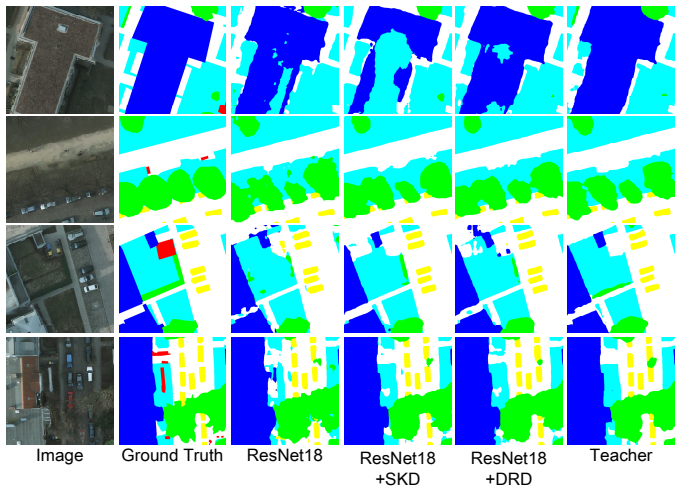
- A ResNet18 student distilled with DRD reaches 72.95 mIoU on Vaihingen, closing more than half of the gap to the ResNet101 teacher while keeping the same 13.07M parameters and 125.8 GFLOPs.
- On Potsdam the same student improves by 3.30 mIoU over the undistilled network, and on Cityscapes the ResNet18(0.5) student gains 7.52 validation / 8.77 test mIoU, indicating the recipe transfers from aerial to street scenes.
- Because all distillation terms are training-only losses, a deployed DRD student has exactly the same inference cost as the original compact model.
- The ablation shows the four terms (pixel-level KL, adversarial, spatial relation, channel relation) make complementary contributions, with the two relation losses adding accuracy on top of the other two.
- Compared with the reproduced SKD and IFVD baselines, DRD is consistently ahead on the two aerial benchmarks, with the largest per-class gains on small objects such as cars.
Reading between the lines
- The paper never says which feature layer is distilled or how ResNet101's 2048 channels are matched with ResNet18's 512 for the $C\times C$ relation loss; a natural extension is to test whether a 1x1 projection or channel subsampling is needed, and whether that adaptation explains part of the gain.
- At the stated 645x645 training crop the spatial relation map would have roughly $1.7\times 10^{11}$ entries, far beyond 24 GB of GPU memory, so the practical implementation must subsample or restrict $N$; quantifying that subsampling would let others reproduce the method and would clarify the true training-time memory cost, which the paper does not report.
- The biggest per-class gains are on rare classes like cars and trees, so a testable extension is to evaluate DRD on strongly imbalanced aerial datasets to see whether relation distillation systematically rescues minority classes.
- Since the method combines four distillation signals, an ablation that isolates the spatial and channel relation terms with all other terms fixed would show how much of the 4.01 mIoU gain is due specifically to dual-relation alignment rather than to the extra pixel-level and adversarial supervision.
Editorial analysis
A structured set of objections, weighed in public.
Referee Report
Summary. This paper proposes Dual Relation Distillation (DRD) for semantic segmentation, in which a compact PSPNet student (ResNet18 or ResNet18(0.5)) is trained to match a PSPNet-ResNet101 teacher through four auxiliary losses: pixel-wise KL divergence on score maps, adversarial alignment, spatial relation-map alignment (Eq. 2), and channel relation-map alignment (Eq. 3). Experiments are reported on Vaihingen, Potsdam, and Cityscapes. The headline result is that on Vaihingen the ResNet18 student's mIoU improves from 68.94 to 72.95 with DRD, shrinking the teacher gap from 7.05 to 3.04 points at identical inference cost.
Significance. The claimed effect is practically valuable: if a lightweight student can be brought within about 3 mIoU of a ResNet101 teacher with no extra inference overhead, that is a useful recipe for edge deployment. The paper's strengths are its consistent ablation (each added loss improves the student on Vaihingen, Table 1), the reproduction of SKD and IFVD baselines on aerial datasets, and the reporting of parameters and FLOPs. However, the significance is contingent on resolving a central reproducibility gap: the relation losses in Eqs. (2)-(4) are underspecified as to which features are distilled and how teacher-student channel dimensions are matched. Also, the two closest prior methods, [12] and [13], are never compared, and all numbers are single runs without variance estimates. With those points fixed, the empirical claim would be a modest but useful contribution.
major comments (3)
- [§3.1, Eqs. (2)-(4)] Equations (2)-(4) define the spatial and channel relation losses over feature maps F in R^{C x H x W}, but the paper never states which layer's feature maps are used for distillation, how the teacher's and student's channel counts are made equal, or how the O(N^2) spatial relation map is handled computationally. At any corresponding backbone stage ResNet101 and ResNet18 have different channel counts (e.g., 2048 vs 512 at conv5), so the channel relation maps C^s and C^t in Eq. (3) would not be the same size unless a projection layer or a shared head with identical output channels is used; neither possibility is described. Because the reported 4.01 mIoU gain on Vaihingen is attributed to these losses, the method is not reproducible as written. Please specify the exact distillation layer (or layers), the channel-alignment mechanism, whether and how feature maps are spatially resized, and the practical handling of the N x N matrix.
- [§4.5, Tables 2-3; §4.7, Table 4] The paper motivates DRD by distinguishing it from [12] (channel and spatial correlation in a single matrix) and [13] (channel-wise distribution transfer), yet neither method appears in any comparison table. Since these are the most closely related distillation losses, the conclusion that DRD achieves better or comparable performance compared to previous state-of-the-art methods is not supported for exactly the baselines that the method is designed against. Please add direct comparisons, either by running the released codes (as done for [9] and [10]) or by quoting published numbers under the same protocol.
- [§4.4, Table 1; §4.7, Table 4] All reported results are single runs with no error bars, standard deviations, or significance tests. This matters because several reported advantages are small: on Vaihingen DRD beats SKD by 0.44 mIoU for ResNet18 and 0.93 mIoU for ResNet18(0.5), and on Cityscapes DRD is actually worse than IFVD for ResNet18(0.5) (62.87 vs 63.68 test mIoU). Without repeated runs it is impossible to tell whether the central gain over SKD and IFVD is systematic or within run-to-run noise. Please report mean and variance over at least three seeds, or otherwise justify stability.
minor comments (7)
- [§3.2, Eq. (6)] Equation (6) re-sums over N pixels after Eq. (5) already sums over N; the KL divergence should be summed over the c classes only.
- [§3.1, §4.3.2, §2.2] There are typos in the text: 'matrx', 'NIVIDIA', and 'meanningful' should be corrected.
- [Figures 2, 5, 8] The captions of Figures 2, 5, and 8 contain garbled text beginning with '/uni00000013...'; these appear to be encoding artifacts and must be fixed.
- [§4.7, Table 4] The text claims DRD yields better or comparable results, but Table 4 shows IFVD outperforms DRD on ResNet18(0.5); please state explicitly where DRD is worse and how 'comparable' is defined.
- [References [31]-[61]] The reference block [31]-[61] is cited in a single sentence with no individual context, and many entries appear unrelated to semantic segmentation distillation; please prune to relevant work and cite each reference where it is used.
- [§3.3, Eq. (9)] Equation (9) includes a minus sign on lambda_2 L_Adv; the paper should clarify whether the adversarial term is minimized with a gradient-reversal convention or whether this is a typo.
- [§4.3, Training details] The paper does not state whether the teacher is frozen during student training; please make this explicit.
Circularity Check
No significant circularity: the DRD gains are independent empirical benchmark measurements, and the loss definitions do not fold the reported metric back into their inputs.
full rationale
The paper's central claim is that adding the Dual Relation Distillation losses (Eqs. 2-4, combined in Eq. 9) improves the student's measured accuracy. The reported gains (e.g., ResNet18 mIoU from 68.94% to 72.95% on Vaihingen in Table 1) are evaluations on held-out test images against external ground truth, not quantities reconstructed from the loss definitions. The three loss weights (lambda1=10, lambda2=0.1, lambda3=25) are fixed hyperparameters, not fitted to the final mIoU, so no fitted input is being renamed as a prediction. The relation losses are training objectives over teacher and student feature maps and are not defined in terms of the benchmark metric, so the derivation chain does not reduce to its own output. The paper does contain a long block of self-citations (refs. [31]-[61]), but these appear only as related-work references and none is load-bearing for the method or the experimental conclusion, so they do not create circularity under the stated rules. The omitted implementation details, such as which feature layer is distilled and how the ResNet101 and ResNet18 channel counts are aligned for Eq. (3), are genuine reproducibility and correctness concerns, but they are not circularity: an underspecified or potentially incompatible loss is still an independently measured input to the training procedure rather than an output that has been assumed into existence. Therefore the appropriate finding is no significant circularity.
Assumptions & free parameters
free parameters (3)
- lambda_1 =
10
- lambda_2 =
0.1
- lambda_3 =
25
assumptions (3)
- domain assumption Softmax-normalized relation maps computed from F^T F summarize transferable spatial and channel knowledge.
- domain assumption Teacher and student feature maps used in Eqs. (1)-(4) have compatible dimensions and are semantically aligned.
- standard math L2 distance between normalized relation maps is an appropriate training objective.
Cite this review
Pith. "Pith review of Building Lightweight Semantic Segmentation Models for Aerial Images Using Dual Relation Distillation." pith.science (2026). https://pith.science/paper/BQYDFK5V
@misc{pith2026250620688,
  author       = {Pith},
  title        = {Pith review of: Building Lightweight Semantic Segmentation Models for Aerial Images Using Dual Relation Distillation},
  year         = {2026},
  howpublished = {\url{https://pith.science/paper/BQYDFK5V}},
  note         = {Machine review of arXiv:2506.20688}
}
read the original abstract
Recently, there have been significant improvements in the accuracy of CNN models for semantic segmentation. However, these models are often heavy and suffer from low inference speed, which limits their practical application. To address this issue, knowledge distillation has emerged as a promising approach to achieve a good trade-off between segmentation accuracy and efficiency. In this paper, we propose a novel dual relation distillation (DRD) technique that transfers both spatial and channel relations in feature maps from a cumbersome model (teacher) to a compact model (student). Specifically, we compute spatial and channel relation maps separately for the teacher and student models, and then align corresponding relation maps by minimizing their distance. Since the teacher model usually learns more information and collects richer spatial and channel correlations than the student model, transferring these correlations from the teacher to the student can help the student mimic the teacher better in terms of feature distribution, thus improving the segmentation accuracy of the student model. We conduct comprehensive experiments on three segmentation datasets, including two widely adopted benchmarks in the remote sensing field (Vaihingen and Potsdam datasets) and one popular benchmark in general scene (Cityscapes dataset). The experimental results demonstrate that our novel distillation framework can significantly boost the performance of the student network without incurring extra computational overhead.
Figures


Figures from the paper (6 more)




Forward citations
Cited by 1 Pith paper
-
MAViE: A Multi-scale Adaptive Vision Encoder for Fine-grained Visual Perception and Efficient Multimodal Reasoning
A multi-scale gated fusion plus question-conditioned token router is specified to cut VLM visual tokens ~80% while improving accuracy, but all reported gains are simulated placeholders.
Reference graph
Works this paper leans on
-
[31]
L. Shan, W. Wang, Densenet-based land cover classification network with deep fusion, IEEE Geoscience and Remote Sensing Letters 19 (2021) 1–5
work page 2021
-
[61]
H. Chen, L. Feng, W. Wu, X. Zhu, S. Leo, K. Hu, F2net: A frequency- fused network for ultra-high resolution remote sensing segmentation, arXiv preprint arXiv:2506.07847
-
[12]
S. Park, Y. S. Heo, Knowledge distillation for semantic segmentation using channel and spatial correlations and adaptive cross entropy, Sensors 20 (16) (2020) 4616
work page 2020
-
[13]
C. Shu, Y. Liu, J. Gao, Z. Yan, C. Shen, Channel-wise knowledge distilla- tion for dense prediction, in: Proceedings of the IEEE/CVF International Conference on Computer Vision (ICCV), 2021, pp. 5311–5320. 21
work page 2021
-
[9]
Y. Liu, K. Chen, C. Liu, Z. Qin, Z. Luo, J. Wang, Structured knowledge distillation for semantic segmentation, in: Proceedings of the IEEE/CVF Conference on Computer Vision and Pattern Recognition (CVPR), 2019
work page 2019
-
[10]
Y. Wang, W. Zhou, T. Jiang, X. Bai, Y. Xu, Intra-class feature variation distillation for semantic segmentation, in: Computer Vision–ECCV 2020: 16th European Conference, Glasgow, UK, August 23–28, 2020, Proceed- ings, Part VII 16, Springer, 2020, pp. 346–362
work page 2020
-
[1]
J. Long, E. Shelhamer, T. Darrell, Fully convolutional networks for seman- tic segmentation, IEEE Transactions on Pattern Analysis and Machine Intelligence 39 (4) (2014) 640–651. 20
work page 2014
-
[2]
M. Sandler, A. Howard, M. Zhu, A. Zhmoginov, L.-C. Chen, Mobilenetv2: Inverted residuals and linear bottlenecks, in: Proceedings of the IEEE Con- ference on Computer Vision and Pattern Recognition (CVPR), 2018
work page 2018
Show all 69 references
-
[3]
Vedaldi, H
D.Zhou, Q.Hou, Y.Chen, J.Feng, S.Yan, Rethinkingbottleneckstructure for efficient mobile network design, in: A. Vedaldi, H. Bischof, T. Brox, J.- M. Frahm (Eds.), Computer Vision – ECCV 2020, Springer International Publishing, Cham, 2020, pp. 680–697
2020
-
[4]
N. Ma, X. Zhang, H.-T. Zheng, J. Sun, Shufflenet v2: Practical guide- lines for efficient cnn architecture design, in: The European Conference on Computer Vision (ECCV), 2018
2018
-
[6]
Bucila, R
C. Bucila, R. Caruana, A. Niculescu-Mizil, Model compression, in: ACM SIGKDD International Conference on Knowledge Discovery and Data Min- ing(KDD’06), 2006
2006
-
[7]
L. J. Ba, R. Caruana, Do deep nets really need to be deep?, in: Proceed- ings of the 27th International Conference on Neural Information Processing Systems - Volume 2, NIPS’14, MIT Press, Cambridge, MA, USA, 2014, p. 2654–2662
2014
-
[8]
Zagoruyko, N
S. Zagoruyko, N. Komodakis, Paying more attention to attention: Improv- ing the performance of convolutional neural networks via attention transfer, in: ICLR, 2017
2017
-
[11]
X. Li, L. Lei, Y. Sun, G. Kuang, Dynamic-hierarchical attention distillation with synergetic instance selection for land cover classification using miss- ing heterogeneity images, IEEE Transactions on Geoscience and Remote Sensing 60 (2021) 1–16
2021
-
[14]
L. C. Chen, G. Papandreou, I. Kokkinos, K. Murphy, A. L. Yuille, Deeplab: Semantic image segmentation with deep convolutional nets, atrous convo- lution, and fully connected crfs, IEEE Transactions on Pattern Analysis and Machine Intelligence 40 (4) (2018) 834
2018
-
[15]
L.-C. Chen, Y. Zhu, G. Papandreou, F. Schroff, H. Adam, Encoder-decoder withatrousseparableconvolutionforsemanticimagesegmentation, in: The European Conference on Computer Vision (ECCV), 2018
2018
-
[16]
H. Zhao, J. Shi, X. Qi, X. Wang, J. Jia, Pyramid scene parsing network, in: CVPR, 2017
2017
-
[17]
X. Hu, Y. Gong, Lightweight asymmetric dilation network for real-time semantic segmentation, IEEE Access 9 (2021) 55630–55643
2021
-
[18]
G. Gao, G. Xu, Y. Yu, J. Xie, J. Yang, D. Yue, Mscfnet: a lightweight net- work with multi-scale context fusion for real-time semantic segmentation, IEEE Transactions on Intelligent Transportation Systems 23 (12) (2021) 25489–25499
2021
-
[19]
Q. Zhou, X. Wu, S. Zhang, B. Kang, Z. Ge, L. J. Latecki, Contextual en- semble network for semantic segmentation, Pattern Recognition 122 (2022) 108290
2022
-
[20]
C. Yu, J. Wang, C. Peng, C.Gao, G. Yu, N. Sang, Learning a discriminative feature network for semantic segmentation, in: Proceedings of the IEEE Conference on Computer Vision and Pattern Recognition (CVPR), 2018
2018
-
[21]
J. Fu, J. Liu, H. Tian, Y. Li, Y. Bao, Z. Fang, H. Lu, Dual attention network for scene segmentation, in: The IEEE Conference on Computer Vision and Pattern Recognition (CVPR), 2019
2019
-
[22]
Mehta, M
S. Mehta, M. Rastegari, A. Caspi, L. Shapiro, H. Hajishirzi, Espnet: Ef- ficient spatial pyramid of dilated convolutions for semantic segmentation, in: The European Conference on Computer Vision (ECCV), 2018
2018
-
[23]
H. Zhao, X. Qi, X. Shen, J. Shi, J. Jia, Icnet for real-time semantic segmen- tation on high-resolution images, in: The European Conference on Com- puter Vision (ECCV), 2018
2018
-
[24]
C. Yu, J. Wang, C. Peng, C. Gao, G. Yu, N. Sang, Bisenet: Bilateral seg- mentation network for real-time semantic segmentation, in: The European Conference on Computer Vision (ECCV), 2018
2018
-
[25]
J. Yim, D. Joo, J. Bae, J. Kim, A gift from knowledge distillation: Fast optimization, network minimization and transfer learning, in: Proceedings of the IEEE conference on computer vision and pattern recognition, 2017, pp. 4133–4141. 22
2017
-
[26]
B.Peng, X.Jin, J.Liu, D.Li, Y.Wu, Y.Liu, S.Zhou, Z.Zhang, Correlation congruence for knowledge distillation, in: Proceedings of the IEEE/CVF International Conference on Computer Vision (ICCV), 2019
2019
-
[27]
Z. Xu, Y. Hsu, J. Huang, Training student networks for acceleration with conditional adversarial networks, in: British Machine Vision Conference (BMVC), 2018
2018
-
[28]
Sambaturu, A
B. Sambaturu, A. Gupta, C. Jawahar, C. Arora, Scribblenet: Efficient interactive annotation of urban city scenes for semantic segmentation, Pat- tern Recognition 133 (2023) 109011
2023
-
[29]
T. He, C. Shen, Z. Tian, D. Gong, C. Sun, Y. Yan, Knowledge adapta- tion for efficient semantic segmentation, in: Proceedings of the IEEE/CVF Conference on Computer Vision and Pattern Recognition (CVPR), 2019
2019
-
[30]
Y. Hou, Z. Ma, C. Liu, C. C. Loy, Learning lightweight lane detection cnns by self attention distillation, in: Proceedings of the IEEE/CVF Interna- tional Conference on Computer Vision (ICCV), 2019
2019
-
[32]
L. Shan, M. Li, X. Li, Y. Bai, K. Lv, B. Luo, S.-B. Chen, W. Wang, Uhrsnet: A semantic segmentation network specifically for ultra-high- resolution images, in: 2020 25th International Conference on Pattern Recognition (ICPR), IEEE, 2021, pp. 1460–1466
2020
-
[33]
L. Shan, W. Wang, K. Lv, B. Luo, Class-incremental learning for semantic segmentation in aerial imagery via distillation in all aspects, IEEE Trans- actions on Geoscience and Remote Sensing 60 (2021) 1–12
2021
-
[34]
L. Shan, X. Li, W. Wang, Decouple the high-frequency and low-frequency information of images for semantic segmentation, in: ICASSP 2021-2021 IEEE International Conference on Acoustics, Speech and Signal Processing (ICASSP), IEEE, 2021, pp. 1805–1809
2021
-
[35]
L. Shan, W. Wang, Mbnet: A multi-resolution branch network for seman- tic segmentation of ultra-high resolution images, in: ICASSP 2022-2022 IEEE International Conference on Acoustics, Speech and Signal Process- ing (ICASSP), IEEE, 2022, pp. 2589–2593
2022
-
[36]
L.Shan, W.Wang, K.Lv, B.Luo, Class-incrementalsemanticsegmentation of aerial images via pixel-level feature generation and task-wise distillation, IEEE Transactions on Geoscience and Remote Sensing 60 (2022) 1–17
2022
-
[37]
M. Li, L. Shan, X. Li, Y. Bai, D. Zhou, W. Wang, K. Lv, B. Luo, S.-B. Chen, Global-local attention network for semantic segmentation in aerial images, in: 2020 25th International Conference on Pattern Recognition (ICPR), IEEE, 2021, pp. 5704–5711. 23
2020
-
[38]
W. Wu, Y. Zhao, Z. Li, L. Shan, H. Zhou, M. Z. Shou, Continual learning for image segmentation with dynamic query, IEEE Transactions on Circuits and Systems for Video Technology 34 (6) (2023) 4874–4886
2023
-
[39]
L. Shan, W. Zhou, G. Zhao, Incremental few shot semantic segmentation via class-agnostic mask proposal and language-driven classifier, in: Pro- ceedings of the 31st ACM International Conference on Multimedia, 2023, pp. 8561–8570
2023
-
[40]
L. S. W. Z. G. Zhao, Boosting general trimap-free matting in the real-world image, arXiv preprint arXiv:2405.17916
-
[41]
L. Shan, G. Zhao, J. Xie, P. Cheng, X. Li, Z. Wang, A data-related patch proposal for semantic segmentation of aerial images, IEEE Geoscience and Remote Sensing Letters 20 (2023) 1–5
2023
-
[42]
G. Zhao, L. Shan, W. Wang, End-to-end remote sensing change detection of unregistered bi-temporal images for natural disasters, in: International Conference on Artificial Neural Networks, Springer, 2023, pp. 259–270
2023
-
[43]
L. Shan, W. Zhou, W. Li, X. Ding, Lifelong learning and selective forgetting via contrastive strategy, arXiv preprint arXiv:2405.18663
-
[44]
L. Shan, S. Luo, Z. Zhu, Y. Yuan, Y. Wu, Cognitive memory in large language models, arXiv preprint arXiv:2504.02441
-
[45]
W. Meng, L. Shan, S. Ma, D. Liu, B. Hu, Dlnet: A dual-level network with self-and cross-attention for high-resolution remote sensing segmentation, Remote Sensing 17 (7) (2025) 1119
2025
-
[46]
B. Du, L. Shan, X. Shao, D. Zhang, X. Wang, J. Wu, Transform dual-branch attention net: Efficient semantic segmentation of ultra-high- resolution remote sensing images, Remote Sensing 17 (3) (2025) 540
2025
-
[47]
X. Li, L. Shan, W. Wang, Fusing multitask models by recursive least squares, in: ICASSP 2021-2021 IEEE International Conference on Acous- tics, Speech and Signal Processing (ICASSP), IEEE, 2021, pp. 3640–3644
2021
-
[48]
Y. Ji, L. Shan, Ldnet: Semantic segmentation of high-resolution images via learnable patch proposal and dynamic refinement, in: 2024 IEEE In- ternational Conference on Multimedia and Expo (ICME), IEEE, 2024, pp. 1–6
2024
-
[49]
L. Shan, W. Zhou, W. Li, X. Ding, Organizing background to explore la- tent classes for incremental few-shot semantic segmentation, arXiv preprint arXiv:2405.19568
-
[50]
L. Shan, W. Wang, K. Lv, B. Luo, Edge-guided and class-balanced ac- tive learning for semantic segmentation of aerial images, arXiv preprint arXiv:2405.18078. 24
-
[51]
X. Ding, L. Shan, G. Zhao, M. Wu, W. Zhou, W. Li, The binary quantized neural network for dense prediction via specially designed upsampling and attention, arXiv preprint arXiv:2405.17776
-
[52]
X. Li, L. Shan, M. Li, W. Wang, Energy minimum regularization in contin- uallearning, in: 202025thInternationalConferenceonPatternRecognition (ICPR), IEEE, 2021, pp. 6404–6409
2021
-
[53]
L. Shan, W. Wang, K. Lv, B. Luo, Boosting semantic segmentation of aerial images via decoupled and multilevel compaction and dispersion, IEEE Transactions on Geoscience and Remote Sensing 61 (2023) 1–16
2023
-
[54]
R. Pi, L. Shan, Synthetic lung x-ray generation through cross-attention and affinity transformation, arXiv preprint arXiv:2503.07209
-
[55]
X. Zhou, L. Shan, X. Gui, Dynrsl-vlm: Enhancing autonomous driving perception with dynamic resolution vision-language models, arXiv preprint arXiv:2503.11265
-
[56]
39, 2025, pp
E.Yi-Ge, L.Shawn, Flexdataset: Craftingannotateddatasetgenerationfor diverse applications, in: Proceedings of the AAAI Conference on Artificial Intelligence, Vol. 39, 2025, pp. 9481–9489
2025
-
[57]
C. Sun, W. Li, X. Li, Y. Liu, L. Shan, Gmm-based comprehensive fea- ture extraction and relative distance preservation for few-shot cross-modal retrieval, arXiv preprint arXiv:2505.13306
-
[58]
H. Luo, B. Wu, H. Jia, Q. Zhu, L. Shan, Llm-cot enhanced graph neural rec- ommendation with harmonized group policy optimization, arXiv preprint arXiv:2505.12396
-
[59]
S. Luo, Z. Zhu, Y. Yuan, Y. Yang, L. Shan, Y. Wu, Geogrambench: Bench- marking the geometric program reasoning in modern llms, arXiv preprint arXiv:2505.17653
-
[60]
Q. Yi, L. Shan, Geolocsft: Efficient visual geolocation via supervised fine- tuning of multimodal foundation models, arXiv preprint arXiv:2506.01277
-
[62]
L. Mou, Y. Hua, X. X. Zhu, A relation-augmented fully convolutional net- work for semantic segmentation in aerial scenes, in: The IEEE Conference on Computer Vision and Pattern Recognition (CVPR), 2019
2019
-
[63]
K. He, X. Zhang, S. Ren, J. Sun, Deep residual learning for image recog- nition, in: Proceedings of the IEEE Conference on Computer Vision and Pattern Recognition (CVPR), 2016. 25
2016
-
[64]
L. Chen, G. Papandreou, I. Kokkinos, K. Murphy, A. L. Yuille, Semantic image segmentation with deep convolutional nets and fully connected crfs, in: Y. Bengio, Y. LeCun (Eds.), 3rd International Conference on Learning Representations, ICLR 2015, San Diego, CA, USA, May 7-9, 20...
2015
-
[65]
X. Pan, J. Shi, P. Luo, X. Wang, X. Tang, Spatial as deep: Spatial cnn for traffic scene understanding, in: Proceedings of the AAAI Conference on Artificial Intelligence, Vol. 32, 2018
2018
-
[66]
Maggiori, Y
E. Maggiori, Y. Tarabalka, G. Charpiat, P. Alliez, High-resolution aerial image labeling with convolutional neural networks, IEEE Transactions on Geoscience and Remote Sensing 55 (12) (2017) 7092–7103
2017
-
[67]
Paszke, A
A. Paszke, A. Chaurasia, S. Kim, E. Culurciello, Enet: A deep neural network architecture for real-time semantic segmentation (2016).arXiv: 1606.02147
2016 arXiv
-
[68]
Oršić, S
M. Oršić, S. Šegvić, Efficient semantic segmentation with pyramidal fusion, Pattern Recognition 110 (2021) 107611
2021
-
[69]
G. Lin, A. Milan, C. Shen, I. Reid, Refinenet: Multi-path refinement net- works for high-resolution semantic segmentation, in: The IEEE Conference on Computer Vision and Pattern Recognition (CVPR), 2017
2017
-
[70]
H. Zhao, J. Shi, X. Qi, X. Wang, J. Jia, Pyramid scene parsing network, in: The IEEE Conference on Computer Vision and Pattern Recognition (CVPR), 2017. 26
2017
Reviewed August 6, 2026 · model on record in the stance chip above.
Discussion (0). Sign in to comment.