Many-Body Simulations of the Fast Flavor Instability
Pith reviewed 2026-05-22 12:45 UTC · model grok-4.3
The pith
Many-body correlations disrupt the inhomogeneous fast flavor instability, with flavor transformation times scaling logarithmically with system size.
A machine-rendered reading of the paper's core claim, the machinery that carries it, and where it could break.
Core claim
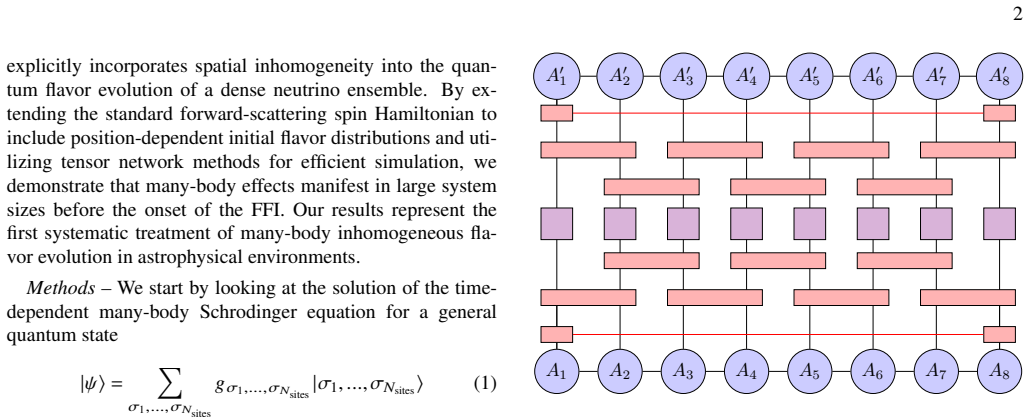
We demonstrate for the first time that the inhomogeneous fast flavor instability is disrupted by many-body correlations using a novel tensor network framework that allows a continuous transition between mean-field and many-body results by tuning the singular value decomposition cutoff value. Generalizing the forward-scattering Hamiltonian to spatially varying conditions, the timescale of flavor transformation scales logarithmically with system size, suggesting that many-body effects could occur before mean-field instabilities are able to saturate.
What carries the argument
A novel tensor network framework with a tunable singular value decomposition cutoff that enables continuous transition from mean-field to many-body simulations of the generalized forward-scattering Hamiltonian for spatially inhomogeneous neutrino systems.
If this is right
- Flavor transformation timescale scales logarithmically with system size.
- Many-body effects could occur before mean-field instabilities saturate.
- Significant implications for astrophysical explosion dynamics, nucleosynthesis, and observable neutrino signatures.
Where Pith is reading between the lines
- In larger, more realistic astrophysical systems, the logarithmic scaling may make many-body disruptions even more dominant over mean-field growth.
- This method could be adapted to study similar quantum correlations in other high-density particle systems beyond neutrinos.
- Mean-field models commonly used in astrophysics might need reevaluation for accuracy in predicting neutrino flavor evolution.
Load-bearing premise
The tensor network truncation with tunable SVD cutoff faithfully represents the many-body quantum dynamics without introducing artifacts that artificially suppress the instability for the system sizes studied.
What would settle it
Numerical simulations of the same system at significantly larger sizes that test whether the flavor transformation timescale continues to follow the logarithmic scaling or saturates at some value.
Figures


read the original abstract
The neutrino fast flavor instability dominates the evolution of neutrino flavor within the engines of core-collapse supernovae and neutron star mergers. However, theoretical models of neutrino flavor change that include many-body quantum correlations can differ starkly from similar mean-field calculations. We demonstrate for the first time that the inhomogeneous fast flavor instability is disrupted by many-body correlations using a novel tensor network framework that allows a continuous transition between mean-field and many-body results by tuning the singular value decomposition cutoff value. Generalizing the forward-scattering Hamiltonian to spatially varying conditions, we demonstrate that the timescale of flavor transformation scales logarithmically with system size, suggesting that many-body effects could occur before mean-field instabilities are able to saturate. Our results have significant implications for astrophysical explosion dynamics, nucleosynthesis, and observable neutrino signatures.
Editorial analysis
A structured set of objections, weighed in public.
Referee Report
Summary. The paper introduces a tensor-network approach to simulate the inhomogeneous fast flavor instability (FFI) in neutrinos by generalizing the forward-scattering Hamiltonian to spatially varying conditions. Using a tunable SVD cutoff to interpolate between mean-field and many-body regimes, the authors report that many-body correlations disrupt the inhomogeneous FFI and that the flavor transformation timescale scales logarithmically with system size. The work aims to bridge mean-field approximations and full quantum many-body dynamics with implications for core-collapse supernovae and neutron-star mergers.
Significance. If the logarithmic scaling and disruption survive scrutiny, the result would indicate that many-body effects can preempt mean-field saturation in inhomogeneous settings, altering predictions for neutrino flavor evolution, nucleosynthesis, and observable signals. The tensor-network framework with continuous mean-field to many-body transition is a methodological strength that enables access to system sizes beyond exact diagonalization while retaining quantum correlations.
major comments (2)
- [Methods and Results] Methods and Results sections: The headline claim that many-body correlations disrupt the inhomogeneous FFI and produce logarithmic scaling rests on the tensor-network evolution faithfully capturing the full dynamics. No systematic extrapolation in bond dimension (or SVD cutoff) is reported, nor is there a direct comparison against exact diagonalization on small inhomogeneous lattices; without these controls it remains possible that the observed suppression is an artifact of finite bond-dimension truncation preferentially damping entanglement generated by spatial gradients.
- [Results] Results on scaling: The logarithmic dependence of the flavor transformation timescale on system size is presented as a key finding, but the manuscript does not quantify how this scaling changes when the SVD cutoff is lowered or when the bond dimension is increased toward the continuum limit; this leaves the central scaling result without demonstrated convergence.
minor comments (2)
- [Abstract and Introduction] The abstract and introduction would benefit from a brief statement of the precise inhomogeneous Hamiltonian used and the range of SVD cutoffs explored.
- [Figures] Figure captions should explicitly state the SVD cutoff values and bond dimensions corresponding to each curve to allow readers to assess proximity to the mean-field limit.
Simulated Author's Rebuttal
We thank the referee for their careful reading of our manuscript and for the constructive comments. We address each major point below and have revised the manuscript accordingly to strengthen the evidence for our claims.
read point-by-point responses
-
Referee: Methods and Results sections: The headline claim that many-body correlations disrupt the inhomogeneous FFI and produce logarithmic scaling rests on the tensor-network evolution faithfully capturing the full dynamics. No systematic extrapolation in bond dimension (or SVD cutoff) is reported, nor is there a direct comparison against exact diagonalization on small inhomogeneous lattices; without these controls it remains possible that the observed suppression is an artifact of finite bond-dimension truncation preferentially damping entanglement generated by spatial gradients.
Authors: We agree that explicit controls on the SVD cutoff and bond dimension are essential to support the headline claim. The original manuscript used a tunable SVD cutoff to interpolate between regimes but did not include a dedicated convergence study. In the revised version we have added a new subsection to the Methods section that systematically varies the SVD cutoff over two orders of magnitude and shows that both the disruption of the inhomogeneous FFI and the logarithmic scaling remain stable once the cutoff is below a threshold value. For direct comparison with exact diagonalization we note that the inhomogeneous spatial structure makes exact methods infeasible beyond very small lattices (N ≲ 8 sites); however, we have added benchmark comparisons for the homogeneous limit in a new appendix, confirming that the tensor-network results reproduce exact dynamics for accessible system sizes. We acknowledge that a full extrapolation for the largest inhomogeneous lattices is computationally prohibitive at present, but the added controls substantially reduce the possibility of truncation artifacts. revision: partial
-
Referee: Results on scaling: The logarithmic dependence of the flavor transformation timescale on system size is presented as a key finding, but the manuscript does not quantify how this scaling changes when the SVD cutoff is lowered or when the bond dimension is increased toward the continuum limit; this leaves the central scaling result without demonstrated convergence.
Authors: We have revised the Results section to include an additional figure that plots the extracted flavor transformation timescale versus system size for three different SVD cutoffs (corresponding to increasing bond dimension). The logarithmic scaling is recovered in all cases, with only a modest shift in the prefactor that saturates at the smallest cutoffs. This demonstrates that the reported scaling is robust within the range of bond dimensions accessible to the tensor-network ansatz. We have also added a brief discussion arguing that the continuous mean-field-to-many-body interpolation provided by the SVD cutoff already constitutes a controlled approach to the continuum limit for the quantities of interest. revision: yes
Circularity Check
No circularity: results are simulation outputs from generalized Hamiltonian evolution
full rationale
The paper reports numerical results from tensor-network evolution of a spatially generalized forward-scattering Hamiltonian, with the SVD cutoff used to interpolate between mean-field and many-body regimes. The claimed logarithmic scaling of flavor transformation timescale and disruption of the inhomogeneous fast flavor instability are direct outputs of that evolution for finite system sizes, not quantities defined in terms of themselves or fitted to reproduce the target outcome. No self-definitional steps, fitted-input predictions, load-bearing self-citations, or ansatzes that reduce the central claim to its inputs appear in the derivation chain. The work is self-contained against external benchmarks in the sense that the reported effects follow from the stated Hamiltonian and truncation scheme without circular reduction.
Axiom & Free-Parameter Ledger
axioms (1)
- domain assumption The forward-scattering Hamiltonian can be generalized to spatially varying conditions while preserving the essential many-body structure.
Forward citations
Cited by 2 Pith papers
-
Collective neutrino-antineutrino pair oscillations
In anisotropic neutrino gases, νν-bar pairing instabilities emerge when the excessive pair-occupation number distribution changes sign, producing pair conversions at growth rates comparable to fast flavor instabilities.
-
Two-beam Multiparticle Many-body simulations of Inhomogeneous FFI
A tensor-network method enables simulations of inhomogeneous many-body neutrino flavor instabilities, showing earlier equilibration than mean-field approximations with differences arising from initial configurations a...
Reference graph
Works this paper leans on
-
[1]
H.-T. Janka, Explosion Mechanisms of Core-Collapse Super- novae, Annual Review of Nuclear and Particle Science 62, 407 (2012)
work page 2012
-
[2]
A. Mezzacappa, P. Marronetti, R. E. Landfield, E. J. Lentz, R. D. Murphy, W. Raphael Hix, J. A. Harris, S. W. Bruenn, J. M. Blondin, O. Bronson Messer, J. Casanova, and L. L. Kro- nzer, Core collapse supernova gravitational wave emission for progenitors of 9.6, 15, and 25 Solar Masses, Physical Review D 107, 043008 (2023), publisher: American Physical Society
work page 2023
-
[3]
F. Foucart, Neutrino transport in general relativistic neutron star merger simulations, Living Reviews in Computational Astro- physics 9, 1 (2023)
work page 2023
-
[4]
A. Burrows and D. Vartanyan, Core-collapse supernova explo- sion theory, Nature 589, 29 (2021)
work page 2021
-
[5]
Y .-Z. Qian and S. E. Woosley, Nucleosynthesis in neutrino- driven winds. i. the physical conditions, Astrophys. J. 471, 331 (1996)
work page 1996
-
[6]
X. Wang and R. Surman, Neutrinos and heavy element nucle- osynthesis, in Handbook of Nuclear Physics (Springer, 2022) pp. 1–19
work page 2022
-
[7]
T. Fischer, G. Guo, K. Langanke, G. Martínez-Pinedo, Y .- Z. Qian, and M.-R. Wu, Neutrinos and nucleosynthesis of el- ements, Progress in Particle and Nuclear Physics , 104107 (2024)
work page 2024
-
[8]
J. N. Bahcall and M. H. Pinsonneault, Standard solar models, with and without helium diffusion, and the solar neutrino prob- lem, Reviews of Modern Physics 64, 885 (1992), publisher: American Physical Society
work page 1992
-
[9]
Wolfenstein, Neutrino oscillations in matter, in Solar neutri- nos (CRC Press, 2018) pp
L. Wolfenstein, Neutrino oscillations in matter, in Solar neutri- nos (CRC Press, 2018) pp. 294–299
work page 2018
-
[10]
S. Mikheyev and A. Y . Smirnov, Resonant neutrino oscilla- tions in matter, Progress in Particle and Nuclear Physics 23, 41 (1989)
work page 1989
-
[11]
A. Suzuki and M. Koshiba, History of neutrino tele- scope/astronomy, Experimental Astronomy 25, 209 (2009)
work page 2009
-
[12]
G. D. Orebi Gann, K. Zuber, D. Bemmerer, and A. Serenelli, The Future of Solar Neutrinos, Annual Review of Nu- clear and Particle Science 71, 491 (2021), _eprint: https://doi.org/10.1146/annurev-nucl-011921-061243
-
[13]
Pantaleone, Neutrino oscillations at high densities, Physics Letters B 287, 128 (1992)
J. Pantaleone, Neutrino oscillations at high densities, Physics Letters B 287, 128 (1992)
work page 1992
-
[14]
H. Duan, G. M. Fuller, and Y .-Z. Qian, Collective neutrino os- cillations, Annual Review of Nuclear and Particle Science 60, 569 (2010)
work page 2010
-
[15]
I. Tamborra and S. Shalgar, New developments in flavor evo- lution of a dense neutrino gas, Annual Review of Nuclear and Particle Science 71, 165 (2021)
work page 2021
-
[16]
F. Capozzi and N. Saviano, Neutrino flavor conversions in high- density astrophysical and cosmological environments, Universe 8, 94 (2022)
work page 2022
-
[17]
S. Richers and M. Sen, Fast Flavor Transformations, in Hand- book of Nuclear Physics (Springer, Singapore, 2022)
work page 2022
-
[18]
M. C. V olpe, Neutrinos from dense environments: Flavor mech- anisms, theoretical approaches, observations, and new direc- tions, Reviews of Modern Physics 96, 025004 (2024)
work page 2024
- [19]
-
[20]
H. Duan, A. Friedland, et al., Self-induced suppression of col- lective neutrino oscillations in a supernova, Physical Review Letters 106, 091101 (2011)
work page 2011
-
[21]
B. Dasgupta, E. P. O’Connor, and C. D. Ott, Role of collective neutrino flavor oscillations in core-collapse supernova shock re- vival, Physical Review D—Particles, Fields, Gravitation, and Cosmology 85, 065008 (2012)
work page 2012
-
[22]
H. Nagakura, A. Burrows, L. Johns, and G. M. Fuller, Where, when, and why: Occurrence of fast-pairwise collective neutrino oscillation in three-dimensional core-collapse supernova mod- els, Physical Review D 104, 083025 (2021)
work page 2021
-
[23]
J. Froustey, S. Richers, E. Grohs, S. D. Flynn, F. Foucart, J. P. 6 Kneller, and G. C. McLaughlin, Neutrino fast flavor oscillations with moments: Linear stability analysis and application to neu- tron star mergers, Phys. Rev. D 109, 043046 (2024)
work page 2024
- [24]
-
[25]
H. Nagakura, K. Sumiyoshi, S. Fujibayashi, Y . Sekiguchi, and M. Shibata, Neutrino flavor instabilities in a binary neutron star merger remnant: Roles of a long-lived hypermassive neutron star, arXiv preprint arXiv:2504.20143 (2025)
-
[26]
R. F. Sawyer, Speed-up of neutrino transformations in a super- nova environment, Physical Review D 72, 045003 (2005)
work page 2005
-
[27]
R. F. Sawyer, Multiangle instability in dense neutrino systems, Physical Review D 79, 105003 (2009)
work page 2009
-
[28]
A. Banerjee, A. Dighe, and G. Raffelt, Linearized flavor- stability analysis of dense neutrino streams, Physical Review D—Particles, Fields, Gravitation, and Cosmology 84, 053013 (2011)
work page 2011
-
[29]
S. Sarikas, D. de Sousa Seixas, and G. Raffelt, Spurious in- stabilities in multiangle simulations of collective flavor conver- sion, Physical Review D—Particles, Fields, Gravitation, and Cosmology 86, 125020 (2012)
work page 2012
-
[30]
S. Chakraborty, R. S. Hansen, I. Izaguirre, and G. Raffelt, Self-induced flavor conversion of supernova neutrinos on small scales, Journal of Cosmology and Astroparticle Physics 2016 (01), 028
work page 2016
-
[31]
B. Dasgupta, A. Mirizzi, and M. Sen, Fast neutrino flavor con- versions near the supernova core with realistic flavor-dependent angular distributions, Journal of Cosmology and Astroparticle Physics 2017 (02), 019
work page 2017
-
[32]
M.-R. Wu, I. Tamborra, O. Just, and H.-T. Janka, Imprints of neutrino-pair flavor conversions on nucleosynthesis in ejecta from neutron-star merger remnants, Physical Review D 96, 123015 (2017)
work page 2017
- [33]
-
[34]
O. Just, S. Abbar, M.-R. Wu, I. Tamborra, H.-T. Janka, and F. Capozzi, Fast neutrino conversion in hydrodynamic simu- lations of neutrino-cooled accretion disks, Physical Review D 105, 083024 (2022)
work page 2022
-
[35]
R. Fernández, S. Richers, N. Mulyk, and S. Fahlman, Fast flavor instability in hypermassive neutron star disk outflows, Physical Review D 106, 103003 (2022), publisher: American Physical Society
work page 2022
- [36]
-
[37]
T. Wang and A. Burrows, The effect of the fast-flavor instability on core-collapse supernova models, The Astrophysical Journal 986, 153 (2025)
work page 2025
-
[38]
N. F. Bell, A. A. Rawlinson, and R. Sawyer, Speed-up through entanglement—many-body effects in neutrino pro- cesses, Physics Letters B 573, 86 (2003)
work page 2003
-
[39]
A. Friedland and C. Lunardini, Do many-particle neutrino inter- actions cause a novel coherent effect?, Journal of High Energy Physics 2003, 043 (2003)
work page 2003
-
[40]
A. Balantekin and Y . Pehlivan, Neutrino–neutrino interactions and flavour mixing in dense matter, Journal of Physics G: Nu- clear and Particle Physics 34, 47 (2006)
work page 2006
-
[41]
A. V . Patwardhan, M. J. Cervia, E. Rrapaj, P. Siwach, and A. B. Balantekin, Many-body collective neutrino oscillations: recent developments, in Handbook of Nuclear Physics (Springer, Sin- gapore, 2023) pp. 1–16, 10.1007/978-981-15-8818-1_126-1
-
[42]
M. J. Cervia, Y . Yamamoto, A. Roggero, J. Carlson, R. T. Glassey, and G. M. Fuller, Entanglement and collective flavor oscillations in a dense neutrino gas, Phys. Rev. D 102, 123019 (2020)
work page 2020
-
[43]
A. V . Patwardhan, M. J. Cervia, and A. B. Balantekin, Spectral splits and entanglement entropy in collective neutrino oscilla- tions, Physical Review D 104, 123035 (2021)
work page 2021
-
[44]
A. B. Balantekin, M. J. Cervia, A. V . Patwardhan, R. Sur- man, and X. Wang, Collective neutrino oscillations and heavy- element nucleosynthesis in supernovae: Exploring potential ef- fects of many-body neutrino correlations, The Astrophysical Journal 967, 146 (2024)
work page 2024
- [45]
-
[46]
A. Roggero, Dynamical phase transitions in models of col- lective neutrino oscillations, Physical Review D 104, 123023 (2021)
work page 2021
-
[47]
A. Roggero, Entanglement and many-body effects in collective neutrino oscillations, Physical Review D 104, 103016 (2021)
work page 2021
-
[48]
A. Roggero, E. Rrapaj, and Z. Xiong, Entanglement and cor- relations in fast collective neutrino flavor oscillations, Physical Review D 106, 043022 (2022)
work page 2022
-
[49]
J. D. Martin, D. Neill, A. Roggero, H. Duan, and J. Carlson, Equilibration of quantum many-body fast neutrino flavor oscil- lations, Physical Review D 108, 123010 (2023)
work page 2023
-
[50]
M. Illa and M. J. Savage, Multi-neutrino entanglement and cor- relations in dense neutrino systems, Physical Review Letters 130, 221003 (2023)
work page 2023
-
[51]
R. Bhaskar, A. Roggero, and M. J. Savage, Timescales in many- body fast-neutrino-flavor conversion, Physical Review C 110, 045801 (2024)
work page 2024
-
[52]
J. D. Martin, A. Roggero, H. Duan, J. Carlson, and V . Cirigliano, Classical and quantum evolution in a simple coherent neutrino problem, Physical Review D 105, 083020 (2022)
work page 2022
-
[53]
S. Shalgar and I. Tamborra, Do we have enough evidence to invalidate the mean-field approximation adopted to model col- lective neutrino oscillations?, Physical Review D 107, 123004 (2023)
work page 2023
-
[54]
A. Kost, L. Johns, and H. Duan, Once-in-a-lifetime encounter models for neutrino media: From coherent oscillations to flavor equilibration, Physical Review D 109, 103037 (2024)
work page 2024
-
[55]
Johns, Neutrino many-body correlations, arXiv preprint arXiv:2305.04916 (2023)
L. Johns, Neutrino many-body correlations, arXiv preprint arXiv:2305.04916 (2023)
-
[56]
V . Cirigliano, S. Sen, and Y . Yamauchi, Neutrino many-body flavor evolution: The full hamiltonian, Physical Review D 110, 123028 (2024)
work page 2024
-
[57]
M. Goimil-García, S. Shalgar, and I. Tamborra, Pauli blocking: Probing beyond-mean-field effects in neutrino flavor evolution, Physical Review D 111, 083054 (2025)
work page 2025
- [58]
-
[59]
M. J. Cervia, P. Siwach, A. V . Patwardhan, A. Balantekin, S. Coppersmith, and C. W. Johnson, Collective neutrino os- cillations with tensor networks using a time-dependent vari- ational principle, Physical Review D 105, 10.1103/phys- revd.105.123025 (2022)
-
[60]
P. Siwach, A. M. Suliga, and A. B. Balantekin, Entanglement in three-flavor collective neutrino oscillations, Physical Review 7 D 107, 10.1103/physrevd.107.023019 (2023)
-
[61]
S. Shalgar and I. Tamborra, Breaking the symmetries in self- interacting neutrino systems: Fast conversions and directional crossings, Phys. Rev. D 103, 063002 (2021)
work page 2021
-
[62]
D. F. Fiorillo and G. G. Raffelt, Fast flavor conversions at the edge of instability in a two-beam model, Physical Review Let- ters 133, 221004 (2024)
work page 2024
-
[63]
D. F. Fiorillo, G. G. Raffelt, and G. Sigl, Inhomogeneous ki- netic equation for mixed neutrinos: tracing the missing energy, Physical Review Letters 133, 021002 (2024)
work page 2024
-
[64]
S. Shalgar and I. Tamborra, Dispelling a myth: Can one avoid the neutrino flavor instability suppression?, Phys. Rev. D 103, 063002 (2021)
work page 2021
-
[65]
M. Fishman, S. White, and E. M. Stoudenmire, The itensor soft- ware library for tensor network calculations, SciPost Physics Codebases , 004 (2022)
work page 2022
-
[66]
M. Fishman, S. White, and E. M. Stoudenmire, Codebase re- lease 0.3 for itensor, SciPost Physics Codebases , 004 (2022)
work page 2022
-
[67]
G. Vidal, Efficient classical simulation of slightly entangled quantum computations, Physical review letters 91, 147902 (2003)
work page 2003
-
[68]
G. Vidal, Efficient simulation of one-dimensional quantum many-body systems, Physical review letters93, 040502 (2004)
work page 2004
-
[69]
F. Verstraete, V . Murg, and J. I. Cirac, Matrix product states, projected entangled pair states, and variational renormalization group methods for quantum spin systems, Advances in physics 57, 143 (2008)
work page 2008
-
[70]
S.-J. Ran, E. Tirrito, C. Peng, X. Chen, L. Tagliacozzo, G. Su, and M. Lewenstein, Tensor Network Contractions: Methods and Applications to Quantum Many-Body Systems , Lecture Notes in Physics, V ol. 964 (Springer International Publishing, Cham, 2020)
work page 2020
-
[71]
U. Schollwöck, The density-matrix renormalization group in the age of matrix product states, Annals of physics 326, 96 (2011)
work page 2011
-
[72]
S. Paeckel, T. Köhler, A. Swoboda, S. R. Manmana, U. Scholl- wöck, and C. Hubig, Time-evolution methods for matrix- product states, Annals of Physics 411, 167998 (2019)
work page 2019
-
[73]
E. Akhmedov, J. Kopp, and M. Lindner, Collective neutrino os- cillations and neutrino wave packets, Journal of Cosmology and Astroparticle Physics 2017 (09), 017
work page 2017
-
[74]
L. Johns and A. Kost, Local-equilibrium theory of neutrino os- cillations, arXiv preprint arXiv:2506.03271 (2025)
discussion (0)
Sign in with ORCID, Apple, or X to comment. Anyone can read and Pith papers without signing in.