Joint Beamforming and Position Optimization for FIRES-NOMA Assisted Wireless Communication Systems
Pith reviewed 2026-05-19 05:54 UTC · model grok-4.3
The pith
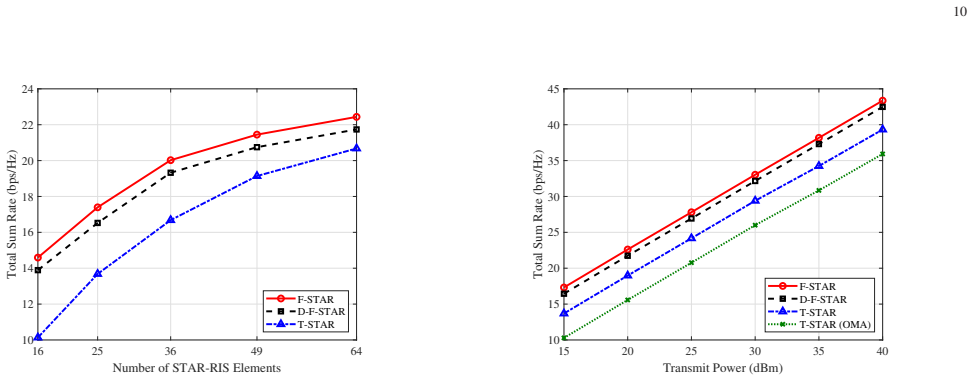
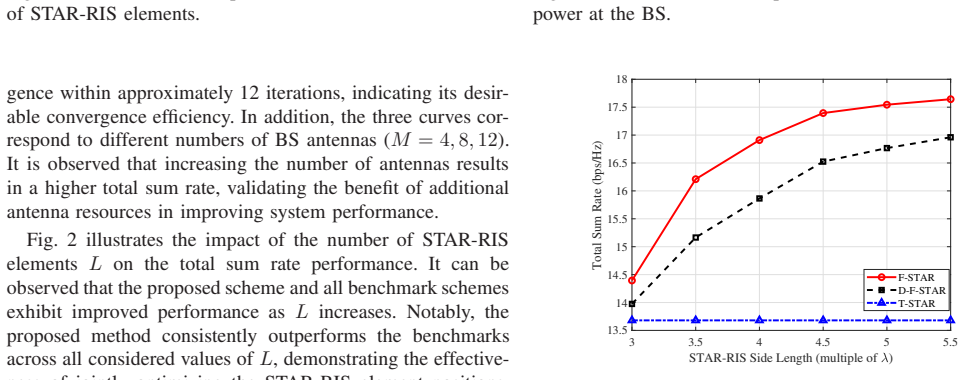
Fluid integrated reflecting and emitting surfaces raise NOMA sum rate by up to 27 percent while needing half as many elements as STAR-RIS.
A machine-rendered reading of the paper's core claim, the machinery that carries it, and where it could break.
Core claim
By allowing each FIRES element to continuously and flexibly adjust its position in response to environmental variations, the system enables simultaneous service to users in transmission and reflection zones, which increases spatial degrees of freedom and, when jointly optimized with beamforming and coefficients, produces higher total sum rates than fixed-surface baselines.
What carries the argument
The fluid integrated reflecting and emitting surface (FIRES) with movable elements, optimized jointly with beamforming via an alternating optimization algorithm that applies SCA, SDR, and MM to handle channel coupling.
If this is right
- The FIRES-NOMA system achieves up to a 27 percent increase in total sum rate over conventional STAR-RIS systems.
- Approximately 50 percent fewer RIS elements suffice to reach the same performance level.
- The movable elements enhance spatial degrees of freedom and service adaptability for multi-user NOMA setups.
- The majorization-minimization step yields an efficient iterative solution for the position subproblem despite direct-FIRES channel coupling.
Where Pith is reading between the lines
- Lower element counts could cut hardware cost and power draw in large-scale deployments.
- The position-adjustment idea could transfer to other reconfigurable surfaces used in emerging wireless standards.
- Practical systems would need fast, low-power actuators to move elements in response to changing user locations.
Load-bearing premise
The alternating optimization algorithm can reliably find good solutions to the non-convex joint problem even with the complex coupling between direct and FIRES paths.
What would settle it
A simulation or measurement showing less than 15 percent sum-rate gain or no meaningful reduction in the number of elements needed to match STAR-RIS performance under the same channel and power conditions.
Figures



read the original abstract
To address the limitations of conventional reconfigurable intelligent surfaces (RIS) in spatial control capability, this paper proposes a fluid integrated reflecting and emitting surface (FIRES) assisted non-orthogonal multiple access (NOMA) multi-user communication system. In this system, each FIRES element can continuously and flexibly adjust its position in response to environmental variations, enabling simultaneous service to users in both transmission and reflection zones. This significantly enhances the system's spatial degrees of freedom (DoF) and service adaptability. To maximize the system's total sum rate, we formulate a non-convex optimization problem that jointly optimizes the base station beamforming, the transmission/reflection coefficients of the FIRES, and the element positions. An alternating optimization (AO) algorithm is developed, incorporating successive convex approximation (SCA), semi-definite relaxation (SDR), and majorization-minimization (MM) techniques. In particular, to address the complex channel coupling introduced by the coexistence of direct and FIRES paths, the MM framework is employed in the element position optimization subproblem, enabling an efficient iterative solution strategy. Simulation results validate that the proposed system achieves up to a 27% increase in total sum rate compared to conventional STAR-RIS systems and requires approximately 50% fewer RIS elements to attain the same performance, highlighting its effectiveness for cost-efficient large-scale deployment.
Editorial analysis
A structured set of objections, weighed in public.
Referee Report
Summary. The manuscript proposes a fluid integrated reflecting and emitting surface (FIRES) assisted NOMA multi-user communication system in which each element can continuously adjust its position to serve users in both transmission and reflection zones, thereby increasing spatial degrees of freedom. A non-convex joint optimization problem is formulated over base-station beamforming vectors, FIRES transmission/reflection coefficients, and element positions to maximize the system sum rate. The problem is solved by an alternating optimization algorithm that applies successive convex approximation (SCA) to the rate expressions, semi-definite relaxation (SDR) to the beamforming subproblem, and majorization-minimization (MM) to the position subproblem that accounts for direct/FIRES channel coupling. Simulation results are reported to show up to a 27% sum-rate gain relative to conventional STAR-RIS and the ability to achieve equivalent performance with approximately 50% fewer elements.
Significance. If the reported gains are shown to be robust, the addition of continuous position control as an optimizable variable would constitute a meaningful extension of RIS technology, offering an extra spatial degree of freedom that could reduce hardware cost and improve adaptability in NOMA deployments. The explicit use of MM to handle the coupled direct and reflected paths is a technically relevant contribution to the algorithmic literature.
major comments (2)
- [§IV] §IV (Algorithm Development): the MM surrogate constructed for the position subproblem is stated to handle direct/FIRES channel coupling, yet no proof or numerical verification is supplied that the majorizer remains sufficiently tight after the first few iterations or that the resulting stationary point is close to a global optimum; without such evidence the 27% sum-rate advantage cannot be confidently attributed to the FIRES architecture rather than favorable local solutions.
- [Simulation Results section] Simulation Results section: the central performance claims (27% sum-rate increase and 50% element reduction) are presented without reporting the number of Monte-Carlo channel realizations, standard deviations, or convergence curves of the AO algorithm; these omissions make it impossible to judge whether the observed gains are statistically reliable or sensitive to initialization.
minor comments (2)
- [§II] The abstract and §II use the term “FIRES element” without an explicit comparison table to STAR-RIS or fluid-antenna baselines, which would help readers immediately grasp the incremental novelty.
- [§II] Notation for the transmission and reflection coefficient vectors is introduced without a clear statement of the unit-modulus or power constraints that apply to each; adding this sentence would improve readability.
Simulated Author's Rebuttal
We thank the referee for the constructive comments, which help improve the clarity and rigor of our work. We address each major comment below and will incorporate the suggested additions in the revised manuscript.
read point-by-point responses
-
Referee: [§IV] §IV (Algorithm Development): the MM surrogate constructed for the position subproblem is stated to handle direct/FIRES channel coupling, yet no proof or numerical verification is supplied that the majorizer remains sufficiently tight after the first few iterations or that the resulting stationary point is close to a global optimum; without such evidence the 27% sum-rate advantage cannot be confidently attributed to the FIRES architecture rather than favorable local solutions.
Authors: We agree that additional validation would strengthen the presentation. In the revised manuscript we will include numerical results that plot the surrogate objective against the true objective function over iterations for representative channel realizations, confirming that the majorizer remains tight after the initial iterations. Regarding global optimality, the joint problem is non-convex; the AO algorithm is guaranteed only to reach a stationary point. We will explicitly state this and report sum-rate statistics obtained from multiple random initializations to show that the observed performance gains are consistent and not artifacts of particular local solutions. revision: yes
-
Referee: [Simulation Results section] Simulation Results section: the central performance claims (27% sum-rate increase and 50% element reduction) are presented without reporting the number of Monte-Carlo channel realizations, standard deviations, or convergence curves of the AO algorithm; these omissions make it impossible to judge whether the observed gains are statistically reliable or sensitive to initialization.
Authors: We concur that these details are necessary for assessing reliability. The revised version will state that all results are averaged over 500 independent Monte-Carlo channel realizations, will add standard-deviation error bars to the sum-rate and element-count figures, and will include a new figure depicting the convergence trajectories of the AO algorithm under different initializations to illustrate rapid convergence and limited sensitivity to starting points. revision: yes
Circularity Check
No circularity: optimization framework and simulation validation are independent
full rationale
The paper formulates a non-convex joint optimization problem maximizing sum rate by optimizing BS beamforming, FIRES transmission/reflection coefficients, and element positions. It develops an AO algorithm using SCA for rate approximation, SDR for beamforming subproblems, and MM to handle direct/FIRES channel coupling in the position subproblem. The reported 27% sum-rate gain and 50% element reduction are obtained from numerical simulations comparing the optimized FIRES-NOMA system against conventional STAR-RIS baselines. These performance numbers do not reduce by construction to fitted parameters, self-definitions, or self-citation chains; the algorithm is a general solver for the stated problem, and simulations constitute external validation on channel realizations rather than tautological outputs.
Axiom & Free-Parameter Ledger
axioms (1)
- domain assumption Channel models for direct and FIRES-assisted paths accurately capture the coupling effects
invented entities (1)
-
FIRES element with continuously adjustable position
no independent evidence
Forward citations
Cited by 2 Pith papers
-
Spectral and Energy Efficiency Tradeoff for Pinching-Antenna Systems
Develops two-stage optimization for single-user and alternating optimization for multi-user pinching-antenna systems, proving position independence from beamforming and algorithm convergence while showing SE-EE gains ...
-
Performance Analysis of Pinching Antenna Systems Enabled NOMA Communications
PASS-NOMA achieves lower blockage outage and higher ergodic rates than PASS-OMA, with further gains as the number of pinching antennas increases.
Reference graph
Works this paper leans on
-
[1]
6G internet of things: A comprehens ive survey,
D. C. Nguyen, M. Ding, P . N. Pathirana, A. Seneviratne, J. Li, D. Niyato, O. Dobre, and H. V . Poor, “6G internet of things: A comprehens ive survey,” IEEE Internet of Things Journal , vol. 9, no. 1, pp. 359–383, 2022
work page 2022
-
[2]
Evolution of NOMA toward next generation multi ple access (NGMA) for 6G,
Y . Liu, S. Zhang, X. Mu, Z. Ding, R. Schober, N. Al-Dhahir, E. Hossain, and X. Shen, “Evolution of NOMA toward next generation multi ple access (NGMA) for 6G,” IEEE Journal on Selected Areas in Commu- nications, vol. 40, no. 4, pp. 1037–1071, 2022
work page 2022
-
[3]
NOMA-based backsc atter communications: Fundamentals, applications, and advance ments,
M. Ahmed, M. Shahwar, F. Khan, W. Ullah Khan, A. Ihsan, U. Sadiq Khan, F. Xu, and S. Chatzinotas, “NOMA-based backsc atter communications: Fundamentals, applications, and advance ments,” IEEE Internet of Things Journal , vol. 11, no. 11, pp. 19303–19327, 2024
work page 2024
-
[4]
E. Basar, G. C. Alexandropoulos, Y . Liu, Q. Wu, S. Jin, C. Y uen, O. A. Dobre, and R. Schober, “Reconfigurable intelligent surface s for 6G: Emerging hardware architectures, applications, and open c hallenges,” IEEE V ehicular Technology Magazine, vol. 19, no. 3, pp. 27–47, 2024
work page 2024
-
[5]
Simultaneou sly transmit- ting and reflecting (STAR) RIS aided wireless communication s,
X. Mu, Y . Liu, L. Guo, J. Lin, and R. Schober, “Simultaneou sly transmit- ting and reflecting (STAR) RIS aided wireless communication s,” IEEE Transactions on Wireless Communications , vol. 21, no. 5, pp. 3083– 3098, 2022
work page 2022
-
[6]
A survey on STAR-RIS: Use cases, recent advances, and future research challenges,
M. Ahmed, A. Wahid, S. S. Laique, W. U. Khan, A. Ihsan, F. Xu , S. Chatzinotas, and Z. Han, “A survey on STAR-RIS: Use cases, recent advances, and future research challenges,” IEEE Internet Things J. , vol. 10, no. 16, pp. 14689–14711, 2023
work page 2023
-
[7]
Joint desi gn for simultaneously transmitting and reflecting (STAR) RIS assi sted NOMA systems,
J. Zuo, Y . Liu, Z. Ding, L. Song, and H. V . Poor, “Joint desi gn for simultaneously transmitting and reflecting (STAR) RIS assi sted NOMA systems,” IEEE Transactions on Wireless Communications , vol. 22, no. 1, pp. 611–626, 2023
work page 2023
-
[8]
Covert communication of STAR-RIS aided NO MA networks,
X. Li, Z. Tian, W. He, G. Chen, M. C. Gursoy, S. Mumtaz, and A. Nallanathan, “Covert communication of STAR-RIS aided NO MA networks,” IEEE Transactions on V ehicular Technology, vol. 73, no. 6, pp. 9055–9060, 2024
work page 2024
-
[9]
Spectrally-efficient beamforming design for STAR- RIS-aided URLLC NOMA systems,
M. V . Katwe, R. Deshpande, K. Singh, C. Pan, P . H. Ghare, an d T. Q. Duong, “Spectrally-efficient beamforming design for STAR- RIS-aided URLLC NOMA systems,” IEEE Transactions on Communications , vol. 72, no. 7, pp. 4414–4431, 2024
work page 2024
-
[10]
STAR-RI S aided secure NOMA integrated sensing and communication,
W. Wei, X. Pang, C. Xing, N. Zhao, and D. Niyato, “STAR-RI S aided secure NOMA integrated sensing and communication,” IEEE Transactions on Wireless Communications , vol. 23, no. 9, pp. 10712– 10725, 2024
work page 2024
-
[11]
STAR-RI S assisted full-duplex NOMA communication networks,
A. Salem, K.-K. Wong, C.-B. Chae, and Y . Zhang, “STAR-RI S assisted full-duplex NOMA communication networks,” IEEE Transactions on Wireless Communications, pp. 1–1, 2025
work page 2025
-
[12]
S TAR- RIS-enabled full-duplex integrated sensing and communica tion system,
Y . Liu, G. Chen, Y . Wen, Q. Luo, C. Zhang, and D. Niyato, “S TAR- RIS-enabled full-duplex integrated sensing and communica tion system,” IEEE Transactions on Wireless Communications , pp. 1–1, 2025
work page 2025
-
[13]
Wideband channel est imation for IRS-aided systems in the face of beam squint,
S. Ma, W. Shen, J. An, and L. Hanzo, “Wideband channel est imation for IRS-aided systems in the face of beam squint,” IEEE Transactions on Wireless Communications , vol. 20, no. 10, pp. 6240–6253, 2021
work page 2021
-
[14]
J. Wang, W. Tang, J. C. Liang, L. Zhang, J. Y . Dai, X. Li, S. Jin, Q. Cheng, and T. J. Cui, “Reconfigurable intelligent surface : Power consumption modeling and practical measurement validatio n,” IEEE Transactions on Communications , vol. 72, no. 9, pp. 5720–5734, 2024
work page 2024
-
[15]
W. K. New, K.-K. Wong, H. Xu, C. Wang, F. R. Ghadi, J. Zhang , J. Rao, R. Murch, P . Ram´ ırez-Espinosa, D. Morales-Jimenez , C.-B. Chae, and K.-F. Tong, “A tutorial on fluid antenna system for 6 G networks: Encompassing communication theory, optimizati on methods and hardware designs,” IEEE Communications Surveys & Tutorials , pp. 1–1, 2024
work page 2024
-
[16]
AI- empowered fluid antenna systems: Opportunities, challenge s, and future directions,
C. Wang, Z. Li, K.-K. Wong, R. Murch, C.-B. Chae, and S. Ji n, “AI- empowered fluid antenna systems: Opportunities, challenge s, and future directions,” IEEE Wireless Communications , vol. 31, no. 5, pp. 34–41, 2024
work page 2024
-
[17]
On performance of RIS-aided fluid antenna systems ,
F. Rostami Ghadi, K.-K. Wong, W. K. New, H. Xu, R. Murch, a nd Y . Zhang, “On performance of RIS-aided fluid antenna systems ,” IEEE Wireless Communications Letters , vol. 13, no. 8, pp. 2175–2179, 2024
work page 2024
-
[18]
Scnr maximization for mimo isac assisted by fluid antenna system,
Y . Y e, L. Y ou, H. Xu, A. Elzanaty, K.-K. Wong, and X. Gao, “ Scnr maximization for mimo isac assisted by fluid antenna system, ” IEEE Transactions on V ehicular Technology, pp. 1–6, 2025
work page 2025
-
[19]
Intelligent reflecting surface-aided wireless communica tion with mov- able elements,
G. Hu, Q. Wu, D. Xu, K. Xu, J. Si, Y . Cai, and N. Al-Dhahir, “Intelligent reflecting surface-aided wireless communica tion with mov- able elements,” IEEE Wireless Communications Letters , vol. 13, no. 4, pp. 1173–1177, 2024
work page 2024
-
[20]
Joint bea mforming and position optimization for fluid RIS-aided ISAC systems,
J. Y e, P . Zhang, X.-P . Li, L. Huang, and Y . Liu, “Joint bea mforming and position optimization for fluid RIS-aided ISAC systems,” arXiv preprint arXiv:2501.13339, 2025
-
[21]
A first look at the performance enhancement potential of fluid recon- figurable intelligent surface,
A. Salem, K.-K. Wong, G. Alexandropoulos, C.-B. Chae, a nd R. Murch, “A first look at the performance enhancement potential of flui d recon- figurable intelligent surface,” arXiv preprint arXiv:2502.17116 , 2025
-
[22]
STAR: Simultaneous transmission and reflection for 360° co verage by intelligent surfaces,
Y . Liu, X. Mu, J. Xu, R. Schober, Y . Hao, H. V . Poor, and L. H anzo, “STAR: Simultaneous transmission and reflection for 360° co verage by intelligent surfaces,” IEEE Wireless Commun. , vol. 28, no. 6, pp. 102– 109, 2021
work page 2021
-
[23]
J. Xu, X. Mu, J. T. Zhou, and Y . Liu, “Simultaneously tran smitting and reflecting (STAR)-RISs: Are they applicable to dual-sided i ncidence?,” IEEE Wireless Commun. Letters , vol. 12, pp. 129–133, Jan. 2023
work page 2023
-
[24]
Simultaneo usly transmitting and reflecting (STAR) RIS aided wireless commu nications,
X. Mu, Y . Liu, L. Guo, J. Lin, and R. Schober, “Simultaneo usly transmitting and reflecting (STAR) RIS aided wireless commu nications,” IEEE Trans. Wireless Commun. , vol. 21, pp. 3083–3098, May. 2022
work page 2022
-
[25]
Towards smart and reconfigurable env ironment: Intelligent reflecting surface aided wireless network,
Q. Wu and R. Zhang, “Towards smart and reconfigurable env ironment: Intelligent reflecting surface aided wireless network,” IEEE Communi- cations Magazine , vol. 58, pp. 106–112, Jan. 2020
work page 2020
-
[26]
Cascaded channel estimation for l arge intelligent metasurface assisted massive MIMO,
Z.-Q. He and X. Y uan, “Cascaded channel estimation for l arge intelligent metasurface assisted massive MIMO,” IEEE Wireless Commun. Letters , vol. 9, pp. 210–214, Feb. 2020
work page 2020
-
[27]
MIMO capacity characteriza tion for movable antenna systems,
W. Ma, L. Zhu, and R. Zhang, “MIMO capacity characteriza tion for movable antenna systems,” IEEE Transactions on Wireless Communica- tions, vol. 23, no. 4, pp. 3392–3407, 2024
work page 2024
-
[28]
Sem idefinite relaxation of quadratic optimization problems,
Z.-q. Luo, W.-k. Ma, A. M.-c. So, Y . Y e, and S. Zhang, “Sem idefinite relaxation of quadratic optimization problems,” IEEE Signal Process. Mag., vol. 27, no. 3, pp. 20–34, 2010
work page 2010
-
[29]
Power allocation for energy efficiency and secrecy of wireless int erference networks,
Z. Sheng, H. D. Tuan, A. A. Nasir, T. Q. Duong, and H. V . Poo r, “Power allocation for energy efficiency and secrecy of wireless int erference networks,” IEEE Trans. Wireless Commun. , vol. 17, no. 6, pp. 3737– 3751, 2018
work page 2018
-
[30]
CVX: Matlab software for di sciplined convex programming,
M. Grant, S. Boyd, and Y . Y e, “CVX: Matlab software for di sciplined convex programming,” 2009
work page 2009
-
[31]
Rank-constrained separabl e semidefinite programming with applications to optimal beamforming,
Y . Huang and D. P . Palomar, “Rank-constrained separabl e semidefinite programming with applications to optimal beamforming,” IEEE Trans. Signal Process. , vol. 58, no. 2, pp. 664–678, 2010
work page 2010
-
[32]
V ariations and extension of the con vex–concave procedure,
T. Lipp and S. Boyd, “V ariations and extension of the con vex–concave procedure,” Optimization and Engineering , vol. 17, pp. 263–287, 2016
work page 2016
-
[33]
Zhang, Matrix analysis and applications
X.-D. Zhang, Matrix analysis and applications . Cambridge University Press, 2017
work page 2017
-
[34]
Fractional programming for communic ation systems—part I: Power control and beamforming,
K. Shen and W. Y u, “Fractional programming for communic ation systems—part I: Power control and beamforming,” IEEE Transactions on Signal Processing , vol. 66, no. 10, pp. 2616–2630, 2018
work page 2018
discussion (0)
Sign in with ORCID, Apple, or X to comment. Anyone can read and Pith papers without signing in.