REVIEW 4 major objections 5 minor 86 references
Mapping Jet-Gas Coupling and energetic ionized outflows in High-Redshift Radio Galaxies with JWST/NIRSpec
T0 review · 4 major / 5 minor · reviewed 2026-08-05 · deepseek-v4-flash
Pith's one-line read Radio jets at z~4 drive galaxy-scale outflows of warm ionized gas, but couple less than ~1% of their mechanical energy into that gas.
desk verdict The new IFU kinematics for six z>3.5 radio galaxies are valuable and the TGSS1530 analysis is genuinely new, but the headline outflow-efficiency range is contradicted by the paper's own tables, so the main feedback claim needs major revision before it can be taken seriously. read the letter →
The pith
A machine-rendered reading of the paper's core claim, the machinery that carries it, and where it could break.
The reading
What carries the argument
The analysis is carried by spatially resolved $W_{80}$ maps—a non-parametric line-width measure enclosing 80% of the line flux—built from the NIRSpec IFU cubes of $[{\rm O\,III}]\(\lambda5007\) (or H$\$\alpha$$), together with radial profiles computed in 1-kpc boxes along the projected radio axis. These maps are converted into resolved outflow properties through a standard prescription that uses $[{\rm S\,II}]$ doublet ratios for electron density and the $|v|>500$ km/s high-velocity channel to isolate the outflow component, yielding gas mass, $\dot{M}_{\rm out}$, momentum flux, and kinetic power $\dot{E} = \frac12 \dot{M} $v^{2}$$. The coupling-efficiency conclusion additionally leans on a newly fi
What would settle it
Measure the jet power of these six galaxies independently of Equation (5)—for example from X-ray cavity enthalpy, inverse-Compton lobe emission, or lobe minimum-energy arguments—and compare with the radio-derived values; a discrepancy of more than the calibration scatter would overturn the $<1\%$ coupling claim. Separately, deep X-ray observations could test whether a hot $T\sim10^7$ K phase with $E_{\rm th}\sim100\times$ the ionized outflow kinetic energy actually exists; its absence would falsify the paper's proposed energy budget.
Extended reading notes
Core claim
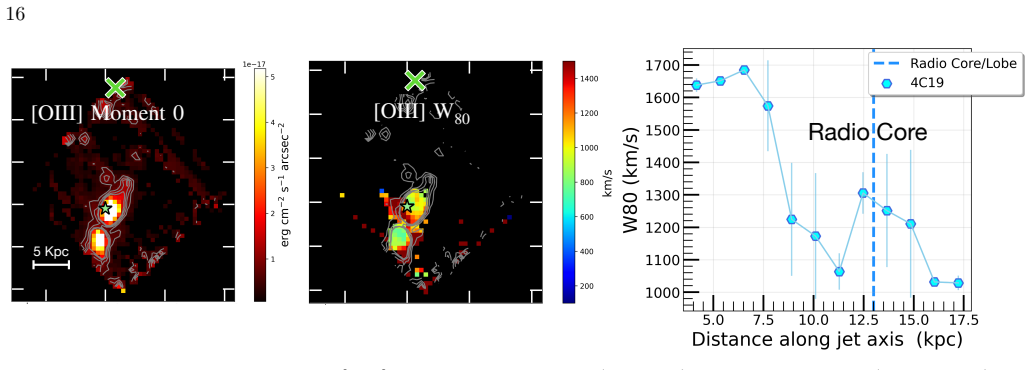
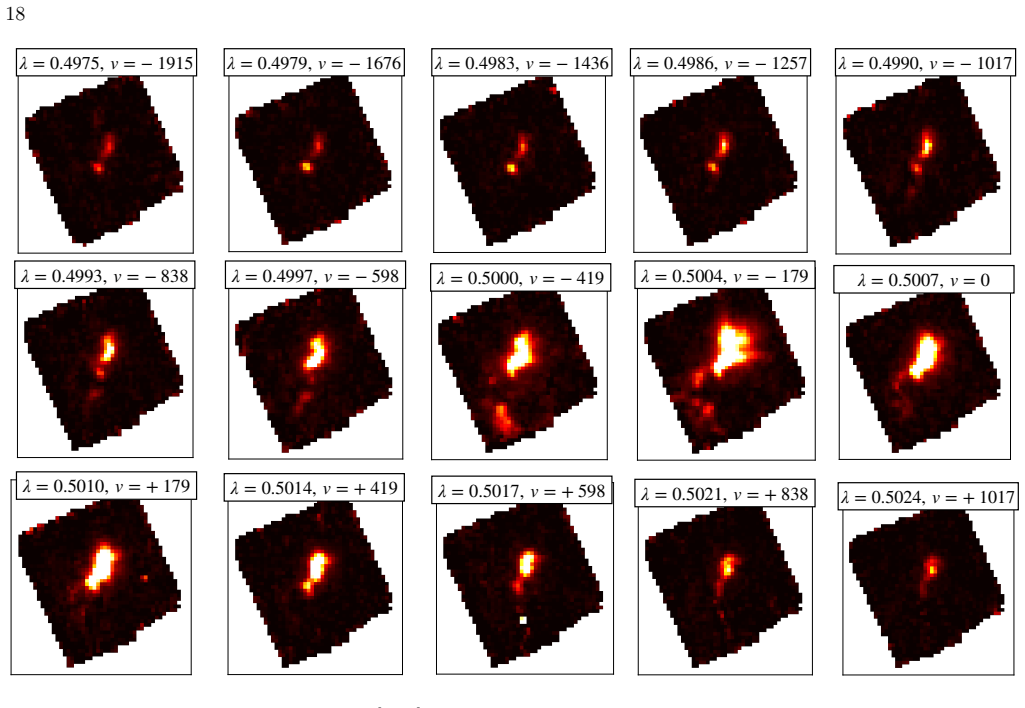
On the paper's own terms, the discovery is a dual one. All six galaxies show broad $[{\rm O\,III}]\(\lambda5007\) (or H$\$\alpha$$ for TGSS1530) emission with $W_{80}$ from about 950 to more than 2500 km/s extending over tens of kiloparsecs, and the highest line widths, highest outflow rates, and peak kinetic powers are spatially coincident with radio cores or lobes. This spatial coincidence is the direct evidence for jet-driven feedback: the gas is not merely disturbed, it is disturbed along the jet's direction. Quantitatively, the outflows carry $0.15\%$--$2\%$ of $L_{\rm bol}$, which the paper argues is sufficient to impact galaxy evolution, yet only $\approx0.1$--$1\%$ of the inferred jet m
Load-bearing premise
The jet mechanical powers are inferred from a 1.4 GHz radio luminosity–jet power relation calibrated on low-redshift X-ray cavity samples; if that calibration is biased or has large scatter when applied at $z\sim4$, the headline coupling-efficiency result of $\lesssim1\%$ is not secure.
Editorial extensions
If this is right
- Radio jets at $z>3.5$ are capable of redistributing hundreds of solar masses per year and depositing kinetic power at or above the $\sim0.5\%$ $L_{\rm bol}$ threshold that feedback models associate with quenching, so jet-driven feedback is a viable mechanism during the peak epoch of galaxy formation.
- Because only $\lesssim1\%$ of the jet mechanical energy appears in warm ionized bulk motion, ionized-outflow studies alone systematically underestimate the feedback energy budget; the dominant reservoir should be a hot, X-ray-emitting phase with $E_{\rm th}\sim 100\times$ the ionized outflow kinetic energy.
- The apparent anti-correlation between $\dot{E}_{\rm out}/L_{\rm jet}$ and radio source size implies compact, young jets couple most efficiently to the dense ISM, so early-stage jet feedback may be the most important for stirring the host galaxy.
- Shock models with $v_{\rm shock}\approx600$--$1000$ km/s can produce the observed emission-line luminosities with shock front areas of 20--80 kpc$^2$, comparable to the outflow areas, so the line-emitting gas may itself be a calorimeter of jet energy loss rather than a passive tracer.
Reading between the lines
- If the $L_{\rm jet}$--$L_{1.4\,\rm GHz}$ relation carries large intrinsic scatter or evolves with redshift, the quoted $<1\%$ coupling efficiency will shift; the qualitative conclusion that jet energy is not dominated by warm-ionized bulk motion is more robust, since even order-of-magnitude changes in $L_{\rm jet}$ leave $\dot{E}_{\rm out}\ll L_{\rm jet}$.
- A direct observational test is to measure the hot gas thermal energy of these same galaxies with deep X-ray observations: if no $T\sim10^7$ K phase with $E_{\rm th}\sim100\times$ the ionized outflow kinetic energy is present, the paper's proposed energy sink must be replaced.
- Applying the same $W_{80}$ and outflow methodology to a matched sample of radio-quiet AGNs at $z\sim4$ would isolate the jet contribution; the paper's comparison already suggests jets produce a directional turbulence component absent in radio-quiet systems, but a controlled sample would make that quantitative.
- If the compact-source efficiency trend is confirmed with larger samples, it would imply feedback is most effective before jets break out of the dense interstellar medium, shifting attention to young compact steep-spectrum sources as the principal feedback agents at early epochs.
Editorial analysis
A structured set of objections, weighed in public.
Referee Report
Summary. The paper presents JWST/NIRSpec IFU observations of six powerful radio galaxies at z ≈ 3.5–4, mapping the morphology, kinematics, and energetics of warm ionized gas. It derives W80 line widths, electron densities from [SII], ionized gas masses, outflow rates, kinetic powers, and compares outflow energetics with AGN bolometric luminosity and with a newly calibrated L_jet–L_1.4GHz relation. The main claims are that all sources show large-scale jet-aligned outflows, that outflow kinetic power reaches 0.15–2% of L_bol (sufficient for feedback), and that only ≲1% of jet mechanical power is transferred to warm ionized gas. The kinematic data and spatial correlations are valuable, but the quantitative headline numbers are internally inconsistent with the paper's own tables.
Significance. If the quantitative results are correct, this would be the largest uniform IFU sample of jet-driven feedback at z > 3.5, with direct implications for models of AGN feedback and galaxy quenching. Strengths include the publicly available data, the consistent methodology across six targets, the spatially resolved nature of the maps, and the comparison with radio-quiet quasars. However, the central quantitative claims are not supported by the paper's own tabulated values, and key systematic assumptions are not propagated into the energetics. The current version requires major revision before the conclusions can be relied upon.
major comments (4)
- [§4.2, Tables 1 and 2] The quoted kinetic efficiencies do not match the tabulated numbers. Dividing Table 2 KE_outflow by Table 1 L_AGN gives log10(KE/L_bol) = -3.60, -3.77, -2.69, -2.70, -3.82, -4.33 for TGSS, TNJ0205, 4C03, 4C19, TNJ0121, TNJ1338 respectively, i.e. 0.025%, 0.017%, 0.20%, 0.20%, 0.015%, 0.005%. The abstract and conclusions state 0.15%–2%, while §4.2 states 0.15%–8%. The maximum value from the tables is 0.2%, below the ~0.5% feedback threshold discussed in §4.2. This internal inconsistency directly undermines the 'sufficient to impact galaxy evolution' claim.
- [§4.4, Figure 23, Table 1 and 2] The claim that 'only 0.1–1%' of jet mechanical power couples to the warm ionized gas is contradicted by 4C03: from Table 1 log Ljet = 46.65 and Table 2 log KE = 44.96, giving KE/Ljet ≈ 2%, not <1%. The abstract's '≲1%' is thus not uniformly supported. Since the coupling-efficiency headline depends on this ratio, the paper should present the per-source ratio and revise the stated range accordingly, or explain why 4C03 is treated differently.
- [§4.3, Eq. (5)] The new L_jet–L_1.4GHz scaling relation is calibrated on low-redshift X-ray cavity samples and then applied to z ≈ 3.5–4 radio galaxies. The HzRGs lie near the upper end of the calibration range, and the relation implicitly assumes no redshift evolution in jet composition, environment, or cavity energetics. The quoted scatter in the calibration (intercept uncertainty ±1.23 dex) is not propagated into the KE/Ljet ratios or into the N17 re-analysis. Because the main coupling conclusion is a ratio involving Ljet, the authors should show how the result changes under plausible systematic shifts (e.g., ±0.5 dex) or with independent jet-power estimators.
- [§3.1.3, Eqs. (2) and (4)] The outflow masses and kinetic powers rest on several unquantified assumptions: (i) electron densities from single-Gaussian fits to [SII], which likely trace the narrow, non-outflow gas rather than the high-velocity component; (ii) clumping factor Ce = 1; (iii) solar oxygen abundance; (iv) for TGSS1530, Av = 0.8 borrowed from another source. These enter the mass and power linearly or, for extinction, exponentially. A sensitivity analysis is needed to show whether the 0.15–2% and <1% conclusions are robust to reasonable variations in these assumptions.
minor comments (5)
- [§2.2, Eq. (1)] W50 is used in Eq. (1) and later in §3.1.3 for v_out, but the paper only defines W80. Please define W50 or replace with W80 for consistency.
- [§2.2] Typo: 'TGSS150' should be 'TGSS1530'.
- [Figure 6, bottom-left panel] The text describes an enhancement 'around ~25 kpc', but the listed outflow size for TGSS is 21 kpc. Please check the radial distance scale and the axis origin.
- [§4.5] The text says 'only a small fraction (∼0.3%)' of jet energy is in the emisson-line outflows, while the abstract and §4.4 quote ≲1%. These numbers should be stated consistently.
- [Table 1 caption] Table 1 states L_AGN is from [OIII]5007, but TGSS1530 lacks [OIII] coverage. Please specify what estimator is used for TGSS (e.g., Hα-based) and whether this affects the reported L_AGN.
Circularity Check
No significant circularity: outflow and jet energetics rest on independent, externally calibrated inputs; the abstract/table efficiency mismatch is a correctness issue, not a circularity.
full rationale
The paper's derivation chain is not circular. Outflow masses, rates, and kinetic powers are computed with standard published prescriptions (Cano-Díaz et al. 2012; Veilleux et al. 2020, 2023; Cresci et al. 2023) applied to measured [OIII]/Hα luminosities, [SII] electron densities, and line widths. The AGN bolometric luminosities are independent [OIII]-based estimates. Jet mechanical powers are obtained from a new L_jet–L_1.4GHz scaling relation fitted to low-redshift X-ray cavity samples (Rafferty et al. 2006; Bîrzan et al. 2004; Cavagnolo et al. 2010; Daly et al. 2012; Ineson et al. 2017), not fitted to the high-redshift outflow measurements. The headline comparison—outflow kinetic power relative to L_bol and to L_jet—therefore combines independently measured quantities rather than reducing to a fitted parameter. Citations to Roy et al. (2024) and Heckman et al. (2024) are methodological or contextual; the equations are restated in this paper and the new sample is analyzed here, so the self-citations are not load-bearing. A separate, non-circular concern is that the abstract and conclusions quote kinetic efficiencies of 0.15%–2%, while dividing Table 2 KE_outflow by Table 1 L_AGN gives ~0.005%–0.2%; this internal inconsistency undermines the quantitative headline but is an arithmetic/correctness problem, not a circular-reasoning reduction.
Assumptions & free parameters
free parameters (7)
- Slope of L_jet-L_radio relation =
0.64 +/- 0.03
- Intercept of L_jet-L_radio relation =
17.68 +/- 1.23
- Extinction Av for TGSS1530 =
0.8
- Electron density clumping factor Ce =
1
- Oxygen abundance [O/H] =
0 (solar)
- Shock velocity for ionization model =
800 km/s
- Ionization parameter U =
1e-2
assumptions (5)
- domain assumption Case B recombination describes the H-alpha luminosity and ionized gas mass relation (Eq 2).
- domain assumption The [SII] 6717/6731 ratio measures the electron density of the outflowing gas component.
- domain assumption The L_jet-L_1.4GHz calibration derived from low-z radio galaxies holds for z~4 HzRGs.
- domain assumption Gas with |v|>500 km/s is outflowing rather than tracing rotation or other dynamical motions.
- domain assumption Shock models from Allen et al. (2008) are applicable to the observed emission-line gas.
Cite this review
Pith. "Pith review of Mapping Jet-Gas Coupling and energetic ionized outflows in High-Redshift Radio Galaxies with JWST/NIRSpec." pith.science (2026). https://pith.science/paper/OG2TJARB
@misc{pith2026250806707,
  author       = {Pith},
  title        = {Pith review of: Mapping Jet-Gas Coupling and energetic ionized outflows in High-Redshift Radio Galaxies with JWST/NIRSpec},
  year         = {2026},
  howpublished = {\url{https://pith.science/paper/OG2TJARB}},
  note         = {Machine review of arXiv:2508.06707}
}
abstract
We present spatially resolved maps of morphology, kinematics, and energetics of warm ionized gas in six powerful radio galaxies at z=3.5-4, using JWST/NIRSpec IFU to quantify jet-driven feedback in the early universe. All sources exhibit broad [OIII] emission-line profiles with W80 (line width) values of 950-2500 km/s across $\sim$10s of kpc, signifying large-scale outflows. The outflowing nebulae are preferentially aligned with the radio jet axis, suggesting jet-driven origin. On average, the regions with the broadest lines and highest velocities are co-spatial with radio lobes or cores, and exhibit the strongest kinetic power. Ionized gas masses associated with the outflows span 1 to 8 $\times 10^{9} \ M_\odot$, with total mass outflow rates of 80-950 Msun/yr and kinetic powers between 10^{43.2} and 10^{45.0} erg/s. The outflow kinetic power corresponds to 0.15%-2% of the AGN bolometric luminosity, sufficient to impact galaxy evolution. However, only $\lesssim 1$\% of the jet mechanical energy couples to the warm ionized gas via outflows, consistent with predictions from hydrodynamic simulations. A large fraction of the jet energy may instead reside in shock-heated hot gas, supported by X-ray detection, or used to thermalize the gas and produce the observed emission-line nebulae. Our results demonstrate that radio jets in massive, gas-rich systems at high-redshift can inject significant kinetic and thermal energy to the surroundings, providing direct evidence for jet-driven feedback operating during the peak epoch of galaxy formation.
Figures


Figures from the paper (20 more)





Reference graph
Works this paper leans on
-
[1]
Allen, M. G., Groves, B. A., Dopita, M. A., Sutherland, R. S., & Kewley, L. J. 2008, ApJS, 178, 20, doi: 10.1086/589652 Astropy Collaboration, Robitaille, T. P., Tollerud, E. J., et al. 2013, A&A, 558, A33, doi: 10.1051/0004-6361/201322068 Astropy Collaboration, Price-Whelan, A. M., Sip˝ ocz, B. M., et al. 2018, AJ, 156, 123, doi: 10.3847/1538-3881/aabc4f...
doi:10.1086/589652 2008
-
[2]
2019, A&A, 632, A124, doi: 10.1051/0004-6361/201935544
Balmaverde, B., Capetti, A., Marconi, A., et al. 2019, A&A, 632, A124, doi: 10.1051/0004-6361/201935544
-
[3]
2019, MNRAS, 486, 4290, doi: 10.1093/mnras/stz1070
Baron, D., & Netzer, H. 2019, MNRAS, 486, 4290, doi: 10.1093/mnras/stz1070
-
[4]
Baum, S. A., & Heckman, T. 1989, ApJ, 336, 702, doi: 10.1086/167044
-
[5]
Begelman, M. C., & Cioffi, D. F. 1989, ApJL, 345, L21, doi: 10.1086/185542
doi:10.1086/185542 1989
-
[6]
Bicknell, G. V., Mukherjee, D., Wagner, A. Y., Sutherland, R. S., & Nesvadba, N. P. H. 2018, MNRAS, 475, 3493, doi: 10.1093/mnras/sty070 B ˆ ırzan, L., Rafferty, D. A., McNamara, B. R., Wise, M. W., & Nulsen, P. E. J. 2004, ApJ, 607, 800, doi: 10.1086/383519
-
[7]
2016, A&A, 588, A58, doi: 10.1051/0004-6361/201527900
Brusa, M., Perna, M., Cresci, G., et al. 2016, A&A, 588, A58, doi: 10.1051/0004-6361/201527900
-
[8]
Bushouse, H., Eisenhamer, J., Dencheva, N., et al. 2023, JWST Calibration Pipeline, 1.11.2, Zenodo, doi: 10.5281/zenodo.8140011 Cano-D ´ ıaz, M., Maiolino, R., Marconi, A., et al. 2012, A&A, 537, L8, doi: 10.1051/0004-6361/201118358
Show all 86 references
-
[9]
W., McNamara, B
Cavagnolo, K. W., McNamara, B. R., Nulsen, P. E. J., et al. 2010, ApJ, 720, 1066, doi: 10.1088/0004-637X/720/2/1066
2010 doi
-
[10]
2015, A&A, 574, A14, doi: 10.1051/0004-6361/201424980
Cicone, C., Maiolino, R., Gallerani, S., et al. 2015, A&A, 574, A14, doi: 10.1051/0004-6361/201424980
2015 doi
-
[11]
P., & Proga, D
Ciotti, L., Ostriker, J. P., & Proga, D. 2010, ApJ, 717, 708, doi: 10.1088/0004-637X/717/2/708
2010 doi
-
[12]
Collet, C., Nesvadba, N. P. H., De Breuck, C., et al. 2016, A&A, 586, A152, doi: 10.1051/0004-6361/201526872
2016 doi
-
[13]
S., Fabian, A
Crawford, C. S., Fabian, A. C., & Johnstone, R. M. 1988, MNRAS, 235, 183, doi: 10.1093/mnras/235.1.183
1988 doi
-
[14]
M., Kraemer, S
Crenshaw, D. M., Kraemer, S. B., Gabel, J. R., et al. 2003, ApJ, 594, 116, doi: 10.1086/376792
2003 doi
-
[15]
2023, A&A, 672, A128, doi: 10.1051/0004-6361/202346001
Cresci, G., Tozzi, G., Perna, M., et al. 2023, A&A, 672, A128, doi: 10.1051/0004-6361/202346001
2023 doi
-
[16]
J., Springel, V., White, S
Croton, D. J., Springel, V., White, S. D. M., et al. 2006, MNRAS, 365, 11, doi: 10.1111/j.1365-2966.2005.09675.x Dall’Agnol de Oliveira, B., Storchi-Bergmann, T., Kraemer, S. B., et al. 2021, MNRAS, 504, 3890, doi: 10.1093/mnras/stab1067
2006
-
[17]
Baum, S. A. 2012, MNRAS, 423, 2498, doi: 10.1111/j.1365-2966.2012.21060.x De Breuck, C., van Breugel, W., Minniti, D., et al. 1999, A&A, 352, L51, doi: 10.48550/arXiv.astro-ph/9909178 De Breuck, C., Seymour, N., Stern, D., et al. 2010, ApJ, 725, 36, doi: 10.1088/0004-637X/725/...
2012
-
[18]
Dunn, R. J. H., & Fabian, A. C. 2006, MNRAS, 373, 959, doi: 10.1111/j.1365-2966.2006.11080.x
2006
- [19]
-
[20]
J., McDowell, J
Elvis, M., Wilkes, B. J., McDowell, J. C., et al. 1994, ApJS, 95, 1, doi: 10.1086/192093
1994 doi
-
[21]
Fabian, A. C. 2012, ARA&A, 50, 455, doi: 10.1146/annurev-astro-081811-125521
2012 doi
-
[22]
D., et al
Falkendal, T., De Breuck, C., Lehnert, M. D., et al. 2019, A&A, 621, A27, doi: 10.1051/0004-6361/201732485 31
2019 doi
-
[23]
2017, A&A, 601, A143, doi: 10.1051/0004-6361/201629478 F¨ orster Schreiber, N
Fiore, F., Feruglio, C., Shankar, F., et al. 2017, A&A, 601, A143, doi: 10.1051/0004-6361/201629478 F¨ orster Schreiber, N. M.,¨Ubler, H., Davies, R. L., et al. 2019, ApJ, 875, 21, doi: 10.3847/1538-4357/ab0ca2 Gab´ anyi, K.´E., Frey, S., Gurvits, L. I., Paragi, Z., &
2017 doi
-
[24]
2018, Research Notes of the American Astronomical Society, 2, 200, doi: 10.3847/2515-5172/aaec82
Perger, K. 2018, Research Notes of the American Astronomical Society, 2, 200, doi: 10.3847/2515-5172/aaec82
2018 doi
-
[25]
E., Zakamska, N
Greene, J. E., Zakamska, N. L., & Smith, P. S. 2012, ApJ, 746, 86, doi: 10.1088/0004-637X/746/1/86
2012 doi
-
[26]
Swinbank, A. M. 2014, MNRAS, 441, 3306, doi: 10.1093/mnras/stu515
2014 doi
-
[27]
M., & Best, P
Heckman, T. M., & Best, P. N. 2014, ARA&A, 52, 589, doi: 10.1146/annurev-astro-081913-035722 —. 2023, Galaxies, 11, 21, doi: 10.3390/galaxies11010021
2014 doi
-
[28]
1991, ApJ, 381, 373, doi: 10.1086/170660
Breugel, W. 1991, ApJ, 381, 373, doi: 10.1086/170660
1991 doi
-
[29]
M., Roy, N., Best, P
Heckman, T. M., Roy, N., Best, P. N., & Kondapally, R. 2024, ApJ, 977, 125, doi: 10.3847/1538-4357/ad8f3e
2024 doi
-
[30]
F., & Elvis, M
Hopkins, P. F., & Elvis, M. 2010, MNRAS, 401, 7, doi: 10.1111/j.1365-2966.2009.15643.x
2010
-
[31]
F., Hernquist, L., Cox, T
Hopkins, P. F., Hernquist, L., Cox, T. J., et al. 2006, ApJS, 163, 1, doi: 10.1086/499298
2006 doi
-
[32]
H., Hardcastle, M
Ineson, J., Croston, J. H., Hardcastle, M. J., & Mingo, B. 2017, MNRAS, 467, 1586, doi: 10.1093/mnras/stx189
2017 doi
-
[33]
T., Jagannathan, P., Mooley, K
Intema, H. T., Jagannathan, P., Mooley, K. P., & Frail, D. A. 2017, A&A, 598, A78, doi: 10.1051/0004-6361/201628536
2017 doi
-
[34]
T., Venemans, B
Intema, H. T., Venemans, B. P., Kurk, J. D., et al. 2006, A&A, 456, 433, doi: 10.1051/0004-6361:20064812
2006 doi
-
[35]
E., Harrison, C
Jarvis, M. E., Harrison, C. M., Thomson, A. P., et al. 2019, MNRAS, 485, 2710, doi: 10.1093/mnras/stz556
2019 doi
-
[36]
E., Harrison, C
Jarvis, M. E., Harrison, C. M., Mainieri, V., et al. 2021, MNRAS, 503, 1780, doi: 10.1093/mnras/stab549
2021 doi
-
[37]
2020, MNRAS, 499, 5749, doi: 10.1093/mnras/staa3259
Ji, X., & Yan, R. 2020, MNRAS, 499, 5749, doi: 10.1093/mnras/staa3259
2020 doi
-
[38]
F., et al
Kakkad, D., Sani, E., Rojas, A. F., et al. 2022, MNRAS, 511, 2105, doi: 10.1093/mnras/stac103
2022 doi
-
[39]
2023, ApJ, 958, 145, doi: 10.3847/1538-4357/acf92b
Kim, C., Woo, J.-H., Luo, R., et al. 2023, ApJ, 958, 145, doi: 10.3847/1538-4357/acf92b
2023 doi
-
[40]
2023, MNRAS, 525, 5831, doi: 10.1093/mnras/stad2647
Kolwa, S., De Breuck, C., Vernet, J., et al. 2023, MNRAS, 525, 5831, doi: 10.1093/mnras/stad2647
2023 doi
-
[41]
A., Perna, M., Willott, C
Marshall, M. A., Perna, M., Willott, C. J., et al. 2023, A&A, 678, A191, doi: 10.1051/0004-6361/202346113
2023 doi
-
[42]
2018, astropy/astroscrappy: v1.0.5 Zenodo Release, v1.0.5, Zenodo, doi: 10.5281/zenodo.1482019
McCully, C., Crawford, S., Kovacs, G., et al. 2018, astropy/astroscrappy: v1.0.5 Zenodo Release, v1.0.5, Zenodo, doi: 10.5281/zenodo.1482019
2018 doi
-
[43]
R., & Nulsen, P
McNamara, B. R., & Nulsen, P. E. J. 2007, ARA&A, 45, 117, doi: 10.1146/annurev.astro.45.051806.110625 —. 2012, New Journal of Physics, 14, 055023, doi: 10.1088/1367-2630/14/5/055023
2007 arXiv
-
[44]
Y., et al
Meenakshi, M., Mukherjee, D., Wagner, A. Y., et al. 2022, MNRAS, 516, 766, doi: 10.1093/mnras/stac2251
2022 doi
-
[45]
P., & Raymond Oonk, J
Morganti, R., Oosterloo, T., Tadhunter, C., Bernhard, E. P., & Raymond Oonk, J. B. 2021, A&A, 656, A55, doi: 10.1051/0004-6361/202141766
2021 doi
-
[46]
V., Sutherland, R., & Wagner, A
Mukherjee, D., Bicknell, G. V., Sutherland, R., & Wagner, A. 2016, MNRAS, 461, 967, doi: 10.1093/mnras/stw1368
2016 doi
-
[47]
V., Wagner, A
Mukherjee, D., Bicknell, G. V., Wagner, A. Y., Sutherland, R. S., & Silk, J. 2018, MNRAS, 479, 5544, doi: 10.1093/mnras/sty1776
2018 doi
-
[48]
2020, MNRAS, 499, 681, doi: 10.1093/mnras/staa2934
Mukherjee, D., Bodo, G., Mignone, A., Rossi, P., & Vaidya, B. 2020, MNRAS, 499, 681, doi: 10.1093/mnras/staa2934
2020 doi
-
[49]
R., Alexander, D
Mullaney, J. R., Alexander, D. M., Fine, S., et al. 2013, MNRAS, 433, 622, doi: 10.1093/mnras/stt751
2013 doi
-
[50]
Nesvadba, N. P. H., De Breuck, C., Lehnert, M. D., Best, P. N., & Collet, C. 2017, A&A, 599, A123, doi: 10.1051/0004-6361/201528040
2017 doi
-
[51]
2007, A&A, 475, 145, doi: 10.1051/0004-6361:20078175
Gilbert, A., & van Breugel, W. 2007, A&A, 475, 145, doi: 10.1051/0004-6361:20078175
2007 doi
-
[52]
M., & van Breugel, W
Gilbert, A. M., & van Breugel, W. 2008, A&A, 491, 407, doi: 10.1051/0004-6361:200810346
2008 doi
-
[53]
Nesvadba, N. P. H., Lehnert, M. D., Eisenhauer, F., et al. 2006, ApJ, 650, 693, doi: 10.1086/507266 O’Dea, C. P. 1998, PASP, 110, 493, doi: 10.1086/316162 O’Dea, C. P., & Saikia, D. J. 2021, A&A Rv, 29, 3, doi: 10.1007/s00159-021-00131-w
2006 doi
- [54]
-
[55]
L., R¨ ottgering, H
Pentericci, L., Van Reeven, W., Carilli, C. L., R¨ ottgering, H. J. A., & Miley, G. K. 2000, A&AS, 145, 121, doi: 10.1051/aas:2000104
2000 doi
-
[56]
2023, A&A, 679, A89, doi: 10.1051/0004-6361/202346649
Perna, M., Arribas, S., Marshall, M., et al. 2023, A&A, 679, A89, doi: 10.1051/0004-6361/202346649
2023 doi
-
[57]
Wise, M. W. 2006, ApJ, 652, 216, doi: 10.1086/507672
2006 doi
-
[58]
M., Kraemer, S
Revalski, M., Crenshaw, D. M., Kraemer, S. B., et al. 2018, ApJ, 856, 46, doi: 10.3847/1538-4357/aab107
2018 doi
-
[59]
2021, ApJ, 910, 139, doi: 10.3847/1538-4357/abdcad
Revalski, M., Meena, B., Martinez, F., et al. 2021, ApJ, 910, 139, doi: 10.3847/1538-4357/abdcad
2021 doi
-
[60]
2018, ApJ, 869, 117, doi: 10.3847/1538-4357/aaee72
Roy, N., Bundy, K., Cheung, E., et al. 2018, ApJ, 869, 117, doi: 10.3847/1538-4357/aaee72
2018 doi
-
[61]
2021a, ApJ, 913, 33, doi: 10.3847/1538-4357/abf1e6
Roy, N., Bundy, K., Nevin, R., et al. 2021a, ApJ, 913, 33, doi: 10.3847/1538-4357/abf1e6
-
[62]
2021b, ApJ, 922, 230, doi: 10.3847/1538-4357/ac24a0 32
Roy, N., Moravec, E., Bundy, K., et al. 2021b, ApJ, 922, 230, doi: 10.3847/1538-4357/ac24a0 32
-
[63]
2024, ApJ, 970, 69, doi: 10.3847/1538-4357/ad4bda
Roy, N., Heckman, T., Overzier, R., et al. 2024, ApJ, 970, 69, doi: 10.3847/1538-4357/ad4bda
2024 doi
-
[64]
2021, MNRAS, 507, 74, doi: 10.1093/mnras/stab2058
Ruschel-Dutra, D., Storchi-Bergmann, T., Schnorr-M¨ uller, A., et al. 2021, MNRAS, 507, 74, doi: 10.1093/mnras/stab2058
2021 doi
-
[65]
L., Shapley, A
Sanders, R. L., Shapley, A. E., Kriek, M., et al. 2016, ApJ, 816, 23, doi: 10.3847/0004-637X/816/1/23
2016 doi
- [66]
-
[67]
2007, ApJS, 171, 353, doi: 10.1086/517887
Seymour, N., Stern, D., De Breuck, C., et al. 2007, ApJS, 171, 353, doi: 10.1086/517887
2007 doi
-
[68]
T., Davies, R
Shimizu, T. T., Davies, R. I., Lutz, D., et al. 2019, MNRAS, 490, 5860, doi: 10.1093/mnras/stz2802
2019 doi
-
[69]
Smail, I., & Blundell, K. M. 2013, MNRAS, 434, 3246, doi: 10.1093/mnras/stt1240
2013 doi
-
[70]
M., Lehmer, B
Smail, I., Blundell, K. M., Lehmer, B. D., & Alexander, D. M. 2012, ApJ, 760, 132, doi: 10.1088/0004-637X/760/2/132
2012 doi
-
[71]
Speagle, J. S. 2020, MNRAS, 493, 3132, doi: 10.1093/mnras/staa278
2020 doi
-
[72]
2021, A&A, 653, A150, doi: 10.1051/0004-6361/202140686
Speranza, G., Balmaverde, B., Capetti, A., et al. 2021, A&A, 653, A150, doi: 10.1051/0004-6361/202140686
2021 doi
-
[73]
M., Vernet, J
Swinbank, A. M., Vernet, J. D. R., Smail, I., et al. 2015, MNRAS, 449, 1298, doi: 10.1093/mnras/stv366 ¨Ubler, H., Maiolino, R., Curtis-Lake, E., et al. 2023, A&A, 677, A145, doi: 10.1051/0004-6361/202346137
2015 doi
-
[74]
2024, A&A, 685, A122, doi: 10.1051/0004-6361/202347436 van Ojik, R., Roettgering, H
Ulivi, L., Venturi, G., Cresci, G., et al. 2024, A&A, 685, A122, doi: 10.1051/0004-6361/202347436 van Ojik, R., Roettgering, H. J. A., Miley, G. K., &
2024 doi
- [75]
- [76]
-
[77]
D., & Aalto, S
Veilleux, S., Maiolino, R., Bolatto, A. D., & Aalto, S. 2020, A&A Rv, 28, 2, doi: 10.1007/s00159-019-0121-9
2020 doi
-
[78]
2023, ApJ, 953, 56, doi: 10.3847/1538-4357/ace10f
Veilleux, S., Liu, W., Vayner, A., et al. 2023, ApJ, 953, 56, doi: 10.3847/1538-4357/ace10f
2023 doi
-
[79]
2021, A&A, 648, A17, doi: 10.1051/0004-6361/202039869 Villar Mart ´ ın, M., Emonts, B
Venturi, G., Cresci, G., Marconi, A., et al. 2021, A&A, 648, A17, doi: 10.1051/0004-6361/202039869 Villar Mart ´ ın, M., Emonts, B. H. C., Cabrera Lavers, A., et al. 2021, A&A, 650, A84, doi: 10.1051/0004-6361/202039642
2021 doi
-
[80]
E., et al
Virtanen, P., Gommers, R., Oliphant, T. E., et al. 2020, Nature Methods, 17, 261, doi: 10.1038/s41592-019-0686-2
2020 doi
-
[81]
Y., & Bicknell, G
Wagner, A. Y., & Bicknell, G. V. 2011, ApJ, 728, 29, doi: 10.1088/0004-637X/728/1/29
2011 doi
-
[82]
Y., Bicknell, G
Wagner, A. Y., Bicknell, G. V., & Umemura, M. 2012, ApJ, 757, 136, doi: 10.1088/0004-637X/757/2/136
2012 doi
-
[83]
2024, A&A, 683, A169, doi: 10.1051/0004-6361/202348531
Wang, W., Wylezalek, D., De Breuck, C., et al. 2024, A&A, 683, A169, doi: 10.1051/0004-6361/202348531
2024 doi
-
[84]
2025, A&A, 696, A88, doi: 10.1051/0004-6361/202553668
Wang, W., De Breuck, C., Wylezalek, D., et al. 2025, A&A, 696, A88, doi: 10.1051/0004-6361/202553668
2025 doi
-
[85]
2019, ApJ, 876, 105, doi: 10.3847/1538-4357/ab164e
Xu, X., Arav, N., Miller, T., & Benn, C. 2019, ApJ, 876, 105, doi: 10.3847/1538-4357/ab164e
2019 doi
-
[86]
A., & Plesha, R
Xu, X., Arav, N., Miller, T., Kriss, G. A., & Plesha, R. 2020, ApJS, 247, 42, doi: 10.3847/1538-4365/ab5f68
2020 doi
Reviewed August 5, 2026 · model on record in the stance chip above.
Discussion (0). Continue with ORCID to comment.