Wide-Area Power System Oscillations from Large-Scale AI Workloads
Pith reviewed 2026-05-18 21:24 UTC · model grok-4.3
The pith
Large-scale AI workloads create periodic power fluctuations that can amplify wide-area oscillations in electric power grids.
A machine-rendered reading of the paper's core claim, the machinery that carries it, and where it could break.
Core claim
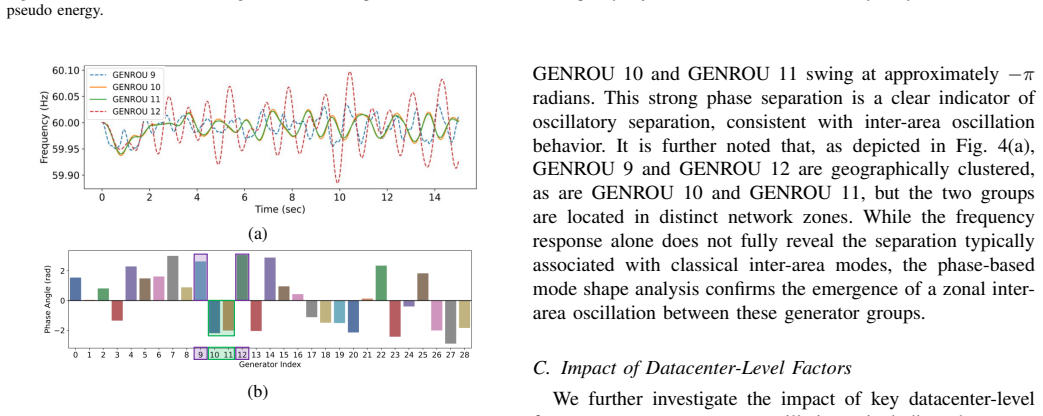
The central claim is that the periodic stochastic power fluctuations inherent to large-scale AI workloads during training and fine-tuning, driven by GPU computing architecture design and distributed mini-batch processing cycles, act as persistent forcing inputs capable of interacting with and amplifying local and inter-area oscillation modes in power systems. This is demonstrated through numerical studies on the WECC 179-bus and NPCC 140-bus systems under various conditions including system strength, penetration level, fluctuation frequency range, individual datacenter size, geographical deployment, fluctuation suppression level, and workload ratio.
What carries the argument
dynamic power profiling approach that extracts periodic stochastic power fluctuations from GPU architecture and mini-batch cycles to serve as forcing inputs for grid oscillation analysis
If this is right
- Narrower fluctuation frequency bands intensify oscillations across multiple modes.
- Larger single-site datacenter capacities increase the amplitude of oscillatory responses.
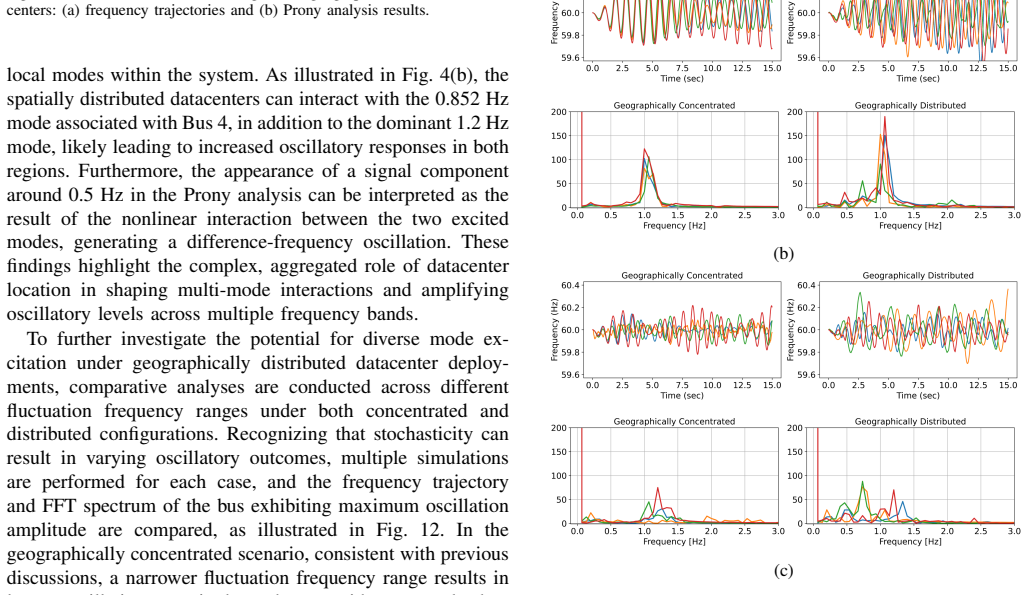
- Dispersed geographical siting of datacenters can intensify oscillations across the system.
- Higher AI load penetration levels and weaker system strength alter the variability of responses to these fluctuations.
Where Pith is reading between the lines
- Grid operators could develop targeted monitoring for frequency bands associated with AI workload cycles.
- Transmission planners might evaluate datacenter siting policies to reduce risks of exciting inter-area modes.
- Real-time control schemes could incorporate suppression of specific fluctuation bands as AI loads scale up.
Load-bearing premise
The periodic stochastic power fluctuations extracted from GPU architecture and mini-batch cycles are assumed to be representative forcing inputs that remain unchanged when scaled to the sizes and locations studied in the WECC and NPCC test systems.
What would settle it
Direct measurement of real-time power draw time series from an operating large GPU cluster during AI training, followed by spectral analysis to check if the frequency content and amplitude match the modeled fluctuations or produce the predicted amplification in a connected power system.
Figures





read the original abstract
This paper develops a new dynamic power profiling approach for modeling AI-centric datacenter loads and analyzing their impact on grid operations, particularly their potential to induce wide-area grid oscillations. We characterize the periodic stochastic power fluctuations inherent to large-scale AI workloads during both the training and fine-tuning stages, driven by the state-of-the-art graphics processing unit (GPU) computing architecture design. % and distributed mini-batch processing cycles. These sustained, large power fluctuations, unlike conventional load ramping, act as persistent forcing inputs capable of interacting with and amplifying local and inter-area oscillation modes. Using the WECC 179-bus system and the NPCC 140-bus system, we have numerically studied the amplitude and variability of oscillatory responses under different factors. These factors include system strength, penetration level, fluctuation frequency range, individual datacenter size, geographical deployment, fluctuation suppression level, and workload ratio. Simulation results show that, notably, narrower fluctuation bands, larger single-site capacities, or dispersed siting can intensify oscillations across multiple modes. Our models and numerical studies provide a quantitative basis for integrating AI-dominant electricity demand into grid oscillation studies and further support the development of new planning and operational measures to power the growth of AI/computing load demands.
Editorial analysis
A structured set of objections, weighed in public.
Referee Report
Summary. The paper develops a dynamic power profiling approach for AI datacenter loads, characterizing periodic stochastic power fluctuations from GPU architectures and mini-batch cycles during training and fine-tuning. It claims these fluctuations, unlike conventional load changes, act as persistent forcing inputs that interact with and amplify local and inter-area oscillation modes. Numerical studies on the WECC 179-bus and NPCC 140-bus systems examine impacts from factors including system strength, penetration level, fluctuation frequency range, datacenter size, geographical deployment, suppression level, and workload ratio, with results indicating that narrower fluctuation bands, larger single-site capacities, or dispersed siting can intensify oscillations across multiple modes.
Significance. If the results hold, the work is significant for highlighting a potential new class of disturbances from the expanding AI sector and providing a quantitative modeling basis using standard test systems. The architecture-driven extraction of fluctuation characteristics offers a reproducible starting point for integrating computing loads into grid dynamics studies, which could inform future planning and operational measures as AI demand grows.
major comments (2)
- [Section on dynamic power profiling] Section on dynamic power profiling (likely §II or §III): The central claim requires that GPU-derived periodic stochastic fluctuations remain representative forcing inputs after amplitude scaling to large single-site datacenter capacities and dispersed locations in the WECC/NPCC studies. No analysis is provided on aggregation effects across many GPUs (e.g., phase randomization, averaging, or low-pass filtering) that could narrow or shift the frequency content away from the 0.1–2 Hz inter-area mode range, which is load-bearing for the reported mode intensification.
- [Numerical studies section] Numerical studies section (likely §IV): Simulation results on oscillation intensification under narrower fluctuation bands and dispersed siting are presented without validation against measured datacenter power traces or sensitivity checks on how fluctuation parameters were selected. This leaves open whether the observed interactions depend on post-hoc tuning of the free parameters (fluctuation frequency range and amplitude) rather than robust properties of the model.
minor comments (2)
- [Abstract] Abstract: A stray LaTeX comment marker '% and distributed mini-batch processing cycles' appears in the text and should be cleaned up for publication.
- [Results presentation] Figure captions and results presentation: The abstract and studies mention amplitude and variability of oscillatory responses but lack explicit mention of error bars, number of Monte Carlo runs, or statistical significance measures, which would improve clarity even if not altering the main findings.
Simulated Author's Rebuttal
We thank the referee for the constructive and detailed comments, which help strengthen the manuscript. We address each major comment below, proposing targeted revisions to improve clarity and robustness while preserving the core contributions.
read point-by-point responses
-
Referee: The central claim requires that GPU-derived periodic stochastic fluctuations remain representative forcing inputs after amplitude scaling to large single-site datacenter capacities and dispersed locations in the WECC/NPCC studies. No analysis is provided on aggregation effects across many GPUs (e.g., phase randomization, averaging, or low-pass filtering) that could narrow or shift the frequency content away from the 0.1–2 Hz inter-area mode range.
Authors: We agree that aggregation effects merit explicit discussion. Our dynamic power profiling in Section II models the datacenter as a single aggregated load whose fluctuation statistics are derived from GPU architecture and synchronized mini-batch cycles during training/fine-tuning; these cycles introduce temporal alignment that tends to preserve spectral content in the 0.1–2 Hz band even after scaling. Nevertheless, to address the referee’s concern directly, we will add a short subsection (or appendix paragraph) examining the impact of phase randomization and averaging, supported by references to existing power-system load-aggregation studies, and will note the conditions under which the reported frequency content remains representative. revision: partial
-
Referee: Simulation results on oscillation intensification under narrower fluctuation bands and dispersed siting are presented without validation against measured datacenter power traces or sensitivity checks on how fluctuation parameters were selected. This leaves open whether the observed interactions depend on post-hoc tuning of the free parameters (fluctuation frequency range and amplitude) rather than robust properties of the model.
Authors: The fluctuation frequency ranges and amplitudes are obtained from the GPU-level power measurements and workload-cycle timings described in Section II, not chosen post hoc to produce the reported effects. We acknowledge that proprietary measured traces from large-scale AI facilities are not publicly available for direct validation. In the revised manuscript we will therefore include a dedicated sensitivity study that systematically varies the frequency-band edges and amplitude scaling factors over physically plausible intervals (drawn from published GPU power traces) and will demonstrate that the mode-amplification trends persist across these ranges. revision: partial
Circularity Check
No circularity: simulation-driven analysis of modeled AI load fluctuations on standard test systems
full rationale
The paper extracts periodic stochastic power fluctuations from GPU architecture and mini-batch cycles, then injects scaled versions of these time series as forcing inputs into the WECC 179-bus and NPCC 140-bus models. All reported results are obtained from time-domain or modal simulations that vary amplitude, frequency band, penetration, siting, and suppression level; none of the oscillation metrics are obtained by fitting parameters to the target modes or by renaming an input quantity as a prediction. The derivation chain therefore remains self-contained and externally falsifiable against the chosen test-system dynamics.
Axiom & Free-Parameter Ledger
free parameters (1)
- fluctuation frequency range and amplitude
axioms (1)
- domain assumption Standard small-signal stability models of the WECC 179-bus and NPCC 140-bus systems accurately capture inter-area modes under new load inputs.
Forward citations
Cited by 3 Pith papers
-
Dynamic Modeling of Data-Center Power Delivery for Power System Resonance Analysis
Derives an explicit component-informed dynamic model of data-center power-delivery chains in the positive-sequence domain to reveal resonance mechanisms from server-load fluctuations.
-
Grid Integration of Gigawatt-Scale AI Data Centers under Connect-and-Manage
A hierarchical request-acceptance protocol with learning-based planning and robust TSO evaluation reduces curtailment for GW-scale AI data centers from 9.1% to 2.8% while preserving 98.1% of frontier training workload.
-
Regime-Adaptive Weighted Ensemble Learning for Computing-Driven Dynamic Load Forecasting in AI Data Centers
A regime-adaptive ensemble with weight-learned neural network and incremental feature engineering reduces minute-scale AI data center load forecasting errors to below 1% on the MIT Supercloud dataset.
Reference graph
Works this paper leans on
-
[1]
The unseen AI dis- ruptions for power grids: LLM-induced transients,
Y . Li, M. Mughees, Y . Chen, and Y . R. Li, “The unseen AI dis- ruptions for power grids: LLM-induced transients,” arXiv preprint arXiv:2409.11416, 2024
-
[2]
Practical guidance and considerations for large load interconnections,
R. Quint et al. , “Practical guidance and considerations for large load interconnections,” Elevate Energy Consulting, Tech. Rep., 2025
work page 2025
-
[3]
2024 United States data center energy usage report,
A. Shehabi et al., “2024 United States data center energy usage report,” Lawrence Berkeley National Laboratory, Berkeley, CA, Tech. Rep., 2024
work page 2024
-
[4]
Powering intelligence: Analyzing artificial intelligence and data center energy consumption,
J. Aljbour, T. Wilson, and P. Patel, “Powering intelligence: Analyzing artificial intelligence and data center energy consumption,” EPRI White Paper no. 3002028905, Tech. Rep., 2024
work page 2024
-
[5]
AI load dynamics–a power electronics perspective,
Y . Li and Y . Li, “AI load dynamics–a power electronics perspective,” arXiv preprint arXiv:2502.01647 , 2025
-
[6]
Data center model for transient stability analysis of power systems,
A. Jimenez-Ruiz and F. Milano, “Data center model for transient stability analysis of power systems,” arXiv preprint arXiv:2505.16575 , 2025
-
[7]
Event records showing data center response to faults,
R. O’Keefe, “Event records showing data center response to faults,”
-
[8]
[Online]. Available: https://www.nerc.com/comm/RSTC/LLTF/ LLTF April Meeting & Technical Workshop Presentations .pdf
-
[9]
Unplanned data center load transfer update,
M. Parker and B. Sterling, “Unplanned data center load transfer update,” 2025. [Online]. Available: https://www.nerc.com/comm/RSTC/ LLTF/LLTF June Workshop Presentations.pdf
work page 2025
-
[10]
Y . Zhang, H. Tang, H. Li, and S. Wang, “Integration and interaction of next-generation AI-focused data centers with smart grids and district energy systems: The state-of-the-art, opportunities and challenges,” Renewable and Sustainable Energy Reviews , vol. 224, p. 116097, 2025
work page 2025
-
[11]
Balance of power: A full-stack approach to power and thermal fluctuations in ml infrastructure,
H. Gan and P. Ranganathan, “Balance of power: A full-stack approach to power and thermal fluctuations in ml infrastructure,”
-
[12]
[Online]. Available: https://cloud.google.com/blog/topics/systems/ mitigating-power-and-thermal-fluctuations-in-ml-infrastructure?hl=en
-
[13]
Characteristics and risks of emerging large loads,
NERC Large Load Task Force, “Characteristics and risks of emerging large loads,” North American Electric Reliability Corporation (NERC), Tech. Rep., 2025
work page 2025
-
[14]
Characterizing power management opportunities for LLMs in the cloud,
P. Patel et al. , “Characterizing power management opportunities for LLMs in the cloud,” in Proceedings of the 29th ACM International Conference on Architectural Support for Programming Languages and Operating Systems, Volume 3 , 2024, pp. 207–222
work page 2024
-
[15]
D. D’Ambrosio et al. , “Energy and AI,” International Energy Agency (IEA), Tech. Rep., 2025
work page 2025
-
[16]
AI, data centers and energy demand: Reassessing and exploring the trends,
L. de Roucy-Rochegonde and A. Buffard, “AI, data centers and energy demand: Reassessing and exploring the trends,” Ifri Papers, 2025
work page 2025
-
[17]
Artificial intelligence: Supply chain constraints and energy implications,
A. de Vries-Gao, “Artificial intelligence: Supply chain constraints and energy implications,” Joule, vol. 9, no. 6, 2025
work page 2025
-
[18]
En- ergy and carbon considerations of fine-tuning BERT,
X. Wang, C. Na, E. Strubell, S. Friedler, and S. Luccioni, “En- ergy and carbon considerations of fine-tuning BERT,” arXiv preprint arXiv:2311.10267, 2023
-
[19]
Characterization and prediction of deep learning workloads in large-scale GPU datacenters,
Q. Hu, P. Sun, S. Yan, Y . Wen, and T. Zhang, “Characterization and prediction of deep learning workloads in large-scale GPU datacenters,” in Proceedings of the International Conference for High Performance Computing, Networking, Storage and Analysis , 2021, pp. 1–15
work page 2021
-
[20]
Scaling intelligence: The exponential growth of AI’s power needs,
J. You et al. , “Scaling intelligence: The exponential growth of AI’s power needs,” EPRI White Paper no. 3002033669, Tech. Rep., 2025
work page 2025
-
[21]
The AI disruption: Challenges and guidance for data center design,
V . Avelar, P. Donovan, P. Lin, W. Torell, and M. A. T. Arango, “The AI disruption: Challenges and guidance for data center design,” Artificial Intelligence in Medicine , vol. 138, 2023
work page 2023
-
[22]
Inference zones: How data centers support real- time AI,
B. Eichman, “Inference zones: How data centers support real- time AI,” 2024. [Online]. Available: https://www.coresite.com/blog/ inference-zones-how-data-centers-support-real-time-ai
work page 2024
-
[23]
Characterization of large language model development in the datacenter,
Q. Hu et al. , “Characterization of large language model development in the datacenter,” in 21st USENIX Symposium on Networked Systems Design and Implementation (NSDI 24) , 2024, pp. 709–729
work page 2024
-
[24]
Empirical measurements of AI training power demand on a GPU-accelerated node,
I. Latif, A. C. Newkirk, M. R. Carbone, A. Munir, Y . Lin, J. Koomey, X. Yu, and Z. Dong, “Empirical measurements of AI training power demand on a GPU-accelerated node,” arXiv preprint arXiv:2412.08602, 2024
-
[25]
Methodology for fine- grain GPU power visibility and insights,
V . Singhania, S. Aga, and M. Assem Ibrahim, “Methodology for fine- grain GPU power visibility and insights,”arXiv e-prints, pp. arXiv–2412, 2024
work page 2024
-
[26]
Understanding GPU power: A survey of profiling, modeling, and simulation methods,
R. A. Bridges, N. Imam, and T. M. Mintz, “Understanding GPU power: A survey of profiling, modeling, and simulation methods,” ACM Computing Surveys (CSUR) , vol. 49, no. 3, pp. 1–27, 2016
work page 2016
-
[27]
Not all GPUs are created equal: characterizing variability in large-scale, accelerator-rich systems,
P. Sinha, A. Guliani, R. Jain, B. Tran, M. D. Sinclair, and S. Venkatara- man, “Not all GPUs are created equal: characterizing variability in large-scale, accelerator-rich systems,” inSC22: International Conference for High Performance Computing, Networking, Storage and Analysis . IEEE, 2022, pp. 01–15. 11
work page 2022
-
[28]
Problems and opportunities in training deep learning software systems: An analysis of variance,
H. V . Pham et al., “Problems and opportunities in training deep learning software systems: An analysis of variance,” in Proceedings of the 35th IEEE/ACM international conference on automated software engineering, 2020, pp. 771–783
work page 2020
-
[29]
PAL: A variability-aware policy for scheduling ML workloads in GPU clusters,
R. Jain, B. Tran, K. Chen, M. D. Sinclair, and S. Venkataraman, “PAL: A variability-aware policy for scheduling ML workloads in GPU clusters,” in SC24: International Conference for High Performance Computing, Networking, Storage and Analysis . IEEE, 2024, pp. 1–18
work page 2024
-
[30]
FinGraV: Methodology for fine-grain gpu power visibility and insights,
V . Singhania, S. Aga, and M. A. Ibrahim, “FinGraV: Methodology for fine-grain gpu power visibility and insights,” in 2025 IEEE International Symposium on Performance Analysis of Systems and Software (ISPASS). IEEE, 2025, pp. 96–107
work page 2025
-
[31]
Battery storage applications at data centers,
S. G. Vennelaganti and S. Jones, “Battery storage applications at data centers,” 2025. [Online]. Avail- able: https://www.nerc.com/comm/RSTC/LLTF/LLTF April Meeting & Technical Workshop Presentations .pdf
work page 2025
-
[32]
B. Li, R. Arora, S. Samsi, T. Patel, W. Arcand, D. Bestor, C. Byun, R. B. Roy, B. Bergeron, J. Holodnak et al. , “AI-enabling workloads on large-scale GPU-accelerated system: characterization, opportunities, and implications,” in 2022 IEEE International Symposium on High- Performance Computer Architecture (HPCA) . IEEE, 2022, pp. 1224– 1237
work page 2022
-
[33]
Power modeling for effective datacenter planning and compute management,
A. Radovanovic, B. Chen, S. Talukdar, B. Roy, A. Duarte, and M. Shah- bazi, “Power modeling for effective datacenter planning and compute management,” IEEE Transactions on Smart Grid , vol. 13, no. 2, pp. 1611–1621, 2021
work page 2021
-
[34]
AI datacenter energy dilemma - race for AI datacenter space,
D. N. D. Patel and J. E. Ontiveros, “AI datacenter energy dilemma - race for AI datacenter space,” 2024. [Online]. Available: https: //semianalysis.com/2024/03/13/ai-datacenter-energy-dilemma-race
work page 2024
-
[35]
Hybrid symbolic-numeric framework for power system modeling and analysis,
H. Cui, F. Li, and K. Tomsovic, “Hybrid symbolic-numeric framework for power system modeling and analysis,” IEEE Transactions on Power Systems, vol. 36, no. 2, pp. 1373–1384, 2020
work page 2020
-
[36]
AI’s power requirements under exponential growth,
L. H. Konstantin F. Pilz, Yusuf Mahmood, “AI’s power requirements under exponential growth,” RAND, Tech. Rep., 2025. [Online]. Available: https://www.rand.org/pubs/research reports/RRA3572-1.html
work page 2025
-
[37]
B. Hartmann, I. V okony, and I. T ´aczi, “Effects of decreasing syn- chronous inertia on power system dynamics—overview of recent ex- periences and marketisation of services,” International Transactions on Electrical Energy Systems , vol. 29, no. 12, p. e12128, 2019
work page 2019
-
[38]
D. J. Trudnowski, J. W. Pierre, N. Zhou, J. F. Hauer, and M. Parashar, “Performance of three mode-meter block-processing algorithms for automated dynamic stability assessment,” IEEE Transactions on Power Systems, vol. 23, no. 2, pp. 680–690, 2008
work page 2008
discussion (0)
Sign in with ORCID, Apple, or X to comment. Anyone can read and Pith papers without signing in.