REVIEW 2 major objections 4 minor 1 cited by
Reconstructing flows from the orbit space
T0 review · 2 major / 4 minor · reviewed 2026-08-05 · deepseek-v4-flash
Pith's one-line read A group action on a bifoliated plane that is properly discontinuous and cocompact on the positive-leaf space W_1^> is exactly the orbit-space action of a topological Anosov flow on a compact 3-manifold.
desk verdict The nonsingular reconstruction theorem is a real result and the W^>_1 idea is a keeper; the singular prong case has a genuine gap that needs fixing before I'd trust Theorem 1.4. read the letter →
The pith
A machine-rendered reading of the paper's core claim, the machinery that carries it, and where it could break.
The reading
What carries the argument
The space W_1^> (Definition 1.1): the set of pairs (x,t) with t on the positive side of the F1-leaf through x. It is homeomorphic to R^3, its constant-first-coordinate foliation is the prospective flow, and the quotient by a properly discontinuous group action is the 3-manifold. The proofs also rely on the closing property and uniform hyperbolicity of fixed points (Definitions 1.8 and 1.9), which are checkable conditions ensuring the action on W_1^> is free and properly discontinuous.
What would settle it
Construct a bifoliated plane with a 2-prong singularity whose stabilizer is cyclic but for which no equivariant identification of the two prong rays exists; then Definition 5.1 fails and the quotient cannot be a 3-manifold, contradicting Theorem 1.4. Alternatively, find an action satisfying the hypotheses of Theorem 1.3 whose quotient W_1^>/G is not homeomorphic to a 3-manifold, such as one developing an orbifold point, which would falsify the reconstruction.
Extended reading notes
Core claim
The central claim is that the space W_1^> = {(x,t) in P×P : t in F_1^>(x)} is a universal model for the flow: it is homeomorphic to R^3, the diagonal group action descends to a 3-manifold M = W_1^>/G, and the constant-first-coordinate foliation becomes the orbit foliation of a flow on M whose orbit space is (P,F_1,F_2) with the induced action equal to G. Thus any properly discontinuous, cocompact, orientation-preserving group action on a bifoliated plane without infinite product regions is rigidly realized by a topological Anosov flow, with the singular (prong) case handled by identifying prong rays equivariantly to form the space W_1^*. The paper also establishes the converse direction, clo
Load-bearing premise
In the singular case, the construction of W_1^* requires choosing, for each prong singularity, equivariant identifications of the prong rays that commute with the stabilizer of the singularity; the paper asserts such identifications exist on a fundamental domain and can be extended equivariantly, but gives no proof, and a failure for some cyclic stabilizer would make W_1^* ill-defined and break Theorem 1.4.
Editorial extensions
If this is right
- Any torsion-free group satisfying the hypotheses is a 3-manifold group, so the theorem produces new 3-manifold groups from plane actions.
- The orbit-space action determines the flow up to orbit equivalence, giving a constructive proof of a classical result without orientability assumptions.
- For non-cocompact actions, the same construction yields expansive flows preserving two transverse foliations, extending the theory to noncompact 3-manifolds.
- In the loom-space application, automorphism groups of loom spaces are shown to carry expansive flows, giving a flow-theoretic route from veering triangulations to 3-manifolds.
- The result generalizes the extended convergence group picture from skew Anosov flows to all transversally orientable pseudo-Anosov flows.
Reading between the lines
- The reconstruction is canonical enough that W_1^> could serve as a universal model for transversally orientable flows; one might expect extensions to bifoliated planes with infinite product regions by excising them, yielding flows with suspension-like behavior.
- The closing property and uniform hyperbolicity are purely dynamical conditions on the plane; they may be verifiable for other classes of group actions, such as actions on universal circles or on circle bundles, producing new expansive flows.
- The proof suggests a dictionary: a leafwise orientation of F1 corresponds to a choice of 'future' in the flow; the nonorientable case requires leafwise metric involutions, indicating that W_1^> is the natural model only in the orientable case and that a doubled space is needed otherwise.
- Since the construction uses only topology and an adapted metric, it is plausible that the results hold for topological Anosov flows without any smooth structure, which the paper already assumes.
Editorial analysis
A structured set of objections, weighed in public.
Referee Report
Summary. The paper gives conditions under which a group action on a bifoliated plane is realized as the induced action of a pseudo-Anosov flow on its orbit space. The main nonsingular result (Theorem 1.3) says that if a torsion-free G < Aut_1^+(P) acts properly discontinuously and cocompactly on W_1^> = {(x,t) : t ∈ F_1^>(x)}, then W_1^>/G is a compact 3-manifold carrying a topological Anosov flow with orbit space P and induced action G. A singular version (Theorem 1.4) replaces W_1^> by a quotient W_1^* in which prong rays are identified, assuming cyclic prong stabilizers. The paper also proves a converse (Theorem 1.7), a new proof of Barbot's theorem that orbit-space actions determine Anosov flows up to orbit equivalence (Section 2), criteria for proper discontinuity via closing and hyperbolic fixed-point properties (Theorems 1.10 and 1.12), and an application to automorphism groups of loom spaces (Theorem 1.13), recovering an expansive flow.
Significance. The nonsingular reconstruction is an appealing and largely elementary construction: the space W_1^> is a natural model of the universal cover of the would-be flow, and the proof that the constant-first-coordinate foliation gives an expansive flow is coherent modulo the leaf-properness point noted below. The constructive proof of Barbot's theorem is a genuine simplification. The loom-space application is a nice illustration of the framework and gives a new route to expansive flows. The paper is transparent about overlap with [BWZ24] and [BJK25]. The singular case, however, rests on an unproved equivariant identification of prongs; this is load-bearing for Theorem 1.4 and the singular versions of the other results.
major comments (2)
- [Definition 5.1 and preceding paragraph] The claim that the identifications σ_j^p can be 'defined arbitrarily on a fundamental domain for the (cyclic) stabilizer of r_1 and then extended equivariantly' does not produce the needed G-invariance of W_1^*. The displayed equivariance condition only covers elements of Stab_G(p) fixing all rays. If the cyclic stabilizer is generated by an element h that permutes the prongs, e.g. h(r_1)=r_2, then for Y={y,σ_2(y),...} the image hY={h(y), hσ_2(y), ...} must again be a set {y',σ_2(y'),...} for some y'∈r_1. This imposes functional equations (e.g. involving σ_2 h σ_2 and h) that are not consequences of the displayed condition. The fundamental-domain sentence does not address h-translates because h does not preserve r_1 setwise. Since W_1^* and its G-action are the foundation of Theorem 1.4, this gap must be repaired, either by proving existence of equivariant σ_j or by defining W_1^* as a q
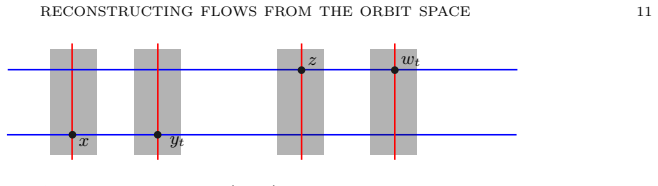
- [Proposition 3.6, first paragraph] The assertion 'In any (bi)-foliated plane, all leaves are necessarily properly embedded' is stated without proof or reference. It is used immediately to conclude that y_t leaves every compact set as t→∞, which is essential for the flow-box argument that x=z. In general foliations of the plane leaves need not be properly embedded (Reeb-type spiraling leaves), and it is not evident that the transverse foliation or the no-infinite-product-region hypothesis rules this out. Please provide a proof/reference, or modify the argument so that it does not rely on this assertion.
minor comments (4)
- [Title] The title contains a typo: 'ORBIT SP ACE' should be 'ORBIT SPACE'.
- [Lemma 4.13 and Section 5] Lemma 4.13 is stated for G < Aut^+(P), but it is invoked in Section 5 in contexts where only G < Aut_1^+(P) is assumed. Either state a version for Aut_1^+(P) or explain why the proof carries over verbatim.
- [Section 3, metric construction] The symbol δ_0 is first used for the Lebesgue number of d_0 and then reused after the metric d is constructed. Rename one of the two quantities to avoid confusion.
- [Definition 5.1] The notation W_1^* ⊂ P × 2^P is somewhat unusual; the second factor is the set of subsets of P of the form {y, σ_2(y), ...}. Consider writing the definition in words or introducing a symbol for the relevant family of finite subsets.
Circularity Check
No significant circularity: the reconstruction is a genuine construction and cited self-results are auxiliary standard lemmas.
full rationale
The paper's central claim is a construction, not a repackaging of its hypotheses. In Theorem 1.3, M = W>_1/G is a 3-manifold and the orbit-space identification is by construction, but the substantive conclusion that the canonical first-coordinate foliation is expansive is proved in Proposition 3.6 from the absence of F_1-infinite product regions and the good-neighborhood geometry; it is not assumed. The proof of Barbot's theorem (Section 2) is an independent reconstruction: h: W>_s -> \tilde M is defined from a strong stable foliation and adapted metric, and W>_s/pi_1(M) is homeomorphic to M is derived, not posited. The cited results [BFP23, Pot25] supply existence of strong stable foliations, a standard tool, and the paper explicitly notes and corrects the error in [BFP23], so the citation is not hiding the target conclusion. Theorem 1.10 (closing + uniform hyperbolicity => proper discontinuity) is proved from dynamics on P, and Theorem 1.7 verifies these hypotheses from the pseudo-Anosov closing lemma and periodic-orbit length growth; this is a check of hypotheses against standard flow theory, not an assumption of the conclusion. The loom-space application credits [BJK25] for the known 3-manifold-group fact and gives standalone proofs; the new expansive-flow statement is derived from the main theorems. The only flagged issue, the equivariant prong identifications in Definition 5.1, is a possible correctness gap in the singular construction, not a circular reduction: no theorem or definition in the paper forces W*_1 to be defined in terms of the flow it is meant to produce. Thus no circularity.
Assumptions & free parameters
assumptions (7)
- domain assumption All leaves of a bifoliated plane are properly embedded
- domain assumption Pseudo-Anosov flows have orbit spaces that are bifoliated planes as described
- domain assumption Pseudo-Anosov closing lemma for orbit space actions
- domain assumption For any topological Anosov flow there is an orbit-equivalent flow with strong stable distribution and adapted metric
- ad hoc to paper Equivariant prong identification homeomorphisms sigma_j^p can be defined for cyclic point stabilizers
- domain assumption Expansive flows without fixed points on compact 3-manifolds are pseudo-Anosov
- standard math Candel's uniformization gives leafwise hyperbolic metrics on universal covers of Anosov foliations
Cite this review
Pith. "Pith review of Reconstructing flows from the orbit space." pith.science (2026). https://pith.science/paper/RW6YK4WB
@misc{pith2026250901594,
  author       = {Pith},
  title        = {Pith review of: Reconstructing flows from the orbit space},
  year         = {2026},
  howpublished = {\url{https://pith.science/paper/RW6YK4WB}},
  note         = {Machine review of arXiv:2509.01594}
}
read the original abstract
We give some simple conditions under which a group acting on a bifoliated plane comes from the induced action of a pseudo-Anosov flow on its orbit space. An application of the strategy is a less technical proof of a result of Barbot that the induced action of an Anosov flow on its orbit space uniquely determines the flow up to orbit equivalence. In another application, we recover an expansive flow on a 3-manifold from the action of a group on a \emph{loom space} as defined by Schleimer and Segerman.
Figures


Figures from the paper (10 more)




Forward citations
Cited by 1 Pith paper
-
From Markovian actions to Anosov flows
Orientation-preserving strong Markovian actions on bifoliated planes are exactly the actions arising from topological Anosov flows on closed orientable 3-manifolds.
Reference graph
Works this paper leans on
-
[1]
I. Agol, Ideal triangulations of pseudo- A nosov mapping tori , Topology and geometry in dimension three, Contemp. Math., vol. 560, Amer. Math. Soc., Providence, RI, 2011, pp. 1--17
work page 2011
-
[2]
I. Agol and C. C. Tsang, Dynamics of veering triangulations: infinitesimal components of their flow graphs and applications, 2024
work page 2024
-
[3]
T. Barbot, Caract\'erisation des flots d' A nosov en dimension 3 par leurs feuilletages faibles , Ergodic Theory Dynam. Systems 15 (1995), no. 2, 247--270
work page 1995
-
[4]
, Actions de groupes sur les 1-vari\' e t\' e s non s\' e par\' e es et feuilletages de codimension un , Ann. Fac. Sci. Toulouse Math. (6) 7 (1998), no. 4, 559--597
work page 1998
-
[5]
T. Barthelm \'e , S. Fenley, and R. Potrie, Collapsed Anosov flows and self orbit equivalences , Comment. Math. Helv. 98 (2023), no. 4, 771--875 (English)
work page 2023
-
[6]
H. Baik, H. Jung, and K. Kim, Groups acting on veering pairs and K leinian groups , J. Lond. Math. Soc. (2) 111 (2025), no. 1, Paper No. e70052, 90
work page 2025
-
[7]
T. Barthelmé and K. Mann, Pseudo- A nosov flows: a plane approach , 2025, In preparation. Preliminary version available at https://sites.google.com/site/thomasbarthelme/research
work page 2025
-
[8]
F. Bonahon, Geometric structures on 3-manifolds, Handbook of geometric topology, North-Holland, Amsterdam, 2002, pp. 93--164
work page 2002
Show all 32 references
-
[9]
Bonahon and L
F. Bonahon and L. C. Siebenmann, The characteristic toric splitting of irreducible compact 3 -orbifolds , Math. Ann. 278 (1987), no. 1-4, 441--479
1987
-
[10]
Bowen and P
R. Bowen and P. Walters, Expansive one-parameter flows, J. Differential Equations 12 (1972), 180--193
1972
-
[11]
H. Baik, C. Wu, and B. Zhao, Reconstruction of A nosov flows from infinity , preprint (2024), arXiv:2407.07634 https://arxiv.org/pdf/2407.07634
2024 arXiv
-
[12]
Candel and L
A. Candel and L. Conlon, Foliations. I , Graduate Studies in Mathematics, vol. 23, American Mathematical Society, Providence, RI, 2000
2000
-
[13]
Fenley, Anosov flows in 3 -manifolds , Ann
S. Fenley, Anosov flows in 3 -manifolds , Ann. of Math. (2) 139 (1994), no. 1, 79--115
1994
-
[14]
, The structure of branching in A nosov flows of 3 -manifolds , Comment. Math. Helv. 73 (1998), no. 2, 259--297
1998
-
[15]
Fisher and B
T. Fisher and B. Hasselblatt, Hyperbolic flows, Zurich Lectures in Advanced Mathematics, 2019
2019
-
[16]
Fenley and L
S. Fenley and L. Mosher, Quasigeodesic flows in hyperbolic 3-manifolds, Topology 40 (2001), no. 3, 503--537
2001
-
[17]
Frankel, S
S. Frankel, S. Schleimer, and H. Segerman, From veering triangulations to link spaces and back again, 2025, arXiv:1911.00006 https://arxiv.org/pdf/1911.00006
2025 arXiv
-
[18]
F. W. Gehring and G. J. Martin, Discrete quasiconformal groups, i., Proc. London Math. Soc. 55 (1987)
1987
-
[19]
Gu \'e ritaud, Veering triangulations and C annon- T hurston maps , J
F. Gu \'e ritaud, Veering triangulations and C annon- T hurston maps , J. Topol. 9 (2016), no. 3, 957--983
2016
-
[20]
Haefliger, Groupo \" des d'holonomie et classifiants , Structure transverse des feuilletages, Toulouse 1982, Ast \'e risque 116, 70-97 (1984)., 1984
A. Haefliger, Groupo \" des d'holonomie et classifiants , Structure transverse des feuilletages, Toulouse 1982, Ast \'e risque 116, 70-97 (1984)., 1984
1982
-
[21]
Iakovoglou, A new combinatorial invariant characterizing A nosov flows on 3-manifolds , 2022, arXiv:2212.13177 https://arxiv.org/pdf/2212.13177
I. Iakovoglou, A new combinatorial invariant characterizing A nosov flows on 3-manifolds , 2022, arXiv:2212.13177 https://arxiv.org/pdf/2212.13177
2022 arXiv
-
[22]
Inaba and S
T. Inaba and S. Matsumoto, Nonsingular expansive flows on 3 -manifolds and foliations with circle prong singularities , Japan. J. Math. (N.S.) 16 (1990), no. 2, 329--340
1990
-
[23]
W. Jung, N. Nguyen, and Y. Yang, Spectral decomposition for rescaling expansive flows with rescaled shadowing, Discrete Contin. Dyn. Syst. 40 (2020), no. 4, 2267--2283
2020
-
[24]
Kapovich, A note on properly discontinuous actions, S\ ao Paulo J
M. Kapovich, A note on properly discontinuous actions, S\ ao Paulo J. Math. Sci. 18 (2024), no. 2, 807--836
2024
-
[25]
Landry, Y
M. Landry, Y. Minsky, and S. Taylor, Flows, growth rates, and the veering polynomial, Ergodic Theory Dynam. Systems 43 (2023), no. 9, 3026--3107
2023
-
[26]
Navas, Groups of circle diffeomorphisms, spanish ed., Chicago Lectures in Mathematics, University of Chicago Press, Chicago, IL, 2011
A. Navas, Groups of circle diffeomorphisms, spanish ed., Chicago Lectures in Mathematics, University of Chicago Press, Chicago, IL, 2011
2011
-
[27]
Paternain, Expansive flows and the fundamental groups, Bol
M. Paternain, Expansive flows and the fundamental groups, Bol. Soc. Bras. Mat., Nova S \'e r. 24 (1993), no. 2, 179--199 (English)
1993
-
[28]
Potrie, Anosov flows in dimension 3: an outside look, J
R. Potrie, Anosov flows in dimension 3: an outside look, J. Fixed Point Theory Appl. 27 (2025), no. 1, 47, Id/No 21
2025
-
[29]
Schleimer and H
S. Schleimer and H. Segerman, From veering triangulations to dynamic pairs, Preprint, arXiv :2305.08799 [math. GT ] (2023), 2023
2023 arXiv
-
[30]
, From loom spaces to veering triangulations, Groups Geom. Dyn. 18 (2024), no. 2, 419--462
2024
-
[31]
Thurston, 3-manifolds, foliations and circles I , math/9712268v1 [math.GT] https://arxiv.org/pdf/math/9712268
W. Thurston, 3-manifolds, foliations and circles I , math/9712268v1 [math.GT] https://arxiv.org/pdf/math/9712268
-
[32]
C. C. Tsang, Veering T riangulations and P seudo- A nosov F lows , ProQuest LLC, Ann Arbor, MI, 2023, Thesis (Ph.D.)--University of California, Berkeley. 4675421
2023
Reviewed August 5, 2026 · model on record in the stance chip above.
Discussion (0). Continue with ORCID to comment.