REVIEW 4 major objections 5 minor 1 cited by
Efficient Particle Acceleration in 2.5-Dimensional, Hybrid-Kinetic Simulations of Decaying, Supersonic, Plasma Turbulence
T0 review · 4 major / 5 minor · reviewed 2026-08-04 · deepseek-v4-flash
Pith's one-line read Supersonic, collisionless plasma turbulence accelerates ions into a non-thermal tail with >10% efficiency and a power-law slope of about q=2.5, matching shock-like acceleration without a large-scale shock.
desk verdict First hybrid-kinetic supersonic turbulence runs show a real non-thermal ion tail; the shock-like efficiency number is plausible but tethered to an unvalidated 5M^2 threshold. read the letter →
The pith
A machine-rendered reading of the paper's core claim, the machinery that carries it, and where it could break.
The reading
What carries the argument
The central tool is a hybrid-kinetic particle-in-cell simulation in a 2.5D geometry: ions are tracked as macro-particles moving in three momentum dimensions, while electrons are treated as a massless fluid. The key analytical move is to compute power spectra of the density-weighted in-plane velocity, w=ρ^{1/3}u⊥, which removes the effect of compression and exposes the cascade scaling. The non-thermal ion population is defined by an injection threshold E_inj=5M^2, assumed to represent particles energized above the average shock speed; the fraction of kinetic energy above this threshold defines the efficiency ξ, and the slope of the energy distribution above it defines q. The simulations are i
What would settle it
Particle tracing of the M=16 run that shows most ions above 5M^2 were energized gradually by large-scale convection rather than by discrete shocklet encounters would invalidate the shocklet-acceleration interpretation; alternatively, a 3D simulation of identical parameters that yields ξ below a few percent would show that the 2.5D geometry was responsible for the apparent efficiency.
Extended reading notes
Core claim
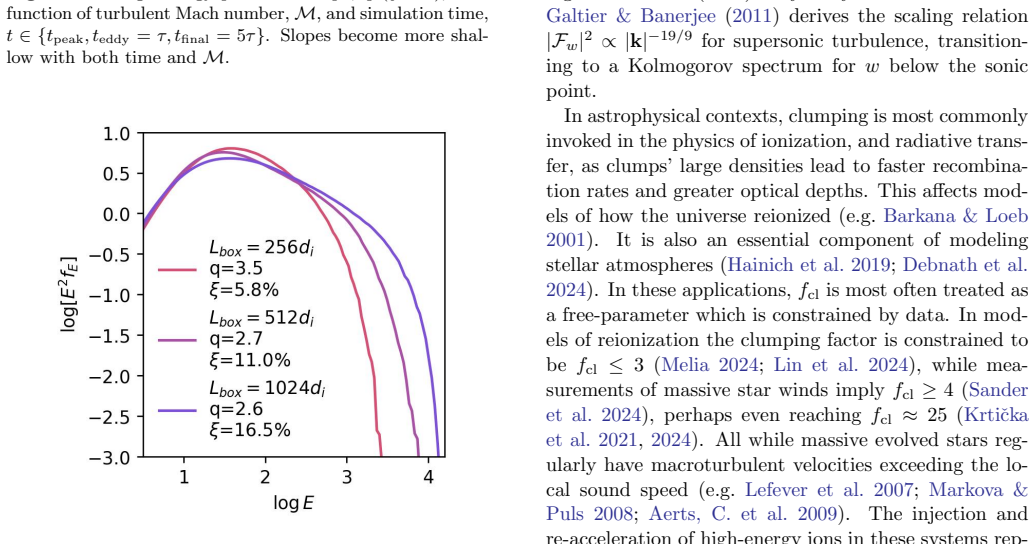
In hybrid-kinetic simulations of decaying supersonic turbulence, ions are accelerated to non-thermal energies with power-law energy slopes of q≈2.5 and efficiencies exceeding 10% of the total kinetic energy, comparable to the ~10% efficiency observed in collisionless shock simulations, even though the turbulent flow contains no large-scale, coherent shock. The paper demonstrates that this efficient acceleration occurs only when the Mach number is sufficiently high (M≳4) and is accompanied by strong density compression (clumping factors f_cl>2). After removing compressibility via the density-weighted velocity w=ρ^{1/3}u, the turbulent spectra show −5/3 inertial-range scaling for low Mach numb
Load-bearing premise
The load-bearing premise is that particles above energy 5M^2 are the true non-thermal population, which assumes the typical shock speed in the turbulence equals the rms velocity M; this threshold is not validated by particle tracing, and changing it would alter both the measured efficiency and the spectral slope.
Editorial extensions
If this is right
- If supersonic turbulence alone can convert >10% of kinetic energy into non-thermal ions, then environments such as superbubbles and star-forming clouds need no single strong shock to be viable cosmic-ray sources; their gamma-ray and neutrino emission could be powered by distributed turbulent acceleration.
- Because the accelerated spectrum is steep (q≈2.5, steeper than DSA's q≈1.5), the energy density is concentrated at low non-thermal energies, so the highest-energy particles are limited by the system size via the Hillas criterion; the paper shows that doubling the simulation box raises the maximum energy and adds about 5% to the efficiency.
- The recovery of Kolmogorov (−5/3) scaling at low Mach numbers and the steepening to −2 at high Mach numbers in the density-weighted spectra indicate that compressibility fundamentally alters the energy cascade in supersonic plasmas, with implications for how turbulent heating is distributed.
- The subsonic control run develops only a weak, steep non-thermal tail, confirming that transition to supersonic, shocklet-bearing turbulence is the key requirement for efficient acceleration, not the presence of magnetic turbulence alone.
Reading between the lines
- The injection threshold E_inj=5M^2 is an assumption; since the authors did not trace particle orbits to verify that ions above this energy are truly shock-accelerated, the absolute efficiency ξ could shift if the threshold is recalibrated. A particle-tracing follow-up would likely show that the Mach-number trend (higher M, higher ξ) is robust, but the 'shock-like' comparison to DSA may need to be
- The 2.5D geometry removes one spatial dimension, allowing flows to accumulate density more than they would in 3D. If 3D shocks and shocklets are weaker and less coherent, the measured efficiency and slope could change; a direct 3D hybrid run at the same Mach numbers would test whether >10% acceleration survives.
- The mechanism described—many small, distributed shocklets acting as first-order Fermi accelerators—sits between DSA and second-order Fermi acceleration. A plausible theoretical model would treat the turbulent medium as a collection of randomly oriented compressive discontinuities with a Mach-number-dependent distribution, yielding the observed power-law index and efficiency scalings; such a model
- Extrapolating the box-size scaling to astrophysical turbulent scales suggests the maximum accelerated energy is set by the largest eddy, which for large superbubbles could reach the TeV-PeV range; this is a testable prediction for gamma-ray observations of such regions.
Editorial analysis
A structured set of objections, weighed in public.
Referee Report
Summary. This paper presents 2.5D hybrid-kinetic PIC simulations (dHybridR) of decaying, supersonic, non-relativistic turbulence in a collisionless plasma. The authors vary the Alfvénic Mach number M = 2, 4, 8, 16, with transonic and subsonic controls. They report compressibility (density clumping factor), omni-directional spectra of the density-weighted velocity w = ρ^{1/3} u_⊥, and ion energy distributions. The main claims are: (i) after density weighting, low-M runs show inertial-range spectra near k^{-5/3}, while high-M runs show spectra near k^{-2}; (ii) supersonic runs develop non-thermal power-law tails in ion energy with slope q ≈ -2.5 and efficiency ξ ≳ 10% at t_final = 5τ, comparable to diffusive shock acceleration; (iii) box-size scaling suggests higher maximum energy and efficiency with larger domains. The results are interpreted in the context of DSA and applied to superbubbles, molecular clouds, and stellar winds.
Significance. If correct, this would be the first direct kinetic evidence that non-relativistic, supersonic turbulence can accelerate ions with efficiencies similar to collisionless shocks, despite the absence of a coherent large-scale shock. The study has clear strengths: a clean Mach-number parameter sweep, transonic and subsonic control runs, a box-size scaling test, and transparent simulation methods. The qualitative existence of non-thermal tails in the supersonic runs is well supported by the plotted energy distributions and the subsonic control. The comparison to DSA is external and not circular. However, the quantitative claims about efficiency and spectral slope rest on an unvalidated injection threshold and lack uncertainty quantification; those claims are not yet robust.
major comments (4)
- [Section 2.4.3, Eq. (6)] The efficiency ξ and the q-fit range are defined relative to the injection threshold E_inj = 5M^2, adopted by analogy to shock simulations under the assumption ⟨v_shock⟩ = M. This threshold is not validated for turbulence and is not tested for sensitivity; the authors themselves note in §4.1 that particle tracing is needed to establish the energization mechanism. Because both ξ and the power-law fit range (5M^2 ≤ E ≤ 10M^2) are tied to this choice, a factor-2 or -4 change in E_inj could materially change the reported ξ and q. I request a systematic sensitivity study (varying E_inj, or using an independent thermal + power-law decomposition) and explicit reporting of how ξ and q change, or the claims of shock-like efficiency must be tempered.
- [Section 3.3, Figs. 10–11] The acceleration efficiency ξ and the non-thermal slope q are reported as single values with no uncertainties. The slope is fitted over the narrow range 5M^2–10M^2 using a least-squares method, and the efficiency is a threshold integral over the same unvalidated boundary. No error bars, fit covariance, or fit-range stability test is provided. Since the central comparison is to DSA (q = -1.5, ξ ≈ 10%), quantitative confidence requires reporting uncertainties and the sensitivity of both quantities to the fit-range endpoints.
- [Section 2.1 / §4.3] The 2.5D geometry is a potential limitation for the generality of the acceleration claims. The only support cited for the 2.5D particle distribution being representative is Comisso & Sironi (2018), which concerns relativistic reconnection, while the authors themselves note in §2.1 that 'many other processes work differently in 2 vs. 3 dimensions.' The compressible shocklet interactions and density clumping central to this work may plausibly depend on dimensionality. Please either supply additional evidence that 2.5D captures the relevant acceleration physics, or explicitly restrict the conclusions to the 2.5D case.
- [Section 2.4.1 and Fig. 10] The reported efficiencies are measured at t_final = 5τ, chosen because evolution has 'slowed dramatically,' yet Fig. 10 shows ξ still increasing through that time, and the text states that 'particle acceleration continues well beyond τ = 1.' Thus the quoted ξ ≳ 10% is not shown to be an asymptotic or converged value. Please show the time dependence of ξ beyond 5τ, specify a convergence criterion, or explicitly report the efficiencies as lower limits at the simulated time.
minor comments (5)
- [Title/Abstract] Typo: 'T urbulence' should be 'Turbulence'; in the abstract, 'using the codedHybridR' should read 'using the code dHybridR.'
- [Throughout] The sign convention for q is inconsistent: the abstract and some text quote q ≈ 2.5, while §4.1 and Figs. 10–11 use q ≈ -2.5 for f_E ∝ E^q. Define f_E ∝ E^q once and use a consistent sign.
- [§3.1 vs. §5] The text in §3.1 says the M=16 simulation 'achieves peak densities more than 10 times greater' than the initial density, while §5 states 'density contrasts up to ~3 orders of magnitude form.' These numbers are inconsistent; please reconcile.
- [Fig. 10 caption] The caption says 'Efficiency drops slightly from M=1 to 2 and from 8 to 16,' which is hard to reconcile with the main text's statement that efficiency roughly scales with M. Rephrase to avoid apparent contradiction.
- [§4.1, §4.2] Minor typographical issues: 'smallshocklet' should be 'small shocklet'; 'T eV-P eV' has inconsistent formatting; 'clumping parameters off_cl>2' in §5 should be 'clumping factors of f_cl > 2.'
Circularity Check
No significant circularity: results are direct simulation measurements with stated conventions; reported efficiency/slopes are not fitted inputs or self-citation artifacts.
full rationale
This paper's central claims are simulation measurements, not derivations from a theory that contains them. The acceleration efficiency ξ and slope q are computed from the ion energy distribution produced by dHybridR; the threshold E_inj=5M^2 in Eq. 6 is a stated convention borrowed from shock studies ('assuming that the average shock will have ⟨v_shock⟩=M'), not a parameter tuned to match the measured spectra. The power-law tail and its steepness emerge from the simulation, so changing the threshold would change the quantitative values but does not make the measurement equivalent to the input. The turbulent-spectrum results are likewise direct Fourier measurements of the density-weighted velocity; the comparison to Kolmogorov, Burgers, and Galtier & Banerjee (2011) is external. Self-citations (Haggerty & Caprioli 2019 for dHybridR; Caprioli & Spitkovsky 2014 for shock efficiency) support the numerical tool and provide external benchmarks; they do not carry the derivation. Acknowledged limitations—no particle tracing to confirm the mechanism (§4.1), 2.5D geometry (§2.1, §4.3), and the assumption on shock speed in Eq. 6—affect robustness but do not constitute circular reasoning. No step reduces by construction to its own input.
Assumptions & free parameters
free parameters (3)
- non-thermal energy threshold E_inj = 5M^2 =
5 M^2
- spectral fit ranges (inertial range and ion range) =
inertial: 0.5 di^-1 to the break; ion: around di to about 5 di^-1
- final simulation time t_final = 5τ =
5 eddy-turnover times
assumptions (5)
- domain assumption Hybrid-kinetic approximation: protons as macro-particles, electrons as massless charge-neutralizing fluid with polytropic index γ=5/3
- domain assumption The 2.5D domain (two spatial dimensions perpendicular to mean B, three momenta) captures the particle acceleration properties of 3D turbulence
- domain assumption Periodic boundary conditions model an isolated patch of astrophysical turbulence despite the domain being of order the injection scale
- domain assumption The density-weighted velocity w=ρ^(1/3) u⊥ is the correct variable for the inertial-range cascade in compressible turbulence
- domain assumption DSA theory (compression-ratio power-law with q=-1.5) and the shock efficiency ~10% from PIC shock simulations are the correct external baselines for comparison
Cite this review
Pith. "Pith review of Efficient Particle Acceleration in 2.5-Dimensional, Hybrid-Kinetic Simulations of Decaying, Supersonic, Plasma Turbulence." pith.science (2026). https://pith.science/paper/OANQIPHB
@misc{pith2026250918374,
  author       = {Pith},
  title        = {Pith review of: Efficient Particle Acceleration in 2.5-Dimensional, Hybrid-Kinetic Simulations of Decaying, Supersonic, Plasma Turbulence},
  year         = {2026},
  howpublished = {\url{https://pith.science/paper/OANQIPHB}},
  note         = {Machine review of arXiv:2509.18374}
}
abstract
Collisionless, turbulent plasmas surround the Earth, from the magnetosphere to the intergalactic medium, and the fluctuations within them affect nearly every field in the space sciences, from space weather forecasts to theories of galaxy formation. Where turbulent motions become supersonic, their interactions can lead to the formation of shocks, which are known to efficiently energize ions to cosmic-ray energies. We present 2.5-dimensional, hybrid-kinetic simulations of decaying, supersonic, non-relativistic turbulence in a collisionless plasma using the code dHybridR. Turbulence within these simulations is highly compressible; after accounting for this compression by taking the omni-directional power-spectrum of the density weighted velocity field, we find turbulent spectra with power-law slopes of $\alpha \approx -\frac{5}{3}$ for low Mach numbers, in the inertial range, and $\alpha \approx -2$ for high Mach numbers. Ions embedded in the highly supersonic simulations are accelerated to non-thermal energies at efficiencies similar to those seen in shocks, despite being in a non-relativistic regime and lacking the large scale structure of a shock. We observe that particles are accelerated into a power-law spectrum, with a slope of $q \approx 2.5$ in (non-relativistic) energy. We compare these results to those obtained from the theory and simulations of diffusive shock acceleration, and discuss the astrophysical implications of this theoretical work.
Figures


Figures from the paper (9 more)


Forward citations
Cited by 1 Pith paper
-
InferenceEvolve: Towards Automated Causal Effect Estimators through Self-Evolving AI
InferenceEvolve uses language-model-guided evolution to discover causal estimators that reportedly outperform baselines and 58 human competition entries on two metrics.
Reference graph
Works this paper leans on
-
[1]
Achikanath Chirakkara, R., Federrath, C., & Seta, A. 2025, arXiv:2502.05235
arXiv 2025
-
[2]
2009, A&A, 508, 409 15
Aerts, C., Puls, J., Godart, M., & Dupret, M.-A. 2009, A&A, 508, 409 15
2009
-
[3]
A., Aschersleben, J., et al
Aharonian, F., Benkhali, F. A., Aschersleben, J., et al. 2024, The Astrophysical Journal Letters, 970, L21
2024
-
[4]
S., & Bale, S
Horbury, T. S., & Bale, S. D. 2013, Space Science Reviews, 178, 101
2013
-
[5]
J., Chen, D., et al
Amenomori, M., Bi, X. J., Chen, D., et al. 2021, Nature Astronomy, 5, 460
2021
-
[6]
N., Guillard, P., Emonts, B., et al
Appleton, P. N., Guillard, P., Emonts, B., et al. 2023, The Astrophysical Journal, 951, 104
2023
-
[7]
2018, The Astrophysical Journal, 859, 69
Araya, M. 2018, The Astrophysical Journal, 859, 69
2018
-
[8]
I., Leer, E., & Skadron, G
Axford, W. I., Leer, E., & Skadron, G. 1977, in International Cosmic Ray Conference, Vol. 11, International Cosmic Ray Conference, 132
1977
Show all 98 references
-
[9]
1934, Proc Natl Acad Sci U.S.A., 20, 259
Baade, W., & Zwicky, F. 1934, Proc Natl Acad Sci U.S.A., 20, 259
1934
-
[10]
Bai, X.-N., & Stone, J. M. 2013, The Astrophysical Journal, 769, 76
2013
-
[11]
2011, Astronomy & Astrophysics, 527, L4
Balbo, M., Walter, R., Ferrigno, C., & Bordas, P. 2011, Astronomy & Astrophysics, 527, L4
2011
-
[12]
2001, Physics Reports, 349, 125
Barkana, R., & Loeb, A. 2001, Physics Reports, 349, 125
2001
-
[13]
2012, Monthly Notices of the Royal Astronomical Society, 423, 2558
Bauer, A., & Springel, V. 2012, Monthly Notices of the Royal Astronomical Society, 423, 2558
2012
-
[14]
2007, Physics Reports, 447, 1
Bec, J., & Khanin, K. 2007, Physics Reports, 447, 1
2007
-
[15]
Bell, A. R. 1978, Monthly Notices of the Royal Astronomical Society, 182, 443
1978
-
[16]
D., & Ostriker, J
Blandford, R. D., & Ostriker, J. P. 1978, Astrophysical Journal, 221, L29
1978
-
[17]
2023, Monthly Notices of the Royal Astronomical Society, 523, 4015
Blasi, P., & Morlino, G. 2023, Monthly Notices of the Royal Astronomical Society, 523, 4015
2023
-
[18]
Boffetta, G., & Ecke, R. E. 2012, Annual Review of Fluid Mechanics, 44, 427
2012
-
[19]
2011, Monthly Notices of the Royal Astronomical Society, 410, 127
Brunetti, G., & Lazarian, A. 2011, Monthly Notices of the Royal Astronomical Society, 410, 127
2011
-
[20]
2014, The Astrophysical Journal Letters, 793, L15
Bruno, R., Trenchi, L., & Telloni, D. 2014, The Astrophysical Journal Letters, 793, L15
2014
-
[21]
Burgers, J. M. 1948, in Advances in Applied Mechanics, ed. R. V. Mises & T. V. K´ arm´ an, Vol. 1, 171–199
1948
-
[22]
2014, Astrophysical Journal, 783, 91
Caprioli, D., & Spitkovsky, A. 2014, Astrophysical Journal, 783, 91
2014
-
[23]
S., Kunz, M
Cerri, S. S., Kunz, M. W., & Califano, F. 2018, The Astrophysical Journal Letters, 856, L13
2018
-
[24]
Chen, C. H. K. 2016, Journal of Plasma Physics, 82, 535820602
2016
-
[25]
2018, Physical Review Letters, 121, 255101 —
Comisso, L., & Sironi, L. 2018, Physical Review Letters, 121, 255101 —. 2022, The Astrophysical Journal Letters, 936, L27
2018
-
[26]
O., Moens, N., et al
Debnath, D., Sundqvist, J. O., Moens, N., et al. 2024, Astronomy & Astrophysics, 684, A177
2024
-
[27]
2023, The Astrophysical Journal, 958, 3
Diesing, R. 2023, The Astrophysical Journal, 958, 3
2023
-
[28]
2001, Rev
Falkovich, G., Gawedzki, K., & Vergassola, M. 2001, Rev. Mod. Phys., 73, 913
2001
-
[29]
2013, Monthly Notices of the Royal Astronomical Society, 436, 1245
Federrath, C. 2013, Monthly Notices of the Royal Astronomical Society, 436, 1245
2013
-
[30]
1949, Physical Review, 75, 1169
Fermi, E. 1949, Physical Review, 75, 1169
1949
-
[31]
Fiorillo, D. F. G., Comisso, L., Peretti, E., Petropoulou, M., & Sironi, L. 2024, The Astrophysical Journal, 974, 75 Fjørtoft, R. 1953, Tellus, 5, 225
2024
-
[32]
Fleck, Jr., R. C. 1996, The Astrophysical Journal, 458, 739
1996
-
[33]
2015, The Astrophysical Journal, 812, 21
Franci, L., Landi, S., Matteini, L., Verdini, A., & Hellinger, P. 2015, The Astrophysical Journal, 812, 21
2015
-
[34]
1975, Journal of Fluid Mechanics, 68, 769
Frisch, U., Pouquet, A., Leorat, J., & Mazure, A. 1975, Journal of Fluid Mechanics, 68, 769
1975
-
[35]
2011, Physical Review Letters, 107, 134501 Gargat´ e, L., Bingham, R., Fonseca, R
Galtier, S., & Banerjee, S. 2011, Physical Review Letters, 107, 134501 Gargat´ e, L., Bingham, R., Fonseca, R. A., & Silva, L. O. 2007, Computer Physics Communications, 176, 419
2011
-
[36]
1995, Astrophysical Journal, 438, 763
Goldreich, P., & Sridhar, S. 1995, Astrophysical Journal, 438, 763
1995
-
[37]
2021, Theses, Universit´ e Grenoble Alpes Gu´ epin, C., Rinchiuso, L., Kotera, K., et al
Gorbunova, A. 2021, Theses, Universit´ e Grenoble Alpes Gu´ epin, C., Rinchiuso, L., Kotera, K., et al. 2018, Journal of Cosmology and Astroparticle Physics, 2018, 042
2021
-
[38]
C., & Caprioli, D
Haggerty, C. C., & Caprioli, D. 2019, The Astrophysical Journal, 887, 165
2019
-
[39]
2019, Astronomy & Astrophysics, 621, A85
Hainich, R., Ramachandran, V., Shenar, T., et al. 2019, Astronomy & Astrophysics, 621, A85
2019
-
[40]
Henriksen, R. N. 1991, The Astrophysical Journal, 377, 500 Hern´ andez-Padilla, D., Esquivel, A., Lazarian, A., Vel´ azquez, P. F., & Cho, J. 2024, The Astrophysical Journal, 972, 93
1991
-
[41]
S., Benjamin, R
Hill, A. S., Benjamin, R. A., Kowal, G., et al. 2008, The Astrophysical Journal, 686, 363
2008
-
[42]
Hillas, A. M. 1984, Annual Review of Astronomy and Astrophysics, 22, 425
1984
-
[43]
Honda, M., & Honda, Y. S. 2007, The Astrophysical Journal, 654, 885
2007
-
[44]
D., Siebert, K
Howarth, I. D., Siebert, K. W., Hussain, G. A. J., & Prinja, R. K. 1997, Monthly Notices of the Royal Astronomical Society, 284, 265 H¨ arer, L., Vieu, T., & Reville, B. 2025, Astronomy & Astrophysics, 698, A6
1997
-
[45]
Iroshnikov, P. S. 1963, Astronomicheskii Zhurnal, 40, 742
1963
-
[46]
2001, SciPy: Open source scientific tools for Python, , Katarzy´ nski, K., Ghisellini, G., Tavecchio, F., Gracia, J., &
Jones, E., Oliphant, T., Peterson, P., & and others. 2001, SciPy: Open source scientific tools for Python, , Katarzy´ nski, K., Ghisellini, G., Tavecchio, F., Gracia, J., &
2001
-
[47]
2006, Monthly Notices of the Royal Astronomical Society, 368, L52
Maraschi, L. 2006, Monthly Notices of the Royal Astronomical Society, 368, L52
2006
-
[48]
1941, Akademiia Nauk SSSR Doklady, 30, 301
Kolmogorov, A. 1941, Akademiia Nauk SSSR Doklady, 30, 301
1941
-
[49]
Kraichnan, R. H. 1965, Physics of Fluids, 8, 1385 16 Krtiˇ cka, J., Kub´ at, J., & Krtiˇ ckov´ a, I. 2021, Astronomy & Astrophysics, 647, A28 —. 2024, Astronomy & Astrophysics, 681, A29
1965
-
[50]
Krymskii, G. F. 1977, Akademiia Nauk SSSR Doklady, 234, 1306
1977
-
[51]
2007, Astronomy & Astrophysics, 463, 1093
Lefever, K., Puls, J., & Aerts, C. 2007, Astronomy & Astrophysics, 463, 1093
2007
-
[52]
2024, Physical Review D, 109, 063006
Lemoine, M., Murase, K., & Rieger, F. 2024, Physical Review D, 109, 063006
2024
-
[53]
1944, Quarterly of Applied Mathematics, 2, 164 LHAASO Collaboration
Levenberg, K. 1944, Quarterly of Applied Mathematics, 2, 164 LHAASO Collaboration. 2024, Science Bulletin, 69, 449
1944
-
[54]
Lighthill, M. J. 1955, in IAU Symposium, Vol. 2, Gas Dynamics of Cosmic Clouds, 121
1955
-
[55]
2024, Monthly Notices of the Royal Astronomical Society, 527, 4173
Lin, Y.-H., Scarlata, C., Williams, H., et al. 2024, Monthly Notices of the Royal Astronomical Society, 527, 4173
2024
-
[56]
Lingenfelter, R. E. 2018, Advances in Space Research, 62, 2750 Mac Low, M.-M., & Klessen, R. S. 2004, Reviews of Modern Physics, 76, 125
2018
-
[57]
2015, Physics of Plasmas, 22, 042902
Cattaneo, F. 2015, Physics of Plasmas, 22, 042902
2015
-
[58]
2008, Astronomy & Astrophysics, 478, 823
Markova, N., & Puls, J. 2008, Astronomy & Astrophysics, 478, 823
2008
-
[59]
Marquardt, D. W. 1963, Journal of the Society for Industrial and Applied Mathematics, 11, 431
1963
-
[60]
2024, Astronomy & Astrophysics, 689, A10
Melia, F. 2024, Astronomy & Astrophysics, 689, A10
2024
-
[61]
2025, Astronomy & Astrophysics, 695, A175
Menchiari, S., Morlino, G., Amato, E., et al. 2025, Astronomy & Astrophysics, 695, A175
2025
-
[62]
2011, Physical Review Letters, 107, 091101
Mertsch, P., & Sarkar, S. 2011, Physical Review Letters, 107, 091101
2011
-
[63]
2021, Monthly Notices of the Royal Astronomical Society, 504, 6096
Morlino, G., Blasi, P., Peretti, E., & Cristofari, P. 2021, Monthly Notices of the Royal Astronomical Society, 504, 6096
2021
-
[64]
2023, The Astrophysical Journal, 953, 49
Blandford, R. 2023, The Astrophysical Journal, 953, 49
2023
-
[65]
2017, Astronomy & Astrophysics, 606, A22
Neronov, Andrii, Malyshev, Denys, & Semikoz, Dmitri V. 2017, Astronomy & Astrophysics, 606, A22
2017
-
[66]
2017, Astronomy & Astrophysics, 599, A99
Orkisz, Jan H., Pety, J´ erˆ ome, Gerin, Maryvonne, et al. 2017, Astronomy & Astrophysics, 599, A99
2017
-
[67]
2017, The Astrophysical Journal, 835, 164
Osmanov, Z., Mahajan, S., & Machabeli, G. 2017, The Astrophysical Journal, 835, 164
2017
-
[68]
2011, Astrophysical Journal, 730, 40
Padoan, P., & Nordlund, A. 2011, Astrophysical Journal, 730, 40
2011
-
[69]
V., Galli, D., et al
Padovani, M., Ivlev, A. V., Galli, D., et al. 2020, Space Science Reviews, 216, 29
2020
-
[70]
2019, A&A, 621, A70
Peng, F.-K., Xi, S.-Q., Wang, X.-Y., Zhi, Q.-J., & Li, D. 2019, A&A, 621, A70
2019
-
[71]
2022, Monthly Notices of the Royal Astronomical Society, 511, 1336
Peretti, E., Morlino, G., Blasi, P., & Cristofari, P. 2022, Monthly Notices of the Royal Astronomical Society, 511, 1336
2022
-
[72]
2024, The Astrophysical Journal Letters, 972, L22
Peron, G., Morlino, G., Gabici, S., et al. 2024, The Astrophysical Journal Letters, 972, L22
2024
-
[73]
2012, Space Science Reviews, 173, 535
Petrosian, V. 2012, Space Science Reviews, 173, 535
2012
-
[74]
Petrosian, V., & Donaghy, T. Q. 1999, The Astrophysical Journal, 527, 945
1999
-
[75]
2018, Monthly Notices of the Royal Astronomical Society, 473, 4077
Pillepich, A., Springel, V., Nelson, D., et al. 2018, Monthly Notices of the Royal Astronomical Society, 473, 4077
2018
-
[76]
M., & Petrosian, V
Pryadko, J. M., & Petrosian, V. 1997, The Astrophysical Journal, 482, 774
1997
-
[77]
A., & Spitkovsky, A
Riquelme, M. A., & Spitkovsky, A. 2010, Astrophysical Journal, 717, 1054
2010
-
[78]
Ryans, R. S. I., Dufton, P. L., Rolleston, W. R. J., et al. 2002, Monthly Notices of the Royal Astronomical Society, 336, 577
2002
-
[79]
Y., Belmont, G., et al
Sahraoui, F., Huang, S. Y., Belmont, G., et al. 2013, The Astrophysical Journal, 777, 15
2013
-
[80]
Sander, A. A. C., Bouret, J. C., Bernini-Peron, M., et al. 2024, Astronomy & Astrophysics, 689, A30
2024
-
[81]
Schekochihin, A. A. 2022, Journal of Plasma Physics, 88, 155880501
2022
-
[82]
2013, The Astrophysical Journal Letters, 766, L17, publisher: The American Astronomical Society
Schneider, N., Andr´ e, P., K¨ onyves, V., et al. 2013, The Astrophysical Journal Letters, 766, L17, publisher: The American Astronomical Society
2013
-
[83]
2010, The Astrophysical Journal, 726, 75
Sironi, L., & Spitkovsky, A. 2010, The Astrophysical Journal, 726, 75
2010
-
[84]
2008, Astrophysical Journal, 682, L5
Spitkovsky, A. 2008, Astrophysical Journal, 682, L5
2008
-
[85]
Hinton, J. A. 2023, Astronomy & Astrophysics, 679, A118
2023
-
[86]
Tan, B., & Fielding, D. B. 2024, Monthly Notices of the Royal Astronomical Society, 527, 9683
2024
-
[87]
M., & Howes, G
TenBarge, J. M., & Howes, G. G. 2013, The Astrophysical Journal Letters, 771, L27
2013
-
[88]
2009, Astronomy & Astrophysics, 504, 33
Vazza, F., Brunetti, G., Kritsuk, A., et al. 2009, Astronomy & Astrophysics, 504, 33
2009
-
[89]
G., & Maruca, B
Verscharen, D., Klein, K. G., & Maruca, B. A. 2019, Living Reviews in Solar Physics, 16, 5
2019
-
[90]
Vieu, T., Larkin, C. J. K., H¨ arer, L., et al. 2024, Monthly Notices of the Royal Astronomical Society, 532, 2174
2024
-
[91]
2022, Monthly Notices of the Royal Astronomical Society, 515, 2256
Vieu, T., Reville, B., & Aharonian, F. 2022, Monthly Notices of the Royal Astronomical Society, 515, 2256
2022
-
[92]
H., Karimabadi, H., et al
Wan, M., Matthaeus, W. H., Karimabadi, H., et al. 2012, Physical Review Letters, 109, 195001
2012
-
[93]
2019, The Astrophysical Journal, 885, 162 17
Xin, Y., Zeng, H., Liu, S., Fan, Y., & Wei, D. 2019, The Astrophysical Journal, 885, 162 17
2019
-
[94]
2021, The Astrophysical Journal, 922, 261
Zhang, H., Sironi, L., & Giannios, D. 2021, The Astrophysical Journal, 922, 261
2021
-
[95]
2019, The Astrophysical Journal, 874, 98
Zhang, X., & Liu, S. 2019, The Astrophysical Journal, 874, 98
2019
-
[96]
Q., Lin, Y., Wang, X
Zhao, G. Q., Lin, Y., Wang, X. Y., et al. 2020, Geophysical Research Letters, 47, e2020GL089720
2020
-
[97]
2021, The Astrophysical Journal, 922, 172
Zhdankin, V. 2021, The Astrophysical Journal, 922, 172
2021
-
[98]
Begelman, M. C. 2017, Monthly Notices of the Royal Astronomical Society, 474, 2514 —. 2019, Physical Review Letters, 122, 055101
2017
Reviewed August 4, 2026 · model on record in the stance chip above.
Discussion (0). Sign in to comment.