Selection mechanisms in front invasion
Pith reviewed 2026-05-16 23:58 UTC · model grok-4.3
The pith
Invasion fronts into unstable states select specific outcomes in complex systems.
A machine-rendered reading of the paper's core claim, the machinery that carries it, and where it could break.
Core claim
Invasion processes act as a selection mechanism in complex systems, with the dynamical systems viewpoint providing a unifying perspective on front propagation into unstable states. The review covers progress on front speed and stability, points to open problems, and supplies examples plus computational methods to address both fundamental and applied questions.
What carries the argument
The dynamical systems viewpoint on invasion fronts, which focuses on their ability to act as selection mechanisms by determining which states are reached from unstable initial conditions.
If this is right
- Particular fronts are selected according to their linear and nonlinear stability properties.
- The same framework applies to both theoretical questions of minimal speed and practical questions of pattern selection.
- Computational methods guided by the dynamical systems view can reliably simulate invasion outcomes.
- Open problems center on extending the selection picture to systems with multiple unstable states or nonlocal interactions.
Where Pith is reading between the lines
- This selection view could be tested by varying initial perturbation shapes in numerical simulations of reaction-diffusion models and checking whether the same front always emerges.
- The perspective suggests links to selection in ecological invasion models where different species compete behind a spreading front.
- If the unification holds, similar selection arguments might apply to invasion in discrete or stochastic media beyond the continuous PDE setting.
Load-bearing premise
That a dynamical systems perspective can unify and address the range of theoretical and practical questions about front invasion across the literature.
What would settle it
A concrete counter-example in which an invasion front reaches a final state that contradicts the selection predicted by the stability and speed analysis of the associated traveling-wave solution.
Figures


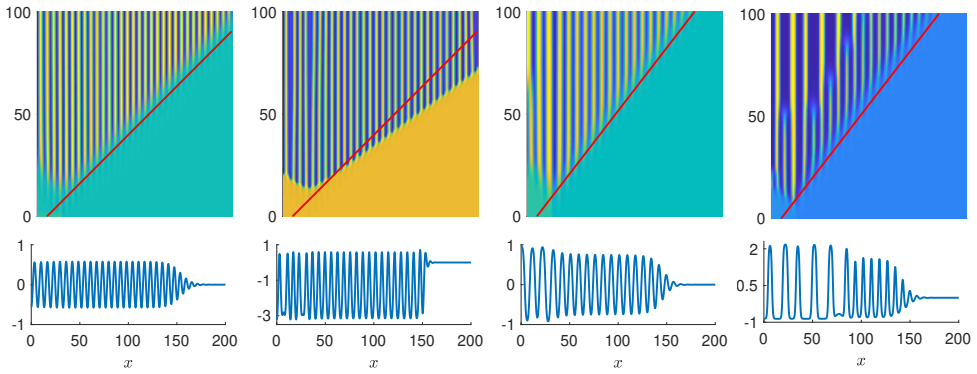


read the original abstract
We review progress on questions related to front propagation into unstable states and point out open problems in the area. We strive to highlight different theoretical perspectives and challenges while also addressing more practical questions with examples and guides to computational methods. Throughout we take a dynamical systems point of view that focuses on the ability of invasion processes to act as a selection mechanism in complex systems.
Editorial analysis
A structured set of objections, weighed in public.
Referee Report
Summary. The manuscript reviews progress on questions related to front propagation into unstable states, points out open problems in the area, highlights different theoretical perspectives and challenges, addresses practical questions with examples and guides to computational methods, and adopts a dynamical systems viewpoint that focuses on the ability of invasion processes to act as a selection mechanism in complex systems.
Significance. If the synthesis of the literature is accurate and comprehensive, the review could provide a valuable unifying dynamical systems perspective on front invasion, helping to connect theoretical approaches with practical computational tools and highlighting open problems that may guide future work in mathematical physics and applied PDEs.
minor comments (2)
- [Abstract] Abstract: The summary of the dynamical systems viewpoint is clear, but the abstract could more explicitly note the range of physical or biological examples covered to better orient readers.
- Ensure that references to prior surveys or key results in front propagation are balanced and include the most recent developments up to the submission date.
Simulated Author's Rebuttal
We thank the referee for the positive summary and recommendation of minor revision. We are pleased that the manuscript is viewed as offering a valuable unifying dynamical systems perspective that connects theoretical approaches, practical computational tools, and open problems in front propagation into unstable states. Since no specific major comments were provided, we will proceed with minor revisions to address any editorial or presentational suggestions.
Circularity Check
No circularity: survey paper without derivations or self-referential predictions
full rationale
This manuscript is explicitly a review surveying progress on front propagation into unstable states, highlighting open problems, and advocating a dynamical-systems perspective as a unifying lens. No new equations, derivations, fitted parameters, or quantitative predictions are introduced within the paper itself. All content consists of summaries of prior literature with external citations; there are no load-bearing steps that reduce by construction to inputs defined in the present work. The reader's assessment of score 0.0 is confirmed by the absence of any of the enumerated circularity patterns.
Axiom & Free-Parameter Ledger
Lean theorems connected to this paper
-
IndisputableMonolith/Foundation/RealityFromDistinction.leanreality_from_one_distinction unclear?
unclearRelation between the paper passage and the cited Recognition theorem.
We review progress on questions related to front propagation into unstable states... taking a dynamical systems point of view that focuses on the ability of invasion processes to act as a selection mechanism
-
IndisputableMonolith/Cost/FunctionalEquation.leanwashburn_uniqueness_aczel unclear?
unclearRelation between the paper passage and the cited Recognition theorem.
linear spreading speeds... pinched double roots of the dispersion relation
What do these tags mean?
- matches
- The paper's claim is directly supported by a theorem in the formal canon.
- supports
- The theorem supports part of the paper's argument, but the paper may add assumptions or extra steps.
- extends
- The paper goes beyond the formal theorem; the theorem is a base layer rather than the whole result.
- uses
- The paper appears to rely on the theorem as machinery.
- contradicts
- The paper's claim conflicts with a theorem or certificate in the canon.
- unclear
- Pith found a possible connection, but the passage is too broad, indirect, or ambiguous to say the theorem truly supports the claim.
Forward citations
Cited by 4 Pith papers
-
Emergent population dynamics of random walkers with cooperative reproduction and spatial selection
Higher-order reproduction in branching random walks eliminates generic invasion fronts beyond binary cases, renders binary front speeds diffusion-independent, and produces critical collapse or spreading behaviors in t...
-
Emergent population dynamics of random walkers with cooperative reproduction and spatial selection
Higher-order reproduction in branching random walks eliminates invasion fronts beyond binary cases, makes binary front speeds diffusion-independent, and produces critical transitions in ternary reproduction between lo...
-
Reduced wave number dynamics in the real and complex Ginzburg-Landau equations
A WKB-derived reduced wave-number equation captures unstable states, self-similar singularities, and traveling shocks in the real and complex Ginzburg-Landau equations, with exact profiles and DNS agreement in the nea...
-
Large time behavior and transition from vanishing to spreading regimes for the generalized Burgers-Fisher-KPP equation
For the generalized Burgers-Fisher-KPP equation, Heaviside-type initial data converge to traveling waves at critical velocities, with a convection coefficient threshold k* separating vanishing and spreading regimes.
Reference graph
Works this paper leans on
-
[1]
J. An, C. Henderson, and L. Ryzhik. Pushed, pulled, and pu shmi-pullyu fronts of the Burgers-FKPP equation. J. Eur. Math. Soc. , 27(5):2073–2154, 2023
work page 2073
-
[2]
J. An, C. Henderson, and L. Ryzhik. Quantitative steepne ss, semi-FKPP reactions, and pushmi-pullyu fronts. Arch. Rat. Mech. Anal. , 247:88, 2023
work page 2023
-
[3]
J. An, C. Henderson, and L. Ryzhik. Front location determ ines convergence rate to traveling waves. A.. Inst. H. Poincar´ e C Anal. Non Lin´ eaire, 2024
work page 2024
-
[4]
I. S. Aranson and L. Kramer. The world of the complex Ginzb urg-Landau equation. Rev. Mod. Phys. , 74:99–143, Feb 2002
work page 2002
-
[5]
D. Aronson and H. Weinberger. Multidimensional nonline ar diffusion arising in population genetics. Adv. Math. , 30(1):33–76, 1978
work page 1978
- [6]
-
[7]
M. Avery. Front selection in reaction-diffusion systems via diffusive normal forms. Arch. Ration. Mech. Anal. , 248(2):Paper No. 16, 63, 2024
work page 2024
- [8]
- [9]
- [10]
- [11]
- [12]
- [13]
- [14]
-
[15]
M. Avery and A. Scheel. Asymptotic stability of critica l pulled fronts via resolvent expansions near the essential spectrum. SIAM J. Math. Anal. , 53(2):2206–2242, 2021
work page 2021
-
[16]
M. Avery and A. Scheel. Universal selection of pulled fr onts. Comm. Amer. Math. Soc. , 2:172–231, 2022
work page 2022
-
[17]
M. Avery and A. Scheel. Sharp decay rates for localized p erturbations to the critical front in the Ginzburg-Landau equation. J. Dynam. Differential Equations , 36:S287–S322, 2024
work page 2024
- [18]
-
[19]
P. W. Bates and F. Chen. Spectral analysis of traveling w aves for nonlocal evolution equations. SIAM J. Math. Anal., 38(1):116–126, 2006
work page 2006
-
[20]
M. Beck, B. Sandstede, and K. Zumbrun. Nonlinear stabil ity of time-periodic viscous shocks. Arch. Rational Mech. Anal., 196:1011–1076, 2010
work page 2010
-
[21]
E. Ben-Naim and A. Scheel. Pattern selection and super- patterns in the bounded confidence model. Europhysics Letters, 112(1):18002, oct 2015
work page 2015
-
[22]
H. Berestycki and L. Nirenberg. Travelling fronts in cy linders. Ann. Inst. H. Poincar´ e Anal. Non Lin´ eaire, 9(5):497– 572, 1992
work page 1992
-
[23]
A. Bers, M. Rosenbluth, and R. Sagdeev. Handbook of plas ma physics. MN Rosenbluth and RZ Sagdeev eds , 1(3.2), 1983
work page 1983
-
[24]
W.-J. Beyn and V. Th¨ ummler. Phase conditions, symmetr ies and pde continuation. Numerical Continuation Methods for Dynamical Systems: Path following and boundary value problems , pages 301–330, 2007
work page 2007
-
[25]
G. Biondini and D. Mantzavinos. Universal nature of the nonlinear stage of modulational instability. Phys. Rev. Lett., 116:043902, Jan 2016
work page 2016
-
[26]
K. Bose, T. Cox, S. Silvestri, and P. Varin. Invasion fro nts and pattern formation in a model of chemotaxis in one and two dimensions. SIAM Undergrad. Res. Online , 6:228–245, 2013
work page 2013
-
[27]
M. Bramson. Maximal displacement of branching Brownia n motion. Comm. Pure Appl. Math. , 31(5):531–581, 1978
work page 1978
-
[28]
M. Bramson. Convergence of solutions of the Kolmogorov equation to trav eling waves . Mem. Amer. Math. Soc. American Mathematical Society, 1983
work page 1983
-
[29]
N. Breindl, G. Schneider, and H. Uecker. Validity of the Ginzburg-Landau approximation in pattern forming systems with time periodic forcing. In Dynamics and bifurcation of patterns in dissipative system s, volume 12 of World Sci. Ser. Nonlinear Sci. Ser. B Spec. Theme Issues Proc. , pages 39–57. World Sci. Publ., Hackensack, NJ, 2004
work page 2004
-
[30]
L. Brevdo. A dynamical system approach to the absolute i nstability of spatially developing localized open flows and media. R. Soc. Lond. Proc. Ser. A Math. Phys. Eng. Sci. , 458(2022):1375–1397, 2002. 74
work page 2022
-
[31]
L. Brevdo. Absolute and convective instabilities of se mi-bounded spatially developing flows. Proc. Steklov Inst. Math., 300(1):13–33, 2018. Published in Russian in Tr. Mat. Inst. Steklova 300 (2018), Sovremennye Problemy i Mechaniki, 19–41
work page 2018
-
[32]
R. J. Briggs. Electron-Stream Interaction with Plasmas . The MIT Press, 12 1964
work page 1964
-
[33]
A. Calsina, X. Mora, and J. Sol` a-Morales. The dynamica l approach to elliptic problems in cylindrical domains, and a study of their parabolic singular limit. J. Differential Equations , 102(2):244–304, 1993
work page 1993
-
[34]
P. Carter and A. Scheel. Wave train selection by invasio n fronts in the FitzHugh-Nagumo equation. Nonlinearity, 31(12):5536–5572, 2018
work page 2018
-
[35]
P. Collet and J.-P. Eckmann. The existence of dendritic fronts. Comm. Math. Phys. , 107(1):39–92, 1986
work page 1986
-
[36]
P. Collet and J.-P. Eckmann. The stability of modulated fronts. Helv. Phys. Acta , 60(8):969–991, 1987
work page 1987
-
[37]
P. Collet and J.-P. Eckmann. Instabilities and fronts in extended systems . Princeton Series in Physics. Princeton University Press, Princeton, NJ, 1990
work page 1990
-
[38]
P. Collet and J.-P. Eckmann. A rigorous upper bound on th e propagation speed for the Swift-Hohenberg and related equations. J. Statist. Phys. , 108(5-6):1107–1124, 2002. Dedicated to David Ruelle and Y asha Sinai on the occasion of their 65th birthdays
work page 2002
-
[39]
C. Conley. Isolated invariant sets and the Morse index , volume 38 of CBMS Regional Conference Series in Mathe- matics. American Mathematical Society, Providence, RI, 1978
work page 1978
-
[40]
M. C. Cross and P. C. Hohenberg. Pattern formation outsi de of equilibrium. Rev. Mod. Phys. , 65:851–1112, Jul 1993
work page 1993
-
[41]
Z. Csah´ ok and C. Misbah. On the invasion of an unstable s tructureless state by a stable hexagonal pattern. Europhysics Letters, 47(3):331, aug 1999
work page 1999
-
[42]
G. Dangelmayr, B. Fiedler, K. Kirchg¨ assner, and A. Mie lke. Dynamics of nonlinear waves in dissipative systems: reduction, bifurcation and stability , volume 352 of Pitman Research Notes in Mathematics Series . Longman, Harlow,
-
[43]
With a contribution by G. Raugel
-
[44]
J. H. Dawes. After 1952: The later development of Alan Tu ring’s ideas on the mathematics of pattern formation. Historia Mathematica , 43(1):49–64, 2016
work page 1952
-
[45]
B. de Rijk, A. Doelman, and J. Rademacher. Spectra and st ability of spatially periodic pulse patterns: Evans function factorization via Riccati transformation. SIAM J. Math. Anal. , 48(1):61–121, 2016
work page 2016
- [46]
-
[47]
A. Doelman, B. Sandstede, A. Scheel, and G. Schneider. P ropagation of hexagonal patterns near onset. European J. Appl. Math. , 14(1):85–110, 2003
work page 2003
-
[48]
A. Doelman, B. Sandstede, A. Scheel, and G. Schneider. T he dynamics of modulated wave trains. Mem. Amer. Math. Soc. , 199(934):viii+105, 2009
work page 2009
-
[49]
A. Doelman. and R. Schielen. Modulation equations for s patially periodic systems: Derivation and solutions. SIAM Journal on Applied Mathematics , 58(6):1901–1930, 1998
work page 1901
- [50]
-
[51]
U. Ebert and W. van Saarloos. Front propagation into uns table states: universal algebraic convergence towards uniformly translating pulled fronts. Phys. D , 146:1–99, 2000
work page 2000
-
[52]
J.-P. Eckmann and T. Gallay. Front solutions for the Gin zburg-Landau equation. Comm. Math. Phys. , 152(2):221– 248, 1993
work page 1993
-
[53]
J.-P. Eckmann and G. Schneider. Nonlinear stability of bifurcating front solutions for the Taylor-Couette proble m. ZAMM Z. Angew. Math. Mech. , 80(11-12):745–753, 2000. Special issue on the occasion of the 125th anniversary of the birth of Ludwig Prandtl
work page 2000
-
[54]
J.-P. Eckmann and G. Schneider. Non-linear stability o f modulated fronts for the Swift-Hohenberg equation. Comm. Math. Phys. , 225(2):361–397, 2002. 75
work page 2002
-
[55]
J.-P. Eckmann and C. E. Wayne. Propagating fronts and th e center manifold theorem. Comm. Math. Phys. , 136(2):285–307, 1991
work page 1991
-
[56]
J.-P. Eckmann and C. E. Wayne. The nonlinear stability o f front solutions for parabolic partial differential equati ons. Comm. Math. Phys. , 161(2):323–334, 1994
work page 1994
-
[57]
G. Faye and M. Holzer. Modulated traveling fronts for a n onlocal Fisher-KPP equation: a dynamical systems approach. J. Differential Equations , 258(7):2257–2289, 2015
work page 2015
-
[58]
G. Faye and M. Holzer. Bifurcation to locked fronts in tw o component reaction-diffusion systems. Ann. Inst. H. Poincar´ e C Anal. Non Lin´ eaire, 36(2):545–584, 2019
work page 2019
-
[59]
G. Faye and M. Holzer. Asymptotic stability of the criti cal pulled front in a Lotka-Volterra competition model. J. Differential Equations , 269(9):6559–6601, 2020
work page 2020
-
[60]
G. Faye, M. Holzer, and A. Scheel. Linear spreading spee ds from nonlinear resonant interaction. Nonlinearity, 30(6):2403–2442, 2017
work page 2017
-
[61]
G. Faye, M. Holzer, A. Scheel, and L. Siemer. Invasion in to remnant instability: a case study of front dynamics. Indiana Univ. Math. J. , 71(5):1819–1896, 2022
work page 2022
- [62]
-
[63]
B. Fiedler and K. Mischaikow. Dynamics of bifurcations for variational problems with O p3q equivariance: a Conley index approach. Arch. Rational Mech. Anal. , 119(2):145–196, 1992
work page 1992
-
[64]
B. Fiedler and A. Scheel. Spatio-temporal dynamics of r eaction-diffusion patterns. In Trends in Nonlinear Analysis , pages 23–152, Berlin, Heidelberg, 2003. Springer, Berlin H eidelberg
work page 2003
-
[65]
R. A. Fisher. The wave of advance of advantageous genes. Annals of Eugenics , 7(4):355–369, 1937
work page 1937
-
[66]
T. Gallay and E. Risler. A variational proof of global st ability for bistable travelling waves. Differential Integral Equations, 20(8):901–926, 2007
work page 2007
- [67]
-
[68]
T. Gallay and C. E. Wayne. Invariant manifolds and long- time asymptotics of the Navier-Stokes and vorticity equations on R2. Arch. Rational Mech. Anal , 163:209–258, 2002
work page 2002
-
[69]
R. Gardner and K. Zumbrun. The gap lemma and geometric cr iteria for instability of viscous shock profiles. Comm. Pure Appl. Math. , 51(7):797–855, 1998
work page 1998
-
[70]
J. Gertner and M. I. Fre ˘ ıdlin. The propagation of conce ntration waves in periodic and random media. Dokl. Akad. Nauk SSSR , 249(3):521–525, 1979
work page 1979
-
[71]
A. Ghazaryan and B. Sandstede. Nonlinear convective in stability of Turing-unstable fronts near onset: a case stud y. SIAM J. Appl. Dyn. Syst. , 6(2):319–347, 2007
work page 2007
-
[72]
T. Giletti. Monostable pulled fronts and logarithmic d rifts. Nonlinear Diff. Equations Appl. NoDEA , 29:35, 2022
work page 2022
-
[73]
L. Girardin and K.-Y. Lam. Invasion of open space by two c ompetitors: spreading properties of monostable two- species competition-diffusion systems. Proceedings of the London Mathematical Society , 119(5):1279–1335, 2019
work page 2019
-
[74]
R. Goh, D. Lloyd, and J. Rademacher. Numerical continua tion and bifurcation in nonlinear pdes: Stability, invasion and wavetrains in the swift-hohenberg equation. I n Handbook on Nonlinear Dynamics. Volume 2, Numerical Methods, edited by Vincent Acary . Elsevier, 2024
work page 2024
- [75]
-
[76]
R. N. Goh, S. Mesuro, and A. Scheel. Spatial wavenumber s election in recurrent precipitation. SIAM J. Appl. Dyn. Syst., 10(1):360–402, 2011
work page 2011
-
[77]
C. Graham. Precise asymptotics for Fisher-KPP fronts. Nonlinearity, 32:1967–1988, 2019
work page 1967
-
[78]
K.-P. Hadeler and F. Rothe. Traveling fronts in nonline ar diffusion equations. J. Math. Biol. , 2(1):251–263, 1975. 76
work page 1975
- [79]
-
[80]
M. H˘ ar˘ agu¸ s-Courcelle and G. Schneider. Bifurcating fronts for the Taylor-Couette problem in infinite cylinder s. Z. Angew. Math. Phys. , 50(1):120–151, 1999
work page 1999
discussion (0)
Sign in with ORCID, Apple, or X to comment. Anyone can read and Pith papers without signing in.