Learning Password Best Practices Through In-Task Instruction
Pith reviewed 2026-05-16 14:50 UTC · model grok-4.3
The pith
Brief instructional prompts inserted during password creation teach users rules they apply correctly in later tasks without guidance.
A machine-rendered reading of the paper's core claim, the machinery that carries it, and where it could break.
Core claim
Pedagogical friction inserts brief instructional interactions at the moment of password entry. Across guided conditions, participants corrected most rule violations in a subsequent task without guidance and showed high alignment between their password behavior and their accuracy on survey questions about the same rules.
What carries the argument
Pedagogical friction: brief instructional interactions inserted directly into the password-creation interface at the point of decision.
If this is right
- Users apply password rules correctly without ongoing interface support.
- Behavior-knowledge alignment rises for multiple rule types, especially symbols.
- The approach works across different depths of guidance in the initial task.
- It offers a design pattern for embedding learning into security-critical actions.
Where Pith is reading between the lines
- Similar in-task prompts could support other repeated privacy decisions such as permission grants or data-sharing choices.
- Testing retention over days or weeks would reveal whether the learned rules persist beyond the immediate study session.
- Designers of authentication flows could reduce long-term reliance on external tools by building rule understanding directly into the interface.
Load-bearing premise
That gains in the follow-up password task come from the inserted instructions rather than from participants sensing the study's goals or simply repeating a familiar task.
What would settle it
A control condition with no instructional prompts that produces similar rates of rule correction and knowledge alignment in the follow-up task would show the effect does not depend on the intervention.
Figures


read the original abstract
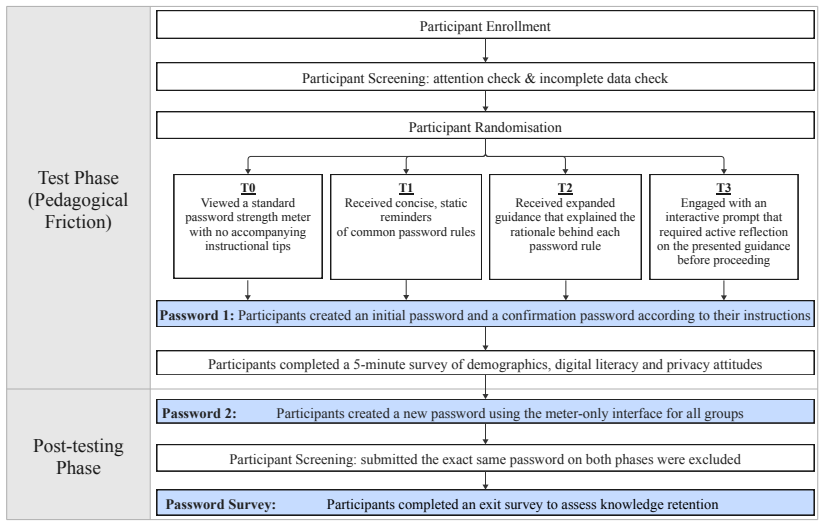
Users often make security- and privacy-relevant decisions without a clear understanding of the rules that govern safe behavior. We introduce pedagogical friction, a design approach that inserts brief, instructional interactions at the moment of action. We evaluate this approach in the context of password creation, a familiar task with clear quality criteria. We conducted a randomized study with 128 participants across four interface conditions that varied the depth and interactivity of guidance. We assessed three outcomes: (1) rule compliance in a subsequent password task without guidance, (2) accuracy on survey questions tied to password rules, and (3) behavior-knowledge alignment, which captures whether participants who correctly followed a rule also recognized it on the survey. Across the guided conditions, participants corrected most rule violations in the follow-up task and showed high behavior-knowledge alignment. Survey results suggested clearer advantages for some rule types, especially symbol related questions. These results position pedagogical friction as a lightweight intervention for security- and privacy-critical interfaces.
Editorial analysis
A structured set of objections, weighed in public.
Referee Report
Summary. The paper introduces 'pedagogical friction' as a design intervention that inserts brief, in-task instructional interactions during password creation to teach security rules. It reports a randomized between-subjects study with 128 participants assigned to four interface conditions that vary the depth and interactivity of guidance. The central claims are that participants in the guided conditions corrected most rule violations when creating a second password without guidance, exhibited high alignment between their behavior and survey-reported knowledge of the rules, and showed clearer benefits for certain rule types (e.g., symbol requirements) on knowledge measures.
Significance. If the results hold after addressing design gaps, the work provides a practical, low-overhead method for embedding security education directly into critical user actions. This could inform interface design in authentication, privacy settings, and other domains where users make repeated decisions without explicit training, offering an alternative to separate tutorials or post-hoc feedback.
major comments (2)
- [Methods / Experimental Design] The experimental design compares only among guided conditions and lacks an explicit no-guidance control arm in which participants complete two sequential password-creation tasks. Without this baseline, it is impossible to separate the effects of pedagogical friction from practice effects, interface familiarity, or demand characteristics when observing corrections in the follow-up task. This directly undermines the attribution of improved compliance to the intervention (see abstract and the description of the four conditions).
- [Abstract and Results] The abstract states that participants 'corrected most rule violations' and showed 'high behavior-knowledge alignment' across guided conditions, but provides no numerical values, statistical tests, effect sizes, or confidence intervals. The results section must report these details (including per-rule breakdowns and any pre-registered analysis plan) for the claims to be verifiable.
minor comments (2)
- [Methods] The four interface conditions are described at a high level; a table or figure explicitly mapping each condition to its guidance elements (e.g., static text vs. interactive prompts) would improve replicability.
- [Procedure] Clarify whether the follow-up task used the same password rules and interface as the first task, and whether any carry-over instructions were present.
Simulated Author's Rebuttal
We thank the referee for their constructive feedback, which highlights important aspects of experimental design and reporting clarity. We address each major comment below and indicate the revisions planned for the manuscript.
read point-by-point responses
-
Referee: [Methods / Experimental Design] The experimental design compares only among guided conditions and lacks an explicit no-guidance control arm in which participants complete two sequential password-creation tasks. Without this baseline, it is impossible to separate the effects of pedagogical friction from practice effects, interface familiarity, or demand characteristics when observing corrections in the follow-up task. This directly undermines the attribution of improved compliance to the intervention (see abstract and the description of the four conditions).
Authors: We acknowledge the validity of this concern. Our study design intentionally varied the depth and interactivity of guidance across four conditions to examine how different levels of in-task instruction affect outcomes, allowing us to observe gradients in compliance and knowledge alignment. However, without a pure no-guidance baseline, we cannot fully rule out practice effects. We will revise the manuscript to include a more explicit discussion of this limitation in a dedicated Limitations section and clarify that the observed improvements are relative to less guided conditions. We will also suggest that future studies include a no-guidance arm. Since the experiment has been conducted, we cannot add new data, but we can strengthen the interpretation of existing comparisons. revision: partial
-
Referee: [Abstract and Results] The abstract states that participants 'corrected most rule violations' and showed 'high behavior-knowledge alignment' across guided conditions, but provides no numerical values, statistical tests, effect sizes, or confidence intervals. The results section must report these details (including per-rule breakdowns and any pre-registered analysis plan) for the claims to be verifiable.
Authors: We agree that the abstract should provide more specific quantitative information to support the claims. We will update the abstract to include key statistics, such as the proportion of rule violations corrected (with exact percentages), relevant p-values or statistical tests, and effect sizes. The full results section already includes per-rule breakdowns, behavior-knowledge alignment metrics, and references to the analysis approach; we will ensure the pre-registered analysis plan is clearly stated if not already. These changes will make the claims verifiable directly from the abstract. revision: yes
- The absence of a no-guidance control condition, which cannot be addressed without conducting additional experiments.
Circularity Check
Empirical HCI study with direct behavioral measurement; no derivations or self-referential logic
full rationale
This paper reports a randomized controlled study with 128 participants comparing interface conditions for password creation guidance. All outcomes—rule compliance in a no-guidance follow-up task, survey accuracy on password rules, and behavior-knowledge alignment—are measured directly from participant actions and responses. The manuscript contains no equations, fitted parameters, predictive models, or derivation chains. No self-citations are invoked to justify uniqueness or to reduce claims to prior author work. The design compares guided conditions to each other and reports observed corrections; while external validity concerns (e.g., demand characteristics) exist, they do not constitute circularity in the derivation sense. The result is self-contained empirical evidence rather than a logical reduction to its own inputs.
Axiom & Free-Parameter Ledger
axioms (1)
- domain assumption Brief instructional interactions at the moment of action produce lasting rule compliance and knowledge alignment
Forward citations
Cited by 1 Pith paper
-
Demonstrably Informed Consent in Privacy Policy Flows: Evidence from a Randomized Experiment
Slide-based and paced privacy policy formats raised the share of parents passing a comprehension quiz to 41.7% and 30.6% on first attempt, with retakes improving scores for 64.9%, yet 97.3% of those below threshold st...
Reference graph
Works this paper leans on
-
[1]
Persuasive technology: using computers to change what we think and do,
B. J. Fogg, “Persuasive technology: using computers to change what we think and do,”Ubiquity, vol. 2002, no. December, p. 5, 2002. [Online]. Available: https://doi.org/10.1145/764008.763957
-
[2]
A behavior model for persuasive design,
B. J. Fogg, “A behavior model for persuasive design,” in Persuasive Technology, Fourth International Conference, PERSUASIVE 2009, Claremont, California, USA, April 26-29, 2009. Proceedings, ser. ACM International Conference Proceeding Series, S. Chatterjee and P. Dev, Eds., vol. 350. ACM, 2009, p. 40. [Online]. Available: https://doi.org/10.1145/1541948.1541999
-
[3]
S. Michie, M. M. Van Stralen, and R. West, “The behaviour change wheel: a new method for characterising and designing behaviour change interventions,”Imple- mentation science, vol. 6, no. 1, p. 42, 2011
work page 2011
-
[4]
R. E. Petty and J. T. Cacioppo,Communication and persuasion: Central and peripheral routes to attitude change. Springer Science & Business Media, 2012
work page 2012
-
[5]
Fast, lean, and accurate: Modeling password guessability using neural networks,
W. Melicher, B. Ur, S. M. Segreti, S. Komanduri, L. Bauer, N. Christin, and L. F. Cranor, “Fast, lean, and accurate: Modeling password guessability using neural networks,” in25th USENIX Security Symposium, USENIX Security 16, Austin, TX, USA, August 10-12, 2016, T. Holz and S. Savage, Eds. USENIX Association, 2016, pp. 175–191. [Online]. Available: https:...
work page 2016
-
[6]
Measuring password guessability for an entire university,
M. L. Mazurek, S. Komanduri, T. Vidas, L. Bauer, N. Christin, L. F. Cranor, P. G. Kelley, R. Shay, and B. Ur, “Measuring password guessability for an entire university,” in2013 ACM SIGSAC Conference on Computer and Communications Security, CCS’13, Berlin, Germany, November 4-8, 2013, A. Sadeghi, V . D. Gligor, and M. Yung, Eds. ACM, 2013, pp. 173–186. [On...
-
[7]
Common nonsense about password security and the expert-layperson knowl- edge gap,
B. M. Frischmann and A. Johnson, “Common nonsense about password security and the expert-layperson knowl- edge gap,”Available at SSRN 4345028, 2023
work page 2023
-
[8]
Sok: Anatomy of data breaches,
H. Saleem and M. Naveed, “Sok: Anatomy of data breaches,”Proceedings on Privacy Enhancing Technolo- gies, 2020
work page 2020
-
[9]
Un- derstanding how people share passwords,
P. Moh, A. Yang, N. Malkin, and M. L. Mazurek, “Un- derstanding how people share passwords,” inTwentieth Symposium on Usable Privacy and Security (SOUPS 2024), 2024, pp. 219–237
work page 2024
-
[10]
“it basically started using me:
S. Oesch, S. Ruoti, J. Simmons, and A. Gautam, ““it basically started using me:” an observational study of password manager usage,” inProceedings of the 2022 CHI Conference on Human Factors in Computing Sys- tems, 2022, pp. 1–23
work page 2022
-
[11]
Detecting stuffing of a {User’s}credentials at her own accounts,
K. C. Wang and M. K. Reiter, “Detecting stuffing of a {User’s}credentials at her own accounts,” in29th usenix security symposium (usenix security 20), 2020, pp. 2201– 2218
work page 2020
-
[12]
J. Simon, S. J. Watson, and I. van Sintemaartens- dijk, “Response-efficacy messages produce stronger pass- words than self-efficacy messages. . . for now: A longitu- dinal experimental study of the efficacy of coping mes- sage types on password creation behaviour,”Computers in Human Behavior Reports, vol. 17, p. 100615, 2025
work page 2025
-
[13]
Awareness, intention,(in) action: individuals’ reactions to data breaches,
P. Mayer, Y . Zou, B. M. Lowens, H. A. Dyer, K. Le, F. Schaub, and A. J. Aviv, “Awareness, intention,(in) action: individuals’ reactions to data breaches,”ACM Transactions on Computer-Human Interaction, vol. 30, no. 5, pp. 1–53, 2023
work page 2023
-
[14]
H. Kocabas, S. Nandy, T. Tamanna, and M. N. Al- Ameen, “Understanding user’s behavior and protection strategy upon losing, or identifying unauthorized ac- cess to online account,” inInternational Conference on Human-Computer Interaction. Springer, 2021, pp. 310– 325
work page 2021
-
[15]
Was this you? investigating the design considerations for suspicious login notifica- tions
S. Sahin, B. Sahin, and F. Li, “Was this you? investigating the design considerations for suspicious login notifica- tions.” inNDSS, 2025
work page 2025
-
[16]
Sok: Web authentication and recovery in the age of end-to-end encryption,
J. Blessing, D. Hugenroth, R. Anderson, and A. Beres- ford, “Sok: Web authentication and recovery in the age of end-to-end encryption,”Proceedings on Privacy Enhancing Technologies, 2025
work page 2025
-
[17]
” who is trying to access my account?
T. Wei, D. Wang, Y . Li, and Y . Wang, “” who is trying to access my account?” exploring user perceptions and reactions to risk-based authentication notifications.” in NDSS, 2025
work page 2025
-
[18]
Password memorability and security: Empirical results,
J. J. Yan, A. F. Blackwell, R. J. Anderson, and A. Grant, “Password memorability and security: Empirical results,” IEEE Secur. Priv., vol. 2, no. 5, pp. 25–31, 2004. [Online]. Available: https://doi.org/10.1109/MSP.2004.81
-
[19]
E. Stobert and R. Biddle, “The password life cycle,”ACM Trans. Priv. Secur., vol. 21, no. 3, pp. 13:1–13:32, 2018. [Online]. Available: https://doi.org/10.1145/3183341
-
[20]
Multiple password interference in text passwords and click-based graphical passwords,
S. Chiasson, A. Forget, E. Stobert, P. C. van Oorschot, and R. Biddle, “Multiple password interference in text passwords and click-based graphical passwords,” in Proceedings of the 2009 ACM Conference on Computer and Communications Security, CCS 2009, Chicago, Illinois, USA, November 9-13, 2009, E. Al-Shaer, S. Jha, and A. D. Keromytis, Eds. ACM, 2009, pp...
-
[21]
You’ve been warned: an empirical study of the effectiveness of web browser phishing warnings,
S. Egelman, L. F. Cranor, and J. I. Hong, “You’ve been warned: an empirical study of the effectiveness of web browser phishing warnings,” inProceedings of the 2008 Conference on Human Factors in Computing Systems, CHI 2008, 2008, Florence, Italy, April 5-10, 2008, M. Czerwinski, A. M. Lund, and D. S. Tan, Eds. ACM, 2008, pp. 1065–1074. [Online]. Available...
-
[22]
Norman,The design of everyday things: Revised and expanded edition
D. Norman,The design of everyday things: Revised and expanded edition. Basic books, 2013
work page 2013
-
[23]
Microlearning: Emerging concepts, practices and technologies after e- learning,
T. Hug, M. Lindner, and P. A. Bruck, “Microlearning: Emerging concepts, practices and technologies after e- learning,”Proceedings of Microlearning 2005, 2006
work page 2005
-
[24]
Introduction to microlearning,
M. Allela, “Introduction to microlearning,”Columbia, Canada: Commonwealth of Learning, 2021
work page 2021
-
[25]
Microlearning in diverse contexts: A bibliometric analysis,
R. Sankaranarayanan, J. Leung, V . Abramenka-Lachheb, G. Seo, and A. Lachheb, “Microlearning in diverse contexts: A bibliometric analysis,”TechTrends, vol. 67, no. 2, pp. 260–276, 2023
work page 2023
-
[26]
Value sensitive design and information systems,
B. Friedman, P. H. Kahn Jr, A. Borning, and A. Huldt- gren, “Value sensitive design and information systems,” inEarly engagement and new technologies: Opening up the laboratory. Springer, 2013, pp. 55–95
work page 2013
-
[27]
The science of guessing: Analyzing an anonymized corpus of 70 million passwords,
J. Bonneau, “The science of guessing: Analyzing an anonymized corpus of 70 million passwords,” in IEEE Symposium on Security and Privacy, SP 2012, 21-23 May 2012, San Francisco, California, USA. IEEE Computer Society, 2012, pp. 538–552. [Online]. Available: https://doi.org/10.1109/SP.2012.49
-
[28]
Betrayed by updates: how negative experiences affect future security,
K. Vaniea, E. J. Rader, and R. Wash, “Betrayed by updates: how negative experiences affect future security,” inCHI Conference on Human Factors in Computing Systems, CHI’14, Toronto, ON, Canada - April 26 - May 01, 2014, M. Jones, P. A. Palanque, A. Schmidt, and T. Grossman, Eds. ACM, 2014, pp. 2671–2674. [Online]. Available: https://doi.org/10.1145/ 25562...
-
[29]
Using personal examples to improve risk communication for security & privacy decisions,
M. Harbach, M. Hettig, S. Weber, and M. Smith, “Using personal examples to improve risk communication for security & privacy decisions,” inCHI Conference on Human Factors in Computing Systems, CHI’14, Toronto, ON, Canada - April 26 - May 01, 2014, M. Jones, P. A. Palanque, A. Schmidt, and T. Grossman, Eds. ACM, 2014, pp. 2647–2656. [Online]. Available: ht...
-
[30]
Design frictions for mindful interac- tions: The case for microboundaries,
A. L. Cox, S. J. Gould, M. E. Cecchinato, I. Iacovides, and I. Renfree, “Design frictions for mindful interac- tions: The case for microboundaries,” inProceedings of the 2016 CHI conference extended abstracts on human factors in computing systems, 2016, pp. 1389–1397
work page 2016
-
[31]
C. Nataliet al., “Per aspera ad astra, or flourishing via friction: Stimulating cognitive activation by design through frictional decision support systems,” inCEUR workshop proceedings, vol. 3481. CEUR-WS, 2023, pp. 15–19
work page 2023
-
[32]
Friction-in-design reg- ulation as 21st century time, place, and manner restric- tion,
B. Frischmann and S. Benesch, “Friction-in-design reg- ulation as 21st century time, place, and manner restric- tion,”Yale JL & Tech., vol. 25, p. 376, 2023
work page 2023
-
[33]
Programmed inefficiencies in dss-supported human de- cision making,
F. Cabitza, A. Campagner, D. Ciucci, and A. Seveso, “Programmed inefficiencies in dss-supported human de- cision making,” inInternational Conference on Modeling Decisions for Artificial Intelligence. Springer, 2019, pp. 201–212
work page 2019
-
[34]
A framework for promoting online prosocial behavior via digital interventions,
D. J. Gr ¨uning, J. Kamin, F. Panizza, M. Katsaros, and P. Lorenz-Spreen, “A framework for promoting online prosocial behavior via digital interventions,”Communi- cations Psychology, vol. 2, no. 1, p. 6, 2024
work page 2024
-
[35]
Seamful design and ubicomp infrastruc- ture,
M. Chalmers, “Seamful design and ubicomp infrastruc- ture,” inProceedings of Ubicomp 2003 workshop at the crossroads: The interaction of HCI and systems issues in Ubicomp, 2003, pp. 577–584
work page 2003
-
[36]
Slow design for meaningful interac- tions,
B. Grosse-Hering, J. Mason, D. Aliakseyeu, C. Bakker, and P. Desmet, “Slow design for meaningful interac- tions,” inProceedings of the SIGCHI conference on human factors in computing systems, 2013, pp. 3431– 3440
work page 2013
-
[37]
Adapting security warnings to counter online disinformation,
B. Kaiser, J. Wei, E. Lucherini, K. Lee, J. N. Matias, and J. Mayer, “Adapting security warnings to counter online disinformation,” in30th USENIX Security Symposium (USENIX Security 21), 2021, pp. 1163–1180
work page 2021
-
[38]
Comparing large-scale privacy and security notifications,
C. Utz, M. Michels, M. Degeling, N. Marnau, and B. Stock, “Comparing large-scale privacy and security notifications,”Proceedings on Privacy Enhancing Tech- nologies, 2023
work page 2023
-
[39]
W. K. Monib, A. Qazi, and R. A. Apong, “Microlearning beyond boundaries: A systematic review and a novel framework for improving learning outcomes,”Heliyon, vol. 11, no. 2, 2025
work page 2025
-
[40]
Microlearning: a concept analysis,
J. Cronin and M. L. Durham, “Microlearning: a concept analysis,”CIN: Computers, Informatics, Nursing, vol. 42, no. 6, pp. 413–420, 2024
work page 2024
-
[41]
Microlearning in health professions education: scoping review,
J. C. De Gagne, H. K. Park, K. Hall, A. Woodward, S. Yamane, and S. S. Kim, “Microlearning in health professions education: scoping review,”JMIR medical education, vol. 5, no. 2, p. e13997, 2019
work page 2019
-
[42]
Scaling the security wall: Developing a security behavior intentions scale (sebis),
S. Egelman and E. P ´eer, “Scaling the security wall: Developing a security behavior intentions scale (sebis),” inProceedings of the 33rd Annual ACM Conference on Human Factors in Computing Systems, CHI 2015, Seoul, Republic of Korea, April 18-23, 2015, B. Begole, J. Kim, K. Inkpen, and W. Woo, Eds. ACM, 2015, pp. 2873–2882. [Online]. Available: https://d...
-
[43]
Why aren’t we using passkeys? obstacles companies face deploying {FIDO2}passwordless authentication,
L. Lassak, E. Pan, B. Ur, and M. Golla, “Why aren’t we using passkeys? obstacles companies face deploying {FIDO2}passwordless authentication,” in33rd USENIX Security Symposium (USENIX Security 24), 2024, pp. 7231–7248
work page 2024
-
[44]
B. Merdenyan and H. Petrie, “Two studies of the per- ceptions of risk, benefits and likelihood of undertaking password management behaviours,”Behaviour & Infor- mation Technology, vol. 41, no. 12, pp. 2514–2527, 2022
work page 2022
-
[45]
On the accuracy of password strength meters,
M. Golla and M. D ¨urmuth, “On the accuracy of password strength meters,” inProceedings of the 2018 ACM SIGSAC Conference on Computer and Communications Security, CCS 2018, Toronto, ON, Canada, October 15-19, 2018, D. Lie, M. Mannan, M. Backes, and X. Wang, Eds. ACM, 2018, pp. 1567–1582. [Online]. Available: https://doi.org/10.1145/3243734.3243769
-
[46]
{“You}still use the password after{all
F. M. Farke, L. Lorenz, T. Schnitzler, P. Markert, and M. D¨urmuth, “{“You}still use the password after{all”}– exploring{FIDO2}security keys in a small company,” inSixteenth Symposium on Usable Privacy and Security (SOUPS 2020), 2020, pp. 19–35
work page 2020
-
[47]
J. Bonneau, C. Herley, P. C. van Oorschot, and F. Stajano, “The quest to replace passwords: A framework for comparative evaluation of web authentication schemes,” inIEEE Symposium on Security and Privacy, SP 2012, 21-23 May 2012, San Francisco, California, USA. IEEE Computer Society, 2012, pp. 553–567. [Online]. Available: https://doi.org/10.1109/SP.2012.44
-
[48]
Prospects for improving password selection,
J. Amador, Y . Ma, S. Hasama, E. Lumba, G. Lee, and E. Birrell, “Prospects for improving password selection,” inNineteenth Symposium on Usable Privacy and Security (SOUPS 2023), 2023, pp. 263–282
work page 2023
-
[49]
It’s a match-enhancing the fit between users and phishing training through personal- isation,
L. Sch ¨oni, N. Roch, H. Sievers, M. Strohmeier, P. Mayer, and V . Zimmermann, “It’s a match-enhancing the fit between users and phishing training through personal- isation,” inProceedings of the 2025 CHI Conference on Human Factors in Computing Systems, 2025, pp. 1–25
work page 2025
-
[50]
The psychology of security for the home computer user,
A. E. Howe, I. Ray, M. Roberts, M. Urbanska, and Z. Byrne, “The psychology of security for the home computer user,” in2012 IEEE Symposium on Security and Privacy. IEEE, 2012, pp. 209–223
work page 2012
-
[51]
Smart, useful, scary, creepy: perceptions of online be- havioral advertising,
B. Ur, P. G. Leon, L. F. Cranor, R. Shay, and Y . Wang, “Smart, useful, scary, creepy: perceptions of online be- havioral advertising,” inproceedings of the eighth sym- posium on usable privacy and security, 2012, pp. 1–15
work page 2012
-
[52]
Gamified cybersecurity initiatives: The trend, limits and lessons,
A. K. Gwenhure and S. Nam, “Gamified cybersecurity initiatives: The trend, limits and lessons,”Journal of Information Technology Education: Research, vol. 24, p. 024, 2025
work page 2025
-
[53]
Successful gamifica- tion of cybersecurity training,
T. van Steen and J. R. Deeleman, “Successful gamifica- tion of cybersecurity training,”Cyberpsychology, Behav- ior, and Social Networking, vol. 24, no. 9, pp. 593–598, 2021
work page 2021
-
[54]
R. Toth, R. A. Dubniczky, O. Limonova, and N. Tihanyi, “Sustaining cyber awareness: The long-term impact of continuous phishing training and emotional triggers,” arXiv preprint arXiv:2510.27298, 2025
-
[55]
Why we use and abandon smart devices,
A. Lazar, C. Koehler, T. J. Tanenbaum, and D. H. Nguyen, “Why we use and abandon smart devices,” inProceedings of the 2015 ACM International Joint Conference on Pervasive and Ubiquitous Computing, UbiComp 2015, Osaka, Japan, September 7-11, 2015, K. Mase, M. Langheinrich, D. Gatica- Perez, H. Gellersen, T. Choudhury, and K. Yatani, Eds. ACM, 2015, pp. 635...
-
[56]
Design and evaluation of a data-driven password meter,
B. Ur, F. Alfieri, M. Aung, L. Bauer, N. Christin, J. Colnago, L. F. Cranor, H. Dixon, P. E. Naeini, H. Habib, N. Johnson, and W. Melicher, “Design and evaluation of a data-driven password meter,” in Proceedings of the 2017 CHI Conference on Human TABLE V GROUP-LEVEL TIP COMPLIANCE(CLUSTER-ROBUST95% CI). Group TipsnResolvednResolved % 95% CI T1 62 57 91.9...
-
[57]
Password guessability service (pgs),
“Password guessability service (pgs),” https://pgs.ece. cmu.edu/, 2025, accessed: 09 February 2025
work page 2025
-
[58]
Measuring digital skills: From digital skills to tangible outcomes,
A. J. van Deursen, E. Helsper, and R. Eynon, “Measuring digital skills: From digital skills to tangible outcomes,” 2014
work page 2014
-
[59]
The power of testing memory: Basic research and implications for edu- cational practice,
H. L. Roediger III and J. D. Karpicke, “The power of testing memory: Basic research and implications for edu- cational practice,”Perspectives on psychological science, vol. 1, no. 3, pp. 181–210, 2006
work page 2006
-
[60]
Defining privacy: How users interpret technical terms in privacy policies,
J. Tang, H. Shoemaker, A. Lerner, and E. Birrell, “Defining privacy: How users interpret technical terms in privacy policies,”Proceedings on Privacy Enhancing Technologies, 2021
work page 2021
-
[61]
User-friendly yet rarely read: A case study on the redesign of an online hipaa authorization,
S. Pearman, E. Young, and L. F. Cranor, “User-friendly yet rarely read: A case study on the redesign of an online hipaa authorization,”Proceedings on Privacy Enhancing Technologies, vol. 2022, no. 3, 2022
work page 2022
-
[62]
A large-scale study of cookie banner interaction tools and their impact on users’ privacy,
N. Demir, T. Urban, N. Pohlmann, and C. Wressnegger, “A large-scale study of cookie banner interaction tools and their impact on users’ privacy,”Proceedings on Privacy Enhancing Technologies, 2024
work page 2024
-
[63]
Navigating social media privacy: Awareness, prefer- ences, and discoverability,
P. Charnsethikul, A. Zunquti, G. Lucas, and J. Mirkovic, “Navigating social media privacy: Awareness, prefer- ences, and discoverability,”Proceedings on Privacy En- hancing Technologies, 2025. APPENDIX This appendix reports detailed numerical values for the compliance and alignment analyses summarized in § IV. Table V expands the group-level tip complianc...
work page 2025
discussion (0)
Sign in with ORCID, Apple, or X to comment. Anyone can read and Pith papers without signing in.