REVIEW 2 major objections 5 minor 1 cited by
Generalization of Stoney's equation for flexoelectric thin films on elastic substrates
T0 review · 2 major / 5 minor · reviewed 2026-08-04 · deepseek-v4-flash
Pith's one-line read This paper derives explicit closed-form generalizations of Stoney's equation that predict curvature and stretching strain of a piezoelectric-flexoelectric thin film on an elastic substrate, opening curvature metrology to electromechanical f
desk verdict A genuinely new Stoney extension for flexoelectric films, but the closed-circuit formulas rest on a questionable swap between two energy forms that differ by a boundary term. read the letter →
The pith
A machine-rendered reading of the paper's core claim, the machinery that carries it, and where it could break.
The reading
What carries the argument
The carrying mechanism is a total enthalpy functional for the film–substrate bilayer: elastic, dielectric, piezoelectric, and flexoelectric energy densities integrated over volume, with flexoelectricity represented in two forms—a direct form coupling strain gradient to electric field (voltage from deformation) and a converse form coupling strain to electric-field gradient (deformation from voltage). The argument proceeds by requiring this functional to be stationary with respect to the midplane stretching strain ε0 and the curvature κ, which yields two coupled algebraic equations whose solution is the closed-form generalization. In the non-uniform case, the same stationarity machinery is app
What would settle it
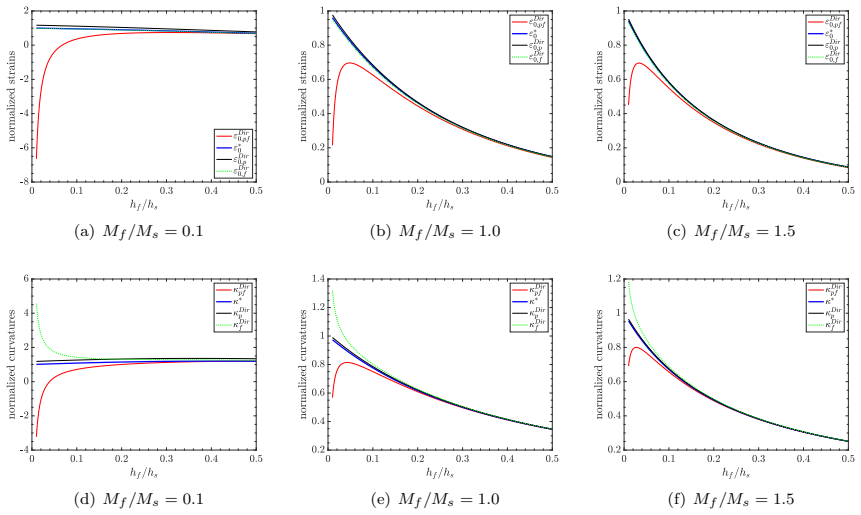
A finite-element solution of the full coupled equilibrium equations using one flexocoupling tensor and explicit surface terms—rather than the paper's two separate enthalpy densities—computed for the same geometry and constants as Figures 3 to 5 would settle the matter: if its predicted stretching strain and curvature do not match Eqs. (51)–(54) in both open and closed circuits, the two-enthalpy treatment is not equivalent.
Extended reading notes
Core claim
The paper's central claim is that electromechanical coupling in a thin film can be incorporated into explicit, energy-minimized expressions for the bilayer's midplane stretching strain ε0 and curvature κ. For uniform film properties it reports closed-form formulas (Eqs. 51–54) that connect ε0 and κ to the film's piezoelectric constant e31, flexocoupling constant µ12, permittivity k33, elastic moduli, film and substrate thicknesses, mismatch strain, and applied voltage, with separate branches for closed-circuit (converse) and open-circuit (direct) conditions; a linearly varying mismatch strain leads to the analogous formulas Eqs. (94)–(97). The paper shows these expressions reduce to the pure
Load-bearing premise
The load-bearing premise is that direct and converse flexoelectricity can be modeled by two distinct enthalpy densities that differ by an integration-by-parts boundary term; if a single flexoelectric tensor together with the correct boundary conditions changes the open- and closed-circuit curvature predictions, the paper's central contrast between the two configurations would not survive.
Editorial extensions
If this is right
- Curvature metrology can be extended from residual stress to electromechanical properties: measuring κ and ε0 in open- and closed-circuit configurations gives access to e31 and µ12 as well as the mismatch strain.
- An applied voltage bends the bilayer, with the bending direction and magnitude set by the film/substrate thickness and stiffness ratios—so the formulas double as a design rule for flexoelectric actuators on compliant substrates.
- In the closed-circuit/converse case with no piezoelectricity, flexoelectricity alone leaves the curvature and stretching strain unchanged; the open-circuit/direct case does change them, so comparing the two configurations separates flexoelectric from piezoelectric effects.
- For films with a linear mismatch gradient, the derived expressions let a single curvature/strain measurement be decomposed into average and gradient contributions to the film stress.
- The polarization is linear through the film thickness and tied to both ε0 and κ, giving an independent surface measurement that can corroborate the curvature-derived constants.
Reading between the lines
- The difference between open- and closed-circuit curvature of the same sample could be used to identify e31 and µ12 separately without knowing the residual stress, because voltage and boundary conditions enter the formulas through different terms—a protocol the paper motivates but does not spell out.
- Because the direct and converse flexoelectric enthalpy densities differ only by an integration-by-parts boundary term, the predicted open/closed contrast should be cross-checked against a formulation with one flexoelectric tensor plus consistent surface terms before taking the quantitative difference at face value.
- The same energy-minimization framework could accommodate finite deformations, anisotropic or inhomogeneous substrates, and non-axisymmetric buckling, with the present formulas serving as the linear benchmark.
- The linear-through-thickness polarization prediction could be tested directly on ultrathin films via surface-potential or second-harmonic measurements, which would also test the constitutive assumption that flexoelectricity couples to strain gradient rather than to strain itself.
Editorial analysis
A structured set of objections, weighed in public.
Referee Report
Summary. The paper derives closed-form extensions of Stoney's equation for a film/substrate bilayer in which the film is piezoelectric and flexoelectric. Assuming Kirchhoff kinematics, transverse isotropy, and axial symmetry, it solves the one-dimensional electrostatic field for open- and closed-circuit conditions, integrates the enthalpy over the thickness, and minimizes with respect to stretching strain and curvature. Explicit formulas are given for uniform properties (Eqs. 51–54) and for a linear mismatch-strain gradient (Eqs. 94–97), followed by parametric plots and polarization expressions. The stated goal is to enable curvature-based extraction of film electromechanical properties.
Significance. The linear-elastic, axisymmetric framework is natural, and the paper is explicit about its variational principle, uses no fitted parameters, and provides closed-form expressions. If the closed-circuit branch is correct, the work is a practical extension of Stoney metrology to piezo/flexo films. However, the central open/closed contrast is tied to an unproven choice of enthalpy density; the most striking result—that flexoelectricity disappears in a closed circuit for e31=0, Eq. (57)—is not supported by a boundary-consistent calculation. The direct/open-circuit part and the elastic/piezoelectric reductions are plausible, but the closed-circuit formulas need revision.
major comments (2)
- [§2 and §4, Eqs. (5)–(6), (49), (57)] The two flexoelectric enthalpy densities are related by ψ_conv − ψ_dir = (µ_ijlk ε_ij E_l),k, a pure divergence. The paper adopts ψ_conv for the closed circuit and ψ_dir for the open circuit, but minimizes the volume integral (49) without including the corresponding surface term. This is not invariant after eliminating the electrostatic field and minimizing over κ, because κ changes ε at the electrode surfaces. A concrete failure is Case IV: for e31=0 the closed-circuit solution (32) gives E_z=V/h_f, so ψ_conv=0 and Eq. (57) follows, whereas the paper's own direct form (5) gives −2µ12 ε_rr,z E_z = 2µ12 κ V/h_f ≠ 0 in the same state. Thus the disappearance of the flexoelectric effect in the closed circuit, and more generally the open/closed contrast in §4.1, is not established unless the missing surface work is included or shown to vanish. Please re-derive with a single energy and consist
- [§4, Eqs. (12)–(13), (40), (51)–(52)] The statement that the stress and electric displacement expressions hold irrespective of the choice of enthalpy density is true for the bulk constitutive laws, but it does not justify replacing the volume enthalpy in Eq. (49). Because the two forms differ by a boundary term, the reduced plate energy is changed by a κ-dependent surface contribution. This affects the closed-circuit formulas: Eq. (40) is proportional to e31, so it vanishes when e31→0 and leads to Eq. (57); using the direct form (5) instead gives a leading closed-circuit flexoelectric term proportional to µ12 V κ/h_f. The open/closed contrast is therefore a consequence of the chosen energy gauge rather than of the physics, unless the authors can prove that the boundary term cancels identically for the stated boundary conditions.
minor comments (5)
- [Eq. (37)] The dielectric enthalpy density for the direct case is missing a factor: −(1/2)k33(E^Dir_z)^2 should contain the coefficient 2e31/k33, not e31. The integrated result in Eq. (46) appears consistent with the corrected density, but the displayed formula is misleading.
- [Eqs. (61), (73)] Eq. (61) uses k instead of κ for the curvature in the strain expression; Eq. (73) writes the substrate elastic enthalpy with M^f instead of M^s. These typos should be fixed.
- [§3, after Eq. (27)] The statement that the electric displacement in the substrate is zero because piezoelectricity and flexoelectricity are absent is not correct as written: for a dielectric substrate, D = kE. Either the substrate is intended to be conductive or the electric field is assumed to be screened; this assumption should be stated explicitly.
- [§4, Eq. (33) and Case IV] The open-circuit electric field (33) is derived for e31 ≠ 0 and contains factors of 1/e31. The e31 → 0 limit used in Case IV is well-defined for the integrated quantities, but this should be stated explicitly to avoid confusion about division by zero.
- [§4.1 and §5.1, Eqs. (51)–(54), (94)–(97)] The final formulas are very long and no intermediate algebra or symbolic verification is provided. Given the typos in nearby equations, the authors should supply a supplementary derivation or a machine-checked symbolic verification of these expressions.
Circularity Check
No circularity: the generalized Stoney formulas follow from a stated variational principle with externally tabulated material parameters; no fitted input is renamed as a prediction.
full rationale
The derivation is self-contained. Starting from the enthalpy densities (Eqs. 2-6) and the variational principle (Eq. 9), the paper solves the equilibrium equations (Eqs. 28-30) for the electric field in the open/closed cases (Eqs. 32-33), integrates the enthalpy density (Eq. 49), and obtains strain and curvature from the stationarity conditions (Eq. 50). The resulting closed-form expressions (Eqs. 51-54 and 94-97) are algebraic outputs of these steps. No parameter is fitted to the curvatures or strains that are then 'predicted': the material constants in Table 1 are taken from prior independent literature, and the elastic-only limits (Eqs. 55-56, 98-99) reproduce Freund's cited results. The author's previous DFT papers are cited only as background context and are not load-bearing for the Stoney generalization. The only substantive concern is physical, not circular: the direct and converse flexoelectric enthalpy forms (Eqs. 5-6) differ by a boundary term, so treating them as separate models for open and closed circuits may make the predicted open/closed difference (e.g., Eq. 57) depend on a gauge choice. That is a modeling/boundary-condition question about assumptions, not a case where an output is identical to an input by construction. No circular step can be exhibited.
Assumptions & free parameters
assumptions (5)
- domain assumption Enthalpy decomposition and constitutive laws of linear electroelasticity including flexoelectricity (Eqs. 1-6), from [56].
- domain assumption Kirchhoff thin-plate kinematics for the substrate: σzz=0, straight normals, axially symmetric deformation with uniform curvature and stretching strain (Section 3).
- ad hoc to paper Film is transversely isotropic, poled along z, and isotropically flexoelectric; substrate has no electrical coupling and is assumed to have zero electric displacement (E=0 in substrate).
- ad hoc to paper Two distinct flexoelectric enthalpy densities (Eqs. 5 and 6) are used respectively for open- and closed-circuit configurations; these forms differ by a boundary term and may not represent independent physics.
- domain assumption For the non-uniform example, the mismatch strain is linear in z with constant material properties (Eq. 88).
Cite this review
Pith. "Pith review of Generalization of Stoney's equation for flexoelectric thin films on elastic substrates." pith.science (2026). https://pith.science/paper/GBZGZ6VT
@misc{pith2026260109160,
  author       = {Pith},
  title        = {Pith review of: Generalization of Stoney's equation for flexoelectric thin films on elastic substrates},
  year         = {2026},
  howpublished = {\url{https://pith.science/paper/GBZGZ6VT}},
  note         = {Machine review of arXiv:2601.09160}
}
read the original abstract
When a thin film is deposited on an incompatible elastic substrate, the film develops an elastic mismatch strain, causing the film-substrate system to bend. Stoney's equation relates the curvature of the bent film-substrate system with the residual stress developed in the film, and can be used to infer film properties from curvature measurements. Certain materials exhibit electromechanical coupling, such as piezoelectricity and flexoelectricity, which can alter the curvature and strains. In this work, we generalize Stoney's equation to include flexoelectric and piezoelectric effects in the film. Considering both open and closed circuit configurations, as well as uniform and non-uniform film properties, we compare different cases of electromechanical coupling and discuss their influence on curvature, strains, and electric polarization in the film.
Figures


Figures from the paper (7 more)


Forward citations
Cited by 1 Pith paper
-
Propagation of elastic waves in a flexomagnetic solid
Elastic waves in flexomagnetic solids are dispersive and can show attenuation, negative group velocity, and transverse waves faster than longitudinal waves, depending on strain-gradient and microstructure lengths.
Reference graph
Works this paper leans on
-
[1]
Thin film materials: stress, defect formation and surface evolution
Lambert Ben Freund and Subra Suresh. Thin film materials: stress, defect formation and surface evolution . Cambridge university press, 2004
2004
-
[2]
The tension of metallic films deposited by electrolysis
George Gerald Stoney. The tension of metallic films deposited by electrolysis. Proceedings of the Royal Society of London. Series A, Containing Papers of a Mathematical and Physical Character , 82(553):172–175, 1909
1909
-
[3]
Extensions of the stoney formula for substrate curvature to configu- rations with thin substrates or large deformations
LB Freund, JA Floro, and E Chason. Extensions of the stoney formula for substrate curvature to configu- rations with thin substrates or large deformations. Applied Physics Letters , 74(14):1987–1989, 1999
1987
-
[4]
Celebrating the 100th anniversary of the stoney equation for film stress: Developments from polycrystalline steel strips to single crystal silicon wafers
Guido CAM Janssen, MM Abdalla, F Van Keulen, BR Pujada, and B Van Venrooy. Celebrating the 100th anniversary of the stoney equation for film stress: Developments from polycrystalline steel strips to single crystal silicon wafers. Thin Solid Films , 517(6):1858–1867, 2009
2009
-
[5]
On the stoney formula for a thin film/substrate system with nonuniform substrate thickness
X Feng, Y Huang, and AJ Rosakis. On the stoney formula for a thin film/substrate system with nonuniform substrate thickness. Journal of Applied Mechanics , 74(6):1276–1281, 2007
2007
-
[6]
Enhancing accuracy to stoney equation
JM Pureza, MM Lacerda, AL De Oliveira, JF Fragalli, and RAS Zanon. Enhancing accuracy to stoney equation. Applied Surface Science , 255(12):6426–6428, 2009
2009
-
[7]
Modified stoney’s equation for evaluation of residual stresses on thin film
Kuen Tsann Chen, Jui Hsing Chang, and Jiun Yu Wu. Modified stoney’s equation for evaluation of residual stresses on thin film. Applied Mechanics and Materials , 789:25–32, 2015. 23
2015
-
[8]
Extending stoney’s equation to thin, elastically anisotropic substrates and bilayer films
Sai Sharan Injeti and Ratna Kumar Annabattula. Extending stoney’s equation to thin, elastically anisotropic substrates and bilayer films. Thin Solid Films , 598:252–259, 2016
2016
Show all 57 references
-
[9]
Extension of the stoney formula for the incremental stress of thin films
Jun Qiang, Bingyan Jiang, Yanzhuo Dong, Benedikt Roth, and Fengze Jiang. Extension of the stoney formula for the incremental stress of thin films. Applied Physics Letters , 118(9), 2021
2021
-
[10]
Large deformation and geometric instability of substrates with thin-film deposits
M Finot, IA Blech, S Suresh, and H Fujimoto. Large deformation and geometric instability of substrates with thin-film deposits. Journal of applied physics , 81(8):3457–3464, 1997
1997
-
[11]
Modified stoney formula for determining stress within thin films on large-deformation isotropic circular plates
Haijun Liu, Minghui Dai, Xiaoqing Tian, Shan Chen, Fangfang Dong, and Lei Lu. Modified stoney formula for determining stress within thin films on large-deformation isotropic circular plates. AIP Advances, 11(12), 2021
2021
-
[12]
Geometrically nonlinear stress-deflection relations for thin film/substrate systems
Christine B Masters and NJ Salamon. Geometrically nonlinear stress-deflection relations for thin film/substrate systems. International journal of engineering science , 31(6):915–925, 1993
1993
-
[13]
Stress-warping relation in thin film coated wafers
J Schicker, W A Khan, T Arnold, and C Hirschl. Stress-warping relation in thin film coated wafers. Modelling and Simulation in Materials Science and Engineering , 25(2):025005, 2016
2016
-
[14]
Modified stoney’s equation with anisotropic substrates undergoing large deformations
Sai Sharan Injeti, Nihit Vyas, and Ratna Kumar Annabattula. Modified stoney’s equation with anisotropic substrates undergoing large deformations. Mechanics Research Communications, 113:103685, 2021
2021
-
[15]
Methods for determining piezoelectric properties of thin epitaxial films: Theoretical foundations
LN McCartney, L Wright, MG Cain, Jason Crain, Glenn J Martyna, and Dennis M Newns. Methods for determining piezoelectric properties of thin epitaxial films: Theoretical foundations. Journal of Applied Physics, 116(1), 2014
2014
-
[16]
Stoney formula for piezo- electric film/elastic substrate system
Wang-Min Zhou, Wang-Jun Li, Sheng-Yun Hong, Jie Jin, and Shu-Yuan Yin. Stoney formula for piezo- electric film/elastic substrate system. Chinese Physics B , 26(3):037701, 2017
2017
-
[17]
Fundamentals of flexoelectricity in solids
Peter V Yudin and Alexander K Tagantsev. Fundamentals of flexoelectricity in solids. Nanotechnology, 24(43):432001, 2013
2013
-
[18]
Comprehensive review on flexoelectric energy harvesting technology: Mechanisms, device configurations, and potential applications
Alekhika Tripathy, Balasubramaniam Saravanakumar, Smita Mohanty, Sanjay K Nayak, and Ananthaku- mar Ramadoss. Comprehensive review on flexoelectric energy harvesting technology: Mechanisms, device configurations, and potential applications. ACS Applied Electronic Materials , 3...
2021
-
[20]
Nanoscale flexoelectricity
Thanh D Nguyen, Sheng Mao, Yao-Wen Yeh, Prashant K Purohit, and Michael C McAlpine. Nanoscale flexoelectricity. Advanced Materials, 25(7):946–974, 2013
2013
-
[21]
Electroactive polymers for sensing
Tiesheng Wang, Meisam Farajollahi, Yeon Sik Choi, I-Ting Lin, Jean E Marshall, Noel M Thompson, Sohini Kar-Narayan, John DW Madden, and Stoyan K Smoukov. Electroactive polymers for sensing. Interface focus, 6(4):20160026, 2016
2016
-
[22]
On the possibility of piezoelectric nanocompos- ites without using piezoelectric materials
Nikhil D Sharma, Ravi Maranganti, and Pradeep Sharma. On the possibility of piezoelectric nanocompos- ites without using piezoelectric materials. Journal of the Mechanics and Physics of Solids , 55(11):2328–2350, 2007
2007
-
[23]
Computational evaluation of the flexoelectric effect in dielectric solids
Amir Abdollahi, Christian Peco, Daniel Millan, Marino Arroyo, and Irene Arias. Computational evaluation of the flexoelectric effect in dielectric solids. Journal of Applied Physics , 116(9), 2014
2014
-
[24]
Flexoelectricity in atomic monolayers from first principles
Shashikant Kumar, David Codony, Irene Arias, and Phanish Suryanarayana. Flexoelectricity in atomic monolayers from first principles. Nanoscale, 13(3):1600–1607, 2021
2021
-
[25]
Ab initio study of flexoelectricity in mxene monolayers
Shashikant Kumar, Zixi Zhang, and Phanish Suryanarayana. Ab initio study of flexoelectricity in mxene monolayers. Nanotechnology, 2025
2025
-
[26]
Transversal flexoelectric coefficient for nanostruc- tures at finite deformations from first principles
David Codony, Irene Arias, and Phanish Suryanarayana. Transversal flexoelectric coefficient for nanostruc- tures at finite deformations from first principles. Physical Review Materials , 5(3):L030801, 2021. 24
2021
-
[27]
Critical curvature localization in graphene
Mrityunjay Kothari, Moon-Hyun Cha, and Kyung-Suk Kim. Critical curvature localization in graphene. i. quantum-flexoelectricity effect. Proceedings of the Royal Society A: Mathematical, Physical and Engineering Sciences, 474(2214):20180054, 2018
2018
-
[28]
Critical curvature localiza- tion in graphene
Mrityunjay Kothari, Moon-Hyun Cha, Victor Lefevre, and Kyung-Suk Kim. Critical curvature localiza- tion in graphene. ii. non-local flexoelectricity–dielectricity coupling. Proceedings of the Royal Society A , 475(2221):20180671, 2019
2019
-
[29]
Flexoelectricity in soft materials and biological membranes
Qian Deng, Liping Liu, and Pradeep Sharma. Flexoelectricity in soft materials and biological membranes. Journal of the Mechanics and Physics of Solids , 62:209–227, 2014
2014
-
[30]
Flexoelectricity in soft elastomers and the molecular mechanisms underpinning the design and emergence of giant flexoelectricity
Matthew Grasinger, Kosar Mozaffari, and Pradeep Sharma. Flexoelectricity in soft elastomers and the molecular mechanisms underpinning the design and emergence of giant flexoelectricity. Proceedings of the National Academy of Sciences , 118(21):e2102477118, 2021
2021
-
[31]
Modeling flexoelectricity in soft dielectrics at finite deformation
David Codony, Prakhar Gupta, Onofre Marco, and Irene Arias. Modeling flexoelectricity in soft dielectrics at finite deformation. Journal of the Mechanics and Physics of Solids , 146:104182, 2021
2021
-
[32]
A static and dynamic theory for photo-flexoelectric liquid crystal elastomers and the coupling of light, deformation and electricity
Amir Hossein Rahmati, Kosar Mozaffari, Liping Liu, and Pradeep Sharma. A static and dynamic theory for photo-flexoelectric liquid crystal elastomers and the coupling of light, deformation and electricity. Journal of the Mechanics and Physics of Solids , 195:105949, 2025
2025
-
[33]
The collusion of flexoelec- tricity and hopf bifurcation in the hearing mechanism
Qian Deng, Fatemeh Ahmadpoor, William E Brownell, and Pradeep Sharma. The collusion of flexoelec- tricity and hopf bifurcation in the hearing mechanism. Journal of the Mechanics and Physics of Solids , 130:245–261, 2019
2019
-
[34]
An electromechanical liquid crystal model of vesicles
Ling-Tian Gao, Xi-Qiao Feng, Ya-Jun Yin, and Huajian Gao. An electromechanical liquid crystal model of vesicles. Journal of the Mechanics and Physics of Solids , 56(9):2844–2862, 2008
2008
-
[35]
Modelling and numerical simulation of remodelling processes in cortical bone: An iga approach to flexoelectricity-induced osteocyte apoptosis and subsequent bone cell diffusion
Carina Witt, Tobias Kaiser, and Andreas Menzel. Modelling and numerical simulation of remodelling processes in cortical bone: An iga approach to flexoelectricity-induced osteocyte apoptosis and subsequent bone cell diffusion. Journal of the Mechanics and Physics of Solids , 17...
2023
-
[36]
The number and types of all possible rotational symmetries for flexoelectric tensors
H Le Quang and Q-C He. The number and types of all possible rotational symmetries for flexoelectric tensors. Proceedings of the royal society a: mathematical, physical and engineering sciences , 467(2132):2369– 2386, 2011
2011
-
[37]
Second gradient of strain and surface-tension in linear elasticity
Raymond David Mindlin. Second gradient of strain and surface-tension in linear elasticity. International journal of solids and structures , 1(4):417–438, 1965
1965
-
[38]
Insights into flexoelectric solids from strain-gradient elasticity
Sheng Mao and Prashant K Purohit. Insights into flexoelectric solids from strain-gradient elasticity. Journal of Applied Mechanics , 81(8):081004, 2014
2014
-
[39]
A theory of flexoelectricity with surface effect for elastic dielectrics
Shengping Shen and Shuling Hu. A theory of flexoelectricity with surface effect for elastic dielectrics. Journal of the Mechanics and Physics of Solids , 58(5):665–677, 2010
2010
-
[40]
Flexoelectric effect on the electroelastic responses of bending piezoelectric nanobeams
Z Yan and LY Jiang. Flexoelectric effect on the electroelastic responses of bending piezoelectric nanobeams. Journal of Applied Physics , 113(19), 2013
2013
-
[41]
Defects in flexoelectric solids
Sheng Mao and Prashant K Purohit. Defects in flexoelectric solids. Journal of the Mechanics and Physics of Solids , 84:95–115, 2015
2015
-
[42]
Asymmetric mechanical properties in ferroelectrics driven by flexo-deformation effect
Yingzhuo Lun, Jiawang Hong, and Daining Fang. Asymmetric mechanical properties in ferroelectrics driven by flexo-deformation effect. Journal of the Mechanics and Physics of Solids , 164:104891, 2022
2022
-
[43]
Constructive and destructive interplay between piezoelectricity and flexoelectricity in flexural sensors and actuators
Amir Abdollahi and Irene Arias. Constructive and destructive interplay between piezoelectricity and flexoelectricity in flexural sensors and actuators. Journal of Applied Mechanics , 82(12):121003, 2015
2015
-
[44]
Inhomogeneous electron gas
Pierre Hohenberg and Walter Kohn. Inhomogeneous electron gas. Physical review, 136(3B):B864, 1964. 25
1964
-
[45]
Self-consistent equations including exchange and correlation effects
Walter Kohn and Lu Jeu Sham. Self-consistent equations including exchange and correlation effects. Physical review, 140(4A):A1133, 1965
1965
-
[46]
Cyclic density functional theory: A route to the first principles simulation of bending in nanostructures
Amartya S Banerjee and Phanish Suryanarayana. Cyclic density functional theory: A route to the first principles simulation of bending in nanostructures. Journal of the Mechanics and Physics of Solids , 96:605– 631, 2016
2016
-
[47]
Symmetry-adapted real-space density functional theory for cylindrical geometries: Application to large group-iv nanotubes
Swarnava Ghosh, Amartya S Banerjee, and Phanish Suryanarayana. Symmetry-adapted real-space density functional theory for cylindrical geometries: Application to large group-iv nanotubes. Physical Review B , 100(12):125143, 2019
2019
-
[48]
Sparc: Accurate and efficient finite-difference formulation and parallel implementation of density functional theory: Isolated clusters
Swarnava Ghosh and Phanish Suryanarayana. Sparc: Accurate and efficient finite-difference formulation and parallel implementation of density functional theory: Isolated clusters. Computer Physics Communi- cations, 212:189–204, 2017
2017
-
[49]
Sparc: Accurate and efficient finite-difference formulation and parallel implementation of density functional theory: Extended systems
Swarnava Ghosh and Phanish Suryanarayana. Sparc: Accurate and efficient finite-difference formulation and parallel implementation of density functional theory: Extended systems. Computer Physics Commu- nications, 216:109–125, 2017
2017
-
[50]
Modeling direct and converse flexoelectricity in soft dielectric rods with application to the follower load
Pushkar Mishra and Prakhar Gupta. Modeling direct and converse flexoelectricity in soft dielectric rods with application to the follower load. Journal of the Mechanics and Physics of Solids , 195:105956, 2025
2025
-
[51]
Giant flexoelectric effect through interfacial strain relaxation
Daesu Lee and Tae Won Noh. Giant flexoelectric effect through interfacial strain relaxation. Philosophical Transactions of the Royal Society A: Mathematical, Physical and Engineering Sciences , 370(1977):4944– 4957, 2012
1977
-
[52]
Piezoelectric thin-film superlattices without using piezo- electric materials
ND Sharma, CM Landis, and Pradeep Sharma. Piezoelectric thin-film superlattices without using piezo- electric materials. Journal of Applied Physics , 108(2), 2010
2010
-
[53]
Mechanical switching of ferroelectric domains beyond flexoelectricity
Weijin Chen, Jianyi Liu, Lele Ma, Linjie Liu, GL Jiang, and Yue Zheng. Mechanical switching of ferroelectric domains beyond flexoelectricity. Journal of the Mechanics and Physics of Solids , 111:43–66, 2018
2018
-
[54]
Utilizing mechanical loads and flexoelectricity to induce and control complicated evolution of domain patterns in ferroelectric nanofilms
Weijin Chen, Yue Zheng, Xue Feng, and Biao Wang. Utilizing mechanical loads and flexoelectricity to induce and control complicated evolution of domain patterns in ferroelectric nanofilms. Journal of the Mechanics and Physics of Solids , 79:108–133, 2015
2015
-
[55]
Analyzing flexoelectric polarization of suspended membrane by nonlinear bending theory of plate
Chunlin Song, Mei Zhang, Wenjie Ming, Xuhui Fan, Boyuan Huang, and Jiangyu Li. Analyzing flexoelectric polarization of suspended membrane by nonlinear bending theory of plate. Journal of the Mechanics and Physics of Solids , 193:105898, 2024
2024
-
[56]
Mathematical and computational modeling of flexoelectricity
David Codony, Alice Mocci, Jordi Barceló-Mercader, and Irene Arias. Mathematical and computational modeling of flexoelectricity. Journal of Applied Physics , 130(23), 2021
2021
-
[57]
Continuum mechanics of solids
Lallit Anand and Sanjay Govindjee. Continuum mechanics of solids . Oxford University Press, 2020
2020
-
[58]
Stability and post-bifurcation of film-substrate systems
Andrew Akerson and Ryan S Elliott. Stability and post-bifurcation of film-substrate systems. Proceedings of the Royal Society A , 478(2264):20220181, 2022. 26
2022
Reviewed August 4, 2026 · model on record in the stance chip above.
Discussion (0). Continue with ORCID to comment.