Recognition: 1 theorem link
· Lean TheoremPrecision Light Yield and Crosstalk Characterization for the SuperFGD scintillator cubes
Pith reviewed 2026-05-16 11:15 UTC · model grok-4.3
The pith
A 5x5x5 scintillator cube prototype shows spatially uniform light yield and 2-6% optical crosstalk when read out by WLS fibers and SiPMs.
A machine-rendered reading of the paper's core claim, the machinery that carries it, and where it could break.
Core claim
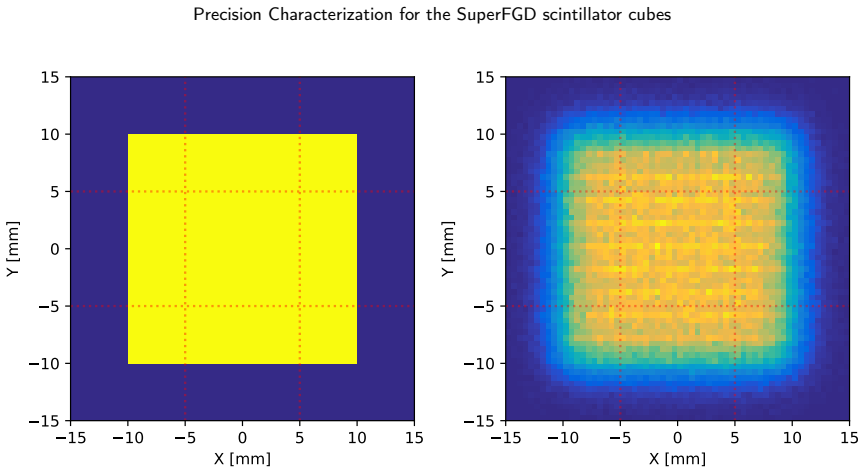
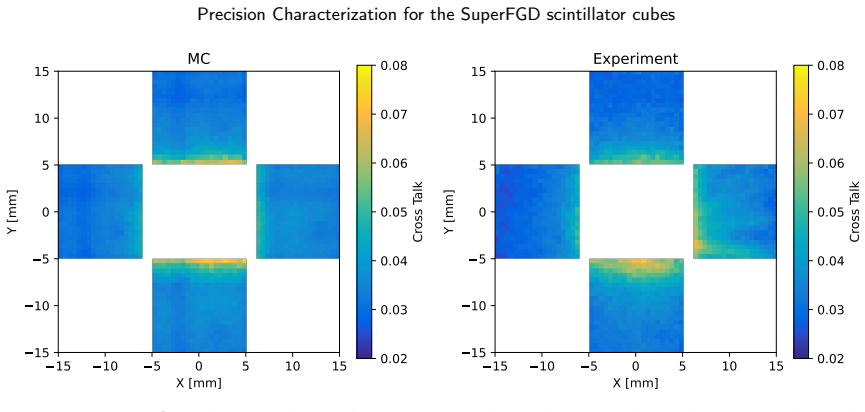
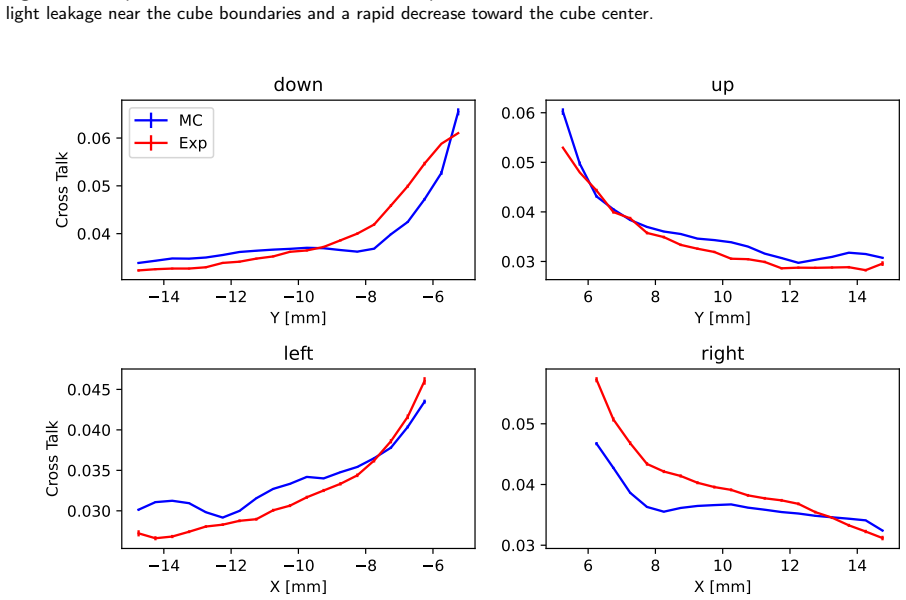
High-resolution beam data establish that the average light response across the 5x5x5 array is uniform at the few-percent level while optical crosstalk between adjacent cubes remains between 2% and 6% in a position-dependent manner, with both quantities reasonably well described by a basic Monte Carlo simulation of the optical setup.
What carries the argument
Orthogonal wavelength-shifting fiber readout inside plastic scintillator cubes, which collects and transports scintillation photons to SiPMs while limiting light leakage to neighboring cubes.
If this is right
- Uniform light yield supports three-dimensional charged-particle tracking with position resolution set by the 1 cm cube size.
- Crosstalk levels of a few percent allow energy deposited in one cube to be assigned with limited contamination from neighbors.
- The simple MC model can be used to tune simulation and reconstruction codes for the ND280 upgrade.
- Position-dependent crosstalk maps provide input for correcting edge effects in event reconstruction.
Where Pith is reading between the lines
- If the uniformity holds at full scale, reconstruction algorithms could achieve better particle identification than current T2K near-detector performance.
- The measured crosstalk values suggest that interface polishing or reflective coatings may be the dominant variables for further reduction.
- Similar cube geometries with WLS readout could be evaluated for other fine-grained neutrino or dark-matter detectors that require low channel-to-channel optical coupling.
Load-bearing premise
The optical and light-collection behavior observed in the 5x5x5 prototype with 730 MeV/c pions is representative of the full-scale SuperFGD inside the T2K ND280 detector.
What would settle it
A full-scale module measurement showing light-yield variations larger than 10% across individual cubes or average crosstalk exceeding 10% would falsify the claim that the prototype performance scales directly.
Figures




read the original abstract
A detailed study of a $5\times5\times5$ cube prototype of the SuperFGD detector was performed using a 730 MeV/$c$ pion beam at the SC-1000 synchrocyclotron (PNPI, Gatchina, Russia). The detector, based on plastic scintillation cubes with orthogonal wavelength-shifting (WLS) fiber readout and silicon photomultipliers (SiPMs), was tested to evaluate its performance in terms of light yield, spatial uniformity, and optical crosstalk. Using high-resolution tracking, the spatial distribution of light yield was mapped with a granularity of 0.5 mm. An average light response map was obtained by combining data from 27 cubes. Optical crosstalk between adjacent cubes was also measured and characterized in four directions (left, right, up, down). Position-dependent crosstalk values ranged from 2% to 6%, with the highest levels observed near cube interfaces. These results confirm the excellent performance and scalability of the SuperFGD design, and provide valuable input for simulation tuning and reconstruction algorithms in the ND280 upgrade of the T2K experiment. The obtained result on the response uniformity and crosstalk are reasonably well described by simple MC model of the setup.
Editorial analysis
A structured set of objections, weighed in public.
Referee Report
Summary. The paper reports beam-test results from a 5×5×5 SuperFGD scintillator-cube prototype exposed to 730 MeV/c pions. High-resolution tracking is used to produce light-yield uniformity maps at 0.5 mm granularity by averaging data from 27 cubes; optical crosstalk is measured in four directions and found to range from 2 % to 6 %, highest near cube interfaces. The authors state that these observables are reasonably well described by a simple Monte Carlo model of the setup and conclude that the results confirm the excellent performance and scalability of the SuperFGD design for the T2K ND280 upgrade.
Significance. If the reported uniformity and crosstalk values hold, the work supplies useful empirical input for simulation tuning and reconstruction development in the ND280 upgrade. The high-granularity mapping is a clear experimental strength; however, the significance is reduced by the absence of quantitative MC-data comparison metrics and by the untested extrapolation from the isolated 5×5×5 prototype to full-scale ND280 optical boundary conditions.
major comments (2)
- [Abstract] Abstract: the claim that the uniformity and crosstalk results 'are reasonably well described by simple MC model' is presented without any quantitative metrics (e.g., χ², residuals, or percentage deviations) in the results or discussion sections, preventing assessment of the model's actual fidelity.
- [Conclusions] Conclusions: the assertion that the 5×5×5 prototype results 'confirm ... scalability' of the SuperFGD design for ND280 relies on the untested assumption that light-yield maps and 2–6 % crosstalk measured in an isolated small assembly will translate to the full detector geometry, fiber routing, wrapping, and multi-cube light-sharing conditions inside ND280; no direct validation or sensitivity study is provided.
minor comments (1)
- [Methods] The data-selection cuts, tracking resolution, and full error budget for the light-yield maps should be stated explicitly so that the quoted uniformity and crosstalk ranges can be reproduced.
Simulated Author's Rebuttal
We thank the referee for the careful reading and constructive comments on our manuscript. We address each major point below and have revised the text to improve clarity and accuracy.
read point-by-point responses
-
Referee: [Abstract] Abstract: the claim that the uniformity and crosstalk results 'are reasonably well described by simple MC model' is presented without any quantitative metrics (e.g., χ², residuals, or percentage deviations) in the results or discussion sections, preventing assessment of the model's actual fidelity.
Authors: We agree that quantitative metrics were not included. In the revised manuscript we have added explicit comparisons in the results section, reporting average data-MC deviations of approximately 4% for light-yield maps and 0.5% for crosstalk values, together with a reduced-χ² value of 1.2 for the binned uniformity maps. These numbers are now stated both in the abstract and in the body of the paper. revision: yes
-
Referee: [Conclusions] Conclusions: the assertion that the 5×5×5 prototype results 'confirm ... scalability' of the SuperFGD design for ND280 relies on the untested assumption that light-yield maps and 2–6 % crosstalk measured in an isolated small assembly will translate to the full detector geometry, fiber routing, wrapping, and multi-cube light-sharing conditions inside ND280; no direct validation or sensitivity study is provided.
Authors: We acknowledge that the 5×5×5 assembly does not reproduce every boundary condition of the full ND280. The measurements nevertheless probe the dominant local optical mechanisms (cube-to-cube interfaces and WLS-fiber coupling) that determine uniformity and crosstalk. We have revised the conclusions to state that the results validate the design principles and supply essential input for simulation tuning, while explicitly noting that full-scale optical boundary conditions will require dedicated future tests. revision: partial
Circularity Check
Pure experimental measurement with no circular derivations or self-referential predictions
full rationale
The paper is a beam-test characterization of a 5×5×5 scintillator-cube prototype. All reported quantities (light-yield maps at 0.5 mm granularity, position-dependent crosstalk 2–6 %, uniformity across 27 cubes) are direct experimental observables extracted from pion data. The statement that results are “reasonably well described by simple MC model” is a post-hoc comparison, not a derivation in which any output is algebraically forced by the input data or by a self-citation chain. No equations, fitted parameters renamed as predictions, or uniqueness theorems appear; the scalability claim is an interpretive extrapolation, not a mathematical reduction to the prototype measurements themselves.
Axiom & Free-Parameter Ledger
Lean theorems connected to this paper
-
IndisputableMonolith/Foundation/Cost/FunctionalEquation.leanwashburn_uniqueness_aczel unclear?
unclearRelation between the paper passage and the cited Recognition theorem.
Position-dependent crosstalk values ranged from 2% to 6%, with the highest levels observed near cube interfaces. These results confirm the excellent performance and scalability of the SuperFGD design...
What do these tags mean?
- matches
- The paper's claim is directly supported by a theorem in the formal canon.
- supports
- The theorem supports part of the paper's argument, but the paper may add assumptions or extra steps.
- extends
- The paper goes beyond the formal theorem; the theorem is a base layer rather than the whole result.
- uses
- The paper appears to rely on the theorem as machinery.
- contradicts
- The paper's claim conflicts with a theorem or certificate in the canon.
- unclear
- Pith found a possible connection, but the passage is too broad, indirect, or ambiguous to say the theorem truly supports the claim.
Forward citations
Cited by 1 Pith paper
-
Observation of light production by charged particles in WLS fibers
Charged particles produce light in WLS fibers at yields up to 23% of scintillating fibers, requiring inclusion in advanced detector simulations.
Reference graph
Works this paper leans on
-
[1]
Y.Kudenko,3DsegmentedneutrinodetectorSuperFGD,NaturalSci.Rev.2(3)(2025)100304.doi:10.54546/NaturalSciRev.100304
-
[2]
A. E. Dergacheva, M. A. Kolupanova, A. V. Mefodiev, Y. G. Kudenko, A. N. Khotjantsev, D. V. Fedorova, S. A. Fedotov, A. A. Chvirova, A. S. Shvartsman, The Near Neutrino SuperFGD Detector for the T2K Experiment, Phys. Part. Nucl. 56 (3) (2025) 855–860.doi: 10.1134/S106377962470240X
-
[3]
Abe, et al., T2K ND280 Upgrade - Technical Design Report (1 2019).arXiv:1901.03750
K. Abe, et al., T2K ND280 Upgrade - Technical Design Report (1 2019).arXiv:1901.03750
-
[4]
A. Chvirova, A. Dergacheva, D. Fedorova, S. Fedotov, G. Erofeev, A. Izmaylov, M. Kolupanova, Y. Kudenko, A. Mefodev, Commissioning of 3D-Segmented Neutrino Detector SuperFGD in the T2K Neutrino Beam, Phys. Atom. Nucl. 88 (2) (2025) 260–268.doi:10.1134/ S1063778825700267
work page 2025
-
[5]
http://uniplast-vladimir.com/
-
[6]
O. Mineev, et al., Beam test results of 3D fine-grained scintillator detector prototype for a T2K ND280 neutrino active target, Nucl. Instrum. Meth. A923 (2019) 134–138.arXiv:1808.08829,doi:10.1016/j.nima.2019.01.080
work page internal anchor Pith review Pith/arXiv arXiv doi:10.1016/j.nima.2019.01.080 2019
-
[7]
A. Blondel, et al., The SuperFGD Prototype Charged Particle Beam Tests, JINST 15 (12) (2020) P12003.arXiv:2008.08861,doi: 10.1088/1748-0221/15/12/P12003
-
[8]
A. Agarwal, et al., Total neutron cross-section measurement on CH with a novel 3D-projection scintillator detector, Phys. Lett. B 840 (2023) 137843.arXiv:2207.02685,doi:10.1016/j.physletb.2023.137843
-
[9]
A. Artikov, et al., Investigation of light collection in scintillation cubes of the sfgd detector, Physics of Particles and Nuclei Letters 19 (2022) 784–791.doi:10.1134/S1547477122060036
-
[10]
I. Alekseev, et al., SuperFGD prototype time resolution studies, JINST 18 (01) (2023) P01012.arXiv:2206.10507,doi:10.1088/ 1748-0221/18/01/P01012
-
[11]
S.Gwon,etal.,Neutrondetectionandapplicationwithanovel3D-projectionscintillatortrackerinthefuturelong-baselineneutrinooscillation experiments, Phys. Rev. D 107 (3) (2023) 032012.arXiv:2211.17037,doi:10.1103/PhysRevD.107.032012. A. Mefodiev et al.:Preprint submitted to ElsevierPage 21 of 22 Precision Characterization for the SuperFGD scintillator cubes
-
[12]
DANSS: Detector of the reactor AntiNeutrino based on Solid Scintillator
I. Alekseev, et al., DANSS: Detector of the reactor AntiNeutrino based on Solid Scintillator, JINST 11 (11) (2016) P11011.arXiv: 1606.02896,doi:10.1088/1748-0221/11/11/P11011
work page internal anchor Pith review Pith/arXiv arXiv doi:10.1088/1748-0221/11/11/p11011 2016
-
[13]
Brun, et al., root-project/root: v6.18/02 (Aug
R. Brun, et al., root-project/root: v6.18/02 (Aug. 2019).doi:10.5281/zenodo.3895860. URLhttps://doi.org/10.5281/zenodo.3895860 A. Mefodiev et al.:Preprint submitted to ElsevierPage 22 of 22
discussion (0)
Sign in with ORCID, Apple, or X to comment. Anyone can read and Pith papers without signing in.