Recognition: no theorem link
Decomposing momentum scales in the Hubbard Model: From Hatsugai-Kohmoto to Aubry-Andr\'e
Pith reviewed 2026-05-10 18:18 UTC · model grok-4.3
The pith
A momentum-space clustering scheme reduces the interacting Aubry-André-Hubbard model to small clusters that match full DMRG energies within 1% for strong potentials.
A machine-rendered reading of the paper's core claim, the machinery that carries it, and where it could break.
Core claim
The authors prove that their momentum clustering scheme is a generalization of Hatsugai-Kohmoto models, with all prior HK versions as special cases, and that the Momentum-Mixing HK model equals the finite-site Hubbard model under twist-averaged boundary conditions. They demonstrate on the Aubry-André-Hubbard model that for sufficiently strong onsite potentials, two-site momentum clusters recover ground state energies to below 1% error relative to DMRG.
What carries the argument
The momentum-space clustering scheme that retains only a chosen subset of interaction channels selected by the dominant wavevectors of the spatially varying potential.
If this is right
- Small momentum clusters suffice for accurate low-energy descriptions in the presence of strong spatially varying potentials.
- The scheme unifies various Hatsugai-Kohmoto models as truncations of the full Hubbard interaction.
- Tractable interacting models of two-dimensional moiré systems become possible through similar momentum truncations.
- The computational cost for ground state calculations drops significantly while maintaining high accuracy.
Where Pith is reading between the lines
- The clustering approach could be tested on other one-dimensional models with incommensurate potentials to check the generality of the two-site accuracy.
- In two dimensions, choosing clusters around the moiré wavevectors might allow simulations of larger supercells than currently feasible with full methods.
- The success suggests that the key to simplifying Hubbard models lies in identifying the relevant momentum scales rather than solving the full all-to-all coupling.
Load-bearing premise
The low-energy behavior is dominated by scattering at a few characteristic wavevectors which the spatially varying potential can select.
What would settle it
DMRG calculations on the Aubry-André-Hubbard model for strong potentials that show more than 1% deviation in ground state energy from the two-site cluster results.
Figures






read the original abstract
The all-to-all momentum coupling of the Hubbard interaction makes interacting lattice models generically unsolvable. In many settings, however, from Peierls instabilities to Moir\'e superlattice physics, the low-energy behavior is dominated by scattering at a few characteristic wavevectors. We exploit this by constructing a momentum-space clustering scheme that retains only a chosen subset of interaction channels. Our scheme can be considered a generalization of twist-averaged boundary conditions. In proving this, we also prove that our scheme can be considered as a generalization of Hatsugai-Kohmoto (HK) models, and all versions of the HK model previously considered in the literature arise as special cases. This shows that the surprising phenomenological success of HK models arises from their correspondence to the finite-site Hubbard model. In particular, the recently introduced "Momentum-Mixing HK" model corresponds to a specific choice of clustering limit, which is equal to the original finite-site Hubbard model with twist-averaged boundary conditions. Our scheme becomes particularly powerful when a spatially varying potential selects the dominant momentum channels. We demonstrate this on the one-dimensional analogue of interacting moir\'e systems: the Aubry-Andr\'e-Hubbard model. We show that for sufficiently strong onsite potential, clusters as small as two sites can recover the ground state energy to below 1% error relative to DMRG benchmarks. This establishes that physically motivated momentum-space truncations can yield accurate low-energy descriptions at feasible computational cost, opening a path toward tractable interacting models of Moir\'e systems in two dimensions. Code for reproducing all numerical results is available at https://github.com/chainik1125/decomposing-hubbard.
Editorial analysis
A structured set of objections, weighed in public.
Referee Report
Summary. The manuscript introduces a momentum-space clustering scheme for the Hubbard model that retains only selected interaction channels corresponding to dominant wavevectors. This construction is shown to generalize twist-averaged boundary conditions and to encompass all previously studied Hatsugai-Kohmoto models as special cases. Applied to the one-dimensional Aubry-André-Hubbard model, the scheme demonstrates that for sufficiently strong onsite potentials, clusters as small as two sites recover the ground-state energy to below 1% relative error compared to DMRG benchmarks, with publicly available code for reproduction.
Significance. If the central numerical claim holds, the work offers a physically motivated truncation strategy that exploits potential-induced momentum selectivity to make interacting quasiperiodic and moiré systems computationally tractable at low cost. The unification of Hatsugai-Kohmoto phenomenology with finite-site Hubbard models under twist averaging provides an internal consistency check, and the availability of reproducible code is a clear strength. The approach could extend to two-dimensional moiré Hubbard models where similar channel selectivity is expected.
major comments (1)
- [Numerical results] Numerical results section: the <1% error claim for 2-site clusters versus DMRG is load-bearing for the central assertion that small clusters suffice, yet the manuscript provides insufficient detail on DMRG system sizes, the precise parameter values (U, V, filling, and quasiperiodic strength) at which the benchmark holds, and the explicit criterion used to select the two dominant momentum channels from the potential's Fourier content.
minor comments (3)
- [Generalization to twist-averaged boundary conditions] The proof that the clustering scheme reduces to twist-averaged boundary conditions should include an explicit mapping of the retained channels to the twist phase factors.
- [Figures] Figure captions for the energy comparisons should state the exact cluster sizes, system lengths, and number of disorder realizations used in the averages.
- [Hatsugai-Kohmoto unification] The statement that all prior Hatsugai-Kohmoto models arise as special cases would benefit from a short table listing the corresponding cluster choices and boundary conditions.
Simulated Author's Rebuttal
We thank the referee for their positive assessment of the manuscript and for the recommendation of minor revision. We address the single major comment below and will incorporate the requested clarifications in the revised version.
read point-by-point responses
-
Referee: [Numerical results] Numerical results section: the <1% error claim for 2-site clusters versus DMRG is load-bearing for the central assertion that small clusters suffice, yet the manuscript provides insufficient detail on DMRG system sizes, the precise parameter values (U, V, filling, and quasiperiodic strength) at which the benchmark holds, and the explicit criterion used to select the two dominant momentum channels from the potential's Fourier content.
Authors: We agree that additional explicit details will strengthen the presentation. In the revised manuscript we will expand the numerical results section (currently Section IV) to include: (i) the DMRG system sizes employed for the benchmarks (up to L=128 sites with open boundaries and bond dimension up to 2000, with extrapolation checks); (ii) the precise parameter set at which the <1% relative error is reported (U=8t, V=4t, filling n=0.5, quasiperiodic strength W=4t, and irrational frequency beta=(sqrt(5)-1)/2); and (iii) the explicit selection criterion for the two dominant momentum channels, which retains the pair of wave-vectors k with the largest |V_k| amplitudes in the Fourier decomposition of the onsite potential (Eq. (12) in the manuscript). These values are already used in the publicly available code repository, but were not stated with sufficient precision in the text. We will also add a short paragraph clarifying that the same channel-selection procedure recovers the exact finite-size Hubbard model when all channels are retained. revision: yes
Circularity Check
No significant circularity in derivation chain
full rationale
The momentum-clustering scheme is introduced as an independent construction that is mathematically shown to reduce to twist-averaged boundary conditions and to contain all prior Hatsugai-Kohmoto models as special cases via explicit proof, without relying on fitted parameters or self-referential definitions. Numerical accuracy claims for the Aubry-André-Hubbard model are validated directly against external DMRG benchmarks rather than internal fits, and the motivating assumption about dominant momentum channels follows from the quasiperiodic potential's Fourier content with explicit tests in the strong-potential regime. No load-bearing step reduces by construction to the target result or to an unverified self-citation chain.
Axiom & Free-Parameter Ledger
axioms (1)
- domain assumption The low-energy behavior of the Hubbard model is dominated by scattering at a few characteristic wavevectors.
invented entities (1)
-
momentum-space clustering scheme
no independent evidence
Forward citations
Cited by 2 Pith papers
-
Hatsugai-Kohmoto-like Models for Altermagnets and Odd-Parity Magnets
Generalized Hatsugai-Kohmoto models support ferromagnetism, p- and d-wave bond-ordered magnets, and non-degenerate singlet states with retained spin splitting when local interactions are added.
-
Local Current Algebra for the HK Universality Class
A local current-algebra Hamiltonian makes the Hatsugai-Kohmoto model spatially local in real space, with identical charge susceptibility to the fermionic formulation.
Reference graph
Works this paper leans on
-
[1]
A set ofDcluster generator vectors∆ 1, . . . ,∆D ∈ B
- [2]
-
[3]
A set of cluster representativesK ⊂ Bsuch that the clusters CK ={K+k(n j) :n j ∈I},k(n j) = DX d=1 nj d ∆d,(4) form a disjoint partition ofB: B= G K∈K CK.(5) Given such a scheme, the cluster-truncated Hubbard interaction is obtained by retaining only those quartic terms for which all four momenta lie in a common clus- ter. Note that care must be taken to ...
-
[4]
2π L }. DenotingX 1 +X 3 −X 2 −X 4 = ∆X, we write the sum overKas: NX −1X m=0 ei 2π L m∆XN ca = NX −1X m=0 ei 2π NX m∆X =N X δ∆X,0 modN X , (27) where the last equality follows from the fact that the coarse lattice coordinateXand the cluster representative mindex a real and reciprocal lattice respectively of size NX, and are hence dual to each other. Sinc...
-
[5]
The full code for all figures is available at: https://github.com/chainik1125/decomposing-hubbard . In each case, we see that there is a generalized scheme which outperforms (in terms of relative deviation from the DMRG ground state energy per site) the maximal separation scheme for a wide range ofUvalues, especially at quarter-filling. At quarter-filling...
-
[6]
The on-site potential ˆV can couple distinct interaction clusters intosuperclus- ters
Consistent clustering conditions for the AAH model Because both the on-site modulation and the interac- tion couple different momenta in the AAH model, care must be taken to efficiently approximate the interac- tion in the clustering scheme. The on-site potential ˆV can couple distinct interaction clusters intosuperclus- ters. To see this, note that repea...
-
[7]
maximal” clustering scheme analyzed in Sec. II E. We use a “symmetric parameterization
General form of the clustered AAH model We now derive the general form of the approximate cluster Hamiltonian in the presence of the onsite modu- lation. Using the result already derived in eq. (35), we only need to derive the form of on-site modulation term ˆV= PN i=1 λcos(2πβi+ϕ)n i under the general cluster- ing procedure outlined in section II A. Re-w...
-
[8]
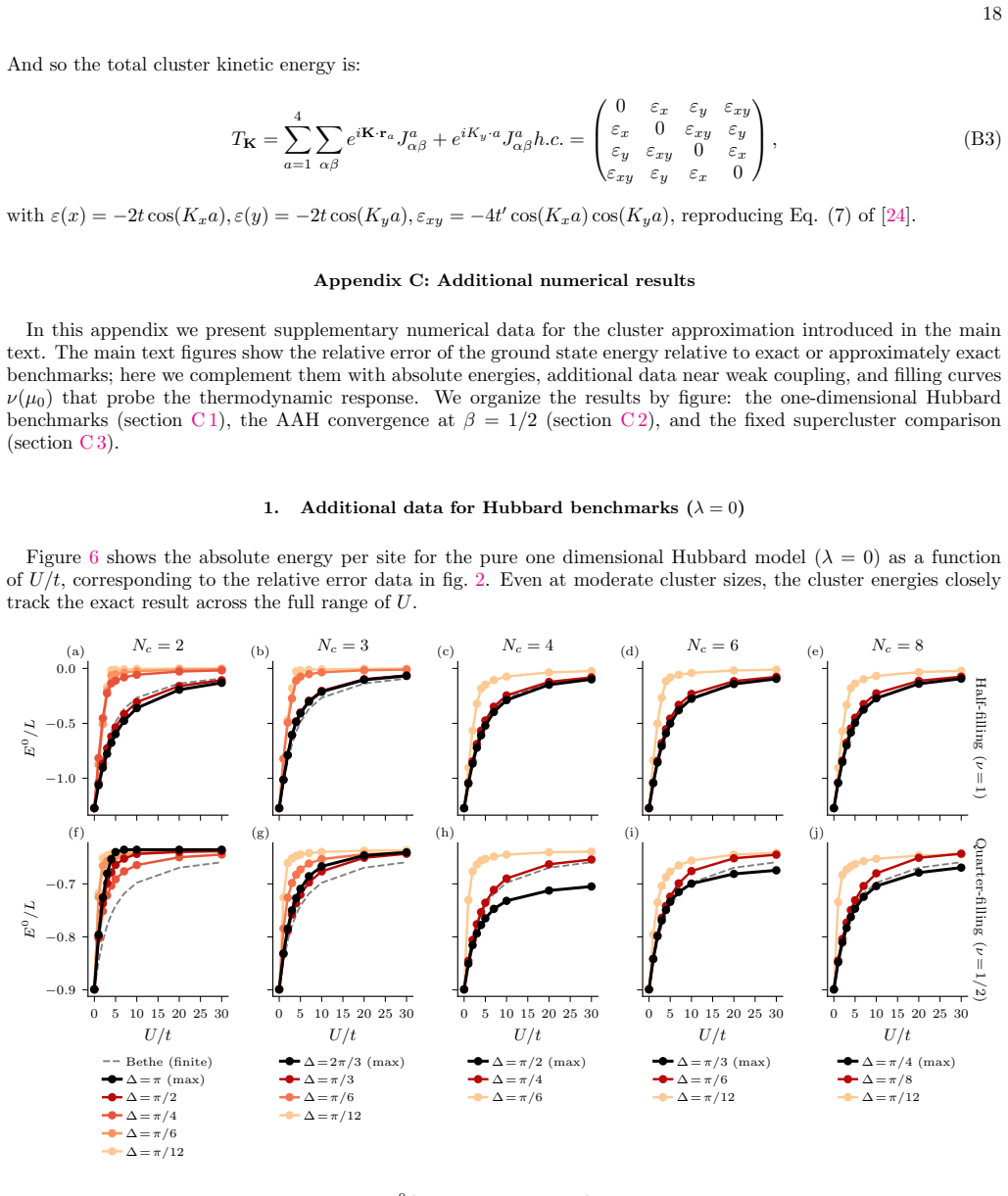
Additional data for Hubbard benchmarks (λ= 0) Figure 6 shows the absolute energy per site for the pure one dimensional Hubbard model (λ= 0) as a function ofU/t, corresponding to the relative error data in fig. 2. Even at moderate cluster sizes, the cluster energies closely track the exact result across the full range ofU. −1.0 −0.5 0.0 E0/L (a) Nc = 2 (b)...
-
[9]
This complements the main text fig
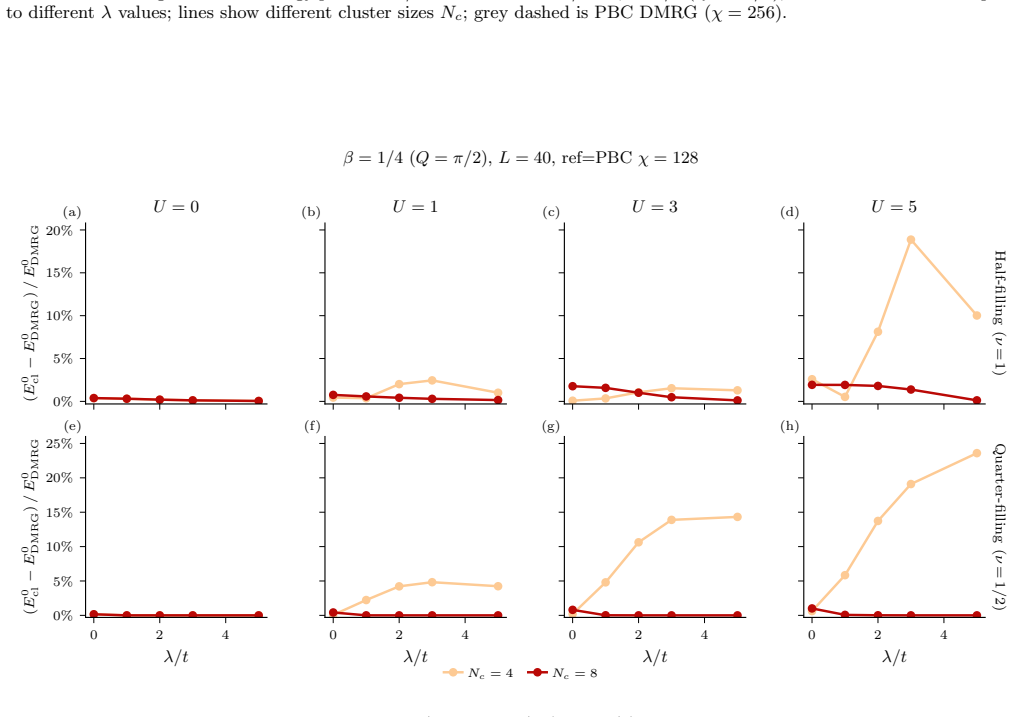
Additional data for AAH convergence (β= 1/2) Figure 9 shows the absolute energy as a function ofU/tatβ= 1/2, with columns corresponding to different values of the Aubry-Andr´ e potentialλ. This complements the main text fig. 4, which sweepsλat fixedU, by showing the U-dependence at fixedλ. −5 −4 −3 −2 −1 0 E0/L (a) λ = 0 (b) λ = 1 (c) λ = 2 (d) λ = 3 (e) ...
-
[10]
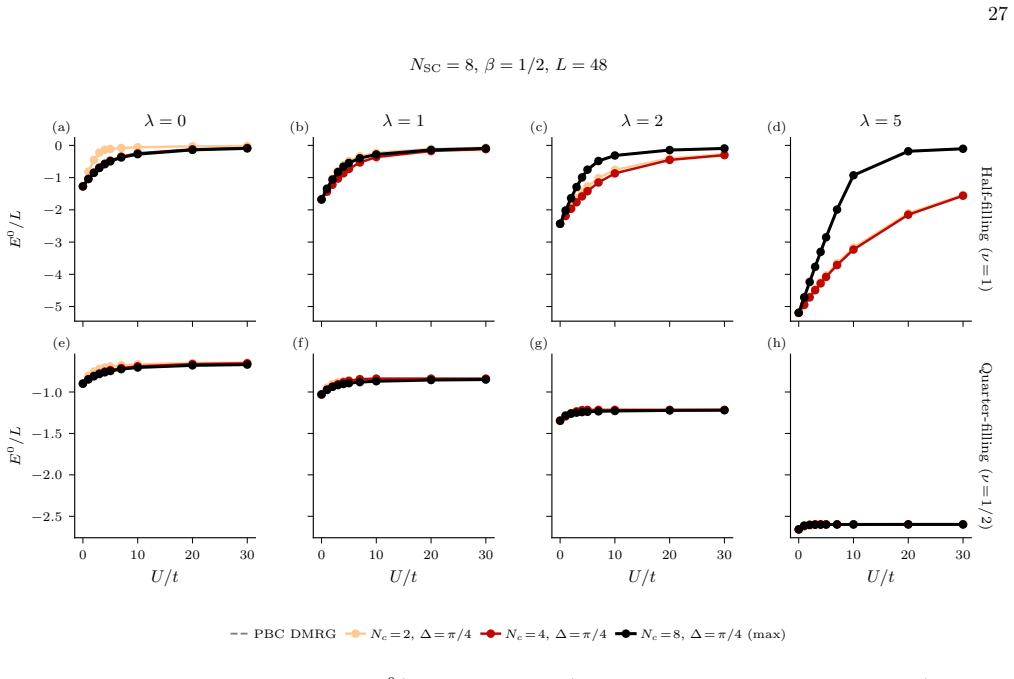
Additional data for fixed supercluster comparison Figure 17 shows the absolute energy for the fixed supercluster comparison atβ= 1/2,L= 48, corresponding to the relative error in fig. 5. Here theU-dependence is shown at eachλvalue for the largest supercluster size, comparing different (Nc,∆) pairs. 27 −5 −4 −3 −2 −1 0 E0/L (a) λ = 0 (b) λ = 1 (c) λ = 2 (d...
-
[11]
1D setup: disjoint clusters and the discard rule Let the microscopic lattice haveLsites with spacinga, and momentak= 2πj/(La),j∈Z L. Fix a cluster sizeN c and a cluster spacing ∆ (a multiple of 2π/(La)) such that the Brillouin zone decomposes into disjoint clusters BZ = G K∈K CK,C K :={K+k j :j= 0,1, . . . , N c −1}, k j :=j∆, with|K|=L/N c. (Equivalently...
-
[12]
Cluster interaction in momentum space (manifestK-decoupling) Define the truncated (discarded) coarse cluster density operator (CCDO) ρ(K) σ (m) := Nc−1X j=0 j+m∈[0,Nc−1] c† K+kj+m ,σ cK+kj ,σ, m∈Z,|m| ≤N c −1.(D1) (Form <0 this is the same definition, i.e.j+mmust still lie in [0, N c −1].) Then the discarded cluster interaction is H(disc) int = U Nc X K∈K...
-
[13]
(D2) to the microscopic lattice
Microscopic real-space form and the appearance of triangular weights We now Fourier transform Eq. (D2) to the microscopic lattice. Substitutingc p,σ = 1√ L P R e−ipRcR,σ, into the CCDO, we obtain: ρ(K) σ (m) = 1 L X R1,R2 eiK(R1−R2) " Nc−1X j=0 j+m∈[0,Nc−1] eikj(R1−R2) # eikmR1 c† R1,σcR2,σ.(D3) The bracket is atruncatedDirichlet sum because of the discar...
- [14]
-
[15]
P. A. Lee, N. Nagaosa, and X.-G. Wen, Doping a Mott in- sulator: Physics of high-temperature superconductivity, Rev. Mod. Phys.78, 17 (2006), arXiv:cond-mat/0410445
work page Pith review arXiv 2006
- [16]
-
[17]
L. Balents, C. R. Dean, D. K. Efetov, and A. F. Young, Superconductivity and strong correlations in moir´ e flat bands, Nat. Phys.16, 725 (2020)
work page 2020
-
[18]
Giamarchi,Quantum Physics in One Dimension(Ox- ford University Press, Oxford, 2003)
T. Giamarchi,Quantum Physics in One Dimension(Ox- ford University Press, Oxford, 2003)
work page 2003
-
[19]
R. Shankar, Renormalization-group approach to interact- ing fermions, Reviews of Modern Physics66, 129 (1994)
work page 1994
-
[20]
S. Weinberg, Superconductivity for particular theorists, Progress of Theoretical Physics Supplement86, 43 (1986)
work page 1986
-
[21]
Gr¨ uner, The dynamics of charge-density waves, Re- views of modern physics60, 1129 (1988)
G. Gr¨ uner, The dynamics of charge-density waves, Re- views of modern physics60, 1129 (1988)
work page 1988
-
[22]
S´ olyom, The Fermi gas model of one-dimensional con- ductors, Adv
J. S´ olyom, The Fermi gas model of one-dimensional con- ductors, Adv. Phys.28, 201 (1979)
work page 1979
-
[23]
R. Bistritzer and A. H. MacDonald, Moir´ e bands in twisted double-layer graphene, Proceedings of the Na- tional Academy of Sciences108, 12233 (2011)
work page 2011
-
[24]
M. Koshino, N. F. Yuan, T. Koretsune, M. Ochi, K. Kuroki, and L. Fu, Maximally localized Wannier or- bitals and the extended Hubbard model for twisted bi- layer graphene, Physical Review X8, 031087 (2018)
work page 2018
- [25]
-
[26]
Y. Hatsugai and M. Kohmoto, Exactly solvable model of correlated lattice electrons in any dimensions, Jour- nal of the Physical Society of Japan61, 2056 (1992), https://doi.org/10.1143/JPSJ.61.2056
-
[27]
P. Phillips, L. Yeo, and E. Huang, Exact theory for super- conductivity in a doped mott insulator, Nature Physics 16, 1175 (2020), publisher Copyright:©2020, The Au- thor(s), under exclusive licence to Springer Nature Lim- ited
work page 2020
-
[28]
J. Zhao, L. Yeo, E. W. Huang, and P. W. Phillips, Ther- modynamics of an exactly solvable model for supercon- ductivity in a doped mott insulator, Phys. Rev. B105, 184509 (2022)
work page 2022
- [29]
-
[30]
D. Manning-Coe and B. Bradlyn, Ground state stability, symmetry, and degeneracy in mott insulators with long- range interactions, Phys. Rev. B108, 165136 (2023)
work page 2023
-
[31]
J. Zhao, P. Mai, B. Bradlyn, and P. Phillips, Failure of topological invariants in strongly correlated matter, Phys. Rev. Lett.131, 106601 (2023)
work page 2023
- [32]
- [33]
- [34]
- [35]
- [36]
-
[37]
P. Mai, J. Zhao, G. Tenkila, N. A. Hackner, D. Kush, D. Pan, and P. W. Phillips, Twisting the hubbard model into the momentum-mixing hatsugai–kohmoto model, Nature Physics 10.1038/s41567-025-03095-1 (2025)
-
[38]
D. Poilblanc and E. Dagotto, Twisted boundary condi- tions in cluster calculations of the optical conductivity in two-dimensional lattice models, Phys. Rev. B44, 9562 (1991)
work page 1991
-
[39]
C. Lin, F. H. Zong, and D. M. Ceperley, Twist-averaged boundary conditions in continuum quantum Monte Carlo algorithms, Phys. Rev. E64, 016702 (2001)
work page 2001
- [40]
-
[41]
S. Iyer, V. Oganesyan, G. Refael, and D. A. Huse, Many- body localization in a quasiperiodic system, Phys. Rev. B87, 134202 (2013)
work page 2013
-
[42]
M. Schreiber, S. S. Hodgman, P. Bordia, H. P. L¨ uschen, M. H. Fischer, R. Vosk, E. Altman, U. Schneider, and I. Bloch, Observation of many-body localization of inter- acting fermions in a quasirandom optical lattice, Science 349, 842 (2015)
work page 2015
- [43]
- [44]
-
[45]
(14) is the discrete Fourier transform on the finite abelian groupI
Equivalently, the transform eq. (14) is the discrete Fourier transform on the finite abelian groupI. The on-site Hubbard interaction is the real-space form of a momentum-independent two-body coupling on any such group, and hence the two are related by Fourier trans- form regardless of the specific spacing vectors
- [46]
-
[47]
Y. Bai and P. W. Phillips, Proof that momentum mix- ing hatsugai kohmoto equals the twisted hubbard model (2025), arXiv:2512.03148 [cond-mat.str-el]
-
[48]
G. Tenkila, J. Zhao, and P. W. Phillips, Dynamical spectral weight transfer in the orbital hatsugai-kohmoto model, Phys. Rev. B111, 045126 (2025)
work page 2025
-
[49]
Dagotto, Correlated electrons in high-temperature su- perconductors, Rev
E. Dagotto, Correlated electrons in high-temperature su- perconductors, Rev. Mod. Phys.66, 763 (1994)
work page 1994
-
[50]
E. H. Lieb and F. Y. Wu, Absence of Mott transition in an exact solution of the short-range, one-band model in one dimension, Phys. Rev. Lett.20, 1445 (1968)
work page 1968
-
[51]
F. H. L. Essler, H. Frahm, F. G¨ ohmann, A. Kl¨ umper, and V. E. Korepin,The One-Dimensional Hubbard Model (Cambridge University Press, 2005)
work page 2005
-
[52]
F. H. L. Essler, A. M. L¨ auchli, and P. Calabrese, Shell- filling effect in the entanglement entropies of spinful fermions, Phys. Rev. Lett.110, 115701 (2013)
work page 2013
-
[53]
P. G. Harper, Single band motion of conduction electrons in a uniform magnetic field, Proc. Phys. Soc. A68, 874 (1955)
work page 1955
-
[54]
S. Aubry and G. Andr´ e, Analyticity breaking and an- derson localization in incommensurate lattices, inGroup Theoretical Methods in Physics, Ann. Israel Phys. Soc., Vol. 3 (Hilger, Bristol, 1980) pp. 133–164
work page 1980
-
[55]
J. Hauschild and F. Pollmann, Efficient numerical sim- ulations with Tensor Networks: Tensor Network Python (TeNPy), SciPost Physics Lecture Notes , 5 (2018)
work page 2018
-
[56]
F. Verstraete, D. Porras, and J. I. Cirac, DMRG and periodic boundary conditions: A quantum information perspective, Phys. Rev. Lett.93, 227205 (2004)
work page 2004
- [57]
-
[58]
Note that we are imposing periodic boundary conditions on the hoppingswithina cluster
discussion (0)
Sign in with ORCID, Apple, or X to comment. Anyone can read and Pith papers without signing in.