The missing ultra-faint satellites of the Milky Way
Pith reviewed 2026-05-10 16:39 UTC · model grok-4.3
The pith
A simulation of a Milky Way-like halo predicts many ultra-faint dwarf satellites remain undiscovered and share properties with recently found compact systems.
A machine-rendered reading of the paper's core claim, the machinery that carries it, and where it could break.
Core claim
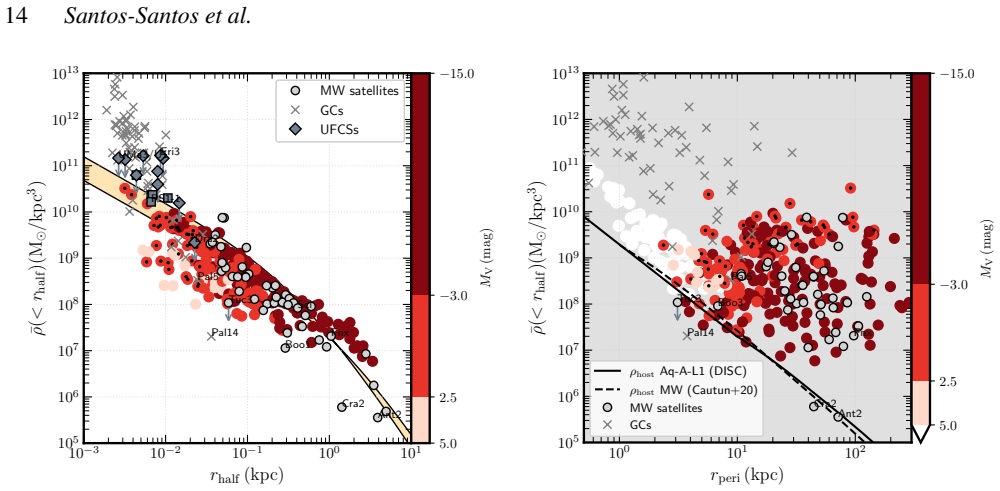
The central claim is that the total number of luminous satellites ever accreted by a Milky Way-like halo is limited to a few hundred down to arbitrarily low luminosity because galaxies form only in subhalos above the hydrogen-cooling threshold. After applying a treatment of dark matter and stellar tidal stripping that preserves all cuspy subhalos to the present day, the model reproduces the massive end of the observed satellite mass function while predicting a substantial population of missing ultra-faint dwarfs. These missing systems avoid the central regions and possess mean densities of order 10^10 to 10^11 solar masses per cubic kiloparsec, properties that align with those of ultra-faint
What carries the argument
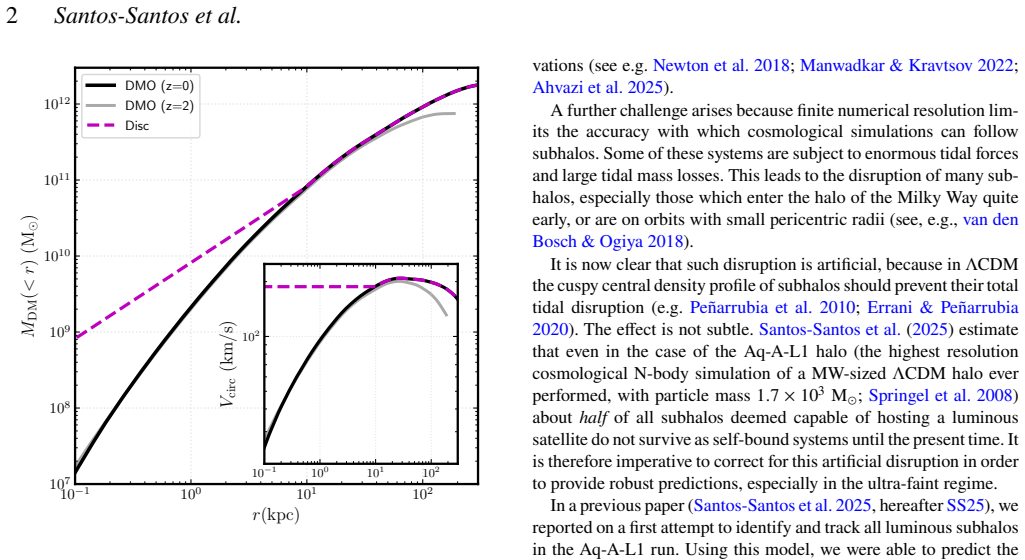
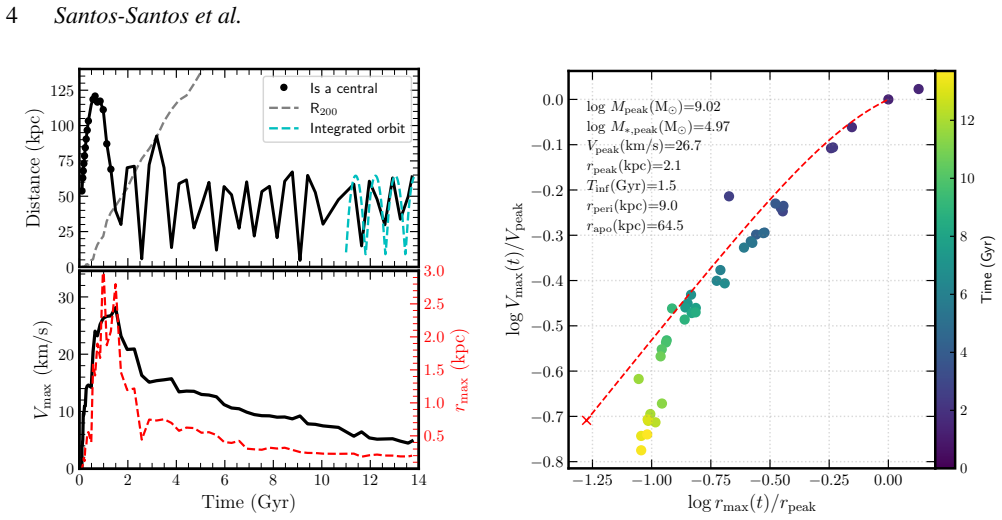
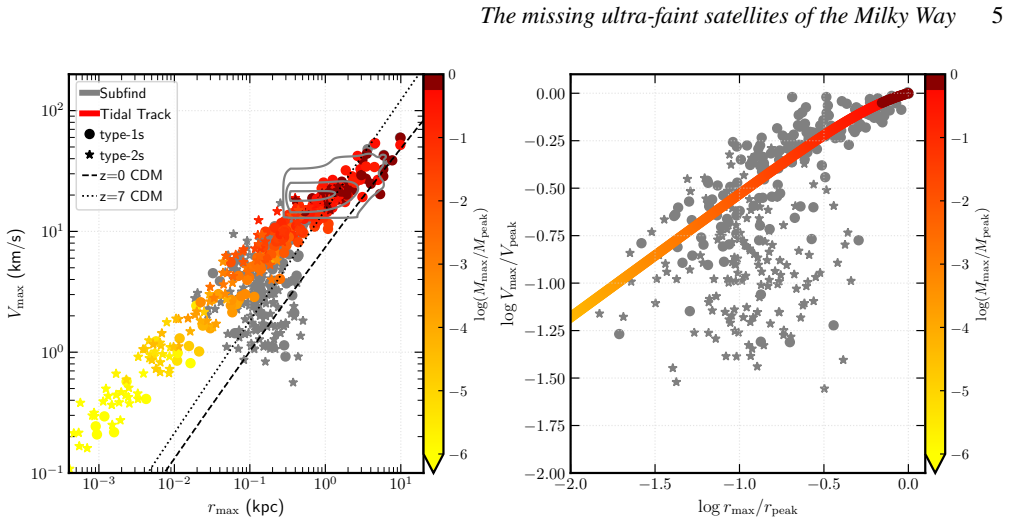
The novel treatment of dark matter and stellar tidal stripping that assumes all dark matter subhalos survive until the present because of their cuspy inner density profiles, together with the tracking of orphan galaxies after their subhalos become unresolved.
If this is right
- The current Milky Way satellite census is incomplete, with a large number of ultra-faint dwarfs still undetected.
- Missing ultra-faint dwarfs avoid the innermost regions of the host halo.
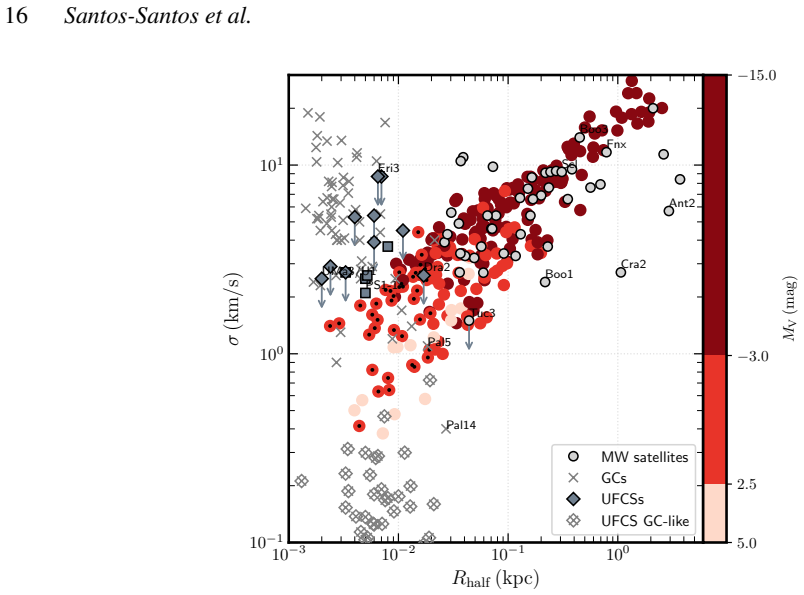
- Ultra-faint compact satellites are dark matter dominated with velocity dispersions of 1 to 3 km/s and mean densities of 10^10 to 10^11 solar masses per cubic kiloparsec.
- Confirmation would support both the cuspy inner structure of dark matter halos and the hydrogen cooling threshold as the limit for galaxy formation.
Where Pith is reading between the lines
- Kinematic data on ultra-faint compact satellites could distinguish whether they are truly dark-matter dominated or star clusters.
- Future surveys sensitive to faint objects at moderate distances from the galactic center could directly test the spatial distribution prediction.
- The high predicted densities imply that some objects currently classified near the globular-cluster boundary may instead be the densest surviving dwarfs.
Load-bearing premise
Galaxies form only in subhalos whose peak circular velocity exceeds the hydrogen cooling threshold and all dark matter subhalos survive to the present day because of their cuspy central density profiles.
What would settle it
A complete census of Milky Way satellites that finds either far fewer or far more ultra-faint systems with mean densities of 10^10 to 10^11 solar masses per cubic kiloparsec, or that finds such systems concentrated in the innermost halo regions, would contradict the predictions.
Figures
read the original abstract
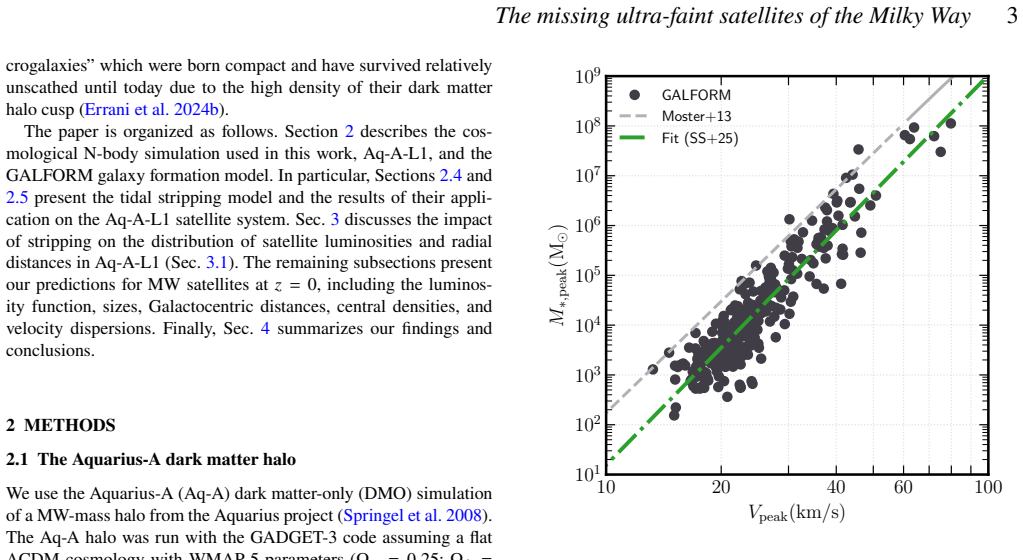
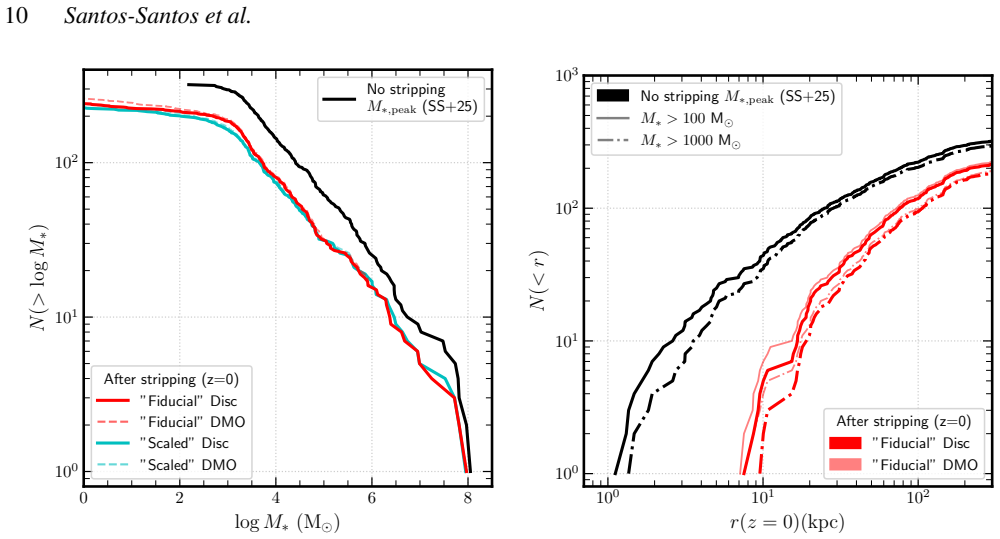
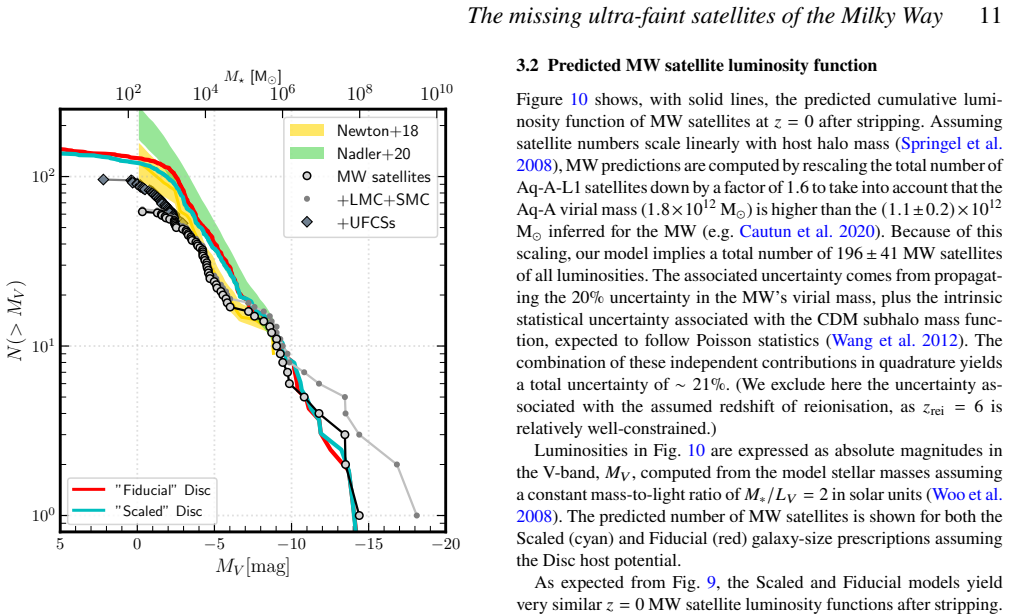
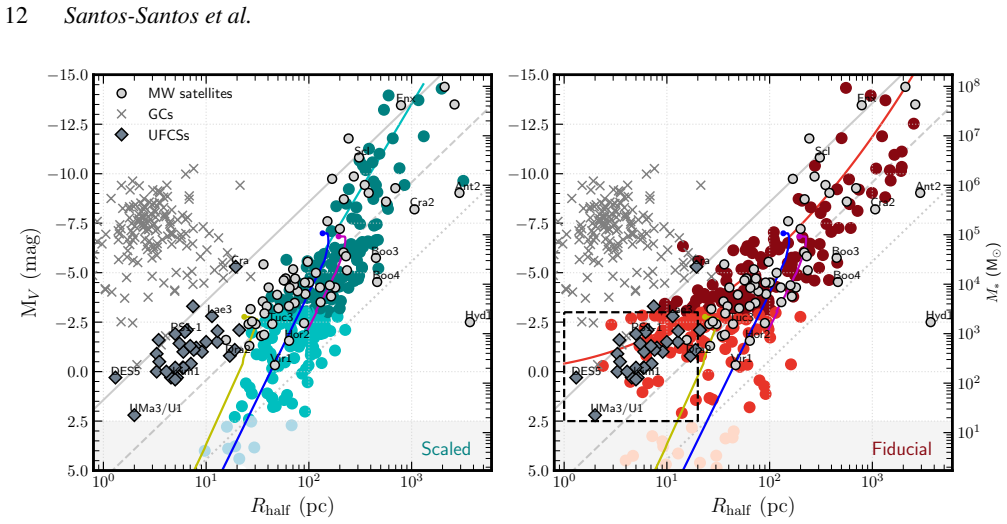
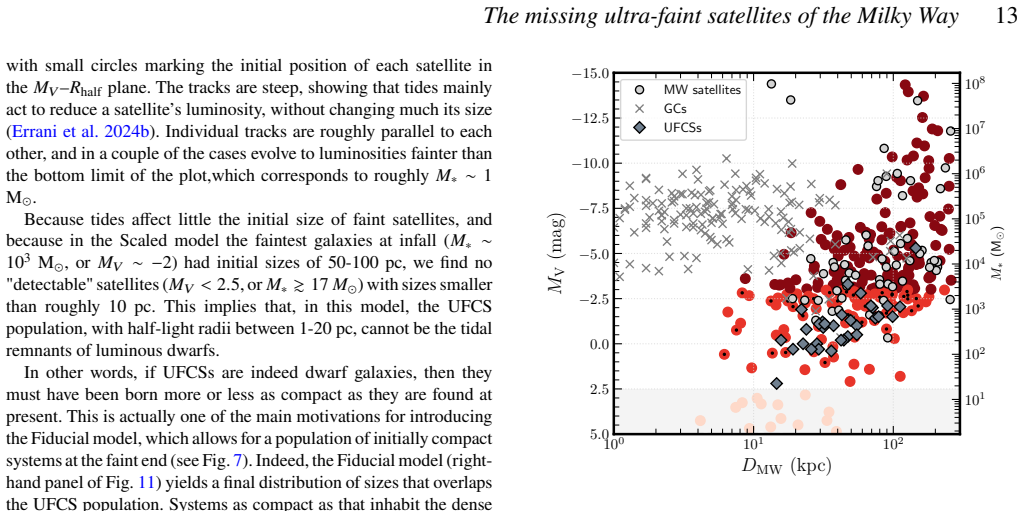
We combine the highest resolution N-body simulation of a $\sim 10^{12}\, M_\odot$ $\Lambda$CDM halo (Aquarius-A) with the {\sc GALFORM} galaxy formation semianalytic model to study the full satellite population expected in a MW-like galaxy. The model assumes that galaxies only form in subhalos whose peak circular velocity exceeds the H-cooling threshold, all of which are well resolved in the simulation. The number of luminous subhalos ever accreted into the main halo is thus well defined, and implies that the total number of MW satellites, down to arbitrarily low luminosity, should not exceed a few hundred. The model tracks satellites even after their halos cease to be resolved ("orphan" galaxies), and includes a novel treatment of dark matter and stellar tidal stripping which takes into account that all $\Lambda$CDM subhalos survive until the present because of their cuspy inner density profiles. After accounting for tides, our results match well the massive end of the observed MW satellite mass function and predict that a large number of ultra-faint dwarfs are missing from the current MW satellite census. The missing UFDs are predicted to avoid the innermost regions of the host, and to have properties that overlap with those of the many ultra-faint compact MW satellites (UFCSs) discovered recently, with properties intermediate between globular clusters and dwarf galaxies. Our results suggest that many UFCS systems are dark matter-dominated dwarfs with velocity dispersions between $1-3$km/s, which have survived disruption because they reside in the dense cusp of $\Lambda$CDM subhalos. UFCSs should have mean densities of order $10^{10}$-$10^{11}\,M_\odot/$kpc$^3$, higher than those of more extended ultra-faint systems. If confirmed, our results would provide support for the cuspy nature of $\Lambda$CDM dark matter halos and for the hydrogen-cooling threshold for galaxy formation.
Editorial analysis
A structured set of objections, weighed in public.
Referee Report
Summary. The manuscript combines the high-resolution Aquarius-A N-body simulation of a ~10^12 M_⊙ ΛCDM halo with the GALFORM semianalytic galaxy formation model. Galaxies are assumed to form only in subhalos whose peak circular velocity exceeds the hydrogen-cooling threshold; the model tracks 'orphan' galaxies after subhalos drop below resolution and applies a novel prescription for dark-matter and stellar tidal stripping that assumes all cuspy ΛCDM subhalos survive to z=0. After accounting for tides, the results match the massive end of the observed Milky Way satellite mass function and predict a large population of missing ultra-faint dwarfs whose properties overlap with recently discovered ultra-faint compact satellites (UFCSs), with mean densities 10^{10}–10^{11} M_⊙ kpc^{-3}. The work concludes that many UFCSs are dark-matter-dominated systems with velocity dispersions 1–3 km s^{-1} and that the findings support cuspy CDM profiles and the H-cooling threshold.
Significance. If the survival assumption and stripping prescription hold, the paper supplies a concrete, observationally testable prediction for the number, radial distribution, and internal densities of undetected ultra-faint satellites, potentially identifying many UFCSs as the missing population. The combination of a well-resolved simulation with a calibrated semianalytic model that explicitly follows orphans to arbitrarily low luminosity is a clear strength, as is the derivation of falsifiable density and velocity-dispersion ranges for the predicted objects. The result, if confirmed, would strengthen the case for cuspy inner profiles in low-mass halos within ΛCDM.
major comments (3)
- [§3] §3 (model description) and the novel tidal-stripping prescription: the central claim that a large number of UFDs survive with densities 10^{10}–10^{11} M_⊙ kpc^{-3} and overlap with UFCS properties rests on the assumption that all cuspy ΛCDM subhalos persist to z=0; no quantitative comparison is presented to hydrodynamical simulations that include baryonic feedback capable of softening cusps or enhancing disruption via disk shocking. This directly determines the predicted survival fraction at the lowest masses.
- [Model assumptions] Model assumptions (H-cooling threshold): the total number of luminous satellites is fixed by the chosen peak-circular-velocity threshold for hydrogen cooling, a free parameter calibrated inside GALFORM to reproduce observed galaxy populations; the statement that the total number 'should not exceed a few hundred' therefore follows from the input calibration rather than constituting an independent prediction from the simulation alone.
- [Results section] Comparison to observations (results section): while a match to the massive end of the MW satellite mass function is asserted, no quantitative metrics (e.g., number counts above a stated mass threshold, Kolmogorov–Smirnov statistic, or tabulated residuals) are supplied, making it difficult to judge how tightly the model is constrained before the extrapolation to the ultra-faint regime is performed.
minor comments (3)
- The mean-density range quoted for UFCSs (10^{10}–10^{11} M_⊙ kpc^{-3}) would benefit from an explicit formula or reference to the exact definition used in the stripping calculation.
- A supplementary table listing predicted numbers of missing UFDs in radial and luminosity bins would improve clarity for future observational tests.
- A few references to the most recent UFCS discoveries appear slightly dated; updating the citation list would strengthen the discussion of observational overlap.
Simulated Author's Rebuttal
We thank the referee for their insightful comments on our manuscript. We address each of the major comments below and indicate the revisions we will make.
read point-by-point responses
-
Referee: §3 (model description) and the novel tidal-stripping prescription: the central claim that a large number of UFDs survive with densities 10^{10}–10^{11} M_⊙ kpc^{-3} and overlap with UFCS properties rests on the assumption that all cuspy ΛCDM subhalos persist to z=0; no quantitative comparison is presented to hydrodynamical simulations that include baryonic feedback capable of softening cusps or enhancing disruption via disk shocking. This directly determines the predicted survival fraction at the lowest masses.
Authors: We agree that our results depend on the survival of cuspy subhalos to z=0, as assumed in the Aquarius simulation and our stripping prescription. A direct quantitative comparison to hydrodynamical simulations is not included in this work, as our approach combines N-body with semianalytic modeling. However, we will add a paragraph in the revised manuscript discussing this assumption, citing hydrodynamical studies on subhalo disruption and baryonic effects, to provide better context for readers. revision: partial
-
Referee: Model assumptions (H-cooling threshold): the total number of luminous satellites is fixed by the chosen peak-circular-velocity threshold for hydrogen cooling, a free parameter calibrated inside GALFORM to reproduce observed galaxy populations; the statement that the total number 'should not exceed a few hundred' therefore follows from the input calibration rather than constituting an independent prediction from the simulation alone.
Authors: The H-cooling threshold is calibrated in GALFORM, but the Aquarius simulation supplies the detailed accretion history and the exact number of subhalos that exceed this threshold. This makes the prediction of no more than a few hundred satellites a specific outcome of applying the calibrated model to this high-resolution simulation. We will revise the text to clarify this point and highlight the role of the simulation in determining the count. revision: yes
-
Referee: Comparison to observations (results section): while a match to the massive end of the MW satellite mass function is asserted, no quantitative metrics (e.g., number counts above a stated mass threshold, Kolmogorov–Smirnov statistic, or tabulated residuals) are supplied, making it difficult to judge how tightly the model is constrained before the extrapolation to the ultra-faint regime is performed.
Authors: We accept this criticism and will strengthen the results section by adding quantitative metrics. Specifically, we will report the number of model satellites above certain mass thresholds and include a Kolmogorov-Smirnov test to assess the goodness of fit to the observed massive satellite mass function. revision: yes
Circularity Check
No significant circularity; model predictions are independent computations from stated inputs
full rationale
The paper's central results follow from applying the Aquarius N-body simulation (which resolves all subhalos above the H-cooling threshold) plus the GALFORM model with its explicit assumptions on galaxy formation and a novel tidal-stripping prescription. The total satellite count is obtained by direct counting of resolved subhalos in the simulation that satisfy the threshold; this count is not set by fitting to the MW satellite census. After applying the stripping model, the massive-end mass function is shown to match observations (a validation step), and the number, locations, and densities of fainter systems are computed outputs. No equation or result is shown to equal its input by construction, and the survival assumption is stated openly rather than smuggled in via self-citation. The derivation therefore remains self-contained against external benchmarks.
Axiom & Free-Parameter Ledger
free parameters (1)
- H-cooling threshold (peak circular velocity)
axioms (2)
- domain assumption LambdaCDM cosmology with cuspy inner density profiles in all subhalos
- domain assumption GALFORM semianalytic model accurately captures galaxy formation physics above the cooling threshold
invented entities (1)
-
orphan galaxies
no independent evidence
Lean theorems connected to this paper
-
IndisputableMonolith/Foundation/AlexanderDuality.leanalexander_duality_circle_linking unclear?
unclearRelation between the paper passage and the cited Recognition theorem.
The model assumes that galaxies only form in subhalos whose peak circular velocity exceeds the H-cooling threshold... novel treatment of dark matter and stellar tidal stripping which takes into account that all ΛCDM subhalos survive until the present because of their cuspy inner density profiles.
-
IndisputableMonolith/Cost/FunctionalEquation.leanwashburn_uniqueness_aczel unclear?
unclearRelation between the paper passage and the cited Recognition theorem.
After accounting for tides, our results match well the massive end of the observed MW satellite mass function and predict... UFCSs should have mean densities of order 10^10-10^11 M_⊙/kpc^3.
What do these tags mean?
- matches
- The paper's claim is directly supported by a theorem in the formal canon.
- supports
- The theorem supports part of the paper's argument, but the paper may add assumptions or extra steps.
- extends
- The paper goes beyond the formal theorem; the theorem is a base layer rather than the whole result.
- uses
- The paper appears to rely on the theorem as machinery.
- contradicts
- The paper's claim conflicts with a theorem or certificate in the canon.
- unclear
- Pith found a possible connection, but the passage is too broad, indirect, or ambiguous to say the theorem truly supports the claim.
Forward citations
Cited by 1 Pith paper
-
The Hubble Missing Globular Clusters Survey IV. Ultra-faint compact satellites of the Milky Way. The case of Koposov 2
Koposov 2 is shown to be an old (13.7 Gyr) star cluster with half-light radius 2.7 pc, absolute magnitude -0.95, and stellar mass 372 solar masses, supporting a star cluster classification over a dwarf galaxy.
Reference graph
Works this paper leans on
-
[1]
N., et al., 2009, ApJS, 182, 543 Abbott T
Abazajian K. N., et al., 2009, ApJS, 182, 543 Abbott T. M. C., et al., 2018, ApJS, 239, 18 Ahvazi N., et al., 2025, arXiv e-prints, p. arXiv:2511.15808 Aihara H., et al., 2018, PASJ, 70, S4 Allen C. W., 1973, Astrophysical quantities Applebaum E., Brooks A. M., Christensen C. R., Munshi F., Quinn T. R., Shen S., Tremmel M., 2021, ApJ, 906, 96 Baumgardt H....
-
[2]
and assuming a solar 𝑉-band absolute magnitude of𝑀𝑉 ,⊙ =4.83(Allen 1973). 3D half- mass radii𝑟half are estimated from observed 2D projected half-light radii𝑅 half by multiplying the latter by a factor of4/3to correct for spherical projection effects. Central mean densities are derived from the observed velocity dispersions using the dynamical mass estimat...
work page 1973
discussion (0)
Sign in with ORCID, Apple, or X to comment. Anyone can read and Pith papers without signing in.