Causal Persuasion
Pith reviewed 2026-05-09 22:38 UTC · model grok-4.3
The pith
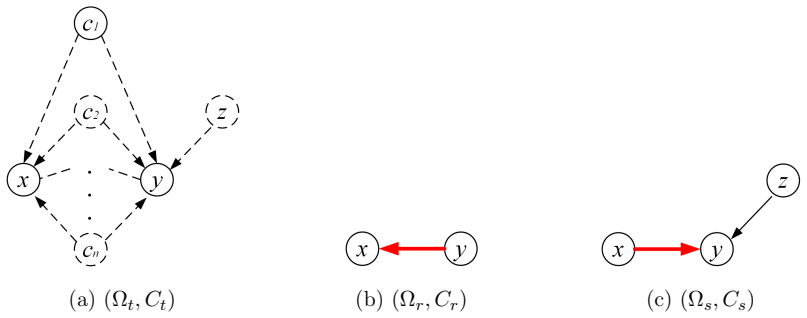
A sender can establish a causal link by disclosing only one or two variables but must disclose every common cause to rule out a perceived link.
A machine-rendered reading of the paper's core claim, the machinery that carries it, and where it could break.
Core claim
The central claim is that establishing a genuine causal link often succeeds after the sender discloses only one or two well-chosen variables together with their joint distribution, whereas persuading the receiver that no causal link exists requires the sender to disclose every common cause. The model also shows that debunking a receiver's pre-existing subjective causal model is informationally comparable to persuading a receiver who begins with no model at all.
What carries the argument
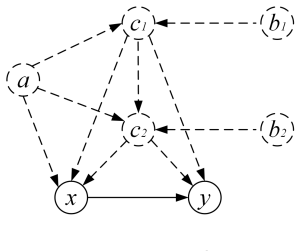
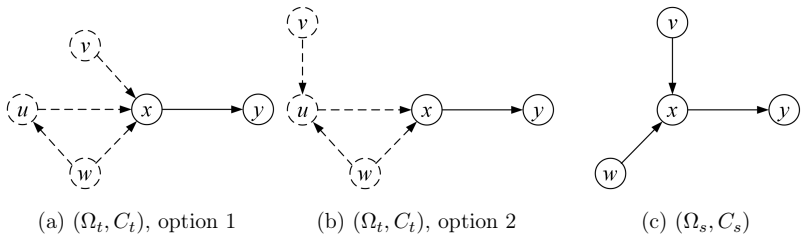
The causal persuasion game in which the sender chooses a subset of variables and their joint distribution to support a proposed causal model that the receiver accepts only if the data uniquely identifies the target causal relationship.
If this is right
- Senders face lower disclosure costs when they aim to create rather than eliminate a causal belief.
- Debunking an existing causal belief requires the same exhaustive revelation as persuading a blank-slate receiver.
- Persuasion succeeds precisely when the chosen variables and their distribution admit no other causal structure consistent with the data.
- The minimal disclosure sets that establish causality are typically far smaller than those that rule it out.
Where Pith is reading between the lines
- Information campaigns in markets or politics can exploit the asymmetry by releasing limited data to imply causation while withholding confounders that would disprove it.
- Regulatory requirements for full disclosure may be especially important when the goal is to prevent false causal beliefs rather than to create true ones.
- The framework predicts observable differences in the amount of data released by advocates versus skeptics in real debates over causation.
Load-bearing premise
The receiver accepts the proposed causal model only when the disclosed data conclusively identifies the causal link of interest and rules out all alternatives.
What would settle it
An experiment that presents subjects with either minimal or exhaustive variable disclosures drawn from the same joint distribution and measures whether belief in the causal link rises with the minimal set but falls only with the exhaustive set.
Figures





read the original abstract
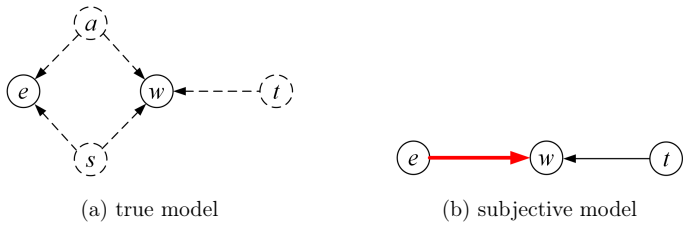
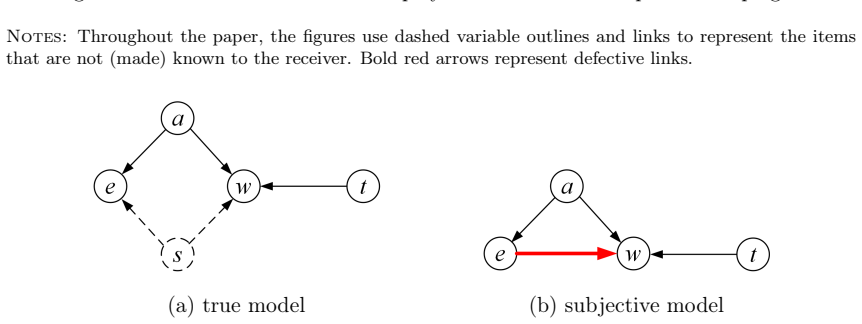
We propose a model of causal persuasion, in which a sender selectively discloses a set of variables together with their true joint distribution and proposes a subjective causal model that binds them. A receiver is persuaded by this model only if the data conclusively identifies the causal link of interest. We characterize when such persuasion succeeds or fails, and how easily it can be achieved. We further show that if the receiver holds a pre-existing subjective model, debunking it is similar to persuading a receiver without one. To establish a true causal link, the sender often needs to disclose only one or two well-chosen variables. But to dispel a perceived link -- to persuade the receiver there is no causal relationship -- every common cause must be disclosed. Our results highlight a fundamental asymmetry in causal persuasion: Establishing causality is often much easier than ruling it out.
Editorial analysis
A structured set of objections, weighed in public.
Referee Report
Summary. The paper proposes a model of causal persuasion in which a sender selectively discloses variables and their true joint distribution while proposing a subjective causal model. The receiver is persuaded only if the disclosed data conclusively identifies the causal link of interest (or its absence) within the proposed graph. The authors characterize conditions for successful persuasion, show that debunking a receiver's pre-existing model is similar to persuading from scratch, and establish an asymmetry: establishing a non-zero causal link often requires disclosing only one or two well-chosen variables, while ruling out a link requires disclosing every common cause.
Significance. If the characterizations hold, the paper contributes a clean theoretical framework linking selective disclosure to causal identification, with implications for Bayesian persuasion, information economics, and debates over causality in policy or science. The self-contained model (no free parameters or ad-hoc axioms) and the explicit asymmetry result are strengths that could generate falsifiable predictions for empirical work on disclosure strategies. The extension to pre-existing receiver models adds robustness.
major comments (3)
- [§2] §2 (model primitives and persuasion definition): Successful persuasion is defined directly as the joint distribution 'conclusively identifies the causal link' inside the sender-proposed graph. This strict identification criterion is imposed rather than derived from receiver utilities, priors, or Bayesian updating; it is load-bearing for the asymmetry because a weaker threshold rule (e.g., posterior probability of effect > threshold) could alter minimal disclosure cardinalities.
- [Characterization theorems] Characterization of minimal disclosures (likely Theorem 1 or Proposition 2): The claim that 'often only one or two well-chosen variables' suffice to establish a true causal link requires explicit statement of the identification strategy (e.g., which variables enable front-door or back-door identification) and the class of graphs considered. Without the full derivation visible, it is unclear whether the result holds generally or only under unstated restrictions on the true DGP.
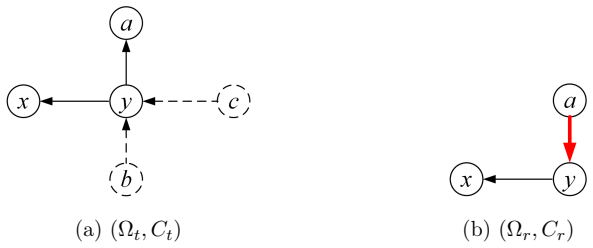
- [§4] Debunking result (likely §4): The statement that 'debunking it is similar to persuading a receiver without one' needs verification that the receiver's pre-existing subjective model is correctly folded into the identification check; if the prior model alters how the disclosed joint distribution is interpreted, the similarity may fail to hold.
minor comments (2)
- [Abstract] The abstract's phrasing 'every common cause must be disclosed' should be qualified as 'every common cause of the treatment and outcome' for precision.
- [§2] Notation for the subjective causal model (e.g., how the proposed graph is formally represented) would benefit from a simple running example with an explicit DAG in the main text.
Circularity Check
Theoretical model self-contained; asymmetry follows directly from persuasion definition
full rationale
The paper defines a model of causal persuasion in which the receiver is persuaded only if the disclosed joint distribution conclusively identifies the causal link of interest (or its absence) within the proposed graph. The claimed asymmetry—that establishing a non-zero causal link often requires disclosing only one or two variables while dispelling a perceived link requires disclosing every common cause—follows immediately from this definition combined with standard causal identification results (e.g., back-door criterion). No step reduces a derived prediction to a fitted parameter, self-citation chain, or ansatz smuggled from prior work by the same authors. The construction is self-contained as pure theory; the persuasion success condition is stipulated rather than derived from receiver utilities or belief updating, but this is an explicit modeling choice, not a circular reduction.
Axiom & Free-Parameter Ledger
axioms (1)
- domain assumption A receiver is persuaded by the proposed causal model only if the disclosed data conclusively identifies the causal link of interest.
invented entities (1)
-
subjective causal model proposed by the sender
no independent evidence
Forward citations
Cited by 1 Pith paper
-
A Model of Multi-turn Human Persuadability Using Probabilistic Belief Tracing
PERSUASIONTRACE introduces a Bayesian-network simulated target for multi-turn persuasion that matches human belief dynamics (81 vs 80) better than LLM baselines (64) and enables process-level evaluation.
Reference graph
Works this paper leans on
-
[1]
Aina, C. (2024). T ailored S tories. Working paper
work page 2024
-
[2]
Aina, C. and Schneider, F. H. (2024). W eighting C ompeting M odels. Working paper
work page 2024
-
[3]
Al-Najjar, N., Pomatto, L., and Sandroni, A. (2014). C laim V alidation. American Economic Review , 104(11):3725--36
work page 2014
-
[4]
Ambuehl, S., Bhui, R., and Thysen, H. C. (2026). Mental models of causal structure in economics and psychology
work page 2026
-
[5]
Bergemann, D. and Morris, S. (2019). I nformation D esign: A unified P erspective. Journal of Economic Literature , 57(1):44--95
work page 2019
-
[6]
Card, D. (1999). T he C ausal E ffect of E ducation on E arnings. Handbook of Labor Economics , 3:1801--1863
work page 1999
-
[7]
Damsbo-Svendsen, S. and Hansen, K. M. (2023). When the election rains out and how bad weather excludes marginal voters from turning out. Electoral Studies , 81:102573
work page 2023
-
[8]
Di Tillio, A., Ottaviani, M., and S rensen, P. N. (2021). Strategic Sample Selection . Econometrica , 89(2):911--953
work page 2021
-
[9]
Dranove, D. and Jin, G. Z. (2010). Q uality D isclosure and C ertification: T heory and P ractice. Journal of Economic Literature , 48(4):935--963
work page 2010
-
[10]
Eliaz, K., Galperti, S., and Spiegler, R. (2025). False narratives and political mobilization. Journal of the European Economic Association , 23(3):983--1027. Publisher: Oxford University Press
work page 2025
-
[11]
Eliaz, K. and Rubinstein, A. (2025). W asonian P ersuasion. Working paper
work page 2025
-
[12]
Eliaz, K. and Spiegler, R. (2020). A Model of Competing Narratives . American Economic Review , 110(12):3786--3816
work page 2020
-
[13]
Eliaz, K., Spiegler, R., and Weiss, Y. (2021). C heating with M odels. American Economic Review: Insights , 3(4):417--434
work page 2021
-
[14]
Gottesman, A. (2025). A limitation of E vidence- B acked C ommunication. Working paper
work page 2025
-
[15]
Gratton, G., Lee, B. E., and Yousaf, H. (2025). Bad Democracy Traps . The Economic Journal , page ueaf111
work page 2025
-
[16]
Grossman, S. J. and Hart, O. D. (1980). D isclosure laws and takeover bids. The Journal of Finance , 35(2):323--334
work page 1980
-
[17]
Guo, R., Cheng, L., Li, J., Hahn, P. R., and Liu, H. (2021). A survey of L earning C ausality with D ata: P roblems and M ethods. ACM Computing Surveys , 53(4):1--37
work page 2021
-
[18]
Hume, D. (1748). A n E nquiry C oncerning H uman U nderstanding . London: Millar
-
[19]
Ispano, A. (2025). T he perils of a coherent narrative. Economic Theory
work page 2025
-
[20]
Johnson, D. S. (1974). Approximation algorithms for combinatorial problems. Journal of Computer and System Sciences , 9(3):256--278
work page 1974
-
[21]
Kamenica, E. (2019). B ayesian P ersuasion and I nformation D esign. Annual Review of Economics , 11(1):249--272
work page 2019
-
[22]
Kamenica, E. and Gentzkow, M. (2011). B ayesian P ersuasion. American Economic Review , 101(6):2590--2615
work page 2011
-
[23]
Karp, R. M. (2009). Reducibility among combinatorial problems. In 50 Years of Integer Programming 1958-2008: from the Early Years to the State-of-the-Art , pages 219--241. Springer Berlin Heidelberg
work page 2009
-
[24]
Kaur, S., Mullainathan, S., Oh, S., and Schilbach, F. (2025). D o F inancial C oncerns M ake W orkers L ess P roductive? The Quarterly Journal of Economics , 140(1):635--689
work page 2025
-
[25]
Little, A. T. (2023). B ayesian E xplanations for P ersuasion. Journal of Theoretical Politics , forthcoming
work page 2023
-
[26]
Lov \'a sz, L. (1975). On the ratio of optimal integral and fractional covers. Discrete Mathematics , 13(4):383--390
work page 1975
-
[27]
Marie, O. and Pinotti, P. (2024). I mmigration and C rime: A n I nternational P erspective. Journal of Economic Perspectives , 38(1)
work page 2024
-
[28]
Meek, C. (1995). C ausal I nference and C ausal E xplanation with B ackground K nowledge. In Proc. Conf. on Uncertainty in Artificial Intelligence (UAI-95) , pages 403--410
work page 1995
-
[29]
M., Mehndiratta, P., and Pande, R
Mehndiratta, M. M., Mehndiratta, P., and Pande, R. (2014). P oliomyelitis: H istorical F acts, E pidemiology, and C urrent C hallenges in E radication. Neurohospitalist , 4(4):223--229
work page 2014
-
[30]
Milgrom, P. R. (1981). G ood news and bad news: R epresentation theorems and applications. The Bell Journal of Economics , pages 380--391
work page 1981
-
[31]
Nemhauser, G. L. and Wolsey, L. A. (1988). Integer and Combinatorial Optimization . Wiley, New York
work page 1988
-
[32]
R., Pugnana, A., Ruggieri, S., Pedreschi, D., and Gama, J
Nogueira, A. R., Pugnana, A., Ruggieri, S., Pedreschi, D., and Gama, J. (2022). M ethods and tools for causal discovery and causal inference. WIREs Data Mining and Knowledge Discovery , 12(2):e1449
work page 2022
-
[33]
Pearl, J. (1988). Probabilistic Reasoning in Intelligent Systems : Networks of Plausible Inference . Morgan Kaufmann
work page 1988
-
[34]
Pearl, J. (2009). C ausality . Cambridge university press
work page 2009
-
[35]
Peppas, P. and Williams, M.-A. (1995). C onstructive M odelings for T heory C hange. Notre Dame Journal of Formal Logic , 36(1)
work page 1995
-
[36]
Peters, J., Janzing, D., and Scholkopf, B. (2017). Elements of causal inference: foundations and learning algorithms . MIT press
work page 2017
-
[37]
Robertson, R. E., Green, J., Ruck, D. J., Ognyanova, K., Wilson, C., and Lazer, D. (2023). Users choose to engage with more partisan news than they are exposed to on Google Search . Nature , 618(7964):342--348
work page 2023
-
[38]
Schwartzstein, J. and Sunderam, A. (2021). U sing M odels to P ersuade. American Economic Review , 111(1):276--323
work page 2021
-
[39]
Spiegler, R. (2020). C an A gents with C ausal M isperceptions be S ystematically F ooled? Journal of the European Economic Association , 18(2):583--617
work page 2020
-
[40]
Tamborini, C. R., Kim, C., and Sakamoto, A. (2015). E ducation and L ifetime E arnings in the U nited S tates. Demography , 52(4):1383--1407
work page 2015
-
[41]
Verma, T. and Pearl, J. (1990). E quivalence and synthesis of causal models. In Proceedings of the Sixth Annual Conference on Uncertainty in Artificial Intelligence , pages 255--270
work page 1990
-
[42]
Verma, T. and Pearl, J. (2022). E quivalence and S ynthesis of C ausal M odels. In Geffner, H., Dechter, R., and Halpern, J. Y., editors, Probabilistic and Causal Inference , pages 221--236. ACM, New York, NY, USA, 1 edition
work page 2022
-
[43]
Williams, G. (2013). Paralysed with Fear: The Story of Polio . Palgrave Macmillan UK, London
work page 2013
- [44]
discussion (0)
Sign in with ORCID, Apple, or X to comment. Anyone can read and Pith papers without signing in.