Measurement of the Weyl Potential Evolution and E_G Statistic from KiDS-1000, BOSS and 2dFLenS
Pith reviewed 2026-05-08 01:39 UTC · model grok-4.3
The pith
KiDS-1000 lensing combined with BOSS clustering measures a weaker high-redshift Weyl potential once Planck priors are imposed.
A machine-rendered reading of the paper's core claim, the machinery that carries it, and where it could break.
Core claim
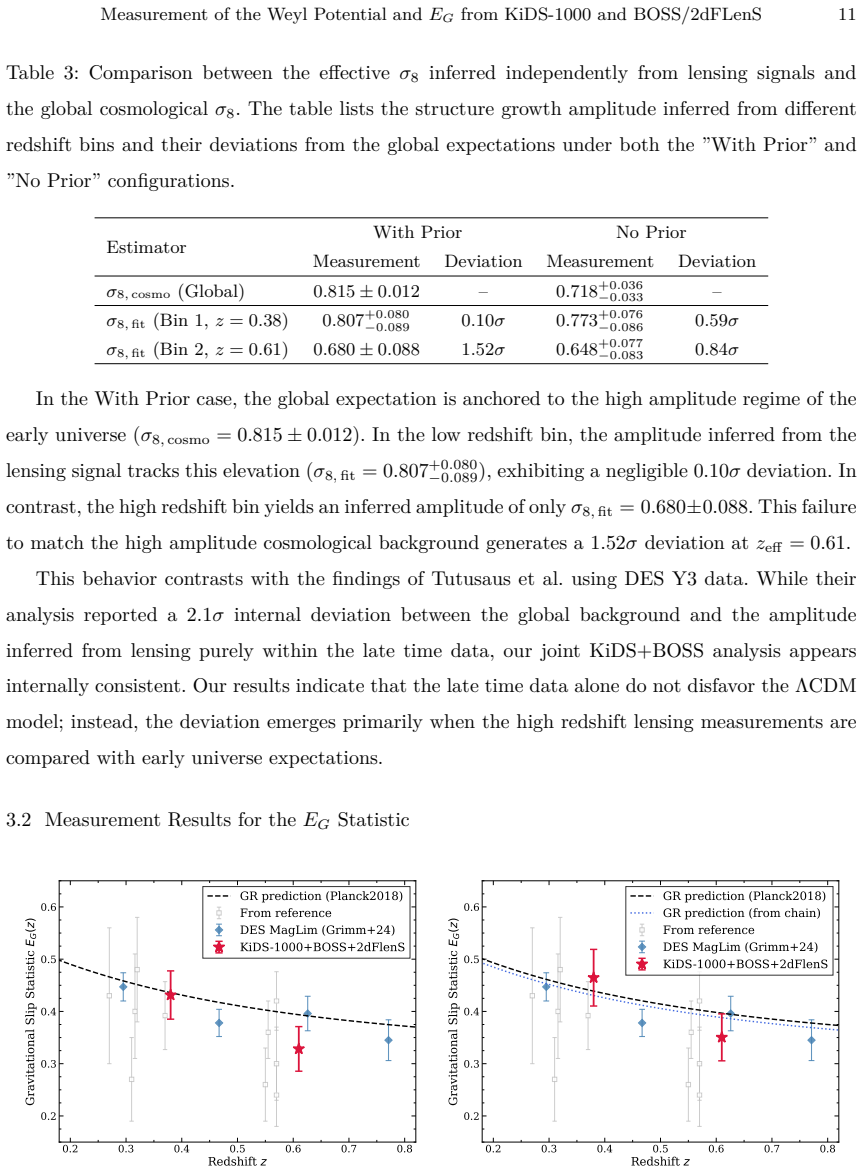
Using KiDS-1000 weak lensing and BOSS plus 2dFLenS galaxy clustering, the Weyl potential and E_G are measured in two redshift bins. Late-time data alone match Lambda CDM, yet after Planck18 priors are imposed the high-redshift bin shows a suppressed Weyl potential and reduced E_G at 1.52 sigma, a deviation driven by the high-redshift CMASS sample and mildly favored by phenomenological modified-gravity parametrizations.
What carries the argument
Model-independent reconstruction of the Weyl potential by combining weak-lensing convergence with galaxy clustering in chosen redshift bins.
If this is right
- Late-time measurements alone remain compatible with standard cosmology.
- High-redshift data prefer a suppressed Weyl potential when CMB priors are included.
- The tension is concentrated in one specific galaxy sample rather than appearing uniformly across bins.
- Phenomenological modified-gravity models accommodate the high-redshift suppression better than Lambda CDM.
Where Pith is reading between the lines
- If the CMASS-driven deviation persists, it may point to scale-dependent modifications of gravity that become noticeable only at intermediate redshifts.
- Cross-checks with independent high-redshift clustering samples could isolate whether the effect is sample-specific or a broader cosmological signal.
- The result links the Weyl-potential measurement directly to the lensing-is-low problem, suggesting that future joint analyses should treat high- and low-redshift bins separately.
Load-bearing premise
The chosen redshift bins and galaxy samples introduce no large unaccounted systematics into the combined lensing-plus-clustering estimator.
What would settle it
Re-analysis of the identical high-redshift CMASS sample with an independent lensing catalogue or clustering estimator that yields an E_G value consistent with Lambda CDM would remove the reported deviation.
Figures



read the original abstract
A recently developed model-independent approach to measuring the Weyl potential has shown some tensions with $\Lambda$CDM (Lambda Cold Dark Matter) in DES (Dark Energy Survey) Y3 data. We apply this framework to Kilo-Degree Survey (KiDS-1000) weak lensing and BOSS/2dFLenS galaxy clustering using the KiDS Cosmology Analysis Pipeline (KCAP) in two redshift bins. Without external CMB priors, both the Weyl potential and $E_G$ measurements are consistent with late time constraints. After imposing Planck18 priors, the low redshift bin remains compatible with General Relativity, whereas the high redshift bin shows a weaker Weyl potential and lower $E_G$, corresponding to a mild $1.52\sigma$ deviation from the $\Lambda$CDM cosmology. Furthermore, phenomenological modified gravity models show a mild preference for a suppressed high redshift Weyl potential, but late time data alone remain consistent with $\Lambda$CDM. Our results also suggest that this deviation is primarily driven by the specific high redshift CMASS sample, reflecting the well-known ``Lensing is low'' problem.
Editorial analysis
A structured set of objections, weighed in public.
Referee Report
Summary. The manuscript applies a model-independent framework to extract the Weyl potential and E_G statistic from KiDS-1000 weak lensing combined with BOSS and 2dFLenS galaxy clustering data processed through the KCAP pipeline, in two redshift bins. Without external priors both quantities are consistent with late-time Lambda CDM constraints; after imposing Planck 2018 priors the low-redshift bin remains compatible with GR while the high-redshift bin exhibits a weaker Weyl potential and lower E_G at 1.52 sigma, driven primarily by the CMASS sample, with a mild preference for phenomenological modified-gravity models that suppress the high-redshift Weyl potential.
Significance. If the central measurement holds after systematic checks, the work supplies an independent, late-time test of the Weyl potential evolution and E_G that can be compared directly to the well-known 'lensing is low' tension. Explicit identification of the CMASS sample as the driver and the demonstration of consistency in the absence of CMB priors are clear strengths. The moderate significance of the reported deviation and its dependence on external priors limit the immediate impact on modified-gravity model selection.
major comments (2)
- [high-redshift bin results (Section 4)] The 1.52 sigma deviation reported for the high-redshift bin after Planck priors is the central result, yet the manuscript does not provide a quantitative assessment of residual CMASS clustering systematics (fiber collisions, redshift failures, incompleteness) within the KCAP pipeline; because the deviation is explicitly attributed to this sample, an unaccounted suppression of the galaxy auto-correlation would directly bias the extracted Weyl potential low.
- [methodology and assumptions (Section 3)] The model-independent extraction of the Weyl potential from the combination of lensing and clustering assumes that the measured galaxy auto- and cross-correlations trace the underlying matter field without scale- or redshift-dependent biases in the chosen bins; given the sample-specific nature of the tension, a dedicated validation (e.g., via mocks that include known CMASS selection effects) is required to confirm that the ratio isolating the Weyl potential remains unbiased.
minor comments (2)
- [Abstract] The abstract refers to 'phenomenological modified gravity models' without naming the specific parametrization or parameter ranges; a brief clarification would improve readability.
- [results tables/figures] Tables or figures presenting the E_G values and Weyl potential amplitudes should explicitly state whether the quoted uncertainties include the full covariance between lensing and clustering or only diagonal terms.
Simulated Author's Rebuttal
We thank the referee for their constructive review and for highlighting both the strengths of our analysis and areas where additional detail would be beneficial. We address each major comment below and will revise the manuscript to incorporate the requested clarifications and validations.
read point-by-point responses
-
Referee: [high-redshift bin results (Section 4)] The 1.52 sigma deviation reported for the high-redshift bin after Planck priors is the central result, yet the manuscript does not provide a quantitative assessment of residual CMASS clustering systematics (fiber collisions, redshift failures, incompleteness) within the KCAP pipeline; because the deviation is explicitly attributed to this sample, an unaccounted suppression of the galaxy auto-correlation would directly bias the extracted Weyl potential low.
Authors: We agree that an explicit quantitative assessment of residual CMASS systematics would strengthen the presentation of the high-redshift result. The KCAP pipeline applies the standard BOSS corrections for fiber collisions, redshift failures, and incompleteness as documented in the BOSS data release papers. To directly address the referee's concern, we will add a dedicated paragraph in Section 4 that quantifies the potential residual impact on the galaxy auto-correlation using literature estimates and mock-based error budgets. This addition will demonstrate that any such residuals remain subdominant to the reported statistical uncertainties and do not alter the central value or significance of the deviation. revision: yes
-
Referee: [methodology and assumptions (Section 3)] The model-independent extraction of the Weyl potential from the combination of lensing and clustering assumes that the measured galaxy auto- and cross-correlations trace the underlying matter field without scale- or redshift-dependent biases in the chosen bins; given the sample-specific nature of the tension, a dedicated validation (e.g., via mocks that include known CMASS selection effects) is required to confirm that the ratio isolating the Weyl potential remains unbiased.
Authors: The model-independent framework assumes scale-independent galaxy bias within the linear scales and redshift bins employed, an assumption validated in prior BOSS analyses. The KCAP pipeline already incorporates mock catalogs that include CMASS selection effects to test the robustness of the correlation measurements. In response to this comment, we will expand Section 3 with an explicit subsection summarizing these mock validations and showing that the ratio used to isolate the Weyl potential remains unbiased at the level of our statistical precision. This will directly confirm the reliability of the extraction for the CMASS sample. revision: yes
Circularity Check
No significant circularity; framework applied to external data with independent priors
full rationale
The paper applies a previously developed model-independent extraction of the Weyl potential and E_G statistic to KiDS-1000 lensing combined with BOSS/2dFLenS clustering via the KCAP pipeline. Results are reported both without priors and after imposing external Planck18 priors, with the mild 1.52σ deviation in the high-z bin explicitly tied to the CMASS sample rather than any internal fit or self-definition. No equation or step reduces the reported deviation to a parameter fitted from the same dataset by construction, and the comparison to ΛCDM uses external benchmarks. Any self-citation of the framework is not load-bearing for the new measurement or the deviation claim.
Axiom & Free-Parameter Ledger
Forward citations
Cited by 1 Pith paper
-
The impact of evolving dark energy on the Weyl potential measured from the Dark Energy Survey Year 3 data
Evolving dark energy models lower the tension in DES Y3 Weyl potential measurements with GR+ΛCDM predictions to 1.6-2.2σ by changing the theoretical background evolution.
Reference graph
Works this paper leans on
- [1]
-
[2]
2022, Phys
Abbott, T., Aguena, M., Alarcon, A., et al. 2022, Phys. Rev. D, 105 2, 7
2022
-
[3]
Ade, P., Aguirre, J., Ahmed, Z., et al. 2019, J. Cosmol. Astropart. Phys., 2019, 056–056 14
2019
-
[4]
2020, A&A, 641, A6 7
Aghanim, N., Akrami, Y., Ashdown, M., et al. 2020, A&A, 641, A6 7
2020
-
[5]
2016, MNRAS, 465, 4853–4865 6
Alam, S., Miyatake, H., More, S., Ho, S., & Mandelbaum, R. 2016, MNRAS, 465, 4853–4865 6
2016
-
[6]
2017, MNRAS, 470, 2617 7
Alam, S., Ata, M., Bailey, S., et al. 2017, MNRAS, 470, 2617 7
2017
-
[7]
2018, MNRAS, 479, 3422–3437 6
Amon, A., Blake, C., Heymans, C., et al. 2018, MNRAS, 479, 3422–3437 6
2018
-
[8]
Arjona, R., Nesseris, S., Tutusaus, I., Blanco, D. S., & Bonvin, C. 2024, preprint (arXiv:2409.15170 [astro-ph.CO]) 2
-
[9]
2015, ApJ, 802, 63 2
Baker, T., Psaltis, D., & Skordis, C. 2015, ApJ, 802, 63 2
2015
-
[10]
Bellini, E., & Sawicki, I. 2014, J. Cosmol. Astropart. Phys., 2014, 050–050 2
2014
-
[11]
2016, MNRAS, 462, 4240 6, 7
Blake, C., Amon, A., Childress, M., et al. 2016, MNRAS, 462, 4240 6, 7
2016
-
[12]
2020, A&A, 642, A158 5, 7
Blake, C., Amon, A., Asgari, M., et al. 2020, A&A, 642, A158 5, 7
2020
-
[13]
E., Park, M., & Watson, S
Bloomfield, J., Flanagan, E. E., Park, M., & Watson, S. 2013, J. Cosmol. Astropart. Phys., 2013, 010–010 2
2013
-
[14]
Bonvin, C., & Fleury, P. 2018, J. Cosmol. Astropart. Phys., 2018, 061–061 2
2018
-
[15]
2025, preprint (arXiv:2506.04387 [astro-ph.CO]) 2
Bonvin, C., Grimm, N., & Tutusaus, I. 2025, preprint (arXiv:2506.04387 [astro-ph.CO]) 2
-
[16]
2016, Physics of the Dark Universe, 12, 56–99 2
Bull, P., Akrami, Y., Adamek, J., et al. 2016, Physics of the Dark Universe, 12, 56–99 2
2016
-
[17]
2026, A&A, 708, A307 2
Chen, S., Yang, X., Ren, Y., et al. 2026, A&A, 708, A307 2
2026
-
[18]
Chen, S., DeRose, J., Zhou, R., et al. 2024, preprint (arXiv:2407.04795) 13
-
[19]
G., Padilla, A., & Skordis, C
Clifton, T., Ferreira, P. G., Padilla, A., & Skordis, C. 2012, Phys. Rep., 513, 1–189 2
2012
-
[20]
2006, Phys
Crocce, M., & Scoccimarro, R. 2006, Phys. Rev. D, 73, 063519 5 Measurement of the Weyl Potential and EG from KiDS-1000 and BOSS/2dFLenS 15 Di Valentino, E., Anchordoqui, L. A., Akarsu, O., et al. 2021, Astroparticle Physics, 131, 102605 2
2006
-
[21]
Eggemeier, A., Scoccimarro, R., Crocce, M., Pezzotta, A., & Sánchez, A. G. 2020, Phys. Rev. D, 102, 103530 5
2020
-
[22]
O., Bonvin, C., & Clarkson, C
Franco, F. O., Bonvin, C., & Clarkson, C. 2020, MNRAS, 492, L34 2
2020
-
[23]
A., Turner, M
Frieman, J. A., Turner, M. S., & Huterer, D. 2008, ARA&A, 46, 385–432 2
2008
-
[24]
Gleyzes, J., Langlois, D., Piazza, F., & Vernizzi, F. 2013, J. Cosmol. Astropart. Phys., 2013, 025– 025 2
2013
-
[25]
2019, ApJ, 883, 203 14
Gong, Y., Liu, X., Cao, Y., et al. 2019, ApJ, 883, 203 14
2019
-
[26]
2024, Phys
Grimm, N., Bonvin, C., & Tutusaus, I. 2024, Phys. Rev. Lett., 133, 211004 2, 6, 11
2024
-
[27]
2021, A&A, 646, A140 2
Heymans, C., Tröster, T., Asgari, M., et al. 2021, A&A, 646, A140 2
2021
-
[28]
L., Wright, A
Hildebrandt, H., van den Busch, J. L., Wright, A. H., et al. 2021, A&A, 647, A124 7 Ivezić, Z., Kahn, S. M., Tyson, J. A., et al. 2019, ApJ, 873, 111 14
2021
-
[29]
2015, Phys
Joyce, A., Jain, B., Khoury, J., & Trodden, M. 2015, Phys. Rep., 568, 1–98 2
2015
-
[30]
2020, Phys
Knox, L., & Millea, M. 2020, Phys. Rev. D, 101 2
2020
-
[31]
2016, Reports on Progress in Physics, 79, 046902 2
Koyama, K. 2016, Reports on Progress in Physics, 79, 046902 2
2016
-
[32]
2019, A&A, 625, A2 7
Kuijken, K., Heymans, C., Dvornik, A., et al. 2019, A&A, 625, A2 7
2019
-
[33]
Lange, J. U. 2023, MNRAS, 525, 3181 8
2023
-
[34]
2017, MNRAS, 467, 3024 10
Leauthaud, A., Saito, S., Hilbert, S., et al. 2017, MNRAS, 467, 3024 10
2017
-
[35]
M., Choi, A., et al
Lee, S., Huff, E. M., Choi, A., et al. 2021, MNRAS, 509, 4982 13
2021
-
[36]
2025, preprint (arXiv:2502.09404 [astro-ph]) 13
Luo, X., Xu, K., Jing, Y., et al. 2025, preprint (arXiv:2502.09404 [astro-ph]) 13
-
[37]
E., et al
Mahony, C., Contreras, S., Angulo, R. E., et al. 2025, MNRAS, 545 13
2025
-
[38]
G., Salcido, J., Schaye, J., et al
McCarthy, I. G., Salcido, J., Schaye, J., et al. 2023, preprint (arXiv:2309.07959 [astro-ph.CO]) 14
-
[39]
2026, Physics of the Dark Universe, 52, 102286 14
Pantos, I., & Perivolaropoulos, L. 2026, Physics of the Dark Universe, 52, 102286 14
2026
-
[40]
Peebles, P. J. E., & Ratra, B. 2003, Reviews of Modern Physics, 75, 559–606 2
2003
-
[41]
J., & White, M
Percival, W. J., & White, M. 2009, MNRAS, 393, 297–308 2
2009
-
[42]
2016, Phys
Pogosian, L., & Silvestri, A. 2016, Phys. Rev. D, 94 2
2016
-
[43]
R., Alam, S., He, S., & Ho, S
Pullen, A. R., Alam, S., He, S., & Ho, S. 2016, MNRAS, 460, 4098–4108 6, 10
2016
-
[44]
2010, Nature, 464, 256–258 6
Reyes, R., Mandelbaum, R., Seljak, U., et al. 2010, Nature, 464, 256–258 6
2010
-
[45]
G., Casertano, S., Yuan, W., Macri, L
Riess, A. G., Casertano, S., Yuan, W., Macri, L. M., & Scolnic, D. 2019, ApJ, 876, 85 2
2019
-
[46]
G., Grieb, J
Salazar-Albornoz, S., Sánchez, A. G., Grieb, J. N., et al. 2017, MNRAS, 468, 2938–2956 5
2017
-
[47]
2022, A&A, 662, A112 14
Scaramella, R., Amiaux, J., Mellier, Y., et al. 2022, A&A, 662, A112 14
2022
-
[48]
2023, MNRAS, 526, 4978–5020 14
Schaye, J., Kugel, R., Schaller, M., et al. 2023, MNRAS, 526, 4978–5020 14
2023
-
[49]
J., von Hausegger, S., Rameez, M., Mohayaee, R., & Sarkar, S
Secrest, N. J., von Hausegger, S., Rameez, M., Mohayaee, R., & Sarkar, S. 2022, ApJ, 937, L31 2
2022
-
[50]
2024, Nature Communications, 15, 9295 3, 6, 7, 10, 13
Tutusaus, I., Bonvin, C., & Grimm, N. 2024, Nature Communications, 15, 9295 3, 6, 7, 10, 13
2024
-
[51]
2023, Physical Review D, 107, 083526 3
Tutusaus, I., Sobral Blanco, D., & Bonvin, C. 2023, Physical Review D, 107, 083526 3
2023
-
[52]
Verde, L., Treu, T., & Riess, A. G. 2019, Nature Astronomy, 3, 891–895 2
2019
-
[53]
2024, The European Physical Journal C, 84, 702 2
Wang, M., Fu, X., Xu, B., et al. 2024, The European Physical Journal C, 84, 702 2
2024
-
[54]
H., Mortonson, M
Weinberg, D. H., Mortonson, M. J., Eisenstein, D. J., et al. 2013, Phys. Rep., 530, 87–255 2 16 X.-W. Zhang et al
2013
-
[55]
2024, Phys
Wenzl, L., Bean, R., Chen, S.-F., et al. 2024, Phys. Rev. D, 109, 083540 6
2024
-
[56]
2007, Phys
Zhang, P., Liguori, M., Bean, R., & Dodelson, S. 2007, Phys. Rev. Lett., 99, 141302 2, 5
2007
- [57]
-
[58]
2015, Astronomy and Computing, 12, 45 8
Zuntz, J., Paterno, M., Jennings, E., et al. 2015, Astronomy and Computing, 12, 45 8
2015
discussion (0)
Sign in with ORCID, Apple, or X to comment. Anyone can read and Pith papers without signing in.