PipeSD: An Efficient Cloud-Edge Collaborative Pipeline Inference Framework with Speculative Decoding
Pith reviewed 2026-06-30 21:31 UTC · model grok-4.3
The pith
PipeSD overlaps token generation and communication via dynamic programming scheduling and dual-threshold verification to accelerate cloud-edge speculative decoding.
A machine-rendered reading of the paper's core claim, the machinery that carries it, and where it could break.
Core claim
PipeSD overlaps token generation and communication by a token-batch pipeline scheduling mechanism optimized by dynamic programming, and improves verification flexibility through a dual-threshold NAV triggering mechanism with a lightweight Bayesian optimization autotuner. Implemented with llama-cpp-python, PyTorch, and FastAPI, it was tested on a real cloud-edge testbed with two model pairs in four scenarios, where it consistently outperforms baselines.
What carries the argument
token-batch pipeline scheduling optimized by dynamic programming, combined with dual-threshold NAV triggering tuned by Bayesian optimization
If this is right
- Higher resource utilization occurs because generation and communication run concurrently instead of sequentially.
- Energy consumption drops 14.3 to 25.3 percent while token throughput rises 1.16x to 2.16x relative to prior collaborative baselines.
- Verification becomes more flexible, avoiding both premature cloud checks and expensive rollbacks after mismatched tokens.
- The same offloading, privacy, and robustness benefits of cloud-edge speculative decoding are retained under the new schedule.
Where Pith is reading between the lines
- The scheduling approach might generalize to other latency-sensitive distributed workloads that mix local and remote computation steps.
- Further gains could appear if the Bayesian tuner were replaced by cheaper online adaptation rules for very resource-constrained edge devices.
- Combining the pipeline with model compression techniques such as quantization would be a direct next measurement to test compounding effects.
Load-bearing premise
The dynamic programming pipeline schedule and Bayesian-tuned dual thresholds will deliver their reported gains without hidden overheads or accuracy loss when applied beyond the two model pairs and four scenarios described.
What would settle it
Measuring end-to-end latency and energy on a third model pair or additional deployment scenario and finding no speedup above 1.0x or energy savings below 14 percent would falsify the claim of consistent outperformance.
Figures



read the original abstract
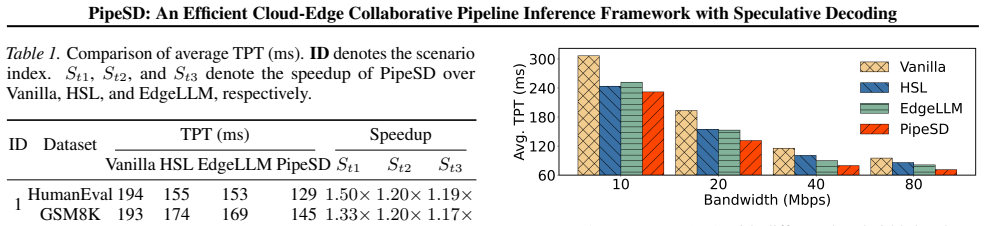
Speculative decoding can significantly accelerate LLM inference, especially given that its cloud-edge collaborative deployment offers cloud workload offloading, offline robustness, and privacy enhancement. However, existing collaborative inference frameworks with speculative decoding are constrained by (i) sequential token generation and communication with low resource utilization, and (ii) inflexible cloud non-autoregressive verification (NAV) triggering that induces premature verification or costly rollbacks. In this paper, we propose PipeSD, an efficient cloud-edge collaborative pipeline inference framework with speculative decoding. PipeSD overlaps token generation and communication by a token-batch pipeline scheduling mechanism optimized by dynamic programming, and improves verification flexibility through a dual-threshold NAV triggering mechanism with a lightweight Bayesian optimization autotuner. We implement PipeSD using llama-cpp-python, PyTorch, and FastAPI, and evaluate it on a real-world cloud-edge testbed with two draft-target model pairs across four scenarios. Results show that PipeSD consistently outperforms state-of-the-art baselines, achieving 1.16x-2.16x speedup and reducing energy consumption by 14.3%-25.3%.
Editorial analysis
A structured set of objections, weighed in public.
Referee Report
Summary. The paper proposes PipeSD, a cloud-edge collaborative inference framework for speculative decoding of LLMs. It introduces a token-batch pipeline scheduling mechanism optimized by dynamic programming to overlap token generation and communication, and a dual-threshold non-autoregressive verification (NAV) triggering mechanism augmented by a lightweight Bayesian optimization autotuner to improve verification flexibility. The system is implemented with llama-cpp-python, PyTorch, and FastAPI; evaluation on a real-world testbed uses two draft-target model pairs across four scenarios and reports consistent outperformance of state-of-the-art baselines with 1.16x–2.16x speedup and 14.3%–25.3% energy reduction.
Significance. If the reported speedups and energy savings hold under wider conditions, PipeSD would offer a practical advance in distributed LLM serving by raising utilization in cloud-edge settings while preserving the privacy and robustness benefits of edge offloading. The combination of DP-based scheduling and Bayesian-tuned thresholds is a concrete engineering contribution that could be adopted in production pipelines, though the narrow experimental scope (two model pairs, four scenarios, single testbed) limits claims of consistent superiority.
major comments (2)
- [Evaluation] Evaluation section: Experiments are confined to two draft-target pairs and four scenarios on one testbed. No data are shown on whether the DP scheduler’s communication overlap remains beneficial under different latency/bandwidth regimes or whether the Bayesian tuner incurs measurable runtime overhead; this directly undermines the central claim that PipeSD “consistently outperforms” baselines.
- [Results] Results section: The headline figures (1.16x–2.16x speedup, 14.3%–25.3% energy reduction) are presented without reported variance, statistical tests, or explicit baseline definitions. Because the abstract supplies no information on controls for accuracy loss or acceptance-rate degradation, it is impossible to judge whether the measured gains are robust or merely artifacts of the chosen pairs.
minor comments (3)
- [Abstract] The abstract states quantitative claims but supplies no information on baselines, statistical tests, variance, or experimental controls; this should be added to the abstract or a dedicated “Experimental Setup” subsection.
- [§3.2] Notation for the dual-threshold NAV and the Bayesian autotuner is introduced without a compact pseudocode or parameter table; a small table listing the two thresholds and the Bayesian objective would improve clarity.
- [Figures] Figure captions and axis labels in the evaluation figures should explicitly state the hardware configuration and network conditions used for each scenario.
Simulated Author's Rebuttal
We thank the referee for the constructive feedback on the evaluation scope and results presentation. We address each major comment below, indicating planned revisions where the manuscript can be strengthened without misrepresenting the work.
read point-by-point responses
-
Referee: [Evaluation] Evaluation section: Experiments are confined to two draft-target pairs and four scenarios on one testbed. No data are shown on whether the DP scheduler’s communication overlap remains beneficial under different latency/bandwidth regimes or whether the Bayesian tuner incurs measurable runtime overhead; this directly undermines the central claim that PipeSD “consistently outperforms” baselines.
Authors: We acknowledge the limited experimental scope to two model pairs and four scenarios on a single testbed. These scenarios were chosen to represent key variations in network latency, bandwidth, and model sizes typical of cloud-edge deployments. However, we agree that explicit sensitivity analysis for the DP scheduler across additional latency/bandwidth regimes and direct measurement of Bayesian tuner overhead are absent. In revision, we will add a dedicated subsection discussing these factors based on the existing implementation traces and include a limitations paragraph noting the boundaries of the current claims. This will qualify the 'consistently outperforms' statement to the evaluated conditions while preserving the core contribution. revision: partial
-
Referee: [Results] Results section: The headline figures (1.16x–2.16x speedup, 14.3%–25.3% energy reduction) are presented without reported variance, statistical tests, or explicit baseline definitions. Because the abstract supplies no information on controls for accuracy loss or acceptance-rate degradation, it is impossible to judge whether the measured gains are robust or merely artifacts of the chosen pairs.
Authors: We will revise the results section to report standard deviations across multiple runs, add statistical significance testing, and explicitly name the baselines (including their configurations). The full manuscript already shows that accuracy and acceptance rates match those of standard speculative decoding with no additional degradation, but we will update the abstract and results to highlight these controls explicitly so readers can assess robustness directly. revision: yes
Circularity Check
No circularity: purely empirical framework with no derivation chain
full rationale
The paper presents an engineering framework (PipeSD) whose core contributions are a token-batch DP scheduler and a dual-threshold NAV mechanism with Bayesian autotuner. All performance claims (1.16x-2.16x speedup, 14.3%-25.3% energy reduction) are reported as direct measurements on a real testbed with two model pairs. No equations, fitted parameters renamed as predictions, self-citations used as uniqueness theorems, or ansatzes appear in the provided text. The DP optimization and Bayesian tuner are described as implementation choices whose benefits are validated externally by experiment rather than derived from prior self-referential results. This is a standard non-circular empirical systems paper.
Axiom & Free-Parameter Ledger
Forward citations
Cited by 1 Pith paper
-
Speculation at a Distance: Where Edge-Cloud Speculative Decoding Actually Pays Off
Analytical bounds demonstrate edge-cloud DSD improves latency only in low-RTT regimes and primarily benefits multi-tenant throughput via draft offloading under client overlap.
Reference graph
Works this paper leans on
-
[1]
Accessed: 2026-01-25. Hugging Face. Gguf: A binary model file format for efficient loading and inference. https:// huggingface.co/docs/hub/gguf, 2023. Kim, S., Mangalam, K., Moon, S., Malik, J., Mahoney, M. W., Gholami, A., and Keutzer, K. Speculative de- coding with big little decoder, 2023. URL https: //arxiv.org/abs/2302.07863. Kwon, W., Li, Z., Zhuang...
-
[2]
URL http: //dx.doi.org/10.1145/3620666.3651335
doi: 10.1145/3620666.3651335. URL http: //dx.doi.org/10.1145/3620666.3651335. NVIDIA. TensorRT-LLM speculative decoding. https: //nvidia.github.io/TensorRT-LLM/ advanced/speculative-decoding.html,
-
[3]
PyTorch: An Imperative Style, High-Performance Deep Learning Library
Accessed: 2026-01-11. 10 PipeSD: An Efficient Cloud-Edge Collaborative Pipeline Inference Framework with Speculative Decoding NVIDIA Corporation.NVIDIA System Manage- ment Interface (nvidia-smi). NVIDIA Corpora- tion, 2025. URL https://docs.nvidia.com/ deploy/nvidia-smi/index.html. Accessed: 2026-01-28. OpenAI, Achiam, J., Adler, S., Agarwal, S., Ahmad, L...
work page internal anchor Pith review Pith/arXiv arXiv doi:10.1109/92.335012 2026
-
[4]
Xie, Z., Xu, Y ., Xu, H., Liao, Y ., and Yao, Z
doi: 10.1109/TPDS.2024.3349617. Xie, Z., Xu, Y ., Xu, H., Liao, Y ., and Yao, Z. A novel hat-shaped device-cloud collaborative inference frame- work for large language models, 2025. URL https: //arxiv.org/abs/2503.18989. Xu, D., Yin, W., Zhang, H., Jin, X., Zhang, Y ., Wei, S., Xu, M., and Liu, X. Edgellm: Fast on-device llm inference with speculative dec...
-
[5]
URL https: //doi.org/10.1109/TMC.2024.3513457
doi: 10.1109/TMC.2024.3513457. URL https: //doi.org/10.1109/TMC.2024.3513457. Zhan, H., Zhang, X., Tan, H., Tian, H., Yong, D., Zhang, J., and Li, X.-Y . Pice: A semantic-driven progressive infer- ence system for llm serving in cloud-edge networks, 2025. URLhttps://arxiv.org/abs/2501.09367. Zhang, P., Zeng, G., Wang, T., and Lu, W. Tinyllama: An open-sour...
-
[6]
Association for Computational Linguistics. ISBN 979-8-89176-332-6. doi: 10.18653/v1/2025.emnlp-main
-
[7]
URL https://aclanthology.org/2025. emnlp-main.844/. Zhao, Y ., Xie, Z., Liang, C., Zhuang, C., and Gu, J. Looka- head: An inference acceleration framework for large lan- guage model with lossless generation accuracy, 2024. URLhttps://arxiv.org/abs/2312.12728. Zheng, L., Yin, L., Xie, Z., Sun, C., Huang, J., Yu, C. H., Cao, S., et al. Sglang: Efficient exe...
-
[8]
In PipeSD, we adopt the Expected Improvement (EI) acquisition function to choose the(R 1, R2)
by maximizing an acquisition function (Alipourfard et al., 2017). In PipeSD, we adopt the Expected Improvement (EI) acquisition function to choose the(R 1, R2). • Third, BO mitigates the risk of converging to a local optimum by adjusting the hyperparameter Expected Improvement (EI). Specifically, a smaller EI encourages exploitation by sampling more dense...
2017
discussion (0)
Sign in with ORCID, Apple, or X to comment. Anyone can read and Pith papers without signing in.