ECHO-PPI: Trustworthy AI for Evidence-Bundled Detection of Overlapping Protein Modules in Protein-Protein Interaction Networks
Pith reviewed 2026-06-30 17:04 UTC · model grok-4.3
The pith
ECHO-PPI attaches topology, semantic and Gene Ontology evidence scores plus hierarchical confidence labels to each protein-module assignment in PPI networks.
A machine-rendered reading of the paper's core claim, the machinery that carries it, and where it could break.
Core claim
ECHO-PPI integrates weighted network topology, semantic protein profiles, and Gene Ontology evidence to identify evidence-potential nuclei, construct candidate modules, perform overlap-aware assignment, and export hierarchical confidence labels. The framework supports trustworthy computational decision support through assignment-level interpretability: each protein-module assignment is accompanied by topology, semantic, and Gene Ontology evidence scores and a hierarchical confidence label, enabling curators to inspect, rank, and triage overlapping module predictions.
What carries the argument
Evidence-potential nuclei that seed modules, followed by overlap-aware assignment exporting bundled topology, semantic and Gene Ontology scores together with hierarchical confidence labels for every protein-module pair.
If this is right
- Overlapping module predictions remain competitive with strong baselines on yeast interaction data.
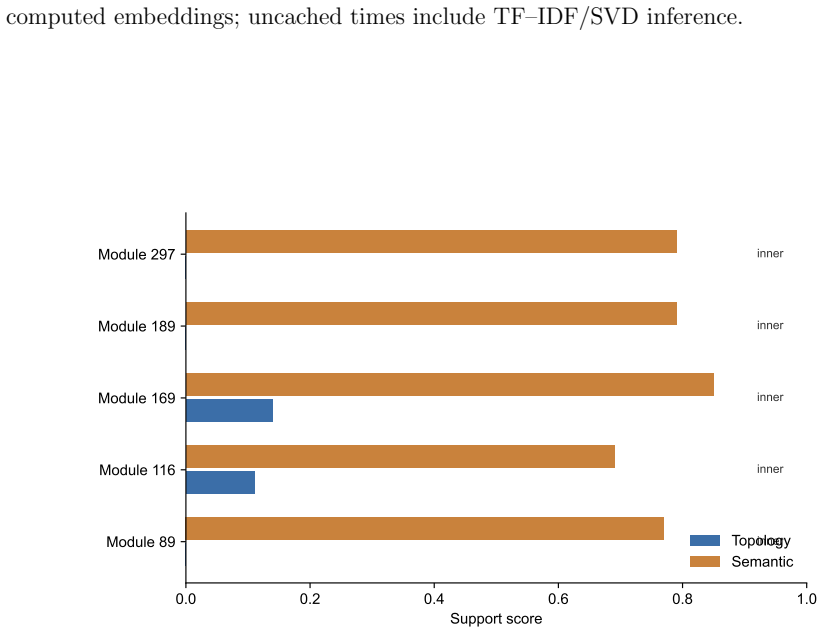
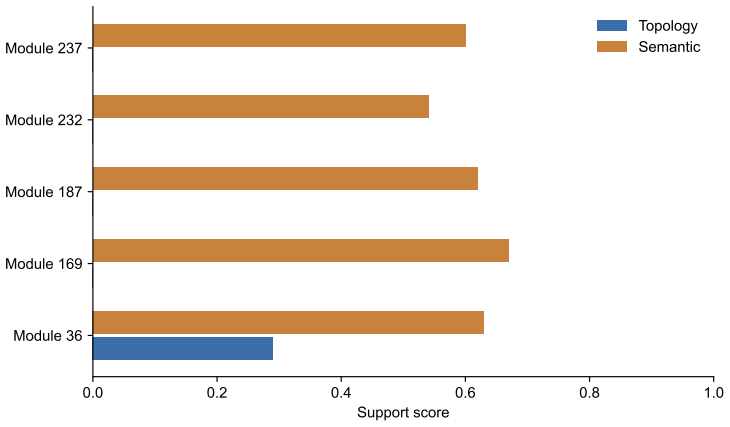
- Each assignment carries explicit topology, semantic and Gene Ontology scores for inspection.
- Hierarchical confidence labels allow ranking and triage of predictions by curators.
- The outputs become reproducible and auditable for biological interpretation tasks.
Where Pith is reading between the lines
- The same evidence-bundling pattern could be applied to other noisy biological or social networks where assignments need audit trails.
- Curators could use the confidence tiers to decide which modules receive priority for targeted wet-lab follow-up.
- The framework illustrates a practical way to add interpretability without sacrificing the core overlap-detection capability.
Load-bearing premise
The integration of weighted network topology, semantic protein profiles, and Gene Ontology evidence produces biologically meaningful evidence-potential nuclei and overlap-aware assignments whose confidence labels reflect actual reliability rather than just internal consistency of the scoring rules.
What would settle it
Independent experiments that find no correlation between the exported hierarchical confidence labels and measured functional coherence or experimental validation success rates of the assigned modules would falsify the reliability claim.
Figures






read the original abstract
Protein-protein interaction networks provide a graph-level view of cellular organization, yet their functional modules are overlapping, noisy, and difficult to interpret from cluster assignments alone. Existing community-detection methods can recover candidate protein complexes, but they rarely explain why an individual protein is assigned to a specific module or whether that assignment should be treated as core, peripheral, or uncertain. Here we introduce ECHO-PPI, an evidence-bundled framework for interpretable overlapping protein-module detection in protein-protein interaction networks. ECHO-PPI integrates weighted network topology, semantic protein profiles, and Gene Ontology evidence to identify evidence-potential nuclei, construct candidate modules, perform overlap-aware assignment, and export hierarchical confidence labels. The framework supports trustworthy computational decision support through assignment-level interpretability: each protein-module assignment is accompanied by topology, semantic, and Gene Ontology evidence scores and a hierarchical confidence label, enabling curators to inspect, rank, and triage overlapping module predictions. Evaluation on yeast protein-interaction data shows that ECHO-PPI preserves the behaviour of strong overlap-aware baselines while adding evidence-bundled auditability. Rather than claiming universal predictive superiority, ECHO-PPI addresses a complementary need: making overlapping protein-module predictions inspectable, confidence-aware, and reproducible for downstream biological interpretation.
Editorial analysis
A structured set of objections, weighed in public.
Referee Report
Summary. The manuscript presents ECHO-PPI, an evidence-bundled framework for interpretable overlapping protein-module detection in PPI networks. It integrates weighted network topology, semantic protein profiles, and Gene Ontology evidence to identify evidence-potential nuclei, construct candidate modules, perform overlap-aware assignment, and export hierarchical confidence labels. The central claim is that this assignment-level interpretability (topology, semantic, and GO evidence scores plus confidence labels) enables trustworthy curator triage and decision support while preserving the behavior of strong overlap-aware baselines on yeast data, without claiming universal predictive superiority.
Significance. If the integrated evidence scores and hierarchical labels are externally validated, the work addresses a genuine practical gap in network module detection by prioritizing inspectability and auditability over raw accuracy gains. This complementary focus on reproducible, confidence-aware outputs is a strength for downstream biological use.
major comments (2)
- [Abstract] Abstract: the statement that evaluation on yeast data 'preserves the behaviour of strong overlap-aware baselines while adding evidence-bundled auditability' supplies no quantitative metrics, comparison tables, error analysis, or derivation of the evidence scores. This is load-bearing for the trustworthiness claim, as it leaves unverified whether the interpretability layer maintains detection quality.
- [Evaluation] Evaluation section: no calibration, correlation with gold-standard complexes, or curator study is described to test whether hierarchical confidence labels reflect actual biological reliability rather than internal consistency of the three evidence sources. This directly affects the central claim that the labels enable trustworthy triage.
minor comments (1)
- [Abstract] The term 'evidence-potential nuclei' is introduced in the abstract without a concise definition or pointer to its algorithmic formalization.
Simulated Author's Rebuttal
We thank the referee for the constructive comments highlighting the need for clearer quantitative support in the abstract and stronger validation of the confidence labels. We address each point below and will revise the manuscript accordingly to better substantiate the interpretability claims while remaining accurate about the scope of our evaluation.
read point-by-point responses
-
Referee: [Abstract] Abstract: the statement that evaluation on yeast data 'preserves the behaviour of strong overlap-aware baselines while adding evidence-bundled auditability' supplies no quantitative metrics, comparison tables, error analysis, or derivation of the evidence scores. This is load-bearing for the trustworthiness claim, as it leaves unverified whether the interpretability layer maintains detection quality.
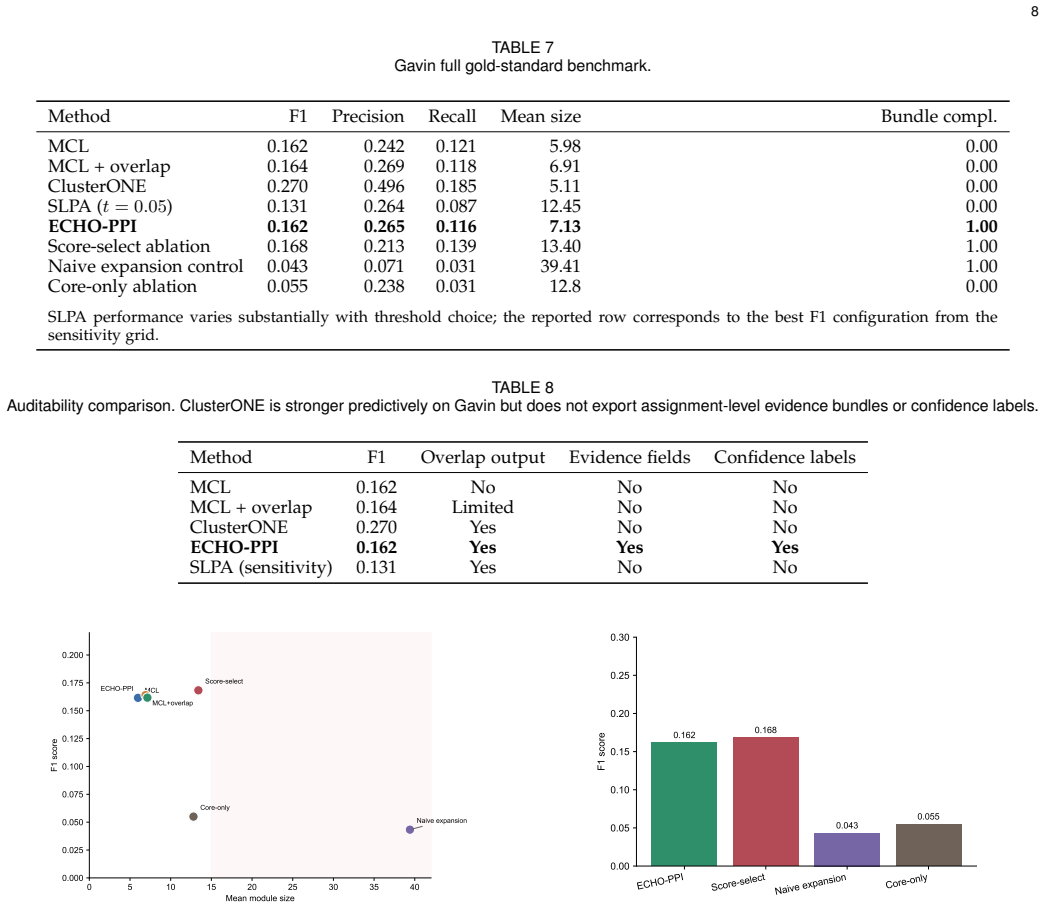
Authors: We agree the abstract is too terse on this point. The full evaluation section reports quantitative results on yeast PPI data, including preservation of overlap-aware performance metrics (e.g., comparable F1 and coverage scores to strong baselines such as ClusterONE and LinkComm) alongside the added evidence scores. We will revise the abstract to include a concise summary of these metrics and note that evidence-score derivation is detailed in Methods. This change will make the preservation claim verifiable directly from the abstract without altering the paper's emphasis on auditability rather than superiority. revision: yes
-
Referee: [Evaluation] Evaluation section: no calibration, correlation with gold-standard complexes, or curator study is described to test whether hierarchical confidence labels reflect actual biological reliability rather than internal consistency of the three evidence sources. This directly affects the central claim that the labels enable trustworthy triage.
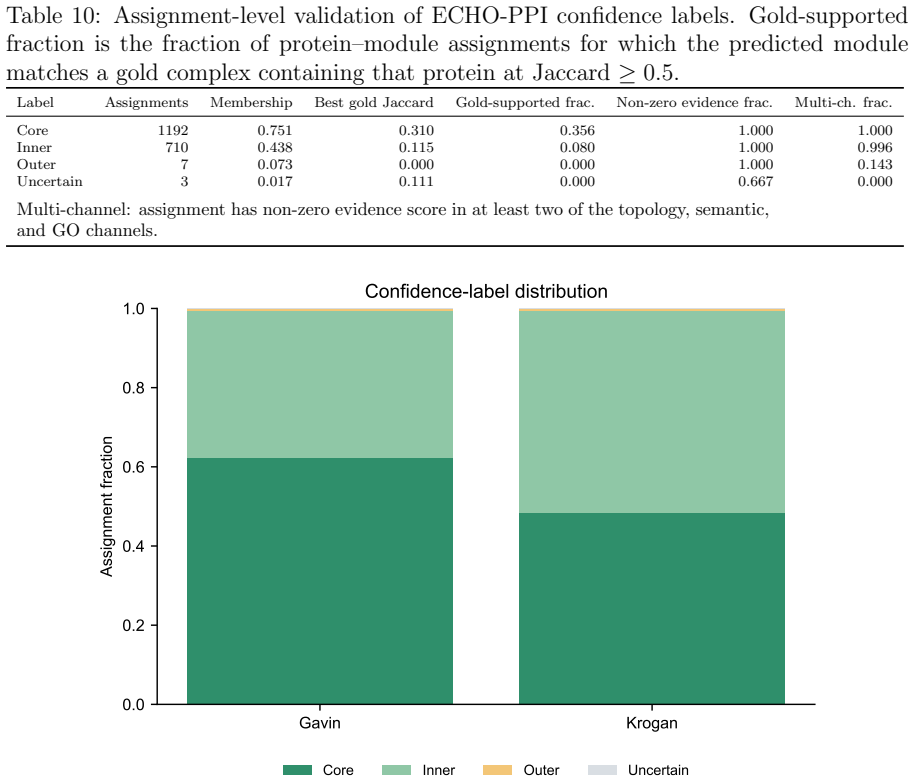
Authors: The labels are explicitly defined as an aggregation of the three internal evidence sources (topology, semantic profiles, GO), so they measure evidential support and consistency rather than external biological ground truth. We acknowledge that additional calibration against gold-standard complexes or a curator study would provide stronger external validation for the triage claim. In revision we will (i) add a correlation analysis between confidence labels and known yeast complexes where data are available and (ii) explicitly discuss this as a limitation, positioning external validation as future work. A full curator study lies outside the current scope and resources. revision: partial
Circularity Check
No significant circularity; framework is an integration without self-referential derivations
full rationale
The provided abstract and description present ECHO-PPI as an integration of weighted network topology, semantic profiles, and Gene Ontology evidence to produce nuclei, modules, assignments, and confidence labels. No equations, fitted parameters, self-citations, or uniqueness theorems are described. The evaluation claim is that it preserves baseline behavior while adding auditability on yeast data, with no reduction of any prediction or label to internal arithmetic by construction. The derivation chain is therefore self-contained as a composite method rather than a closed loop.
Axiom & Free-Parameter Ledger
axioms (1)
- domain assumption Gene Ontology annotations provide independent evidence that can be combined with network topology to assess module assignment quality
invented entities (1)
-
evidence-potential nuclei
no independent evidence
Forward citations
Cited by 1 Pith paper
-
Evidence-Aware Protein Complex Detection: Methods, Benchmarks, and Reproducibility Challenges
A methodological review of post-2018 evidence-aware protein complex detection methods concludes that transparent graph-based approaches offer the best plausibility-reproducibility tradeoff while calling for harmonized...
Reference graph
Works this paper leans on
-
[1]
String v11: protein–protein association networks with increased coverage,
D. Szklarczyk, A. L. Gable, D. Lyonet al., “String v11: protein–protein association networks with increased coverage,”Nucleic Acids Research, vol. 47, no. D1, pp. D607–D613, 2019
2019
-
[2]
Proteome survey reveals modularity of the yeast cell machinery,
A.-C. Gavin, P. Aloy, P. Grandiet al., “Proteome survey reveals modularity of the yeast cell machinery,”Nature, vol. 440, no. 7084, pp. 631–636, 2006
2006
-
[3]
Global landscape of protein complexes in the yeastSaccharomyces cerevisiae,
N. J. Krogan, G. Cagney, H. Yuet al., “Global landscape of protein complexes in the yeastSaccharomyces cerevisiae,”Nature, vol. 440, no. 7084, pp. 637–643, 2006
2006
-
[4]
The EBI Complex Portal: a resource of macromolecular complexes,
B. H. M. Meldal, H. Bye-A-Jee, L. Gajdoˇ set al., “The EBI Complex Portal: a resource of macromolecular complexes,”Nucleic Acids Research, vol. 50, no. D1, pp. D578–D586, 2022
2022
-
[5]
Uncovering the overlapping com- munity structure of complex networks in nature and society,
G. Palla, I. Der´ enyi, I. J. Farkas, and T. Vicsek, “Uncovering the overlapping com- munity structure of complex networks in nature and society,”Nature, vol. 435, no. 7043, pp. 814–818, 2005
2005
-
[6]
Link communities reveal multiscale complexity in networks,
Y.-Y. Ahn, J. P. Bagrow, and S. Lehmann, “Link communities reveal multiscale complexity in networks,”Nature, vol. 466, no. 7307, pp. 761–764, 2010
2010
-
[7]
Graph clustering by flow simulation,
S. van Dongen, “Graph clustering by flow simulation,” Ph.D. dissertation, University of Utrecht, 2000
2000
-
[8]
An efficient algorithm for large-scale detection of protein families,
A. J. Enright, S. Van Dongen, and C. A. Ouzounis, “An efficient algorithm for large-scale detection of protein families,”Nucleic Acids Research, vol. 30, no. 7, pp. 1575–1584, 2002
2002
-
[9]
CFinder: locating cliques and overlapping modules in biological networks,
B. Adamcsek, G. Palla, I. J. Farkas, I. Der´ enyi, and T. Vicsek, “CFinder: locating cliques and overlapping modules in biological networks,”Bioinformatics, vol. 22, no. 8, pp. 1021–1023, 2006. 28
2006
-
[10]
Detecting overlapping protein complexes from protein–protein interaction networks,
T. Nepusz, H. Yu, and A. Paccanaro, “Detecting overlapping protein complexes from protein–protein interaction networks,”Bioinformatics, vol. 28, no. 18, pp. i429–i437, 2012
2012
-
[11]
An automated method for finding molecular complexes in large protein interaction networks,
G. D. Bader and C. W. V. Hogue, “An automated method for finding molecular complexes in large protein interaction networks,”BMC Bioinformatics, vol. 4, p. 2, 2003
2003
-
[12]
Sentence-BERT: Sentence embeddings using siamese BERT-networks,
N. Reimers and I. Gurevych, “Sentence-BERT: Sentence embeddings using siamese BERT-networks,” inProceedings of the 2019 Conference on Empirical Methods in Natural Language Processing, 2019, pp. 3982–3992
2019
-
[13]
Gene ontology: tool for the unification of biology,
M. Ashburner, C. A. Ball, J. A. Blakeet al., “Gene ontology: tool for the unification of biology,”Nature Genetics, vol. 25, no. 1, pp. 25–29, 2000
2000
-
[14]
The gene ontology resource: enriching a GOLD mine,
G. O. Consortiumet al., “The gene ontology resource: enriching a GOLD mine,” Nucleic Acids Research, vol. 49, no. D1, pp. D325–D334, 2021
2021
-
[15]
The black hole strategy: Gravity-based representative sampling for frugal graph learning on metal–organic framework networks,
M. Jalali, A. D. D. Wonanke, P. Friederich, and C. W¨ oll, “The black hole strategy: Gravity-based representative sampling for frugal graph learning on metal–organic framework networks,”Journal of Chemical Information and Modeling, vol. 65, no. 20, pp. 10 885–10 902, 2025
2025
-
[16]
Comparative assessment of large-scale data sets of protein–protein interactions,
C. von Mering, R. Krause, B. Snel, M. Cornell, S. G. Oliver, S. Fields, and P. Bork, “Comparative assessment of large-scale data sets of protein–protein interactions,” Nature, vol. 417, no. 6887, pp. 399–403, 2002
2002
-
[17]
BioGRID: a general repository for interaction datasets,
C. Stark, B.-J. Breitkreutz, T. Reguly, L. Boucher, A. Breitkreutz, and M. Tyers, “BioGRID: a general repository for interaction datasets,”Nucleic Acids Research, vol. 34, no. Database issue, pp. D535–D539, 2006
2006
-
[18]
Up-to-date catalogues of yeast protein complexes,
S. Pu, J. Wong, B. Turner, E. Cho, and S. J. Wodak, “Up-to-date catalogues of yeast protein complexes,”Nucleic Acids Research, vol. 37, no. 3, pp. 825–831, 2009
2009
-
[19]
CORUM: the comprehensive resource of mammalian protein complexes–2019,
M. Giurgiu, J. Reinhard, B. Brauner, I. Dunger-Kaltenbach, G. Fobo, G. Frishman, C. Montrone, and A. Ruepp, “CORUM: the comprehensive resource of mammalian protein complexes–2019,”Nucleic Acids Research, vol. 47, no. D1, pp. D559–D563, 2019
2019
-
[20]
Evaluation of clustering algorithms for protein–protein interaction networks,
S. Brohee and J. van Helden, “Evaluation of clustering algorithms for protein–protein interaction networks,”BMC Bioinformatics, vol. 7, p. 488, 2006
2006
-
[21]
Evaluation of network cluster- ing methods for protein–protein interaction networks,
S. Pu, J. Wong, B. Turner, E. Cho, and S. J. Wodak, “Evaluation of network cluster- ing methods for protein–protein interaction networks,”BMC Bioinformatics, vol. 20, p. 58, 2019
2019
-
[22]
A review on efficient and scalable graph-based clustering algorithms for protein complex identification in PPI networks,
S. Patra and T. R. Sahoo, “A review on efficient and scalable graph-based clustering algorithms for protein complex identification in PPI networks,”Proteins: Structure, Function, and Bioinformatics, vol. 94, pp. 477–501, 2026. 29
2026
-
[23]
PRING: Rethinking protein-protein interaction prediction from pairs to graphs,
X. Zheng, H. Du, F. Xu, J. Li, Z. Liu, W. Wang, T. Chen, W. Ouyang, S. Z. Li, Y. Lu, N. Dong, and Y. Zhang, “PRING: Rethinking protein-protein interaction prediction from pairs to graphs,” inAdvances in Neural Information Processing Systems, Datasets and Benchmarks Track, 2025
2025
-
[24]
Fast unfolding of communities in large networks,
V. D. Blondel, J.-L. Guillaume, R. Lambiotte, and E. Lefebvre, “Fast unfolding of communities in large networks,”Journal of Statistical Mechanics: Theory and Experiment, vol. 2008, no. 10, p. P10008, 2008
2008
-
[25]
From Louvain to Leiden: guaranteeing well-connected communities,
V. A. Traag, L. Waltman, and N. J. van Eck, “From Louvain to Leiden: guaranteeing well-connected communities,”Scientific Reports, vol. 9, p. 5233, 2019
2019
-
[26]
Detecting the overlapping and hier- archical community structure in complex networks,
A. Lancichinetti, S. Fortunato, and J. Kert´ esz, “Detecting the overlapping and hier- archical community structure in complex networks,”New Journal of Physics, vol. 11, no. 3, p. 033015, 2009
2009
-
[27]
SLPA: Uncovering overlapping communities in social networks via a speaker-listener interaction dynamic process,
J. Xie, B. K. Szymanski, and X. Liu, “SLPA: Uncovering overlapping communities in social networks via a speaker-listener interaction dynamic process,” inProceedings of the IEEE International Conference on Data Mining Workshops, 2011, pp. 344–349
2011
-
[28]
Extending the definition of modularity to directed graphs with overlapping communities,
V. Nicosia, G. Mangioni, V. Carchiolo, and M. Malgeri, “Extending the definition of modularity to directed graphs with overlapping communities,”Journal of Statistical Mechanics: Theory and Experiment, vol. 2009, no. 03, p. P03024, 2009
2009
-
[29]
RDS: A ReCIPE for overlap- ping community detection in biological networks,
F. Ocitti, C. Versavel, S. Sledzieski, and L. Cowen, “RDS: A ReCIPE for overlap- ping community detection in biological networks,” inProceedings of the 16th ACM International Conference on Bioinformatics, Computational Biology, and Health In- formatics, 2025, pp. 1–6
2025
-
[30]
A survey on overlapping community detection: label propagation,
S. Goswami and A. K. Singh, “A survey on overlapping community detection: label propagation,”Multimedia Tools and Applications, vol. 84, pp. 32 563–32 592, 2025
2025
-
[31]
Overlapping community detection with a new modularity measure in directed weighted networks,
A. Kumar, A. Kumari, P. Kumar, and R. Dohare, “Overlapping community detection with a new modularity measure in directed weighted networks,”Data Mining and Knowledge Discovery, vol. 39, no. 6, p. 77, 2025
2025
-
[32]
Exploiting indirect neighbours and topo- logical weight to predict protein function from protein–protein interactions,
H. N. Chua, W.-K. Sung, and L. Wong, “Exploiting indirect neighbours and topo- logical weight to predict protein function from protein–protein interactions,”Bioin- formatics, vol. 22, no. 13, pp. 1623–1630, 2006
2006
-
[33]
Improving the performance of evolutionary- based complex detection models using gene ontology-based mutation operator in protein-protein interaction networks,
M. Abbas, D. Broneske, and G. Saake, “Improving the performance of evolutionary- based complex detection models using gene ontology-based mutation operator in protein-protein interaction networks,” inIntelligent Systems and Applications, ser. Lecture Notes in Networks and Systems, K. Arai, Ed. Cham: Springer, 2025, vol. 1553, pp. 512–528
2025
-
[34]
A novel GAER-GMM framework for overlapping protein complex detection in protein interaction networks,
J. Tu, R. Li, X. Gao, and L. Ma, “A novel GAER-GMM framework for overlapping protein complex detection in protein interaction networks,”IEEE Transactions on Computational Biology and Bioinformatics, vol. 22, no. 6, pp. 3486–3499, 2025. 30
2025
-
[35]
On the permanence of vertices in network communities,
T. Chakraborty, S. Srinivasan, N. Ganguly, A. Mukherjee, and S. Bhowmick, “On the permanence of vertices in network communities,” inProceedings of the 20th ACM SIGKDD International Conference on Knowledge Discovery and Data Mining, 2014, pp. 1396–1405. 31
2014
discussion (0)
Sign in with ORCID, Apple, or X to comment. Anyone can read and Pith papers without signing in.