Topics in Symplectic Dynamics: Barcode Entropy
Pith reviewed 2026-06-29 19:15 UTC · model grok-4.3
The pith
Barcode entropy is defined as the exponential growth rate of not-too-short bars in Floer or symplectic homology persistence modules for Hamiltonian systems.
A machine-rendered reading of the paper's core claim, the machinery that carries it, and where it could break.
Core claim
Barcode entropy is an invariant of a Hamiltonian system -- a Hamiltonian diffeomorphism or a Reeb flow -- measuring its Morse or Floer theoretic complexity at a small scale. More specifically, it is the exponential growth rate of the number of not-too-short bars in the Floer or symplectic homology persistence module. Barcode entropy is closely related to topological entropy, even though they originate in different contexts, and in low dimensions they coincide.
What carries the argument
Barcode entropy, the exponential growth rate of the number of not-too-short bars in the Floer or symplectic homology persistence module.
If this is right
- Barcode entropy supplies a symplectic-topological measure of complexity that can be compared directly with topological entropy.
- The two quantities coincide for all such systems in low dimensions.
- The invariant extends to a range of Hamiltonian and Reeb settings and connects algebraic persistence data to dynamical features.
- Related invariants built from the same persistence modules can be studied with the same methods.
Where Pith is reading between the lines
- The construction may allow bounds on topological entropy to be read off from filtered Floer homology without computing orbit growth directly.
- In higher dimensions the two entropies could diverge, giving a new way to distinguish algebraic from metric complexity.
- The same bar-counting technique might apply to other filtered homologies that detect periodic orbits or Reeb chords.
Load-bearing premise
The bar-length distribution in the Floer or symplectic homology persistence module yields an invariant whose exponential growth rate meaningfully captures dynamical complexity and can be compared to topological entropy.
What would settle it
A concrete Hamiltonian diffeomorphism or Reeb flow in dimension two or three for which the computed growth rate of long bars in the persistence module differs from the topological entropy of the map or flow.
Figures
read the original abstract
Barcode entropy is an invariant of a Hamiltonian system -- a Hamiltonian diffeomorphism or a Reeb flow -- measuring its Morse or Floer theoretic complexity at a small scale. More specifically, it is the exponential growth rate of the number of not-too-short bars in the Floer or symplectic homology persistence module. Barcode entropy is closely related to topological entropy, even though they originate in different contexts, and in low dimensions they coincide. In these notes, we study barcode entropy and related invariants in various settings and explore their connections with pure dynamics features and, in particular, topological entropy. The methods build on techniques from symplectic topology and Floer theory, dynamical systems, and smooth integral geometry. We also touch upon some other applications of the machinery we develop. These notes are based on the mini-course given by the second author at the CIME summer school "Symplectic Dynamics and Topology" (Cetraro, Italy, June 16-20, 2025).
Editorial analysis
A structured set of objections, weighed in public.
Referee Report
Summary. The manuscript consists of lecture notes on barcode entropy, an invariant of Hamiltonian diffeomorphisms and Reeb flows defined as the exponential growth rate of the number of not-too-short bars in the associated Floer or symplectic homology persistence module. The notes examine this quantity across settings, its relations to topological entropy (including coincidence in low dimensions), and connections to dynamical features, drawing on symplectic topology, Floer theory, dynamical systems, and integral geometry. The material originates from a 2025 CIME mini-course.
Significance. If the invariance properties and low-dimensional coincidence with topological entropy are established, barcode entropy supplies a new Floer-theoretic measure of small-scale dynamical complexity that could bridge algebraic invariants and classical dynamics. The notes' systematic exploration of the construction in multiple contexts and its potential applications represent a useful contribution to symplectic dynamics.
minor comments (3)
- The abstract states the definition and low-dimensional coincidence but does not indicate which specific theorems or comparisons receive detailed proofs in the body; adding a short outline of the main results would improve navigability for readers.
- Notation for the persistence module and bar-length filtration should be introduced with a single consolidated definition early in the notes rather than piecemeal across sections, to avoid ambiguity when comparing different settings (Hamiltonian diffeomorphisms vs. Reeb flows).
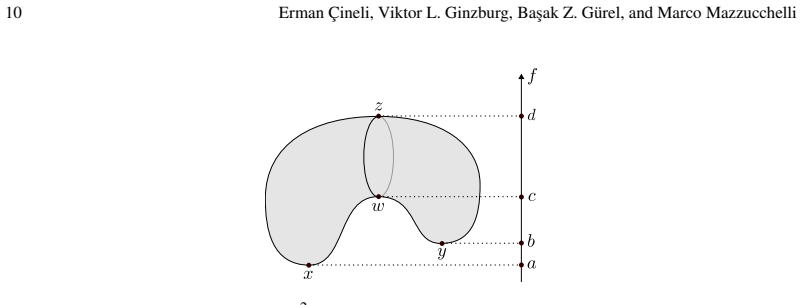
- Several figures illustrating barcodes or persistence diagrams are referenced but lack captions that explicitly connect the visual to the growth-rate formula; adding such captions would aid clarity.
Simulated Author's Rebuttal
We thank the referee for their positive summary and significance assessment of the lecture notes on barcode entropy, as well as the recommendation for minor revision. No specific major comments were provided in the report.
Circularity Check
No significant circularity; definition is the starting point
full rationale
The paper is a set of lecture notes that introduces barcode entropy explicitly by definition as the exponential growth rate of not-too-short bars in Floer/symplectic homology persistence modules. This definition serves as the central object of study rather than emerging from a derivation that reduces to its own inputs, fitted parameters, or self-citation chains. Relations to topological entropy are explored as comparisons in specific settings (e.g., low dimensions), not forced equivalences. No load-bearing step matches any enumerated circularity pattern; the construction is self-contained against external benchmarks from symplectic topology and dynamics. Minor self-citations are expected in lecture notes but do not render the core invariant circular.
Axiom & Free-Parameter Ledger
axioms (1)
- standard math Standard properties of Floer homology and persistence modules hold in the relevant symplectic settings
invented entities (1)
-
Barcode entropy
no independent evidence
Forward citations
Cited by 1 Pith paper
-
Filtered Symplectic Homology and Closed Reeb Orbits
For star-shaped domains, S¹-equivariant spectral invariants are bounded in positive characteristic, filtered symplectic homology dimension is bounded for pseudo-rotations, and non-degenerate Reeb flows with a negative...
Reference graph
Works this paper leans on
-
[1]
A2S2. A. Abbondandolo, M.R.R. Alves, M. Sağlam, F. Schlenk, Entropy collapse versus entropy rigidity for Reeb and Finsler flows,Selecta Math. (NS)29(2023), Article No
2023
-
[2]
ABE. A. Abbondandolo, G. Benedetti, O. Edtmair, Symplectic capacities of domains close to the ball and Banach–Mazur geodesics in the space of contact forms,Duke Math. J.,174(2025), 1567–1646. Abu. M. Abouzaid, Symplectic cohomology and Viterbo’s theorem, inFree loop spaces in geometry and topology, 271–485. IRMA Lect. Math. Theor. Phys., 24 European Mathe...
2025
-
[3]
Ah. J. Ahn, Barcode entropy and relative symplectic cohomology, Preprint arXiv:2601.15606. All. S. Allais, On periodic points of Hamiltonian diffeomorphisms ofCP 𝑑 via generating functions,J. Sym- plectic Geom.,20(2022), 1–48. APF98. J.C. Álvarez Paiva, E. Fernandes, Crofton formulas in projective Finsler spaces,Electron. Res. Announc. Amer. Math. Soc.,4(...
-
[4]
M.R.R.Alves,LegendriancontacthomologyandtopologicalentropyJ.Topol.Anal.,11(2019),53–108
Al19. M.R.R.Alves,LegendriancontacthomologyandtopologicalentropyJ.Topol.Anal.,11(2019),53–108. ACH. M.R.R.Alves,V.Colin,K.Honda,TopologicalentropyforReebvectorfieldsindimensionthreeviaopen book decompositions,J. Éc. polytech. Math.,6(2019), 119–148. ADM2. M.R.R. Alves, L. Dahinden, M. Meiwes, L. Merlin𝐶 0-Robustness of topological entropy for geodesic flo...
-
[5]
Ar90a. V.I. Arnold, Dynamics of complexity of intersections,Bol. Soc. Brasil. Mat. (N.S.),21(1990), 1–10. Ar90b. V.I. Arnold, Dynamics of intersections,Analysis, et cetera, 77–84, Academic Press, Boston, MA,
1990
-
[6]
As. M. Asaoka, Abundance of fast growth of the number of periodic points in 2-dimensional area-preserving dynamics,Comm. Math. Phys.,356(2017), 1–17. ACW. A. Avila, S. Crovisier, A. Wilkinson,𝐶 1 density of stable ergodicity,Adv. Math.,379(2021), Paper No. 107496, 68 pp. BL. H. Bae, S. Lee, A comparison of categorical and topological entropies on Weinstei...
-
[7]
G.Carlsson,A.Zomorodian,A.Collins,L.Guibas,Persistencebarcodesforshapes,Int.J.ShapeModel., 11(2005), 149–187
CZCG. G.Carlsson,A.Zomorodian,A.Collins,L.Guibas,Persistencebarcodesforshapes,Int.J.ShapeModel., 11(2005), 149–187. Ce. L. Cesari,Surface Area, Princeton University Press, Princeton, NJ,
2005
-
[8]
Ch. Yu.V. Chekanov, Lagrangian intersections, symplectic energy, and areas of holomorphic curves,Duke Math. J.,95(1998), 213–226. CFH. K. Cieliebak, A. Floer, H. Hofer, Symplectic homology II: A general construction,Math. Z.,218(1995), 103–122. CFHW. K. Cieliebak, A. Floer, H. Hofer, K. Wysocki, Applications of symplectic homology II: Stability of the act...
work page internal anchor Pith review Pith/arXiv arXiv doi:10.1112/blms.70021 1998
-
[9]
x+120 pp. CSEHM. D.Cohen-Steiner,H.Edelsbrunner,J.Harer,Y.Mileyko,Lipschitzfunctionshave𝐿 𝑝-stablepersistence, Found. Comput. Math., 10 (2010), 127–139. Topics in Symplectic Dynamics: Barcode Entropy 63 CDHR. V. Colin, P. Dehornoy, U. Hryniewicz, A. Rechtman, Generic properties of 3-dimensional Reeb flows: Birkhoff sections and entropy, Preprint arXiv:220...
-
[10]
Fr96. J. Franks, Area preserving homeomorphisms of open surfaces of genus zero,New York Jour. of Math.,2 (1996), 1–19. Fr99. J. Franks, The Conley index and non-existence of minimal homeomorphisms. Proceedings of the Con- ference on Probability, Ergodic Theory, and Analysis (Evanston, IL, 1997).Illinois J. Math.,43(1999), 457–464. FrHa. J. Franks, M. Hand...
1996
-
[11]
U.Frauenfelder,V.L.Ginzburg,F.Schlenk,Energycapacityinequalitiesviaanactionselector,Contemp
FGS. U.Frauenfelder,V.L.Ginzburg,F.Schlenk,Energycapacityinequalitiesviaanactionselector,Contemp. Math.,387, Israil Math. Conf. Proc., American Mathematical Society, RI, 2005, 129–152. FrLS. U. Frauenfelder, C. Labrousse, F. Schlenk, Slow volume growth for Reeb flows on spherizations and contact Bott–Samelson theorems,J. Topol. Anal.,7(2015), 407–451. FS0...
2005
-
[12]
GeSm. I.M. Gelfand, M.M. Smirnov, Lagrangians satisfying Crofton formulas, Radon transforms, and nonlocal differentials,Adv. Math.,109(1994), 188–227. G209. V.L.Ginzburg,B.Z.Gürel,ActionandindexspectraandperiodicorbitsinHamiltoniandynamics,Geom. Topol.,13(2009), 2745–2805. G214. V.L. Ginzburg, B.Z. Gürel, Hyperbolic fixed points and periodic orbits of Ham...
1994
-
[13]
G2M. V.L. Ginzburg, B.Z. Gürel, M. Mazzucchelli, Barcode entropy of geodesic flows,J. Eur. Math. Soc. (JEMS), doi: 10.4171/JEMS/1572; First online: 13 Dec
-
[14]
GuSt. V. Guillemin, S. Sternberg, The moment map revisited,J. Differential Geom.,69(2005), 137–162. Gu. J. Gutt, The positive equivariant symplectic homology as an invariant for some contact manifolds,J. Symplectic Geom.,15(2017), 1019–1069. GH. J. Gutt, M. Hutchings, Symplectic capacities from positive𝑆 1-equivariant symplectic homology,Algebr. Geom. Top...
2005
-
[15]
Hum. V. Humilière, On some completions of the space of Hamiltonian maps,Bull. Soc. Math. France,136 (2008), 373–404. HLS. V.Humilière,R.Leclercq,S.Seyfaddini,Reductionofsymplectichomeomorphisms,Ann.Sci.Éc.Norm. Supér. (4),49(2016), 633–668. Hu16. M. Hutchings, Beyond ECH capacities,Geom. Topol.,20(2016), 1085–1126. Hu24. M. Hutchings, Zeta functions of dy...
work page internal anchor Pith review Pith/arXiv arXiv 2008
-
[16]
KT. A. Katok, J.P. Thouvenot, Slow entropy type invariants and smooth realization of commuting measure- preserving transformations,Ann. Inst. H. Poincaré Probab. Statist.,33(1997), 323–338. KS. A. Kislev, E. Shelukhin, Bounds on spectral norms and barcodes,Geom. Topol.,25(2021), 3257–3350. KLCN. A.Koropecki,P.LeCalvez,M.Nassiri,Primeendsrotationnumbersand...
1997
-
[17]
Me18. M. Meiwes,Rabinowitz Floer Homology, Leafwise Intersections, and Topological Entropy, Inau- gural Dissertation zur Erlangung der Doktorwürde der Naturwissenschaftlich – Mathematischen Gesamtfakultät der Ruprecht – Karls – Universität Heidelberg, 2018; available at http://www.ub.uni- heidelberg.de/archiv/24153. Me24. M. Meiwes, Relative barcode entro...
-
[18]
P2S. I. Polterovich, L. Polterovich, V. Stojisavljević, Persistence barcodes and Laplace eigenfunctions on surfaces,Geom. Dedicata,201(2019), 111–138. Po93. L. Polterovich, Symplectic displacement energy for Lagrangian submanifolds,Ergodic Theory Dynam. Systems,13(1993), 357–367. Po01. L.Polterovich,TheGeometryoftheGroupofSymplecticDiffeomorphisms,Lecture...
2019
-
[19]
L.Polterovich,E.Shelukhin,AutonomousHamiltonianflows,Hofer’sgeometryandpersistencemodules, Selecta Math
PS. L.Polterovich,E.Shelukhin,AutonomousHamiltonianflows,Hofer’sgeometryandpersistencemodules, Selecta Math. (N.S.)22(2016), 227–296. PRSZ. L. Polterovich, D. Rosen, K. Samvelyan, J. Zhang,Topological Persistence in Geometry and Analysis, University Lecture Series, vol. 74, Amer. Math. Soc., Providence, RI,
2016
-
[20]
D.A.Salamon,LecturesonFloerhomology.InSymplecticGeometryandTopology,IAS/ParkCityMath
Sa. D.A.Salamon,LecturesonFloerhomology.InSymplecticGeometryandTopology,IAS/ParkCityMath. Ser., vol. 7, Amer. Math. Soc., Providence, RI, 1999, 143–229. SaZe. D. Salamon, E. Zehnder, Morse theory for periodic solutions of Hamiltonian systems and the Maslov index,Comm. Pure Appl. Math.,45(1992), 1303–1360. Sc. M.Schwarz,Ontheactionspectrumforclosedsymplect...
1999
-
[21]
Sh22. E. Shelukhin, On the Hofer–Zehnder conjecture,Ann. of Math. (2),195(2022), 775–839. StZh. V. Stojisavljević, J. Zhang, Persistence modules, symplectic Banach–Mazur distance and Riemannian metrics,Internat. J. Math.,32(2021), Paper No. 2150040, 76 pp. Su. Y. Sugimoto, On the generic Conley conjecture,Arch. Math.,117(2021), 423–432. Us08. M. Usher, Sp...
2022
-
[22]
Ginzburg, Başak Z
66 Erman Çineli, Viktor L. Ginzburg, Başak Z. Gürel, and Marco Mazzucchelli UZ. M.Usher,J.Zhang,PersistenthomologyandFloer–Novikovtheory,Geom.Topol.,20(2016),3333–3430, Vi92. C. Viterbo, Symplectic topology as the geometry of generating functions,Math. Ann.,292(1992), 685–
2016
-
[23]
Vi99. C. Viterbo, Functors and computations in Floer cohomology, I,Geom. Funct. Anal.,9(1999), 985–1033. Vi00. C. Viterbo, Metric and isoperimetric problems in symplectic geometry.J. Amer. Math. Soc.,13(2000), 411–431. Yo. Y. Yomdin, Volume growth and entropy,Israel J. Math.,57(1987), 285–300. ZC. A.Zomorodian,G.Carlsson,Computingpersistenthomology,Discre...
1999
-
[24]
Zu. N.T. Zung, Non-degenerate singularities of integrable dynamical systems,Ergodic Theory Dynam. Sys- tems,35(2015), 994–1008
2015
discussion (0)
Sign in with ORCID, Apple, or X to comment. Anyone can read and Pith papers without signing in.