Tail observability and fourth-order closure recovery in physics-informed neural networks for Bhatnagar-Gross-Krook normal shocks
Pith reviewed 2026-06-29 05:58 UTC · model grok-4.3
The pith
A shock-local correction aligned with unobserved tail-weighted cancellation reduces relative R_xx^cl error to 0.112 in PINN BGK Mach-2 shocks while preserving lower moments.
A machine-rendered reading of the paper's core claim, the machinery that carries it, and where it could break.
Core claim
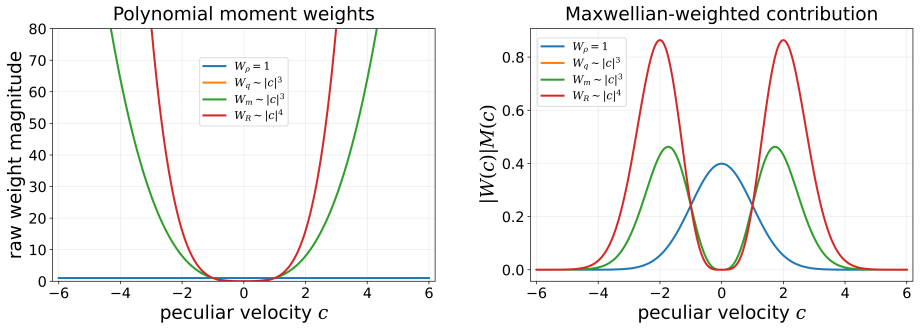
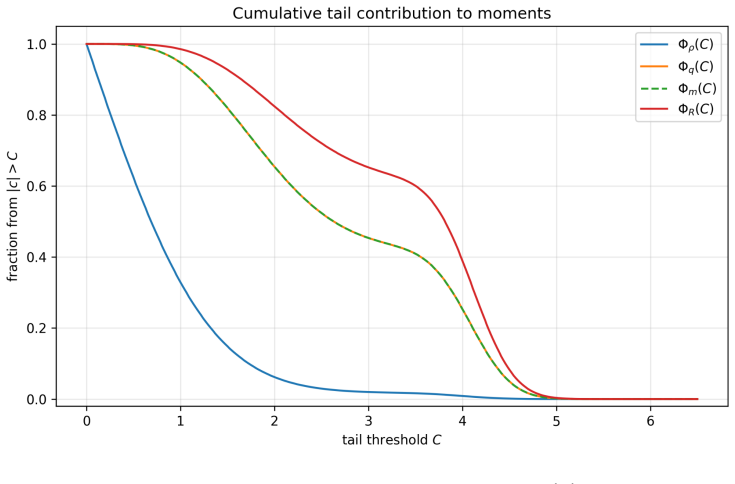
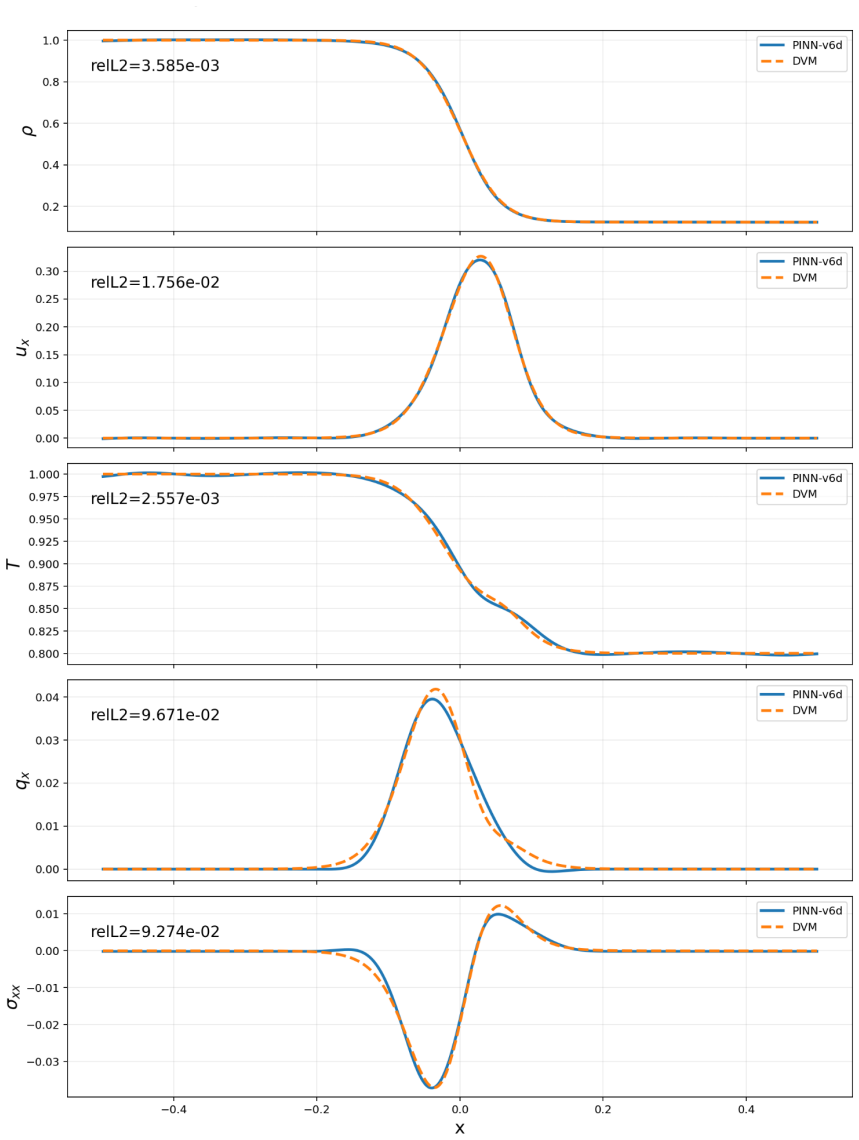
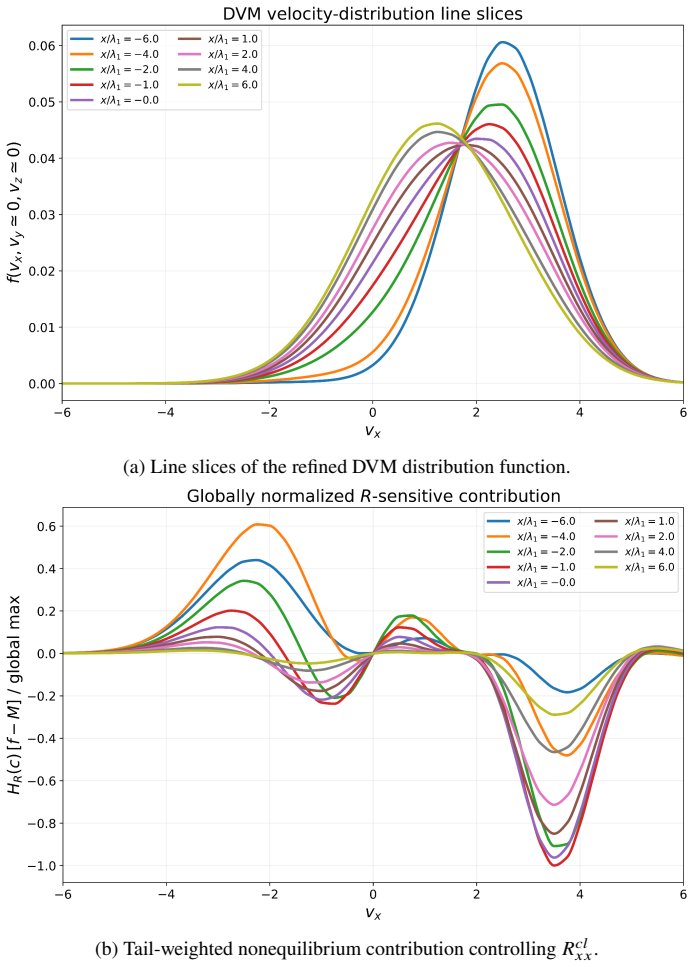
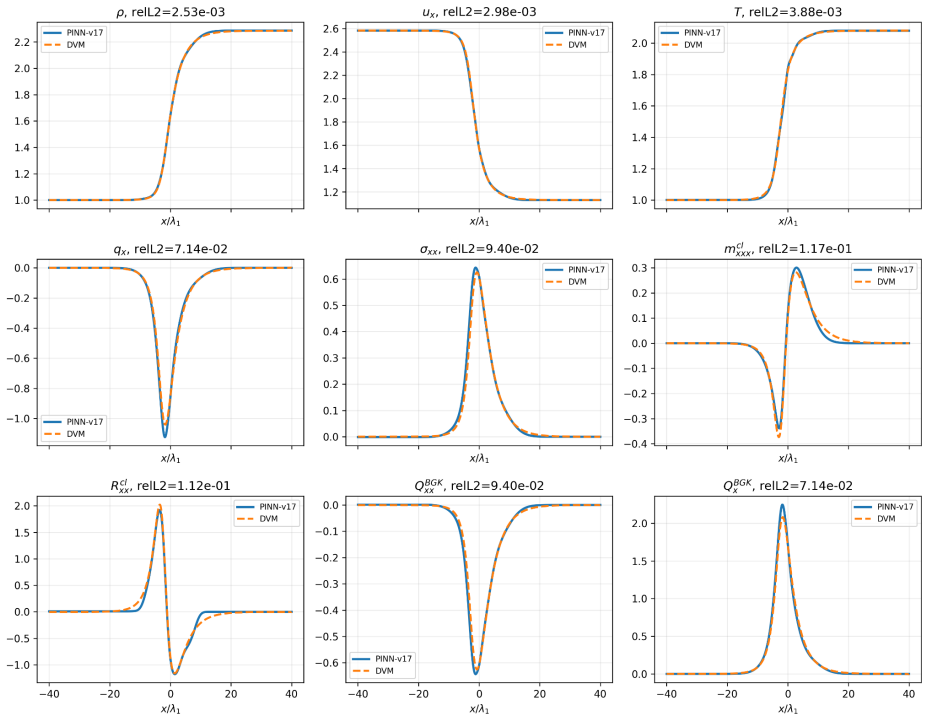
In a stationary Mach-2 normal shock the positive macro-micro PINN recovers rho, u_x, T, q_x, sigma_xx and m_xxx^cl but leaves R_xx^cl with order-unity error. DVM diagnostics show that R_xx^cl is controlled by a sign-changing, tail-weighted cancellation weakly observed by lower moments. A shock-local closure correction aligned with this missing projection reduces the relative R_xx^cl error to 1.12 times 10 to the minus 1 while preserving the lower moments.
What carries the argument
The shock-local closure correction aligned with the sign-changing tail-weighted cancellation in the nonequilibrium distribution that controls R_xx^cl.
If this is right
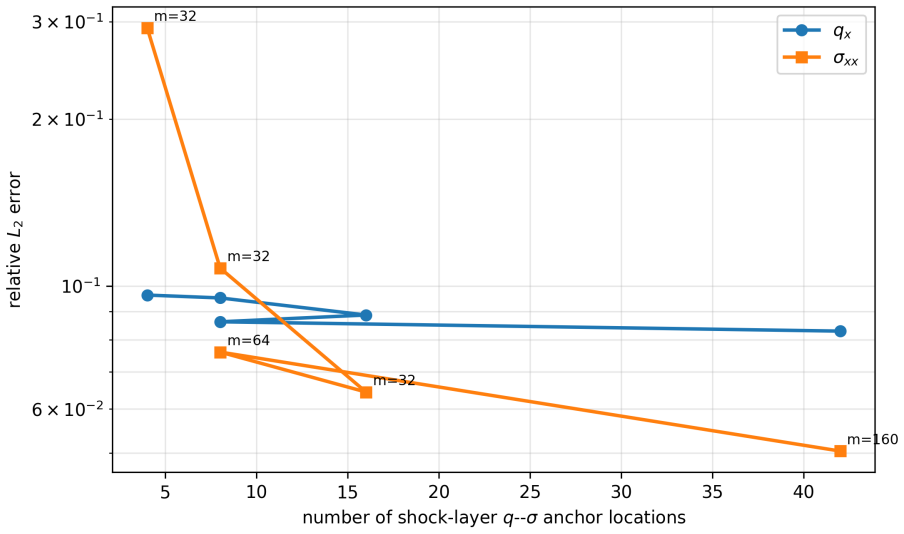
- Sparse joint anchoring of heat flux and normal stress stabilises the primary nonequilibrium layer.
- Residual-only, macro-only and single-moment variants fail in distinct ways.
- Optional distribution-function probe losses are diagnostic rather than constitutive.
- The obstruction to fourth-order recovery is anisotropic sign-changing tail weighting rather than polynomial degree alone.
Where Pith is reading between the lines
- The same tail-observability limitation is likely to appear in multi-dimensional or unsteady shock configurations where higher moments matter.
- PINN kinetic solvers for other nonequilibrium problems may require explicit tail-sensitive anchoring beyond standard moment losses.
- The diagnostic value of probe losses suggests a general strategy for verifying whether a learned distribution captures the projections needed for closure.
Load-bearing premise
The sign-changing, tail-weighted cancellation diagnosed by DVM is the dominant and correctable source of the R_xx^cl discrepancy rather than an artifact of the chosen PINN representation or the specific Mach-2 stationary shock setup.
What would settle it
Applying the identical PINN architecture and correction to a Mach-3 or Mach-1.5 stationary BGK shock and checking whether the relative R_xx^cl error remains near 0.112 or returns to order unity.
Figures
read the original abstract
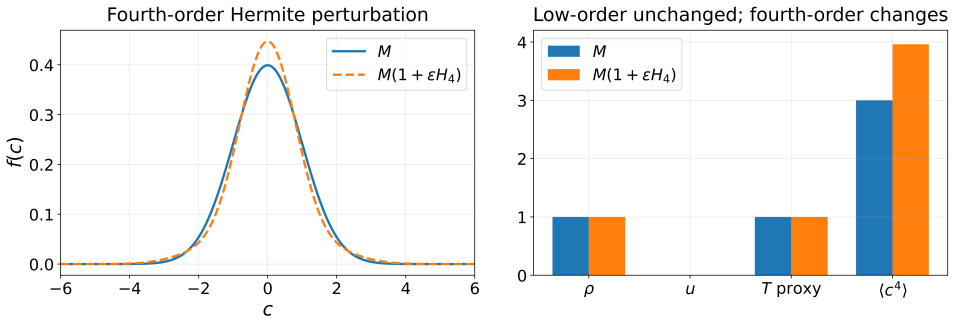
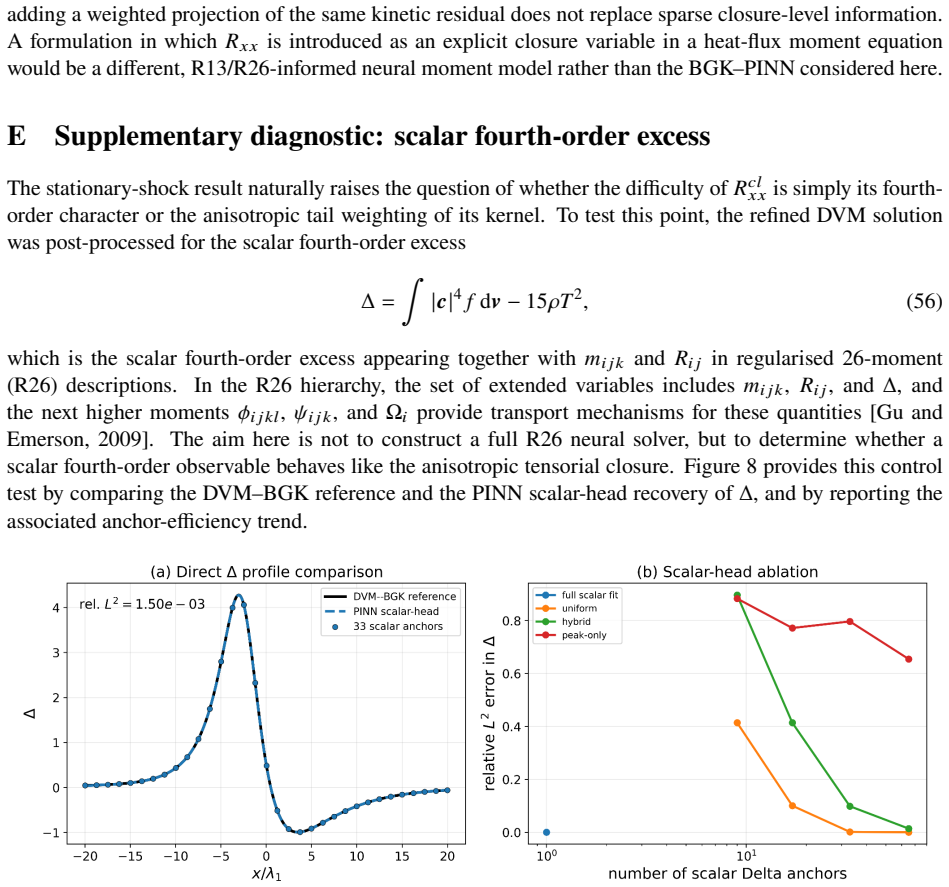
Closure-level accuracy in neural kinetic shock solvers is not guaranteed by accurate density, velocity and temperature profiles, because the relevant observables are velocity-weighted projections of the nonequilibrium distribution. We study this observability problem for one-dimensional Bhatnagar--Gross--Krook (BGK) shock waves using a positive macro--micro physics-informed neural network (PINN) in which the distribution is represented as a local Maxwellian multiplied by a bounded exponential correction. Independent discrete-velocity method (DVM) references are used for validation. Shock-tube tests show that sparse joint anchoring of heat flux and normal stress stabilises the primary nonequilibrium layer, whereas residual-only, macro-only and single-moment variants fail in distinct ways. In a stationary Mach-2 normal shock, a flux-locked compact model recovers $\rho$, $u_x$, $T$, $q_x$, $\sigma_{xx}$ and $m_{xxx}^{cl}$, but leaves $R_{xx}^{cl}$ with order-unity error. DVM diagnostics show that $R_{xx}^{cl}$ is controlled by a sign-changing, tail-weighted cancellation weakly observed by lower moments. A shock-local closure correction aligned with this missing projection reduces the relative $R_{xx}^{cl}$ error to $1.12\times10^{-1}$ while preserving the lower moments. A common-initialisation ablation shows that optional distribution-function probe losses are diagnostic rather than constitutive. A supplementary DVM--PINN comparison for the scalar fourth-order excess $\Delta$ shows that the obstruction is anisotropic, sign-changing tail weighting rather than fourth-order polynomial degree alone.
Editorial analysis
A structured set of objections, weighed in public.
Referee Report
Summary. The paper claims that accurate recovery of density, velocity and temperature in a positive macro-micro PINN for BGK shocks does not guarantee closure-level accuracy for higher moments because of velocity-weighted tail projections; using DVM validation it shows that joint anchoring of heat flux and normal stress stabilizes the nonequilibrium layer, while a post-hoc shock-local correction aligned with a DVM-diagnosed sign-changing tail cancellation reduces relative error in R_xx^cl to 1.12×10^{-1} for a stationary Mach-2 shock while preserving lower moments.
Significance. If the tail-observability diagnosis and correction generalize beyond the single Mach-2 stationary case, the work would usefully highlight a structural limitation in neural kinetic solvers and provide a practical route to fourth-order closure recovery. The use of independent DVM references for quantitative validation is a clear strength; the reported error reduction is concrete but remains tied to one specific setup.
major comments (2)
- [Mach-2 stationary shock results] Mach-2 stationary shock results (abstract and main text): the shock-local closure correction is introduced after DVM diagnostics of the sign-changing tail cancellation and reduces relative R_xx^cl error to 1.12×10^{-1}; however, no tests are reported for different Mach numbers, moving shocks, or altered collision models, so the claim that this alignment recovers general tail observability rests on a single-case demonstration.
- [Abstract and supplementary DVM-PINN comparison] Abstract and supplementary DVM-PINN comparison: the central assertion that the obstruction is 'anisotropic, sign-changing tail weighting rather than fourth-order polynomial degree alone' is supported only by the Mach-2 DVM diagnostics; without additional cases the distinction between setup-specific artifact and general mechanism remains untested and load-bearing for the observability claim.
minor comments (1)
- [Abstract] The abstract states that 'optional distribution-function probe losses are diagnostic rather than constitutive' but provides no quantitative ablation metrics; a brief table or sentence with the common-initialisation error values would clarify this point.
Simulated Author's Rebuttal
We thank the referee for the careful review and constructive comments on the scope of the study. The manuscript presents a detailed diagnostic analysis for the stationary Mach-2 BGK shock using PINN and independent DVM validation to identify the tail-weighted observability issue. We address each major comment below.
read point-by-point responses
-
Referee: [Mach-2 stationary shock results] Mach-2 stationary shock results (abstract and main text): the shock-local closure correction is introduced after DVM diagnostics of the sign-changing tail cancellation and reduces relative R_xx^cl error to 1.12×10^{-1}; however, no tests are reported for different Mach numbers, moving shocks, or altered collision models, so the claim that this alignment recovers general tail observability rests on a single-case demonstration.
Authors: We agree that all quantitative results, including the error reduction to 1.12×10^{-1} and the shock-local correction, are demonstrated exclusively for the stationary Mach-2 case. The manuscript frames this as a canonical example to diagnose the anisotropic tail-weighting mechanism via DVM, rather than asserting immediate generality of the correction. The text does not claim the alignment recovers tail observability for arbitrary Mach numbers or moving shocks; such extensions would require new simulations and lie outside the present scope. revision: no
-
Referee: [Abstract and supplementary DVM-PINN comparison] Abstract and supplementary DVM-PINN comparison: the central assertion that the obstruction is 'anisotropic, sign-changing tail weighting rather than fourth-order polynomial degree alone' is supported only by the Mach-2 DVM diagnostics; without additional cases the distinction between setup-specific artifact and general mechanism remains untested and load-bearing for the observability claim.
Authors: The supplementary comparison of the scalar fourth-order excess Δ versus the tensorial R_xx^cl is performed within the Mach-2 DVM data to illustrate that the obstruction arises from anisotropic, sign-changing tail weighting rather than polynomial degree. We acknowledge this remains a single-configuration demonstration. We will revise the abstract and relevant passages to state that the mechanism is diagnosed for the Mach-2 stationary shock, avoiding any implication of untested generality. revision: partial
Circularity Check
No significant circularity; derivation relies on independent external DVM benchmarks
full rationale
The paper's central results use independent discrete-velocity method (DVM) references for validation and diagnostics, with the shock-local closure correction introduced after DVM analysis of tail-weighted cancellation rather than being forced by the PINN equations or any self-referential fitting. No load-bearing self-citations, fitted inputs renamed as predictions, or self-definitional steps are present; the derivation chain remains self-contained against external benchmarks.
Axiom & Free-Parameter Ledger
invented entities (1)
-
shock-local closure correction
no independent evidence
Forward citations
Cited by 1 Pith paper
-
Closure-channel identifiability and two-channel recovery in monatomic kinetic normal shocks
Heat-flux budget observes only projected fourth-order channel S, not separate R_cl_xx and Δ; scalar-excess budget supplies the missing channel for two-channel reconstruction with low error in BGK and Shakhov models.
Reference graph
Works this paper leans on
-
[1]
Nicholas Daultry Ball, Jonathan F. MacArt, and Justin Sirignano. Online optimisation of machine learning collision models to accelerate direct molecular simulation of rarefied gas flows. Journal of Computational Physics, 530: 0 114601, 2026. doi:10.1016/j.jcp.2025.114601
-
[2]
P. L. Bhatnagar, E. P. Gross, and M. Krook. A model for collision processes in gases. i. small amplitude processes in charged and neutral one-component systems. Physical Review, 94 0 (3): 0 511--525, 1954. doi:10.1103/PhysRev.94.511
- [3]
-
[4]
Shengze Cai, Zhicheng Wang, Frederik Fuest, Young Jin Jeon, Callum Gray, and George Em Karniadakis. Flow over an espresso cup: inferring three-dimensional velocity and pressure fields from tomographic background oriented schlieren via physics-informed neural networks. Journal of Fluid Mechanics, 915: 0 A102, 2021. doi:10.1017/jfm.2021.135
-
[5]
The Boltzmann Equation and Its Applications
Carlo Cercignani. The Boltzmann Equation and Its Applications . Springer, 1988. doi:10.1007/978-1-4612-1039-9
-
[6]
Sydney Chapman and T. G. Cowling. The Mathematical Theory of Non-Uniform Gases. Cambridge University Press, 3 edition, 1970. Cambridge Core https://www.cambridge.org/us/universitypress/subjects/mathematics/fluid-dynamics-and-solid-mechanics/mathematical-theory-non-uniform-gases-account-kinetic-theory-viscosity-thermal-conduction-and-diffusion-gases
1970
-
[7]
Wei Chen, Giacomo Dimarco, and Lorenzo Pareschi. Structure and asymptotic preserving deep neural surrogates for uncertainty quantification in multiscale kinetic equations. arXiv preprint arXiv :2506.10636 , 2025. doi:10.48550/arXiv.2506.10636
-
[8]
Numerical methods for kinetic equations
Giacomo Dimarco and Lorenzo Pareschi. Numerical methods for kinetic equations. Acta Numerica, 23: 0 369--520, 2014. doi:10.1017/S0962492914000063
-
[9]
Physics-informed neural networks for solving reynolds-averaged navier--stokes equations
Hamidreza Eivazi, Mojtaba Tahani, Philipp Schlatter, and Ricardo Vinuesa. Physics-informed neural networks for solving reynolds-averaged navier--stokes equations. Physics of Fluids, 34 0 (7): 0 075117, 2022. doi:10.1063/5.0095270
-
[10]
Physics-informed deep-learning applications to experimental fluid mechanics
Hamidreza Eivazi, Yuning Wang, and Ricardo Vinuesa. Physics-informed deep-learning applications to experimental fluid mechanics. Measurement Science and Technology, 35 0 (7): 0 075303, 2024. doi:10.1088/1361-6501/ad3fd3
-
[11]
A benchmark study of kinetic models for shock waves
Fei Fei, Haihong Liu, Zhaohui Liu, and Jun Zhang. A benchmark study of kinetic models for shock waves. AIAA Journal, 58 0 (6): 0 2596--2608, 2020. doi:10.2514/1.J059029
-
[12]
Francis Filbet and Shi Jin. A class of asymptotic-preserving schemes for kinetic equations and related problems with stiff sources. Journal of Computational Physics, 229 0 (20): 0 7625--7648, 2010. doi:10.1016/j.jcp.2010.06.017
-
[13]
Observable-augmented manifold learning for multi-source turbulent flow data
Kai Fukami and Kunihiko Taira. Observable-augmented manifold learning for multi-source turbulent flow data. Journal of Fluid Mechanics, 1010: 0 R4, 2025. doi:10.1017/jfm.2025.383
-
[14]
On the kinetic theory of rarefied gases
Harold Grad. On the kinetic theory of rarefied gases. Communications on Pure and Applied Mathematics, 2 0 (4): 0 331--407, 1949. doi:10.1002/cpa.3160020403
-
[15]
Xiao-Jun Gu and David R. Emerson. A high-order moment approach for capturing non-equilibrium phenomena in the transition regime. Journal of Fluid Mechanics, 636: 0 177--216, 2009. doi:10.1017/S002211200900768X
-
[16]
Hirschfelder, Charles F
Joseph O. Hirschfelder, Charles F. Curtiss, and R. Byron Bird. Molecular Theory of Gases and Liquids. Wiley, 1954. URL https://www.wiley.com/en-us/Molecular+Theory+of+Gases+and+Liquids-p-9780471400653
1954
-
[17]
Efficient asymptotic-preserving schemes for some multiscale kinetic equations
Shi Jin. Efficient asymptotic-preserving schemes for some multiscale kinetic equations. SIAM Journal on Scientific Computing, 21 0 (2): 0 441--454, 1999. doi:10.1137/S1064827598334599
-
[18]
Asymptotic-preserving neural networks for multiscale time-dependent linear transport equations
Shi Jin, Zheng Ma, and Keke Wu. Asymptotic-preserving neural networks for multiscale time-dependent linear transport equations. arXiv preprint arXiv:2111.02541, 2021. doi:10.48550/arXiv.2111.02541
-
[19]
Asymptotic-preserving neural networks for multiscale kinetic equations
Shi Jin, Zheng Ma, and Keke Wu. Asymptotic-preserving neural networks for multiscale kinetic equations. arXiv preprint arXiv:2306.15381, 2023. doi:10.48550/arXiv.2306.15381
-
[20]
George E. Karniadakis and Ali Beskok. Micro Flows: Fundamentals and Simulation. Springer, 2001. doi:10.1007/978-0-387-28676-1
-
[21]
A Theory-guided Weighted $L^2$ Loss for solving the BGK model via Physics-informed neural networks
Gyounghun Ko, Sung-Jun Son, Seung Yeon Cho, and Myeong-Su Lee. A theory-guided weighted L2 loss for solving the BGK model via physics-informed neural networks. arXiv preprint arXiv :2604.04971 , 2026. doi:10.48550/arXiv.2604.04971
work page internal anchor Pith review Pith/arXiv arXiv doi:10.48550/arxiv.2604.04971 2026
-
[22]
C. David Levermore. Moment closure hierarchies for kinetic theories. Journal of Statistical Physics, 83: 0 1021--1065, 1996. doi:10.1007/BF02179552
-
[23]
Liu Liu, Xueyu Zhu, and Zhenyi Zhu. A bi-fidelity based asymptotic-preserving neural network for the semiconductor boltzmann equation and its inverse problem. Journal of Computational Physics, page 115076, 2026. doi:10.1016/j.jcp.2026.115076
-
[24]
Qin Lou, Xuhui Meng, and George Em Karniadakis. Physics-informed neural networks for solving forward and inverse flow problems via the Boltzmann--BGK formulation. Journal of Computational Physics, 447: 0 110676, 2021. doi:10.1016/j.jcp.2021.110676
-
[25]
Probabilistic neural networks for fluid flow surrogate modeling and data recovery
Romit Maulik, Kai Fukami, Nesar Ramachandra, Koji Fukagata, and Kunihiko Taira. Probabilistic neural networks for fluid flow surrogate modeling and data recovery. Physical Review Fluids, 5 0 (10): 0 104401, 2020. doi:10.1103/PhysRevFluids.5.104401
-
[26]
Discrete velocity model and implicit scheme for the BGK equation of rarefied gas dynamics
Luc Mieussens. Discrete velocity model and implicit scheme for the BGK equation of rarefied gas dynamics. Mathematical Models and Methods in Applied Sciences, 10 0 (8): 0 1121--1149, 2000. doi:10.1142/S0218202500000562
-
[27]
Masaki Morimoto, Kai Fukami, Romit Maulik, Ricardo Vinuesa, and Koji Fukagata. Assessments of epistemic uncertainty using Gaussian stochastic weight averaging for fluid-flow regression. Physica D: Nonlinear Phenomena, 440: 0 133454, 2022. doi:10.1016/j.physd.2022.133454
-
[28]
Separable physics-informed neural networks for solving the BGK model of the Boltzmann equation
Jaemin Oh, Seung Yeon Cho, Seok-Bae Yun, Eunbyung Park, and Youngjoon Hong. Separable physics-informed neural networks for solving the BGK model of the Boltzmann equation. SIAM Journal on Scientific Computing, 47 0 (2): 0 C451--C474, 2025. doi:10.1137/24M1668809
-
[29]
Stochastic numerics for the Boltzmann equation
Sergej Rjasanow and Wolfgang Wagner. Stochastic numerics for the Boltzmann equation. Springer Series in Computational Mathematics, 37, 2005. doi:10.1007/3-540-27689-0
-
[30]
Ehsan Roohi, Ahmad Shoja-Sani, and Fatemeh Ebrahimzadeh Azghadi. Neural networks for rarefied gas dynamics: Relaxation problem, polyatomic shock waves, and hypersonic cylinder flow. Physics of Fluids, 38 0 (5): 0 057108, 2026 a . doi:10.1063/5.0334590
-
[31]
Ehsan Roohi, Ahmad Shoja-Sani, and Stefan Stefanov. Physics constrained neural collision operators for hard sphere surrogates and ab initio angle prediction in direct simulation Monte Carlo . Physics of Fluids, 38 0 (5): 0 057123, 2026 b . doi:10.1063/5.0328463
-
[32]
Ahmad Shoja-Sani, Ehsan Roohi, and Stefan Stefanov. Homogeneous relaxation and shock wave problems: Assessment of the simplified and generalized bernoulli trial collision schemes. Physics of Fluids, 33: 0 032004, 2021. doi:10.1063/5.0039071
-
[33]
Molecular Gas Dynamics: Theory, Techniques, and Applications
Yoshio Sone. Molecular Gas Dynamics: Theory, Techniques, and Applications. Birkh\"auser, 2007. doi:10.1007/978-0-8176-4573-3
-
[34]
Macroscopic Transport Equations for Rarefied Gas Flows
Henning Struchtrup. Macroscopic Transport Equations for Rarefied Gas Flows. Springer, 2005. doi:10.1007/3-540-32386-4
-
[35]
Regularization of Grad 's 13 moment equations: Derivation and linear analysis
Henning Struchtrup and Manuel Torrilhon. Regularization of Grad 's 13 moment equations: Derivation and linear analysis. Physics of Fluids, 15 0 (9): 0 2668--2680, 2003. doi:10.1063/1.1597472
-
[36]
Physics-constrained Bayesian neural network for fluid flow reconstruction with sparse and noisy data
Luning Sun and Jian-Xun Wang. Physics-constrained Bayesian neural network for fluid flow reconstruction with sparse and noisy data. Theoretical and Applied Mechanics Letters, 10 0 (3): 0 161--169, 2020. doi:10.1016/j.taml.2020.01.031
-
[37]
F. G. Tcheremissine. Conservative evaluation of Boltzmann collision integral in discrete ordinates approximation. Computers & Mathematics with Applications, 35 0 (1--2): 0 215--221, 1998. doi:10.1016/S0898-1221(97)00269-1
-
[38]
Modeling nonequilibrium gas flow based on moment equations
Manuel Torrilhon. Modeling nonequilibrium gas flow based on moment equations. Annual Review of Fluid Mechanics, 48: 0 429--458, 2016. doi:10.1146/annurev-fluid-122414-034259
-
[39]
Regularized 13-moment equations: shock structure calculations and comparison to Burnett models
Manuel Torrilhon and Henning Struchtrup. Regularized 13-moment equations: shock structure calculations and comparison to Burnett models. Journal of Fluid Mechanics, 513: 0 171--198, 2004. doi:10.1017/S0022112004009907
-
[40]
A unified gas-kinetic scheme for continuum and rarefied flows
Kun Xu and Jian-Cheng Huang. A unified gas-kinetic scheme for continuum and rarefied flows. Journal of Computational Physics, 229 0 (20): 0 7747--7764, 2010. doi:10.1016/j.jcp.2010.06.032
-
[41]
Dashan Zhang, Yuntian Chen, and Shiyi Chen. Filtered partial differential equations: a robust surrogate constraint in physics-informed deep learning framework. Journal of Fluid Mechanics, 999: 0 A40, 2024. doi:10.1017/jfm.2024.471
-
[42]
Lu Zhu, Xianyang Jiang, Adrien Lefauve, Rich R. Kerswell, and P. F. Linden. New insights into experimental stratified flows obtained through physics-informed neural networks. Journal of Fluid Mechanics, 981: 0 R1, 2024. doi:10.1017/jfm.2024.49
discussion (0)
Sign in with ORCID, Apple, or X to comment. Anyone can read and Pith papers without signing in.