Undecidability in Relevant Logic
Pith reviewed 2026-06-28 23:55 UTC · model grok-4.3
The pith
Every positive relevant logic from hypothetical syllogism axioms up to semilattice logic S is undecidable.
A machine-rendered reading of the paper's core claim, the machinery that carries it, and where it could break.
Core claim
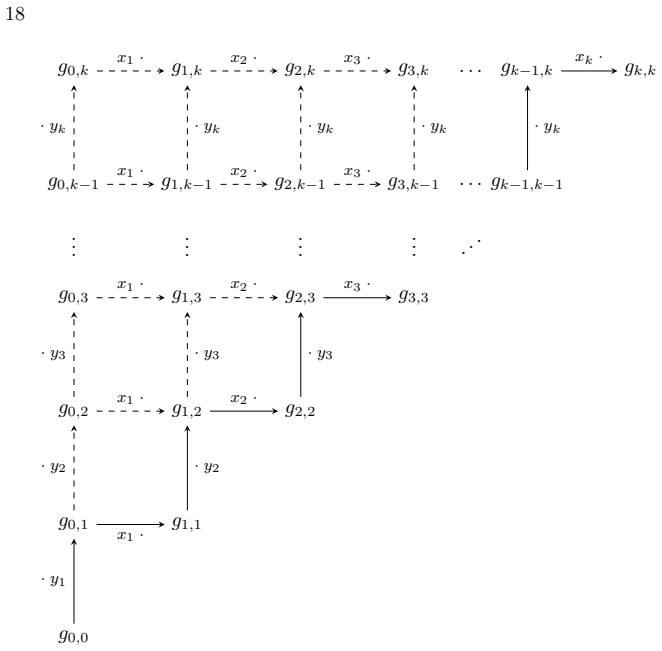
We prove undecidability for every positive relevant logic extending the system axiomatized by hypothetical syllogism, prefixing, and suffixing and contained in the logic of the semilattice frame (P_fin(N), ∪, ∅). This settles the longstanding decision problem for the semilattice relevant logic S in the negative, contrary to prevailing expectations of decidability. It also provides a new proof of Urquhart's (1984) undecidability theorem for R, E, and T, now by reduction from the Wang tiling problem for arbitrarily large finite isosceles right triangular regions of the plane.
What carries the argument
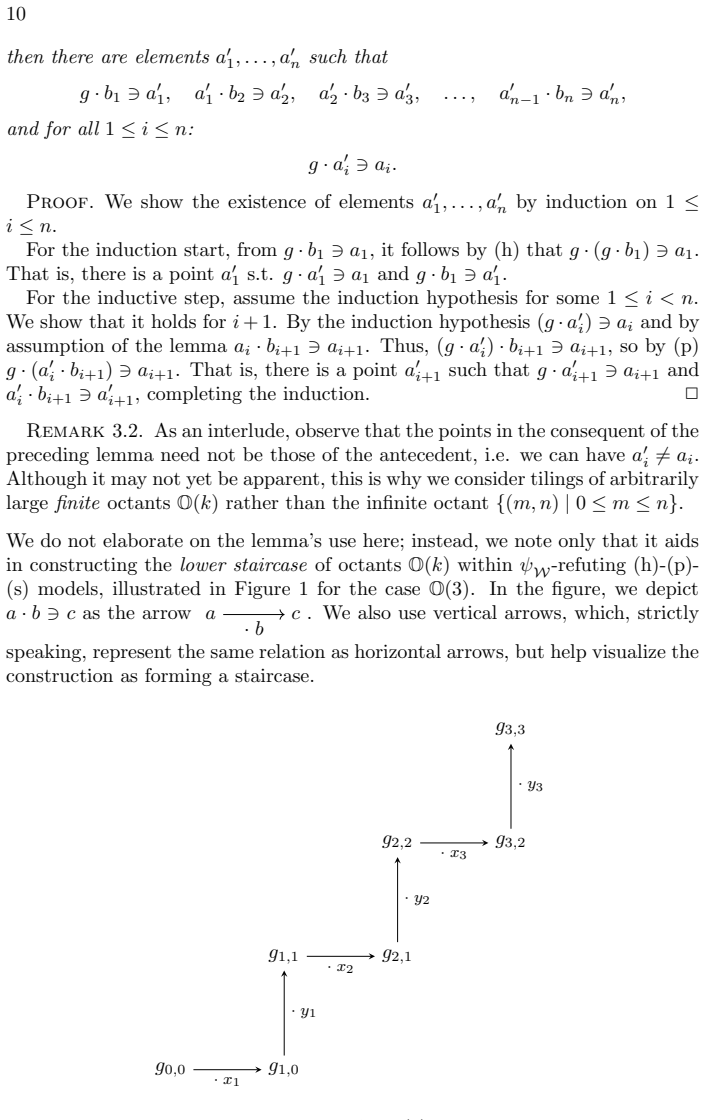
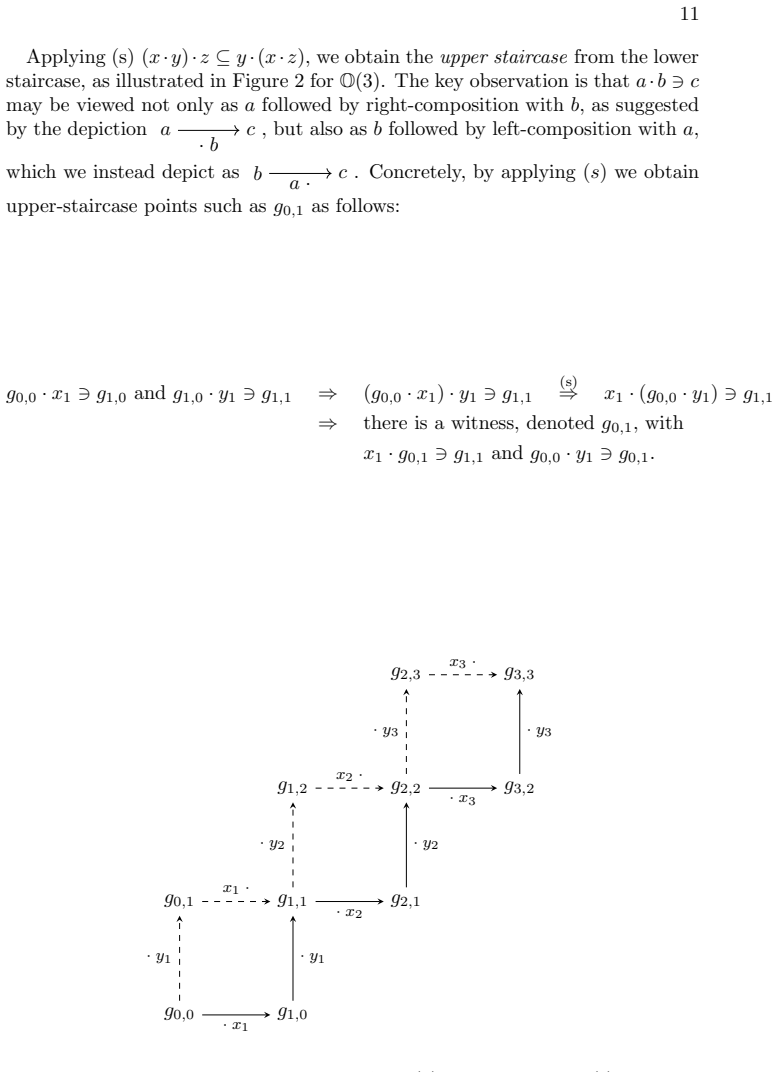
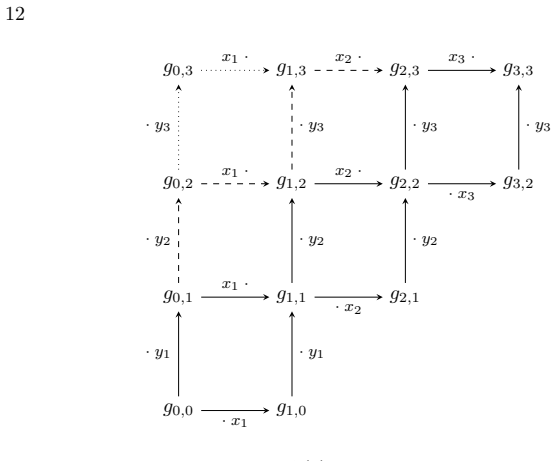
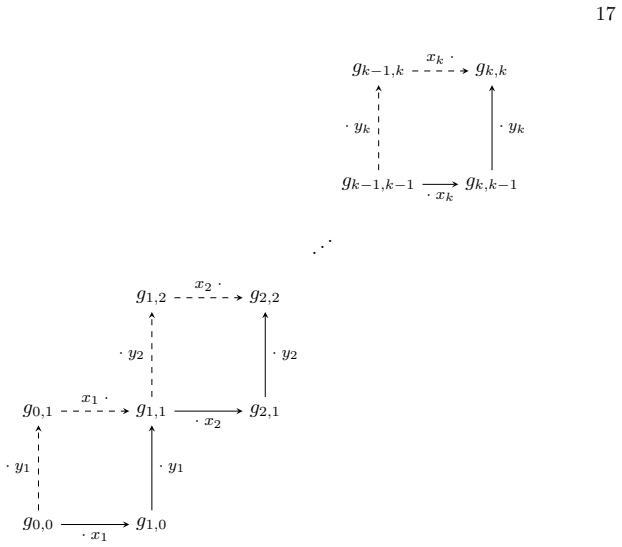
Reduction from the Wang tiling problem on finite isosceles right triangular regions of the plane to the validity problem in semilattice frame semantics.
If this is right
- The semilattice relevant logic S is undecidable.
- The logics R, E and T are undecidable, with a new proof via triangular tiling.
- No decision procedure exists for any positive relevant logic strictly between the basic axioms and S.
- Validity checking in these logics can encode the existence of tilings of arbitrary finite triangular regions.
Where Pith is reading between the lines
- Similar tiling reductions may establish undecidability for other substructural logics whose semantics contain semilattice-like structures.
- The boundary between decidable and undecidable relevant logics may be located by checking which frames can embed triangular tiling constraints.
- Extending the result to logics with negation or to infinite regions could reveal further undecidability thresholds.
Load-bearing premise
The reduction correctly translates the existence of a tiling into non-validity of a corresponding formula without allowing the logic to decide the tiling question on its own.
What would settle it
An algorithm that decides validity for all formulas in the semilattice relevant logic S, or an explicit triangular region together with its encoded formula where the tiling exists but the formula is valid (or the converse).
Figures
read the original abstract
We prove undecidability for every positive relevant logic extending the system axiomatized by hypothetical syllogism, prefixing, and suffixing and contained in the logic of the semilattice frame $(P_{\mathrm{fin}}(\mathbb{N}), \cup, \varnothing)$. This settles the longstanding decision problem for the semilattice relevant logic S in the negative, contrary to prevailing expectations of decidability. It also provides a new proof of Urquhart's (1984) undecidability theorem for R, E, and T, now by reduction from the Wang tiling problem for arbitrarily large finite isosceles right triangular regions of the plane.
Editorial analysis
A structured set of objections, weighed in public.
Referee Report
Summary. The manuscript proves undecidability for every positive relevant logic extending the axiomatization consisting of hypothetical syllogism, prefixing, and suffixing and contained in the semilattice logic S, interpreted over the frame (P_fin(N), ∪, ∅). The central argument is a reduction from the undecidability of the Wang tiling problem restricted to arbitrarily large finite isosceles right triangular regions of the plane; this yields a negative resolution of the decision problem for S and supplies an alternative proof of Urquhart’s 1984 undecidability theorems for R, E, and T.
Significance. If the reduction is faithful, the result is significant: it resolves a longstanding open question for the semilattice logic S (previously expected to be decidable) and furnishes a new, tiling-based proof for the undecidability of the stronger systems R, E, and T. The technique is standard in the field and directly extends cited prior work of Urquhart.
minor comments (1)
- The abstract states that the result is 'contrary to prevailing expectations of decidability' for S; a single sentence indicating the source of those expectations (e.g., a citation or prior conjecture) would help readers situate the claim.
Simulated Author's Rebuttal
We thank the referee for their positive assessment and recommendation to accept the manuscript. The report accurately summarizes the main results.
Circularity Check
No significant circularity; reduction to external undecidability result
full rationale
The paper establishes undecidability of the target relevant logics by explicit reduction from the Wang tiling problem on finite isosceles right triangles, an independently known undecidable problem. This is an external benchmark, not a self-referential definition, fitted parameter, or self-citation chain. The construction embeds tiling constraints into the semilattice frame semantics without deriving the undecidability from the logics' own axioms or prior results by the same author. No step matches the enumerated circularity patterns; the central claim remains independent of its own outputs.
Axiom & Free-Parameter Ledger
axioms (2)
- domain assumption The semilattice frame (P_fin(N), ∪, ∅) validates exactly the target relevant logics
- standard math Wang tiling is undecidable for arbitrarily large finite isosceles right triangular regions
Forward citations
Cited by 1 Pith paper
-
Possibly Relevant Translations
Translations from relevant logics to normal modal logics are developed to explore their structural connections.
Reference graph
Works this paper leans on
-
[1]
,Diamonds and dominoes: Impossibility results for associative modal logics, 2025, Preprint
2025
-
[2]
,Possibly relevant translations,Advances in modal logic, aiml 2026, 2026
2026
-
[3]
[18]Saul A
,R is incomplete for sets, Unpublished manuscript, in preparation. [18]Saul A. Kripke,The problem of entailment,The Journal of Symbolic Logic, vol. 24 (1959), no. 4, p. 324, Abstract. [19]L. Lipshitz,The undecidability of the word problems for projective geometries and modular lattices,Transactions of the American Mathematical Society, vol. 193 (1974), pp...
1959
-
[4]
[24]Alasdair Urquhart,Semantics for relevant logics,The Journal of Symbolic Logic, vol
,Relevant logics: Implication, modality, quantification, Cambridge Univer- sity Press, 2026. [24]Alasdair Urquhart,Semantics for relevant logics,The Journal of Symbolic Logic, vol. 37 (1972), pp. 159 – 169
2026
-
[5]
thesis, University of Pittsburgh, 1973
,The semantics of entailment,Ph.D. thesis, University of Pittsburgh, 1973
1973
-
[6]
49 (1984), no
,The undecidability of entailment and relevant implication,The Journal of Symbolic Logic, vol. 49 (1984), no. 4, pp. 1059–1073
1984
-
[7]
64 (1999), no
,The complexity of decision procedures in relevance logic II,The Journal of Symbolic Logic, vol. 64 (1999), no. 4, pp. 1774–1802
1999
-
[8]
13 (2016)
,Relevance logic: Problems open and closed,The Australasian Journal of Logic, vol. 13 (2016)
2016
-
[9]
20 (2023), no
,The geometry of relevant implication II,The Australasian Journal of Logic, vol. 20 (2023), no. 1, pp. 88–94. [30]John von Neumann,Continuous geometry, Princeton University Press, Princeton, New Jersey, 1960. [31]Hao Wang,Proving theorems by pattern recognition — II,The Bell System Technical Journal, vol. 40 (1961), no. 1, pp. 1–41
2023
-
[10]
,Dominoes and the∀∃∀case of the decision problem,Mathematical theory of automata, 1963, pp. 23–55. [33]Yale Weiss,A note on the relevance of semilattice relevance logic,Australasian Journal of Logic, vol. 16 (2019), no. 6, pp. 177–185
1963
-
[11]
109 (2021), pp
,A characteristic frame for positive intuitionistic and relevance logic,Studia Logica, vol. 109 (2021), pp. 687–699
2021
-
[12]
109 (2021), pp
,A conservative negation extension of positive semilattice logic without the finite model property,Studia Logica, vol. 109 (2021), pp. 125–136
2021
-
[13]
15 (2021), pp
,A reinterpretation of the semilattice semantics with applications,Logica Uni- versalis, vol. 15 (2021), pp. 171–191. 27 [37]Yale WeissandShawn Standefer,Constructivism and relevance,Erkenntnis, (forthcoming). ILLC & PHILOSOPHY UNIVERSITY OF AMSTERDAM AMSTERDAM, THE NETHERLANDS E-mail: s.b.knudstorp@uva.nl URL: https://knudstorp.github.io/
2021
discussion (0)
Sign in with ORCID, Apple, or X to comment. Anyone can read and Pith papers without signing in.