Where not to find the spectrum of the partial theta function
Pith reviewed 2026-06-29 00:03 UTC · model grok-4.3
The pith
The partial theta function has no multiple zeros for any q in a wide sector union disk of radius 0.20787, with only one spectral value at 0.309249 in the slightly larger disk.
A machine-rendered reading of the paper's core claim, the machinery that carries it, and where it could break.
Core claim
We show that there is no spectral value in the set S ∪ D_c0, c0=0.2078750206…, where S is the sector {0<|z|<0.6, arg(z)∈[π/4,7π/4]}. There is a single spectral value in the set S ∪ D_0.31 which equals 0.309249…. For q∈S∪D_c0, the moduli of the zeros of θ are separated by the negative half-integer powers of |q|.
What carries the argument
The spectrum of θ(q,·), defined as the q-values at which the power series in x has a multiple root (i.e., simultaneous vanishing of θ and its x-derivative).
If this is right
- All zeros of θ(q,·) are simple whenever q lies in S ∪ D_c0.
- The moduli of successive zeros satisfy a strict separation |x_{k+1}| ≥ C |q|^{-(m+1/2)} for integers m determined by |q|.
- Any search for the full spectrum can safely ignore the entire sector-disk region and focus on the complementary part of the unit disk.
- The spacing law supplies an explicit asymptotic template for locating the simple zeros inside the proven region.
Where Pith is reading between the lines
- The same separation property may persist for q just outside the stated region and could be used to bound the distance to the nearest spectral value.
- Computational enumeration of the spectrum can now be restricted to a narrow annular sector near the positive real axis.
- The result supplies a concrete test set for any future analytic or numerical method that claims to locate all multiple zeros.
Load-bearing premise
Numerical checks have correctly detected every multiple root inside the tested disks and excluded none by rounding or truncation error.
What would settle it
An explicit pair (q,x) with |q| ≤ 0.31, q inside S or inside D_c0, such that θ(q,x) = 0 and ∂θ/∂x(q,x) = 0.
Figures
read the original abstract
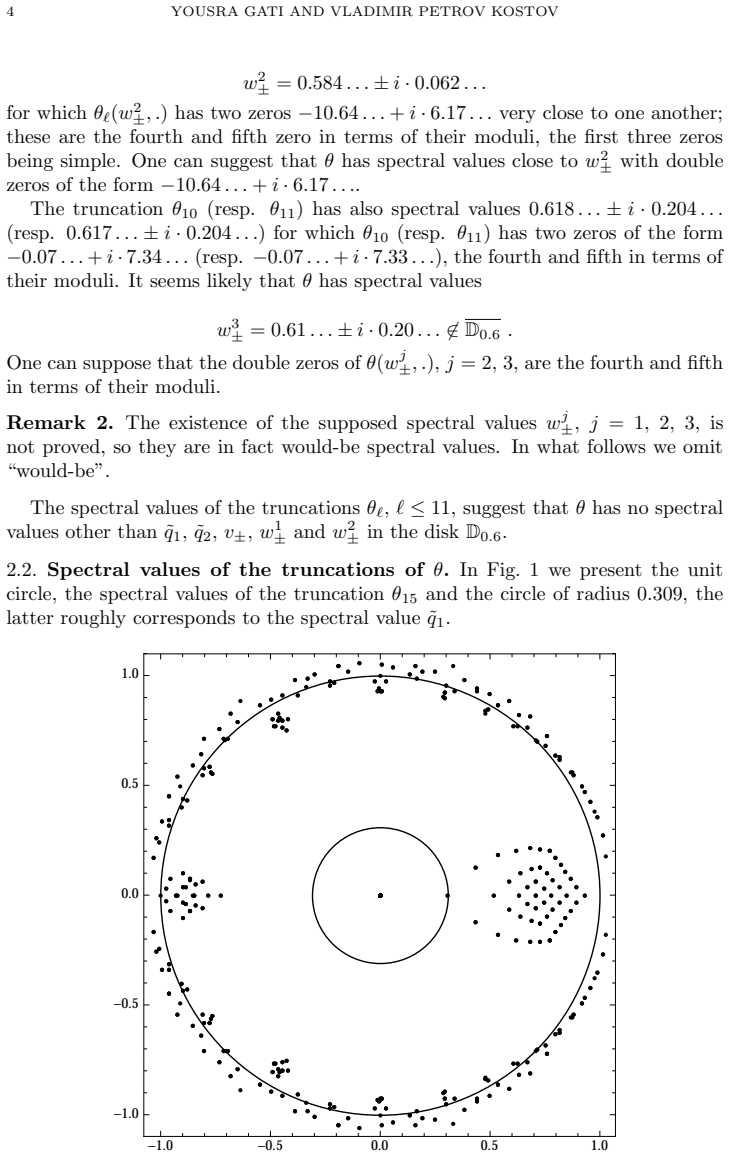
The spectrum of Ramanujan's partial theta function $\theta (q,x):=\sum _{j=0}^{\infty}q^{j(j+1)/2}x^j$, $q\in \mathbb{D}_1$ (the unit disk centered at the origin), $x\in \mathbb{C}$, is the set of values of the parameter $q$ for which $\theta (q,.)$ has a multiple zero. We show that there is no spectral value in the set $\mathbb{S}\cup \mathbb{D}_{c_0}$, $c_0=0.2078750206\ldots$, where $\mathbb{S}$ is the sector $\{ 0<|z|<0.6,{\rm arg}(z)\in [\pi /4 ,7\pi /4 ]\}$. There is a single spectral value in the set $\mathbb{S}\cup \mathbb{D}_{0.31}$ which equals $0.309249\ldots$. For $q\in \mathbb{S}\cup \mathbb{D}_{c_0}$, the moduli of the zeros of $\theta$ are separated by the negative half-integer powers of $|q|$.
Editorial analysis
A structured set of objections, weighed in public.
Referee Report
Summary. The paper studies the spectrum of Ramanujan's partial theta function θ(q,x) = ∑ q^{j(j+1)/2} x^j, defined as the set of q in the unit disk where θ(q,·) has a multiple zero. It claims to establish that this spectrum is empty in the sector S = {0 < |z| < 0.6, arg(z) ∈ [π/4, 7π/4]} union the disk D_{c0} with explicit numerical radius c0 ≈ 0.2078750206…, identifies exactly one spectral value ≈0.309249… inside the slightly larger disk D_{0.31}, and proves that for q in S ∪ D_{c0} the moduli of the zeros of θ are separated by negative half-integer powers of |q|.
Significance. If rigorously established, the explicit exclusion of spectral values from a concrete region together with the separation property would supply useful concrete information on the zero structure of the partial theta function, a topic of ongoing interest in q-series and complex analysis. The separation statement in particular could serve as a tool for further analytic work on the function.
major comments (1)
- [Abstract and numerical sections] The central absence claim for S ∪ D_{c0} and the count/identity of the single spectral value inside D_{0.31} rest on the numerical determination of c0 = 0.2078750206… and the value 0.309249…. No section supplies a description of the search algorithm, sampling density, floating-point precision, or rigorous a-posteriori error bounds that would exclude undetected roots or rounding artifacts inside the claimed region. This is load-bearing for both the absence statement and the separation corollary.
minor comments (1)
- [Abstract] The notation D_r for the disk of radius r centered at 0 should be defined explicitly on first use.
Simulated Author's Rebuttal
We thank the referee for their careful reading and for highlighting the importance of rigorous numerical validation for the central claims. We address the single major comment below.
read point-by-point responses
-
Referee: [Abstract and numerical sections] The central absence claim for S ∪ D_{c0} and the count/identity of the single spectral value inside D_{0.31} rest on the numerical determination of c0 = 0.2078750206… and the value 0.309249…. No section supplies a description of the search algorithm, sampling density, floating-point precision, or rigorous a-posteriori error bounds that would exclude undetected roots or rounding artifacts inside the claimed region. This is load-bearing for both the absence statement and the separation corollary.
Authors: We agree that the current manuscript does not contain an explicit description of the numerical search procedure, grid density, precision, or a-posteriori error analysis. In the revised version we will add a new appendix (or subsection) that fully documents: (i) the root-finding algorithm (a combination of Newton iteration on a polar grid followed by continuation along rays), (ii) the sampling density (explicit radial and angular step sizes together with adaptive refinement near suspected multiple zeros), (iii) the floating-point environment (IEEE-754 double precision supplemented by targeted 100-digit arbitrary-precision checks), and (iv) rigorous a-posteriori bounds obtained via interval arithmetic that certify the absence of additional multiple zeros inside S ∪ D_{c0} and the uniqueness of the reported spectral value inside D_{0.31}. These additions will make the numerical foundation of both the absence statement and the separation corollary fully transparent and verifiable. revision: yes
Circularity Check
No circularity: numerical results presented as outputs, not inputs by construction
full rationale
The abstract states explicit numerical outputs (c0 = 0.2078750206… and the single spectral value 0.309249…) obtained by computation, along with a claimed absence region and a separation property for zeros. No equations or steps are shown that define the spectrum in terms of these values or that rename a fit as a prediction. The derivation chain relies on external numerical search rather than self-definition, self-citation load-bearing, or ansatz smuggling. The result is therefore self-contained against the paper's own inputs.
Axiom & Free-Parameter Ledger
free parameters (2)
- c0 =
0.2078750206
- 0.31 =
0.31
axioms (1)
- standard math The partial theta function is defined by the power series sum q^{j(j+1)/2} x^j for |q|<1.
Forward citations
Cited by 1 Pith paper
-
Complex spectrum of the partial theta function
The spectrum of the partial theta function accumulates at every point on the unit circle and is locally finite inside |q| ≤ 0.8, with a truncation-seeded Newton method and radial monodromy for computation.
Reference graph
Works this paper leans on
-
[1]
G. E. Andrews, B. C. Berndt, Ramanujan’s lost notebook. Part II. Springer, NY, 2009. MR2474043
2009
- [2]
-
[3]
Bringmann, A
K. Bringmann, A. Folsom and A. Milas, Asymptotic behavior of partial and false theta functions arising from Jacobi forms and regularized characters. J. Math. Phys. 58:1 (2017), 011702, 19 pp. MR3597015 Zbl 06683891
2017
-
[4]
K. Bringmann, A. Folsom, R. C. Rhoades, Partial theta functions and mock modular forms asq-hypergeometric series, Ramanujan J. 29:1-3 (2012), 295–310. MR2994103 Zbl 1283.11077
-
[5]
T. Creutzig, A. Milas and S. Wood, On regularised quantum dimensions of the singlet vertex operator algebra and false theta functions. Int. Math. Res. Not. IMRN 5 (2017), 1390–1432. MR3658169 Zbl 1405.17053 10 YOUSRA GATI AND VLADIMIR PETROV KOSTOV
-
[6]
Flores and J
R. Flores and J. Gonz´ alez-Meneses, On the growth of Artin-Tits monoids and the partial theta function. J. Combin. Theory Ser. A 190 (2022), Paper No. 105623, 39 pp
2022
-
[7]
G. H. Hardy, On the zeros of a class of integral functions, Messenger of Mathematics 34 (1904), 97–101. MR0527275 (81e:01028)
1904
-
[8]
J. I. Hutchinson, On a remarkable class of entire functions, Trans. Amer. Math. Soc. 25 (1923), 325–332. MR1501248 JFM 49.0217.02
1923
-
[9]
O.M. Katkova, T. Lobova and A.M. Vishnyakova, On power series having sections with only real zeros. Comput. Methods Funct. Theory 3:2 (2003), 425–441. MR2082027 Zbl 1058.30009
- [10]
-
[11]
V. P. Kostov, A separation in modulus property of the zeros of a partial theta function, Analysis Mathematica 44:4 (2018), 501–519
2018
- [12]
- [13]
- [14]
- [15]
- [16]
-
[17]
V. P. Kostov, Asymptotics of the spectrum of partial theta function, Revista Mat. Complut. 27:2 (2014), 677–684. MR3223585 Zbl 1303.11053 DOI: 10.1007/s13163-013- 0133-3
-
[18]
V. P. Kostov, A domain containing all zeros of the partial theta function, Publicationes Mathematicae Debrecen 93:1-2 (2018), 189–203. MR3840729 Zbl 06931221
2018
-
[19]
V. P. Kostov, Partial theta function and separation in modulus property of its zeros, Vietnam Journal of Mathematics 48:1 March 2020, 145-157
2020
-
[20]
V.P. Kostov, No zeros of the partial theta function in the unit disk, Annual of Sofia University “St. Kliment Ohridski”, Faculty of Mathematics and Informatics 111 (2024) 129-137. DOI: 10.60063/gsu.fmi.111.129-137
-
[21]
On the location of the complex conjugate zeros of the partial theta function
V.P. Kostov, On the location of the complex conjugate zeros of the partial theta func- tion, Serdica Math. J. (to appear) arXiv:2501.15866
work page internal anchor Pith review Pith/arXiv arXiv
- [22]
-
[23]
Lubinsky, E
D.S. Lubinsky, E. Saff, Convergence of Pad´ e approximants of partial theta functions and the Rogers-Szeg˝ o polynomials, Constructive Approximation, 3 (1987), 331-361
1987
-
[24]
Mortenson, On the dual nature of partial theta functions and Appell-Lerch sums, Adv
E.T. Mortenson, On the dual nature of partial theta functions and Appell-Lerch sums, Adv. Math. 264 (2014), 236-260
2014
- [25]
-
[26]
Petrovitch, Une classe remarquable de s´ eries enti` eres, Atti del IV Congresso Inter- nationale dei Matematici, Rome (Ser
M. Petrovitch, Une classe remarquable de s´ eries enti` eres, Atti del IV Congresso Inter- nationale dei Matematici, Rome (Ser. 1), 2 (1908), 36–43
1908
-
[27]
The combinatorics of the leading root of the partial theta function
T. Prellberg, The combinatorics of the leading root of the partial theta function, http://arxiv.org/pdf/1210.0095.pdf
work page internal anchor Pith review Pith/arXiv arXiv
-
[28]
Sokal, The leading root of the partial theta function, Adv
A. Sokal, The leading root of the partial theta function, Adv. Math. 229:5 (2012), 2603–2621. MR2889137 Zbl 1239.05018
-
[29]
L. H. Sun, An extension of the Andrews-Warnaar partial theta function identity. Adv. in Appl. Math. 115 (2020), 101985, 20 pp
2020
-
[30]
Walter, G
B. Walter, G. Perfetto and A. Gambassi, Thermodynamic phases in first detected return times of quantum many-body systems, Physical Review A 111, L040202 (2025)
2025
-
[31]
Wang and X
J. Wang and X. Ma, On the Andrews-Warnaar identities for partial theta functions. Adv. in Appl. Math. 97 (2018), 36-53
2018
- [32]
-
[33]
Wei, Partial theta function identities from Wang and Ma’s conjecture
C. Wei, Partial theta function identities from Wang and Ma’s conjecture. J. Difference Equ. Appl. 26 (2020), no. 4, 532-539. Universit´e de Carthage, EPT-LIM, Tunisie Email address:yousra.gati@gmail.com Universit´e Cˆote d’Azur, LJAD, Nice, France Email address:vladimir.kostov@unice.fr
2020
discussion (0)
Sign in with ORCID, Apple, or X to comment. Anyone can read and Pith papers without signing in.