Scalable GNN-Based Power Allocation for Rate-Splitting Cell-Free Massive MIMO Systems
Pith reviewed 2026-06-30 10:57 UTC · model grok-4.3
The pith
A scalable graph neural network achieves near-optimal power allocation in rate-splitting cell-free massive MIMO systems using only large-scale fading coefficients.
A machine-rendered reading of the paper's core claim, the machinery that carries it, and where it could break.
Core claim
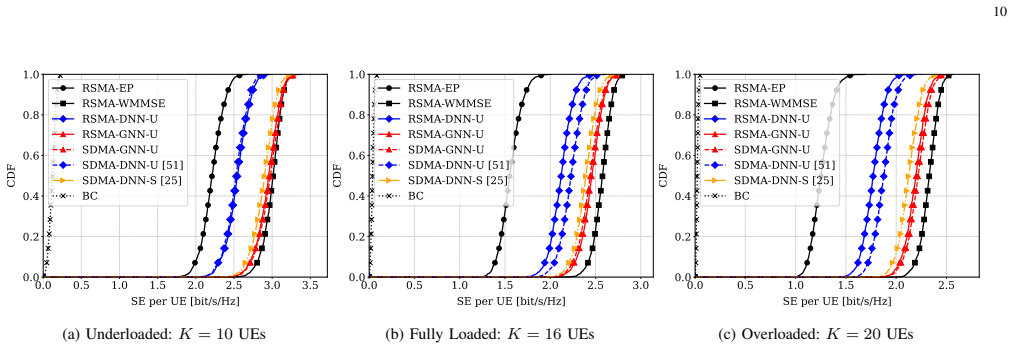
The paper claims that an unsupervised scalable GNN framework for power allocation in RS-CF-mMIMO systems, relying exclusively on large-scale fading coefficients and a slice-based adaptive layer to resolve dimensionality mismatch, maximizes sum spectral efficiency under per-AP power constraints with maximum-ratio precoding for common streams and regularized zero-forcing for private streams, achieves near-optimal performance, and outperforms unsupervised DNNs while the scalable variant reduces trainable parameters by over 57 percent and inference latency by up to three orders of magnitude relative to WMMSE-ADMM.
What carries the argument
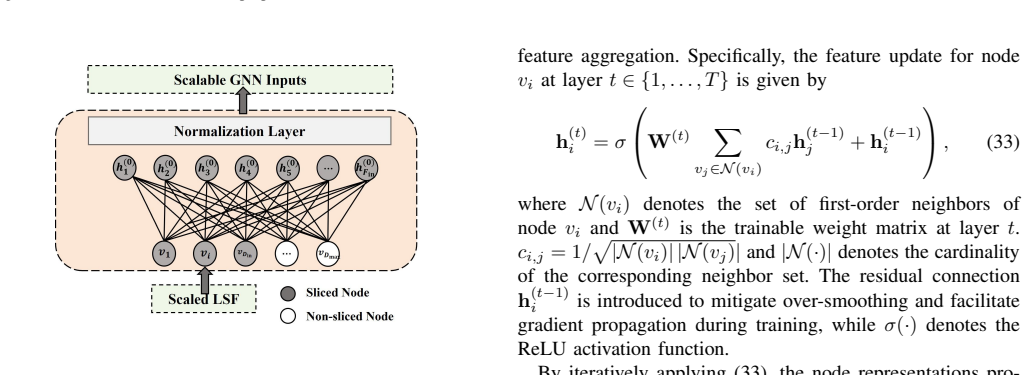
The slice-based adaptive layer that projects variable-dimension features into a fixed latent space, enabling a single model to generalize across diverse network topologies without retraining.
Load-bearing premise
Large-scale fading coefficients alone suffice to optimize power allocation for near-optimal sum spectral efficiency, and the slice-based adaptive layer maps variable-dimension inputs without meaningful loss of optimality across arbitrary topologies.
What would settle it
A set of simulations or real deployments in which the GNN sum spectral efficiency falls substantially below the WMMSE-ADMM bound when small-scale fading realizations differ strongly from the training distribution would falsify the central performance claim.
Figures

read the original abstract
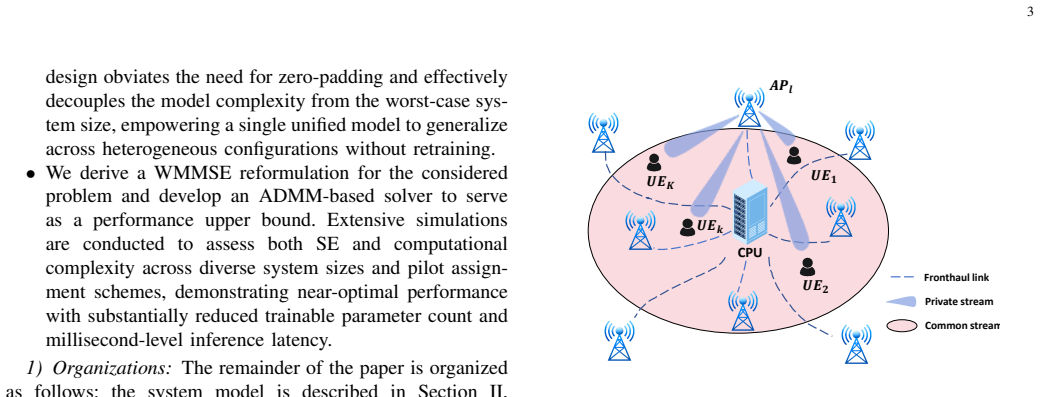
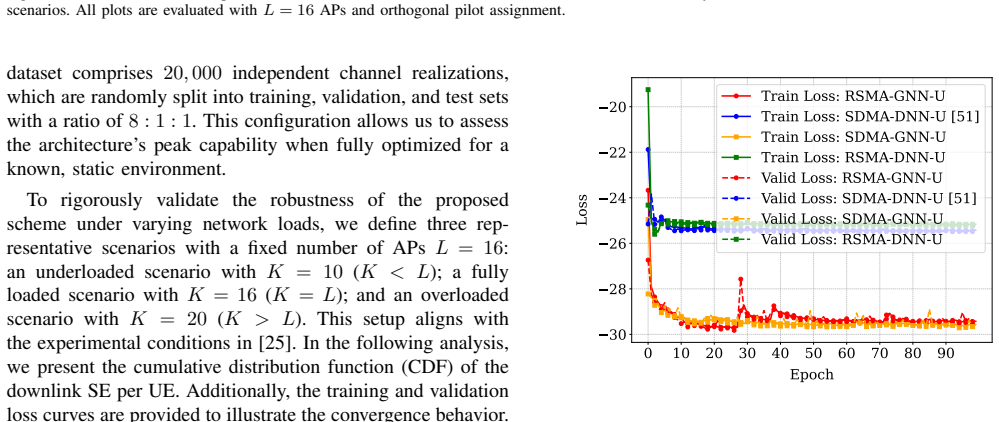
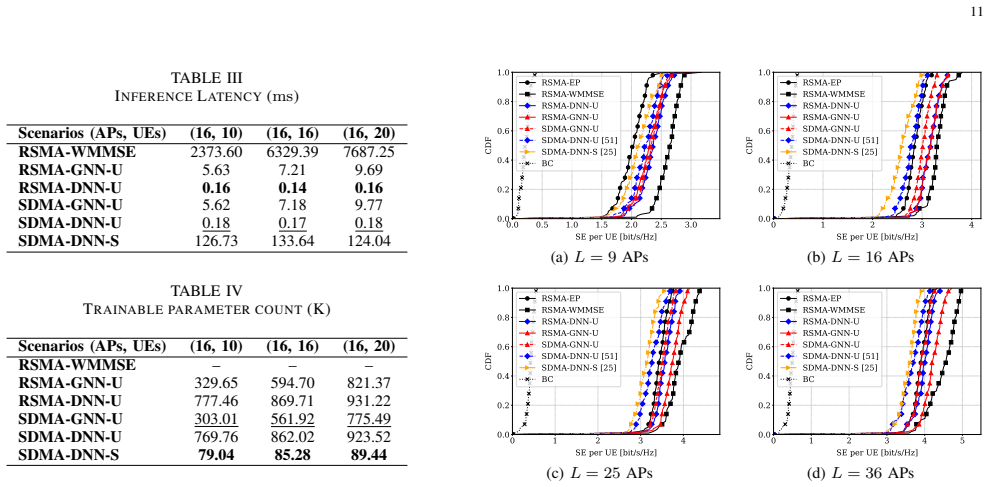
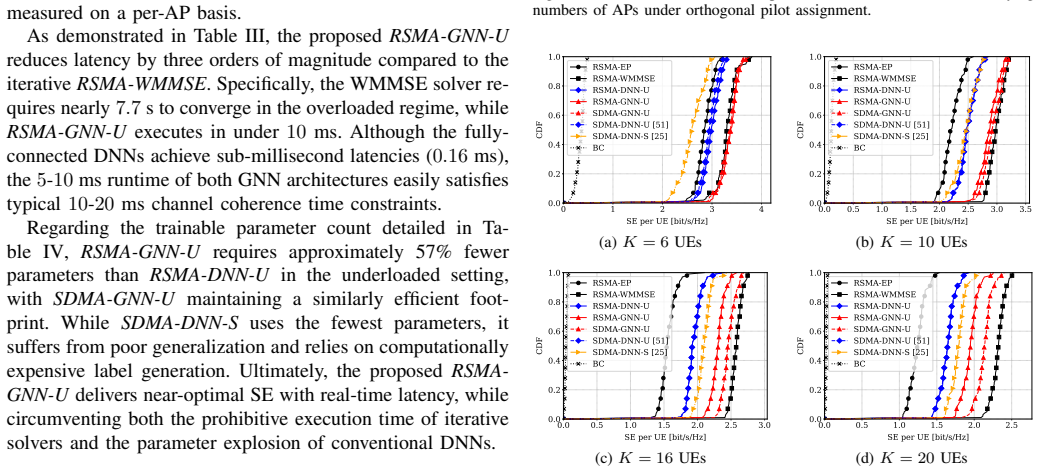
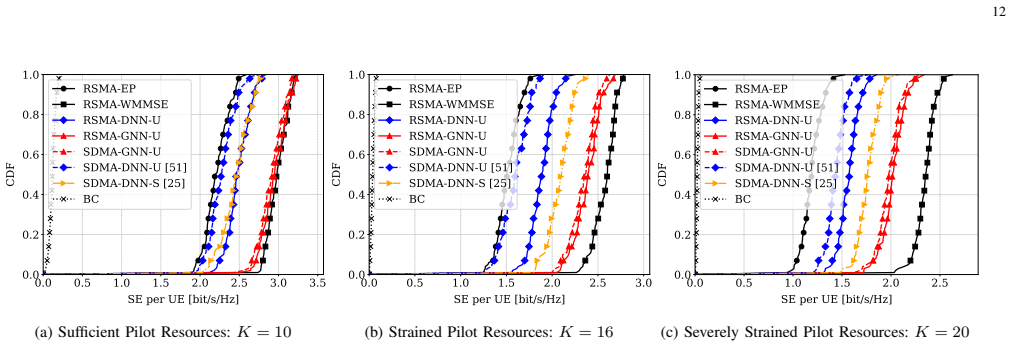
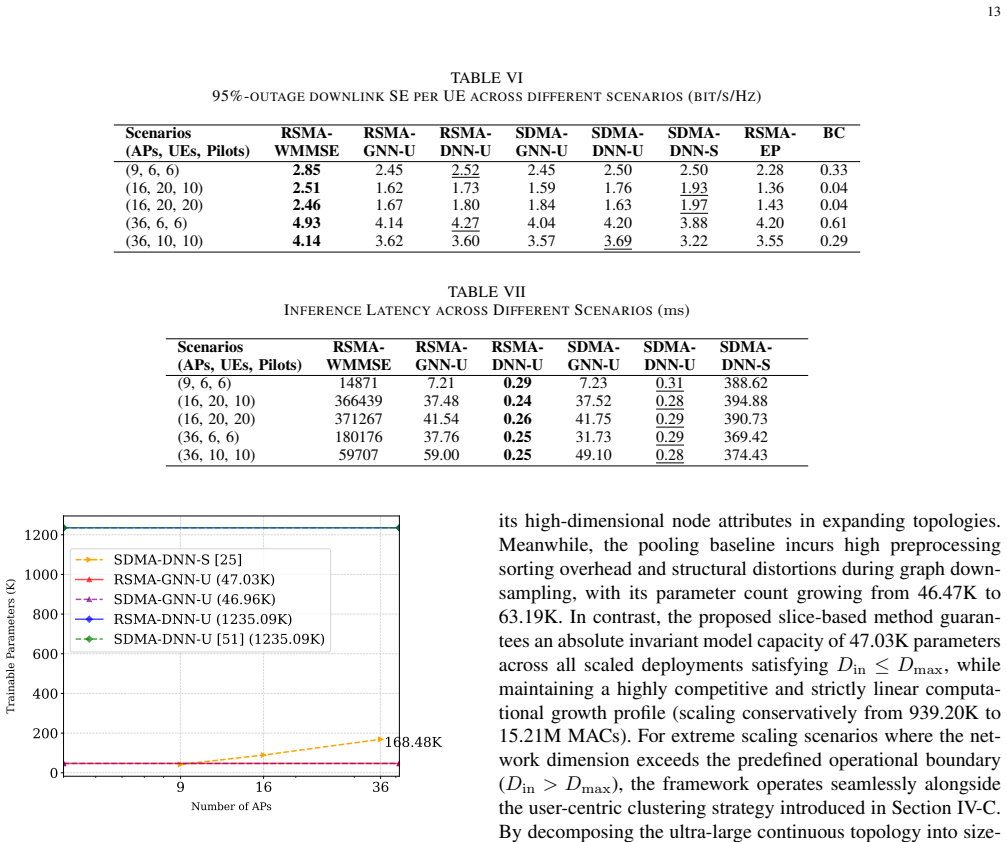
Cell-free massive multiple-input multiple-output (CF-mMIMO) systems provide enhanced coverage and capacity for next-generation wireless networks. However, CF-mMIMO systems face significant challenges in downlink power allocation (PA) due to imperfect channel state information (CSI), severe multi-user interference (MUI), and high computational complexity. To address these issues, rate-splitting multiple access (RSMA) is adopted as a robust interference management strategy. Accordingly, this paper proposes an unsupervised and scalable graph neural network (GNN) framework for PA in rate-splitting CF-mMIMO (RS-CF-mMIMO) systems, relying exclusively on large-scale fading (LSF) coefficients without instantaneous CSI. To resolve the dimensionality mismatch in dynamic networks, we introduce a slice-based adaptive layer that projects variable-dimension features into a fixed latent space. This mechanism enables a unified model to generalize across diverse topologies without retraining. Within this architecture, the sum spectral efficiency (SE) is maximized under per-AP power constraints, assuming maximum-ratio precoding for common streams and regularized zero-forcing precoding for private streams. We also derive a weighted minimum mean-square error-alternating direction method of multipliers (WMMSE-ADMM) algorithm as a performance upper bound. Extensive simulations verify that the proposed GNN framework achieves near-optimal SE and outperforms unsupervised deep neural networks (DNNs) across diverse system sizes and pilot assignment schemes. Furthermore, the scalable variant maintains robust performance while reducing the trainable parameter count by over 57% relative to DNNs and decreasing inference latency by up to three orders of magnitude compared with WMMSE-ADMM.
Editorial analysis
A structured set of objections, weighed in public.
Referee Report
Summary. The paper proposes an unsupervised scalable GNN framework for downlink power allocation in rate-splitting cell-free massive MIMO systems. It relies exclusively on large-scale fading coefficients (no instantaneous CSI), introduces a slice-based adaptive layer to map variable-dimension inputs to a fixed latent space for generalization across topologies without retraining, maximizes sum spectral efficiency under per-AP power constraints with MR precoding for common streams and RZF for private streams, derives a WMMSE-ADMM algorithm as an upper bound, and reports via simulations that the GNN achieves near-optimal SE while outperforming unsupervised DNNs, with the scalable variant cutting trainable parameters by over 57% and inference latency by up to three orders of magnitude versus WMMSE-ADMM.
Significance. If the central claims hold, the work provides a practical, low-complexity, topology-agnostic solution for power allocation in dynamic RS-CF-mMIMO networks. Strengths include the unsupervised GNN formulation that exploits the underlying graph structure, the derivation of an independent WMMSE-ADMM benchmark from first principles, and the emphasis on scalability via the adaptive layer. These elements address key deployment barriers of computational cost and retraining in cell-free systems.
major comments (2)
- [slice-based adaptive layer description] The slice-based adaptive layer (introduced to resolve dimensionality mismatch): no analytical bound or approximation-error analysis is supplied for the projection of variable-dimension LSF feature vectors into a fixed latent space. This is load-bearing for the claims of near-optimality and generalization across arbitrary AP/user counts without retraining, as the abstract states the framework 'relies exclusively on LSF coefficients' and the layer enables a 'unified model'.
- [simulation results] Simulation results (extensive simulations verifying near-optimal SE): the central performance claims rest on empirical comparisons to WMMSE-ADMM and DNN baselines, yet no details are provided on the number of Monte Carlo trials, statistical significance testing, data exclusion rules, or the precise definition of 'near-optimal' (e.g., SE gap thresholds). This undermines confidence in the assertion that LSF coefficients alone suffice for near-optimal allocation under the stated precoding assumptions.
minor comments (2)
- [Abstract] The abstract states the scalable variant reduces trainable parameters by 'over 57%' relative to DNNs; specify the exact DNN architecture and layer counts used for this comparison to allow direct replication.
- [system model] Notation for the common and private stream power variables should be introduced consistently when first appearing in the system model to improve readability.
Simulated Author's Rebuttal
We thank the referee for the constructive feedback and positive assessment of the significance of our unsupervised scalable GNN framework for power allocation in RS-CF-mMIMO systems. We address each major comment below and indicate the revisions we will make.
read point-by-point responses
-
Referee: [slice-based adaptive layer description] The slice-based adaptive layer (introduced to resolve dimensionality mismatch): no analytical bound or approximation-error analysis is supplied for the projection of variable-dimension LSF feature vectors into a fixed latent space. This is load-bearing for the claims of near-optimality and generalization across arbitrary AP/user counts without retraining, as the abstract states the framework 'relies exclusively on LSF coefficients' and the layer enables a 'unified model'.
Authors: We agree that the manuscript currently lacks an analytical bound or approximation-error analysis for the slice-based adaptive layer. The layer's design and effectiveness are supported by empirical results across varying network sizes, but to better substantiate the generalization claims, we will revise the manuscript to include a detailed characterization of the projection mechanism along with a bound on the approximation error derived from the slicing operation. revision: yes
-
Referee: [simulation results] Simulation results (extensive simulations verifying near-optimal SE): the central performance claims rest on empirical comparisons to WMMSE-ADMM and DNN baselines, yet no details are provided on the number of Monte Carlo trials, statistical significance testing, data exclusion rules, or the precise definition of 'near-optimal' (e.g., SE gap thresholds). This undermines confidence in the assertion that LSF coefficients alone suffice for near-optimal allocation under the stated precoding assumptions.
Authors: We acknowledge that the simulation section would benefit from additional methodological details. In the revised manuscript, we will explicitly report the number of Monte Carlo trials, any statistical significance testing performed, data exclusion rules, and a precise definition of 'near-optimal' (e.g., in terms of the relative gap to the WMMSE-ADMM benchmark). These additions will improve transparency and support the empirical claims. revision: yes
Circularity Check
No significant circularity; claims rest on independent benchmarks and empirical validation
full rationale
The paper's core chain derives WMMSE-ADMM from first principles as an external upper bound, trains the GNN unsupervised on the SE objective using only LSF inputs, and validates via simulation against that bound plus separate DNN baselines. No equation or claim reduces by construction to its own fitted parameters or self-citations; the slice layer is an architectural choice whose losslessness is asserted empirically rather than defined into the result. This matches the default non-circular case.
Axiom & Free-Parameter Ledger
free parameters (1)
- GNN trainable weights
axioms (2)
- domain assumption Maximum-ratio precoding is used for common streams and regularized zero-forcing precoding for private streams
- domain assumption Sum spectral efficiency is the appropriate objective to maximize under per-AP power constraints
invented entities (1)
-
slice-based adaptive layer
no independent evidence
Forward citations
Cited by 1 Pith paper
-
Low-Complexity Hybrid Precoding for Cell-Free Massive MU-MIMO ISAC Systems
The work develops an AO-based hybrid precoding scheme with multi-branch RS MMSE-THP updates that reduces complexity by 87% while meeting ESR and PEB sensing constraints in CF massive MU-MIMO ISAC.
Reference graph
Works this paper leans on
-
[1]
An overview of massive MIMO: Benefits and challenges,
L. Lu, G. Y . Li, A. L. Swindlehurst, A. Ashikhmin, and R. Zhang, “An overview of massive MIMO: Benefits and challenges,”IEEE J. Sel. Topics Signal Process., vol. 8, no. 5, pp. 742–758, 2014
2014
-
[2]
Advancements and challenges in scalable modular antenna arrays for 5G massive MIMO networks,
A. Ashraf, T. S. Gunawan, M. Kartiwi, L. O. Nur, B. S. Nugroho, and R. P. Astuti, “Advancements and challenges in scalable modular antenna arrays for 5G massive MIMO networks,”IEEE Access, vol. 12, pp. 57 895–57 916, 2024
2024
-
[3]
Cell-free massive MIMO for 6G wireless communication networks,
H. He, X. Yu, J. Zhang, S. Song, and K. B. Letaief, “Cell-free massive MIMO for 6G wireless communication networks,”IEEE J. Commun. Inf. Netw., vol. 6, no. 4, pp. 321–335, 2021
2021
-
[4]
Next- generation multiple access with cell-free massive MIMO,
M. Mohammadi, Z. Mobini, H. Q. Ngo, and M. Matthaiou, “Next- generation multiple access with cell-free massive MIMO,”Proc. IEEE, 2024
2024
-
[5]
A survey of NOMA-aided cell-free massive MIMO systems,
A. Apiyo and J. Izydorczyk, “A survey of NOMA-aided cell-free massive MIMO systems,”Electronics, vol. 13, no. 1, p. 231, Jan. 2024
2024
-
[6]
Mobile cell-free massive MIMO: Challenges, solutions, and future directions,
J. Zheng, J. Zhang, H. Du, D. Niyato, B. Ai, M. Debbah, and K. B. Letaief, “Mobile cell-free massive MIMO: Challenges, solutions, and future directions,”IEEE Wireless Commun., vol. 31, no. 3, pp. 140– 147, 2024
2024
-
[7]
Ultradense cell-free massive MIMO for 6G: Technical overview and open questions,
H. Q. Ngo, G. Interdonato, E. G. Larsson, G. Caire, and J. G. Andrews, “Ultradense cell-free massive MIMO for 6G: Technical overview and open questions,”Proc. IEEE, vol. 112, no. 7, pp. 805–831, 2024
2024
-
[8]
User-centric cell-free massive MIMO networks: A survey of opportunities, challenges and solutions,
H. A. Ammar, R. Adve, S. Shahbazpanahi, G. Boudreau, and K. V . Srinivas, “User-centric cell-free massive MIMO networks: A survey of opportunities, challenges and solutions,”IEEE Commun. Surveys Tuts., vol. 24, no. 1, pp. 611–652, 2022
2022
-
[9]
Scalable cell-free massive MIMO systems,
E. Bj ¨ornson and L. Sanguinetti, “Scalable cell-free massive MIMO systems,”IEEE Trans. Commun., vol. 68, no. 7, pp. 4247–4261, 2020
2020
-
[10]
Making cell-free massive MIMO competitive with MMSE pro- cessing and centralized implementation,
——, “Making cell-free massive MIMO competitive with MMSE pro- cessing and centralized implementation,”IEEE Trans. Wireless Com- mun., vol. 19, no. 1, pp. 77–90, 2020
2020
-
[11]
Generalized superimposed training scheme in cell-free massive MIMO systems,
N. Garg and T. Ratnarajah, “Generalized superimposed training scheme in cell-free massive MIMO systems,”IEEE Trans. Wireless Commun., vol. 21, no. 9, pp. 7668–7681, 2022
2022
-
[12]
Mitigating intra-cell pilot contamination in massive MIMO: A rate- splitting approach,
A. Mishra, Y . Mao, C. K. Thomas, L. Sanguinetti, and B. Clerckx, “Mitigating intra-cell pilot contamination in massive MIMO: A rate- splitting approach,”IEEE Trans. Wireless Commun., vol. 22, no. 5, pp. 3472–3487, 2023. 15
2023
-
[13]
Rate-splitting multiple access: Fundamentals, survey, and future research trends,
Y . Mao, O. Dizdar, B. Clerckx, R. Schober, P. Popovski, and H. V . Poor, “Rate-splitting multiple access: Fundamentals, survey, and future research trends,”IEEE Commun. Surveys Tuts., vol. 24, no. 4, pp. 2073– 2126, 2022
2073
-
[14]
A primer on rate-splitting multiple access: Tutorial, myths, and frequently asked questions,
B. Clerckx, Y . Mao, E. A. Jorswieck, J. Yuan, D. J. Love, E. Erkip, and D. Niyato, “A primer on rate-splitting multiple access: Tutorial, myths, and frequently asked questions,”IEEE J. Sel. Areas Commun., vol. 41, no. 5, pp. 1265–1308, 2023
2023
-
[15]
Rate-splitting multiple access for downlink communication systems: bridging, generalizing, and outper- forming SDMA and NOMA,
Y . Mao, B. Clerckx, and V . O. Li, “Rate-splitting multiple access for downlink communication systems: bridging, generalizing, and outper- forming SDMA and NOMA,”EURASIP J. Wireless Commun. Netw., vol. 2018, no. 1, p. 133, 2018
2018
-
[16]
Fairness scheduling in user-centric cell-free massive MIMO wireless networks,
F. G ¨ottsch, N. Osawa, I. Kanno, T. Ohseki, and G. Caire, “Fairness scheduling in user-centric cell-free massive MIMO wireless networks,” IEEE Trans. Wireless Commun., vol. 23, no. 9, pp. 11 942–11 957, 2024
2024
-
[17]
A review of energy efficiency and power control schemes in ultra-dense cell-free massive MIMO systems for sustainable 6G wireless communication,
A. L. Imoize, H. I. Obakhena, F. I. Anyasi, and S. N. Sur, “A review of energy efficiency and power control schemes in ultra-dense cell-free massive MIMO systems for sustainable 6G wireless communication,” Sustainability, vol. 14, no. 17, 2022
2022
-
[18]
Cell-free massive MIMO versus small cells,
H. Q. Ngo, A. Ashikhmin, H. Yang, E. G. Larsson, and T. L. Marzetta, “Cell-free massive MIMO versus small cells,”IEEE Trans. Wireless Commun., vol. 16, no. 3, pp. 1834–1850, 2017
2017
-
[19]
Joint user association and power control for cell-free massive MIMO,
C. Hao, T. T. Vu, H. Q. Ngo, M. N. Dao, X. Dang, C. Wang, and M. Matthaiou, “Joint user association and power control for cell-free massive MIMO,”IEEE Internet Things J., vol. 11, no. 9, pp. 15 823– 15 841, 2024
2024
-
[20]
Pre- coding and power optimization in cell-free massive MIMO systems,
E. Nayebi, A. Ashikhmin, T. L. Marzetta, H. Yang, and B. D. Rao, “Pre- coding and power optimization in cell-free massive MIMO systems,” IEEE Trans. Wireless Commun., vol. 16, no. 7, pp. 4445–4459, 2017
2017
-
[21]
Max-min beamforming for large-scale cell-free massive MIMO: A randomized ADMM algorithm,
B. Wang, J. Fang, Y . Xiao, and M. Haardt, “Max-min beamforming for large-scale cell-free massive MIMO: A randomized ADMM algorithm,” IEEE Trans. Wireless Commun., vol. 24, no. 5, pp. 4315–4328, 2025
2025
-
[22]
A practical max-min fair resource allocation algo- rithm for rate-splitting multiple access,
F. Luo and Y . Mao, “A practical max-min fair resource allocation algo- rithm for rate-splitting multiple access,”IEEE Commun. Lett., vol. 27, no. 12, pp. 3285–3289, 2023
2023
-
[23]
Clustered cell-free multi-user multiple-antenna systems with rate-splitting: Precoder design and power allocation,
A. R. Flores, R. C. de Lamare, and K. V . Mishra, “Clustered cell-free multi-user multiple-antenna systems with rate-splitting: Precoder design and power allocation,”IEEE Trans. Commun., vol. 71, no. 10, pp. 5920– 5934, 2023
2023
-
[24]
Deep learning based power control for cell- free massive MIMO with MRT,
L. Sala ¨un and H. Yang, “Deep learning based power control for cell- free massive MIMO with MRT,” inProc. IEEE Global Commun. Conf. (GLOBECOM). IEEE, 2021, pp. 01–07
2021
-
[25]
Learning-based downlink power allocation in cell-free massive MIMO systems,
M. Zaher, ¨O. T. Demir, E. Bj ¨ornson, and M. Petrova, “Learning-based downlink power allocation in cell-free massive MIMO systems,”IEEE Trans. Wireless Commun., vol. 22, no. 1, pp. 174–188, 2023
2023
-
[26]
Learning optimal fronthauling and decentralized edge computation in fog radio access networks,
H. Lee, J. Kim, and S.-H. Park, “Learning optimal fronthauling and decentralized edge computation in fog radio access networks,”IEEE Trans. Wireless Commun., vol. 20, no. 9, pp. 5599–5612, 2021
2021
-
[27]
Deep learning-based power control for cell-free massive MIMO networks,
N. Rajapaksha, K. S. Manosha, N. Rajatheva, and M. Latva-Aho, “Deep learning-based power control for cell-free massive MIMO networks,” in Proc. IEEE Int. Conf. Commun. (ICC). IEEE, 2021, pp. 1–7
2021
-
[28]
Joint power control and pilot assignment in cell-free massive MIMO using deep learning,
M. Usman Khan, E. Testi, M. Chiani, and E. Paolini, “Joint power control and pilot assignment in cell-free massive MIMO using deep learning,”IEEE Open J. Commun. Soc., vol. 5, pp. 5260–5275, 2024
2024
-
[29]
Unsupervised learning-based joint power control and fronthaul capacity allocation in cell-free massive MIMO with hardware impairments,
N. Rajapaksha, K. S. Manosha, N. Rajatheva, and M. Latva-Aho, “Unsupervised learning-based joint power control and fronthaul capacity allocation in cell-free massive MIMO with hardware impairments,”IEEE Wireless Commun. Lett., vol. 12, no. 7, pp. 1159–1163, 2023
2023
-
[30]
Decen- tralized beamforming for cell-free massive mimo with unsupervised learning,
H. Hojatian, J. Nadal, J.-F. Frigon, and F. Leduc-Primeau, “Decen- tralized beamforming for cell-free massive mimo with unsupervised learning,”IEEE Commun. Lett., vol. 26, no. 5, pp. 1042–1046, 2022
2022
-
[31]
Model-based neural collaboration framework for resource-efficient downlink beamforming in cell-free massive mimo systems,
D. Yu, M. Boloursaz Mashhadi, and R. Tafazolli, “Model-based neural collaboration framework for resource-efficient downlink beamforming in cell-free massive mimo systems,”IEEE Trans. Commun., vol. 73, no. 10, pp. 8980–8995, 2025
2025
-
[32]
A federated deep learning framework for cell-free RSMA networks,
S. A. Mousavi, M. Monemi, R. Mohseni, and M. Latva-aho, “A federated deep learning framework for cell-free RSMA networks,” arXiv:2501.07126, 2025
-
[33]
Deep reinforcement learn- ing enhanced rate-splitting multiple access for interference mitigation,
O. N. Irkicatal, E. T. Ceran, and M. Yuksel, “Deep reinforcement learn- ing enhanced rate-splitting multiple access for interference mitigation,” arXiv:2403.05974, 2024
-
[34]
RNN beamforming optimizer for rate- splitting multiple access and cell-free massive MIMO,
J. Johnston and X. Wang, “RNN beamforming optimizer for rate- splitting multiple access and cell-free massive MIMO,”IEEE Trans. Commun., vol. 73, no. 5, pp. 3579–3592, 2025
2025
-
[35]
Deep learning-based power control for uplink cell-free massive MIMO systems,
Y . Zhang, J. Zhang, Y . Jin, S. Buzzi, and B. Ai, “Deep learning-based power control for uplink cell-free massive MIMO systems,” inProc. IEEE Global Commun. Conf. (GLOBECOM). IEEE, 2021, pp. 1–6
2021
-
[36]
Unsupervised deep learning for power control of cell-free massive MIMO systems,
Y . Zhang, J. Zhang, S. Buzzi, H. Xiao, and B. Ai, “Unsupervised deep learning for power control of cell-free massive MIMO systems,”IEEE Trans. Veh. Technol., vol. 72, no. 7, pp. 9585–9590, 2023
2023
-
[37]
Power allocation in cell-free massive MIMO: A deep learning method,
Y . Zhao, I. G. Niemegeers, and S. H. De Groot, “Power allocation in cell-free massive MIMO: A deep learning method,”IEEE Access, vol. 8, pp. 87 185–87 200, 2020
2020
-
[38]
Graph representation learning for wireless communications,
M. Mohsenivatani, S. Ali, V . Ranasinghe, N. Rajatheva, and M. Latva- Aho, “Graph representation learning for wireless communications,” IEEE Commun. Mag., vol. 62, no. 1, pp. 141–147, 2024
2024
-
[39]
Graph neural networks for scalable radio resource management: Architecture design and theoretical analysis,
Y . Shen, Y . Shi, J. Zhang, and K. B. Letaief, “Graph neural networks for scalable radio resource management: Architecture design and theoretical analysis,”IEEE J. Sel. Areas Commun., vol. 39, no. 1, pp. 101–115, 2021
2021
-
[40]
Energy-efficient power allocation in cell-free massive MIMO via graph neural networks,
R. Raghunath, B. Peng, and E. A. Jorswieck, “Energy-efficient power allocation in cell-free massive MIMO via graph neural networks,” in Proc. IEEE Int. Conf. Mach. Learn. Commun. Netw. (ICMLCN). IEEE, 2024, pp. 31–37
2024
-
[41]
Dis- tributed graph neural network design for sum ergodic spectral efficiency maximization in cell-free massive MIMO,
N. X. Tung, T. Van Chien, H. Q. Ngo, and W. J. Hwang, “Dis- tributed graph neural network design for sum ergodic spectral efficiency maximization in cell-free massive MIMO,”IEEE Trans. Veh. Technol., vol. 74, no. 3, pp. 5181–5186, 2025
2025
-
[42]
Scalable user rate and energy-efficiency optimization in cell-free massive MIMO,
H. D. Tuan, A. A. Nasir, H. Q. Ngo, E. Dutkiewicz, and H. V . Poor, “Scalable user rate and energy-efficiency optimization in cell-free massive MIMO,”IEEE Trans. Commun., vol. 70, no. 9, pp. 6050–6065, 2022
2022
-
[43]
Learning optimal linear precoding for cell-free massive MIMO with GNN,
B. Parlier, L. Sala ¨un, and H. Yang, “Learning optimal linear precoding for cell-free massive MIMO with GNN,” inProc. Eur. Conf. Mach. Learn. Knowl. Discov. Databases (ECML PKDD). Brno, Czech Republic: Springer, Sept. 2024, pp. 72–88
2024
-
[44]
GNN-based RSMA for energy efficiency in hardware-impaired cell-free URLLC systems,
Y . Huang, Y . Jiang, F.-C. Zheng, and P. Zhu, “GNN-based RSMA for energy efficiency in hardware-impaired cell-free URLLC systems,” in Proc. IEEE Int. Conf. Commun. (ICC). IEEE, 2025, pp. 3551–3556
2025
-
[45]
Graph neural network aided power control in partially connected cell-free massive MIMO,
S. Mishra, L. Salaun, H. Yang, and C. S. Chen, “Graph neural network aided power control in partially connected cell-free massive MIMO,” IEEE Trans. Wireless Commun., vol. 23, no. 9, pp. 12 412–12 423, 2024
2024
-
[46]
Resource allocation in heterogeneous network with node and edge enhanced graph attention network,
Q. Sun, Y . He, and O. Petrosian, “Resource allocation in heterogeneous network with node and edge enhanced graph attention network,”Applied Intelligence, vol. 54, no. 6, pp. 4865–4877, 2024
2024
-
[47]
A dynamic power allocation approach for downlink cell-free massive MIMO with graph neural network,
Y . Zhao, F. Zhang, Z. Zhou, and G. Hu, “A dynamic power allocation approach for downlink cell-free massive MIMO with graph neural network,”IEEE Trans. Veh. Technol., vol. 74, no. 4, pp. 6518–6532, 2025
2025
-
[48]
Heterogeneous graph neural network for power allocation in multicarrier-division duplex cell-free massive MIMO systems,
B. Li, L.-L. Yang, R. G. Maunder, S. Sun, and P. Xiao, “Heterogeneous graph neural network for power allocation in multicarrier-division duplex cell-free massive MIMO systems,”IEEE Trans. Wireless Commun., vol. 23, no. 2, pp. 962–977, 2024
2024
-
[49]
Heterogeneous resource allocation with multi-task learning for wireless networks,
N. A. Mitsiou, P. S. Bouzinis, P. G. Sarigiannidis, and G. K. Karagian- nidis, “Heterogeneous resource allocation with multi-task learning for wireless networks,”IEEE Trans. Wireless Commun., vol. 25, pp. 7191– 7205, 2026
2026
-
[50]
On size-oriented long-tailed graph classification of graph neural networks
Z. Liu, Q. Mao, C. Liu, Y . Fang, and J. Sun, “On size-oriented long-tailed graph classification of graph neural networks.” New York, NY , USA: Association for Computing Machinery, 2022. [Online]. Available: https://doi.org/10.1145/3485447.3512197
-
[51]
Unsupervised learning-based downlink power allocation for CF-mMIMO networks,
M. Fabiani, A. Abdallah, A. Celik, and A. M. Eltawil, “Unsupervised learning-based downlink power allocation for CF-mMIMO networks,” inProc. IEEE Global Commun. Conf. (GLOBECOM). IEEE, 2023, pp. 6309–6314
2023
-
[52]
Unsupervised learning for distributed downlink power allocation in cell-free mMIMO networks,
M. Fabiani, A. Abdallah, A. Celik, O. Haliloglu, and A. M. Eltawil, “Unsupervised learning for distributed downlink power allocation in cell-free mMIMO networks,”IEEE Trans. Mach. Learn. Commun. Netw., vol. 3, pp. 644–658, 2025
2025
discussion (0)
Sign in with ORCID, Apple, or X to comment. Anyone can read and Pith papers without signing in.