Probing kinetic enhancement of fusion reactivity in turbulent hot spots
Pith reviewed 2026-06-28 12:36 UTC · model grok-4.3
The pith
Turbulence generates non-Maxwellian ion tails that boost fusion reactivity, but the BGK operator overestimates the effect while the Fokker-Planck operator yields roughly half as much under typical ICF conditions.
A machine-rendered reading of the paper's core claim, the machinery that carries it, and where it could break.
Core claim
By comparing steady-state distributions obtained with the BGK and FP collision operators in sinusoidal shear flow, the work shows that BGK overestimates reactivity enhancement from non-Maxwellian tails while FP produces a more modest enhancement that is nearly halved under typical ICF parameters. PIC simulations that incorporate nuclear reactions further reveal that the combined effects of preferential ion heating during shear flow dissipation and tail enhancement can amplify the reactivity enhancement beyond the steady-state prediction.
What carries the argument
Sinusoidal shear flow model evolved with BGK versus Fokker-Planck collision operators to produce and compare non-Maxwellian ion tails, then extended by PIC runs that track nuclear reactions.
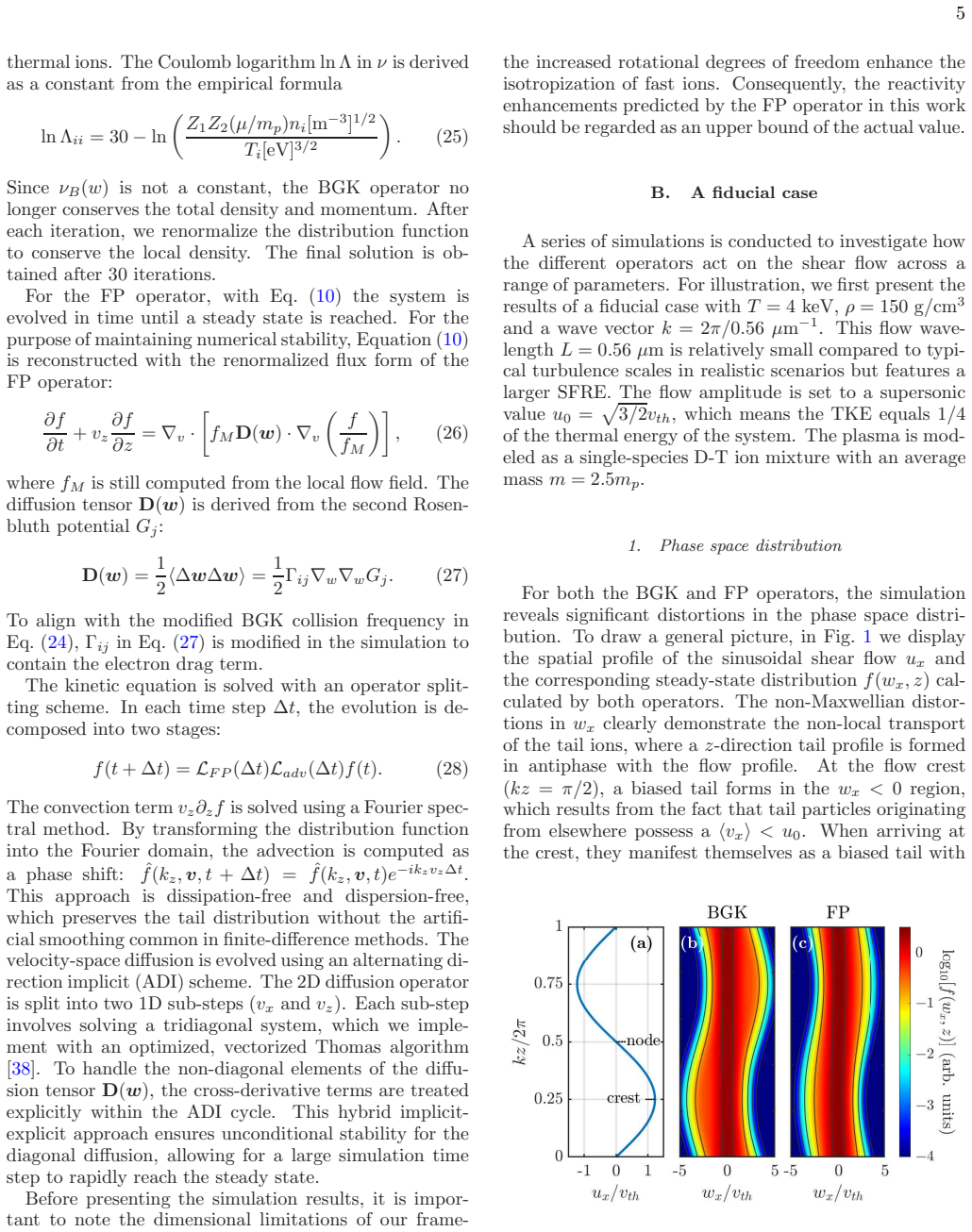
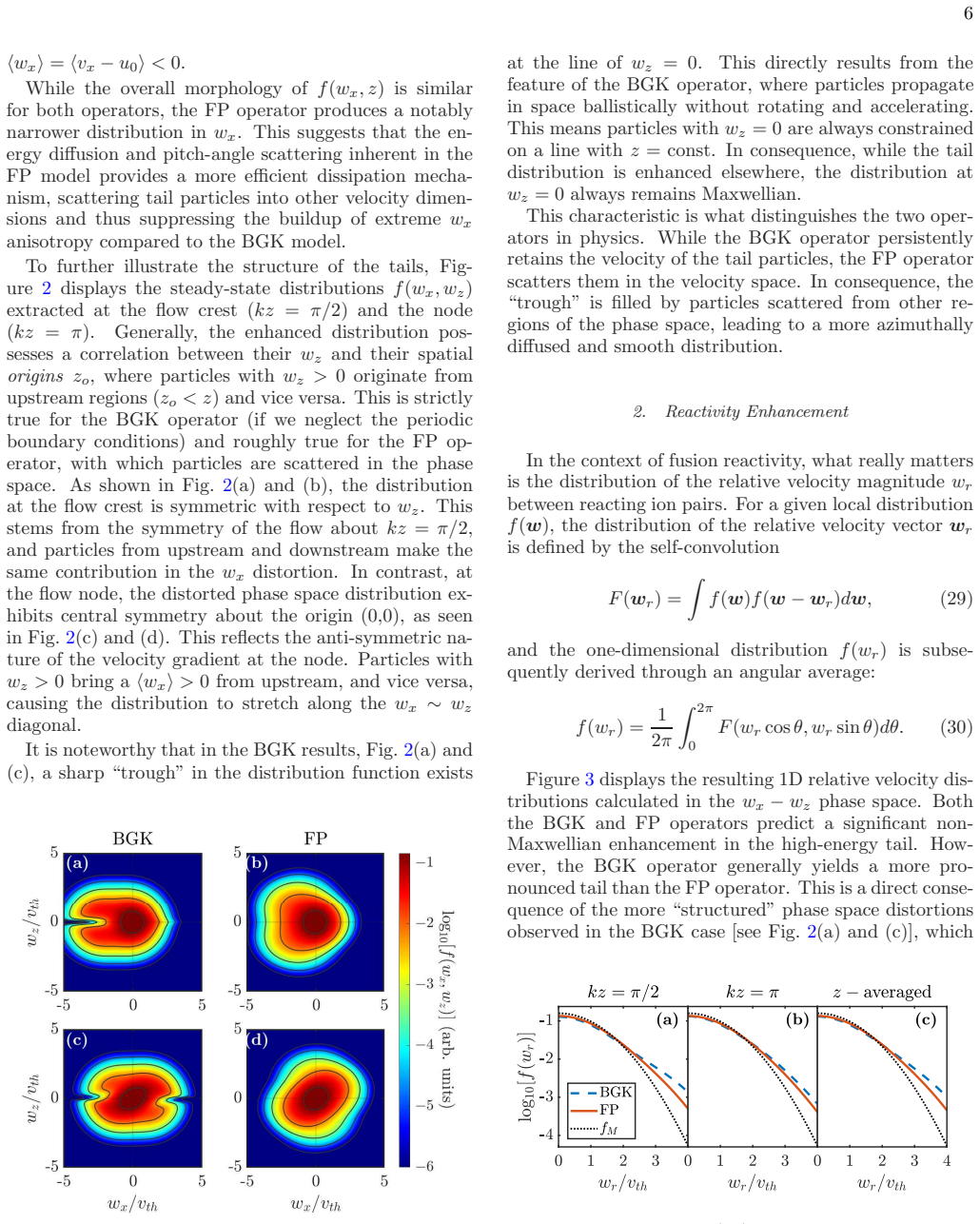
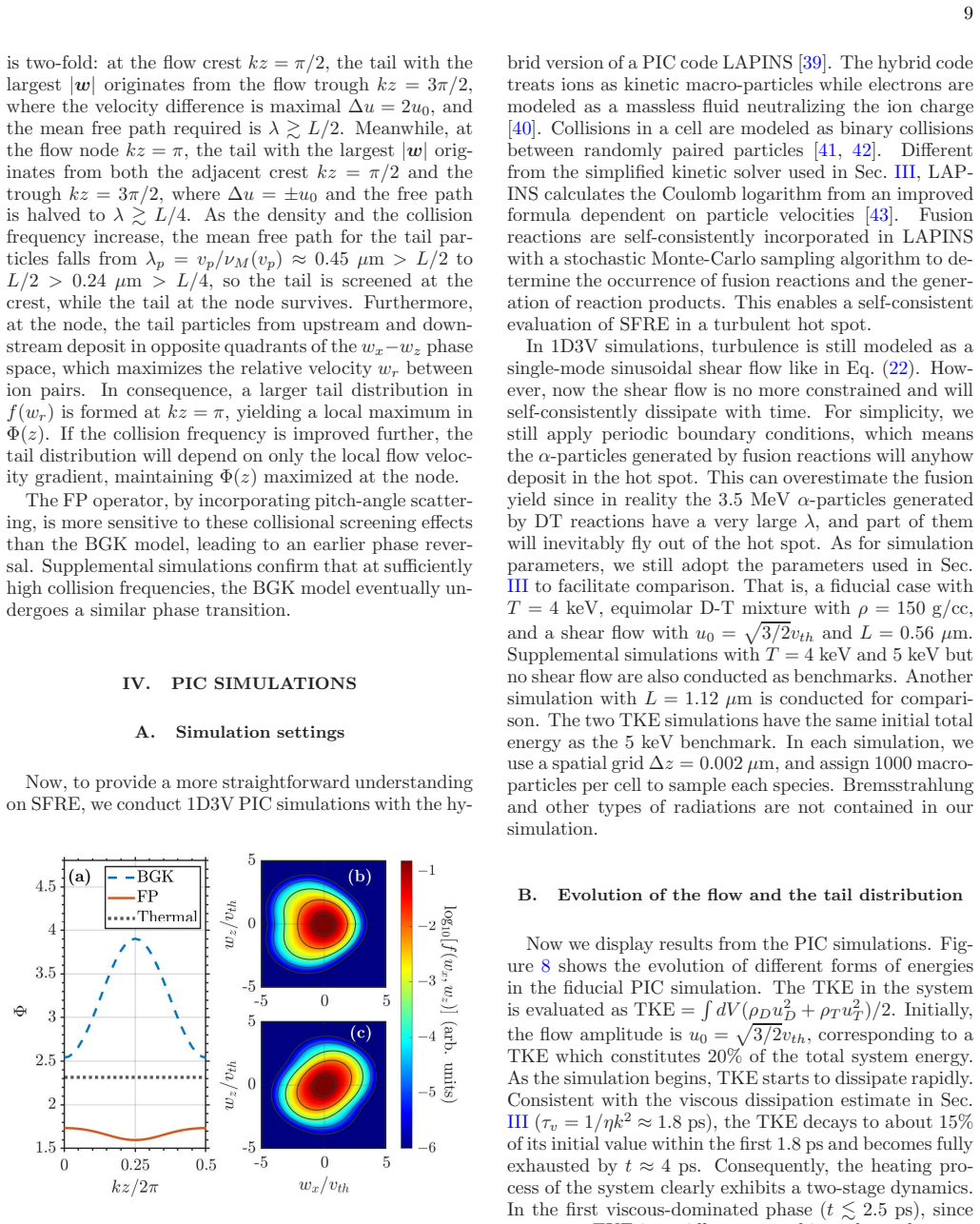
If this is right
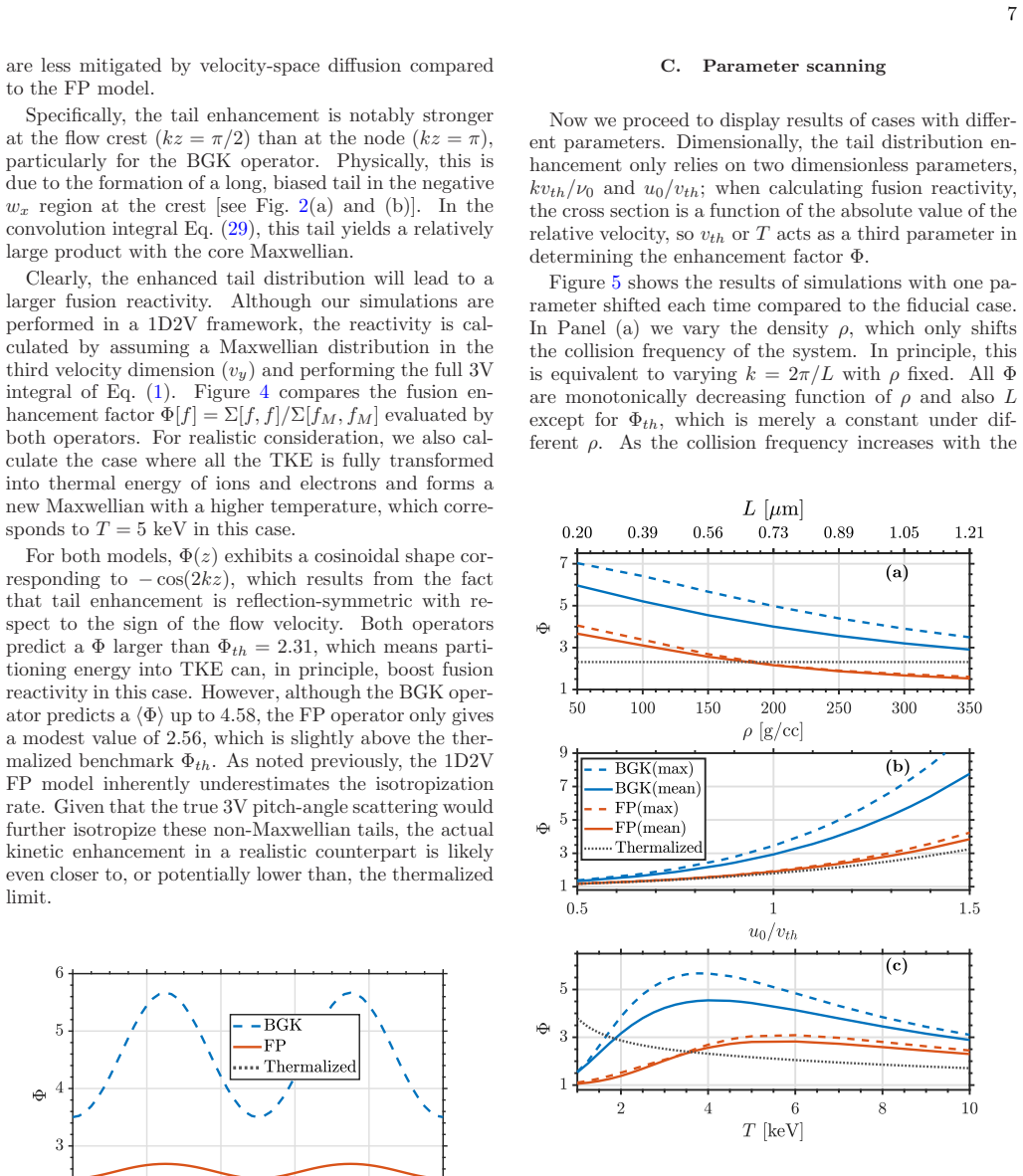
- The BGK collision operator overestimates the reactivity enhancement produced by turbulence-induced tails.
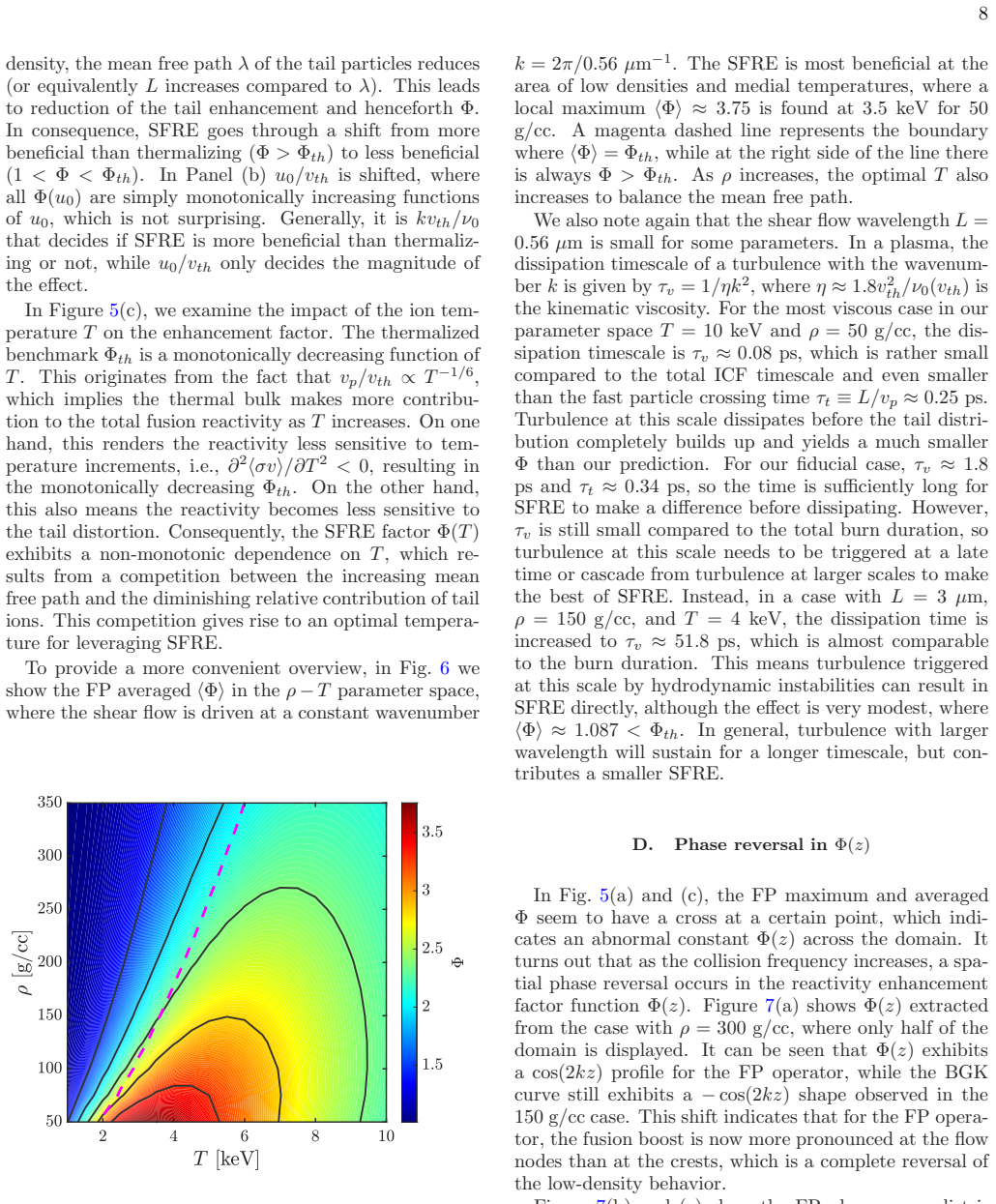
- The Fokker-Planck operator reduces the predicted enhancement by nearly half under typical ICF parameters.
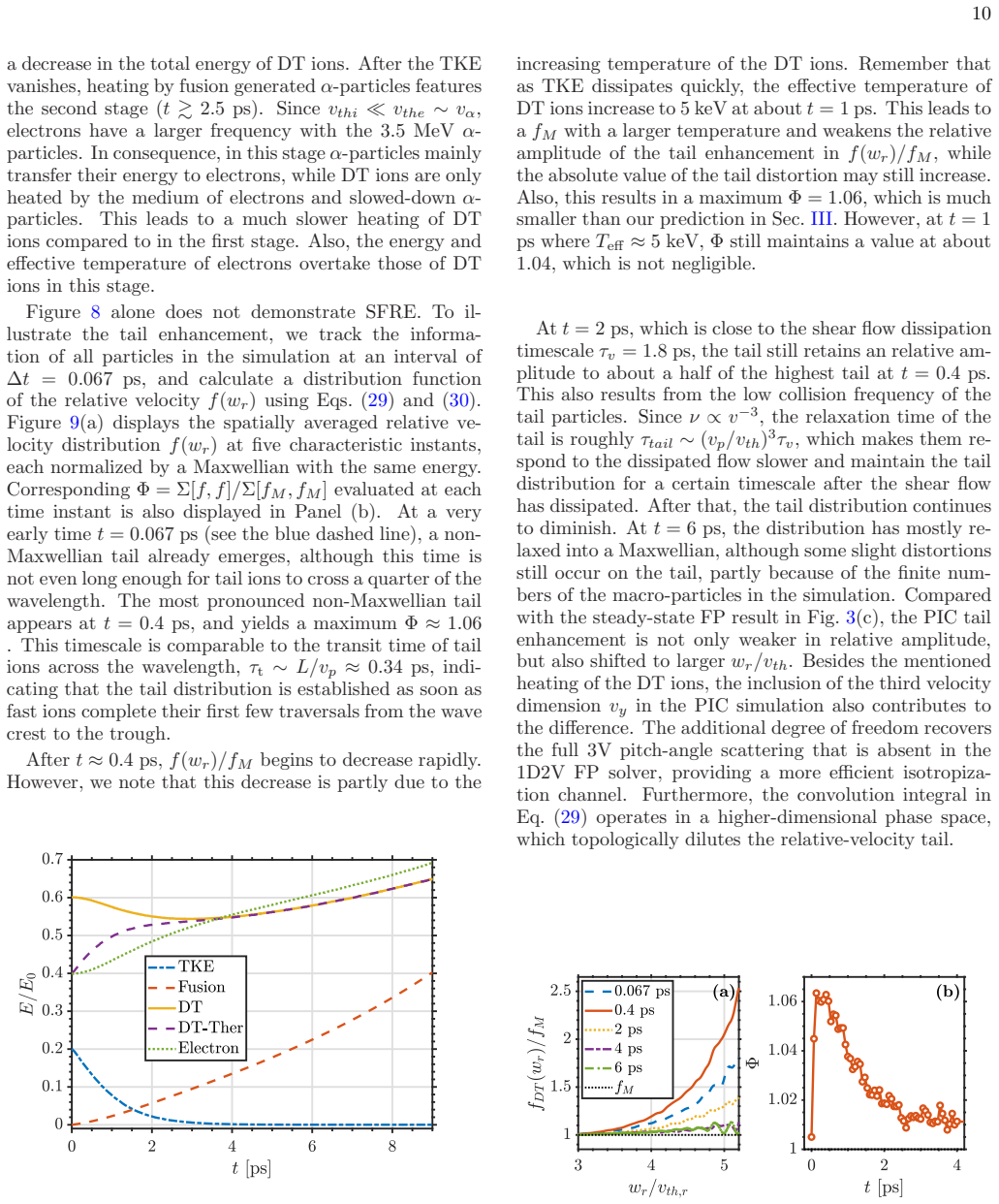
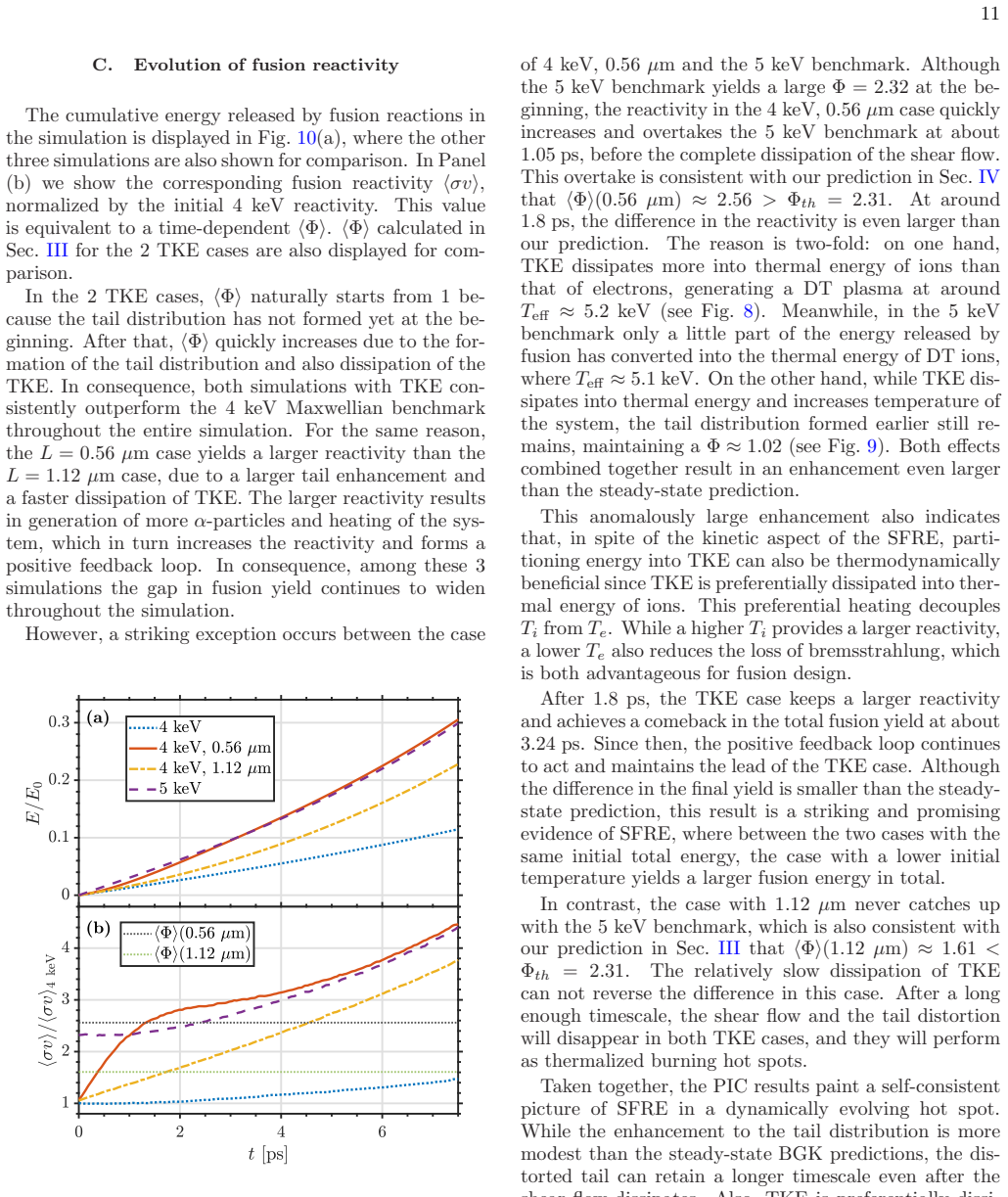
- Preferential ion heating during shear-flow dissipation can raise the reactivity gain above the steady-state value obtained from the distribution alone.
- Accurate fusion-yield predictions require choosing the collision operator that correctly captures tail formation.
Where Pith is reading between the lines
- If real hot-spot turbulence has a broader spectrum or different dissipation channels than a single sinusoidal mode, the reported enhancement factors would shift.
- Design codes that rely on BGK-based tail corrections for inertial confinement fusion may overstate expected yields and require recalibration.
- Laboratory experiments that impose controlled shear while diagnosing both distribution functions and reaction rates could directly test the relative size of the BGK and FP effects.
Load-bearing premise
The sinusoidal shear flow is a sufficient representation of the turbulence that creates non-Maxwellian tails inside real hot spots.
What would settle it
Measure the ion velocity distribution and the actual fusion rate in a laboratory plasma subjected to a controlled sinusoidal shear flow and compare both quantities against Maxwellian expectations.
Figures
read the original abstract
Traditionally, fusion reactivity in thermonuclear plasmas has been calculated by assuming a local Maxwellian ion distribution. However, recent theoretical work [Phys. Rev. Lett. 135, 155101 (2025)] suggests that turbulence in plasmas can generate non-Maxwellian tail distributions, thereby enhancing reactivity. In this paper, we investigate this effect through numerical simulations of a sinusoidal shear flow. By comparing steady-state distributions obtained with the Bhatnagar-Gross-Krook (BGK) and Fokker-Planck (FP) collision operators, respectively, we demonstrate that the BGK model overestimates the reactivity enhancement while the FP operator gives a much more modest enhancement that is nearly halved under typical ICF parameters. Particle-in-cell (PIC) simulations incorporating nuclear reactions are also conducted, which reveal that the combined effects of preferential ion heating during shear flow dissipation and tail enhancement can even amplify the reactivity enhancement to be larger than the steady-state prediction.
Editorial analysis
A structured set of objections, weighed in public.
Referee Report
Summary. The manuscript investigates turbulence-induced non-Maxwellian ion tails and their effect on fusion reactivity in hot spots, modeled via numerical simulations of a sinusoidal shear flow. Steady-state comparisons show the BGK collision operator overestimates reactivity enhancement relative to the Fokker-Planck operator (nearly halved under typical ICF parameters), while PIC simulations with nuclear reactions indicate that preferential ion heating during shear-flow dissipation combined with tail enhancement can produce reactivity gains exceeding the steady-state prediction.
Significance. If the central results hold, the work usefully quantifies the sensitivity of reactivity enhancement to the choice of collision operator and demonstrates that time-dependent dissipation effects can increase (rather than reduce) the enhancement. The explicit BGK-vs-FP comparison and the inclusion of nuclear reactions in the PIC runs are concrete strengths that allow direct assessment of modeling approximations.
major comments (1)
- [modeling approach (abstract and methods)] The sinusoidal shear flow is adopted as the sole model for turbulence without quantitative evidence that the wavenumber, amplitude, or dissipation mechanism produces ion tails whose energy dependence and amplitude match those generated by the actual turbulent spectrum in hot spots; this modeling choice is load-bearing for the claim that the reported factor-of-two difference between operators (and the PIC amplification) applies to real ICF conditions.
minor comments (1)
- The phrase 'typical ICF parameters' is used for the halved enhancement but the specific values of density, temperature, and flow amplitude are not stated in the abstract or summary; adding these values would improve reproducibility.
Simulated Author's Rebuttal
We thank the referee for their constructive review and for highlighting the modeling assumptions in our work. We address the major comment below.
read point-by-point responses
-
Referee: The sinusoidal shear flow is adopted as the sole model for turbulence without quantitative evidence that the wavenumber, amplitude, or dissipation mechanism produces ion tails whose energy dependence and amplitude match those generated by the actual turbulent spectrum in hot spots; this modeling choice is load-bearing for the claim that the reported factor-of-two difference between operators (and the PIC amplification) applies to real ICF conditions.
Authors: We acknowledge that the sinusoidal shear flow constitutes a simplified, canonical model chosen to generate non-Maxwellian tails in a controlled, high-resolution setting that permits direct BGK–FP comparison and inclusion of nuclear reactions. The manuscript does not supply quantitative evidence that the specific wavenumber, amplitude, or dissipation mechanism reproduces the precise energy dependence and amplitude of tails arising from a realistic, broadband turbulent spectrum in ICF hot spots. In the revised manuscript we will add explicit language in the methods and discussion sections stating the idealized character of the flow, noting that the reported numerical factors (including the factor-of-two difference) are specific to this model, and clarifying that extrapolation to full turbulence spectra would require additional studies. The qualitative conclusion that BGK overestimates the enhancement relative to FP is expected to be robust across tail-generating flows, but we accept that the quantitative applicability to real ICF conditions rests on this modeling choice. revision: yes
Circularity Check
Minor self-citation to prior suggestion; core results from independent simulations
full rationale
The paper motivates its study by citing a 2025 PRL suggesting turbulence generates non-Maxwellian tails, then performs its own BGK/FP comparisons and PIC simulations with nuclear reactions inside a sinusoidal shear flow to quantify reactivity enhancement. No load-bearing step reduces the reported factor-of-two difference or PIC amplification to a self-referential fit, self-definition, or unverified self-citation chain. The sinusoidal flow is an explicit modeling assumption whose validity is external to the derivation; the quantitative outputs are generated by the operators and particle tracking rather than by construction from the citation. This yields a normal minor self-citation score with no circular reduction.
Axiom & Free-Parameter Ledger
axioms (1)
- domain assumption BGK and Fokker-Planck operators are appropriate models for ion collisions in the simulated shear flow
Forward citations
Cited by 1 Pith paper
-
Fusion-power amplification by compressive hydrodynamic fluctuations
Compressive hydrodynamic fluctuations amplify fusion power in plasmas via hydrodynamic, two-temperature, and kinetic mechanisms, often exceeding the gain from using the same energy for heating.
Reference graph
Works this paper leans on
-
[1]
Neglect- ing the relatively weak dependence of the prefactors on vr, the integrand in Eq
reduces to a one-dimensional integral, ⟨σv ⟩ = 2 − δij 2 ∫ vr 4S(vr)√ πv 3 th e− vG/v r− v2 r /v 2 thdvr, (3) where vth = √ 2T /m is the thermal velocity. Neglect- ing the relatively weak dependence of the prefactors on vr, the integrand in Eq. (
-
[2]
reaches its maximum at vp = ( vGv2 th/ 2)1/ 3, which corresponds to the Gamow peak EP = µv 2 r / 2 = ( EGT 2/ 4)1/ 3. Given vG ≫ vth, it follows that vp ≫ vth, implying that ions from the high- energy tail of the distribution function, which constitute only a small fraction of the total population, contribute the bulk of the fusion reactivity. B. Collisio...
-
[3]
For a single Fourier mode with wavevector k and velocity am- plitude ˜u(k), where k ⊥ ˜u, the spatial gradient trans- forms as ∇ → ik
and retaining only first-order terms yields the linearized steady-state equation: w · ∇ f1 − w · ∇ u · ∂f M ∂w = ˆC[f1], (13) where ˆC is the generic linearized collision operator. For a single Fourier mode with wavevector k and velocity am- plitude ˜u(k), where k ⊥ ˜u, the spatial gradient trans- forms as ∇ → ik. Without loss of generality, we can assume ...
-
[4]
Consequently, the lowest- order reactivity enhancement is second-order, Σ[ f1, f 1] + Σ[ fM , f 2], which necessitates computing the second-order perturbation f2
is an odd function of wx, yielding zero net enhancement in fusion reactivity when reacting with fM (i.e., Σ[ f1, f M ] = 0). Consequently, the lowest- order reactivity enhancement is second-order, Σ[ f1, f 1] + Σ[ fM , f 2], which necessitates computing the second-order perturbation f2. 4 Expanding Eq. ( 12) to the second order in u yields: w · ∇ f2 + u ·...
-
[5]
(18) Now, to the second order, the reactivity enhancement factor can be written as Φ[ f, f ] = 1 + Σ[ f1, f 1] + Σ[ f2, f M ] Σ[ fM , f M ]
gives a lengthy expression for ˜f2: ˜f2(k, w) = [ i(k ·w) − ˆC ]− 1 ∑ k1+k2=k i [ (w ·k1) ˜u(k1) · ∂ ˜f1(k2, w) ∂w − ( ˜u(k1) ·k2) ˜f1(k2, w) ] . (18) Now, to the second order, the reactivity enhancement factor can be written as Φ[ f, f ] = 1 + Σ[ f1, f 1] + Σ[ f2, f M ] Σ[ fM , f M ] . (19) To explicitly evaluate Eqs. ( 15) and ( 18), one must spec- ify ...
-
[6]
Hence- forth, in the next Section we will present numerical cal- culations of the steady-state tail distribution
and ( 18) intractable. Hence- forth, in the next Section we will present numerical cal- culations of the steady-state tail distribution. III. STEADY STATE TAIL DISTRIBUTION A. Simulation settings To investigate the tail distribution established by the shear flow, we numerically solve for the steady-state dis- tribution and calculate the resulting SFRE, usi...
-
[7]
In accordance with FF, the collision fre- quency here is modified to include a constant electron drag term: νB(w) = νM (w) + ν0(vth) √ me mi , (24) where ν0 and νM are defined by Eqs
is solved with the method of characteristics, where the distribution is prop- agated ballistically along vz, and collision acts as an at- tenuation factor: f (v, z + ∆ z) = f (v, z )e− νB (w)∆ t +fM (w)(1 − e− νB (w)∆ t), (23) where ∆ t = ∆ z/v z, and the local Maxwellian is com- puted from the prescribed shear flow via fM (w) = fM (|v − u(z)|). In accorda...
-
[8]
the system is evolved in time until a steady state is reached. For the purpose of maintaining numerical stability, Equation ( 10) is reconstructed with the renormalized flux form of the FP operator: ∂f ∂t + vz ∂f ∂z = ∇ v · [ fM D(w) · ∇ v ( f fM )] , (26) where fM is still computed from the local flow field. The diffusion tensor D(w) is derived from the seco...
-
[9]
To draw a general picture, in Fig
Phase space distribution For both the BGK and FP operators, the simulation reveals significant distortions in the phase space distri- bution. To draw a general picture, in Fig. 1 we display the spatial profile of the sinusoidal shear flow ux and the corresponding steady-state distribution f (wx, z ) cal- culated by both operators. The non-Maxwellian distor- ...
-
[10]
structured
Reactivity Enhancement In the context of fusion reactivity, what really matters is the distribution of the relative velocity magnitude wr between reacting ion pairs. For a given local distribution f (w), the distribution of the relative velocity vector wr is defined by the self-convolution F (wr) = ∫ f (w)f (w − wr)dw, (29) and the one-dimensional distribu...
-
[11]
In a plasma, the dissipation timescale of a turbulence with the wavenum- ber k is given by τv = 1/ηk 2, where η ≈ 1
56 µ m is small for some parameters. In a plasma, the dissipation timescale of a turbulence with the wavenum- ber k is given by τv = 1/ηk 2, where η ≈ 1. 8v2 th/ν 0(vth) is the kinematic viscosity. For the most viscous case in our parameter space T = 10 keV and ρ = 50 g/cc, the dis- sipation timescale is τv ≈ 0. 08 ps, which is rather small compared to th...
-
[12]
Figure 9(a) displays the spatially averaged relative ve- locity distribution f (wr) at five characteristic instants, each normalized by a Maxwellian with the same energy
and ( 30). Figure 9(a) displays the spatially averaged relative ve- locity distribution f (wr) at five characteristic instants, each normalized by a Maxwellian with the same energy. Corresponding Φ = Σ[ f, f ]/ Σ[ fM , f M ] evaluated at each time instant is also displayed in Panel (b). At a very early time t = 0. 067 ps (see the blue dashed line), a non- ...
-
[13]
operates in a higher-dimensional phase space, which topologically dilutes the relative-velocity tail. FIG. 9. (a) The spatial averaged tail distributions of the relative velocity, normalized by their Maxwellian counter part, f (wr)/f M , extracted at 0.067 ps (blue), 0.4 ps (red), 2 ps (yellow), 4 ps (purple), and 6 ps (green) respectively. (b) The corres...
-
[14]
Nuckolls, L
J. Nuckolls, L. Wood, A. Thiessen, and G. Zim- merman, Laser compression of matter to super- high densities: Thermonuclear (ctr) applications, Nature 239, 139 (1972)
1972
-
[15]
J. D. Lindl, P. Amendt, R. L. Berger, S. G. Glendin- ning, S. H. Glenzer, S. W. Haan, R. L. Kauffman, O. L. Landen, and L. J. Suter, The physics basis for ignition us- ing indirect-drive targets on the national ignition facili ty, Physics of Plasmas 11, 339 (2004)
2004
-
[16]
Betti and O
R. Betti and O. Hurricane, Inertial-confinement fusion with lasers, Nature Physics 12, 435 (2016)
2016
-
[17]
M. M. Marinak, G. D. Kerbel, N. A. Gentile, O. Jones, D. Munro, S. Pollaine, T. R. Dittrich, and S. W. Haan, Three-dimensional hydra simulations of national ignition facility targets, Physics of Plasmas 8, 2275 (2001)
2001
-
[18]
D. S. Clark, C. R. Weber, J. L. Milovich, A. E. Pak, D. T. Casey, B. A. Hammel, et al. , Three-dimensional model- ing and hydrodynamic scaling of national ignition facility implosions, Physics of Plasmas 26, 050601 (2019)
2019
-
[19]
Spitzer, Physics of fully ionized gases (Courier Corpo- ration, 2006)
L. Spitzer, Physics of fully ionized gases (Courier Corpo- ration, 2006)
2006
-
[20]
A. L. Kritcher, R. Town, D. Bradley, D. Clark, B. Spears, O. Jones, S. Haan, P. T. Springer, J. Lindl, R. H. H. Scott, D. Callahan, M. J. Edwards, and O. L. Landen, Metrics for long wavelength asymmetries in inertial con- finement fusion implosions on the national ignition facil- ity, Physics of Plasmas 21, 042708 (2014)
2014
-
[21]
Zhou, Rayleigh–taylor and richtmyer–meshkov in- stability induced flow, turbulence, and mixing
Y. Zhou, Rayleigh–taylor and richtmyer–meshkov in- stability induced flow, turbulence, and mixing. i, Physics Reports 720-722, 1 (2017) , rayleigh-Taylor and Richtmyer-Meshkov instability induced flow, turbulence, and mixing. I
2017
-
[22]
Zhou, Rayleigh–taylor and richtmyer–meshkov in- stability induced flow, turbulence, and mixing
Y. Zhou, Rayleigh–taylor and richtmyer–meshkov in- stability induced flow, turbulence, and mixing. ii, Physics Reports 723-725, 1 (2017) , rayleigh–Taylor and Richtmyer–Meshkov instability induced flow, turbulence, and mixing. II
2017
-
[23]
Y. Guo, D. Wu, and J. Zhang, Effects of mass diffu- sion on rayleigh–taylor instability under a large gravity, Physics of Plasmas 31, 112106 (2024)
2024
-
[24]
Springer, O
P. Springer, O. Hurricane, J. Hammer, R. Betti, D. Callahan, et al. , A 3d dynamic model to as- sess the impacts of low-mode asymmetry, aneurysms and mix-induced radiative loss on capsule perfor- mance across inertial confinement fusion platforms, Nuclear Fusion 59, 032009 (2018)
2018
-
[25]
Kline, S
J. Kline, S. Batha, L. Benedetti, D. Bennett, S. Bhandarkar, et al. , Progress of indirect drive inertial confinement fusion in the united states, Nuclear Fusion 59, 112018 (2019)
2019
-
[26]
Tabak, D
M. Tabak, D. S. Clark, S. P. Hatchett, M. H. Key, B. F. Lasinski, R. A. Snavely, S. C. Wilks, R. P. J. Town, R. Stephens, E. M. Campbell, R. Ko- dama, K. Mima, K. A. Tanaka, S. Atzeni, and R. Freeman, Review of progress in fast ignition, Physics of Plasmas 12, 057305 (2005)
2005
-
[27]
Zhang, W
J. Zhang, W. M. Wang, X. H. Yang, D. Wu, Y. Y. Ma, J. L. Jiao, Z. Zhang, F. Y. Wu, X. H. Yuan, Y. T. Li, and J. Q. Zhu, Double- cone ignition scheme for inertial confinement fusion, Philosophical Transactions of the Royal Society A: Mathema tical, Ph
-
[28]
Zylstra, O
A. Zylstra, O. Hurricane, D. Callahan, A. Kritcher, J. Ralph, H. Robey, J. Ross, C. Young, K. Baker, D. Casey, et al. , Burning plasma achieved in inertial fu- sion, Nature 601, 542 (2022)
2022
-
[29]
Abu-Shawareb, R
H. Abu-Shawareb, R. Acree, P. Adams, J. Adams, B. Addis, R. Aden, et al. , Achievement of target gain larger than unity in an inertial fusion experiment, Phys. Rev. Lett. 132, 065102 (2024)
2024
-
[30]
H. G. Rinderknecht, H. Sio, C. K. Li, A. B. Zylstra, M. J. Rosenberg, P. Amendt, J. Delettrez, C. Bellei, J. A. Frenje, M. Gatu Johnson, F. H. S´ eguin, R. D. Petrasso, R. Betti, V. Y. Glebov, D. D. Meyerhofer, T. C. Sangster, C. Stoeckl, O. Landen, V. A. Smalyuk, S. Wilks, A. Greenwood, and A. Nikroo, First obser- vations of nonhydrodynamic mix at the fu...
2014
-
[31]
H. G. Rinderknecht, P. A. Amendt, S. C. Wilks, and G. Collins, Kinetic physics in icf: present understanding and future directions, Plasma Physics and Controlled Fusion 60, 064001 (2018)
2018
-
[32]
L. Yin, B. J. Albright, E. L. Vold, W. D. Nystrom, R. F. Bird, and K. J. Bowers, Plasma kinetic effects on in- terfacial mix and burn rates in multispatial dimensions, Physics of Plasmas 26, 062302 (2019)
2019
-
[33]
Hartouni, A
E. Hartouni, A. Moore, A. Crilly, B. Appelbe, P. Amendt, K. Baker, D. Casey, D. Clark, T. D¨ oppner, M. Eckart, et al. , Evidence for suprathermal ion distribu- tion in burning plasmas, Nature physics 19, 72 (2023)
2023
-
[34]
D. P. Higginson, N. Izumi, M. D. Rosen, P. Volegov, T. Chapman, D. N. Fittinghoff, et al. , Direct evidence of multispecies hydrodynamics in ignition-scale hohlraums, Phys. Rev. Lett. 134, 165101 (2025)
2025
-
[35]
T. J. Murphy, The effect of turbulent kinetic en- ergy on inferred ion temperature from neutron spectra, Physics of Plasmas 21, 072701 (2014)
2014
-
[36]
O. M. Mannion, W. T. Taitano, B. D. Appelbe, A. J. Crilly, C. J. Forrest, V. Y. Glebov, J. P. Knauer, P. W. McKenty, Z. L. Mohamed, C. Stoeckl, B. D. Keenan, J. P. Chittenden, P. Adrian, J. Frenje, N. Kabadi, M. Gatu Johnson, and S. P. Regan, Evidence of non- maxwellian ion velocity distributions in spherical shock- driven implosions, Phys. Rev. E 108, 03...
2023
-
[37]
W. T. Taitano, A. N. Simakov, L. Chac´ on, and B. Keenan, Yield degradation in inertial- confinement-fusion implosions due to shock-driven kinetic fuel-species stratification and viscous heating, 14 Physics of Plasmas 25, 056310 (2018)
2018
-
[38]
Petschek and D
A. Petschek and D. Henderson, Influence of high-energy ion loss on dt reaction rate in laser fusion pellets, Nuclear Fusion 19, 1678 (1979)
1979
-
[39]
Molvig, N
K. Molvig, N. M. Hoffman, B. J. Albright, E. M. Nelson, and R. B. Webster, Knudsen layer reduction of fusion reactivity, Phys. Rev. Lett. 109, 095001 (2012)
2012
-
[40]
B. J. Albright, K. Molvig, C.-K. Huang, A. N. Simakov, E. S. Dodd, N. M. Hoffman, G. Kagan, and P. F. Schmit, Revised knudsen-layer reduction of fusion reac- tivity, Physics of Plasmas 20, 122705 (2013)
2013
-
[41]
P. F. Schmit, K. Molvig, and C. W. Nakhleh, Tail-ion transport and knudsen layer formation in the presence of magnetic fields, Physics of Plasmas 20, 112705 (2013)
2013
-
[42]
Fisher, P
R. Fisher, P. Parks, J. McChesney, and M. Rosenbluth, Fast alpha particle diagnostics using knock-on ion tails, Nuclear Fusion 34, 1291 (1994)
1994
-
[43]
Ballabio, G
L. Ballabio, G. Gorini, and J. K¨ allne, α -particle knock- on signature in the neutron emission of dt plasmas, Phys. Rev. E 55, 3358 (1997)
1997
-
[44]
Y. Xue, D. Wu, and J. Zhang, Mechanisms behind the surprising observation of supra-thermal ions in nif’s fu- sion burning plasmas, Science Bulletin 70, 359 (2025)
2025
-
[45]
Fetsch and N
H. Fetsch and N. J. Fisch, Enhance- ment to fusion reactivity in sheared flows, Phys. Rev. Lett. 135, 155101 (2025)
2025
-
[46]
Fetsch and N
H. Fetsch and N. J. Fisch, Analytical models for the enhancement of fusion reactivity by turbulence, Physics of Plasmas 32, 112703 (2025)
2025
-
[47]
F. M. Rieger and P. Duffy, Shear accel- eration in relativistic astrophysical jets, The Astrophysical Journal 617, 155 (2004)
2004
-
[48]
Bosch and G
H.-S. Bosch and G. Hale, Improved formulas for fusion cross-sections and thermal reactivities, Nuclear Fusion 32, 611 (1992)
1992
-
[49]
M. N. Rosenbluth, W. M. MacDonald, and D. L. Judd, Fokker-planck equation for an inverse-square force, Phys. Rev. 107, 1 (1957)
1957
-
[50]
P. L. Bhatnagar, E. P. Gross, and M. Krook, A model for collision processes in gases. i. small amplitude pro- cesses in charged and neutral one-component systems, Phys. Rev. 94, 511 (1954)
1954
-
[51]
W. H. Press, S. A. Teukolsky, W. T. Vetterling, and B. P. Flannery, Numerical Recipes 3rd Edition: The Art of Sci- entific Computing , 3rd ed. (Cambridge University Press, USA, 2007)
2007
-
[52]
Wu and J
D. Wu and J. Zhang, Head-on collision of large-scale high density plasmas jets: A first-principle kinetic simulation approach, Physics of Plasmas 30, 072711 (2023)
2023
-
[53]
A. Le, A. Stanier, L. Yin, B. Wetherton, B. Keenan, and B. Albright, Hybrid-vpic: An open-source kinetic/fluid hybrid particle-in-cell code, Physics of Plasmas 30, 063902 (2023)
2023
-
[54]
Takizuka and H
T. Takizuka and H. Abe, A binary collision model for plasma simulation with a particle code, Journal of Computational Physics 25, 205 (1977)
1977
-
[55]
Nanbu and S
K. Nanbu and S. Yonemura, Weighted parti- cles in coulomb collision simulations based on the theory of a cumulative scattering angle, Journal of Computational Physics 145, 639 (1998)
1998
-
[56]
P´ erez, L
F. P´ erez, L. Gremillet, A. Decoster, M. Drouin, and E. Lefebvre, Improved modeling of relativistic colli- sions and collisional ionization in particle-in-cell code s, Physics of Plasmas 19, 083104 (2012)
2012
discussion (0)
Sign in with ORCID, Apple, or X to comment. Anyone can read and Pith papers without signing in.