A Cosmic Archipelago of lensed metal-poor galaxies at zsim6
Pith reviewed 2026-06-28 13:26 UTC · model grok-4.3
The pith
UV-faint metal-poor galaxies at z~6 show high Lyman-continuum escape fractions and may drive reionization.
A machine-rendered reading of the paper's core claim, the machinery that carries it, and where it could break.
Core claim
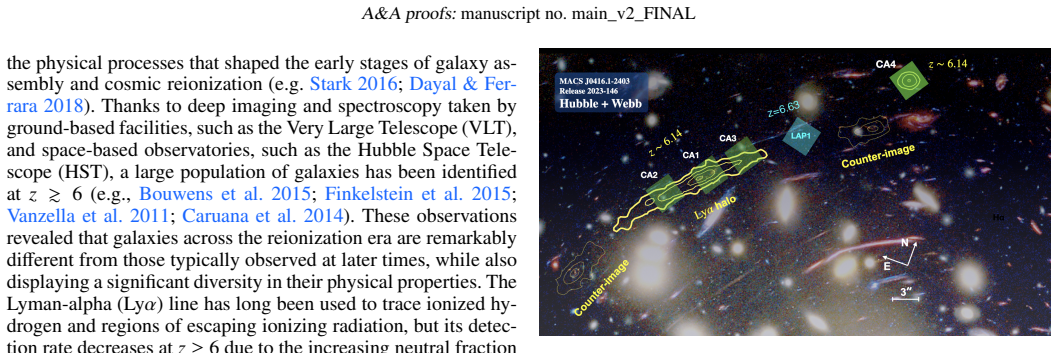
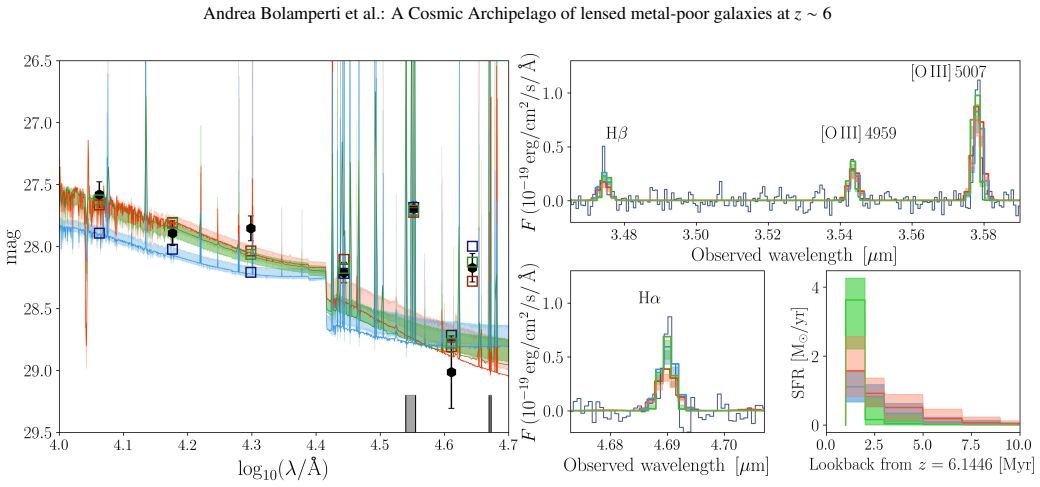
The Cosmic Archipelago is an ensemble of galaxies strongly lensed by MACSJ0416 at z~6.14. CA4 is a young, low-mass (4.3e6 solar masses), metal-poor (Z~0.02 Z_sun) star-forming galaxy with high ionizing-photon output and escape fractions f_esc^Lyα~43% and f_esc~47%, consistent with its blue UV slope and small Lyα velocity offset. Five more systems at the same redshift are all young (<11 Myr) and metal-poor (<0.05 Z_sun), yielding a significant overdensity delta_gal=12.3 in the small volume.
What carries the argument
The Cosmic Archipelago ensemble of lensed galaxies at z~6.14, characterized through joint spectrophotometric fitting across far-UV to red-optical wavelengths using lensing magnification factors.
If this is right
- UV-faint metal-poor galaxies can supply a large fraction of the ionizing photons required for reionization.
- The Cosmic Archipelago produces a galaxy overdensity of 12.3 at z~6 within delta z~0.08.
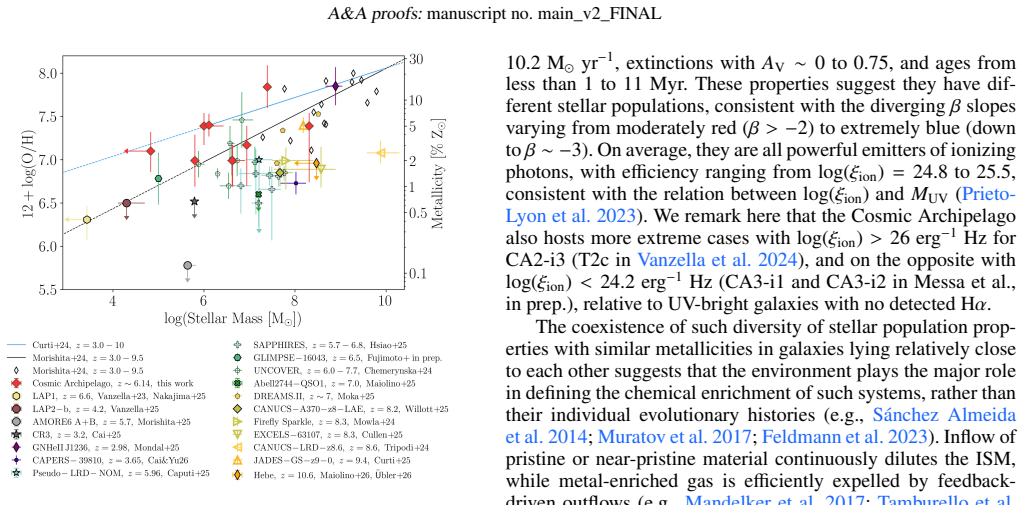
- All members are young bursty systems with mass-weighted ages under 11 Myr and metallicities below 0.05 solar.
- These galaxies occupy the interface between stellar clusters and dwarf galaxies and efficiently produce ionizing radiation.
- The combination of high escape fractions, blue UV slopes, and small velocity offsets enables significant Lyman-continuum leakage.
Where Pith is reading between the lines
- If the overdensity holds, models of reionization must assign greater weight to the faint end of the luminosity function at z>6.
- Similar archipelagos may appear behind other massive lensing clusters, allowing statistical samples of early low-mass galaxies.
- The link between extremely blue UV slopes and high escape fractions could be tested in larger JWST surveys of unlensed fields.
- The placement at the cluster-dwarf boundary suggests that feedback and gas-clearing processes in low-mass systems differ from those in more massive galaxies.
Load-bearing premise
The lensing magnification values and the stellar masses, metallicities, star-formation rates, and escape fractions derived from the spectrophotometric models are accurate and unbiased.
What would settle it
A measurement of the Lyman-continuum escape fraction in an unlensed galaxy at z~6 with comparable UV luminosity and metallicity that returns a value well below 20%.
Figures
read the original abstract
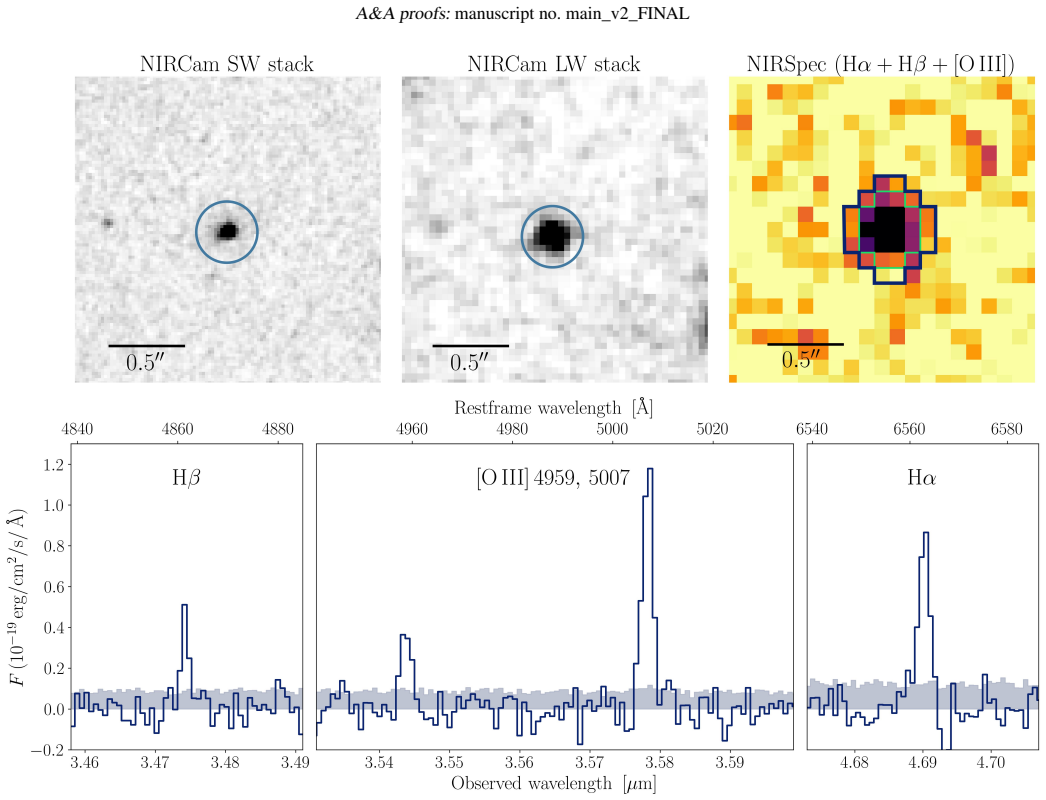
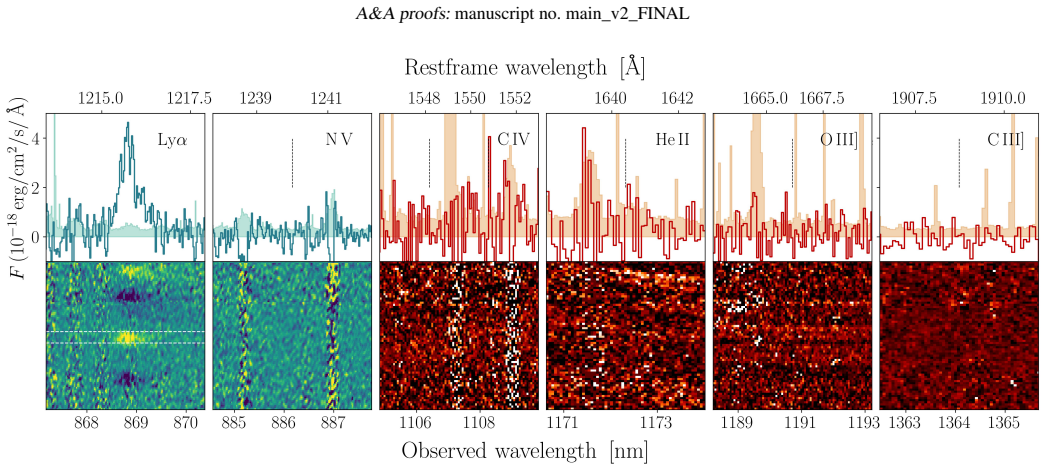
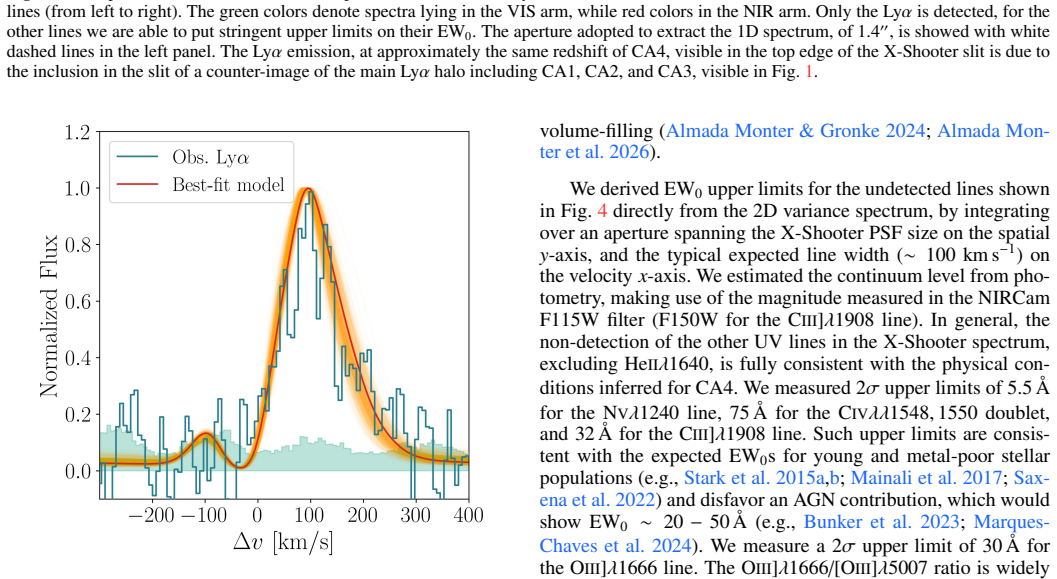
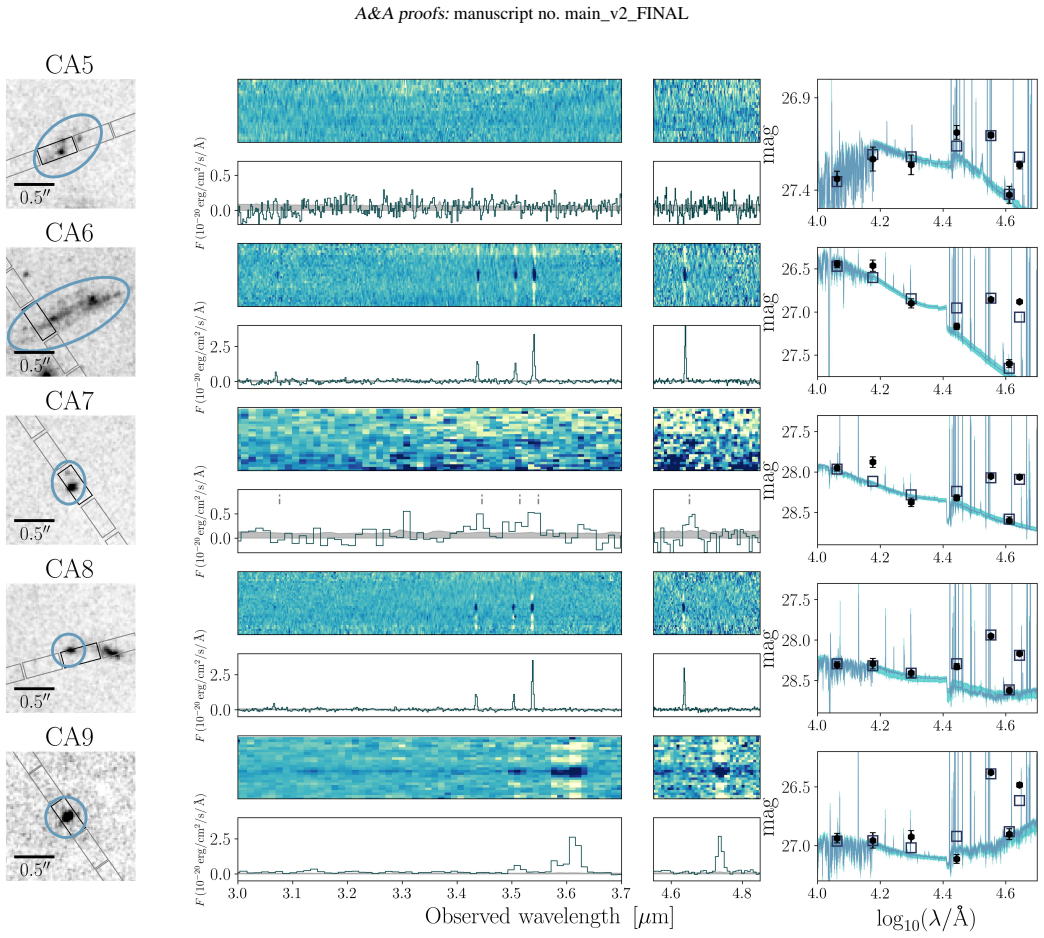
The Cosmic Archipelago is an ensemble of galaxies, strongly lensed by the cluster MACSJ0416, showing extreme physical properties at $z\sim6.14$. We combine JWST/NIRCam with deep VLT/X-Shooter and JWST/NIRSpec IFU to perform a joint spectrophotometric analysis from the far ultraviolet to red optical rest-frame. We focus on CA4, a UV-faint ($M_{UV}=-17.7$), compact ($r_e=81\pm11$ pc) galaxy at $z=6.1446$, magnified by a factor $\mu=3.73$. CA4 is a young, low-mass ($M_\star =4.3\times10^6$ M$\odot$), star-forming (${\rm SFR}=0.46$ M$\odot$/yr), and metal-poor ($Z\sim0.02$ Z$\odot$) galaxy, and an efficient producer of ionizing photons ($\log(\xi_{ion}/{\rm erg^{-1} Hz})\sim25.5$). Its properties place CA4 at the poorly explored interface between massive stellar clusters and dwarf galaxies during the epoch of reionization. Moreover, CA4 shows large Ly$\alpha$ ($f_{esc}^{\rm Ly\alpha}\sim43\%$) and Lyman-continuum ($f_{esc}\sim47\%$) escape fractions, consistent with its small Ly$\alpha$ velocity offset ($\Delta v\sim100$ km/s) and extremely blue UV-continuum slope ($\beta=-3.10$). These characteristics suggest that such UV-faint, metal-poor galaxies may contribute significantly to cosmic reionization. We also confirm five additional systems at the redshift of the Cosmic Archipelago, magnified by factors up to 12.5. They are all young (mass-weighted ages $<11$ Myr) and metal-poor ($Z<0.05$ Z$_\odot$), spanning a wide range of stellar masses and SFRs. Given the large number of these bursty star-forming galaxies in a small cosmic volume, we estimate that the currently known members of the Cosmic Archipelago result in a significant overdensity at $z\sim6$ ($\Delta z\sim0.08$), with $\delta_{gal}=12.3^{+6.6}_{-4.6}$. These results highlight the Cosmic Archipelago as an unprecedented laboratory for studying the earliest groups of low-mass, low-metallicity galaxies during the epoch of reionization.
Editorial analysis
A structured set of objections, weighed in public.
Referee Report
Summary. The paper reports the discovery via JWST/NIRCam, VLT/X-Shooter and JWST/NIRSpec of a strongly lensed ensemble (the 'Cosmic Archipelago') at z≈6.14 behind MACSJ0416. It focuses on CA4 (M_UV=-17.7, μ=3.73, r_e≈81 pc, M_*≈4.3×10^6 M_⊙, SFR≈0.46 M_⊙ yr^{-1}, Z≈0.02 Z_⊙, log ξ_ion≈25.5) and five additional members, all young and metal-poor. CA4 exhibits high Lyα (f_esc^Lyα≈43%) and Lyman-continuum (f_esc≈47%) escape fractions together with a blue UV slope (β=-3.10) and small velocity offset (Δv≈100 km s^{-1}). The authors argue these UV-faint systems may contribute substantially to reionization and report a galaxy overdensity δ_gal=12.3^{+6.6}_{-4.6} within Δz≈0.08.
Significance. If the reported escape fractions and intrinsic properties survive scrutiny of the lens model and SED assumptions, the work would strengthen the case that low-mass, low-metallicity galaxies at the cluster-dwarf interface are important reionization sources, providing rare, magnified examples at z∼6 that are otherwise inaccessible.
major comments (3)
- [§3] §3 (lens modeling): Only a single fiducial magnification (μ=3.73 for CA4, up to 12.5 for others) is presented; no alternative lens models, systematic error budgets, or robustness tests are shown. Because all intrinsic quantities (M_UV, M_*, SFR, ξ_ion) and the derived escape fractions scale directly with 1/μ, this is load-bearing for the reionization claim.
- [§4] §4 (spectrophotometric fitting): The values f_esc^Lyα∼43% and f_esc∼47% are obtained from a single set of SED assumptions (SFH, IMF, dust law, metallicity grid). No alternative template libraries or parameter variations are reported, leaving open the possibility that the high escape fractions are partly driven by model choice rather than data.
- [Abstract & §5] Abstract & §5: The statement that CA4 'may contribute significantly to cosmic reionization' rests on the combination of the above two quantities; without quantified uncertainties from lens and SED choices, the quantitative support for this central implication remains incomplete.
minor comments (2)
- [Table 1] Table 1: the reported velocity offset Δv∼100 km s^{-1} for CA4 should be accompanied by its measurement uncertainty and the precise definition (e.g., peak-to-peak or centroid).
- [Figure 3] Figure 3: the UV slope β=-3.10 is quoted without the fitting wavelength range or covariance with the escape-fraction derivation.
Simulated Author's Rebuttal
We thank the referee for their constructive and detailed comments. We address each major point below, agreeing where the manuscript can be strengthened through additional analysis and revisions.
read point-by-point responses
-
Referee: [§3] §3 (lens modeling): Only a single fiducial magnification (μ=3.73 for CA4, up to 12.5 for others) is presented; no alternative lens models, systematic error budgets, or robustness tests are shown. Because all intrinsic quantities (M_UV, M_*, SFR, ξ_ion) and the derived escape fractions scale directly with 1/μ, this is load-bearing for the reionization claim.
Authors: We agree that the presentation of only the fiducial magnification limits the assessment of robustness. The adopted lens model is the most recent detailed reconstruction available for MACSJ0416. In the revised manuscript we will add comparisons to alternative published lens models for this cluster, derive a systematic uncertainty budget on μ, and propagate these to the intrinsic quantities and escape fractions. revision: yes
-
Referee: [§4] §4 (spectrophotometric fitting): The values f_esc^Lyα∼43% and f_esc∼47% are obtained from a single set of SED assumptions (SFH, IMF, dust law, metallicity grid). No alternative template libraries or parameter variations are reported, leaving open the possibility that the high escape fractions are partly driven by model choice rather than data.
Authors: We acknowledge that the escape fractions are derived under a single set of SED assumptions. In the revision we will repeat the spectrophotometric fits using alternative SFHs (including bursty histories), IMF choices, and dust attenuation laws, and report the resulting range in f_esc values to demonstrate that the high escape fractions are robust to reasonable model variations. revision: yes
-
Referee: [Abstract & §5] Abstract & §5: The statement that CA4 'may contribute significantly to cosmic reionization' rests on the combination of the above two quantities; without quantified uncertainties from lens and SED choices, the quantitative support for this central implication remains incomplete.
Authors: We agree that the reionization implication requires quantified uncertainties. After incorporating the lens-model and SED-variation analyses described above, we will revise the abstract and §5 to include the propagated uncertainties on the key quantities and adjust the strength of the claim accordingly while retaining the physical motivation based on the observed properties. revision: yes
Circularity Check
No circularity; observational derivations from spectra and photometry
full rationale
The paper reports galaxy properties (magnification, M_UV, M_*, SFR, Z, ξ_ion, f_esc^Lyα, f_esc) extracted via standard lens modeling and joint NIRCam/X-Shooter/NIRSpec spectrophotometric fitting. No equations or steps reduce a claimed prediction to its own fitted inputs by construction. No self-citation load-bearing, uniqueness theorems, or ansatzes are invoked to justify core results. The derivation chain is self-contained against external data and standard methods.
Axiom & Free-Parameter Ledger
axioms (1)
- standard math Standard flat Lambda-CDM cosmology for redshift-to-distance conversion and lensing geometry
Forward citations
Cited by 1 Pith paper
-
Possible chemical signatures of first-star enrichment in a very metal-poor galaxy overdensity near the end of reionization
Discovery of a very metal-poor galaxy overdensity of 17 members near a possible Pop III-enriched absorber at z=5.945, with estimated minimum halo mass of log(M_h,min/M_⊙)=10.68.
Reference graph
Works this paper leans on
-
[1]
L., Coe, D., et al
Abdurro’uf, Larson, R. L., Coe, D., et al. 2024, ApJ, 973, 47
2024
-
[2]
D., Vanzella, E., et al
Adamo, A., Bradley, L. D., Vanzella, E., et al. 2024, Nature, 632, 513
2024
-
[3]
Adams, T. F. 1972, ApJ, 174, 439
1972
-
[4]
Ahn, S.-H., Lee, H.-W., & Lee, H. M. 2000, Journal of Korean Astronomical Society, 33, 29 Almada Monter, S. & Gronke, M. 2024, MNRAS, 534, L7 Almada Monter, S., Gronke, M., & Chang, S.-J. 2026, MNRAS, 547, stag330
2000
-
[5]
& Tosi, M
Annibali, F. & Tosi, M. 2022, Nature Astronomy, 6, 48
2022
-
[6]
2024, A&A, 688, A146
Arribas, S., Perna, M., Rodríguez Del Pino, B., et al. 2024, A&A, 688, A146
2024
-
[7]
J., & Scott, P
Asplund, M., Grevesse, N., Sauval, A. J., & Scott, P. 2009, ARA&A, 47, 481 Astropy Collaboration, Price-Whelan, A. M., Lim, P. L., et al. 2022, ApJ, 935, 167 Astropy-Specutils Development Team. 2019, Specutils: Spectroscopic analysis and reduction, Astrophysics Source Code Library, record ascl:1902.012
2009
-
[8]
J., et al
Atek, H., Shuntov, M., Furtak, L. J., et al. 2023, MNRAS, 519, 1201
2023
-
[9]
J., Adams, N
Austin, D., Conselice, C. J., Adams, N. J., et al. 2025, ApJ, 995, 43
2025
-
[10]
2016, ApJS, 224, 33
Balestra, I., Mercurio, A., Sartoris, B., et al. 2016, ApJS, 224, 33
2016
-
[11]
P., Goudfrooij, P., et al
Bastian, N., Saglia, R. P., Goudfrooij, P., et al. 2006, A&A, 448, 881
2006
-
[12]
2023, A&A, 674, A79
Bergamini, P., Grillo, C., Rosati, P., et al. 2023, A&A, 674, A79
2023
-
[13]
2021, A&A, 645, A140
Bergamini, P., Rosati, P., Vanzella, E., et al. 2021, A&A, 645, A140
2021
-
[14]
& Arnouts, S
Bertin, E. & Arnouts, S. 1996, A&AS, 117, 393
1996
-
[15]
2023, MNRAS, 526, 5263
Bolamperti, A., Zanella, A., Meštri´c, U., et al. 2023, MNRAS, 526, 5263
2023
-
[16]
2018, ApJ, 864, 98
Bonamigo, M., Grillo, C., Ettori, S., et al. 2018, ApJ, 864, 98
2018
-
[17]
J., Aravena, M., Decarli, R., et al
Bouwens, R. J., Aravena, M., Decarli, R., et al. 2016, ApJ, 833, 72
2016
-
[18]
J., Illingworth, G
Bouwens, R. J., Illingworth, G. D., Oesch, P. A., et al. 2012, ApJ, 754, 83
2012
-
[19]
J., Illingworth, G
Bouwens, R. J., Illingworth, G. D., Oesch, P. A., et al. 2015, ApJ, 803, 34
2015
-
[20]
J., Illingworth, G
Bouwens, R. J., Illingworth, G. D., Oesch, P. A., et al. 2010, ApJ, 708, L69
2010
-
[21]
J., Illingworth, G
Bouwens, R. J., Illingworth, G. D., van Dokkum, P. G., et al. 2022, ApJ, 927, 81
2022
-
[22]
J., Oesch, P
Bouwens, R. J., Oesch, P. A., Stefanon, M., et al. 2021, AJ, 162, 47
2021
-
[23]
J., Curtis-Lake, E., et al
Boyett, K., Bunker, A. J., Curtis-Lake, E., et al. 2024, MNRAS, 535, 1796
2024
-
[24]
2025, astropy/photutils: 2.2.0
Bradley, L., Sip˝ocz, B., Robitaille, T., et al. 2025, astropy/photutils: 2.2.0
2025
-
[25]
1971, MNRAS, 153, 471
Brocklehurst, M. 1971, MNRAS, 153, 471
1971
-
[26]
& Gnedin, O
Brown, G. & Gnedin, O. Y . 2021, MNRAS, 508, 5935
2021
-
[27]
J., Saxena, A., Cameron, A
Bunker, A. J., Saxena, A., Cameron, A. J., et al. 2023, A&A, 677, A88
2023
-
[28]
2023, JWST Calibration Pipeline
Bushouse, H., Eisenhamer, J., Dencheva, N., et al. 2023, JWST Calibration Pipeline
2023
-
[29]
2025, ApJ, 993, L52
Cai, S., Li, M., Cai, Z., et al. 2025, ApJ, 993, L52
2025
-
[30]
Cai, S. & Yu, Z. 2026, arXiv e-prints, arXiv:2601.17498
arXiv 2026
-
[31]
2022, MNRAS, 516, 5914
Calura, F., Lupi, A., Rosdahl, J., et al. 2022, MNRAS, 516, 5914
2022
-
[32]
2021, MNRAS, 500, 3083
Calura, F., Vanzella, E., Carniani, S., et al. 2021, MNRAS, 500, 3083
2021
-
[33]
L., & Storchi-Bergmann, T
Calzetti, D., Kinney, A. L., & Storchi-Bergmann, T. 1994, ApJ, 429, 582
1994
-
[34]
B., Grillo, C., Rosati, P., et al
Caminha, G. B., Grillo, C., Rosati, P., et al. 2017, A&A, 600, A90
2017
-
[35]
B., Grillo, C., Rosati, P., et al
Caminha, G. B., Grillo, C., Rosati, P., et al. 2023, A&A, 678, A3
2023
-
[36]
Caputi, K. I., Cooper, R. A., Rinaldi, P., Navarro-Carrera, R., & Iani, E. 2026, submitted to ApJ, arXiv:2601.11466
Pith/arXiv arXiv 2026
-
[37]
A., Clayton, G
Cardelli, J. A., Clayton, G. C., & Mathis, J. S. 1989, ApJ, 345, 245
1989
-
[38]
C., McLure, R
Carnall, A. C., McLure, R. J., Dunlop, J. S., et al. 2019, MNRAS, 490, 417
2019
-
[39]
C., McLure, R
Carnall, A. C., McLure, R. J., Dunlop, J. S., & Davé, R. 2018, MNRAS, 480, 4379
2018
-
[40]
J., Wilkins, S
Caruana, J., Bunker, A. J., Wilkins, S. M., et al. 2014, MNRAS, 443, 2831
2014
-
[41]
2016, A&A, 590, A31
Castellano, M., Amorín, R., Merlin, E., et al. 2016, A&A, 590, A31
2016
-
[42]
2023, A&A, 675, A121
Castellano, M., Belfiori, D., Pentericci, L., et al. 2023, A&A, 675, A121
2023
-
[43]
2022, ApJ, 938, L15
Castellano, M., Fontana, A., Treu, T., et al. 2022, ApJ, 938, L15
2022
-
[44]
2018, Nature Astronomy, 2, 76
Cava, A., Schaerer, D., Richard, J., et al. 2018, Nature Astronomy, 2, 76
2018
-
[45]
2024, ApJ, 976, L15
Chemerynska, I., Atek, H., Dayal, P., et al. 2024, ApJ, 976, L15
2024
-
[46]
P., Mason, C., et al
Chen, Z., Stark, D. P., Mason, C., et al. 2024, MNRAS, 528, 7052
2024
-
[47]
2013, ApJ, 779, 127
Chiang, Y .-K., Overzier, R., & Gebhardt, K. 2013, ApJ, 779, 127
2013
-
[48]
2022, MNRAS, 517, 5104 Article number, page 15 of 22 A&A proofs:manuscript no
Chisholm, J., Saldana-Lopez, A., Flury, S., et al. 2022, MNRAS, 517, 5104 Article number, page 15 of 22 A&A proofs:manuscript no. main_v2_FINAL
2022
-
[49]
2024, MNRAS, 532, 2463
Choustikov, N., Katz, H., Saxena, A., et al. 2024, MNRAS, 532, 2463
2024
-
[50]
2026, submitted to A&A, arXiv:2601.16281
Claeyssens, A., Adamo, A., Kokorev, V ., et al. 2026, submitted to A&A, arXiv:2601.16281
arXiv 2026
-
[51]
2025, MNRAS, 537, 2535
Claeyssens, A., Adamo, A., Messa, M., et al. 2025, MNRAS, 537, 2535
2025
-
[52]
2023, MNRAS, 520, 2180
Claeyssens, A., Adamo, A., Richard, J., et al. 2023, MNRAS, 520, 2180
2023
-
[53]
C., Scholte, D., et al
Cullen, F., Carnall, A. C., Scholte, D., et al. 2025, MNRAS, 540, 2176
2025
-
[54]
J., McLure, R
Cullen, F., McLeod, D. J., McLure, R. J., et al. 2024, MNRAS, 531, 997
2024
-
[55]
J., McLeod, D
Cullen, F., McLure, R. J., McLeod, D. J., et al. 2023, MNRAS, 520, 14
2023
-
[56]
2023, MNRAS, 518, 425
Curti, M., D’Eugenio, F., Carniani, S., et al. 2023, MNRAS, 518, 425
2023
-
[57]
2024, A&A, 684, A75
Curti, M., Maiolino, R., Curtis-Lake, E., et al. 2024, A&A, 684, A75
2024
-
[58]
2020, MNRAS, 491, 944
Curti, M., Mannucci, F., Cresci, G., & Maiolino, R. 2020, MNRAS, 491, 944
2020
-
[59]
2025, A&A, 697, A89
Curti, M., Witstok, J., Jakobsen, P., et al. 2025, A&A, 697, A89
2025
-
[60]
& Ferrara, A
Dayal, P. & Ferrara, A. 2018, Phys. Rep., 780, 1 de Graaff, A., Brammer, G., Weibel, A., et al. 2025, A&A, 697, A189 de Vaucouleurs, G. 1948, Annales d’Astrophysique, 11, 247
2018
-
[61]
2014, PASA, 31, e040
Dijkstra, M. 2014, PASA, 31, e040
2014
-
[62]
2016, ApJ, 828, 71
Dijkstra, M., Gronke, M., & Venkatesan, A. 2016, ApJ, 828, 71
2016
-
[63]
T., Dickinson, M., Taylor, A
Donnan, C. T., Dickinson, M., Taylor, A. J., et al. 2025, ApJ, 993, 224
2025
-
[64]
Dopita, M. A. & Sutherland, R. S. 2003, Astrophysics of the diffuse universe
2003
-
[65]
2025, A&A, 698, A234
Dottorini, D., Calabrò, A., Pentericci, L., et al. 2025, A&A, 698, A234
2025
-
[66]
J., Stanway, E
Eldridge, J. J., Stanway, E. R., Xiao, L., et al. 2017, PASA, 34, e058
2017
-
[67]
2020, ApJ, 895, 116
Emami, N., Siana, B., Alavi, A., et al. 2020, ApJ, 895, 116
2020
-
[68]
K., Pettini, M., Shapley, A
Erb, D. K., Pettini, M., Shapley, A. E., et al. 2010, ApJ, 719, 1168 ESO CPL Development Team. 2015, EsoRex: ESO Recipe Execution Tool, As- trophysics Source Code Library, record ascl:1504.003
2010
-
[69]
2023, MNRAS, 522, 3831
Feldmann, R., Quataert, E., Faucher-Giguère, C.-A., et al. 2023, MNRAS, 522, 3831
2023
-
[70]
2026, submitted to A&A, arXiv:2602.17499
Felicioni, G., Brada ˇc, M., Asada, Y ., et al. 2026, submitted to A&A, arXiv:2602.17499
arXiv 2026
-
[71]
& Bournaud, F
Fensch, J. & Bournaud, F. 2021, MNRAS, 505, 3579
2021
-
[72]
J., Chatzikos, M., Guzmán, F., et al
Ferland, G. J., Chatzikos, M., Guzmán, F., et al. 2017, Rev. Mexicana Astron. Astrofis., 53, 385
2017
-
[73]
P., Cameron, E., & Pettitt, A
Feroz, F., Hobson, M. P., Cameron, E., & Pettitt, A. N. 2019, The Open Journal of Astrophysics, 2, 10
2019
-
[74]
L., Bagley, M., Song, M., et al
Finkelstein, S. L., Bagley, M., Song, M., et al. 2022, ApJ, 928, 52
2022
-
[75]
L., Ryan, Jr., R
Finkelstein, S. L., Ryan, Jr., R. E., Papovich, C., et al. 2015, ApJ, 810, 71
2015
-
[76]
Fudamoto, Y ., Helton, J. M., Lin, X., et al. 2025, submitted to ApJ, arXiv:2503.15597
arXiv 2025
-
[77]
J., Secunda, A
Furtak, L. J., Secunda, A. R., Greene, J. E., et al. 2025, A&A, 698, A227
2025
-
[78]
A., Weibel, A., et al
Giovinazzo, E., Oesch, P. A., Weibel, A., et al. 2026, A&A, 707, A352
2026
-
[79]
2015, ApJ, 812, 123
Gronke, M., Bull, P., & Dijkstra, M. 2015, ApJ, 812, 123
2015
-
[80]
Gronke, M., Dijkstra, M., McCourt, M., & Oh, S. P. 2016, ApJ, 833, L26
2016
discussion (0)
Sign in with ORCID, Apple, or X to comment. Anyone can read and Pith papers without signing in.