Foundation Models for Wireless Communications: From PHY Intelligence to Network Autonomy
Pith reviewed 2026-06-28 00:10 UTC · model grok-4.3
The pith
Foundation models adapt pre-trained versions, build on wireless data, or act as agents to manage 6G networks from physical layer to full autonomy.
A machine-rendered reading of the paper's core claim, the machinery that carries it, and where it could break.
Core claim
Foundation models reshape physical-layer processing and wireless resource management across three paradigms: adaptation of off-the-shelf pre-trained models to wireless tasks, wireless-native models built from scratch on wireless data to bridge modality gaps and capture universal physical characteristics, and agentic models that turn static processing into autonomous, reasoning-driven network orchestration, with further effects on ISAC, MIMO, semantic communications, and system-level autonomy.
What carries the argument
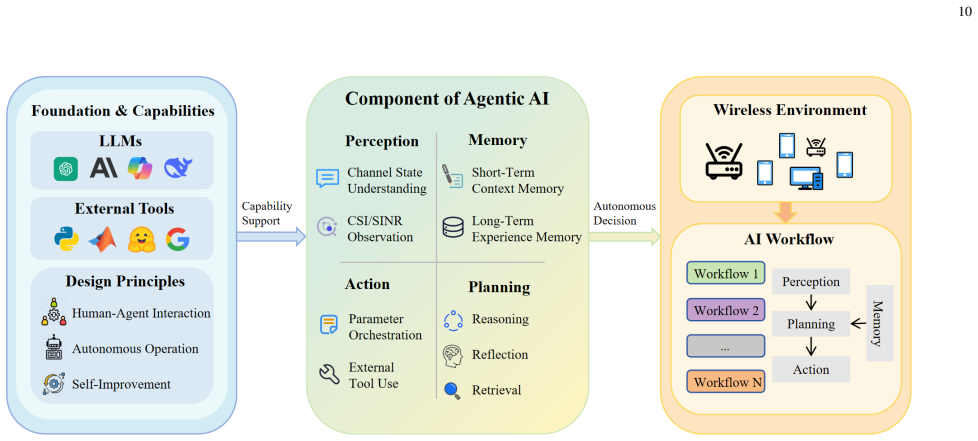
Three progressive paradigms of foundation model application (off-the-shelf adaptation, wireless-native construction from wireless data, and agentic orchestration for autonomy).
If this is right
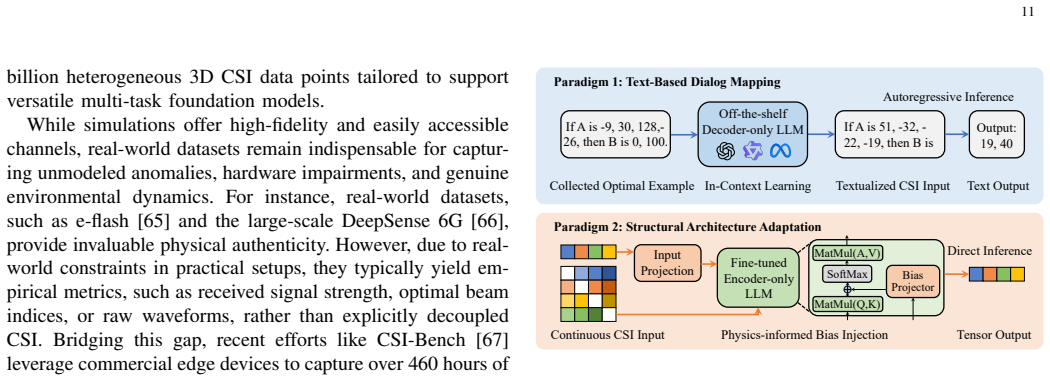
- Adaptation of pre-trained models enables zero-shot or few-shot solutions for wireless tasks without full retraining.
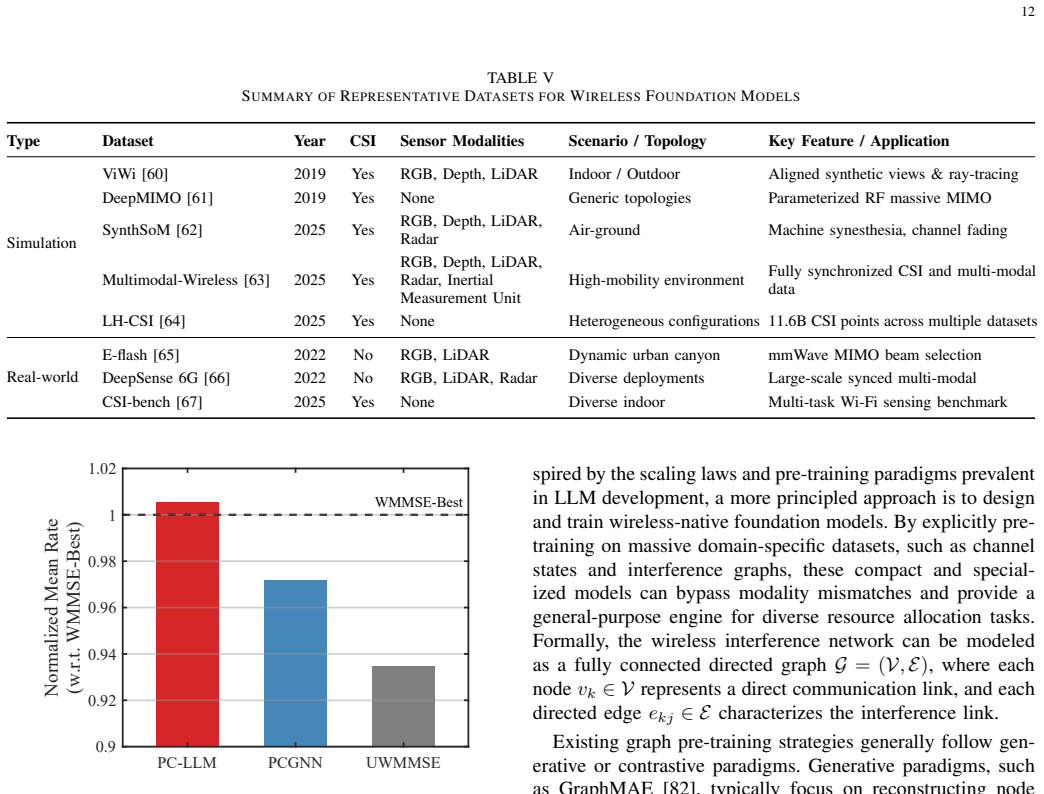
- Wireless-native models capture domain-specific physical traits and reduce gaps when transferring across wireless modalities.
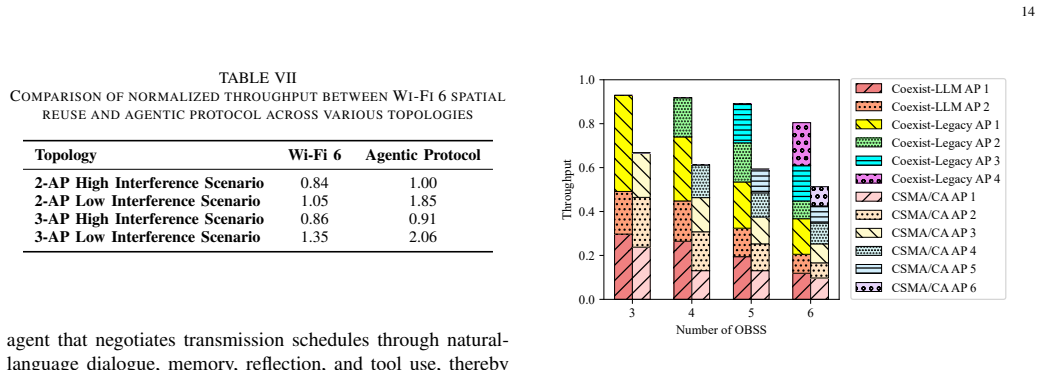
- Agentic models support reasoning-based decisions that move network management from reactive to proactive and autonomous.
- Applications extend to integrated sensing and communications, advanced MIMO, semantic communications, and overall network autonomy.
- The approach charts a path to fully intelligent and adaptive wireless networks for 6G.
Where Pith is reading between the lines
- If universal wireless characteristics exist, the same foundation model could handle tasks across different frequencies or standards with minimal changes.
- Agentic models might enable networks that continuously self-optimize based on live conditions without human intervention.
- Training wireless-native models would require large, diverse wireless datasets, potentially shifting research focus toward data collection methods.
- This framework could reduce reliance on hand-crafted algorithms for each new wireless problem.
Load-bearing premise
Wireless data contains universal physical characteristics that foundation models can learn to overcome differences between data types.
What would settle it
A controlled test showing that models trained from scratch on wireless data perform no better than generic pre-trained models or task-specific networks on downstream wireless tasks such as channel estimation or resource allocation.
Figures
read the original abstract
6G networks will introduce unprecedented complexity, which calls for a paradigm shift in network optimization and management. Artificial intelligence (AI)-based solutions, especially those enabled by the recently developed foundation models, have been recognized as promising candidates. Foundation models are large-scale AI models with general-purpose feature extraction capabilities, and once trained on massive amounts of data, they can be adapted to solve a wide range of downstream tasks, either in a zero-shot manner or with few-shot fine-tuning. This article provides a comprehensive overview of how foundation models are reshaping physical-layer processing and wireless resource management across three progressive paradigms. First, we examine the adaptation of off-the-shelf pre-trained foundation models to various wireless tasks. Second, we explore wireless-native foundation models, built from scratch on wireless data to bridge cross-domain modality gaps and capture universal wireless-domain physical characteristics. Third, we highlight agentic foundation models, which elevate static data processing into autonomous, reasoning-driven network orchestration. Furthermore, we discuss the impact of applying foundation models to emerging 6G frontiers, including integrated sensing and communications (ISAC), new multiple-input multiple-output (MIMO) architectures, semantic communications, and system-level network autonomy. Finally, we identify critical open challenges and opportunities, charting a promising path toward fully intelligent and adaptive wireless networks.
Editorial analysis
A structured set of objections, weighed in public.
Referee Report
Summary. The manuscript is a survey providing a comprehensive overview of foundation models for wireless communications. It organizes the topic into three progressive paradigms—adaptation of off-the-shelf pre-trained models to wireless tasks, wireless-native foundation models constructed from scratch on wireless data, and agentic foundation models for reasoning-driven autonomous orchestration—while mapping these to 6G use cases including ISAC, new MIMO architectures, semantic communications, and system-level network autonomy, and outlining open challenges and opportunities.
Significance. If the taxonomy and literature mapping are accurate and balanced, the paper would offer a useful organizational framework for an emerging area, helping researchers navigate the shift toward general-purpose AI in wireless systems. The explicit treatment of the wireless-native paradigm as a prospective research direction (rather than a demonstrated result) is a strength that avoids overclaiming. No new theorems, datasets, or experiments are advanced, which is appropriate for a survey but means the work's value rests on the quality of its synthesis and coverage.
minor comments (1)
- [Abstract] Abstract: the phrase 'capture universal wireless-domain physical characteristics' is used to motivate the wireless-native paradigm but is not accompanied by concrete examples or citations in the provided abstract; expanding this briefly in the introduction or §2 would improve clarity without altering the survey's descriptive claims.
Simulated Author's Rebuttal
We thank the referee for the positive summary, significance assessment, and recommendation of minor revision. The report does not list any specific major comments under the MAJOR COMMENTS section, so we have no individual points to address.
Circularity Check
No significant circularity; survey with no derivations or fitted quantities
full rationale
The manuscript is a literature survey categorizing existing and prospective uses of foundation models into three paradigms (off-the-shelf adaptation, wireless-native construction, agentic orchestration) and mapping them to 6G use cases. It advances no new theorems, datasets, or experimental results. No equations appear, and the wireless-native paradigm is explicitly framed as an open research direction rather than a demonstrated result whose validity depends on the universality assumption. All claims are descriptive and externally supported by cited literature; the central discussion does not reduce to self-referential definitions or self-citation chains.
Axiom & Free-Parameter Ledger
Forward citations
Cited by 1 Pith paper
-
Physics-Informed Path-Parametric Learning for Efficient and Lightweight CSI Feedback
HS-PINNnet integrates multipath physics into a hierarchical neural network for efficient CSI feedback, outperforming prior methods with major reductions in computational cost.
Reference graph
Works this paper leans on
-
[1]
BERT: Pre-training of deep bidirectional transformers for language understanding,
J. Devlin, M.-W. Chang, K. Lee, and K. Toutanova, “BERT: Pre-training of deep bidirectional transformers for language understanding,” inProc. Conf. N. Amer. Chapter Assoc. Com- put. Linguist. Hum. Lang. Technol. (NAACL-HLT), 2019, pp. 4171–4186
2019
-
[2]
Language models are unsupervised multitask learners,
A. Radford, J. Wu, R. Child, D. Luan, D. Amodei, and I. Sutskever, “Language models are unsupervised multitask learners,”OpenAI blog, vol. 1, no. 8, pp. 1–9, Feb. 2019
2019
-
[3]
An image is worth 16x16 words: Transformers for image recognition at scale,
A. Dosovitskiyet al., “An image is worth 16x16 words: Transformers for image recognition at scale,” inProc. Int. Conf. Learn. Represent. (ICLR), 2021, pp. 1–21
2021
-
[4]
Large language models for wireless communi- cations: From adaptation to autonomy,
L. Lianget al., “Large language models for wireless communi- cations: From adaptation to autonomy,”IEEE Commun. Mag., vol. 64, no. 5, pp. 140–147, May 2026. 20
2026
-
[5]
LLM4CP: Adapting large language models for channel prediction,
B. Liu, X. Liu, S. Gao, X. Cheng, and L. Yang, “LLM4CP: Adapting large language models for channel prediction,”J. Commun. Inf. Netw., vol. 9, no. 2, pp. 113–125, Jun. 2024
2024
-
[6]
Beam prediction based on large language models,
Y . Sheng, K. Huang, L. Liang, P. Liu, S. Jin, and G. Y . Li, “Beam prediction based on large language models,”IEEE Wireless Commun. Lett., vol. 14, no. 5, pp. 1406–1410, May 2025
2025
-
[7]
WiFo: Wireless foundation model for channel prediction,
B. Liu, S. Gao, X. Liu, X. Cheng, and L. Yang, “WiFo: Wireless foundation model for channel prediction,”Sci. China Inf. Sci., vol. 68, no. 6, p. 162302, Jul. 2025
2025
-
[8]
A wireless foundation model for multi-task prediction,
Y . Shenget al., “A wireless foundation model for multi-task prediction,”arXiv preprint arXiv:2507.05938, Jul. 2025
arXiv 2025
-
[9]
WirelessLLM: Empowering large language models towards wireless intelligence,
J. Shaoet al., “WirelessLLM: Empowering large language models towards wireless intelligence,”J. Commun. Inf. Netw., vol. 9, no. 2, pp. 99–112, June 2024
2024
-
[10]
Learning multi-access point coordination in agentic AI Wi-Fi with large language models,
Y . Fanet al., “Learning multi-access point coordination in agentic AI Wi-Fi with large language models,” inProc. IEEE Int. Conf. Commun. (ICC), 2026, pp. 1–6
2026
-
[11]
Language models are few-shot learners,
T. Brownet al., “Language models are few-shot learners,” in Proc. Adv. Neural Inf. Process. Syst. (NeurIPS), vol. 33, 2020, pp. 1877–1901
2020
-
[12]
A survey of state of the art large vision language models: Benchmark evaluations and challenges,
Z. Li, X. Wu, H. Du, F. Liu, H. Nghiem, and G. Shi, “A survey of state of the art large vision language models: Benchmark evaluations and challenges,” inProc. Comput. Vis. Pattern Recog. Conf., 2025, pp. 1587–1606
2025
-
[13]
On the opportunities and risks of foundation models,
R. Bommasaniet al., “On the opportunities and risks of foundation models,”arXiv preprint arXiv:2108.07258, Jul. 2022
Pith/arXiv arXiv 2022
-
[14]
Attention is all you need,
A. Vaswaniet al., “Attention is all you need,” inProc. Adv. Neural Inf. Process. Syst. (NeurIPS), vol. 30, 2017, pp. 5998– 6008
2017
-
[15]
Learning transferable visual models from natural language supervision,
A. Radfordet al., “Learning transferable visual models from natural language supervision,” inProc. Int. Conf. Mach. Learn- ing (ICML), 2021, pp. 8748–8763
2021
-
[16]
LLaV A-OneVision: Easy visual task transfer,
B. Liet al., “LLaV A-OneVision: Easy visual task transfer,” Trans. Mach. Learn. Res., pp. 1–44, Feb. 2025
2025
-
[17]
Representation learning with contrastive predictive coding,
A. v. d. Oord, Y . Li, and O. Vinyals, “Representation learning with contrastive predictive coding,”arXiv preprint arXiv:1807.03748, 2018
Pith/arXiv arXiv 2018
-
[18]
Chain-of-thought prompting elicits reasoning in large language models,
J. Weiet al., “Chain-of-thought prompting elicits reasoning in large language models,” inProc. Adv. Neural Inf. Process. Syst. (NeurIPS), vol. 35, 2022, pp. 24 824–24 837
2022
-
[19]
Retrieval-augmented generation for knowledge-intensive NLP tasks,
P. Lewiset al., “Retrieval-augmented generation for knowledge-intensive NLP tasks,” inProc. Adv. Neural Inf. Process. Syst. (NeurIPS), vol. 33, 2020, pp. 9459–9474
2020
-
[20]
ReAct: Synergizing reasoning and acting in language models,
S. Yaoet al., “ReAct: Synergizing reasoning and acting in language models,” inProc. Int. Conf. Learn. Represent. (ICLR), 2023
2023
-
[21]
LLM4XCE: Large language models for extremely large-scale massive MIMO channel estimation,
R. Li, S. Li, and P. Dong, “LLM4XCE: Large language models for extremely large-scale massive MIMO channel estimation,” inProc. 17th Int. Conf. Wireless Commun. Signal Process. (WCSP), 2025, pp. 1–6
2025
-
[22]
LVM4CSI: Enabling direct application of pre-trained large vision models for wireless channel tasks,
J. Guo, P. Jiang, C.-K. Wen, S. Jin, and J. Zhang, “LVM4CSI: Enabling direct application of pre-trained large vision models for wireless channel tasks,”arXiv preprint arXiv:2507.05121, Jul. 2025
arXiv 2025
-
[23]
Semantic pilot design for data- aided channel estimation using a large language model,
S. Park and H. J. Yang, “Semantic pilot design for data- aided channel estimation using a large language model,”arXiv preprint arXiv:2602.04126, Feb. 2026
Pith/arXiv arXiv 2026
-
[24]
Exploring the potential of large language models for massive MIMO CSI feedback,
Y . Cui, J. Guo, C.-K. Wen, S. Jin, and E. Tong, “Exploring the potential of large language models for massive MIMO CSI feedback,” inProc. IEEE Global Commun. Conf. (GLOBE- COM), 2025, pp. 3511–3516
2025
-
[25]
OLAMCF: Offline large AI models enhanced CSI feedback in FDD massive MIMO systems,
J. Zhuang, Y . Wang, H. Hou, Y . Han, W. Wang, and S. Jin, “OLAMCF: Offline large AI models enhanced CSI feedback in FDD massive MIMO systems,” inProc. IEEE Global Commun. Conf. (GLOBECOM), 2025, pp. 3517–3522
2025
-
[26]
Bridging the modality gap: Enhancing channel prediction with semantically aligned LLMs and knowledge distillation,
Z. Li, Q. Yang, Z. Xiong, Z. Shi, and T. Q. S. Quek, “Bridging the modality gap: Enhancing channel prediction with semantically aligned LLMs and knowledge distillation,” IEEE J. Sel. Areas Commun., vol. 44, pp. 3382–3396, Dec. 2025
2025
-
[27]
SCA-LLM: Spectral-attentive LLM-based wire- less world modeling for agentic communications,
K. Heet al., “SCA-LLM: Spectral-attentive LLM-based wire- less world modeling for agentic communications,”arXiv preprint arXiv:2509.08139, Sep. 2025
arXiv 2025
-
[28]
Sensing- assisted channel prediction in complex wireless environments: An LLM-based approach,
J. He, Z. Ren, J. Yao, H. Hu, T. X. Han, and J. Xu, “Sensing- assisted channel prediction in complex wireless environments: An LLM-based approach,”IEEE Wireless Commun. Lett., vol. 14, no. 12, pp. 3857–3861, Dec. 2025
2025
-
[29]
LLM- MM: End-to-end robust multimodal beam prediction for 6G V2X networks via MoE-LoRA adaptation,
J. Lei, X. Li, C. Wu, Q. Fu, J. Liu, and N. Kato, “LLM- MM: End-to-end robust multimodal beam prediction for 6G V2X networks via MoE-LoRA adaptation,”IEEE J. Sel. Areas Commun., vol. 44, pp. 2964–2977, Dec. 2025
2025
-
[30]
Large-model AI for near field beam prediction: A CNN- GPT2 framework for 6G XL-MIMO,
W. Liu, C. Pan, H. Ren, W. Zhang, C.-X. Wang, and J. Wang, “Large-model AI for near field beam prediction: A CNN- GPT2 framework for 6G XL-MIMO,”IEEE Trans. Wireless Commun., vol. 25, pp. 15 149–15 165, Apr. 2026
2026
-
[31]
BeamVLM for low-altitude economy: Generative beam prediction via vision-language models,
C. Kou, C. You, M. Wu, D. Wen, Z. Zhang, and C. Xing, “BeamVLM for low-altitude economy: Generative beam prediction via vision-language models,”arXiv preprint arXiv:2602.19929, Feb. 2026
arXiv 2026
-
[32]
Large sequence model for MIMO equalization in fully decoupled radio access network,
K. Yu, H. Zhou, Y . Xu, Z. Liu, H. Du, and X. Shen, “Large sequence model for MIMO equalization in fully decoupled radio access network,”IEEE Open J. Commun. Soc., vol. 6, pp. 4491–4504, May 2025
2025
-
[33]
Decision feedback in-context symbol detection over block-fading channels,
L. Fan, J. Yang, C. Shen, and C. L. Brown, “Decision feedback in-context symbol detection over block-fading channels,” in Proc. IEEE Int. Conf. Commun. (ICC), 2025, pp. 3785–3790
2025
-
[34]
Turbo- ICL: In-context learning-based turbo equalization,
Z. Song, M. Zecchin, B. Rajendran, and O. Simeone, “Turbo- ICL: In-context learning-based turbo equalization,”arXiv preprint arXiv:2505.06175, May 2025
arXiv 2025
-
[35]
Large language model enabled multi- task physical layer network,
T. Zheng and L. Dai, “Large language model enabled multi- task physical layer network,”IEEE Trans. Commun., vol. 74, pp. 307–321, 2026
2026
-
[36]
SignalLLM: A general purpose LLM agent framework for automated signal processing,
J. Ke, Q. Hu, S. Yuan, Y . Xu, and J. Yang, “SignalLLM: A general purpose LLM agent framework for automated signal processing,”arXiv preprint arXiv:2509.17197, Sep. 2025
arXiv 2025
-
[37]
Beam prediction based on multimodal large language models,
T. Mao, L. Liang, J. Yang, X. Li, S. Jin, and G. Y . Li, “Beam prediction based on multimodal large language models,”arXiv preprint arXiv:2603.15093, 2026
arXiv 2026
-
[38]
Reducing pilots in channel estimation with predictive foun- dation models,
X. Zhou, L. Liang, H. Ye, J. Zhang, C.-K. Wen, and S. Jin, “Reducing pilots in channel estimation with predictive foun- dation models,”arXiv preprint arXiv:2512.15562, Dec. 2025
arXiv 2025
-
[39]
Generative diffusion models for high dimensional channel estimation,
X. Zhou, L. Liang, J. Zhang, P. Jiang, Y . Li, and S. Jin, “Generative diffusion models for high dimensional channel estimation,”IEEE Trans. Wireless Commun., vol. 24, no. 7, pp. 5840–5854, Jul. 2025
2025
-
[40]
Prompt-enabled large AI models for CSI feedback,
J. Guo, Y . Cui, C.-K. Wen, and S. Jin, “Prompt-enabled large AI models for CSI feedback,”IEEE J. Sel. Areas Commun., vol. 44, pp. 2654–2668, 2026
2026
-
[41]
WiFo-CF: Wireless foundation model for CSI feedback,
X. Liu, S. Gao, B. Liu, X. Cheng, and L. Yang, “WiFo-CF: Wireless foundation model for CSI feedback,”IEEE Trans. Wireless Commun., vol. 25, pp. 15 039–15 053, Apr. 2026
2026
-
[42]
Signal compression for wireless communication and sensing: A general approach utilizing pretrained wireless foundation models,
L. Jing, T. Yang, H. Zhang, Y . Shi, C. Zhang, and B. Zhang, “Signal compression for wireless communication and sensing: A general approach utilizing pretrained wireless foundation models,”IEEE Trans. Mobile Comput., 2026, early Access
2026
-
[43]
Self-supervised radio pre-training: Toward foundational models for spectrogram learning,
A. Aboulfotouh, A. Eshaghbeigi, D. Karslidis, and H. Abou- Zeid, “Self-supervised radio pre-training: Toward foundational models for spectrogram learning,” inProc. IEEE Global Com- mun. Conf. (GLOBECOM), 2024, pp. 1269–1274
2024
-
[44]
SpectrumFM: A foundation model for intel- ligent spectrum management,
F. Zhouet al., “SpectrumFM: A foundation model for intel- ligent spectrum management,”IEEE J. Sel. Areas Commun., vol. 44, pp. 4471–4488, Apr. 2026
2026
-
[45]
Self-supervised and in- variant representations for wireless localization,
A. Salihu, M. Rupp, and S. Schwarz, “Self-supervised and in- variant representations for wireless localization,”IEEE Trans. Wireless Commun., vol. 23, no. 8, pp. 8281–8296, 2024
2024
-
[46]
WiFo-MUD: 21 Wireless foundation model for heterogeneous multi-user de- modulator,
Z. Yang, S. Gao, X. Cai, X. Cheng, and L. Yang, “WiFo-MUD: 21 Wireless foundation model for heterogeneous multi-user de- modulator,”arXiv preprint arXiv:2601.00612, Jan. 2026
arXiv 2026
-
[47]
A foundation model for massive MIMO precoding with an adaptive per-user rate-power tradeoff,
J. Emery, A. H. Karkan, J.-F. Frigon, and F. Leduc-Primeau, “A foundation model for massive MIMO precoding with an adaptive per-user rate-power tradeoff,” inProc. IEEE Int. Symp. Pers., Indoor, Mobile Radio Commun. (PIMRC), 2025, pp. 1–6
2025
-
[48]
Y . Wang, L. Sun, T. Yang, Y . Shi, M. Elkashlan, and X. Tang, “Filter-and-attend: Wireless channel foundation model with noise-plus-interference suppression structure,”arXiv preprint arXiv:2509.15993, Jan. 2026
arXiv 2026
-
[49]
Wirelessagent: Large language model agents for intelligent wireless networks,
J. Tong, J. Shao, Q. Wu, W. Guo, Z. Li, Z. Lin, and J. Zhang, “Wirelessagent: Large language model agents for intelligent wireless networks,”China Commun., vol. 23, no. 3, pp. 265– 285, Mar. 2024
2024
-
[50]
Large wireless model (LWM): A foundation model for wireless channels,
S. Alikhani, G. Charan, and A. Alkhateeb, “Large wireless model (LWM): A foundation model for wireless channels,” arXiv preprint arXiv:2411.08872, Nov. 2024
arXiv 2024
-
[51]
WirelessGPT: A generative pre-trained multi- task learning framework for wireless communication,
T. Yanget al., “WirelessGPT: A generative pre-trained multi- task learning framework for wireless communication,”IEEE Netw., vol. 39, no. 5, pp. 158–165, Sep. 2025
2025
-
[52]
ICWLM: A multi-task wireless large model via in-context learning,
Y . Wen, X. Chen, M. Zhang, Z. Yang, C. Huang, and Z. Zhang, “ICWLM: A multi-task wireless large model via in-context learning,”IEEE Trans. Commun., vol. 74, pp. 3646–3658, 2026
2026
-
[53]
LLM4WM: Adapting LLM for wireless multi-tasking,
X. Liu, S. Gao, B. Liu, X. Cheng, and L. Yang, “LLM4WM: Adapting LLM for wireless multi-tasking,”IEEE Trans. Mach. Learn. Commun. Netw., vol. 3, pp. 835–847, Jul. 2025
2025
-
[54]
Large and small model collaboration for air interface,
Y . Cui, J. Guo, X. Li, C.-K. Wen, and S. Jin, “Large and small model collaboration for air interface,”arXiv preprint arXiv:2512.12170, Dec. 2025
arXiv 2025
-
[55]
X. Wang, Y . Zhang, and N. Cheng, “BeamAgent: LLM- aided MIMO beamforming with decoupled intent parsing and alternating optimization for joint site selection and precoding,” arXiv preprint arXiv:2603.18855, Mar. 2026
arXiv 2026
-
[56]
LLM agents as 6G orchestrator: A paradigm for task-oriented physical-layer automation,
Z. Xiaoet al., “LLM agents as 6G orchestrator: A paradigm for task-oriented physical-layer automation,” inProc. IEEE GLOBECOM Workshops (GC Wkshps), 2024, pp. 1–6
2024
-
[57]
Z. Li, X. Jin, J. Pan, Q. Yang, and Z. Shi, “Agentic wireless communication for 6G: Intent-aware and contin- uously evolving physical-layer intelligence,”arXiv preprint arXiv:2602.17096, Feb. 2026
arXiv 2026
-
[58]
LLM-integrated digital twins for hierarchical resource allocation in 6G networks,
M. Haider, I. Ahmed, M. Z. Hassan, K. Hasan, and H. V . Poor, “LLM-integrated digital twins for hierarchical resource allocation in 6G networks,”IEEE Commun. Mag., pp. 1–10, Mar. 2026
2026
-
[59]
AgentRAN: An agentic AI architecture for autonomous control of open 6G networks,
M. Elkael, S. D’Oro, L. Bonati, M. Polese, Y . Lee, K. Furueda, and T. Melodia, “AgentRAN: An agentic AI architecture for autonomous control of open 6G networks,”IEEE Commun. Mag., pp. 1–7, May. 2026
2026
-
[60]
ViWi: A deep learning dataset framework for vision-aided wireless communications,
M. Alrabeiah, A. Hredzak, Z. Liu, and A. Alkhateeb, “ViWi: A deep learning dataset framework for vision-aided wireless communications,” inProc. IEEE Veh. Technol. Conf. (VTC- Fall), 2019, pp. 1–5
2019
-
[61]
DeepMIMO: A generic deep learning dataset for millimeter wave and massive MIMO applications,
A. Alkhateeb, “DeepMIMO: A generic deep learning dataset for millimeter wave and massive MIMO applications,” inProc. Inf. Theory Appl. Workshop (ITA), 2019, pp. 1–8
2019
-
[62]
SynthSoM: A synthetic intelligent multi-modal sensing- communication dataset for synesthesia of machines (SoM),
X. Cheng, H. Zhang, S. Gao, B. Liu, X. Liu, and L. Yang, “SynthSoM: A synthetic intelligent multi-modal sensing- communication dataset for synesthesia of machines (SoM),” Sci. Data, vol. 12, pp. 36–41, May 2025
2025
-
[63]
Multimodal-Wireless: A large-scale dataset for sensing and communication,
T. Mao, L. Liang, J. Yang, H. Ye, S. Jin, and G. Y . Li, “Multimodal-Wireless: A large-scale dataset for sensing and communication,” inProc. IEEE Int. Conf. Commun. (ICC), 2026, pp. 1–6
2026
-
[64]
Foundation model for intelligent wireless communications,
B. Liu, X. Liu, S. Gao, X. Cheng, and L. Yang, “Foundation model for intelligent wireless communications,”arXiv preprint arXiv:2511.22222, Nov. 2025
Pith/arXiv arXiv 2025
-
[65]
Multimodal- ity in mmWave MIMO beam selection using deep learning: Datasets and challenges,
J. Gu, B. Salehi, D. Roy, and K. R. Chowdhury, “Multimodal- ity in mmWave MIMO beam selection using deep learning: Datasets and challenges,”IEEE Commun. Mag., vol. 60, no. 11, pp. 36–41, Nov. 2022
2022
-
[66]
DeepSense 6G: A large-scale real- world multi-modal sensing and communication dataset,
A. Alkhateebet al., “DeepSense 6G: A large-scale real- world multi-modal sensing and communication dataset,”IEEE Commun. Mag., vol. 61, no. 9, pp. 122–128, Sep. 2023
2023
-
[67]
CSI-Bench: A large-scale in-the-wild dataset for multi-task WiFi sensing,
G. Zhuet al., “CSI-Bench: A large-scale in-the-wild dataset for multi-task WiFi sensing,” inProc. Adv. Neural Inf. Process. Syst. (NeurIPS), 2025
2025
-
[68]
LLM-empowered resource allocation in wireless communications systems,
W. Lee and J. Park, “LLM-empowered resource allocation in wireless communications systems,”IEEE Access, vol. 14, pp. 15 260–15 272, Jan. 2026
2026
-
[69]
Wireless power control based on large language models,
J. Wang, Y . Sheng, L. Liang, H. Ye, and S. Jin, “Wireless power control based on large language models,”arXiv preprint arXiv:2603.00474, Apr. 2026
arXiv 2026
-
[70]
Adaptive resource allocation optimization using large language models in dynamic wireless environments,
H. Noh, B. Shim, and H. J. Yang, “Adaptive resource allocation optimization using large language models in dynamic wireless environments,”IEEE Trans. Veh. Technol., vol. 74, no. 10, pp. 16 630–16 635, Oct. 2025
2025
-
[71]
Weighted sum-rate maximization using weighted MMSE for MIMO-BC beamforming design,
S. S. Christensen, R. Agarwal, E. de Carvalho, and J. M. Cioffi, “Weighted sum-rate maximization using weighted MMSE for MIMO-BC beamforming design,”IEEE Trans. Wireless Com- mun., vol. 7, no. 12, pp. 4868–4877, Dec. 2008
2008
-
[72]
Graph neural networks for wireless communications: From theory to practice,
Y . Shen, J. Zhang, S. Song, and K. B. Letaief, “Graph neural networks for wireless communications: From theory to practice,”IEEE Trans. Wireless Commun., vol. 22, no. 5, pp. 3554–3569, May 2023
2023
-
[73]
Unfolding WMMSE using graph neural networks for efficient power allocation,
A. Chowdhury, G. Verma, C. Rao, A. Swami, and S. Segarra, “Unfolding WMMSE using graph neural networks for efficient power allocation,”IEEE Trans. Wireless Commun., vol. 20, no. 9, pp. 6004–6017, Apr. 2021
2021
-
[74]
LLM-augmented deep reinforcement learning for dynamic O-RAN network slicing,
F. Lotfi, H. Rajoli, and F. Afghah, “LLM-augmented deep reinforcement learning for dynamic O-RAN network slicing,” inProc. IEEE Int. Conf. Commun. (ICC), 2025, pp. 3827– 3832
2025
-
[75]
AI-driven decentralized network management: Leveraging multi-agent large language models for scalable optimization,
H. Lee, M. Kim, S. Baek, W. Zhou, M. Debbah, and I. Lee, “AI-driven decentralized network management: Leveraging multi-agent large language models for scalable optimization,” IEEE Commun. Mag., vol. 63, no. 6, pp. 50–56, May 2025
2025
-
[76]
Large language model-enabled reinforcement learning for wireless network optimization,
J. Zhenget al., “Large language model-enabled reinforcement learning for wireless network optimization,”IEEE Commun. Mag., vol. 64, no. 4, pp. 82–89, Feb. 2026
2026
-
[77]
LLM-hRIC: LLM- empowered hierarchical RAN intelligent control for O-RAN,
L. Bao, S. Yun, J. Lee, and T. Q. Quek, “LLM-hRIC: LLM- empowered hierarchical RAN intelligent control for O-RAN,” IEEE Commun. Mag., pp. 1–7, Apr. 2026
2026
-
[78]
Multi-LLM cooperation-based joint intent- driven network slicing and resource allocation,
M. Hanet al., “Multi-LLM cooperation-based joint intent- driven network slicing and resource allocation,”IEEE Wireless Commun. Lett., vol. 15, pp. 1568–1572, Jan. 2026
2026
-
[79]
ComAgent: Multi-LLM based agentic AI empowered intelligent wireless networks,
H. Li, M. Xiao, K. Wang, R. Schober, D. I. Kim, and Y . L. Guan, “ComAgent: Multi-LLM based agentic AI empowered intelligent wireless networks,”arXiv preprint arXiv:2601.19607, Jan. 2026
arXiv 2026
-
[80]
LAMeTA: Intent-aware agentic network op- timization via a large AI model-empowered two-stage ap- proach,
Y . Liuet al., “LAMeTA: Intent-aware agentic network op- timization via a large AI model-empowered two-stage ap- proach,”IEEE J. Sel. Areas Commun., vol. 44, pp. 2462–2478, Feb. 2026
2026
discussion (0)
Sign in with ORCID, Apple, or X to comment. Anyone can read and Pith papers without signing in.