Low-symmetry lattices of non-chiral meta-atoms for resonant handedness-preserving reflection
Pith reviewed 2026-06-27 08:45 UTC · model grok-4.3
The pith
Low-symmetry lattices of high-symmetry non-chiral meta-atoms support resonant reflection that preserves light handedness.
A machine-rendered reading of the paper's core claim, the machinery that carries it, and where it could break.
Core claim
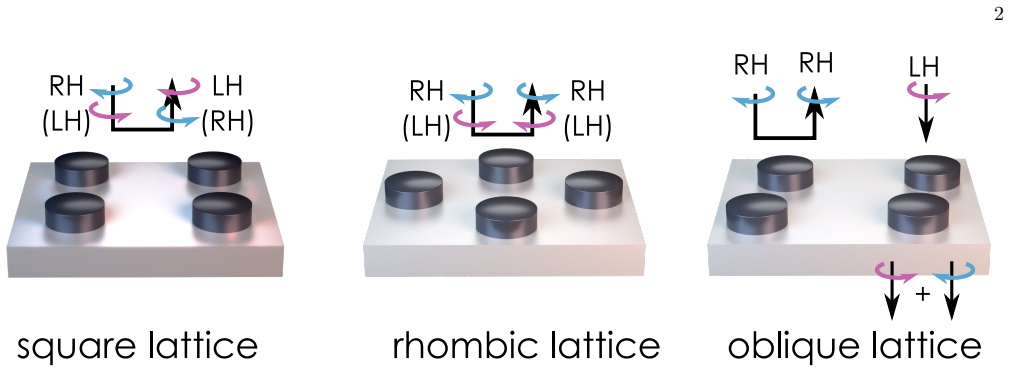
Low-symmetry periodic lattices composed of high-symmetry non-chiral meta-atoms enable regimes of near-perfect handedness-preserving reflection. Full-wave simulations on families of rhombic and monoclinic lattices of circular dielectric disks and holes locate these regimes, quantify their robustness to geometric deviations, material losses, and incidence angle, and show that coupled-mode theory reproduces the resonant response.
What carries the argument
Rhombic and monoclinic lattices of circular dielectric disks and holes, whose reduced translational symmetry supplies the handedness preservation that the individual high-symmetry meta-atoms lack.
If this is right
- Such lattices function as handedness-preserving mirrors for nanophotonic structures aimed at enantiomeric discrimination.
- The preservation effect persists across a range of geometric tolerances and material losses.
- Coupled-mode theory supplies an analytic description of the resonance that matches the numerical results.
- Performance holds for incidence angles near normal, with degradation only at larger angles.
Where Pith is reading between the lines
- The design separates the source of chirality to the lattice arrangement, allowing simpler, non-chiral fabrication of the individual elements.
- The same symmetry-breaking principle could be tested in other frequency ranges or with different high-symmetry particle shapes.
- Integration with existing dielectric platforms may reduce the need for complex chiral meta-atoms in sensing applications.
Load-bearing premise
Full-wave numerical simulations accurately capture the electromagnetic response of the lattices without experimental confirmation.
What would settle it
Fabricated samples measured at the simulated resonance wavelengths and angles that instead show handedness reversal rather than preservation.
Figures
read the original abstract
Mirrors that preserve the handedness of optical radiation upon reflection are an essential building block for the design of numerous resonant nanophotonic structures with capabilities for enantiomeric discrimination. Ordinary metallic and Bragg dielectric mirrors are not suitable in these context since they flip handedness of electromagnetic field upon reflection around normal incidence. While there has been considerable progress in the development of such reflecting structures, this research area remains largely unexplored. Here, we present a detailed numerical and theoretical analysis of the potential of low-symmetry periodic lattices composed of high-symmetry non-chiral meta-atoms for resonant reflection with handedness preservation (HP). Using full-wave numerical simulations, we analyze a family of rhombic and monoclinic (oblique) lattices of circular dielectric disks and/or holes, and in each identify the regime of near-perfect HP reflection. We study the robustness of these structures to geometric deviations, material losses, and incidence angle. Finally, we describe the resonant HP response of these structures using the coupled-mode theory formalism.
Editorial analysis
A structured set of objections, weighed in public.
Referee Report
Summary. The manuscript claims that low-symmetry (rhombic and monoclinic) periodic lattices of high-symmetry non-chiral meta-atoms (circular dielectric disks and/or holes) support resonant handedness-preserving (HP) reflection. This is demonstrated via full-wave numerical simulations identifying near-perfect HP regimes, with additional analysis of robustness to geometric deviations, material losses, and incidence angle, and a description of the response using coupled-mode theory.
Significance. If the numerical findings hold, the work offers a design route to HP mirrors that avoids chiral meta-atoms, which could simplify fabrication for nanophotonic enantiomer-discrimination structures. The exploration of multiple lattice types and the robustness study are positive features; the coupled-mode theory framing provides a useful explanatory layer.
major comments (2)
- [Numerical simulations] Numerical simulations section: the central claim of near-perfect HP reflection rests on full-wave simulations, yet no mesh-convergence data, solver settings, or error estimates are reported. This directly affects in the reported coefficients and must be addressed to substantiate the result.
- [Coupled-mode theory] Coupled-mode theory description: the formalism is invoked to explain the resonant HP response, but the manuscript provides only a high-level account with no explicit equations or derivation showing how the low-symmetry lattice produces HP without reducing to a fitted parameter. This weakens the theoretical support for the claim.
minor comments (1)
- [Abstract] The abstract and introduction would benefit from a clearer statement of the specific lattice parameters and frequency ranges where near-perfect HP is achieved.
Simulated Author's Rebuttal
We thank the referee for the constructive comments and positive assessment of the significance of our work. We address each major comment below and will revise the manuscript to strengthen the numerical and theoretical sections.
read point-by-point responses
-
Referee: [Numerical simulations] Numerical simulations section: the central claim of near-perfect HP reflection rests on full-wave simulations, yet no mesh-convergence data, solver settings, or error estimates are reported. This directly affects in the reported coefficients and must be addressed to substantiate the result.
Authors: We agree that mesh-convergence data, solver settings, and error estimates are necessary to substantiate the simulation results. In the revised manuscript we will add a dedicated paragraph (or subsection) reporting the mesh convergence tests, the specific full-wave solver parameters employed, and quantitative error bounds on the reflection coefficients in the near-perfect HP regimes. revision: yes
-
Referee: [Coupled-mode theory] Coupled-mode theory description: the formalism is invoked to explain the resonant HP response, but the manuscript provides only a high-level account with no explicit equations or derivation showing how the low-symmetry lattice produces HP without reducing to a fitted parameter. This weakens the theoretical support for the claim.
Authors: The current manuscript presents the coupled-mode theory at a conceptual level to link lattice symmetry to the HP response. To address the concern, the revised version will include the explicit coupled-mode equations together with a concise derivation showing how the low-symmetry lattice symmetry enforces the handedness-preserving condition without introducing fitted parameters. revision: yes
Circularity Check
No circularity; results derive from independent full-wave simulations explained by standard theory
full rationale
The paper obtains its central claim of near-perfect handedness-preserving reflection from full-wave numerical simulations on rhombic and monoclinic lattices of circular meta-atoms, then accounts for the response via the established coupled-mode theory formalism. No self-definitional parameters, fitted inputs renamed as predictions, or load-bearing self-citations appear in the provided text; the numerical identification and theoretical description remain independent of each other and of the target result, satisfying the self-contained criterion.
Axiom & Free-Parameter Ledger
axioms (1)
- standard math Maxwell's equations govern electromagnetic wave propagation in the structures
Forward citations
Cited by 1 Pith paper
-
Broken-symmetry phenomena enhanced by quasi-bound states in the continuum
Symmetry-protected qBICs in a four-fold rotationally symmetric metasurface enable perfect helicity-preserving reflection for arbitrarily small angular deviations from normal incidence via resonant enhancement.
Reference graph
Works this paper leans on
-
[1]
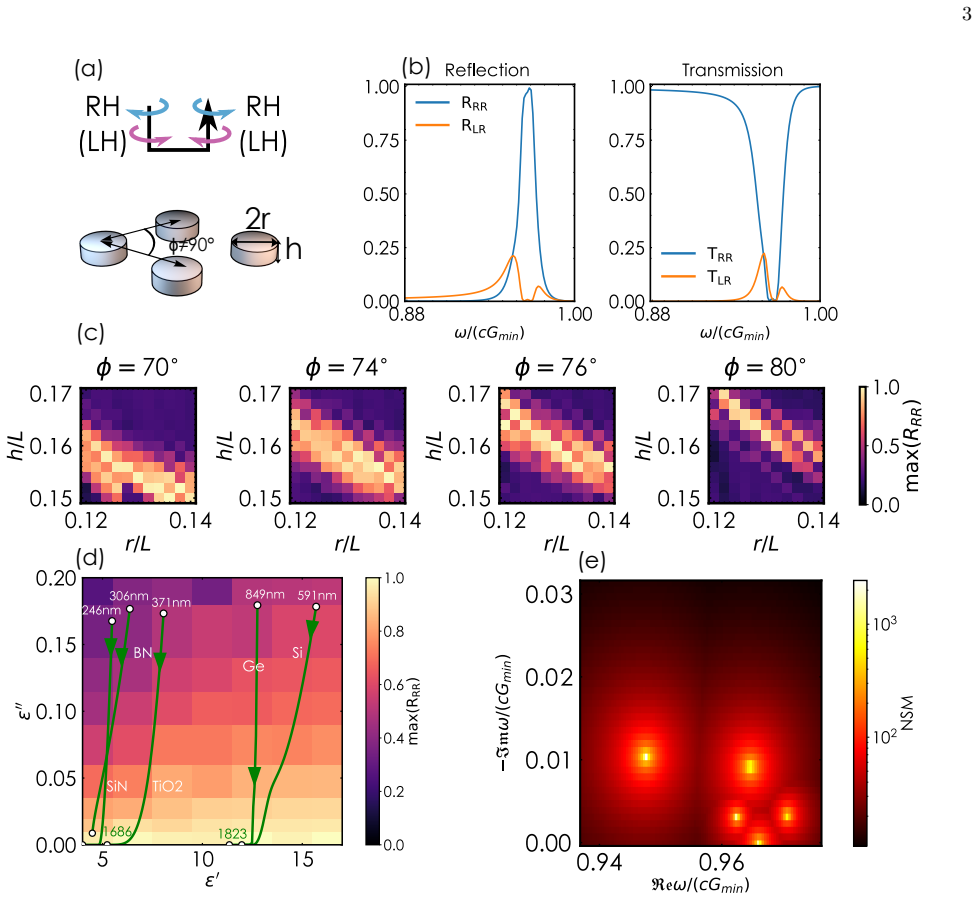
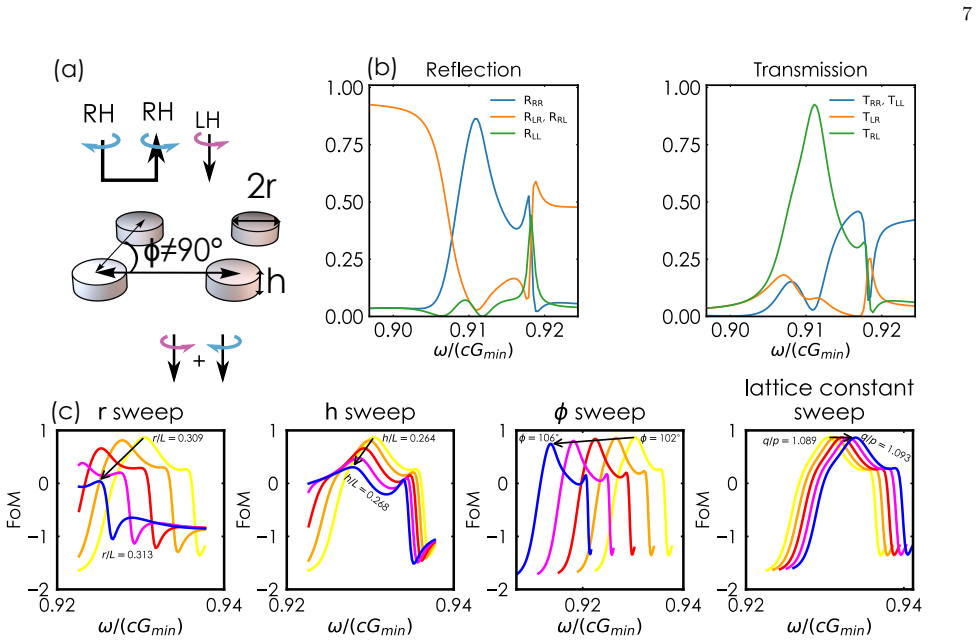
Array of circular disks in air We begin our analysis of rhombic metasurfaces with maximization of HP intensity reflection|rRR|2 in an array of dielectric circular disks in air arranged in a rhombic lattice, Fig. 2(a). The optimization of the geometric parameters of the lattice was conducted for a system of dielectric disks,n= 4, in air. Numerical modeling...
-
[2]
To approach the realistic conditions, we next analyze a similar rhombic array of circular dielectric disks on a dielectric substrate, Fig
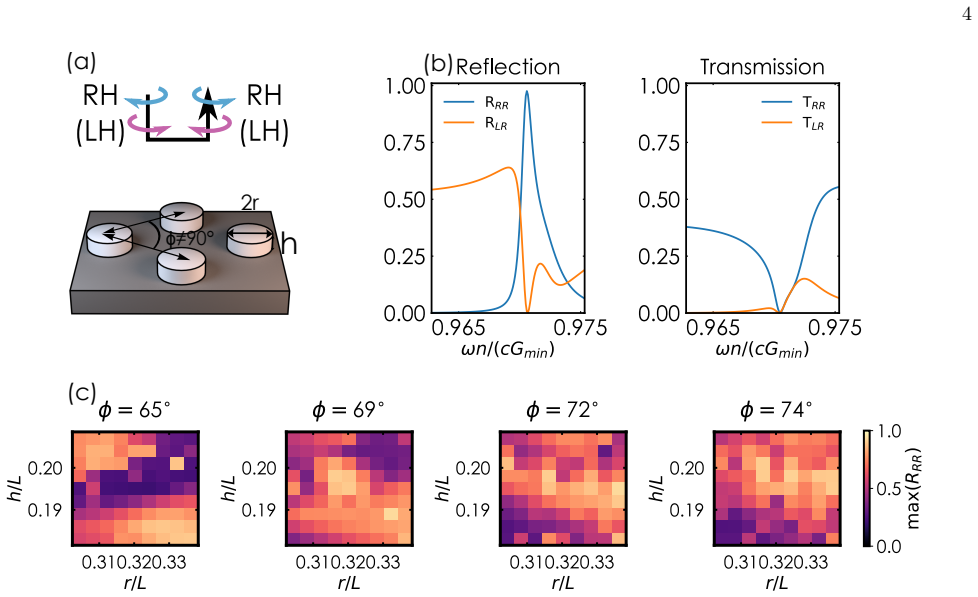
Array of circular disks on a substrate Although being a useful toy model for preliminary nu- merical analysis, a periodic lattice of free-standing disks cannot be implemented experimentally. To approach the realistic conditions, we next analyze a similar rhombic array of circular dielectric disks on a dielectric substrate, Fig. 3(a). The presence of the s...
-
[3]
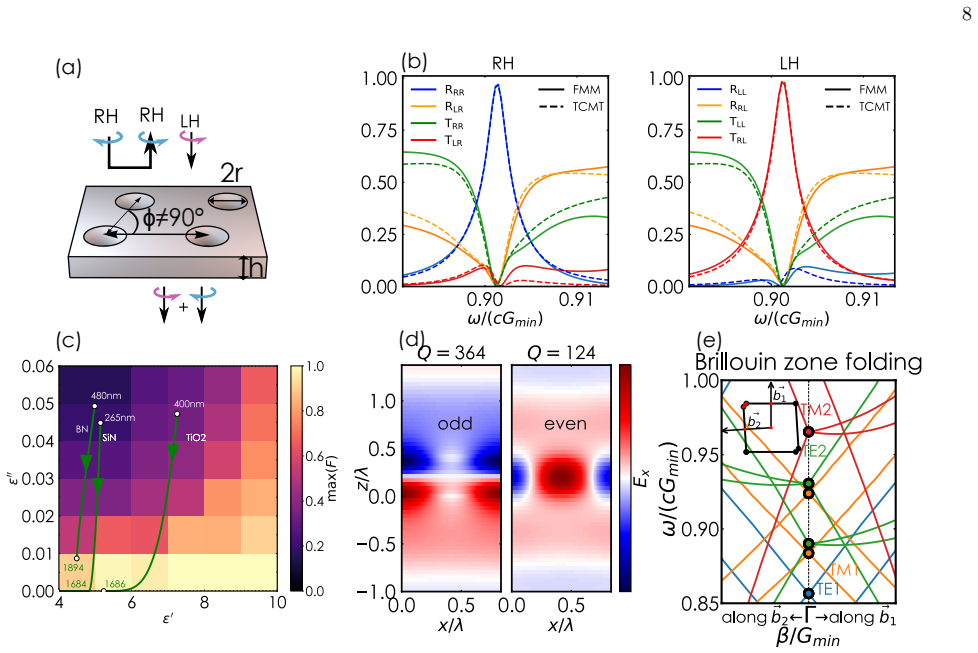
Array of circular holes in a membrane As another example of structures with rhombic sym- metry exhibiting HPR we analyze a rhombic lattice of holes within a dielectric membrane, Fig. 4(a). This sys- tem shares the same symmetry properties as the array of free-standing circular disks, ensuringr RR =r LL. Figure 4(b) shows numerically simulated reflection a...
-
[4]
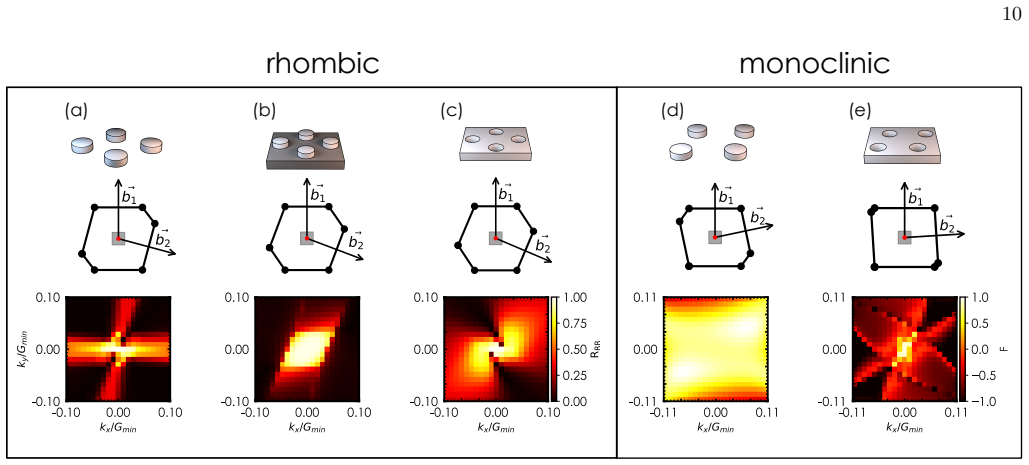
Array of circular disks in air Similarly to the analysis of rhombic lattices, we be- gin with the analysis of a monoclinic array of circular dielectric disks,n= 4, in air, Fig. 5(a). Optimiza- tion of the FoM of interest, (15), was performed with respect to the following geometric parameters: the angle of the lattice, the ratio of the base lengths of the ...
-
[5]
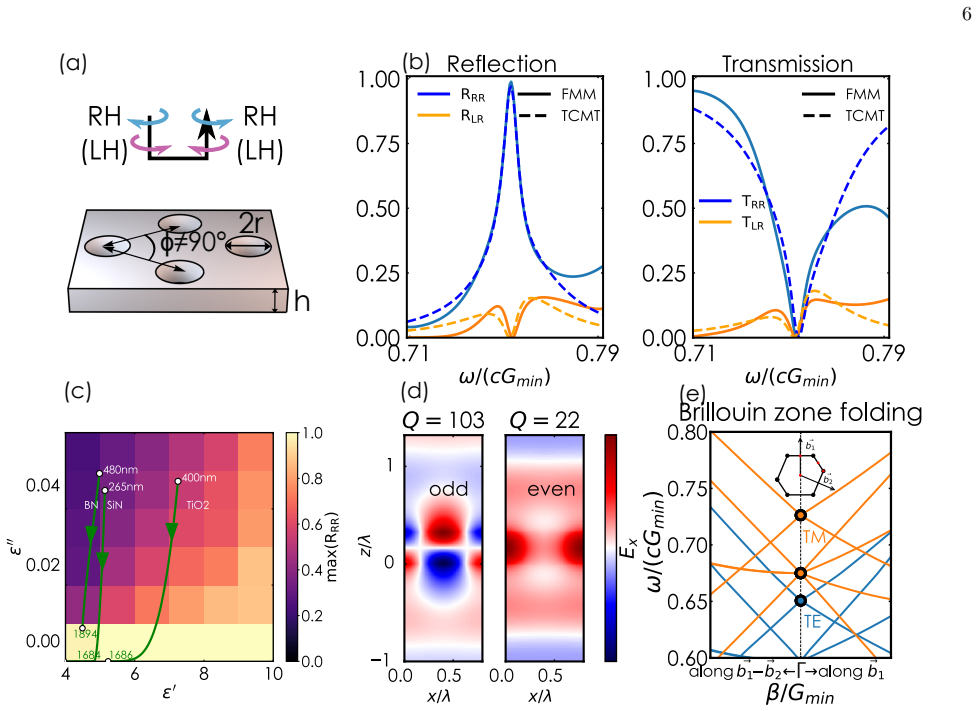
Array of circular holes in a membrane Similarly to the monoclinic array of circular disks, we optimize the geometry of the monoclinic lattice of circu- lar holes in an= 2 dielectric membrane to maximize the handedness-selective FoM, Fig. 6(a). Figure 6(b) shows exemplary reflection and transmission spectra of a near- optimal system. The spectra clearly de...
2024
-
[6]
Pfeifer, L
H. Pfeifer, L. Ratschbacher, J. Gallego, C. Saavedra, A. Faßbender, A. von Haaren, W. Alt, S. Hofferberth, M. K¨ ohl, S. Linden,et al., Achievements and perspectives of optical fiber fabry–perot cavities, Applied Physics B 128, 29 (2022)
2022
-
[7]
V. J. Sorger, R. F. Oulton, J. Yao, G. Bartal, and X. Zhang, Plasmonic fabry-p´ erot nanocavity, Nano let- ters9, 3489 (2009)
2009
-
[8]
Hunger, T
D. Hunger, T. Steinmetz, Y. Colombe, C. Deutsch, T. W. H¨ ansch, and J. Reichel, A fiber fabry–perot cavity with high finesse, New Journal of Physics12, 065038 (2010)
2010
-
[9]
Lodahl, S
P. Lodahl, S. Mahmoodian, and S. Stobbe, Interfac- ing single photons and single quantum dots with pho- tonic nanostructures, Reviews of Modern Physics87, 347 (2015)
2015
-
[10]
Canales, O
A. Canales, O. V. Kotov, B. K¨ u¸ c¨ uk¨ oz, and T. O. She- gai, Self-hybridized vibrational-mie polaritons in water droplets, Physical Review Letters132, 193804 (2024)
2024
-
[11]
Munkhbat, A
B. Munkhbat, A. Canales, B. K¨ u¸ c¨ uk¨ oz, D. G. Baranov, and T. O. Shegai, Tunable self-assembled Casimir micro- cavities and polaritons, Nature597, 214 (2021)
2021
-
[12]
Wang and G
B. Wang and G. P. Wang, Plasmon bragg reflectors and nanocavities on flat metallic surfaces, Applied Physics Letters87(2005)
2005
-
[13]
B. S. Kawasaki, K. O. Hill, D. C. Johnson, and Y. Fu- jii, Narrow-band bragg reflectors in optical fibers, Optics Letters3, 66 (1978)
1978
-
[14]
F. Ding, A. Pors, and S. I. Bozhevolnyi, Gradient meta- surfaces: a review of fundamentals and applications, Re- ports on Progress in Physics81, 026401 (2017)
2017
-
[15]
Park, J.-H
J. Park, J.-H. Kang, S. J. Kim, X. Liu, and M. L. Brongersma, Dynamic reflection phase and polarization control in metasurfaces, Nano letters17, 407 (2017)
2017
-
[16]
Arbabi, E
A. Arbabi, E. Arbabi, Y. Horie, S. M. Kamali, and A. Faraon, Planar metasurface retroreflector, Nature Photonics11, 415 (2017)
2017
-
[17]
J. Rui, D. Wei, A. Rubio-Abadal, S. Hollerith, J. Zeiher, D. M. Stamper-Kurn, C. Gross, and I. Bloch, A subradi- ant optical mirror formed by a single structured atomic layer, Nature583, 369 (2020)
2020
-
[18]
Merchiers, F
O. Merchiers, F. Moreno, F. Gonz´ alez, and J. M. Saiz, Light scattering by an ensemble of interacting dipolar particles with both electric and magnetic polarizabili- ties, Physical Review A - Atomic, Molecular, and Optical Physics76, 043834 (2007)
2007
-
[19]
Fernandez-Corbaton, M
I. Fernandez-Corbaton, M. Fruhnert, and C. Rockstuhl, Objects of maximum electromagnetic chirality, Physical Review X6, 031013 (2016)
2016
-
[20]
D. G. Baranov, B. Munkhbat, N. O. L¨ ank, R. Verre, M. K¨ all, and T. Shegai, Circular dichroism mode split- ting and bounds to its enhancement with cavity-plasmon- polaritons, Nanophotonics9, 283 (2020)
2020
-
[21]
E. U. Condon, Theories of optical rotatory power, Re- views of Modern Physics9, 432 (1937)
1937
-
[22]
V. K. Valev, J. J. Baumberg, C. Sibilia, and T. Verbiest, Chirality and chiroptical effects in plasmonic nanostruc- tures: Fundamentals, recent progress, and outlook, Ad- vanced Materials25, 2517 (2013)
2013
-
[23]
Tang and A
Y. Tang and A. E. Cohen, Optical chirality and its inter- action with matter, Physical Review Letters104, 163901 (2010)
2010
-
[24]
A. O. Govorov, Z. Fan, P. Hernandez, J. M. Slocik, and R. R. Naik, Theory of circular dichroism of nanomaterials comprising chiral molecules and nanocrystals: Plasmon enhancement, dipole interactions, and dielectric effects, Nano Letters10, 1374 (2010)
2010
-
[25]
V. V. Klimov, D. V. Guzatov, and M. Ducloy, Engineer- ing of radiation of optically active molecules with chi- ral nano-meta-particles, EPL (Europhysics Letters)97, 47004 (2012)
2012
-
[26]
N. Yang, Y. Tang, and A. E. Cohen, Spectroscopy in sculpted fields, Nano Today4, 269 (2009)
2009
-
[27]
Yang and A
N. Yang and A. E. Cohen, Local geometry of electromag- netic fields and its role in molecular multipole transitions, Journal of Physical Chemistry B115, 5304 (2011)
2011
-
[28]
Plum and N
E. Plum and N. I. Zheludev, Chiral mirrors, Applied Physics Letters106, 221901 (2015)
2015
-
[29]
Semnani, J
B. Semnani, J. Flannery, R. Al Maruf, and M. Bajcsy, Spin-preserving chiral photonic crystal mirror, Light: Science and Applications9, 23 (2020)
2020
-
[30]
Q. Duan, Y. Zeng, Y. Yin, S. Zhu, J. Xu, H. Chen, and Y. Liu, Spin-preserving chiral mirror based on a pattern of rotated elliptical holes in thin monolithic all-dielectric photonic crystal slabs, Physical Review B110, 115401 (2024)
2024
-
[31]
J. K. Gansel, M. Thiel, M. S. Rill, M. Decker, K. Bade, V. Saile, G. Von Freymann, S. Linden, and M. Wegener, Gold helix photonic metamaterial as broadband circular polarizer, Science325, 1513 (2009)
2009
-
[32]
Zhao and A
Y. Zhao and A. Al` u, Manipulating light polarization with ultrathin plasmonic metasurfaces, Physical Review B - Condensed Matter and Materials Physics84, 205428 (2011)
2011
-
[33]
Y. Zhao, M. A. Belkin, and A. Al` u, Twisted optical meta- materials for planarized ultrathin broadband circular po- larizers, Nature Communications3, 870 (2012)
2012
-
[34]
X. Ding, F. Monticone, K. Zhang, L. Zhang, D. Gao, S. N. Burokur, A. De Lustrac, Q. Wu, C.-W. Qiu, and A. Al` u, Ultrathin pancharatnam–berry metasurface with maximal cross-polarization efficiency, Advanced materi- als27, 1195 (2015)
2015
-
[35]
Kang and Y
M. Kang and Y. D. Chong, Coherent optical control of polarization with a critical metasurface, Physical Review A92, 043826 (2015)
2015
-
[36]
J. P. Balthasar Mueller, N. A. Rubin, R. C. Devlin, B. Groever, and F. Capasso, Metasurface Polarization Optics: Independent Phase Control of Arbitrary Orthog- onal States of Polarization, Physical Review Letters118, 113901 (2017). 12
2017
-
[37]
Cerjan and S
A. Cerjan and S. Fan, Achieving Arbitrary Control over Pairs of Polarization States Using Complex Birefrin- gent Metamaterials, Physical Review Letters118, 253902 (2017)
2017
-
[38]
A. H. Dorrah, N. A. Rubin, A. Zaidi, M. Tamagnone, and F. Capasso, Metasurface optics for on-demand po- larization transformations along the optical path, Nature Photonics15, 287 (2021)
2021
-
[39]
J. Feis, D. Beutel, J. K¨ opfler, X. Garcia-Santiago, C. Rockstuhl, M. Wegener, and I. Fernandez-Corbaton, Helicity-Preserving Optical Cavity Modes for Enhanced Sensing of Chiral Molecules, Physical Review Letters 124, 33201 (2020)
2020
-
[40]
Voronin, A
K. Voronin, A. S. Taradin, M. V. Gorkunov, and D. G. Baranov, Single-handedness chiral optical cavities, ACS Photonics9, 2652 (2022)
2022
-
[41]
S. A. Dyakov, N. S. Salakhova, A. V. Ignatov, I. M. Frad- kin, V. P. Panov, J.-K. Song, and N. A. Gippius, Chiral light in twisted fabry–p´ erot cavities, Advanced Optical Materials , 2302502 (2023)
2023
-
[42]
Dams and C
D. Dams and C. Rockstuhl, Enantiomer selectivity and energy transfer in imperfect chiral cavities, Physical Re- view A112, 033707 (2025)
2025
-
[43]
Beutel, P
D. Beutel, P. Scott, M. Wegener, C. Rockstuhl, and I. Fernandez-Corbaton, Enhancing the optical rota- tion of chiral molecules using helicity preserving all- dielectric metasurfaces, Applied Physics Letters118, 221108 (2021)
2021
-
[44]
Mauro, J
L. Mauro, J. Fregoni, J. Feist, and R. Avriller, Chiral discrimination in helicity-preserving fabry-p´ erot cavities, Physical Review A107, L021501 (2023)
2023
-
[45]
D. G. Baranov, C. Sch¨ afer, and M. V. Gorkunov, To- ward molecular chiral polaritons, ACS Photonics10, 2440 (2023)
2023
-
[46]
Sch¨ afer and D
C. Sch¨ afer and D. G. Baranov, Chiral polaritonics: Ana- lytical solutions, intuition, and use, J. Phys. Chem. Lett. 14, 3777 (2023)
2023
-
[47]
R. R. Riso, L. Grazioli, E. Ronca, T. Giovannini, and H. Koch, Strong Coupling in Chiral Cavities: Nonpertur- bative Framework for Enantiomer Discrimination, Phys- ical Review X13, 31002 (2023)
2023
-
[48]
Y. Ke, Z. Song, and Q. D. Jiang, Vacuum-Induced Symmetry Breaking of Chiral Enantiomer Formation in Chemical Reactions, Physical Review Letters131, 223601 (2023)
2023
-
[49]
F. Graf, J. Feis, X. Garcia-Santiago, M. Wegener, C. Rockstuhl, and I. Fernandez-Corbaton, Achiral, He- licity Preserving, and Resonant Structures for Enhanced Sensing of Chiral Molecules, ACS Photonics6, 482 (2019)
2019
-
[50]
Dyakov, I
S. Dyakov, I. Smagin, N. Salakhova, O. Blokhin, D. G. Baranov, I. Fradkin, and N. Gippius, Strong coupling of chiral light with chiral matter: a macroscopic study, Optica12, 1406 (2025)
2025
-
[51]
K. V. Voronin, A. N. Toksumakov, G. A. Ermolaev, A. S. Slavich, M. K. Tatmyshevskiy, S. M. Novikov, A. A. Vyshnevyy, A. V. Arsenin, K. S. Novoselov, D. A. Ghaz- aryan, v. Volkov, and D. G. Baranov, Chiral photonic super-crystals based on helical van der waals homostruc- tures, Laser & Photonics Reviews18, 2301113 (2024)
2024
-
[52]
Toftul, P
I. Toftul, P. Tonkaev, K. Koshelev, F. Lai, Q. Song, M. Gorkunov, and Y. Kivshar, Chiral dichroism in res- onant metasurfaces with monoclinic lattices, Phys. Rev. Lett. (2024)
2024
-
[53]
Toftul, D
I. Toftul, D. Hariharan, P. Tonkaev, F. Lai, Q. Song, and Y. Kivshar, Monoclinic nonlinear metasurfaces for reso- nant engineering of polarization states, Nanophotonics (2025)
2025
-
[54]
Sinev, F
I. Sinev, F. U. Richter, I. Toftul, N. Glebov, K. Koshelev, Y. Hwang, D. G. Lancaster, Y. Kivshar, and H. Al- tug, Chirality encoding in resonant metasurfaces gov- erned by lattice symmetries, Nature Communications16, 6091 (2025)
2025
-
[55]
N. I. Landy, S. Sajuyigbe, J. J. Mock, D. R. Smith, and W. J. Padilla, Perfect metamaterial absorber, Physical review letters100, 207402 (2008)
2008
-
[56]
Meinzer, W
N. Meinzer, W. L. Barnes, and I. R. Hooper, Plasmonic meta-atoms and metasurfaces, Nature photonics8, 889 (2014)
2014
-
[57]
M. V. Gorkunov, A. A. Antonov, and Y. S. Kivshar, Metasurfaces with Maximum Chirality Empowered by Bound States in the Continuum, Physical Review Let- ters125, 93903 (2020)
2020
-
[58]
Zograf, B
G. Zograf, B. K¨ u¸ c¨ uk¨ oz, A. Y. Polyakov, A. B. Yankovich, A. Ranjan, M. Bancerek, A. V. Agrawal, E. Olsson, W. Wieczorek, T. J. Antosiewicz,et al., Ultrathin 3r- mos2 metasurfaces with atomically precise edges for effi- cient nonlinear nanophotonics, Communications Physics 8, 271 (2025)
2025
-
[59]
Menzel, C
C. Menzel, C. Rockstuhl, and F. Lederer, Advanced Jones calculus for the classification of periodic metamaterials, Physical Review A82, 053811 (2010)
2010
-
[60]
S. S. Kruk, A. N. Poddubny, D. A. Powell, C. Helgert, M. Decker, T. Pertsch, D. N. Neshev, and Y. S. Kivshar, Polarization properties of optical metasurfaces of differ- ent symmetries, Physical Review B - Condensed Matter and Materials Physics91, 195401 (2015)
2015
-
[61]
Y. Xu, Y. Fu, and H. Chen, Planar gradient metamate- rials, Nature Reviews Materials1, 16067 (2016)
2016
-
[62]
G´ omez-Medina, M
R. G´ omez-Medina, M. Laroche, and J. J. S´ aenz, Extraor- dinary optical reflection from sub-wavelength cylinder ar- rays, Optics Express14, 3730 (2006)
2006
-
[63]
F. J. De Abajo, Colloquium: Light scattering by particle and hole arrays, Reviews of Modern Physics79, 1267 (2007)
2007
-
[64]
Moharam, E
M. Moharam, E. B. Grann, D. A. Pommet, and T. Gay- lord, Formulation for stable and efficient implementation of the rigorous coupled-wave analysis of binary gratings, Journal of the Optical Society of America A12, 1068 (1995)
1995
-
[65]
S. G. Tikhodeev, A. Yablonskii, E. Muljarov, N. A. Gip- pius, and T. Ishihara, Quasiguided modes and optical properties of photonic crystal slabs, Physical Review B 66, 045102 (2002)
2002
-
[66]
I. M. Fradkin, S. A. Dyakov, and N. A. Gippius, Fourier modal method for the description of nanoparticle lat- tices in the dipole approximation, Physical Review B99, 075310 (2019)
2019
-
[67]
Lalanne, W
P. Lalanne, W. Yan, K. Vynck, C. Sauvan, and J. P. Hugonin, Light Interaction with Photonic and Plasmonic Resonances, Laser and Photonics Reviews12, 1700113 (2018)
2018
-
[68]
Trøst Kristensen, K
P. Trøst Kristensen, K. Herrmann, F. Intravaia, and K. Busch, Modeling electromagnetic resonators using quasinormal modes: Erratum, Advances in Optics and Photonics13, 834 (2021)
2021
-
[69]
Both and T
S. Both and T. Weiss, Resonant states and their role in nanophotonics, Semiconductor Science and Technology 13 37, 013002 (2021)
2021
-
[70]
Sauvan, T
C. Sauvan, T. Wu, R. Zarouf, E. A. Muljarov, and P. Lalanne, Normalization, orthogonality, and complete- ness of quasinormal modes of open systems: the case of electromagnetism, Optics Express30, 6846 (2022)
2022
-
[71]
V. E. Babicheva and J. V. Moloney, Lattice zenneck modes on subwavelength antennas, Laser & Photonics Reviews13, 1800267 (2019)
2019
-
[72]
Ustimenko, C
N. Ustimenko, C. Rockstuhl, and A. B. Evlyukhin, Res- onances in finite-size all-dielectric metasurfaces for light trapping and propagation control, Physical Review B 109, 115436 (2024)
2024
-
[73]
Allayarov, V
I. Allayarov, V. Aita, D. J. Roth, B. Van Casteren, A. Y. Bykov, A. B. Evlyukhin, A. V. Zayats, and A. Cal` a Lesina, Strong coupling of collective optical res- onances in dielectric metasurfaces, Light: Science & Ap- plications14, 387 (2025)
2025
-
[74]
S. Fan, W. Suh, and J. D. Joannopoulos, Temporal coupled-mode theory for the fano resonance in optical resonators, JOSA A20, 569 (2003)
2003
-
[75]
W. Suh, Z. Wang, and S. Fan, Temporal coupled-mode theory and the presence of non-orthogonal modes in loss- less multimode cavities, IEEE Journal of Quantum Elec- tronics40, 1511 (2004)
2004
-
[76]
A. C. Overvig, S. Shrestha, and N. Yu, Dimerized high contrast gratings, Nanophotonics7, 1157 (2018)
2018
-
[77]
W. Wang, Y. K. Srivastava, T. C. Tan, Z. Wang, and R. Singh, Brillouin zone folding driven bound states in the continuum, Nature Communications14, 2811 (2023)
2023
-
[78]
K. Sun, H. Wei, W. Chen, Y. Chen, Y. Cai, C.-W. Qiu, and Z. Han, Infinite-q guided modes radiate in the con- tinuum, Physical Review B107, 115415 (2023)
2023
-
[79]
S. A. Dyakov, M. V. Stepikhova, A. A. Bogdanov, A. V. Novikov, D. V. Yurasov, M. V. Shaleev, Z. F. Krasilnik, S. G. Tikhodeev, and N. A. Gippius, Photonic bound states in the continuum in si structures with the self- assembled ge nanoislands, Laser & Photonics Reviews 15, 2000242 (2021)
2021
-
[80]
N. Salakhova, A. Demenev, O. Klimenko, V. Kulakovskii, V. Antonov, N. Gippius, and S. Dyakov, Broadband wide-view all-dielectric handedness-preserving mirror, arXiv preprint arXiv:2601.08695 (2026)
arXiv 2026
discussion (0)
Sign in with ORCID, Apple, or X to comment. Anyone can read and Pith papers without signing in.