REVIEW 2 major objections 1 cited by
On the later evolution of observationally selected protocluster candidates at $z\,{\gtrsim}\,5$
T0 review · 2 major / 0 minor · reviewed 2026-06-26 · grok-4.3
Pith's one-line read Observationally selected protocluster candidates at z ≳ 5 include both genuine cluster progenitors and many interlopers that will not reach cluster mass by z=0.
desk verdict The clustering mismatch between FLAMINGO and observations undercuts the merger probabilities and interloper claims for real protocluster candidates. read the letter →
The pith
A machine-rendered reading of the paper's core claim, the machinery that carries it, and where it could break.
The reading
What carries the argument
Comparison of three selection methods (mass-selected, abundance-matched, and observational) within the FLAMINGO simulations to track later evolution and merger histories from z ≳ 5 to z=0.
What would settle it
Direct measurement of how many observed z ≳ 5 protocluster candidates actually end up as z=0 clusters of the expected mass, compared against the simulated fractions.
Extended reading notes
Core claim
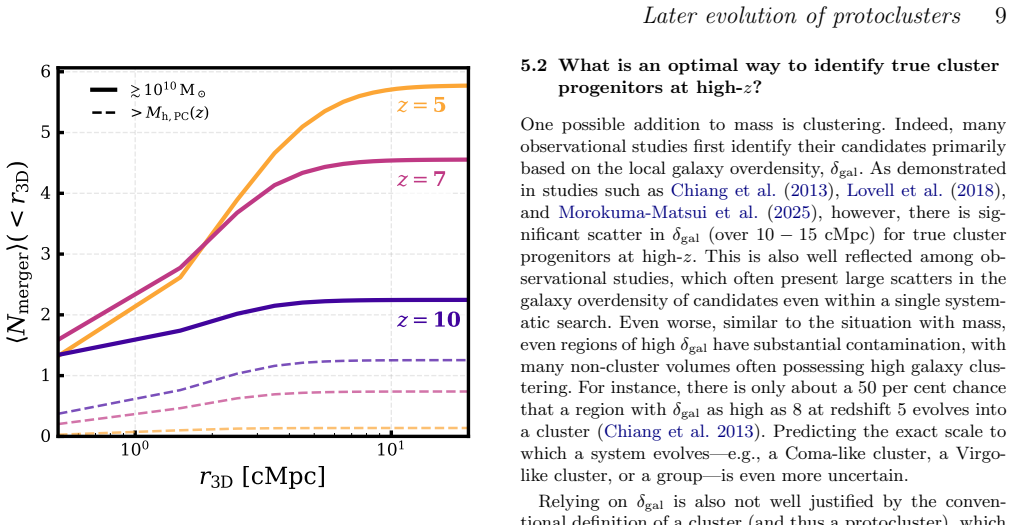
Using the FLAMINGO simulations, observationally selected protocluster candidates at z ≳ 5 have a number density that falls between the mass-selected and abundance-matched samples, indicating that searches recover both genuine cluster progenitors and significant interlopers that will not reach cluster masses by z=0. These candidates are heavily clustered, with 2-10 neighbors within 10 cMpc, and a neighbor at 5 cMpc (10 cMpc) implies ≳50% (≳30%) probability of later merging into a larger system, mostly at z ≲ 2. Each candidate experiences 2-6 later major mergers, mostly with systems too small to be identified as massive at the selection epoch, while observations exhibit weaker clustering than
Load-bearing premise
The simulations correctly capture the clustering, merger rates, and mass growth of these systems from high redshift down to the present.
Editorial extensions
If this is right
- A candidate with a neighbor at 5 cMpc faces ≳50% chance of merging into a larger system, mostly at z ≲ 2.
- Merger counts converge beyond ~10 cMpc, marking a characteristic scale in structure formation.
- Relying only on high-z mass and galaxy overdensity produces severe scatter and systematic error in predicting final fate.
- Robust identification requires summing total galaxy mass down to faint limits inside a 10 cMpc radius.
Reading between the lines
- Clustering strength around candidates could serve as an additional diagnostic to separate true progenitors from interlopers.
- Upcoming wide and deep surveys can test the prediction by measuring total enclosed mass rather than just bright galaxy counts.
- The mismatch between observed and simulated clustering may point to either selection biases in real data or missing processes in the models.
Editorial analysis
A structured set of objections, weighed in public.
Referee Report
Summary. The paper uses the FLAMINGO simulations to follow the z=0 descendants of protocluster candidates at z≳5. Three selection methods are compared: mass-selected, abundance-matched, and observationally selected. The observed number density is reported to lie between the mass-selected and abundance-matched samples, implying a mixture of genuine progenitors and interlopers. The simulations show strong clustering (2–10 neighbors within 10 cMpc), yielding merger probabilities of ≳50% (≳30%) for a neighbor at 5 cMpc (10 cMpc), mostly at z≲2. Observations exhibit weaker clustering than the simulations; each candidate experiences 2–6 later major mergers, mostly with systems too small to be identified at selection. The paper concludes that mass and overdensity alone are insufficient and that a total mass sum within 10 cMpc is required for robust identification.
Significance. If the simulation-based merger statistics and selection comparisons hold, the work supplies quantitative guidance on the reliability of current high-z protocluster searches and identifies clustering amplitude as a potentially useful diagnostic. The large-volume simulation approach that tracks individual systems across cosmic time is a clear methodological strength.
major comments (2)
- [Abstract] Abstract: The inference that the observed number density lying between the mass-selected and abundance-matched samples implies a substantial interloper fraction rests on the assumption that FLAMINGO correctly predicts merger probabilities from the measured clustering (e.g., neighbor at 5 cMpc → ≳50% merger probability). The same abstract states that observations show markedly weaker clustering than the simulations, creating an internal tension: if the simulated clustering (and therefore the derived merger dynamics) does not match reality, the positioning of the observed density does not reliably constrain the interloper fraction or later evolution.
- [Abstract] Abstract: No numerical values, error bars, or tables are provided for the number densities of the three samples or for the observed sample, nor are the precise definitions of the mass-selected and abundance-matched selections given. Without these, the claim that the observed density 'falls between' the two simulated samples cannot be evaluated for statistical significance or sensitivity to parameter choices.
Simulated Author's Rebuttal
We thank the referee for their constructive comments, which help clarify the presentation of our results. We address each major comment below.
read point-by-point responses
-
Referee: [Abstract] Abstract: The inference that the observed number density lying between the mass-selected and abundance-matched samples implies a substantial interloper fraction rests on the assumption that FLAMINGO correctly predicts merger probabilities from the measured clustering (e.g., neighbor at 5 cMpc → ≳50% merger probability). The same abstract states that observations show markedly weaker clustering than the simulations, creating an internal tension: if the simulated clustering (and therefore the derived merger dynamics) does not match reality, the positioning of the observed density does not reliably constrain the interloper fraction or later evolution.
Authors: The number density comparison and resulting implication for interlopers is based on the high-redshift selection statistics in the simulations versus observations, not directly on the merger probabilities. The merger probabilities are derived separately from the clustering properties within the simulations. We do note the discrepancy in clustering strength between simulations and observations, which we interpret as suggesting that clustering amplitude could serve as an additional diagnostic. However, we agree that this discrepancy introduces some uncertainty when applying the simulated merger rates to observed systems. We will revise the abstract to explicitly separate these points and add a caveat regarding the applicability of the merger statistics to observations given the clustering difference. revision: partial
-
Referee: [Abstract] Abstract: No numerical values, error bars, or tables are provided for the number densities of the three samples or for the observed sample, nor are the precise definitions of the mass-selected and abundance-matched selections given. Without these, the claim that the observed density 'falls between' the two simulated samples cannot be evaluated for statistical significance or sensitivity to parameter choices.
Authors: We agree that including specific numerical values and clearer definitions in the abstract would improve the accessibility of the key result. The full paper provides the definitions of the mass-selected and abundance-matched samples, along with the number densities in the relevant sections. We will update the abstract to include approximate number density values (with uncertainties where applicable) and brief definitions of the selection methods. revision: yes
Circularity Check
No circularity: external simulation outputs compared to independent observations without reduction to fitted inputs or self-citations.
full rationale
The paper defines mass-selected and abundance-matched samples within the FLAMINGO simulations and tracks their z=0 descendants, then positions the externally measured observed number density between those two simulated distributions to infer a mix of progenitors and interlopers. Clustering statistics, neighbor counts, and merger probabilities are computed directly from the simulation particle data without any fitting or tuning to the target observational number density or clustering measurements. The noted mismatch between simulated and observed clustering is reported as an output rather than an input. No self-citations, ansatzes, or uniqueness theorems are invoked to justify the central claims, and the derivation remains self-contained against external benchmarks.
Assumptions & free parameters
assumptions (1)
- domain assumption FLAMINGO simulations correctly capture the physics and statistics of protocluster evolution and mergers at z ≳ 5.
Cite this review
Pith. "Pith review of On the later evolution of observationally selected protocluster candidates at $z\,{\gtrsim}\,5$." pith.science (2026). https://pith.science/paper/4ZWOX2BE
@misc{pith2026260619463,
  author       = {Pith},
  title        = {Pith review of: On the later evolution of observationally selected protocluster candidates at $z\,\gtrsim\,5$},
  year         = {2026},
  howpublished = {\url{https://pith.science/paper/4ZWOX2BE}},
  note         = {Machine review of arXiv:2606.19463}
}
abstract
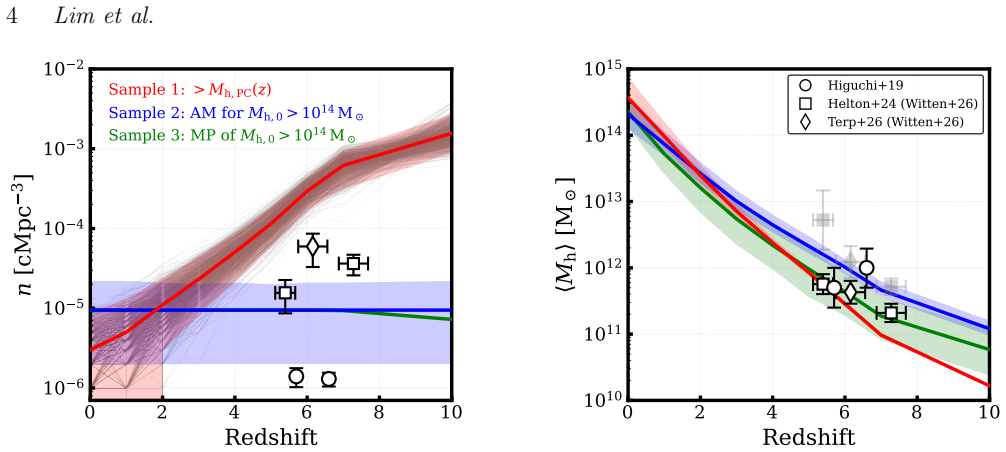
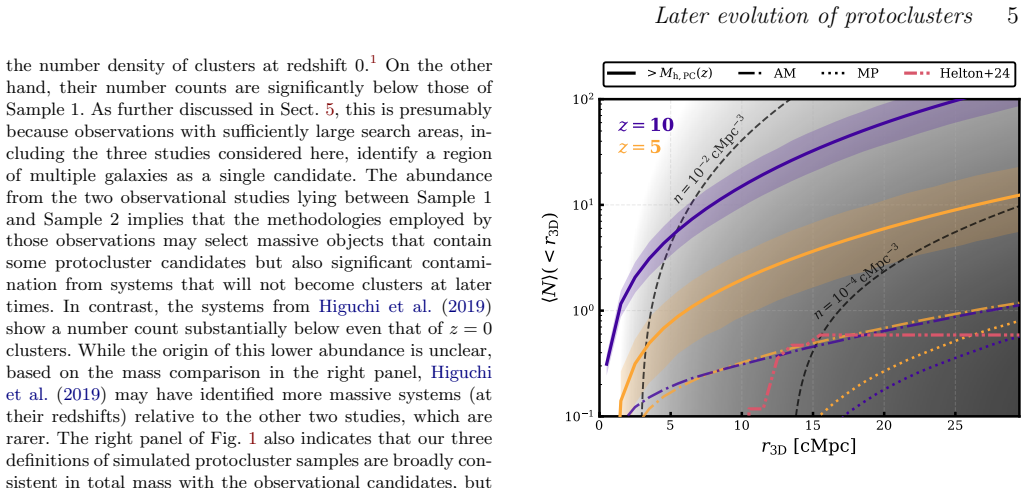
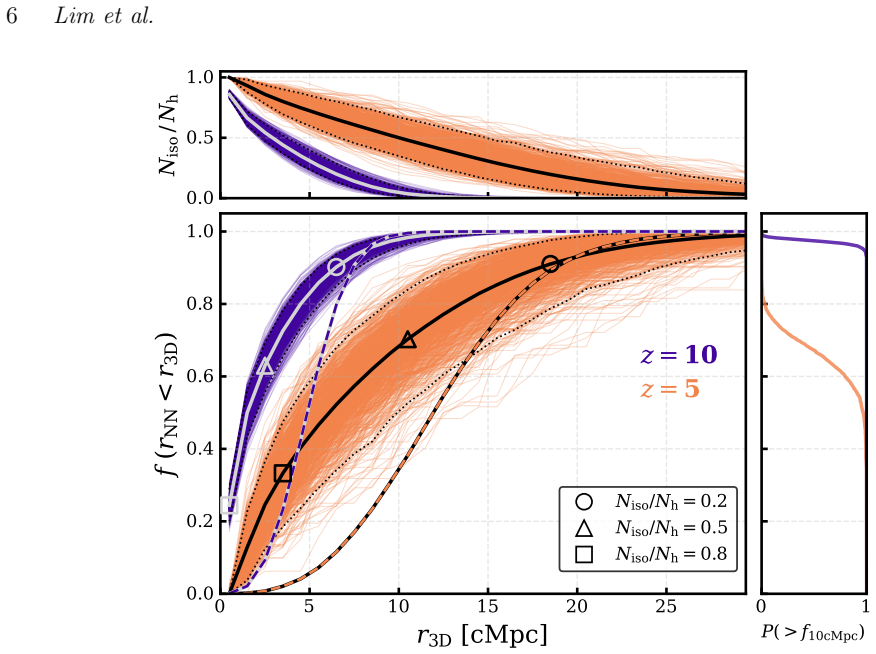
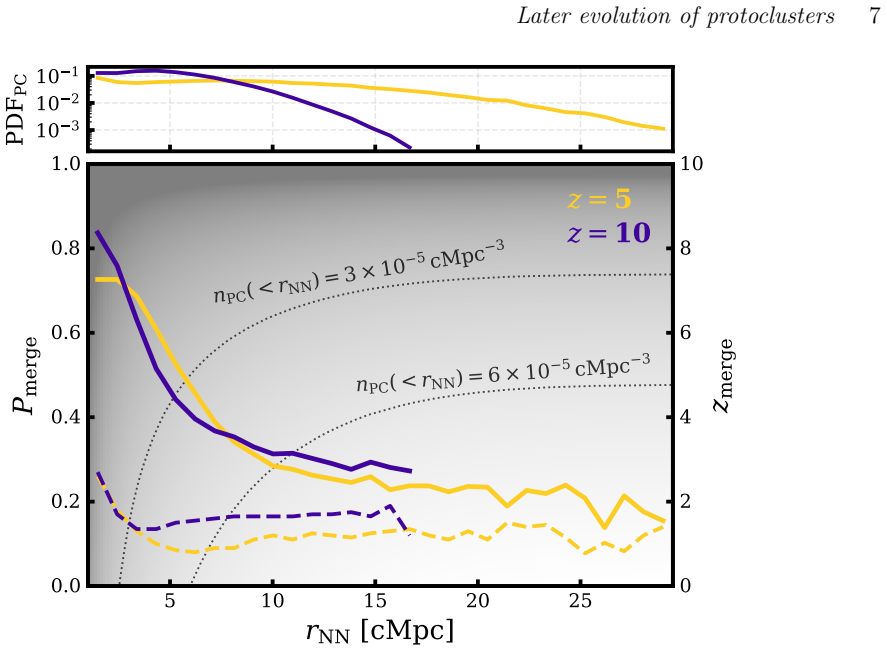
Recent observations have revealed numerous protocluster candidates at $z\,{\gtrsim}\,5$, yet whether these systems will eventually evolve into today's galaxy clusters remains an open question. Using the FLAMINGO simulations -- resolving protocluster cores up to $z\,{\simeq}\,10$ -- we track the later evolution of observationally selected protocluster candidates, comparing three selection methods against observational samples. The observed number density falls between our mass-selected and abundance-matched samples, implying that current searches pick up both genuine cluster progenitors and significant interlopers that will not reach cluster masses by $z\,{=}\,0$. We find that candidates at $z\gtrsim5$ are heavily clustered, hosting 2$-$10 neighbors within 10\,cMpc. Consequently, a candidate with a neighbor at 5\,cMpc (10\,cMpc) faces a $\gtrsim50\%$ ($\gtrsim30\%$) probability of later merging into a larger system, mostly at $z\,{\lesssim}\,2$. The merger count converges beyond ${\sim}10$\,cMpc, pointing to a fundamental scale in structure formation. Observations show markedly weaker clustering than our simulations predict, suggesting clustering offers a currently overlooked diagnostic. Each candidate undergoes roughly 2$-$6 later major mergers, mostly with systems too small to be recognized as massive at the selection epoch. Hence, relying solely on high-$z$ mass and galaxy overdensity to forecast a candidate's fate is prone to severe scatter and systematic error. A robust identification of true cluster progenitors demands a total mass sum of galaxies down to the faintest levels within a 10\,cMpc radius. Upcoming surveys with both depth and area will be key to reliably linking high-$z$ protocluster candidates to their ultimate destiny.
Figures
Figures from the paper (2 more)
Forward citations
Cited by 1 Pith paper
-
What becomes of JWST/NIRCam-selected high-redshift massive galaxies?
Observational JWST/NIRCam selections recover almost none of TNG300's M⋆≥10^11 M⊙ galaxies at z~5 and their descendants rarely become the most massive systems at z=0 unless they experience late merger growth.
Reference graph
Works this paper leans on
-
[1]
Too many protoclusters? Reconciling the overabundance of cluster progenitors within the first billion years of the Universe. arXiv e-prints , keywords =. doi:10.48550/arXiv.2605.28930 , archivePrefix =. 2605.28930 , primaryClass =
-
[2]
EPOCHS paper ─ X. Environmental effects on Galaxy formation and protocluster Galaxy candidates at 4.5 < z < 10 from JWST observations. , keywords =. doi:10.1093/mnras/staf543 , archivePrefix =. 2405.17359 , primaryClass =
-
[3]
A Quasar-anchored Protocluster at z = 6.6 in the ASPIRE Survey. I. Properties of [O III] Emitters in a 10 Mpc Overdensity Structure. , keywords =. doi:10.3847/1538-4357/adb1bd , archivePrefix =. 2410.03826 , primaryClass =
-
[4]
JADES: A Prominent Galaxy Overdensity Candidate within the First 500 Myr
JADES: A Prominent Galaxy Overdensity Candidate within the First 500 Myr. arXiv e-prints , keywords =. doi:10.48550/arXiv.2601.15960 , archivePrefix =. 2601.15960 , primaryClass =
-
[5]
Photometrically selected protocluster candidates at in the JWST COSMOS-Web field. , keywords =. doi:10.1017/pasa.2025.10096 , archivePrefix =. 2510.20172 , primaryClass =
-
[6]
Quantifying the Impact of Incompleteness on Identifying and Interpreting Galaxy Protocluster Populations with the TNG-Cluster Simulation. , keywords =. doi:10.3847/1538-4357/adf644 , archivePrefix =. 2504.03836 , primaryClass =
-
[7]
What are Protoclusters? -- Defining High Redshift Galaxy Clusters and Protoclusters
What are protoclusters? - Defining high-redshift galaxy clusters and protoclusters. , keywords =. doi:10.1093/mnras/stv1449 , archivePrefix =. 1506.08835 , primaryClass =
-
[8]
Galaxy evolution in protoclusters
Galaxy evolution in protoclusters. , keywords =. doi:10.1093/mnras/stx2454 , archivePrefix =. 1709.07009 , primaryClass =
Show all 300 references
-
[9]
arXiv e-prints , keywords =
All the Massive Galaxy Overdensities during Reionization: JWST Rest-Frame Optical Selection Reveals Young, Chemically Evolved Galaxies Embedded in Dense, Neutral Gas at z > 5. arXiv e-prints , keywords =. doi:10.48550/arXiv.2602.09091 , archivePrefix =. 2602.09091 , primaryClass =
- [10]
- [11]
-
[12]
, keywords =
Assessing subhalo finders in cosmological hydrodynamical simulations. , keywords =. doi:10.1093/mnras/staf1478 , archivePrefix =. 2502.06932 , primaryClass =
-
[13]
Galaxy Formation and Evolution
-
[14]
, keywords =
The effects of reionization on Ly galaxy surveys. , keywords =. doi:10.1111/j.1365-2966.2005.09785.x , archivePrefix =. astro-ph/0507266 , primaryClass =
2005 doi
- [15]
- [16]
- [17]
- [18]
- [19]
- [20]
-
[21]
, keywords =
A Detailed Study of Massive Galaxies in a Protocluster at z = 3.13. , keywords =. doi:10.3847/1538-4357/aba626 , archivePrefix =. 2007.07055 , primaryClass =
2007 doi
-
[22]
, keywords =
Is there enough star formation in simulated protoclusters?. , keywords =. doi:10.1093/mnras/staa3693 , archivePrefix =. 2010.02259 , primaryClass =
2010 doi
- [23]
-
[24]
Universe , keywords =
From Clusters to Proto-Clusters: The Infrared Perspective on Environmental Galaxy Evolution. Universe , keywords =. doi:10.3390/universe8110554 , archivePrefix =. 2209.02781 , primaryClass =
- [25]
- [26]
- [27]
- [28]
-
[29]
, keywords =
Spectroscopic Confirmation of a Coma Cluster Progenitor at z 2.2. , keywords =. doi:10.3847/1538-4357/ab75c3 , archivePrefix =. 2002.06207 , primaryClass =
2002 doi
-
[30]
, keywords =
The JWST Advanced Deep Extragalactic Survey: Discovery of an Extreme Galaxy Overdensity at z = 5.4 with JWST/NIRCam in GOODS-S. , keywords =. doi:10.3847/1538-4357/ad0da7 , archivePrefix =. 2302.10217 , primaryClass =
-
[31]
, keywords =
Identification of High-redshift Galaxy Overdensities in GOODS-N and GOODS-S. , keywords =. doi:10.3847/1538-4357/ad6867 , archivePrefix =. 2311.04270 , primaryClass =
- [32]
-
[33]
, keywords =
The discovery of the first luminous z -0.5ex 6 quasar in the UKIDSS Large Area Survey. , keywords =. doi:10.1111/j.1745-3933.2007.00290.x , archivePrefix =. astro-ph/0612162 , primaryClass =
2007 doi
- [34]
- [35]
-
[36]
, keywords =
Physical Properties of a Coma-analog Protocluster at z = 6.5. , keywords =. doi:10.3847/1538-4357/ab1a34 , adsurl =
- [37]
- [38]
-
[39]
SILVERRUSH. VIII. Spectroscopic Identifications of Early Large-scale Structures with Protoclusters over 200 Mpc at z 6-7: Strong Associations of Dusty Star-forming Galaxies. , keywords =. doi:10.3847/1538-4357/ab2cd5 , archivePrefix =. 1902.09555 , primaryClass =
1902 doi
- [40]
- [41]
- [42]
- [43]
-
[44]
, keywords =
Megaparsec-scale structure around the protocluster core SPT2349-56 at z = 4.3. , keywords =. doi:10.1093/mnras/staa1275 , archivePrefix =. 2002.11600 , primaryClass =
2002 doi
-
[45]
, keywords =
Overdensities of submillimetre-bright sources around candidate protocluster cores selected from the South Pole Telescope survey. , keywords =. doi:10.1093/mnras/stab2800 , archivePrefix =. 2010.02909 , primaryClass =
2010 doi
- [46]
-
[47]
EIGER. I. A Large Sample of [O III]-emitting Galaxies at 5.3 < z < 6.9 and Direct Evidence for Local Reionization by Galaxies. , keywords =. doi:10.3847/1538-4357/acc588 , archivePrefix =. 2211.08254 , primaryClass =
- [48]
- [49]
- [50]
-
[51]
, keywords =
ODIN: Where Do Ly Blobs Live? Contextualizing Blob Environments within Large-scale Structure. , keywords =. doi:10.3847/1538-4357/acd341 , archivePrefix =. 2302.07860 , primaryClass =
-
[52]
, keywords =
A lensed protocluster candidate at z = 7.66 identified in JWST observations of the galaxy cluster SMACS0723 - 7327. , keywords =. doi:10.1051/0004-6361/202244719 , archivePrefix =. 2208.04930 , primaryClass =
-
[53]
Early Results from GLASS-JWST. XIV. A Spectroscopically Confirmed Protocluster 650 Million Years after the Big Bang. , keywords =. doi:10.3847/2041-8213/acb99e , archivePrefix =. 2211.09097 , primaryClass =
-
[54]
New insights into the most distant Ly detection
GN-z11: The environment of an active galactic nucleus at z = 10.603. New insights into the most distant Ly detection. , keywords =. doi:10.1051/0004-6361/202347187 , archivePrefix =. 2306.09142 , primaryClass =
-
[55]
, keywords =
JADES Imaging of GN-z11: Revealing the Morphology and Environment of a Luminous Galaxy 430 Myr after the Big Bang. , keywords =. doi:10.3847/1538-4357/acdbc6 , archivePrefix =. 2302.07234 , primaryClass =
-
[56]
, keywords =
A SPectroscopic Survey of Biased Halos in the Reionization Era (ASPIRE): JWST Reveals a Filamentary Structure around a z = 6.61 Quasar. , keywords =. doi:10.3847/2041-8213/accd6f , archivePrefix =. 2304.09894 , primaryClass =
- [57]
-
[58]
, keywords =
The FLAMINGO project: cosmological hydrodynamical simulations for large-scale structure and galaxy cluster surveys. , keywords =. doi:10.1093/mnras/stad2419 , archivePrefix =. 2306.04024 , primaryClass =
-
[59]
, keywords =
FLAMINGO: calibrating large cosmological hydrodynamical simulations with machine learning. , keywords =. doi:10.1093/mnras/stad2540 , archivePrefix =. 2306.05492 , primaryClass =
- [60]
- [61]
- [62]
- [63]
-
[64]
, keywords =
Consistent lensing and clustering in a low-S _ 8 Universe with BOSS, DES Year 3, HSC Year 1, and KiDS-1000. , keywords =. doi:10.1093/mnras/stac2938 , archivePrefix =. 2202.07440 , primaryClass =
-
[65]
, keywords =
SWIFT: A modern highly-parallel gravity and smoothed particle hydrodynamics solver for astrophysical and cosmological applications. , keywords =. doi:10.1093/mnras/stae922 , archivePrefix =. 2305.13380 , primaryClass =
-
[66]
, keywords =
The physics driving the cosmic star formation history. , keywords =. doi:10.1111/j.1365-2966.2009.16029.x , archivePrefix =. 0909.5196 , primaryClass =
2009 doi
- [67]
- [68]
-
[69]
, keywords =
Radiative cooling rates, ion fractions, molecule abundances, and line emissivities including self-shielding and both local and metagalactic radiation fields. , keywords =. doi:10.1093/mnras/staa2172 , archivePrefix =. 2006.14322 , primaryClass =
2006 doi
-
[70]
, keywords =
On the relation between the Schmidt and Kennicutt-Schmidt star formation laws and its implications for numerical simulations. , keywords =. doi:10.1111/j.1365-2966.2007.12639.x , archivePrefix =. 0709.0292 , primaryClass =
2007 doi
- [71]
-
[72]
, keywords =
Chemical enrichment in cosmological, smoothed particle hydrodynamics simulations. , keywords =. doi:10.1111/j.1365-2966.2009.15331.x , archivePrefix =. 0902.1535 , primaryClass =
2009 doi
-
[73]
, keywords =
Simulating galactic outflows with kinetic supernova feedback. , keywords =. doi:10.1111/j.1365-2966.2008.13322.x , archivePrefix =. 0801.2770 , primaryClass =
2008 doi
- [74]
-
[75]
, keywords =
Cosmological simulations of the growth of supermassive black holes and feedback from active galactic nuclei: method and tests. , keywords =. doi:10.1111/j.1365-2966.2009.15043.x , archivePrefix =. 0904.2572 , primaryClass =
2009 doi
-
[76]
, keywords =
Modelling feedback from stars and black holes in galaxy mergers. , keywords =. doi:10.1111/j.1365-2966.2005.09238.x , archivePrefix =. astro-ph/0411108 , primaryClass =
2005 doi
- [77]
-
[78]
, keywords =
The importance of black hole repositioning for galaxy formation simulations. , keywords =. doi:10.1093/mnras/stac1339 , archivePrefix =. 2109.01489 , primaryClass =
- [79]
- [80]
-
[81]
, keywords =
The evolution of large-scale structure in a universe dominated by cold dark matter. , keywords =. doi:10.1086/163168 , adsurl =
- [82]
- [83]
-
[84]
Kravtsov , title =
Surhud More and Benedikt Diemer and Andrey V. Kravtsov , title =. The Astrophysical Journal , abstract =. 2015 , month =. doi:10.1088/0004-637X/810/1/36 , url =
2015 doi
-
[85]
arXiv e-prints , keywords =
Identification of Galaxy Protoclusters Based on the Spherical Top-hat Collapse Theory. arXiv e-prints , keywords =. doi:10.48550/arXiv.2308.00571 , archivePrefix =. 2308.00571 , primaryClass =
-
[86]
, keywords =
Emergence of an Ultrared, Ultramassive Galaxy Cluster Core at z = 4. , keywords =. doi:10.3847/1538-4357/ab9d1f , archivePrefix =. 2003.13694 , primaryClass =
2003 doi
- [87]
- [88]
- [89]
-
[90]
, keywords =
Spectroscopic observations of PHz G237.01+42.50: A galaxy protocluster at z = 2.16 in the Cosmos field. , keywords =. doi:10.1051/0004-6361/202140612 , archivePrefix =. 2109.04396 , primaryClass =
- [91]
-
[92]
, keywords =
Probing the existence of a rich galaxy overdensity at z = 5.2. , keywords =. doi:10.1093/mnras/staa4037 , archivePrefix =. 2101.02747 , primaryClass =
- [93]
-
[94]
, keywords =
JEMS: A Deep Medium-band Imaging Survey in the Hubble Ultra Deep Field with JWST NIRCam and NIRISS. , keywords =. doi:10.3847/1538-4365/acf130 , archivePrefix =. 2301.09780 , primaryClass =
-
[95]
, keywords =
The JWST FRESCO survey: legacy NIRCam/grism spectroscopy and imaging in the two GOODS fields. , keywords =. doi:10.1093/mnras/stad2411 , archivePrefix =. 2304.02026 , primaryClass =
-
[96]
, keywords =
Spectroscopic Confirmation of a Protocluster at z = 3.37 with a High Fraction of Quiescent Galaxies. , keywords =. doi:10.3847/1538-4357/ac2b9f , archivePrefix =. 2109.07696 , primaryClass =
- [97]
-
[98]
Millimeter and Submillimeter Detectors for Astronomy , year = 2003, editor =
LABOCA: a first generation bolometer camera for APEX. Millimeter and Submillimeter Detectors for Astronomy , year = 2003, editor =. doi:10.1117/12.459176 , adsurl =
2003 doi
- [99]
- [100]
- [101]
-
[102]
, keywords =
Rapid early coeval star formation and assembly of the most-massive galaxies in the Universe. , keywords =. doi:10.1093/mnras/staa541 , archivePrefix =. 1907.00977 , primaryClass =
1907 doi
- [103]
- [104]
- [105]
- [106]
- [107]
- [108]
- [109]
-
[110]
Environmental dependence of high-redshift galaxy evolution
First Light And Reionization Epoch Simulations (FLARES) - I. Environmental dependence of high-redshift galaxy evolution. , keywords =. doi:10.1093/mnras/staa3360 , archivePrefix =. 2004.07283 , primaryClass =
2004 doi
- [111]
- [112]
-
[113]
, keywords =
The Environmental Dependence of Gas Properties in Dense Cores of a Protocluster at z 2.5 Revealed with ALMA. , keywords =. doi:10.3847/1538-4357/ac34fa , adsurl =
- [114]
-
[115]
, keywords =
The DEEP2 Galaxy Redshift Survey: the role of galaxy environment in the cosmic star formation history. , keywords =. doi:10.1111/j.1365-2966.2007.12613.x , archivePrefix =. 0706.4089 , primaryClass =
2007 doi
- [116]
-
[117]
Accelerated and enhanced galaxy formation in the densest regions of a protocluster at z = 2.5
MAHALO Deep Cluster Survey I. Accelerated and enhanced galaxy formation in the densest regions of a protocluster at z = 2.5. , keywords =. doi:10.1093/mnras/stx2494 , archivePrefix =. 1708.06369 , primaryClass =
-
[118]
, keywords =
JADES: Resolving the Stellar Component and Filamentary Overdense Environment of Hubble Space Telescope (HST)-dark Submillimeter Galaxy HDF850.1 at z = 5.18. , keywords =. doi:10.3847/1538-4357/ad07e3 , archivePrefix =. 2309.04529 , primaryClass =
-
[119]
, keywords =
Web of the giant: Spectroscopic confirmation of a large-scale structure around the z = 6.31 quasar SDSS J1030+0524. , keywords =. doi:10.1051/0004-6361/202039045 , archivePrefix =. 2009.00024 , primaryClass =
2009 doi
-
[120]
Early Results from GLASS-JWST. XIX. A High Density of Bright Galaxies at z 10 in the A2744 Region. , keywords =. doi:10.3847/2041-8213/accea5 , archivePrefix =. 2212.06666 , primaryClass =
-
[121]
, keywords =
COSMOS2020: A Panchromatic View of the Universe to z 10 from Two Complementary Catalogs. , keywords =. doi:10.3847/1538-4365/ac3078 , archivePrefix =. 2110.13923 , primaryClass =
-
[122]
, keywords =
DEIMOS spectroscopy of z = 6 protocluster candidate in COSMOS - a massive protocluster embedded in a large-scale structure?. , keywords =. doi:10.1093/mnras/stad3409 , archivePrefix =. 2311.00511 , primaryClass =
-
[123]
, keywords =
COSMOS2020: Identification of High-z Protocluster Candidates in COSMOS. , keywords =. doi:10.3847/1538-4357/ac9d96 , archivePrefix =. 2210.17334 , primaryClass =
-
[124]
arXiv e-prints , keywords =
GA-NIFS: The core of an extremely massive proto-cluster at the Epoch of Reionization probed with JWST/NIRSpec. arXiv e-prints , keywords =. doi:10.48550/arXiv.2312.00899 , archivePrefix =. 2312.00899 , primaryClass =
-
[125]
Nature Astronomy , keywords =
Stress testing CDM with high-redshift galaxy candidates. Nature Astronomy , keywords =. doi:10.1038/s41550-023-01937-7 , archivePrefix =. 2208.01611 , primaryClass =
-
[126]
, keywords =
A population of red candidate massive galaxies 600 Myr after the Big Bang. , keywords =. doi:10.1038/s41586-023-05786-2 , archivePrefix =. 2207.12446 , primaryClass =
- [127]
- [128]
-
[129]
, keywords =
On the quenching of star formation in observed and simulated central galaxies: evidence for the role of integrated AGN feedback. , keywords =. doi:10.1093/mnras/stab3673 , archivePrefix =. 2112.07672 , primaryClass =
- [130]
-
[131]
and Varoquaux, G
Pedregosa, F. and Varoquaux, G. and Gramfort, A. and Michel, V. and Thirion, B. and Grisel, O. and Blondel, M. and Prettenhofer, P. and Weiss, R. and Dubourg, V. and Vanderplas, J. and Passos, A. and Cournapeau, D. and Brucher, M. and Perrot, M. and Duchesnay, E. , journal=. S...
-
[132]
, keywords =
Mergers, starbursts, and quenching in the SIMBA simulation. , keywords =. doi:10.1093/mnras/stz2580 , archivePrefix =. 1907.12680 , primaryClass =
1907 doi
-
[133]
, keywords =
The relationship between black hole mass and galaxy properties: examining the black hole feedback model in IllustrisTNG. , keywords =. doi:10.1093/mnras/staa374 , archivePrefix =. 1906.02747 , primaryClass =
1906 doi
-
[134]
, keywords =
Fast, Slow, Early, Late: Quenching Massive Galaxies at z 0.8. , keywords =. doi:10.3847/1538-4357/ac449b , archivePrefix =. 2102.12494 , primaryClass =
-
[135]
, keywords =
On the formation of massive quiescent galaxies with diverse morphologies in the TNG50 simulation. , keywords =. doi:10.1093/mnras/stac1773 , archivePrefix =. 2112.07679 , primaryClass =
- [136]
-
[137]
, keywords =
Galaxy Formation through Hierarchical Clustering. , keywords =. doi:10.1086/170483 , adsurl =
-
[138]
, keywords =
Core condensation in heavy halos: a two-stage theory for galaxy formation and clustering. , keywords =. doi:10.1093/mnras/183.3.341 , adsurl =
-
[139]
, keywords =
The Origin of Dwarf Galaxies, Cold Dark Matter, and Biased Galaxy Formation. , keywords =. doi:10.1086/164050 , adsurl =
- [140]
-
[141]
, keywords =
Revisiting the cosmic cooling crisis. , keywords =. doi:10.1111/j.1365-2966.2001.04667.x , archivePrefix =. astro-ph/0104041 , primaryClass =
2001 doi
- [142]
- [143]
- [144]
-
[145]
, keywords =
The many lives of active galactic nuclei: cooling flows, black holes and the luminosities and colours of galaxies. , keywords =. doi:10.1111/j.1365-2966.2005.09675.x , archivePrefix =. astro-ph/0508046 , primaryClass =
2005 doi
-
[146]
, keywords =
Breaking the hierarchy of galaxy formation. , keywords =. doi:10.1111/j.1365-2966.2006.10519.x , archivePrefix =. astro-ph/0511338 , primaryClass =
2006 doi
-
[147]
, keywords =
A unified model for AGN feedback in cosmological simulations of structure formation. , keywords =. doi:10.1111/j.1365-2966.2007.12153.x , archivePrefix =. 0705.2238 , primaryClass =
2007 doi
- [148]
-
[149]
, keywords =
The growth of red sequence galaxies in a cosmological hydrodynamic simulation. , keywords =. doi:10.1111/j.1365-2966.2012.21640.x , archivePrefix =. 1202.5315 , primaryClass =
2012 doi
-
[150]
, keywords =
On the fundamental dichotomy in the local radio-AGN population: accretion, evolution and host galaxy properties. , keywords =. doi:10.1111/j.1365-2966.2012.20414.x , archivePrefix =. 1201.2397 , primaryClass =
2012 doi
- [151]
- [152]
- [153]
-
[154]
, year = 1974, month = nov, volume =
Effects of supernovae on the early evolution of galaxies. , year = 1974, month = nov, volume =. doi:10.1093/mnras/169.2.229 , adsurl =
1974 doi
-
[155]
, keywords =
Galactic Winds. , keywords =. doi:10.1146/annurev.astro.43.072103.150610 , archivePrefix =. astro-ph/0504435 , primaryClass =
- [156]
- [157]
- [158]
- [159]
-
[160]
, keywords =
Evidence of strong quasar feedback in the early Universe. , keywords =. doi:10.1111/j.1745-3933.2012.01303.x , archivePrefix =. 1204.2904 , primaryClass =
2012 doi
- [161]
- [162]
- [163]
-
[164]
, keywords =
An AGN with an Ionized Gas Outflow in a Massive Quiescent Galaxy in a Protocluster at z = 3.09. , keywords =. doi:10.3847/1538-4357/ac7f2d , archivePrefix =. 2207.03628 , primaryClass =
- [165]
-
[166]
, keywords =
Quasars: the characteristic spectrum and the induced radiative heating. , keywords =. doi:10.1111/j.1365-2966.2004.07184.x , archivePrefix =. astro-ph/0305233 , primaryClass =
2004 doi
- [167]
-
[168]
, keywords =
Cosmological smoothed particle hydrodynamics simulations: a hybrid multiphase model for star formation. , keywords =. doi:10.1046/j.1365-8711.2003.06206.x , archivePrefix =. astro-ph/0206393 , primaryClass =
2003 doi
- [169]
-
[170]
, keywords =
The evolution of disk galaxies and the origin of S0 galaxies. , keywords =. doi:10.1086/157917 , adsurl =
-
[171]
, keywords =
H photometry of Abell 2390. , keywords =. doi:10.1046/j.1365-8711.2000.03826.x , archivePrefix =. astro-ph/0007111 , primaryClass =
2000 doi
-
[172]
, keywords =
Galaxy bimodality due to cold flows and shock heating. , keywords =. doi:10.1111/j.1365-2966.2006.10145.x , archivePrefix =. astro-ph/0412300 , primaryClass =
2006 doi
- [173]
- [174]
-
[175]
, keywords =
Galaxy bimodality versus stellar mass and environment. , keywords =. doi:10.1111/j.1365-2966.2006.11081.x , archivePrefix =. astro-ph/0607648 , primaryClass =
2006 doi
-
[176]
, keywords =
The environmental dependence of the relations between stellar mass, structure, star formation and nuclear activity in galaxies. , keywords =. doi:10.1111/j.1365-2966.2004.08117.x , archivePrefix =. astro-ph/0402030 , primaryClass =
2004 doi
-
[177]
, keywords =
Galaxy morphology in rich clusters: implications for the formation and evolution of galaxies. , keywords =. doi:10.1086/157753 , adsurl =
- [178]
-
[179]
, year = 1972, month = aug, volume =
On the Infall of Matter Into Clusters of Galaxies and Some Effects on Their Evolution. , year = 1972, month = aug, volume =. doi:10.1086/151605 , adsurl =
1972 doi
- [180]
-
[181]
, year = 1972, month = may, volume =
A Note on Mass Loss during Collisions between Galaxies and the Formation of Giant Systems. , year = 1972, month = may, volume =. doi:10.1086/111280 , adsurl =
1972 doi
-
[182]
Relaxation and tidal stripping in rich clusters of galaxies. II. Evolution of the luminosity distribution. , keywords =. doi:10.1086/161590 , adsurl =
- [183]
- [184]
- [185]
- [186]
- [187]
-
[188]
, keywords =
On the origin of the galaxy luminosity function. , keywords =. doi:10.1111/j.1365-2966.2004.07277.x , archivePrefix =. astro-ph/0308172 , primaryClass =
2004 doi
-
[189]
A machine learning approach for identifying causality in astronomical data
The quenching of galaxies, bulges, and disks since cosmic noon. A machine learning approach for identifying causality in astronomical data. , keywords =. doi:10.1051/0004-6361/202142643 , archivePrefix =. 2201.07814 , primaryClass =
-
[190]
, keywords =
Are galactic star formation and quenching governed by local, global, or environmental phenomena?. , keywords =. doi:10.1093/mnras/stz3264 , archivePrefix =. 1911.08857 , primaryClass =
1911 doi
-
[191]
, keywords =
How do central and satellite galaxies quench? - Insights from spatially resolved spectroscopy in the MaNGA survey. , keywords =. doi:10.1093/mnras/staa2806 , archivePrefix =. 2009.05341 , primaryClass =
2009 doi
-
[192]
, keywords =
The Fundamental Signature of Star Formation Quenching from AGN Feedback: A Critical Dependence of Quiescence on Supermassive Black Hole Mass, Not Accretion Rate. , keywords =. doi:10.3847/1538-4357/acac7c , archivePrefix =. 2301.03677 , primaryClass =
- [193]
- [194]
- [195]
-
[196]
, keywords =
Relativistic Jets from Active Galactic Nuclei. , keywords =. doi:10.1146/annurev-astro-081817-051948 , archivePrefix =. 1812.06025 , primaryClass =
- [197]
-
[198]
, keywords =
Different regulation of stellar metallicities between star-forming and quiescent galaxies - insights into galaxy quenching. , keywords =. doi:10.1093/mnras/stae2059 , archivePrefix =. 2309.00670 , primaryClass =
-
[199]
, keywords =
The abundance and nature of high-redshift quiescent galaxies from JADES spectroscopy and the FLAMINGO simulations. , keywords =. doi:10.1093/mnras/staf475 , archivePrefix =. 2410.14773 , primaryClass =
-
[200]
, keywords =
An Atlas of Color-selected Quiescent Galaxies at z > 3 in Public JWST Fields. , keywords =. doi:10.3847/1538-4357/acbefa , archivePrefix =. 2302.10936 , primaryClass =
-
[201]
, keywords =
The diverse star formation histories of early massive, quenched galaxies in modern galaxy formation simulations. , keywords =. doi:10.1093/mnras/stae2626 , archivePrefix =. 2409.16916 , primaryClass =
-
[202]
, keywords =
A surprising abundance of massive quiescent galaxies at 3 < z < 5 in the first data from JWST CEERS. , keywords =. doi:10.1093/mnras/stad369 , archivePrefix =. 2208.00986 , primaryClass =
-
[203]
, keywords =
GA-NIFS: A massive black hole in a low-metallicity AGN at z 5.55 revealed by JWST/NIRSpec IFS. , keywords =. doi:10.1051/0004-6361/202346137 , archivePrefix =. 2302.06647 , primaryClass =
-
[204]
arXiv e-prints , keywords =
Resolving the nature and putative nebular emission of GS9422: an obscured AGN without exotic stars. arXiv e-prints , keywords =. doi:10.48550/arXiv.2404.02194 , archivePrefix =. 2404.02194 , primaryClass =
-
[205]
, keywords =
A Comprehensive Study of Galaxies at z 9-16 Found in the Early JWST Data: Ultraviolet Luminosity Functions and Cosmic Star Formation History at the Pre-reionization Epoch. , keywords =. doi:10.3847/1538-4365/acaaa9 , archivePrefix =. 2208.01612 , primaryClass =
-
[206]
, keywords =
A JWST/NIRSpec First Census of Broad-line AGNs at z = 4-7: Detection of 10 Faint AGNs with M _ BH 10 ^ 6 - 10 ^ 8 M _ and Their Host Galaxy Properties. , keywords =. doi:10.3847/1538-4357/ad029e , archivePrefix =. 2303.11946 , primaryClass =
-
[207]
, keywords =
A small and vigorous black hole in the early Universe. , keywords =. doi:10.1038/s41586-024-07052-5 , archivePrefix =. 2305.12492 , primaryClass =
-
[208]
, keywords =
Little Red Dots: An Abundant Population of Faint Active Galactic Nuclei at z 5 Revealed by the EIGER and FRESCO JWST Surveys. , keywords =. doi:10.3847/1538-4357/ad2345 , archivePrefix =. 2306.05448 , primaryClass =
- [209]
- [210]
- [211]
- [212]
-
[213]
, keywords =
The JWST EXCELS survey: too much, too young, too fast? Ultra-massive quiescent galaxies at 3 < z < 5. , keywords =. doi:10.1093/mnras/stae2092 , archivePrefix =. 2405.02242 , primaryClass =
- [214]
-
[215]
, keywords =
A semi-analytic model for the co-evolution of galaxies, black holes and active galactic nuclei. , keywords =. doi:10.1111/j.1365-2966.2008.13805.x , archivePrefix =. 0808.1227 , primaryClass =
2008 doi
- [216]
-
[217]
, keywords =
Hierarchical galaxy formation. , keywords =. doi:10.1046/j.1365-8711.2000.03879.x , archivePrefix =. astro-ph/0007281 , primaryClass =
2000 doi
-
[218]
, keywords =
The flip side of galaxy formation: a combined model of galaxy formation and cluster heating. , keywords =. doi:10.1111/j.1365-2966.2008.13869.x , archivePrefix =. 0808.2994 , primaryClass =
2008 doi
- [219]
- [220]
-
[221]
Scatter in the resolved star-forming main sequence is primarily due to variations in star formation efficiency
The ALMaQUEST survey - III. Scatter in the resolved star-forming main sequence is primarily due to variations in star formation efficiency. , keywords =. doi:10.1093/mnrasl/slz179 , archivePrefix =. 1911.11887 , primaryClass =
1911 doi
-
[222]
The molecular gas main sequence of 'retired' regions in galaxies
The ALMaQUEST survey - VI. The molecular gas main sequence of 'retired' regions in galaxies. , keywords =. doi:10.1093/mnrasl/slaa199 , archivePrefix =. 2012.04772 , primaryClass =
2012 doi
-
[223]
ALMaQUEST. IV. The ALMA-MaNGA QUEnching and STar Formation (ALMaQUEST) Survey. , keywords =. doi:10.3847/1538-4357/abba3a , archivePrefix =. 2010.01751 , primaryClass =
2010 doi
- [224]
- [225]
-
[226]
From Haloes to Galaxies. II. The Fundamental Relations in Star Formation and Quenching. , keywords =. doi:10.3847/1538-4357/abd17c , archivePrefix =. 2010.03579 , primaryClass =
2010 doi
-
[227]
From Haloes to Galaxies. III. The Gas Cycle of Local Galaxy Populations. , keywords =. doi:10.3847/1538-4357/abfaf7 , archivePrefix =. 2104.12794 , primaryClass =
-
[228]
, keywords =
The EDGE-CALIFA survey: exploring the role of molecular gas on galaxy star formation quenching. , keywords =. doi:10.1051/0004-6361/202039005 , archivePrefix =. 2009.08383 , primaryClass =
2009 doi
-
[229]
, keywords =
Towards a deeper understanding of the physics driving galaxy quenching - inferring trends in the gas content via extinction. , keywords =. doi:10.1093/mnrasl/slz172 , archivePrefix =. 1911.06693 , primaryClass =
1911 doi
- [230]
-
[231]
, keywords =
Ejective and preventative: the IllustrisTNG black hole feedback and its effects on the thermodynamics of the gas within and around galaxies. , keywords =. doi:10.1093/mnras/staa2607 , archivePrefix =. 2004.06132 , primaryClass =
2004 doi
- [232]
-
[233]
, year =
Chawla, Nitesh and Bowyer, Kevin and Hall, Lawrence and Kegelmeyer, W. , year =. SMOTE: Synthetic Minority Over-sampling Technique , volume =. J. Artif. Intell. Res. (JAIR) , doi =
-
[234]
ArXiv , year=
To SMOTE, or not to SMOTE? , author=. ArXiv , year=
-
[235]
, keywords =
Ram pressure stripping of spiral galaxies in clusters. , keywords =. doi:10.1046/j.1365-8711.1999.02715.x , archivePrefix =. astro-ph/9903436 , primaryClass =
1999 doi
-
[236]
, keywords =
The star formation histories of z 1 post-starburst galaxies. , keywords =. doi:10.1093/mnras/staa674 , archivePrefix =. 2001.09154 , primaryClass =
2001 doi
- [237]
- [238]
- [239]
-
[240]
Chen, Zhu and Faber, S. M. and Koo, David C. and Somerville, Rachel S. and Primack, Joel R. and Dekel, Avishai and Rodríguez-Puebla, Aldo and Guo, Yicheng and Barro, Guillermo and Kocevski, Dale D. and Wel, A. van der and Woo, Joanna and Bell, Eric F. and Fang, Jerome J. and F...
- [241]
-
[242]
, keywords =
The Evolving Effect of Cosmic Web Environment on Galaxy Quenching. , keywords =. doi:10.3847/1538-4357/acd11c , archivePrefix =. 2303.08088 , primaryClass =
-
[243]
, keywords =
Widespread Rapid Quenching at Cosmic Noon Revealed by JWST Deep Spectroscopy. , keywords =. doi:10.3847/1538-4357/ad7e15 , archivePrefix =. 2404.17945 , primaryClass =
-
[244]
, keywords =
The case for AGN feedback in galaxy groups. , keywords =. doi:10.1111/j.1365-2966.2010.16750.x , archivePrefix =. 0911.2641 , primaryClass =
2010 doi
-
[245]
, keywords =
A thermal-kinetic subgrid model for supernova feedback in simulations of galaxy formation. , keywords =. doi:10.1093/mnras/stad1626 , archivePrefix =. 2211.04619 , primaryClass =
-
[246]
, keywords =
Towards an understanding of the evolution of the scaling relations for supermassive black holes. , keywords =. doi:10.1111/j.1365-2966.2011.18203.x , archivePrefix =. 1005.0844 , primaryClass =
2011 doi
- [247]
- [248]
- [249]
- [250]
- [251]
-
[252]
, keywords =
The quenching and morphological evolution of central galaxies is facilitated by the feedback-driven expulsion of circumgalactic gas. , keywords =. doi:10.1093/mnras/stz3201 , archivePrefix =. 1908.11380 , primaryClass =
1908 doi
-
[253]
, keywords =
Feedback from supermassive black holes transforms centrals into passive galaxies by ejecting circumgalactic gas. , keywords =. doi:10.1093/mnras/stz3124 , archivePrefix =. 1904.05904 , primaryClass =
1904 doi
-
[254]
A New Census of the 0.2 < z < 3.0 Universe. II. The Star-forming Sequence. , keywords =. doi:10.3847/1538-4357/ac887d , archivePrefix =. 2110.04314 , primaryClass =
- [255]
- [256]
-
[257]
, keywords =
How gas flows shape the stellar-halo mass relation in the EAGLE simulation. , keywords =. doi:10.1093/mnras/stab3339 , archivePrefix =. 2103.10966 , primaryClass =
-
[258]
, keywords =
The role of environment and AGN feedback in quenching local galaxies: comparing cosmological hydrodynamical simulations to the SDSS. , keywords =. doi:10.1093/mnras/stae269 , archivePrefix =. 2401.12953 , primaryClass =
-
[259]
, keywords =
Galaxy Quenching at the High Redshift Frontier: A Fundamental Test of Cosmological Models in the Early Universe with JWST-CEERS. , keywords =. doi:10.3847/1538-4357/ad0a98 , archivePrefix =. 2311.02526 , primaryClass =
-
[260]
, keywords =
The evolution of the galaxy stellar-mass function over the last 12 billion years from a combination of ground-based and HST surveys. , keywords =. doi:10.1093/mnras/stab731 , archivePrefix =. 2009.03176 , primaryClass =
2009 doi
-
[261]
, keywords =
A massive galaxy that formed its stars at z 11. , keywords =. doi:10.1038/s41586-024-07191-9 , archivePrefix =. 2308.05606 , primaryClass =
-
[262]
, keywords =
A Lower Bound of Star Formation Activity in Ultra-high-redshift Galaxies Detected with JWST: Implications for Stellar Populations and Radiation Sources. , keywords =. doi:10.3847/2041-8213/ac9310 , archivePrefix =. 2208.06872 , primaryClass =
-
[263]
, keywords =
Reconciling M/L Ratios Across Cosmic Time: a Concordance IMF for Massive Galaxies. , keywords =. doi:10.3847/2041-8213/ad77b8 , archivePrefix =. 2407.06281 , primaryClass =
-
[264]
, keywords =
Feedback-free starbursts at cosmic dawn: Observable predictions for JWST. , keywords =. doi:10.1051/0004-6361/202348727 , archivePrefix =. 2311.14662 , primaryClass =
-
[265]
, keywords =
Efficient formation of massive galaxies at cosmic dawn by feedback-free starbursts. , keywords =. doi:10.1093/mnras/stad1557 , archivePrefix =. 2303.04827 , primaryClass =
-
[266]
, keywords =
The impact of UV variability on the abundance of bright galaxies at z 9. , keywords =. doi:10.1093/mnras/stad2508 , archivePrefix =. 2305.05679 , primaryClass =
-
[267]
, keywords =
Bursty Star Formation Naturally Explains the Abundance of Bright Galaxies at Cosmic Dawn. , keywords =. doi:10.3847/2041-8213/acf85a , archivePrefix =. 2307.15305 , primaryClass =
-
[268]
arXiv e-prints , keywords =
Stochastic star formation and the abundance of z>10 UV-bright galaxies. arXiv e-prints , keywords =. doi:10.48550/arXiv.2405.04578 , archivePrefix =. 2405.04578 , primaryClass =
-
[269]
Scientific Reports , keywords =
A population of faint, old, and massive quiescent galaxies at 3 <z <4 revealed by JWST NIRSpec Spectroscopy. Scientific Reports , keywords =. doi:10.1038/s41598-024-52585-4 , archivePrefix =. 2212.11638 , primaryClass =
-
[270]
, keywords =
Galaxy build-up in the first 1.5 Gyr of cosmic history: insights from the stellar mass function at z 4-9 from JWST NIRCam observations. , keywords =. doi:10.1093/mnras/stae1891 , archivePrefix =. 2403.08872 , primaryClass =
-
[271]
EPOCHS. IV. SED Modeling Assumptions and Their Impact on the Stellar Mass Function at 6.5 z 13.5 Using PEARLS and Public JWST Observations. , keywords =. doi:10.3847/1538-4357/ad8c29 , archivePrefix =. 2403.03908 , primaryClass =
-
[272]
, keywords =
Constraints on the Faint End of the Galaxy Stellar Mass Function at z ≃ 4 8 from Deep JWST Data. , keywords =. doi:10.3847/1538-4357/ad0df6 , archivePrefix =. 2305.16141 , primaryClass =
- [273]
-
[274]
, keywords =
Finding High-redshift Galaxies with JWST. , keywords =. doi:10.3847/1538-4357/ac2a2f , archivePrefix =. 2111.14865 , primaryClass =
-
[275]
, keywords =
On the Significance of Rare Objects at High Redshift: The Impact of Cosmic Variance. , keywords =. doi:10.3847/1538-4357/adb422 , archivePrefix =. 2403.00050 , primaryClass =
-
[276]
, keywords =
Explaining Ultramassive Quiescent Galaxies at 3 < z < 5 in the Context of Their Environments. , keywords =. doi:10.3847/2041-8213/adeb7c , archivePrefix =. 2507.05340 , primaryClass =
-
[277]
, keywords =
The FLAMINGO simulation view of cluster progenitors observed in the epoch of reionization with JWST. , keywords =. doi:10.1093/mnras/stae1790 , archivePrefix =. 2402.17819 , primaryClass =
-
[278]
1958 , lastchecked =
Statistics of Extremes , author =. 1958 , lastchecked =. doi:doi:10.7312/gumb92958 , isbn =
1958 doi
-
[279]
2000 , publisher=
Extreme Value Distributions: Theory and Applications , author=. 2000 , publisher=
2000
-
[280]
, keywords =
Extreme value statistics of the halo and stellar mass distributions at high redshift: are JWST results in tension with CDM?. , keywords =. doi:10.1093/mnras/stac3224 , archivePrefix =. 2208.10479 , primaryClass =
-
[281]
ex-situ drivers of galaxy quenching: ubiquity of main sequence and critical black hole mass from the FLAMINGO simulation
In-situ vs. ex-situ drivers of galaxy quenching: ubiquity of main sequence and critical black hole mass from the FLAMINGO simulation. arXiv e-prints , keywords =. doi:10.48550/arXiv.2504.02027 , archivePrefix =. 2504.02027 , primaryClass =
-
[282]
, keywords =
Age-dating early quiescent galaxies: high star formation efficiency, but consistent with direct, higher-redshift observations. , keywords =. doi:10.1093/mnras/staf128 , archivePrefix =. 2410.05377 , primaryClass =
- [283]
-
[284]
, keywords =
The Statistics of Peaks of Gaussian Random Fields. , keywords =. doi:10.1086/164143 , adsurl =
-
[285]
, keywords =
Merger rates in hierarchical models of galaxy formation. , keywords =. doi:10.1093/mnras/262.3.627 , adsurl =
-
[286]
, keywords =
Accelerated formation of ultra-massive galaxies in the first billion years. , keywords =. doi:10.1038/s41586-024-08094-5 , archivePrefix =. 2309.02492 , primaryClass =
-
[287]
, keywords =
COSMOS-Web: Stellar mass assembly in relation to dark matter halos across 0.2 < z < 12 of cosmic history. , keywords =. doi:10.1051/0004-6361/202452570 , archivePrefix =. 2410.08290 , primaryClass =
- [288]
- [289]
-
[290]
, keywords =
Galaxy Stellar Mass Functions from z 10 to z 6 using the Deepest Spitzer/Infrared Array Camera Data: No Significant Evolution in the Stellar-to-halo Mass Ratio of Galaxies in the First Gigayear of Cosmic Time. , keywords =. doi:10.3847/1538-4357/ac1bb6 , archivePrefix =. 2103....
- [291]
-
[292]
, keywords =
Two Massive, Compact, and Dust-obscured Candidate z ≃ 8 Galaxies Discovered by JWST. , keywords =. doi:10.3847/1538-4357/acef21 , archivePrefix =. 2304.12347 , primaryClass =
-
[293]
, keywords =
COSMOS-Web: An Overview of the JWST Cosmic Origins Survey. , keywords =. doi:10.3847/1538-4357/acc2bc , archivePrefix =. 2211.07865 , primaryClass =
-
[294]
PRIMER: Public Release IMaging for Extragalactic Research
-
[295]
arXiv e-prints , keywords =
SAPPHIRES: A Galaxy Over-Density in the Heart of Cosmic Reionization at z=8.47. arXiv e-prints , keywords =. doi:10.48550/arXiv.2503.15597 , archivePrefix =. 2503.15597 , primaryClass =
-
[296]
, keywords =
FOREVER22: insights into star formation and clustering properties of protoclusters from simulations and JWST. , keywords =. doi:10.1093/mnras/staf601 , archivePrefix =. 2504.06788 , primaryClass =
-
[297]
, keywords =
JWST/MIRI Reveals the True Number Density of Massive Galaxies in the Early Universe. , keywords =. doi:10.3847/2041-8213/adebe7 , archivePrefix =. 2403.02399 , primaryClass =
-
[298]
CEERS Key Paper. V. Galaxies at 4 < z < 9 Are Bluer than They Appear Characterizing Galaxy Stellar Populations from Rest-frame 1 m Imaging. , keywords =. doi:10.3847/2041-8213/acc948 , archivePrefix =. 2301.00027 , primaryClass =
-
[299]
, keywords =
The Galaxies Missed by Hubble and ALMA: The Contribution of Extremely Red Galaxies to the Cosmic Census at 3 < z < 8. , keywords =. doi:10.3847/1538-4357/ad3f17 , archivePrefix =. 2311.07483 , primaryClass =
-
[300]
The dependence of colour, star formation and morphology on halo mass
Properties of galaxy groups in the Sloan Digital Sky Survey - I. The dependence of colour, star formation and morphology on halo mass. , keywords =. doi:10.1111/j.1365-2966.2005.09865.x , archivePrefix =. astro-ph/0509147 , primaryClass =
2005 doi
Reviewed June 26, 2026 · model on record in the stance chip above.
Discussion (0). Sign in to comment.