REVIEW 1 minor 1 cited by
Persistent Subdivisions of Coxeter Permutahedra
T0 review · 0 major / 1 minor · reviewed 2026-06-30 · grok-4.3
Pith's one-line read The geometric properties of Coxeter permutahedra realized as matroid polytopes change in controlled ways as the generating vector a varies.
desk verdict The paper tracks how persistent simplices, triangulations, and subdivisions in conv(W · a) polytopes shift with generic a, but this looks like a modest extension of existing Coxeter matroid work. read the letter →
The pith
A machine-rendered reading of the paper's core claim, the machinery that carries it, and where it could break.
The reading
What carries the argument
The orbit polytope conv(W · a) for generic a, which encodes the geometric properties through the Coxeter group action and allows study of persistent features in subdivisions.
What would settle it
A counterexample where for some generic a the polytope conv(W · a) lacks the expected persistent simplices in its subdivisions would disprove the persistence claims.
Extended reading notes
Core claim
Polytopes of the form conv(W · a) for generic a realize Coxeter permutahedra that are also Coxeter matroid polytopes, and their triangulations and subdivisions feature persistent simplices whose presence and structure depend on the choice of a in a manner that can be analyzed through the group action and matroid properties.
Load-bearing premise
That polytopes of the form conv(W · a) for generic a can be treated as both Coxeter permutahedra and Coxeter matroid polytopes simultaneously.
Editorial extensions
If this is right
- Persistent simplices appear in the triangulations across different values of a.
- The subdivisions can be described using the matroid structure associated with the polytope.
- Changes in a lead to controlled modifications in the geometric features of the polytope.
- The properties hold for all finite Coxeter groups acting on R^n.
Reading between the lines
- This approach could extend to classifying all matroid polytopes that admit Coxeter symmetry.
- Computations for small groups like the symmetric group could test the persistence explicitly.
- Links may exist to other subdivision theories in polyhedral combinatorics.
Signed reviews
Editorial analysis
A structured set of objections, weighed in public.
Referee Report
Summary. The manuscript investigates realizations of Coxeter permutahedra that are simultaneously Coxeter matroid polytopes, specifically the polytopes conv(W · a) for a finite Coxeter group W acting on R^n and generic a. The central focus is the dependence of geometric properties on the choice of a, with emphasis on persistent simplices, triangulations, and subdivisions.
Significance. If the claimed results on persistent subdivisions hold, the work would provide a systematic study of how subdivisions of these polytopes vary with the generic vector a, potentially unifying aspects of Coxeter matroid theory with subdivision theory. The setup is standard in the literature, and the introduction of persistence as a lens could open connections to other areas of combinatorial geometry.
minor comments (1)
- The abstract states the objects under study but does not indicate the main theorems or the precise definition of 'persistent simplices'; a clearer statement of the principal results would help readers assess the contribution.
Simulated Author's Rebuttal
We thank the referee for their review and for accurately summarizing the content and potential significance of our work on persistent subdivisions of Coxeter permutahedra. No major comments were provided in the report.
Circularity Check
No significant circularity; self-contained mathematical investigation
full rationale
The paper describes an investigation of geometric properties (persistent simplices, triangulations, subdivisions) of polytopes conv(W · a) that are simultaneously Coxeter permutahedra and Coxeter matroid polytopes for generic a. This is a definitional setup in combinatorial geometry with no fitted parameters, no predictions derived from data subsets, and no load-bearing self-citations or ansatzes that reduce claims to inputs by construction. The abstract and described program contain no equations or derivations that could exhibit circularity. The central program of tracking variation with a is independent of any internal reduction.
Assumptions & free parameters
Cite this review
Pith. "Pith review of Persistent Subdivisions of Coxeter Permutahedra." pith.science (2026). https://pith.science/paper/EW2OX6TR
@misc{pith2026260628680,
  author       = {Pith},
  title        = {Pith review of: Persistent Subdivisions of Coxeter Permutahedra},
  year         = {2026},
  howpublished = {\url{https://pith.science/paper/EW2OX6TR}},
  note         = {Machine review of arXiv:2606.28680}
}
abstract
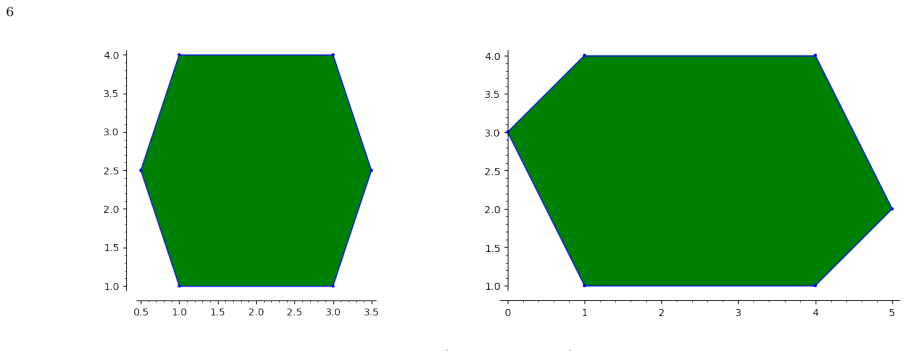
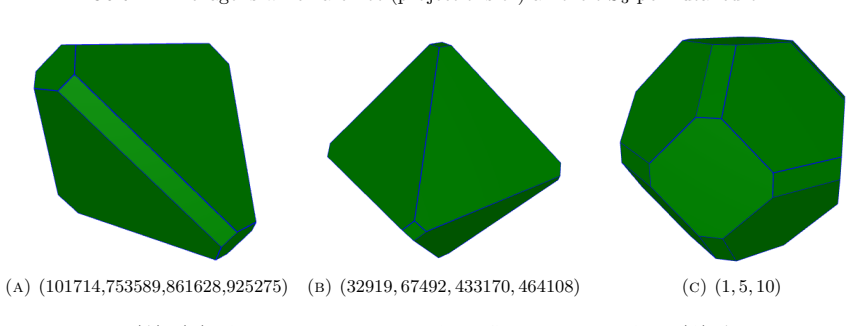
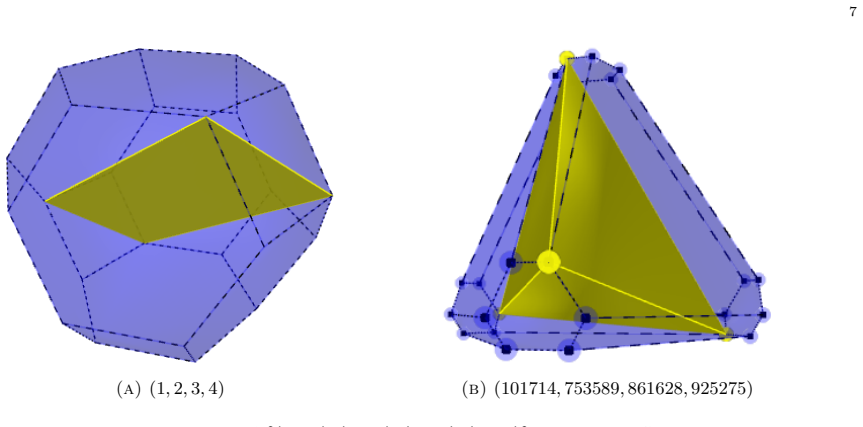
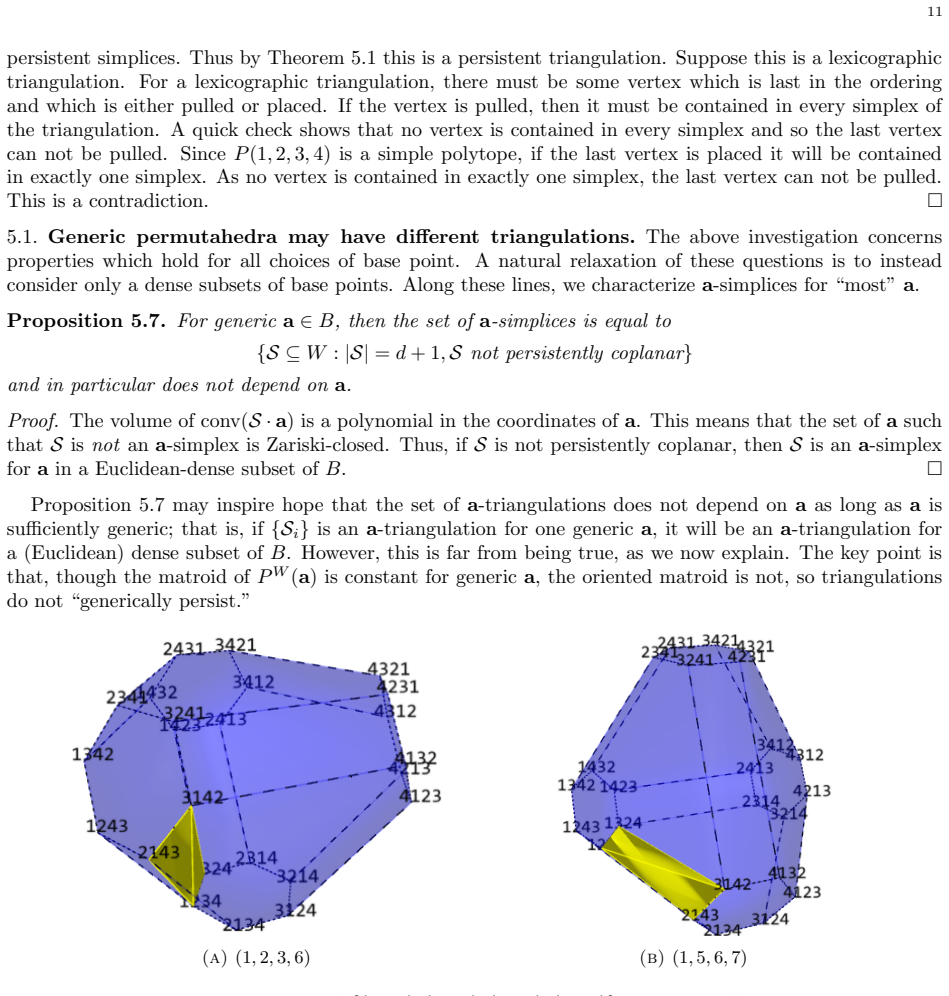
We investigate the realizations of Coxeter permutahedra which are also Coxeter matroid polytopes; these are polytopes of the form $\mathrm{conv}(W \cdot \mathbf{a})$ where $W$ is a finite Coxeter group acting on $\mathbb{R}^n$ and $\mathbf{a}$ is generic. Our main focus is how the geometric properties of $\mathrm{conv}(W \cdot \mathbf{a})$ change as $\mathbf{a}$ changes, with particular attention to persistent simplices, triangulations, and subdivisions.
Figures
Figures from the paper (2 more)
Forward citations
Cited by 1 Pith paper
-
Permutahedra, Lusztig varieties, degenerations, and subdivisions
Lusztig varieties degenerate equivariantly inside G/B to unions of Richardson varieties, inducing (regular in types ABC) subdivisions of the permutahedron into Bruhat interval polytopes.
Reference graph
Works this paper leans on
-
[1]
Coxeter submodular functions and deformations of Coxeter permutahedra
F. Ardila, F. Castillo, C. Eur, and A. Postnikov. “Coxeter submodular functions and deformations of Coxeter permutahedra”. In:Adv. Math.365 (2020), pp. 107039, 36.issn: 0001-8708,1090-2082.doi: 10.1016/j.aim.2020.107039.url:https://doi.org/10.1016/j.aim.2020.107039
work page doi:10.1016/j.aim.2020.107039.url:https://doi.org/10.1016/j.aim.2020.107039 2020
-
[2]
A regular unimodular triangulation of the matroid base polytope
S. Backman and G. Liu. “A regular unimodular triangulation of the matroid base polytope”. In:Duke Math. J.174.14 (2025), pp. 3047–3061.issn: 0012-7094,1547-7398.doi:10.1215/00127094- 2025- 0015.url:https://doi.org/10.1215/00127094-2025-0015
-
[3]
How to integrate a polynomial over a simplex
V. Baldoni, N. Berline, J. A. De Loera, M. K¨ oppe, and M. Vergne. “How to integrate a polynomial over a simplex”. In:Math. Comp.80.273 (2011), pp. 297–325.issn: 0025-5718,1088-6842.doi: 10.1090/S0025-5718-2010-02378-6.url:https://doi.org/10.1090/S0025-5718-2010-02378- 6
work page doi:10.1090/s0025-5718-2010-02378-6.url:https://doi.org/10.1090/s0025-5718-2010-02378- 2011
-
[4]
Barvinok.Integer Points in Polyhedra
A. Barvinok.Integer Points in Polyhedra. Zurich Lectures in Advanced Mathematics. Z¨ urich: European Mathematical Society, 2008.isbn: 978-3-03719-052-4
work page 2008
-
[5]
An Algorithmic Theory of Lattice Points in Polyhedra
A. Barvinok and J. E. Pommersheim. “An Algorithmic Theory of Lattice Points in Polyhedra”. In:New Perspectives in Algebraic Combinatorics. Ed. by L. J. Billera, A. Bj¨ orner, C. Greene, R. E. Simion, and R. P. Stanley. Vol. 38. Mathematical Sciences Research Institute Publications. Cambridge: Cambridge University Press, 1999, pp. 91–147
work page 1999
-
[6]
M. Beck and S. Robins.Computing the continuous discretely: integer-point enumeration in polyhedra. Undergraduate Texts in Mathematics. Springer, 2007
work page 2007
-
[7]
A. Bj¨ orner and F. Brenti.Combinatorics of Coxeter groups. Vol. 231. Graduate Texts in Mathematics. Springer, New York, 2005, pp. xiv+363.isbn: 978-3540-442387; 3-540-44238-3
work page 2005
-
[8]
A. Bj¨ orner, M. L. Vergnas, B. Sturmfels, N. White, and G. M. Ziegler.Oriented Matroids. 2nd. Vol. 46. Encyclopedia of Mathematics and its Applications. Cambridge: Cambridge University Press, 1999
work page 1999
Show all 31 references
-
[9]
A. V. Borovik, I. M. Gelfand, and N. White.Coxeter matroids. Vol. 216. Progress in Mathematics. Birkh¨ auser Boston, Inc., Boston, MA, 2003, pp. xxii+264.isbn: 0-8176-3764-8.doi:10.1007/978- 1-4612-2066-4.url:https://doi.org/10.1007/978-1-4612-2066-4. 17
2003 doi
-
[10]
Tropical flag varieties
M. Brandt, C. Eur, and L. Zhang. “Tropical flag varieties”. In:Adv. Math.384 (2021), Paper No. 107695, 41.issn: 0001-8708,1090-2082.doi:10.1016/j.aim.2021.107695.url:https://doi.org/ 10.1016/j.aim.2021.107695
2021 doi
-
[11]
The\(s\)-Weak Order and\(s\)-Permutahedra I: Combinatorics and Lattice Structure
C. Ceballos and V. Pons. “The\(s\)-Weak Order and\(s\)-Permutahedra I: Combinatorics and Lattice Structure”. In:SIAM J. Discret. Math.38.4 (2024), pp. 2855–2895.doi:10.1137/23M1605818.url: https://doi.org/10.1137/23m1605818
2024 doi
-
[12]
Wonderful models of subspace arrangements
C. De Concini and C. Procesi. “Wonderful models of subspace arrangements”. In:Selecta Mathematica (N.S.)1.3 (1995), pp. 459–494.doi:10.1007/BF01589496
1995 doi
-
[13]
Ehrhart Polynomials of Matroid Polytopes and Poly- matroids
J. A. De Loera, D. C. Haws, and M. K¨ oppe. “Ehrhart Polynomials of Matroid Polytopes and Poly- matroids”. In:Discrete & Computational Geometry42.4 (2009), pp. 670–702.doi:10.1007/s00454- 008-9080-z
2009 doi
-
[14]
J. A. De Loera, J. Rambau, and F. Santos.Triangulations. Vol. 25. Algorithms and Computation in Mathematics. Structures for algorithms and applications. Springer-Verlag, Berlin, 2010, pp. xiv+535. isbn: 978-3-642-12970-4.doi:10.1007/978-3-642-12971-1.url:https://doi.org/10.100...
2010 doi
-
[15]
Defant, M
C. Defant, M. Sherman-Bennett, and N. Williams.Permutahedron Triangulations via Total Linear Stability and the Dual Braid Group. 2025. arXiv:2509.11497 [math.CO].url:https://arxiv.org/ abs/2509.11497
2025
-
[16]
Hatcher.Algebraic topology
A. Hatcher.Algebraic topology. Cambridge University Press, Cambridge, 2002, pp. xii+544.isbn: 0-521-79160-X; 0-521-79540-0
2002
-
[17]
Permutahedra and generalized associahedra
C. Hohlweg, C. E. Lange, and H. Thomas. “Permutahedra and generalized associahedra”. In:Advances in Mathematics226.1 (2011), pp. 608–640.issn: 0001-8708.doi:https://doi.org/10.1016/j.aim. 2010.07.005.url:https://www.sciencedirect.com/science/article/pii/S0001870810002586
2011 doi
-
[18]
J. E. Humphreys.Reflection groups and Coxeter groups. Vol. 29. Cambridge Studies in Advanced Mathematics. Cambridge University Press, Cambridge, 1990, pp. xii+204.isbn: 0-521-37510-X.doi: 10.1017/CBO9780511623646.url:https://doi.org/10.1017/CBO9780511623646
1990 doi
-
[19]
The universality theorems on the classification problem of configuration varieties and convex polytope varieties
N. E. Mn”ev. “The universality theorems on the classification problem of configuration varieties and convex polytope varieties”. In:Topology and geometry—Rohlin Seminar. Vol. 1346. Lecture Notes in Math. Springer, Berlin, 1988, 527–544
1988
-
[20]
Pons.Combinatorics of the Permutahedra, Associahedra, and Friends
V. Pons.Combinatorics of the Permutahedra, Associahedra, and Friends. 2023.url:https://tel. archives-ouvertes.fr/tel-04390473
2023
-
[21]
Faces of generalized permutohedra
A. Postnikov, V. Reiner, and L. Williams. “Faces of generalized permutohedra”. In:Doc. Math.13 (2008), pp. 207–273.issn: 1431-0635,1431-0643
2008
-
[22]
Permutohedra, associahedra, and beyond
A. Postnikov. “Permutohedra, associahedra, and beyond”. In:Int. Math. Res. Not. IMRN6 (2009), pp. 1026–1106.issn: 1073-7928,1687-0247.doi:10.1093/imrn/rnn153.url:https://doi.org/10. 1093/imrn/rnn153
2009 doi
-
[23]
An inequality
R. Rado. “An inequality”. In:J. London Math. Soc.27 (1952), pp. 1–6.issn: 0024-6107,1469-7750. doi:10.1112/jlms/s1-27.1.1.url:https://doi.org/10.1112/jlms/s1-27.1.1
1952 doi
-
[24]
Richter-Gebert.Realization spaces of polytopes
J. Richter-Gebert.Realization spaces of polytopes. Vol. 1643. Lecture Notes in Mathematics. Springer- Verlag, Berlin, 1996, pp. viii+177.isbn: 3-540-61987-X
1996
-
[25]
The universality theorems for oriented matroids and polytopes
J. Richter-Gebert. “The universality theorems for oriented matroids and polytopes”. In:Discrete and Computational Geometry: Ten Years Later. Vol. 223. Contemp. Math. Amer. Math. Soc., Providence, RI, 1999, 269–292
1999
-
[26]
Realization spaces of 4-polytopes are universal
J. Richter-Gebert and G. M. Ziegler. “Realization spaces of 4-polytopes are universal”. In:Bull. Amer. Math. Soc. (N.S.)32.4 (1995), 403–412
1995
-
[27]
P. H. Schoute.Analytic treatment of the polytopes regularly derived from the regular polytopes. Vol. 11. Verhandelingen der K. Akad. Wetenschappen te Amsterdam 3. First systematic study of the permu- tahedron (no explicit name yet). Amsterdam: Johannes M¨ uller, 1911, pp. 1–87
1911
-
[28]
R. P. Stanley.Enumerative Combinatorics, Volume 1. 2nd. Vol. 49. Cambridge Studies in Advanced Mathematics. Cambridge: Cambridge University Press, 2012.isbn: 978-1-107-60262-5
2012
-
[29]
Polyeder und Raumeinteilungen
E. Steinitz. “Polyeder und Raumeinteilungen”. In:Encyklop¨ adie der Mathematischen Wissenschaften. Vol. 3.3AB12. Leipzig: Teubner, 1922, pp. 1–139. 18
1922
-
[30]
Steinitz and H
E. Steinitz and H. Rademacher.Vorlesungen ¨ uber die Theorie der Polyeder unter Einschluss der Elemente der Topologie. Vol. No. 41. Grundlehren der Mathematischen Wissenschaften. Reprint der 1934 Auflage. Springer-Verlag, Berlin-New York, 1976, pp. viii+351
1934
-
[31]
Bruhat interval polytopes
E. Tsukerman and L. Williams. “Bruhat interval polytopes”. In:Adv. Math.285 (2015), pp. 766–810. issn: 0001-8708,1090-2082.doi:10.1016/j.aim.2015.07.030.url:https://doi.org/10.1016/j. aim.2015.07.030
2015 doi
Reviewed June 30, 2026 · model on record in the stance chip above.
Discussion (0). Continue with ORCID to comment.