Semi-Empirical Pulsation Reconstruction of Delta Cephei with Photometry, Radial Velocities, and Temperature Constraints
Pith reviewed 2026-07-02 20:51 UTC · model grok-4.3
The pith
Delta Cephei's visual light curve, radial displacements, and temperature variations align on a common phase, with absolute radius as the chief uncertainty.
A machine-rendered reading of the paper's core claim, the machinery that carries it, and where it could break.
Core claim
These results show that the observed visual morphology, radial displacement, and temperature-driven luminosity variation are mutually consistent when placed on a common phase convention, while the absolute radius scale remains the dominant systematic.
What carries the argument
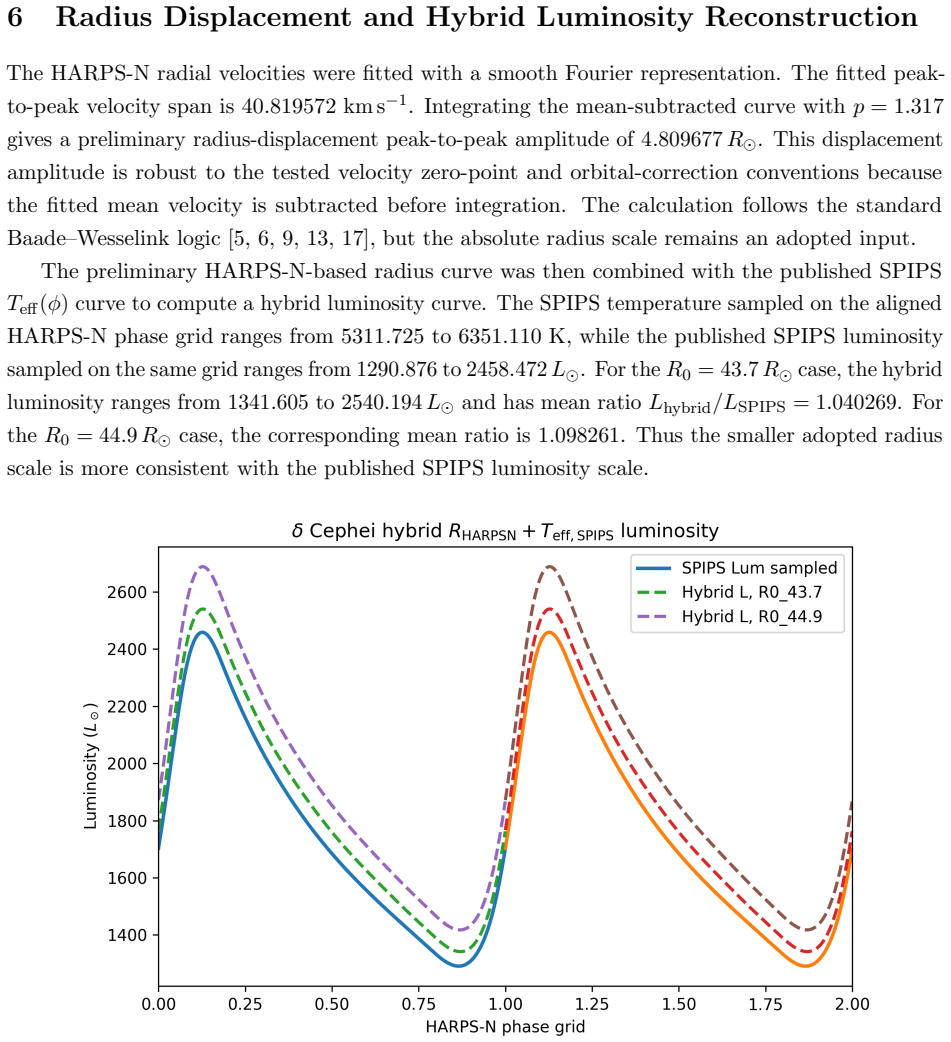
The hybrid luminosity curve formed by multiplying the radius-displacement curve (derived from radial velocities via projection factor p = 1.317) by the SPIPS effective-temperature curve.
If this is right
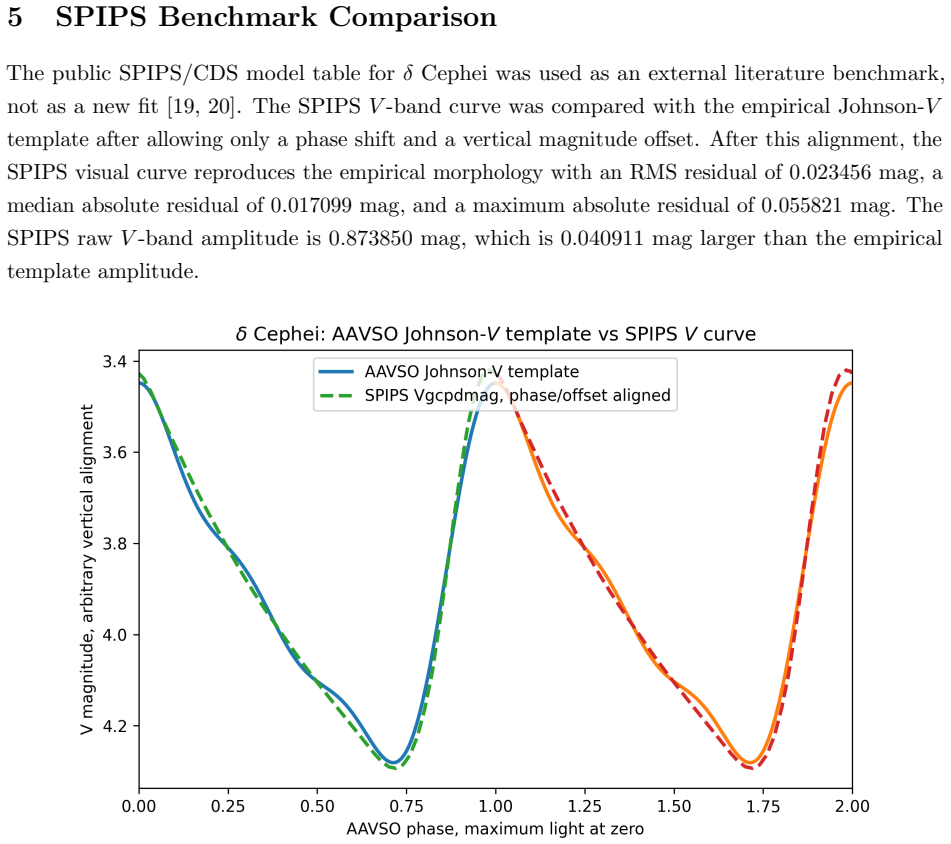
- The empirical Johnson-V Fourier template matches the SPIPS V-band curve to 0.023 mag RMS after phase and zero-point alignment.
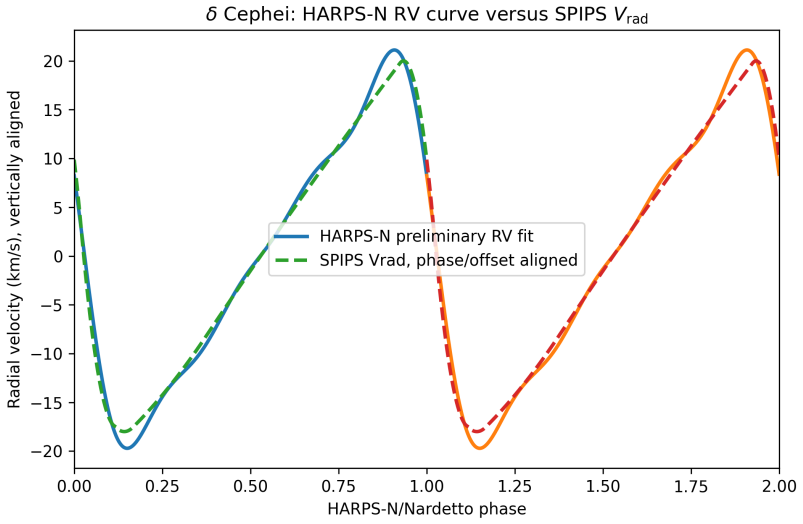
- The HARPS-N velocity span of 40.82 km s^{-1} corresponds to a radius-displacement amplitude of 4.81 solar radii.
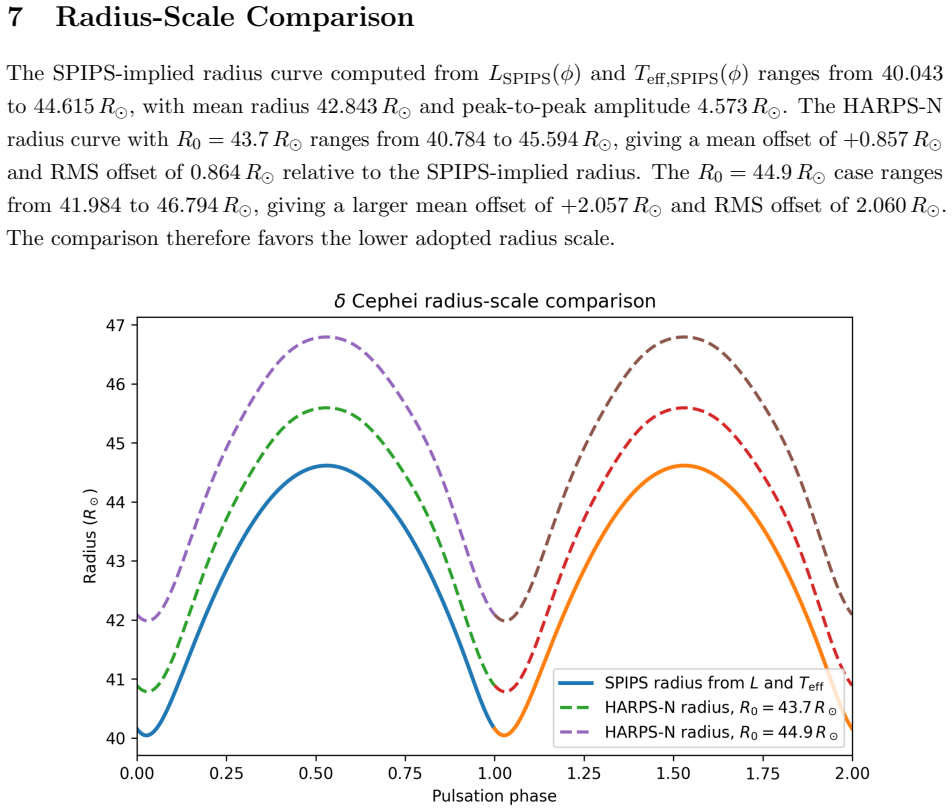
- Adopting R0 = 43.7 solar radii yields a mean hybrid-to-SPIPS luminosity ratio of 1.04 and an RMS radius offset of 0.864 solar radii.
- Adopting R0 = 44.9 solar radii produces a luminosity ratio of 1.10 and a larger RMS radius offset of 2.06 solar radii.
Where Pith is reading between the lines
- The same alignment procedure could be repeated on other classical Cepheids to test whether the radius-scale tension is common across the instability strip.
- An independent angular-diameter measurement at a known phase would directly falsify or support the adopted projection factor without assuming the SPIPS temperature curve.
- If the lower radius scale is confirmed, it would tighten the zero-point of the period-luminosity relation used for distance calibration.
Load-bearing premise
The fixed projection factor of 1.317 correctly converts the observed radial-velocity amplitude into the true pulsational velocity of the stellar surface.
What would settle it
An independent radius measurement from interferometry or a precise parallax plus angular diameter that lies well outside the 43.7–44.9 solar-radii range tested here.
Figures
read the original abstract
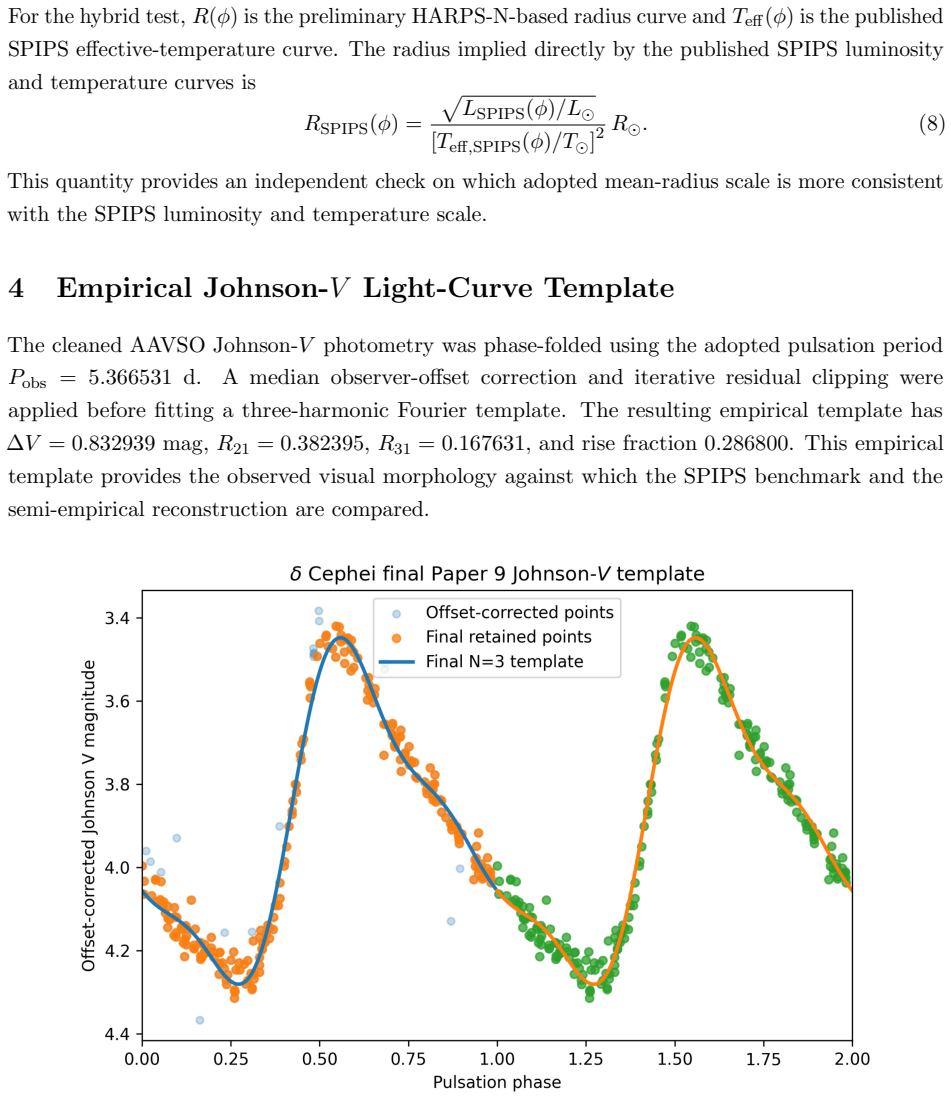
We present a semi-empirical reconstruction of the pulsation behavior of the classical Cepheid delta Cephei using observed Johnson-V photometry, HARPS-N radial velocities, and published SPIPS pulsation-model curves. A cleaned AAVSO Johnson-V data set was phase folded with P = 5.366531 d, corrected for observer zero-point offsets, clipped for residual outliers, and fitted with a three-harmonic Fourier template. The resulting empirical template has Delta V about 0.833 mag, R21 about 0.382, R31 about 0.168, and a rise fraction about 0.287. After phase and vertical alignment, the published SPIPS V-band curve reproduces the empirical Johnson-V morphology with an RMS residual about 0.023 mag. A Fourier representation of the HARPS-N radial velocities gives a peak-to-peak velocity span about 40.82 km s^-1, corresponding to a preliminary radius-displacement amplitude about 4.81 solar radii for p = 1.317. Combining this radius curve with the SPIPS Teff(phi) curve yields a hybrid luminosity curve close to the published SPIPS luminosity curve. The adopted R0 = 43.7 solar radii scale gives a mean luminosity ratio L_hybrid/L_SPIPS about 1.04, while R0 = 44.9 solar radii gives about 1.10. A direct radius-scale comparison also favors the lower adopted radius scale, with an RMS offset of 0.864 solar radii relative to the SPIPS-implied radius, compared with 2.060 solar radii for the larger-radius case. These results show that the observed visual morphology, radial displacement, and temperature-driven luminosity variation are mutually consistent when placed on a common phase convention, while the absolute radius scale remains the dominant systematic.
Editorial analysis
A structured set of objections, weighed in public.
Referee Report
Summary. The manuscript presents a semi-empirical reconstruction of δ Cephei pulsations by phase-folding and Fourier-fitting cleaned AAVSO Johnson-V photometry (three-harmonic template with ΔV ≈ 0.833 mag), converting HARPS-N radial velocities to a radius-displacement curve (peak-to-peak 40.82 km s⁻¹ → 4.81 R⊙ amplitude) using projection factor p = 1.317, and combining the resulting radius curve with published SPIPS Teff(φ) to form a hybrid luminosity curve. After phase alignment, the SPIPS V-band curve matches the empirical photometry to 0.023 mag RMS. Two mean radii (R0 = 43.7 R⊙ and 44.9 R⊙) are tested, producing mean L_hybrid/L_SPIPS ratios of 1.04 and 1.10; the lower value is also favored by direct radius comparison (RMS offset 0.864 R⊙ vs. 2.060 R⊙). The authors conclude that observed visual morphology, radial displacement, and temperature-driven luminosity variation are mutually consistent on a common phase convention, with absolute radius scale as the dominant systematic.
Significance. If the consistency claim survives scrutiny of the projection factor and radius-scale choices, the work supplies a quantitative cross-check of the SPIPS model against independent photometry and spectroscopy for a benchmark Cepheid. The explicit reporting of RMS residuals, Fourier coefficients, and results for two discrete R0 values is a strength that permits readers to evaluate robustness directly. The primary advance is confirmation of phase alignment and relative variations rather than new absolute-parameter constraints.
major comments (2)
- [Radial velocity and radius displacement] § on radial-velocity analysis (abstract and corresponding methods): The projection factor p = 1.317 is stated without a specific literature citation for δ Cephei, without sensitivity tests, and without discussion of its uncertainty. Because p scales the entire 4.81 R⊙ displacement amplitude linearly, any revision directly rescales both the hybrid-luminosity ratios and the reported RMS radius offsets (0.864 vs. 2.060 R⊙), undermining the quantitative consistency statements.
- [Hybrid luminosity and radius comparison] § on hybrid luminosity construction: The two R0 values are selected to produce L_hybrid/L_SPIPS ratios near unity (1.04 and 1.10). Combined with the use of the SPIPS Teff(φ) curve to build the hybrid luminosity that is then compared to the SPIPS luminosity curve, this choice reduces the independence of the test. The direct radius comparison is less affected but still inherits the p scaling; an a-priori R0 from interferometry or other independent method would strengthen the claim.
minor comments (2)
- Abstract and text repeatedly use approximate phrasing (“about 0.833 mag”, “about 40.82 km s⁻¹”); replace with exact fitted values or 1σ uncertainties where available.
- Ensure consistent notation for mean radius (R0) and projection factor (p) between text, any equations, and figure captions.
Simulated Author's Rebuttal
We are grateful to the referee for the careful reading and insightful comments. We respond to each major comment below and will make revisions to enhance the manuscript's clarity and address the concerns raised.
read point-by-point responses
-
Referee: [Radial velocity and radius displacement] § on radial-velocity analysis (abstract and corresponding methods): The projection factor p = 1.317 is stated without a specific literature citation for δ Cephei, without sensitivity tests, and without discussion of its uncertainty. Because p scales the entire 4.81 R⊙ displacement amplitude linearly, any revision directly rescales both the hybrid-luminosity ratios and the reported RMS radius offsets (0.864 vs. 2.060 R⊙), undermining the quantitative consistency statements.
Authors: We thank the referee for highlighting this issue. The value p = 1.317 originates from a specific study on δ Cephei (we will include the appropriate citation in the revised version). To address the lack of sensitivity tests, we will add a short section or paragraph discussing the uncertainty in p and its linear effect on the radius amplitude. This will include recalculating the L ratios and RMS offsets for a range of p values around 1.317. We note, however, that the primary result—the agreement in phase and morphology between the empirical photometry and the SPIPS model—is unaffected by the choice of p, as it concerns relative variations rather than absolute scaling. The quantitative statements will be qualified accordingly in the revision. revision: partial
-
Referee: [Hybrid luminosity and radius comparison] § on hybrid luminosity construction: The two R0 values are selected to produce L_hybrid/L_SPIPS ratios near unity (1.04 and 1.10). Combined with the use of the SPIPS Teff(φ) curve to build the hybrid luminosity that is then compared to the SPIPS luminosity curve, this choice reduces the independence of the test. The direct radius comparison is less affected but still inherits the p scaling; an a-priori R0 from interferometry or other independent method would strengthen the claim.
Authors: The two R0 values tested (43.7 R⊙ and 44.9 R⊙) are based on previously published estimates for δ Cephei from the literature, not chosen post hoc to force the luminosity ratio near unity. We will revise the manuscript to explicitly state the sources of these radii and their independence from the current SPIPS analysis. While the hybrid luminosity uses the SPIPS Teff(φ), the radius variation comes from an independent radial velocity dataset, providing a meaningful cross-validation of the pulsation model. The direct radius comparison is indeed less dependent on the luminosity construction. We agree that an independent interferometric radius would be valuable but note that such data may not be available at the required precision for this star; our approach uses the best available constraints. We will emphasize the limitations of the test in the revised discussion. revision: partial
Circularity Check
No significant circularity; consistency checks rely on independent empirical reductions against external published SPIPS curves
full rationale
The paper performs direct comparisons of Fourier-fitted empirical Johnson-V photometry and HARPS-N radial velocities against published SPIPS model curves for V-band morphology, Teff(phi), and luminosity. The hybrid luminosity is formed from the RV-derived radius variation (via fixed literature p=1.317) plus SPIPS Teff and then compared to the SPIPS luminosity curve; this is a consistency test, not a derivation that reduces to the inputs by construction, because the radius amplitude is obtained from independent velocity data rather than from the SPIPS luminosity itself. No self-citations appear in the load-bearing steps, no fitted parameters are relabeled as predictions, and the absolute radius scale is explicitly flagged as the dominant systematic. The paper is therefore self-contained against external benchmarks.
Axiom & Free-Parameter Ledger
free parameters (2)
- projection factor p =
1.317
- mean radius R0 =
43.7 or 44.9 solar radii
axioms (2)
- domain assumption The pulsation period is exactly 5.366531 days for phase folding
- domain assumption The published SPIPS Teff(phi) and luminosity curves are sufficiently accurate for the comparison
Forward citations
Cited by 1 Pith paper
-
Native-Opacity Sensitivity of a Fixed Delta Cephei MESA-RSP Pulsation Model
Varying high-temperature opacity tables in a fixed MESA-RSP delta Cephei model shifts the period by up to 0.037 days and amplitude growth by up to 43 percent, with OPAL-A09 closest to the observed period.
Reference graph
Works this paper leans on
-
[1]
W. L. Freedman, B. F. Madore, B. K. Gibson, L. Ferrarese, D. D. Kelson, S. Sakai, J. R. Mould, R. C. Kennicutt, H. C. Ford, J. A. Graham, J. P. Huchra, S. M. G. Hughes, G. D. Illingworth, L. M. Macri, and P. B. Stetson. Final results from the hubble space telescope key project to measure the hubble constant.The Astrophysical Journal, 553:47–72, 2001. doi:...
-
[2]
W. L. Freedman and B. F. Madore. The hubble constant.Annual Review of Astronomy and Astrophysics, 48:673–710, 2010. doi: 10.1146/annurev-astro-082708-101829. 10
-
[3]
A. G. Riess, L. M. Macri, S. L. Hoffmann, D. Scolnic, S. Casertano, A. V. Filippenko, B. E. Tucker, M. J. Reid, D. O. Jones, J. M. Silverman, R. Chornock, P. Challis, W. Yuan, P. J. Brown, and R. J. Foley. A 2.4% determination of the local value of the hubble constant.The Astrophysical Journal, 826:56, 2016. doi: 10.3847/0004-637X/826/1/56
-
[4]
A. G. Riess, W. Yuan, L. M. Macri, D. Scolnic, D. Brout, S. Casertano, D. O. Jones, Y. Mu- rakami, G. S. Anand, L. Breuval, T. G. Brink, A. V. Filippenko, S. Hoffmann, S. W. Jha, W. D’Arcy Kenworthy, J. Mackenty, B. E. Stahl, and W. Zheng. A comprehensive measurement of the local value of the hubble constant with 1 km s −1 mpc−1 uncertainty from the hubbl...
-
[5]
W. Baade. Zur bestimmung der entfernung von ver¨ anderlichen sternen.Astronomische Nachrichten, 228:359, 1926
1926
-
[6]
A. J. Wesselink. The method of determining the distances of cepheids.Bulletin of the Astronomical Institutes of the Netherlands, 10:91, 1946
1946
-
[7]
T. G. Barnes and D. S. Evans. Stellar angular diameters and visual surface brightness. i. late spectral types.Monthly Notices of the Royal Astronomical Society, 174:489–502, 1976
1976
-
[8]
Fouqu´ e and W
P. Fouqu´ e and W. P. Gieren. A calibration of the infrared surface brightness technique for cepheid distance determination.Astronomy & Astrophysics, 320:799–810, 1997
1997
-
[9]
J. Storm, W. Gieren, P. Fouqu´ e, T. G. Barnes, I. Soszy´ nski, G. Pietrzy´ nski, N. Nardetto, and D. Queloz. Calibrating the cepheid period-luminosity relation from the infrared surface brightness technique. i. the p-factor, the milky way relations, and comparison with parallaxes. Astronomy & Astrophysics, 534:A94, 2011. doi: 10.1051/0004-6361/201117154
-
[10]
J. Storm, W. Gieren, P. Fouqu´ e, T. G. Barnes, G. Pietrzy´ nski, N. Nardetto, M. Weber, T. Granzer, and K. G. Strassmeier. Calibrating the cepheid period-luminosity relation from the infrared surface brightness technique. ii. the effect of metallicity and the distance to the lmc.Astronomy & Astrophysics, 534:A95, 2011. doi: 10.1051/0004-6361/201117155
-
[11]
J. T. Armstrong, T. E. Nordgren, M. E. Germain, A. R. Hajian, D. Mozurkewich, R. B. Hindsley, C. A. Hummel, H. R. Schmitt, J. A. Benson, T. A. Pauls, and C. Tycner. Diameters of delta cephei and eta aquilae measured with the navy prototype optical interferometer.The Astronomical Journal, 121:476–484, 2001. doi: 10.1086/318037
-
[12]
P. Kervella, N. Nardetto, D. Bersier, D. Mourard, and V. Coud´ e du Foresto. Cepheid distances from infrared long-baseline interferometry. i. vinci/vlti observations of seven galactic cepheids. Astronomy & Astrophysics, 416:941–953, 2004. doi: 10.1051/0004-6361:20031743. 11
-
[13]
A. M´ erand, P. Kervella, V. Coud´ e du Foresto, G. Perrin, S. T. Ridgway, J. P. Aufdenberg, T. A. ten Brummelaar, D. H. Berger, J. Sturmann, L. Sturmann, N. H. Turner, and H. A. McAlister. A calibration of the baade-wesselink method using the chara array: The cepheid delta cephei. Astronomy & Astrophysics, 438:L9–L12, 2005. doi: 10.1051/0004-6361:200500139
-
[14]
G. F. Benedict, B. E. McArthur, L. W. Fredrick, T. E. Harrison, C. L. Slesnick, J. Rhee, R. J. Patterson, M. F. Skrutskie, O. G. Franz, L. H. Wasserman, W. H. Jefferys, E. Nelan, W. van Altena, P. J. Shelus, P. D. Hemenway, R. L. Duncombe, D. Story, A. L. Whipple, and A. J. Bradley. Astrometry with the hubble space telescope: A parallax of the fundamental...
-
[15]
G. F. Benedict, B. E. McArthur, M. W. Feast, T. G. Barnes, T. E. Harrison, R. J. Patterson, J. W. Menzies, J. L. Bean, and W. L. Freedman. Hubble space telescope fine guidance sensor parallaxes of galactic cepheid variable stars: Period-luminosity relations.The Astronomical Journal, 133:1810–1827, 2007. doi: 10.1086/511980
-
[16]
Nardetto, D
N. Nardetto, D. Mourard, P. Mathias, A. Fokin, and D. Gillet. High-resolution spectroscopy for cepheids distance determination. i. line asymmetry.Astronomy & Astrophysics, 471:661–669,
-
[17]
doi: 10.1051/0004-6361:20066853
-
[18]
Nardetto, W
N. Nardetto, W. Gieren, P. Kervella, P. Fouqu´ e, J. Storm, G. Pietrzy´ nski, D. Mourard, and D. Queloz. High-resolution spectroscopy for cepheids distance determination. ii. a period- projection factor relation.Astronomy & Astrophysics, 502:951–963, 2009. doi: 10.1051/ 0004-6361/200912034
2009
-
[19]
B. Trahin, L. Breuval, P. Kervella, A. Gallenne, V. Hocd´ e, N. Nardetto, W. Gieren, J. Storm, G. Pietrzy´ nski, B. Pilecki, D. Graczyk, and R. I. Anderson. Inspecting the cepheid parallax of pulsation using gaia edr3 parallaxes: Projection factor and period-luminosity and period-radius relations.Astronomy & Astrophysics, 656:A102, 2021. doi: 10.1051/0004...
-
[21]
M´ erand, P
A. M´ erand, P. Kervella, J. Breitfelder, A. Gallenne, V. Coud´ e du Foresto, T. A. ten Brummelaar, H. A. McAlister, S. Ridgway, L. Sturmann, J. Sturmann, and N. H. Turner. Pulsation model data for delta cep and eta aql. CDS/VizieR catalog J/A+A/584/A80, 2015. Data associated with A&A 584, A80
2015
-
[22]
Gaia Collaboration, A. G. A. Brown, A. Vallenari, T. Prusti, J. H. J. de Bruijne, C. Babusiaux, M. Biermann, et al. Gaia early data release 3: Summary of the contents and survey properties. Astronomy & Astrophysics, 649:A1, 2021. doi: 10.1051/0004-6361/202039657. 12
-
[23]
P. Kervella, A. Gallenne, N. R. Evans, C. R. Proffitt, N. Nardetto, R. I. Anderson, W. Gieren, S. Borgniet, L. Eyer, V. Hocd´ e, A. M´ erand, J. Breitfelder, G. Pietrzy´ nski, and B. Pilecki. Multiplicity of galactic cepheids from gaia dr2.Astronomy & Astrophysics, 623:A117, 2019. doi: 10.1051/0004-6361/201834210
-
[24]
N. Nardetto, V. Hocd´ e, P. Kervella, A. Gallenne, W. Gieren, D. Graczyk, A. M´ erand, M. Rainer, J. Storm, G. Pietrzy´ nski, B. Pilecki, E. Poretti, M. Bailleul, G. Bras, and A. Afanasiev. The orbital parameters of the delta cep inner binary system determined using 2019 harps- n spectroscopic data.Astronomy & Astrophysics, 684:L9, 2024. doi: 10.1051/0004...
discussion (0)
Sign in with ORCID, Apple, or X to comment. Anyone can read and Pith papers without signing in.