REVIEW 2 major objections 1 minor 2 cited by
Sloshing Motions in Abell 3571 Revealed by XRISM/Resolve Velocity Mapping
T0 review · 2 major / 1 minor · reviewed 2026-06-30 · grok-4.3
Pith's one-line read XRISM velocity maps show Abell 3571 has large-scale gas sloshing from an off-axis minor merger.
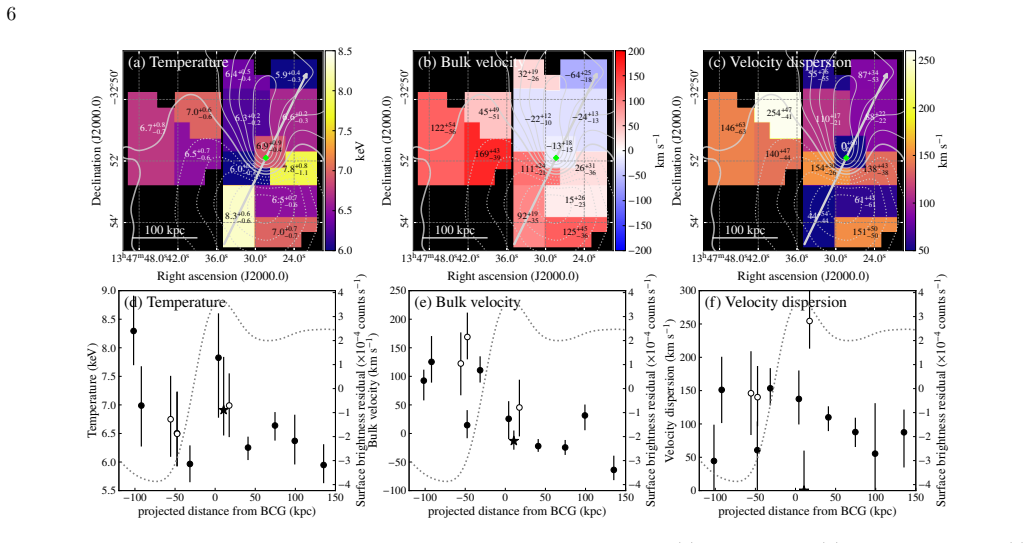
desk verdict New XRISM Resolve velocity maps of Abell 3571 show ~60 km/s blueshift in the north and ~170 km/s redshift in the south that track the thermodynamic asymmetry, but the sloshing attribution rests on a qualitative simulation match. read the letter →
The pith
A machine-rendered reading of the paper's core claim, the machinery that carries it, and where it could break.
The reading
What carries the argument
Line-of-sight velocity field from X-ray line spectroscopy combined with surface-brightness and temperature maps, tested against hydrodynamic simulations of minor-merger sloshing.
What would settle it
A tailored simulation with the observed mass ratio and impact parameter that fails to reproduce the measured north-south velocity gradient of ~230 km/s, or deeper observations that reveal a different line-of-sight velocity pattern.
Extended reading notes
Core claim
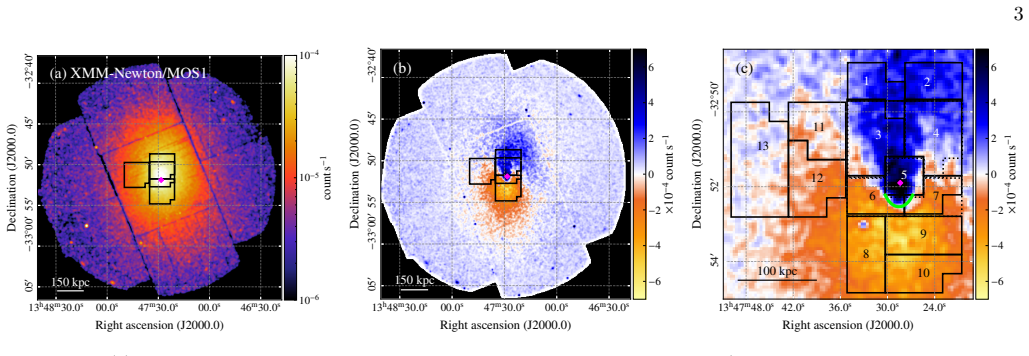
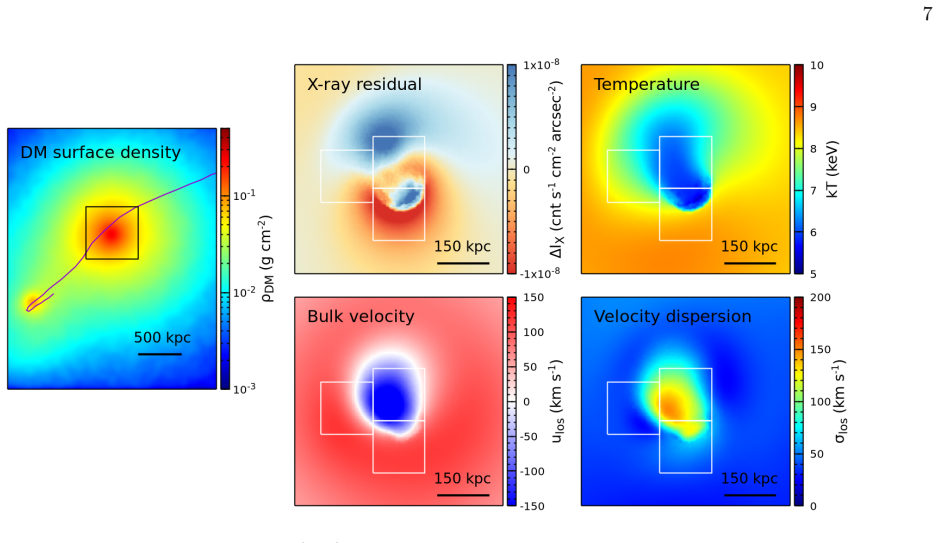
The large-scale thermodynamic and kinematic asymmetry is broadly consistent with early-phase sloshing induced by an off-axis minor merger. Velocity dispersions remain subsonic across most regions. The cooler northern excess is blueshifted relative to the BCG while the hotter southern and eastern regions are redshifted. Numerical simulations reproduce this configuration for an early-stage off-axis encounter, and the lack of strong AGN signatures implies sloshing-driven redistribution contributes to delaying cool-core re-establishment.
Load-bearing premise
The velocity shifts and thermodynamic asymmetries are produced by sloshing from a minor merger rather than projection effects, AGN motions, or other processes.
Editorial extensions
If this is right
- Sloshing signatures can appear in clusters that look relaxed in X-ray images.
- Minor mergers can redistribute gas and affect cool-core evolution on Gyr timescales.
- Abell 3572 is a viable perturber whose orbit and mass can be tested with further data.
- Clusters without prominent AGN feedback may still experience delayed cool-core recovery due to sloshing.
Reading between the lines
- Velocity mapping with XRISM could be applied to other apparently relaxed clusters to search for hidden sloshing.
- The observed velocity amplitudes set a lower limit on the time since the merger pericenter passage.
- If sloshing is common, models of cool-core fraction evolution must include minor-merger effects alongside AGN heating.
Signed reviews
Editorial analysis
A structured set of objections, weighed in public.
Referee Report
Summary. The manuscript presents XRISM/Resolve spectroscopic observations of the central ~300 kpc of Abell 3571, reporting subsonic velocity dispersions of ~100-150 km/s and line-of-sight velocity shifts with the northern cool surface-brightness excess blueshifted by up to -60 km/s and the southern/eastern hot deficit redshifted by up to 170 km/s relative to the BCG. The thermodynamic and kinematic asymmetry is interpreted as broadly consistent with early-phase sloshing induced by an off-axis minor merger, with Abell 3572 suggested as the perturber, in the absence of strong AGN feedback signatures.
Significance. If the sloshing attribution holds, the work supplies direct kinematic constraints from microcalorimeter spectroscopy on merger-driven gas motions in a cluster core. It illustrates how velocity mapping can distinguish dynamical processes in apparently relaxed systems and informs models of cool-core evolution via sloshing-driven redistribution.
major comments (2)
- [Abstract] Abstract: the reported velocity shifts (~-60 km/s and ~170 km/s) are given without uncertainties or error budgets. This omission is load-bearing because the central claim of a significant large-scale asymmetry and its consistency with simulations cannot be quantitatively assessed without them.
- [Discussion] Discussion of numerical simulations: the statement that the observations are 'broadly consistent with early-phase sloshing' supplies no quantitative metrics (velocity amplitude match, spatial pattern after projection, or comparison at the inferred mass ratio and impact parameter with Abell 3572). This leaves the attribution to sloshing as an untested qualitative interpretation rather than a verified match.
minor comments (1)
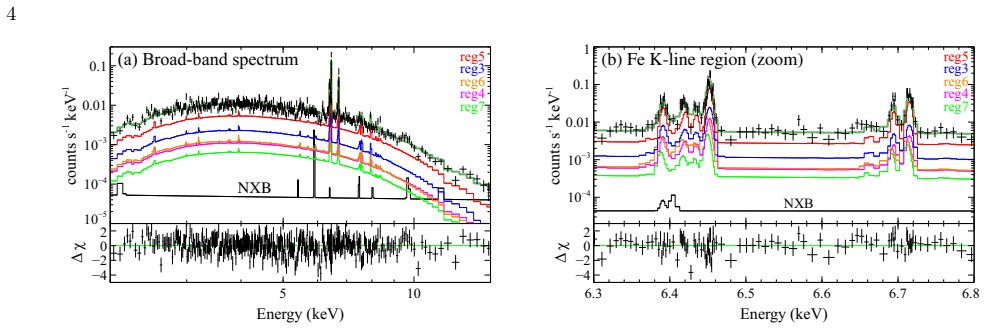
- [Methods] Methods: provide explicit details on how the line-of-sight velocities and dispersions were extracted from the Resolve spectra, including any assumptions on the emission-line modeling or background subtraction.
Simulated Author's Rebuttal
We thank the referee for their constructive comments, which help strengthen the presentation of our results. We address each major comment below.
read point-by-point responses
-
Referee: [Abstract] Abstract: the reported velocity shifts (~-60 km/s and ~170 km/s) are given without uncertainties or error budgets. This omission is load-bearing because the central claim of a significant large-scale asymmetry and its consistency with simulations cannot be quantitatively assessed without them.
Authors: We agree that uncertainties are necessary for quantitative assessment. The reported shifts are extracted from the spectral fits in Section 3.2, where the 1σ uncertainties on the line centroids are approximately ±30 km/s for the northern blueshift and ±40 km/s for the southern redshift. We will revise the abstract to include these uncertainties. revision: yes
-
Referee: [Discussion] Discussion of numerical simulations: the statement that the observations are 'broadly consistent with early-phase sloshing' supplies no quantitative metrics (velocity amplitude match, spatial pattern after projection, or comparison at the inferred mass ratio and impact parameter with Abell 3572). This leaves the attribution to sloshing as an untested qualitative interpretation rather than a verified match.
Authors: We agree that the current wording presents a qualitative rather than quantitative comparison. The consistency statement draws from general features in published sloshing simulations (velocity amplitudes of order 100 km/s and the expected north-south thermodynamic/kinematic pattern for early-phase off-axis mergers). A rigorous quantitative match, including projection and specific mass ratio/impact parameter for Abell 3572, would require new tailored hydrodynamic simulations, which lie outside the scope of this observational study. We have revised the discussion to emphasize the qualitative basis and to note this limitation explicitly. revision: partial
Circularity Check
No circularity: purely observational velocity mapping with interpretive claim independent of data reduction
full rationale
The manuscript reports direct spectroscopic measurements of line-of-sight velocities, dispersions, temperatures, and surface-brightness features from XRISM Resolve pointings. These quantities are extracted from the data without any model fitting that feeds back into the reported values. The statement that the observed asymmetry is 'broadly consistent with early-phase sloshing' is a qualitative comparison to external numerical simulations and does not constitute a derivation, prediction, or self-referential step. No equations, fitted parameters, or self-citations are used to generate the primary results; the central kinematic and thermodynamic maps stand as independent observations.
Assumptions & free parameters
Cite this review
Pith. "Pith review of Sloshing Motions in Abell 3571 Revealed by XRISM/Resolve Velocity Mapping." pith.science (2026). https://pith.science/paper/WJ5CYMJM
@misc{pith2026260630413,
  author       = {Pith},
  title        = {Pith review of: Sloshing Motions in Abell 3571 Revealed by XRISM/Resolve Velocity Mapping},
  year         = {2026},
  howpublished = {\url{https://pith.science/paper/WJ5CYMJM}},
  note         = {Machine review of arXiv:2606.30413}
}
abstract
Minor mergers can induce sloshing motions in the intracluster medium, leaving characteristic signatures in the thermodynamic structure and gas kinematics of cluster cores. Abell 3571 is an X-ray-bright, apparently relaxed cluster at $z \sim 0.04$. We observed the central $\sim 300$ kpc region of Abell 3571 with four partially overlapping XRISM Resolve pointings, covering three contiguous Resolve fields to the north, south and east with a total exposure time of approximately 575 ks. The velocity dispersions are subsonic and are at the level of $\sim 100$--$150 \, \mathrm{km~ \, s^{-1}}$ across most regions. The cooler region associated with the northern surface-brightness excess is blueshifted by up to $\sim -60 \, \mathrm{km \, s^{-1}}$ relative to the brightest cluster galaxy (BCG), while the hotter region in the southern and eastern surface-brightness deficit regions is redshifted by up to $\sim 170 \, \mathrm{km \, s^{-1}}$. Numerical simulations suggest that this large-scale thermodynamic and kinematic asymmetry is broadly consistent with early-phase sloshing induced by an off-axis minor merger. Abell 3572, an X-ray-faint gas-poor cluster located 1.6 Mpc to the south, is a promising candidate for the perturber. Given the lack of clear signatures of prominent AGN feedback in Abell 3571, these results suggest that sloshing-driven gas redistribution may contribute to delaying the re-establishment of a strong cool core in Abell 3571.
Figures
Figures from the paper (1 more)
Forward citations
Cited by 2 Pith papers
-
Diagnosing the Fe line complex of the intracluster medium by XRISM high-resolution spectroscopy
A sample-wide XRISM analysis finds Fe Lyα2/Lyα1 = 0.55 ± 0.02, consistent with an unresolved M1 transition, and a tentative excess in hotter systems.
-
XRISM Reveals a Kinematically Coherent Core System of the Nearby Cool-Core Cluster Abell 2199
XRISM observations show the core of Abell 2199 is kinematically coherent with low turbulence, where turbulent heating may offset ~20% of radiative cooling losses.
Reference graph
Works this paper leans on
-
[1]
doi:10.1086/191333 , keywords =
Abell, G. O., Corwin, Jr., H. G., & Olowin, R. P. 1989, ApJS, 70, 1, doi: 10.1086/191333
-
[2]
Arnaud, K. A. 1996, in Astronomical Society of the Pacific Conference Series, Vol. 101, Astronomical Data Analysis Software and Systems V, ed. G. H. Jacoby & J. Barnes, 17
1996
-
[3]
doi:10.1086/506508 , keywords =
Ascasibar, Y., & Markevitch, M. 2006, ApJ, 650, 102, doi: 10.1086/506508
-
[4]
doi:10.1051/0004-6361/202556957 , keywords =
Baier-Soto, R., Jaff´ e, Y., Finoguenov, A., et al. 2025, A&A, 704, A228, doi: 10.1051/0004-6361/202556957
-
[5]
2005, ApJ, 627, 647, doi: 10.1086/430397
Bailin, J., & Steinmetz, M. 2005, ApJ, 627, 647, doi: 10.1086/430397 9
-
[6]
Bellomi, E., ZuHone, J. A., Truong, N., et al. 2025, arXiv e-prints, arXiv:2512.12754, doi: 10.48550/arXiv.2512.12754
-
[7]
Binggeli, B. 1982, A&A, 107, 338 Bˆ ırzan, L., Rafferty, D. A., Nulsen, P. E. J., et al. 2012, MNRAS, 427, 3468, doi: 10.1111/j.1365-2966.2012.22083.x
- [8]
Show all 50 references
-
[9]
2003, ApJ, 590, 225, doi: 10.1086/374923
Churazov, E., Forman, W., Jones, C., & B¨ ohringer, H. 2003, ApJ, 590, 225, doi: 10.1086/374923
2003 doi
-
[10]
2025, PASJ, 77, S270, doi: 10.1093/pasj/psaf089
Kondo, M. 2025, PASJ, 77, S270, doi: 10.1093/pasj/psaf089
2025 doi
-
[11]
P., Busarello, G., Merluzzi, P., et al
Haines, C. P., Busarello, G., Merluzzi, P., et al. 2018, MNRAS, 481, 1055, doi: 10.1093/mnras/sty2338
2018 doi
-
[12]
2025, ApJL, 995, L50, doi: 10.3847/2041-8213/ae2609
Heinrich, A., Zhang, C., Zhuravleva, I., et al. 2025, ApJL, 995, L50, doi: 10.3847/2041-8213/ae2609
2025 doi
- [13]
-
[14]
W., et al
Herbonnet, R., von der Linden, A., Allen, S. W., et al. 2019, MNRAS, 490, 4889, doi: 10.1093/mnras/stz2913 HI4PI Collaboration, Bekhti, N. B., Fl¨ oer, L., Keller, R., et al. 2016, A&A, 594, A116
2019 doi
-
[15]
S., Mittal, R., Reiprich, T
Hudson, D. S., Mittal, R., Reiprich, T. H., et al. 2010, A&A, 513, A37, doi: 10.1051/0004-6361/200912377
2010 doi
-
[16]
N., & Meaburn, J
Kemp, S. N., & Meaburn, J. 1991, MNRAS, 251, 10P, doi: 10.1093/mnras/251.1.10P
1991 doi
-
[17]
R., Postman, M., Strauss, M
Lauer, T. R., Postman, M., Strauss, M. A., Graves, G. J., & Chisari, N. E. 2014, ApJ, 797, 82, doi: 10.1088/0004-637X/797/2/82
2014 doi
-
[18]
2025, A&A, 702, A25, doi: 10.1051/0004-6361/202554374
Lehle, K., Nelson, D., & Pillepich, A. 2025, A&A, 702, A25, doi: 10.1051/0004-6361/202554374
2025 doi
-
[19]
Lodders, K., Palme, H., & Gail, H. P. 2009, Landolt B¨ ornstein, 4B, 712, doi: 10.1007/978-3-540-88055-434
2009 doi
-
[20]
Lopes, P. A. A., Trevisan, M., Lagan´ a, T. F., et al. 2018, MNRAS, 478, 5473, doi: 10.1093/mnras/sty1374
2018 doi
- [21]
-
[22]
2011, A&A, 527, A134, doi: 10.1051/0004-6361/200913432
Matsushita, K. 2011, A&A, 527, A134, doi: 10.1051/0004-6361/200913432
2011 doi
- [23]
-
[24]
2015, ApJ, 800, 60, doi: 10.1088/0004-637X/800/1/60
Miniati, F. 2015, ApJ, 800, 60, doi: 10.1088/0004-637X/800/1/60
2015 doi
-
[25]
N., et al
Nevalainen, J., Kaastra, J., Parmar, A. N., et al. 2001, A&A, 369, 459, doi: 10.1051/0004-6361:20010119
2001 doi
-
[26]
2023, ApJ, 954, 56, doi: 10.3847/1538-4357/ace359
Olivares, V., Su, Y., Forman, W., et al. 2023, ApJ, 954, 56, doi: 10.3847/1538-4357/ace359
2023 doi
-
[27]
2026a, PASJ, 78, 719, doi: 10.1093/pasj/psag013
Omiya, Y., Okabe, N., Nakazawa, K., et al. 2026a, PASJ, 78, 719, doi: 10.1093/pasj/psag013
-
[28]
2026b, ApJL, 996, L15, doi: 10.3847/2041-8213/ae2a28
Omiya, Y., Ichinohe, Y., Nakazawa, K., et al. 2026b, ApJL, 996, L15, doi: 10.3847/2041-8213/ae2a28
- [29]
-
[30]
R., Meunier, J., et al
Rose, T., McNamara, B. R., Meunier, J., et al. 2025, ApJ, 990, 42, doi: 10.3847/1538-4357/adf32d
2025 doi
-
[31]
2010, A&A, 510, A83, doi: 10.1051/0004-6361/200913156
Rossetti, M., & Molendi, S. 2010, A&A, 510, A83, doi: 10.1051/0004-6361/200913156
2010 doi
-
[32]
S., Dennerl, K., Russell, H
Sanders, J. S., Dennerl, K., Russell, H. R., et al. 2020, A&A, 633, A42, doi: 10.1051/0004-6361/201936468
2020 doi
-
[33]
M., Roediger, E., et al
Sheardown, A., Fish, T. M., Roediger, E., et al. 2019, ApJ, 874, 112, doi: 10.3847/1538-4357/ab0c06
2019 doi
-
[34]
2012, ApJ, 757, 182, doi: 10.1088/0004-637X/757/2/182
Simionescu, A., Werner, N., Urban, O., et al. 2012, ApJ, 757, 182, doi: 10.1088/0004-637X/757/2/182
2012 doi
-
[35]
J., Lucey, J
Smith, R. J., Lucey, J. R., Hudson, M. J., Schlegel, D. J., & Davies, R. L. 2000, MNRAS, 313, 469, doi: 10.1046/j.1365-8711.2000.03251.x
2000 doi
-
[36]
Raymond, J. C. 2001, ApJL, 556, L91, doi: 10.1086/322992
2001 doi
-
[37]
2010, MNRAS, 401, 791, doi: 10.1111/j.1365-2966.2009.15715.x
Springel, V. 2010, MNRAS, 401, 791, doi: 10.1111/j.1365-2966.2009.15715.x
2010 doi
-
[38]
Springel, V., & Farrar, G. R. 2007, MNRAS, 380, 911, doi: 10.1111/j.1365-2966.2007.12159.x
2007 doi
-
[39]
2026, PASJ, doi: 10.1093/pasj/psag028
Tanaka, K., Eckart, M., Fukushima, K., et al. 2026, PASJ, doi: 10.1093/pasj/psag028
2026 doi
-
[40]
2025, PASJ, 77, S1, doi: 10.1093/pasj/psaf023
Tashiro, M., Kelley, R., Watanabe, S., et al. 2025, PASJ, 77, S1, doi: 10.1093/pasj/psaf023
2025 doi
-
[41]
2009, A&A, 504, 33, doi: 10.1051/0004-6361/200912535
Vazza, F., Brunetti, G., Kritsuk, A., et al. 2009, A&A, 504, 33, doi: 10.1051/0004-6361/200912535
2009 doi
-
[42]
2002, A&A, 385, 39, doi: 10.1051/0004-6361:20020117
Morganti, R. 2002, A&A, 385, 39, doi: 10.1051/0004-6361:20020117
2002 doi
-
[43]
2008, A&A, 484, 327, doi: 10.1051/0004-6361:200809622
Venturi, T., Giacintucci, S., Dallacasa, D., et al. 2008, A&A, 484, 327, doi: 10.1051/0004-6361:200809622
2008 doi
-
[44]
2020, ApJS, 248, 32, doi: 10.3847/1538-4365/ab908c XRISM Collaboration, Audard, M., Awaki, H., et al
Weinberger, R., Springel, V., & Pakmor, R. 2020, ApJS, 248, 32, doi: 10.3847/1538-4365/ab908c XRISM Collaboration, Audard, M., Awaki, H., et al. 2025a, Nature, 638, 365, doi: 10.1038/s41586-024-08561-z XRISM Collaboration, Audard, M., Awaki, H., et al. 2025b, PASJ, 77, 1278, d...
2020 doi
-
[45]
2026a, arXiv e-prints, arXiv:2601.05803, doi: 10.48550/arXiv.2601.05803
Zhang, C., Churazov, E., Khabibullin, I., et al. 2026a, arXiv e-prints, arXiv:2601.05803, doi: 10.48550/arXiv.2601.05803
-
[46]
2014, ApJ, 796, 138, doi: 10.1088/0004-637X/796/2/138
Zhang, C., Yu, Q., & Lu, Y. 2014, ApJ, 796, 138, doi: 10.1088/0004-637X/796/2/138
2014 doi
-
[47]
2026b, A&A, 707, A109, doi: 10.1051/0004-6361/202557660
Zhang, C., Zhuravleva, I., Heinrich, A., et al. 2026b, A&A, 707, A109, doi: 10.1051/0004-6361/202557660
-
[48]
2026, arXiv e-prints, arXiv:2601.04619, doi: 10.48550/arXiv.2601.04619
Zheng, X., Yu, H., Jia, S., et al. 2026, arXiv e-prints, arXiv:2601.04619, doi: 10.48550/arXiv.2601.04619
2026 doi
-
[49]
A., Markevitch, M., & Johnson, R
ZuHone, J. A., Markevitch, M., & Johnson, R. E. 2010, ApJ, 717, 908, doi: 10.1088/0004-637X/717/2/908
2010 doi
-
[50]
A., Miller, E
ZuHone, J. A., Miller, E. D., Simionescu, A., & Bautz, M. W. 2016, ApJ, 821, 6, doi: 10.3847/0004-637X/821/1/6
2016 doi
Reviewed June 30, 2026 · model on record in the stance chip above.
Discussion (0). Continue with ORCID to comment.