REVIEW 2 major objections 6 minor 1 cited by
Beyond Semantic IDs: Encoding Business-Value Ranking into Document Identifiers for Generative Retrieval
T0 review · 2 major / 6 minor · reviewed 2026-07-14 · grok-4.5
Pith's one-line read Encoding business-value ranks inside semantic clusters yields collision-free DocIDs that lift generative retrieval past embedding baselines and raise GMV.
desk verdict Clean industrial DocID fix: ordinal business ranks inside semantic clusters, collision-free by design, with real +1.06% GMV and a useful cluster-size analysis. read the letter →
The pith
A machine-rendered reading of the paper's core claim, the machinery that carries it, and where it could break.
The reading
What carries the argument
Cluster-Ranked Identifier (CRID): each DocID is a semantic-cluster prefix obtained by quantizing contrastive query-item embeddings, followed by a single ordinal rank token given by a business-value statistic (e.g., conversion count) inside that cluster.
What would settle it
Replace the conversion-rank last token with a pure random permutation of the same cluster sizes and measure whether top-K hit-rate and online GMV still improve over the embedding baseline; if they do not, the business-value ranking claim fails.
Extended reading notes
Core claim
The paper establishes that a DocID whose last token is the business-value rank of an item inside its semantic cluster is collision-free, supports incremental updates by re-ranking only the affected cluster, and yields higher top-K retrieval accuracy than both prior semantic DocID schemes and a production embedding-based retriever, with a corresponding online GMV gain of 1.06 percent.
Load-bearing premise
Historical business-value statistics computed inside each semantic cluster form a stable ordinal prior that the model can generalize over, even for new or low-interaction items.
Editorial analysis
A structured set of objections, weighed in public.
Referee Report
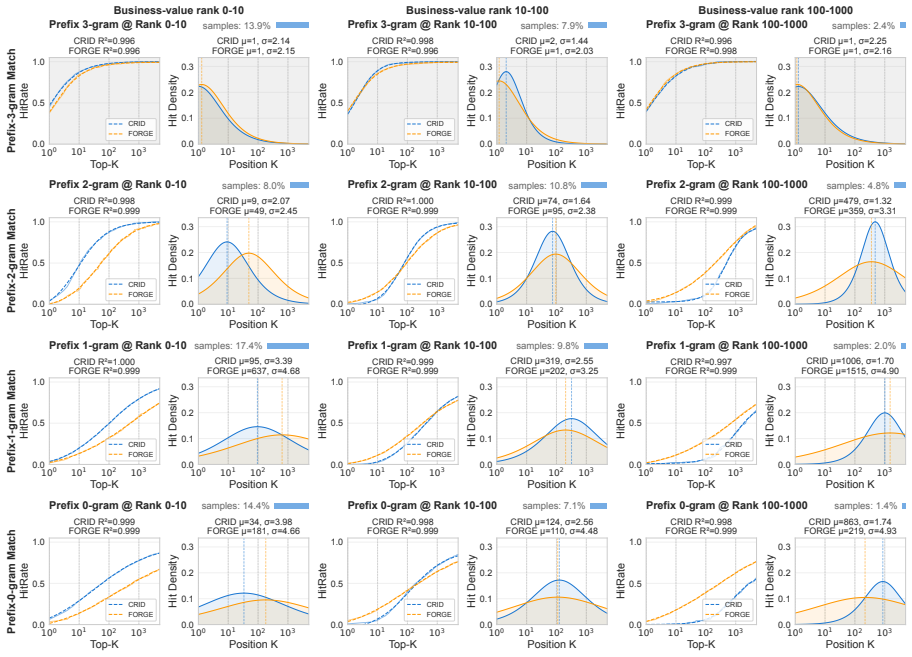
Summary. The paper proposes Cluster-Ranked Identifier (CRID) for generative retrieval: hierarchical DocIDs whose first levels are semantic clusters (from contrastive query–item embeddings quantized by RQ-KMeans) and whose last level is an ordinal business-value rank within each cluster. This construction is collision-free by design and supports incremental updates by intra-cluster reranking without codebook retraining. The authors further introduce a stratification analysis (prefix N-gram match × business-value rank) that attributes gains to personalized preference versus statistical-prior generalization and shows that average semantic cluster size trades off composition shift against per-group Hitrate. On a 300M-item Taobao search corpus, CRID improves offline conversion Hitrate over alternative third-level DocID schemes and over a strong personalized EBR baseline at top-K, and a full-traffic A/B test reports +1.06% GMV.
Significance. If the reported offline and online gains hold, the work is a practically important and conceptually clean contribution to industrial generative retrieval. Encoding business value as an ordinal last-level token—rather than further semantic quantization or unordered attribute buckets—is simple, aligns DocID structure with the conversion objective, and yields collision-free IDs with a natural incremental-update path. The controlled third-level ablations (Table 1, Fig. 2), the prefix N-gram gap (Fig. 4), the hit-density concentration analysis (Fig. 3), and the composition-shift study that guided the production codebook (§4.3, 32768×8192) are useful both as evidence and as design guidance. Full-traffic deployment with a measured GMV lift is a strong form of validation uncommon in purely academic DocID papers. Strengths include the explicit factorization in Eq. (2), collision-freeness by construction, and the production-facing analysis of beam sizing and cluster size.
major comments (2)
- [§3.2–3.4, Tables 1–4] §3.2–3.4 and Tables 1–4 report large Hitrate deltas without uncertainty estimates, multiple seeds, or significance tests. Gaps such as CRID vs Tiger on HR@20 (41.20% vs 37.48%) and the small differences among ranking signals in Table 3 (e.g., Conv-rank vs Score-rank) cannot be assessed for stability. For a journal result that also claims superiority over production EBR (Table 4), bootstrap CIs, multi-run variance, or at least query-level paired tests on the evaluation set would make the offline claims load-bearing rather than point estimates.
- [§2.1 Business-value ranking; §3.3 Table 2; Limitations] The central industrial claim of incremental updates via intra-cluster reranking (§2.1, Table 2) rests on the assumption that historical business-value ranks remain a usable ordinal prior. Table 2 evaluates a 10-day pool refresh under full rerank vs insert-only, but does not isolate pure cold-start items (zero or near-zero 30-day conversions) or measure how long new items remain under-ranked. Given that Limitations already flags cold-start bias, a dedicated cold-start / low-interaction slice (Hitrate or recall share for items below a conversion threshold, before vs after accumulation) is needed to support the update story at the same strength as the main Hitrate tables.
minor comments (6)
- [Abstract; Table 4] Abstract and §1 claim CRID “surpasses the strongest embedding-based retrieval baseline on top-K Hitrate”; Table 4 shows clear top-K gains but in-search degradation at HR@500/1000. A single clarifying sentence that deep-K in-search is not improved would prevent over-reading the abstract.
- [§4.2; Fig. 3; Appendix D] Fig. 3 and Appendix D fit logistic CDFs on log K and report μ(K), σ(log K). State explicitly that this is a descriptive post-hoc fit (not a generative model of retrieval) and how μ(K) is obtained from the logistic parameters so readers can reproduce the heatmaps.
- [Table 1] Table 1 “Collision-free” column: FORGE is marked N (up to five items per DocID) while Tiger and CRID are Y—consistent with the text, but a footnote defining the collision policy for each baseline would help skimming readers.
- [§2.1 Eq. (2)] Eq. (2) factors P(i|q,h)=P(cs|q,h)·P(r|cs,q,h). Briefly note whether the GR model is trained with a single joint loss over the full DocID or with any stage-wise weighting; this affects how strongly the last-level rank is optimized.
- [§1; Appendix A.2] Related work (Appendix A) correctly distinguishes CRID from GR4AD/UniVA categorical or binning schemes; consider promoting a short paragraph of that distinction into the main §1 so the “ordinal ranking” novelty claim is self-contained without the appendix.
- [Table 1] Minor wording: “81923” in Table 1 header/row is easy to misread as 8192³; write 8192×8192×8192 or “three-level 8192” for clarity.
Circularity Check
No circularity: CRID gains and the preference/prior decomposition are measured empirically against independent baselines and held-out logs; nothing reduces by construction to the ranking statistic or self-citation.
full rationale
The paper defines CRID by construction (semantic prefix + ordinal business-value rank inside clusters, Eq. 2) and then evaluates it on independent metrics: item-level Hitrate@K on held-out in-search/out-of-search conversion logs (Tables 1–4, Fig. 2–4), incremental-update coverage after a 10-day cutoff (Table 2), and live full-traffic A/B GMV (+1.06%). The §4 analytical framework merely stratifies those same observed Hitrate curves by prefix N-gram match and rank bins, fits logistic CDFs, and reports composition shifts; the fits (R²>0.99) and μ(K)/σ(log K) are descriptive summaries of the evaluation data, not predictions forced by the ranking input. No uniqueness theorem, self-citation chain, or fitted parameter is load-bearing for the central claim. Related-work citations (TIGER, FORGE, OPQ, etc.) supply baselines that are re-implemented and outperformed, not premises that force the result. Cold-start and single-domain caveats are acknowledged in Limitations but do not create definitional circularity. The derivation chain is therefore self-contained and non-circular.
Assumptions & free parameters
free parameters (4)
- semantic codebook sizes (e.g. 8192×8192, 32768×8192)
- business-value rank range (8192)
- 30-day conversion/click window
- dynamic beam sizes (100 / 400 / 1500)
assumptions (4)
- domain assumption Contrastive learning on query-item pairs yields embeddings whose RQ-KMeans clusters capture query-level semantic relevance.
- domain assumption Business conversion (or click) rate is a suitable ordinal proxy for the system’s optimization target inside a semantic cluster.
- ad hoc to paper Ordinal ranks permit the autoregressive model to generalize relative item quality better than unordered categorical buckets.
- domain assumption Constrained beam search over a trie of valid DocID prefixes recovers near-lossless top-K coverage under the chosen beam widths.
invented entities (2)
-
Cluster-Ranked Identifier (CRID)
-
personalized-preference vs statistical-prior gain decomposition
Cite this review
Pith. "Pith review of Beyond Semantic IDs: Encoding Business-Value Ranking into Document Identifiers for Generative Retrieval." pith.science (2026). https://pith.science/paper/LMXLEVX6
@misc{pith2026260711392,
  author       = {Pith},
  title        = {Pith review of: Beyond Semantic IDs: Encoding Business-Value Ranking into Document Identifiers for Generative Retrieval},
  year         = {2026},
  howpublished = {\url{https://pith.science/paper/LMXLEVX6}},
  note         = {Machine review of arXiv:2607.11392}
}
read the original abstract
Generative Retrieval (GR) formulates retrieval as a sequence-to-sequence generation task, assigning each document a document identifier (DocID) and retrieving it through autoregressive decoding, making DocID design a critical factor in retrieval quality. However, existing schemes based on discrete representation learning suffer from inherent collision issues and create a mismatch between the DocID's encoding objective and the system's business optimization target. To address these limitations, we propose Cluster-Ranked Identifier (CRID), which decouples DocID into semantic clustering and business-value ranking, yielding collision-free identifiers that support incremental updates via intra-cluster reranking. We further introduce an analytical framework that decomposes retrieval gains into personalized preference and statistical prior generalization, revealing how semantic cluster size governs the balance between the two components. Experiments on a 300M-item Taobao e-commerce corpus show that CRID surpasses the strongest embedding-based retrieval baseline on top-K Hitrate, and delivers +1.06% GMV in full-traffic deployment.
Figures


Figures from the paper (5 more)



Forward citations
Cited by 1 Pith paper
-
TSGR: Taobao Search Generative Retrieval
TSGR makes Taobao search retrieval value-aware by ordering item IDs by clicks and query intent and re-ranking generated candidates with a value module, improving HR@1000 and GMV.
Reference graph
Works this paper leans on
-
[1]
arXiv preprint arXiv:1807.03748 , year=
Representation learning with contrastive predictive coding , author=. arXiv preprint arXiv:1807.03748 , year=
-
[2]
Proceedings of the 34th ACM International Conference on Information and Knowledge Management , pages=
Qarm: Quantitative alignment multi-modal recommendation at kuaishou , author=. Proceedings of the 34th ACM International Conference on Information and Knowledge Management , pages=
-
[3]
Proceedings of the 34th ACM International Conference on Information and Knowledge Management , pages=
Generative Recommendation with Semantic IDs: A Practitioner's Handbook , author=. Proceedings of the 34th ACM International Conference on Information and Knowledge Management , pages=
-
[4]
Companion Proceedings of the ACM on Web Conference 2025 , pages=
Generative retrieval and alignment model: A new paradigm for e-commerce retrieval , author=. Companion Proceedings of the ACM on Web Conference 2025 , pages=
2025
-
[5]
arXiv preprint arXiv:2508.15308 , year=
Reg4rec: Reasoning-enhanced generative model for large-scale recommendation systems , author=. arXiv preprint arXiv:2508.15308 , year=
-
[6]
arXiv preprint arXiv:2511.18805 , year=
STORE: Semantic Tokenization, Orthogonal Rotation and Efficient Attention for Scaling Up Ranking Models , author=. arXiv preprint arXiv:2511.18805 , year=
-
[7]
Proceedings of the 2025 Annual International ACM SIGIR Conference on Research and Development in Information Retrieval in the Asia Pacific Region , pages=
C2T-ID: Converting Semantic Codebooks to Textual Document Identifiers for Generative Search , author=. Proceedings of the 2025 Annual International ACM SIGIR Conference on Research and Development in Information Retrieval in the Asia Pacific Region , pages=
2025
-
[8]
arXiv preprint arXiv:2010.00904 , year=
Autoregressive entity retrieval , author=. arXiv preprint arXiv:2010.00904 , year=
arXiv 2010
Show all 25 references
-
[9]
Advances in neural information processing systems , volume=
Transformer memory as a differentiable search index , author=. Advances in neural information processing systems , volume=
-
[10]
Advances in Neural Information Processing Systems , volume=
A neural corpus indexer for document retrieval , author=. Advances in Neural Information Processing Systems , volume=
-
[11]
Advances in Neural Information Processing Systems , volume=
Recommender systems with generative retrieval , author=. Advances in Neural Information Processing Systems , volume=
-
[12]
arXiv preprint arXiv:2506.13695 , year=
Onerec technical report , author=. arXiv preprint arXiv:2506.13695 , year=
-
[13]
arXiv preprint arXiv:2509.03236 , year=
Onesearch: A preliminary exploration of the unified end-to-end generative framework for e-commerce search , author=. arXiv preprint arXiv:2509.03236 , year=
-
[14]
arXiv preprint arXiv:2602.22732 , year=
Generative Recommendation for Large-Scale Advertising , author=. arXiv preprint arXiv:2602.22732 , year=
-
[15]
arXiv preprint arXiv:2511.10138 , year=
GPR: Towards a Generative Pre-trained One-Model Paradigm for Large-Scale Advertising Recommendation , author=. arXiv preprint arXiv:2511.10138 , year=
-
[16]
2024 IEEE 40th International Conference on Data Engineering (ICDE) , pages=
Adapting large language models by integrating collaborative semantics for recommendation , author=. 2024 IEEE 40th International Conference on Data Engineering (ICDE) , pages=. 2024 , organization=
2024
-
[17]
arXiv preprint arXiv:2602.23978 , year=
Towards Efficient and Generalizable Retrieval: Adaptive Semantic Quantization and Residual Knowledge Transfer , author=. arXiv preprint arXiv:2602.23978 , year=
-
[18]
arXiv preprint arXiv:2603.10409 , year=
Differentiable Geometric Indexing for End-to-End Generative Retrieval , author=. arXiv preprint arXiv:2603.10409 , year=
-
[19]
arXiv preprint arXiv:2605.05803 , year=
Unified Value Alignment for Generative Recommendation in Industrial Advertising , author=. arXiv preprint arXiv:2605.05803 , year=
-
[20]
Proceedings of the IEEE/CVF conference on computer vision and pattern recognition , pages=
Autoregressive image generation using residual quantization , author=. Proceedings of the IEEE/CVF conference on computer vision and pattern recognition , pages=
-
[21]
arXiv preprint arXiv:2509.20904 , year=
Forge: Forming semantic identifiers for generative retrieval in industrial datasets , author=. arXiv preprint arXiv:2509.20904 , year=
-
[22]
Advances in neural information processing systems , volume=
Direct preference optimization: Your language model is secretly a reward model , author=. Advances in neural information processing systems , volume=
-
[23]
5 Technical Report , author=
Qwen2. 5 Technical Report , author=. arXiv e-prints , pages=
-
[24]
Advances in neural information processing systems , volume=
Sinkhorn distances: Lightspeed computation of optimal transport , author=. Advances in neural information processing systems , volume=
-
[25]
IEEE transactions on pattern analysis and machine intelligence , volume=
Optimized product quantization , author=. IEEE transactions on pattern analysis and machine intelligence , volume=. 2013 , publisher=
2013
Reviewed July 14, 2026 · model on record in the stance chip above.
Discussion (0). Sign in to comment.