UAV-Involved Wireless Physical-Layer Secure Communications: Overview and Research Directions
Pith reviewed 2026-05-25 17:49 UTC · model grok-4.3
The pith
Physical-layer security techniques can counter the eavesdropping risks created by UAV line-of-sight links while UAV mobility itself supplies new tools for protecting wireless transmissions.
A machine-rendered reading of the paper's core claim, the machinery that carries it, and where it could break.
Core claim
The broadcast nature and dominant line-of-sight channel conditions of UAV communications create specific security vulnerabilities that physical-layer security techniques can address, while UAVs can also be exploited to cooperatively protect secure communications through the design of secure transmission schemes and optimization of the degrees of freedom introduced by UAV mobility and positioning.
What carries the argument
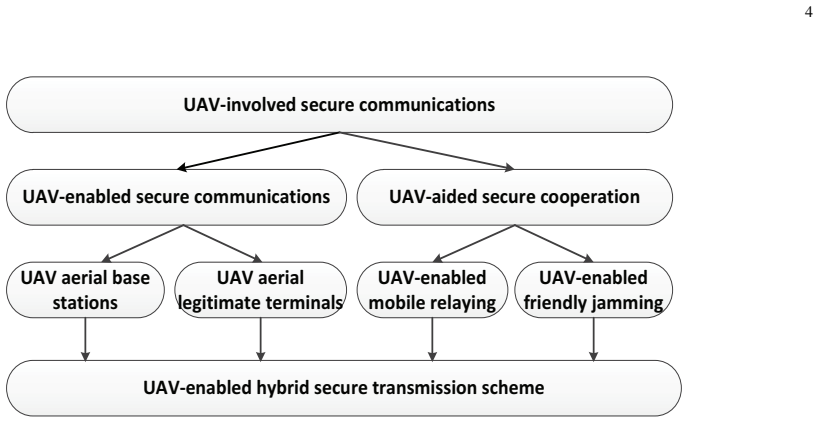
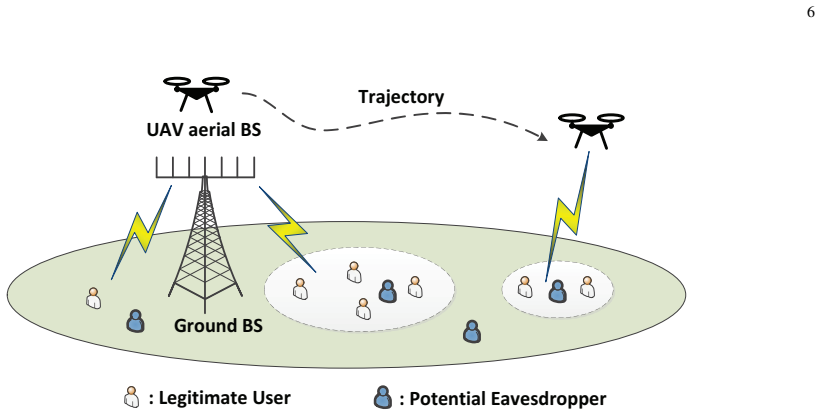
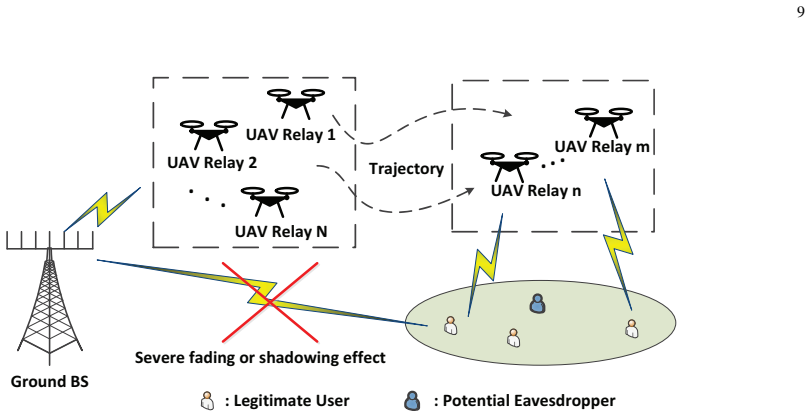
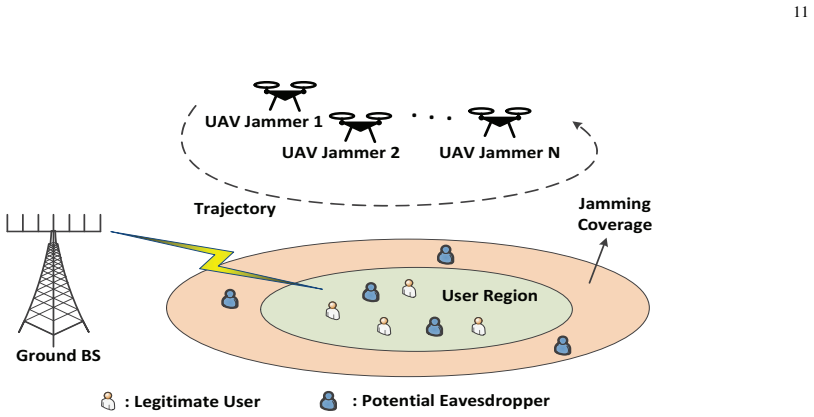
Classification of UAV roles (transmitter, receiver, jammer, relay) together with optimization of UAV-specific degrees of freedom such as trajectory and three-dimensional position.
Load-bearing premise
The premise that the broadcast nature and dominant line-of-sight channel conditions of UAV communications create specific security vulnerabilities that physical-layer security techniques can address.
What would settle it
A measurement campaign in which no combination of UAV trajectory or role assignment raises the secrecy rate above conventional non-UAV baselines under realistic line-of-sight conditions.
Figures
read the original abstract
Due to their flexible deployment and on-demand mobility, small-scale unmanned aerial vehicles (UAVs) are anticipated to be involved in widespread communication applications in the forthcoming fifth-generation (5G) networks. However, the confidentiality of UAV communication applications is vulnerable to security threats due to the broadcast nature and dominant line-of-sight (LoS) channel conditions, and physical-layer security (PLS) technique can be applied for secrecy performance enhancement in such a context. On the other hand, it is also promising to exploit UAVs to cooperatively protect secure communications. This article provides an overview of the recent research efforts on UAV-involved secure communications at the physical layer. We focus on the design of secure transmission schemes according to different roles of UAVs and the optimization of introduced degrees of freedom (DoFs) by the unique characteristics of UAVs. We also propose some future research directions on this topic.
Editorial analysis
A structured set of objections, weighed in public.
Referee Report
Summary. The manuscript is a literature survey on UAV-involved physical-layer secure communications. It reviews how PLS techniques can mitigate security threats in UAV links arising from their broadcast nature and dominant LoS channels, examines UAV roles as transmitters, jammers, or relays in secure transmission schemes, discusses optimization of the additional degrees of freedom (DoFs) enabled by UAV mobility and channel properties, and outlines several future research directions.
Significance. If the survey accurately reflects the cited literature, it consolidates work on an emerging intersection of UAV communications and PLS that is relevant to 5G and beyond. The identification of mobility/DoF optimization as open problems provides a useful roadmap for the field.
minor comments (3)
- [Abstract] Abstract: the claim that 'PLS technique can be applied for secrecy performance enhancement' is presented without quantifying how many works were surveyed or the criteria used for inclusion, which would strengthen the overview's transparency.
- [UAV roles discussion] The section discussing UAV roles as jammer or relay would benefit from explicit cross-references to the specific optimization formulations (e.g., power allocation or trajectory design) used in the cited works rather than high-level descriptions only.
- [Future directions] Future research directions paragraph: the proposed open problems on DoF optimization are stated at a high level; adding one or two concrete example metrics (e.g., secrecy rate vs. UAV altitude) drawn from the surveyed papers would make the suggestions more actionable.
Simulated Author's Rebuttal
We thank the referee for the positive review and recommendation of minor revision. We appreciate the recognition that the survey consolidates emerging work at the intersection of UAV communications and physical-layer security, and that the discussion of mobility/DoF optimization provides a useful roadmap.
Circularity Check
No significant circularity in survey paper
full rationale
This paper is a literature survey providing an overview of existing research on UAV-involved physical-layer secure communications. It does not introduce any new derivations, predictions, fitted parameters, mathematical claims, or optimization results that could be circular. All content consists of descriptive summaries of prior work, role classifications (transmitter/jammer/relay), and suggestions for future research directions. No equations, self-definitional constructs, or load-bearing self-citations are present. The broadcast/LoS vulnerability premise is referenced as standard context from the broader PLS literature rather than derived or asserted as novel within this document.
Axiom & Free-Parameter Ledger
Reference graph
Works this paper leans on
-
[1]
Survey on unmanned aerial vehicle networks for civil applications: A communications viewpoint,
S. Hayat, E. Yanmaz, and R. Muzaffar, “Survey on unmanned aerial vehicle networks for civil applications: A communications viewpoint,” IEEE Commun. Surv. Tuts. , vol. 18, no. 4, pp. 2624–2661, Fourth Quarter 2016. June 25, 2019 DRAFT 16
work page 2016
-
[2]
Wireless communication s with unmanned aerial vehicles: Opportunities and challen ges,
Y . Zeng, R. Zhang, and T. J. Lim, “Wireless communication s with unmanned aerial vehicles: Opportunities and challen ges,” IEEE Commun. Mag. , vol. 54, no. 5, pp. 36–42, May 2016
work page 2016
-
[3]
M. Bloch and J. Barros, Physical-layer security: From information theory to secur e engineering. Cambridge University Press, Aug. 2008
work page 2008
-
[4]
Securing UA V commun ications via joint trajectory and power control,
G. Zhang, Q. Wu, M. Cui, and R. Zhang, “Securing UA V commun ications via joint trajectory and power control,” IEEE Trans. Wireless Commun. , vol. 18, no. 2, pp. 1376-1389, Jan. 2019
work page 2019
-
[5]
Robust trajectory and transmit power design for secure UA V communications,
M. Cui, G. Zhang, Q. Wu, and D. W. K. Ng, “Robust trajectory and transmit power design for secure UA V communications,” IEEE Trans. V eh. Technol., vol. 67, no. 9, pp. 9042–9046, Sep. 2018
work page 2018
-
[6]
Secrecy rate analysis of U A V-enabled mmWave networks using mat´ ern hardcore point processes,
Y . Zhu, G. Zheng, and M. Fitch, “Secrecy rate analysis of U A V-enabled mmWave networks using mat´ ern hardcore point processes,” IEEE J. Sel. Areas Commun. , vol. 36, no. 7, pp. 1397–1409, Jul. 2018
work page 2018
-
[7]
Secure UA V communicatio n in the presence of active eavesdropper,
C. Liu, T. Q. S. Quek, and J. Lee, “Secure UA V communicatio n in the presence of active eavesdropper,” in Proc. Int. Conf. Wireless Commun. Signal Process. (WCSP) , Nanjing, China, Oct. 2017, pp. 1–6
work page 2017
-
[8]
Trajectory plannin g in UA V communication with jamming,
H. Wang, J. Chen, G. Ding, and J. Sun, “Trajectory plannin g in UA V communication with jamming,” in Proc. Int. Conf. Wireless Commun. Signal Process. (WCSP) , Hangzhou, China, Oct. 2018, pp. 1–6
work page 2018
-
[9]
Improving physical layer security using UA V-enabled mobile relaying,
Q. Wang, Z. Chen, W. Mei, and J. Fang, “Improving physical layer security using UA V-enabled mobile relaying,” IEEE Wireless Commun. Lett. , vol. 6, no. 3, pp. 310–313, Jun. 2017
work page 2017
-
[10]
Q. Wang, Z. Chen, H. Li, and S. Li, “Joint power and trajec tory design for physical-layer secrecy in the UA V-aided mobile relaying system,” IEEE Access , vol. 6, pp. 62849–62855, 2018
work page 2018
-
[11]
H. Liu, S. Y oo, and K. S. Kwak, “Opportunistic relaying f or low-altitude UA V swarm secure communications with multiple eavesdroppers,” J. Commun. Netw. , vol. 20, no. 5, pp. 496–508, Oct. 2018
work page 2018
-
[12]
UA V-enabled cooperative jam ming for improving secrecy of ground wiretap channel,
A. Li, Q. Wu, and R. Zhang, “UA V-enabled cooperative jam ming for improving secrecy of ground wiretap channel,” IEEE Wireless Commun. Lett. , vol. 8, no. 1, pp. 181–184, Feb. 2019
work page 2019
-
[13]
Improving physical layer security via a UA V friendly jammer for unknown eavesdropper location,
Y . Zhou, P . L. Yeoh, H. Chen, Y . Li, R. Schober, L. Zhuo, an d B. Vucetic, “Improving physical layer security via a UA V friendly jammer for unknown eavesdropper location,” IEEE Trans. V eh. Technol., vol. 67, no. 11, pp. 11280–11284, Nov. 2018
work page 2018
-
[14]
UA V-aided secure com munications with cooperative jamming,
H. Lee, S. Eom, J. Park, and I. Lee, “UA V-aided secure com munications with cooperative jamming,” IEEE Trans. V eh. Technol., vol. 67, no. 10, pp. 9385–9392, Oct. 2018
work page 2018
-
[15]
Dual-UA V-en abled secure communications: joint trajectory design and user scheduling,
Y . Cai, F. Cui, Q. Shi, M. Zhao, and G. Y . Li, “Dual-UA V-en abled secure communications: joint trajectory design and user scheduling,” IEEE J. Sel. Areas Commun. , vol. 36, no. 9, pp. 1972–1985, Sep. 2018. June 25, 2019 DRAFT 17 Hui-Ming Wang (S’07–M’10–SM’16) received the B.S. and Ph.D. degrees in el ectrical engineering from Xi’an Jiaotong University...
work page 1972
discussion (0)
Sign in with ORCID, Apple, or X to comment. Anyone can read and Pith papers without signing in.