EVulHunter: Detecting Fake Transfer Vulnerabilities for EOSIO's Smart Contracts at Webassembly-level
Pith reviewed 2026-05-25 16:48 UTC · model grok-4.3
The pith
EVulHunter is the first static analysis tool that detects fake-transfer vulnerabilities in EOSIO smart contracts directly from WebAssembly bytecode.
A machine-rendered reading of the paper's core claim, the machinery that carries it, and where it could break.
Core claim
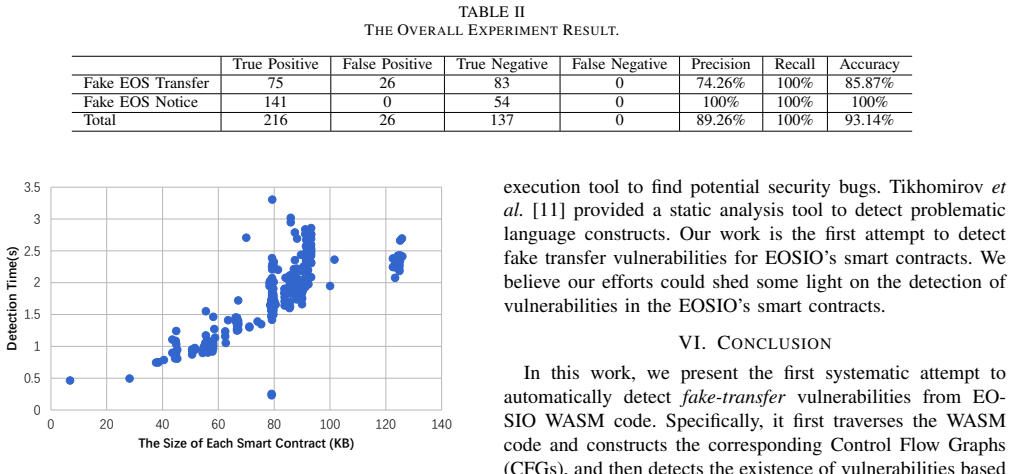
EVulHunter is the first automatic tool to detect vulnerabilities of EOSIO's smart contracts. It performs static analysis on WebAssembly code to identify fake-transfer vulnerabilities, which have led to millions of dollars in damages. The experimental results demonstrate that the tool detects these vulnerabilities quickly and precisely.
What carries the argument
Static pattern matching on compiled WebAssembly bytecode to recognize fake-transfer vulnerabilities without source code or dynamic traces.
If this is right
- Audits of closed-source EOSIO contracts become feasible at the bytecode level.
- Detection of fake transfers no longer requires access to source code or runtime monitoring.
- Financial losses from fake-transfer exploits can be reduced through automated pre-deployment checks.
- The same static-analysis approach can be extended to other vulnerability types in EOSIO contracts.
Where Pith is reading between the lines
- The pattern-based method could be tested on other blockchain platforms that compile to WebAssembly.
- Community contributions via the released GitHub code could add support for additional vulnerability classes beyond fake transfers.
- Combining the tool with dynamic analysis might catch vulnerabilities whose patterns are not fully static.
Load-bearing premise
Fake-transfer vulnerabilities produce static, recognizable patterns in WebAssembly bytecode that can be identified reliably without source code or execution traces.
What would settle it
An EOSIO contract containing a fake-transfer vulnerability that EVulHunter fails to flag when given only its WebAssembly bytecode, or a contract without the vulnerability that the tool incorrectly flags.
Figures

read the original abstract
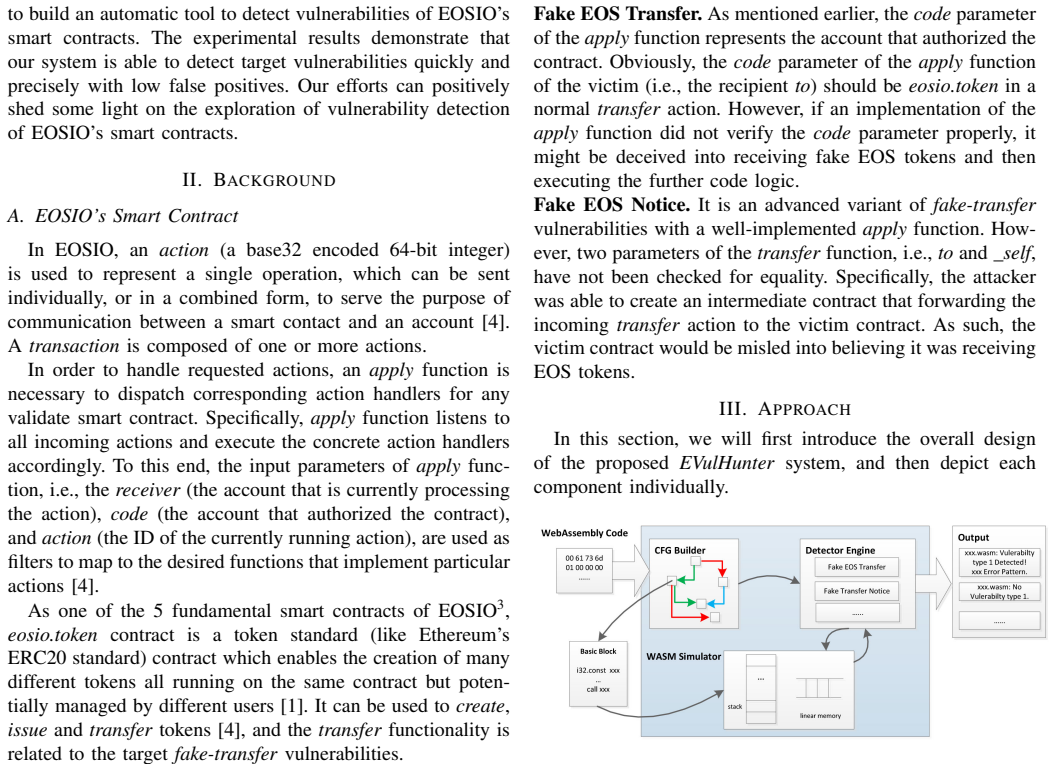
As one of the representative Delegated Proof-of-Stake (DPoS) blockchain platforms, EOSIO's ecosystem grows rapidly in recent years. A number of vulnerabilities and corresponding attacks of EOSIO's smart contracts have been discovered and observed in the wild, which caused a large amount of financial damages. However, the majority of EOSIO's smart contracts are not open-sourced. As a result, the WebAssembly code may become the only available object to be analyzed in most cases. Unfortunately, current tools are web-application oriented and cannot be applied to EOSIO WebAssembly code directly, which makes it more difficult to detect vulnerabilities from those smart contracts. In this paper, we propose \toolname, a static analysis tool that can be used to detect vulnerabilities from EOSIO WASM code automatically. We focus on one particular type of vulnerabilities named \textit{fake-transfer}, and the exploitation of such vulnerabilities has led to millions of dollars in damages. To the best of our knowledge, it is the first attempt to build an automatic tool to detect vulnerabilities of EOSIO's smart contracts. The experimental results demonstrate that our tool is able to detect fake transfer vulnerabilities quickly and precisely. EVulHunter is available on GitHub\footnote{Tool and benchmarks: https://github.com/EVulHunter/EVulHunter} and YouTube\footnote{Demo video: https://youtu.be/5SJ0ZJKVZvw}.
Editorial analysis
A structured set of objections, weighed in public.
Referee Report
Summary. The manuscript presents EVulHunter, a static analysis tool for detecting fake-transfer vulnerabilities in EOSIO smart contracts directly from their WebAssembly bytecode. It claims to be the first automatic tool for EOSIO contract vulnerabilities and states that experimental results demonstrate quick and precise detection. The tool and benchmarks are released on GitHub.
Significance. A reliable static detector for fake-transfer issues in closed-source EOSIO contracts would address a real security gap, given the documented financial losses from such exploits. However, the significance cannot be assessed because the manuscript supplies no quantitative results, ground-truth construction details, or validation that the chosen WASM patterns are both sound and complete.
major comments (3)
- [Abstract] Abstract: the central claim that EVulHunter detects fake-transfer vulnerabilities 'quickly and precisely' is unsupported by any reported metrics (precision, recall, dataset size, number of contracts, false-positive/negative rates, or baseline comparisons).
- [Method description] Method (inferred from abstract and skeptic note): the approach rests on the unvalidated assumption that fake-transfer vulnerabilities possess unique, static, recognizable patterns in EOSIO WASM bytecode identifiable without source or execution traces; no formal argument, soundness proof, or testing on variant implementations is supplied to establish that the rules are both sound and complete.
- [Experimental results] Experimental evaluation: no description of how ground truth was obtained for closed-source contracts, no table of results, and no discussion of how the tool handles legitimate transfer patterns that might share opcode sequences with vulnerable ones.
minor comments (1)
- [Abstract] The abstract mentions a YouTube demo and GitHub release but provides no concrete performance numbers that would allow readers to judge the 'quickly and precisely' assertion.
Simulated Author's Rebuttal
We thank the referee for the careful and constructive review. The comments correctly identify gaps in the presentation of quantitative results, method validation, and experimental details. We will revise the manuscript accordingly to address these points.
read point-by-point responses
-
Referee: [Abstract] Abstract: the central claim that EVulHunter detects fake-transfer vulnerabilities 'quickly and precisely' is unsupported by any reported metrics (precision, recall, dataset size, number of contracts, false-positive/negative rates, or baseline comparisons).
Authors: We agree that the abstract's qualitative claim requires supporting data. In the revision we will add or reference concrete metrics including the number of contracts analyzed, detection times, precision/recall figures, false-positive and false-negative rates, and any baseline comparisons performed on the released benchmarks. revision: yes
-
Referee: [Method description] Method (inferred from abstract and skeptic note): the approach rests on the unvalidated assumption that fake-transfer vulnerabilities possess unique, static, recognizable patterns in EOSIO WASM bytecode identifiable without source or execution traces; no formal argument, soundness proof, or testing on variant implementations is supplied to establish that the rules are both sound and complete.
Authors: The patterns are extracted from the semantics of documented fake-transfer exploits. We will add a dedicated subsection that formally motivates the chosen WASM instruction sequences, provides an argument for their soundness and completeness with respect to the vulnerability definition, and reports results of testing the rules on multiple variant implementations. revision: yes
-
Referee: [Experimental results] Experimental evaluation: no description of how ground truth was obtained for closed-source contracts, no table of results, and no discussion of how the tool handles legitimate transfer patterns that might share opcode sequences with vulnerable ones.
Authors: We will expand the evaluation section with an explicit account of ground-truth construction (manual analysis of publicly disclosed vulnerable contracts and their WASM bytecode), insert a results table, and add a discussion explaining how the selected patterns differentiate fake-transfer misuse from standard legitimate transfer sequences. revision: yes
Circularity Check
No circularity; static-analysis tool paper makes no derived predictions or self-referential claims.
full rationale
The paper presents a static-analysis tool for detecting fake-transfer vulnerabilities in EOSIO WASM bytecode. Its central claim is the existence and performance of EVulHunter on a set of benchmarks; no equations, fitted parameters, or 'predictions' appear. The 'first attempt' statement is a factual claim about tool novelty, not a load-bearing derivation. No self-citation chains, uniqueness theorems, or ansatzes are invoked. The work is therefore self-contained against external benchmarks and receives the default non-circularity finding.
Axiom & Free-Parameter Ledger
axioms (1)
- domain assumption Fake-transfer vulnerabilities produce identifiable static patterns in EOSIO WebAssembly bytecode
Reference graph
Works this paper leans on
-
[1]
Eos developer documentation, https://www.eosdocs.io/ dappdevelopment/tokencontract/
-
[2]
Eosio, https://eos.io/
-
[3]
Ethereum, https://www.ethereum.org/
-
[4]
Official developer portal of eosio, https://developers.eos.io/eosio-cpp/ docs/abi
-
[5]
Webassembly, https://en.wikipedia.org/wiki/WebAssembly
-
[6]
Wiki of eosio, https://en.wikipedia.org/wiki/WebAssembly
-
[7]
A survey of attacks on ethereum smart contracts (sok)
Nicola Atzei, Massimo Bartoletti, and Tiziana Cimoli. A survey of attacks on ethereum smart contracts (sok). In International Conference on Principles of Security and Trust , pages 164–186. Springer, 2017
work page 2017
-
[8]
Contractfuzzer: Fuzzing smart con- tracts for vulnerability detection
Bo Jiang, Ye Liu, and WK Chan. Contractfuzzer: Fuzzing smart con- tracts for vulnerability detection. In Proceedings of the 33rd ACM/IEEE International Conference on Automated Software Engineering , pages 259–269. ACM, 2018
work page 2018
-
[9]
Reguard: finding reentrancy bugs in smart contracts
Chao Liu, Han Liu, Zhao Cao, Zhong Chen, Bangdao Chen, and Bill Roscoe. Reguard: finding reentrancy bugs in smart contracts. In Pro- ceedings of the 40th International Conference on Software Engineering: Companion Proceeedings, pages 65–68. ACM, 2018
work page 2018
-
[10]
Making smart contracts smarter
Loi Luu, Duc-Hiep Chu, Hrishi Olickel, Prateek Saxena, and Aquinas Hobor. Making smart contracts smarter. In Proceedings of CCS 2016 , pages 254–269. ACM, 2016
work page 2016
-
[11]
Smartcheck: Static analysis of ethereum smart contracts
Sergei Tikhomirov, Ekaterina V oskresenskaya, Ivan Ivanitskiy, Ramil Takhaviev, Evgeny Marchenko, and Yaroslav Alexandrov. Smartcheck: Static analysis of ethereum smart contracts. In WETSEB 2018 , pages 9–16. IEEE, 2018
work page 2018
-
[12]
Securify: Practical security analysis of smart contracts
Petar Tsankov, Andrei Dan, Dana Drachsler-Cohen, Arthur Gervais, Florian Buenzli, and Martin Vechev. Securify: Practical security analysis of smart contracts. In Proceedings of the 2018 ACM SIGSAC Conference on Computer and Communications Security , pages 67–82. ACM, 2018
work page 2018
discussion (0)
Sign in with ORCID, Apple, or X to comment. Anyone can read and Pith papers without signing in.