Free Ride on LDPC Coded Transmission
Pith reviewed 2026-05-25 15:41 UTC · model grok-4.3
The pith
Extra bits can ride for free on LDPC coded transmissions by using the gap to channel capacity.
A machine-rendered reading of the paper's core claim, the machinery that carries it, and where it could break.
Core claim
Accessible capacity characterizes the maximum rate for reliable superposition of extra bits on a coded transmission link, given for BIOS channels by the difference between channel capacity and the mutual information rate of the coded payload link, with a simple lower bound of channel capacity minus the code rate.
What carries the argument
Accessible capacity, defined as the difference between channel capacity and the mutual information rate of the coded payload link.
If this is right
- Accessible capacity is at least channel capacity minus the payload code rate for any code.
- Structured superposition of extra bits is possible using repetition codes or first-order Reed-Muller codes over the syndrome channel.
- Random superposition with exhaustive search decoding aided by statistical learning works for general LDPC payload codes.
Where Pith is reading between the lines
- The method could embed control or metadata streams into existing links without dedicated resources.
- The syndrome channel construction might extend to other linear block codes beyond the examples given.
- Numerical evaluation of accessible capacity for short codes could guide selection of payload codes that leave more room for extra bits.
Load-bearing premise
The superposition of extra bits produces a negligible effect on the error-rate performance of the original payload link.
What would settle it
A test showing that the payload code's bit error rate rises by more than a negligible amount when extra bits are superimposed at the accessible capacity rate would show the definition does not hold in practice.
Figures




read the original abstract
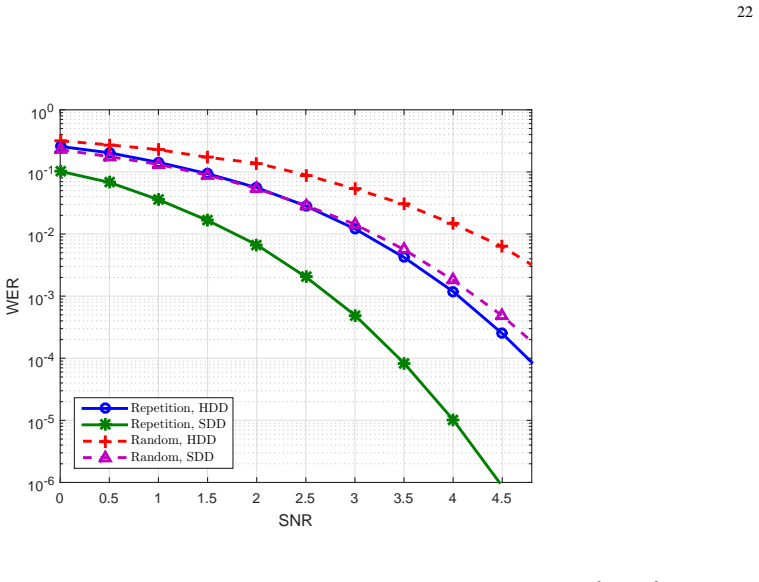
In this paper, we formulate a new problem to cope with the transmission of extra bits over an existing coded transmission link (referred to as coded payload link) without any cost of extra transmission energy or extra bandwidth. This is possible since a gap to the channel capacity typically exists for a practical code. A new concept, termed as accessible capacity, is introduced to specify the maximum rate at which the superposition transmission of extra bits is reliable and has a negligible effect on the performance of the coded payload link. For a binary-input output-symmetric (BIOS) memoryless channel, the accessible capacity can be characterized as the difference between the channel capacity and the mutual information rate of the coded payload link, which can be numerically evaluated for very short payload codes. For a general payload code, we present a simple lower bound on the accessible capacity, given by the channel capacity minus the coding rate of the payload code. We then focus on the scenarios where low-density parity-check (LDPC) codes are implemented for the payload link. We propose to transmit extra bits by random superposition for encoding, and exhaustive search (with the aid of statistical learning) for decoding. We further propose, by establishing an auxiliary channel (called syndrome channel) induced from "zero-forcing" over the binary field, to transmit extra bits with structured codes such as repetition codes and first-order Reed-Muller (RM) codes. Numerical results show that up to 60 extra bits can be reliably transmitted along with a rate-1/2 LDPC code of length 8064.
Editorial analysis
A structured set of objections, weighed in public.
Referee Report
Summary. The paper introduces the concept of accessible capacity to quantify the maximum rate for reliable superposition of extra bits onto an existing coded payload link (such as LDPC) without extra energy or bandwidth and with negligible impact on payload performance. For BIOS memoryless channels it characterizes this as the difference between channel capacity and the mutual information rate of the payload code (with a simple lower bound of C minus the payload code rate), proposes random superposition encoding with exhaustive-search decoding (aided by statistical learning) or structured encoding via an auxiliary syndrome channel for repetition and RM codes, and reports numerical results claiming that up to 60 extra bits can be reliably transmitted alongside a rate-1/2 LDPC code of length 8064.
Significance. If the central numerical claim is validated, the work would demonstrate a practical method to exploit the gap to capacity for throughput gains in existing coded systems. The information-theoretic characterization follows directly from standard mutual-information identities and the lower bound is parameter-free; the syndrome-channel construction provides a concrete auxiliary-channel approach for structured extra-bit coding.
major comments (1)
- [Numerical results] Numerical results section (and abstract claim of 60 extra bits): the accessible-capacity definition requires that extra-bit superposition produces a negligible effect on the payload link's error-rate performance. The headline numerical result therefore depends on simulations having verified that the payload decoder's FER/BER curves remain essentially unchanged; no such side-by-side comparison is described, which is load-bearing for the practical validity of the 60-bit claim.
minor comments (2)
- [Abstract] Abstract: the phrase 'exhaustive search (with the aid of statistical learning)' for decoding is introduced without indicating what statistical learning procedure is used or how it reduces complexity, making the method hard to assess from the high-level description.
- [Abstract] Abstract: the numerical claim would be strengthened by stating the precise channel model, SNR operating point, and exact payload code parameters used to obtain the 'up to 60 extra bits' figure.
Simulated Author's Rebuttal
We thank the referee for the careful review and constructive comment on the numerical validation. We address the major comment below.
read point-by-point responses
-
Referee: [Numerical results] Numerical results section (and abstract claim of 60 extra bits): the accessible-capacity definition requires that extra-bit superposition produces a negligible effect on the payload link's error-rate performance. The headline numerical result therefore depends on simulations having verified that the payload decoder's FER/BER curves remain essentially unchanged; no such side-by-side comparison is described, which is load-bearing for the practical validity of the 60-bit claim.
Authors: We agree that an explicit demonstration of negligible impact on the payload decoder's FER/BER performance is essential to support the accessible-capacity definition and the headline claim. The current manuscript reports the extra-bit error rates but does not include side-by-side payload performance curves with and without superposition. In the revised version we will add these comparisons (for the rate-1/2 LDPC code of length 8064) to confirm that the payload curves remain essentially unchanged. revision: yes
Circularity Check
No circularity: accessible capacity defined directly as C minus payload mutual information; lower bound is C minus rate
full rationale
The paper introduces accessible capacity by explicit definition as the difference between channel capacity and the mutual information rate of the coded payload link (or C minus coding rate for the lower bound). These are definitional statements, not derivations that reduce to their own inputs by construction. No self-citations, fitted parameters renamed as predictions, or ansatzes smuggled via prior work appear in the provided text. Numerical claims are simulation results, not forced outputs of a self-referential model. The derivation chain is therefore self-contained against external benchmarks.
Axiom & Free-Parameter Ledger
axioms (1)
- domain assumption The channel is binary-input output-symmetric and memoryless.
invented entities (2)
-
accessible capacity
no independent evidence
-
syndrome channel
no independent evidence
Reference graph
Works this paper leans on
-
[1]
Low-density parity-check codes,
R. Gallager, “Low-density parity-check codes,” IRE Transactions on Information Theory , vol. 8, no. 1, pp. 21–28, 1962
work page 1962
-
[2]
ETSI EN 301 307 Digital Video Broadcasting (DVB); V1.1.2 (2006-06), Second generation framing structure, channel coding and modulation systems for Broadcasting, Interacti ve Services, News Gathering and other Broadband satellite applications, 2006, ETSI web site. Available: http://www. etsi.org
work page 2006
-
[3]
IEEE P802.11 Wireless LANs WWiSE Proposal: High Throughout Extension to the 802.11 Standard , IEEE 11-04-0886- 00-000n, Aug. 2004
work page 2004
-
[4]
NR; Multiplexing and channel coding,
3GPP TS 38.212, “NR; Multiplexing and channel coding,” 2 017
-
[5]
Transmitter identification using embedded pseudo random sequences,
X. Wang, Y . Wu, and B. Caron, “Transmitter identification using embedded pseudo random sequences,” IEEE Transactions on Broadcasting, vol. 50, no. 3, pp. 244–252, Sep. 2004
work page 2004
-
[6]
Robust data transmiss ion using the transmitter identification sequences in ASTC DTV signals,
X. Wang, Y . Wu, and J. . Chouinard, “Robust data transmiss ion using the transmitter identification sequences in ASTC DTV signals,” IEEE Transactions on Consumer Electronics , vol. 51, no. 1, pp. 41–47, Feb 2005
work page 2005
-
[7]
Piggybacking an additiona l lonely bit on linearly coded payload data,
E. G. Larsson and R. Moosavi, “Piggybacking an additiona l lonely bit on linearly coded payload data,” IEEE Wireless Communications Letters , vol. 1, no. 4, pp. 292–295, August 2012
work page 2012
-
[8]
A novel transmissio n scheme for STBC with one additional bit based on labeled MPSK constellation,
Y . Yan, L. Jun, W. Duan, and M. H. Lee, “A novel transmissio n scheme for STBC with one additional bit based on labeled MPSK constellation,” in 2011 International Conference on Electrical and Control En gineering, Sep. 2011, pp. 5687–5690
work page 2011
-
[9]
Additional data transm ission with rotated QPSK constellation,
S. Hong, E. S. Kang, and D. S. Han, “Additional data transm ission with rotated QPSK constellation,” Electronics Letters, vol. 51, no. 5, pp. 394–395, 2015
work page 2015
-
[10]
Novel blind identification of LDPC code s using average LLR of syndrome a posteriori probability,
T. Xia and H. Wu, “Novel blind identification of LDPC code s using average LLR of syndrome a posteriori probability,” IEEE Transactions on Signal Processing , vol. 62, no. 3, pp. 632–640, Feb 2014
work page 2014
-
[11]
Grant-free massive MTC-ena bled massive MIMO: A compressive sensing approach,
K. Senel and E. G. Larsson, “Grant-free massive MTC-ena bled massive MIMO: A compressive sensing approach,” IEEE Transactions on Communications , vol. 66, no. 12, pp. 6164–6175, Dec 2018
work page 2018
-
[12]
Packing additional bits into LDPC coded data,
S. Cai, S. Zhao, and X. Ma, “Packing additional bits into LDPC coded data,” submitted to Electronics Letters
-
[13]
A. J. Viterbi and J. K. Omura, Principles of Digital Communication and Coding . Courier Corporation, 2013
work page 2013
-
[14]
Accessible capacity of secondary users,
X. Huang, X. Ma, L. Lin, and B. Bai, “Accessible capacity of secondary users,” IEEE Transactions on Information Theory , vol. 60, no. 8, pp. 4722–4738, Aug 2014
work page 2014
-
[15]
Coding theorem for systematic low density gener ator matrix codes,
X. Ma, “Coding theorem for systematic low density gener ator matrix codes,” in 2016 9th International Symposium on Turbo Codes and Iterative Information Processing (ISTC) , Sep. 2016, pp. 11–15. 27
work page 2016
-
[16]
A low latency cod ing scheme: Semi-random block oriented convolutional code,
W. Lin, S. Cai, J. Sun, X. Ma, and B. Wei, “A low latency cod ing scheme: Semi-random block oriented convolutional code,” in 2018 IEEE 10th International Symposium on Turbo Codes Itera tive Information Processing (ISTC) , Dec 2018, pp. 1–5
work page 2018
-
[17]
List decoding with statistica l check for semi-random block-oriented convolutional code ,
W. Lin, B. Wei, and X. Ma, “List decoding with statistica l check for semi-random block-oriented convolutional code ,” Electronics Letters, vol. 55, no. 10, pp. 601–603, 2019
work page 2019
-
[18]
F. J. MacWilliams and N. J. A. Sloane, The Theory of Error-correcting Codes . Elsevier, 1977, vol. 16
work page 1977
discussion (0)
Sign in with ORCID, Apple, or X to comment. Anyone can read and Pith papers without signing in.