Throughput Scaling of Covert Communication over Wireless Adhoc Networks
Pith reviewed 2026-05-25 13:31 UTC · model grok-4.3
The pith
Covert communication in ad hoc networks with n^kappa wardens achieves the same throughput scaling as non-covert networks via preservation regions and rerouted paths.
A machine-rendered reading of the paper's core claim, the machinery that carries it, and where it could break.
Core claim
Under the covert communication constraint, the throughput scaling law is achieved by multi-hop, hierarchical cooperation, and hybrid schemes with suitably modified data paths around preservation regions, and matching upper bounds hold when every active legitimate node consumes the same average transmit power over the time period in which the wardens observe the channel outputs.
What carries the argument
Preservation regions around each warden node that forbid transmissions inside to allow higher transmit powers outside while maintaining covertness, combined with evenly distributed detours in data paths for multi-hop and hybrid schemes.
If this is right
- Modified multi-hop routing with detours around preservation regions achieves the covert throughput scaling law.
- Hierarchical cooperation with adjusted symbol power and scheduling achieves the covert throughput scaling law.
- Hybrid hierarchical-multi-hop schemes with path modifications achieve the covert throughput scaling law.
- Upper bounds on throughput match the lower bounds achieved by the schemes when all active nodes use equal average transmit power.
Where Pith is reading between the lines
- The preservation-region technique could extend to scenarios with spatially varying warden densities without changing the overall scaling order.
- At higher warden densities closer to linear in n, overlapping preservation regions might force additional power reductions that alter the scaling.
- Allowing nodes to adapt preservation region sizes dynamically based on local activity could reduce average detour lengths and improve finite-n performance.
Load-bearing premise
Every active legitimate node consumes the same average transmit power over the period when wardens observe the channel outputs.
What would settle it
A calculation or simulation in which nodes use unequal average transmit powers and the achieved throughput scaling exceeds the upper bound stated for the equal-power case.
Figures




read the original abstract
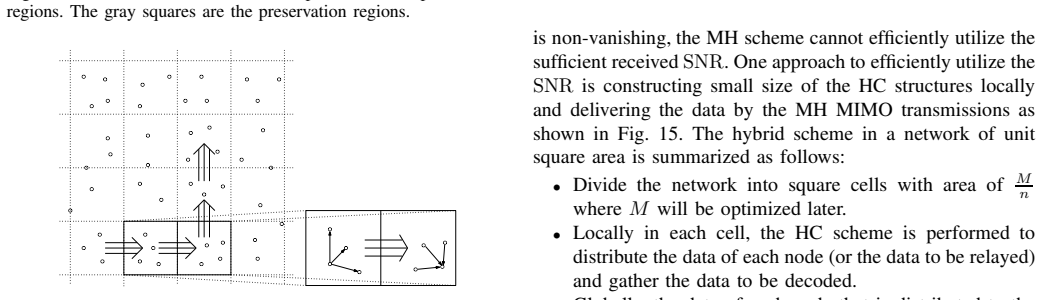
We consider the problem of covert communication over wireless adhoc networks in which (roughly) $n$ legitimate nodes (LNs) and $n^{\kappa}$ for $0<\kappa<1$ non-communicating warden nodes (WNs) are randomly distributed in a square of unit area. Each legitimate source wants to communicate with its intended destination node while ensuring that every WN is unable to detect the presence of the communication. In this scenario, we study the throughput scaling law. Due the covert communication constraint, the transmit powers are necessarily limited. Under this condition, we introduce a preservation region around each WN. This region serves to prevent transmission from the LNs and to increase the transmit power of the LNs outside the preservation regions. For the achievability results, multi-hop (MH), hierarchical cooperation (HC), and hybrid HC-MH schemes are utilized with some appropriate modifications. In the proposed MH and hybrid schemes, because the preservation regions may impede communication along direct data paths, the data paths are suitably modified by taking a detour around each preservation region. To avoid the concentration of detours resulting extra relaying burdens, we distribute the detours evenly over a wide region. In the proposed HC scheme, we control the symbol power and the scheduling of distributed multiple-input multiple-output transmission. We also present matching upper bounds on the throughput scaling under the assumption that every active LN consumes the same average transmit power over the time period in which the WNs observe the channel outputs.
Editorial analysis
A structured set of objections, weighed in public.
Referee Report
Summary. The paper studies throughput scaling for covert communication in a wireless ad hoc network with n legitimate nodes (LNs) and n^κ (0<κ<1) warden nodes (WNs) randomly placed in a unit square. Each LN source-destination pair must communicate while keeping every WN unable to detect the transmission. The authors introduce preservation regions around each WN to limit LN transmit powers, then derive achievability results by modifying multi-hop (MH), hierarchical cooperation (HC), and hybrid HC-MH schemes (with data-path detours around preservation regions in the MH and hybrid cases, and power/scheduling control in HC). Matching upper bounds are stated under the explicit modeling assumption that every active LN consumes identical average transmit power during the WN observation window.
Significance. If the central scaling exponents are shown to hold without post-hoc parameter tuning, the work would supply the first scaling-law characterization of covertness constraints in large random networks, extending classical ad hoc network results (Gupta-Kumar, Özgür et al.) to the covert regime and quantifying the impact of warden density κ. The explicit construction of detour routing that distributes relaying load evenly is a concrete technical contribution.
major comments (2)
- [Abstract] Abstract (upper-bound paragraph): the matching upper bounds are derived only under the modeling assumption that 'every active LN consumes the same average transmit power over the time period in which the WNs observe the channel outputs.' This assumption is not shown to follow from the per-WN covertness constraint nor argued to be the worst case; heterogeneous per-LN powers (still satisfying the covertness condition at each WN) could alter the aggregate energy or the detection statistic and potentially improve the scaling exponent. Because the converse is load-bearing for the claimed 'matching' result, the gap must be closed.
- [Abstract / preservation-region definition] The radius of each preservation region is listed as a free parameter in the model. The achievability constructions and the upper-bound derivation both depend on a specific choice of this radius; the manuscript must state the exact functional dependence on n and κ and verify that the same radius works for both the lower and upper bounds without additional tuning.
Simulated Author's Rebuttal
We thank the referee for the careful review and constructive comments on our manuscript. The two major comments raise important points about the modeling assumptions in the upper bound and the specification of the preservation region radius. We address each below and indicate where revisions will be made to the manuscript.
read point-by-point responses
-
Referee: [Abstract] Abstract (upper-bound paragraph): the matching upper bounds are derived only under the modeling assumption that 'every active LN consumes the same average transmit power over the time period in which the WNs observe the channel outputs.' This assumption is not shown to follow from the per-WN covertness constraint nor argued to be the worst case; heterogeneous per-LN powers (still satisfying the covertness condition at each WN) could alter the aggregate energy or the detection statistic and potentially improve the scaling exponent. Because the converse is load-bearing for the claimed 'matching' result, the gap must be closed.
Authors: We acknowledge the referee's observation that the uniform-power assumption for the converse is stated explicitly but not derived from the per-WN covertness constraint. This modeling choice is adopted because the achievability constructions employ uniform power control outside the preservation regions, and the assumption allows a clean characterization of the aggregate energy observed by each warden. We agree that a more rigorous argument is required to establish that heterogeneous powers (still meeting the per-warden covertness condition) cannot improve the scaling exponent. In the revised manuscript we will add a dedicated paragraph in the converse section justifying the assumption or, if necessary, qualify the 'matching' claim accordingly. revision: yes
-
Referee: [Abstract / preservation-region definition] The radius of each preservation region is listed as a free parameter in the model. The achievability constructions and the upper-bound derivation both depend on a specific choice of this radius; the manuscript must state the exact functional dependence on n and κ and verify that the same radius works for both the lower and upper bounds without additional tuning.
Authors: The radius of each preservation region is chosen to balance the conflicting requirements of limiting transmissions near wardens while permitting sufficient power elsewhere; its scaling is a function of both n and κ. We will revise the model section and the abstract to state the precise order (specifically Θ(n^−β(κ)) for an explicit β depending on κ) and to confirm that this identical functional form is used without retuning in both the achievability constructions (including the detour routing) and the upper-bound analysis. revision: yes
Circularity Check
No significant circularity; upper bounds explicitly conditioned on uniform-power assumption with no reduction to inputs by construction.
full rationale
The paper states its matching upper bounds only under the explicit assumption that every active LN consumes the same average transmit power during the WN observation window. This is presented as a modeling choice for the converse result rather than derived from the covertness constraint. Achievability proceeds via modified MH/HC/hybrid schemes with preservation regions and detours, independent of that assumption. No equation or claim reduces a derived quantity to a fitted parameter, self-citation chain, or input by construction. The derivation remains self-contained against the stated assumption.
Axiom & Free-Parameter Ledger
free parameters (1)
- preservation region radius
axioms (2)
- domain assumption Legitimate nodes and wardens are randomly and uniformly distributed in a unit square.
- domain assumption Covertness requires that every warden cannot detect the presence of communication.
invented entities (1)
-
preservation region
no independent evidence
Reference graph
Works this paper leans on
-
[1]
Limits of reliabl e commu- nication with low probability of detection on AWGN channels ,
B. A. Bash, D. Goeckel, and D. Towsley, “Limits of reliabl e commu- nication with low probability of detection on AWGN channels ,” IEEE Journal on Selected Areas in Communications , vol. 31, no. 9, pp. 1921– 1930, Sep. 2013
work page 1921
-
[2]
Fundamental limits of communication with low probability of detection,
L. Wang, G. W. Wornell, and L. Zheng, “Fundamental limits of communication with low probability of detection,” IEEE Transactions on Information Theory , vol. 62, no. 6, pp. 3493–3503, June 2016
work page 2016
-
[3]
Covert communication over noisy channels: A resolv- ability perspective,
M. R. Bloch, “Covert communication over noisy channels: A resolv- ability perspective,” IEEE Transactions on Information Theory , vol. 62, no. 5, pp. 2334–2354, May 2016
work page 2016
-
[4]
Reliable deni able communication with channel uncertainty,
P . H. Che, M. Bakshi, C. Chan, and S. Jaggi, “Reliable deni able communication with channel uncertainty,” in Proc. IEEE Information Theory W orkshop, Hobart, TAS, Australia, Nov 2014, pp. 30–34
work page 2014
-
[5]
Achieving undetectable communication,
S. Lee, R. J. Baxley, M. A. Weitnauer, and B. Walkenhorst, “Achieving undetectable communication,” IEEE Journal of Selected Topics in Signal Processing, vol. 9, no. 7, pp. 1195–1205, Oct 2015
work page 2015
-
[6]
Fundamental limits of cov ert com- munication over MIMO AWGN channel,
A. Abdelaziz and C. E. Koksal, “Fundamental limits of cov ert com- munication over MIMO AWGN channel,” in Proc. IEEE Conference on Communications and Network Security , Las V egas, NV , USA, Oct 2017, pp. 1–9
work page 2017
-
[7]
Covert capacity of non- coherent Rayleigh-fading channels,
M. Tahmasbi, A. Savard, and M. R. Bloch, “Covert capacity of non- coherent Rayleigh-fading channels,” 2018, arXiv:1810.07 687
work page 2018
-
[8]
Covert c om- munication with channel-state information at the transmit ter,
S.-H. Lee, L. Wang, A. Khisti, and G. W. Wornell, “Covert c om- munication with channel-state information at the transmit ter,” IEEE Transactions on Information F orensics and Security , vol. 13, no. 9, pp. 2310–2319, Sep. 2018
work page 2018
-
[9]
Keyless covert communi cation over multiple-access channels,
K. S. K. Arumugam and M. R. Bloch, “Keyless covert communi cation over multiple-access channels,” in Proc. IEEE International Symposium on Information Theory , Jul. 2016, pp. 2229–2233
work page 2016
-
[10]
Time-division is optimal for covert communication over some broadcast channels,
V . Y . F. Tan and S.-H. Lee, “Time-division is optimal for covert communication over some broadcast channels,” IEEE Transactions on Information F orensics and Security, vol. 14, no. 5, pp. 1377–1389, May 2019
work page 2019
-
[11]
Covert wireless communication with artificial noise generation,
R. Soltani, D. Goeckel, D. Towsley, B. A. Bash, and S. Guh a, “Covert wireless communication with artificial noise generation,” IEEE Trans- actions on Wireless Communications , vol. 17, no. 11, pp. 7252–7267, Nov 2018
work page 2018
-
[12]
The square root law of steganographic capacity,
A. D. Ker, T. Pevn´ y, J. Kodovsk´ y, and J. Fridrich, “The square root law of steganographic capacity,” in Proc. 10th ACM W orkshop on Multimedia and Security , Oxford, UK, Sep. 2008, pp. 107–116
work page 2008
-
[13]
Fisher information determi nes capacity of ǫ-secure steganography,
T. Filler and J. Fridrich, “Fisher information determi nes capacity of ǫ-secure steganography,” in Proc. 11th International Conference on Information Hiding , Darmstadt, Germany, Jun. 2009, pp. 31–47
work page 2009
-
[14]
The capacity of wireless netwo rks,
P . Gupta and P . R. Kumar, “The capacity of wireless netwo rks,” IEEE Transactions on Information Theory , vol. 46, no. 2, pp. 388–404, March 2000
work page 2000
-
[15]
Closing the gap in the capacity of wireless networks via percolation the ory,
M. Franceschetti, O. Dousse, D. N. C. Tse, and P . Thiran, “Closing the gap in the capacity of wireless networks via percolation the ory,” IEEE Transactions on Information Theory , vol. 53, no. 3, pp. 1009–1018, March 2007
work page 2007
-
[16]
Information theoretic up per bounds on the capacity of large extended ad-hoc wireless networks,
O. L´ evˆ eque and E. Telatar, “Information theoretic up per bounds on the capacity of large extended ad-hoc wireless networks,” i n Proc. International Symposium on Information Theory , Chicago Downtown Marriott, Chicago, USA, Jun. 2004, pp. 370–370
work page 2004
-
[17]
Hierarchical cooper ation achieves optimal capacity scaling in ad hoc networks,
A. ¨Ozg¨ ur, O. L´ evˆ eque, and D. N. C. Tse, “Hierarchical cooper ation achieves optimal capacity scaling in ad hoc networks,” IEEE Transac- tions on Information Theory , vol. 53, no. 10, pp. 3549–3572, Oct 2007
work page 2007
-
[18]
On capacity scaling in arbitrary wireless networks,
U. Niesen, P . Gupta, and D. Shah, “On capacity scaling in arbitrary wireless networks,” IEEE Transactions on Information Theory , vol. 55, no. 9, pp. 3959–3982, Sep. 2009
work page 2009
-
[19]
Informati on- theoretic operating regimes of large wireless networks,
A. ¨Ozg¨ ur, R. Johari, D. N. C. Tse, and O. L´ evˆ eque, “Informati on- theoretic operating regimes of large wireless networks,” IEEE Trans- actions on Information Theory , vol. 56, no. 1, pp. 427–437, Jan 2010
work page 2010
-
[20]
Cognitive networks achieve throughput scaling of a homogeneous netwo rk,
S.-W. Jeon, N. Devroye, M. Vu, S.-Y . Chung, and V . Tarokh , “Cognitive networks achieve throughput scaling of a homogeneous netwo rk,” IEEE Transactions on Information Theory , vol. 57, no. 8, pp. 5103–5115, Aug 2011
work page 2011
-
[21]
T. M. Cover and J. A. Thomas, Elements of Information Theory (Wiley Series in Telecommunications and Signal Processing) . New Y ork, NY , USA: Wiley-Interscience, 2006
work page 2006
discussion (0)
Sign in with ORCID, Apple, or X to comment. Anyone can read and Pith papers without signing in.