Investigation of infrasound noise background at M\'atra Gravitational and Geophysical Laboratory (MGGL)
Pith reviewed 2026-05-25 12:21 UTC · model grok-4.3
The pith
A discrete Haar transform algorithm detects transients in infrasound signals recorded at a mine laboratory.
A machine-rendered reading of the paper's core claim, the machinery that carries it, and where it could break.
Core claim
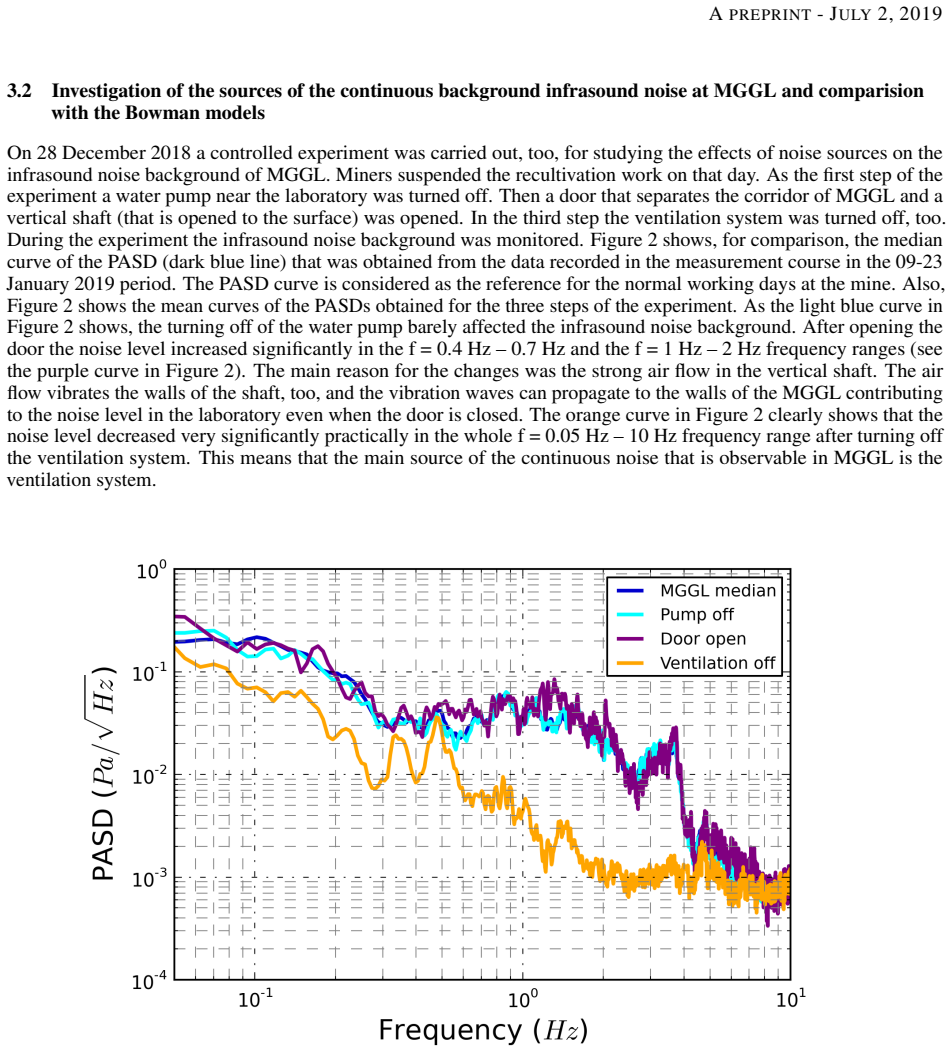
The paper claims that a discrete Haar transform algorithm identifies transients in the infrasound signal, and that their removal decreases variation in the noise spectra. Systematic on-off experiments on mine machinery establish the ventilation system as the dominant contributor to the continuous background noise.
What carries the argument
Discrete Haar transform algorithm for detecting transients in the infrasound signal
If this is right
- Eliminating transients yields noise spectra with lower variation for more reliable background characterization.
- The ventilation system is established as the primary source of continuous noise at the site.
- Targeted mitigation of ventilation noise becomes feasible for reducing Newtonian noise in subterranean gravitational-wave detectors.
- Site characterization measurements gain accuracy by accounting for mining-induced transients.
Where Pith is reading between the lines
- The transient detection method could extend to seismic data collected at the same or similar underground sites.
- Engineering changes to the ventilation system might lower overall noise levels without affecting other mine operations.
- Repeated application of the algorithm across multiple sites could help rank candidate locations for third-generation detectors.
Load-bearing premise
The on-off experiments on individual machines isolate their noise contributions without interference from other sources or environmental variations.
What would settle it
If the Haar transform algorithm leaves detectable transients in the data or if disabling the ventilation system produces no measurable drop in the continuous noise level.
Figures
read the original abstract
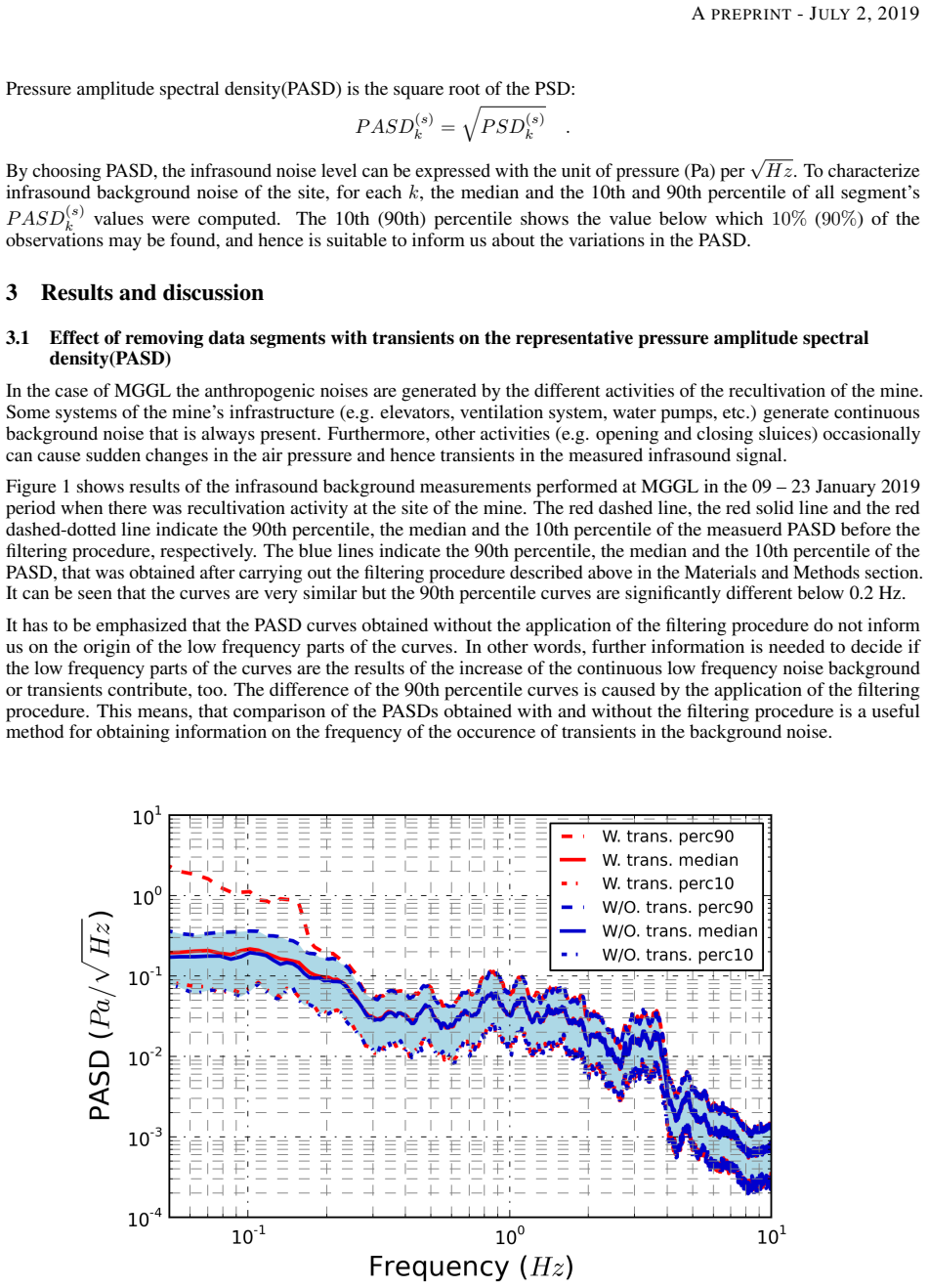
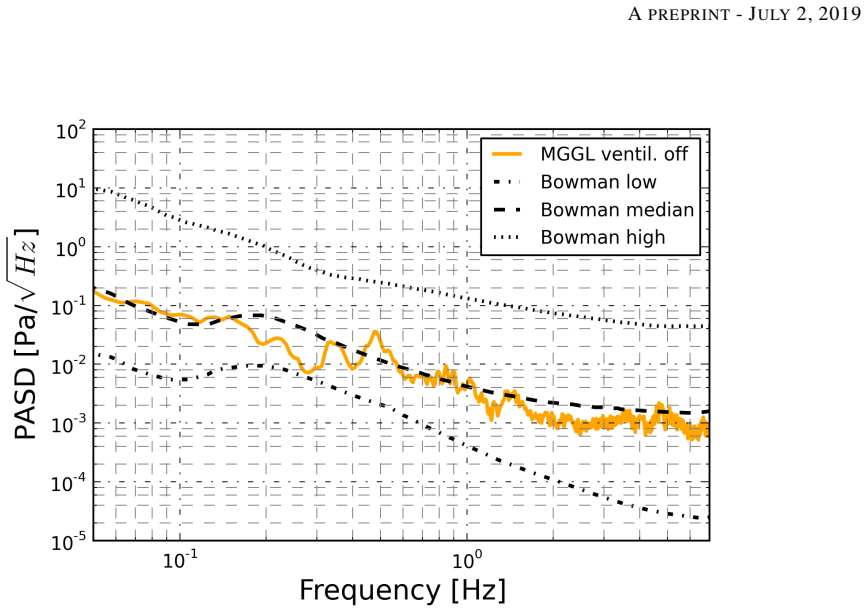
Infrasonic and seismic waves are supposed to be the main contributors to the gravity-gradient noise (Newtonian noise) of the third generation subterranean gravitational-wave detectors. This noise will limit the sensitivity of the instrument at frequencies below 20 Hz. Investigation of its origin and the possible methods of mitigation have top priority during the designing period of the detectors. Therefore long-term site characterizing measurements are needed at several subterranean sites. However, at some sites, mining activities can occur. These activities can cause sudden changes (transients) in the measured signal, and increase the continuous background noise, too. We have developed a new algorithm based on discrete Haar transform to find these transients in the infrasound signal. We found that eliminating the transients decreases the variation of the noise spectra, and hence results a more accurate characterization of the background noise. We also carried out experiments for controlling the continuous noise. Machines operating at the mine was turned on and off systematically in order to see their effect on the noise spectra. These experiments showed that the main contributor of the continuous noise is the ventilation system of the mine.
Editorial analysis
A structured set of objections, weighed in public.
Referee Report
Summary. The manuscript reports infrasound measurements at the Mátra Gravitational and Geophysical Laboratory (MGGL) in support of site characterization for third-generation gravitational-wave detectors. It introduces a discrete Haar transform algorithm to identify transients in the infrasound time series, demonstrates that transient removal reduces spectral variability, and presents on-off experiments on mine machinery that identify the ventilation system as the dominant source of continuous noise background.
Significance. Site-specific identification of Newtonian-noise contributors is relevant for subterranean GW detector design. If the on-off isolation and transient algorithm are robust, the results could directly inform mitigation priorities at mining-adjacent sites; the empirical data add to the limited body of underground infrasound characterizations.
major comments (2)
- [on-off experiments] On-off experiments section: the central claim that ventilation is the main continuous-noise contributor rests on systematic machine on-off tests, yet the manuscript provides no description of repeated interleaved trials, statistical significance testing or error propagation on the observed spectral differences, or independent monitoring of confounding variables (airflow, pressure, temperature) that are expected to change when ventilation is altered in an underground environment.
- [algorithm] Transient-detection algorithm section: the discrete Haar transform method is presented as newly developed for this application, but the text does not supply quantitative validation (e.g., detection efficiency, false-positive rate on injected transients or comparison against standard wavelet or matched-filter approaches) needed to establish that the algorithm improves upon existing transient-finding techniques.
minor comments (2)
- [figures] Figure captions and axis labels should explicitly state the frequency range, averaging method, and whether spectra are shown before or after transient removal.
- [abstract and results] The abstract states that transients were eliminated to obtain a 'more accurate characterization,' but the main text should quantify the reduction in spectral variance (e.g., standard deviation across epochs) rather than stating it qualitatively.
Simulated Author's Rebuttal
We thank the referee for the constructive comments on our manuscript. We address each major comment below, indicating planned revisions where appropriate to strengthen the presentation of the on-off experiments and the transient-detection algorithm.
read point-by-point responses
-
Referee: On-off experiments section: the central claim that ventilation is the main continuous-noise contributor rests on systematic machine on-off tests, yet the manuscript provides no description of repeated interleaved trials, statistical significance testing or error propagation on the observed spectral differences, or independent monitoring of confounding variables (airflow, pressure, temperature) that are expected to change when ventilation is altered in an underground environment.
Authors: We agree that the on-off section would benefit from greater detail on experimental design and limitations. The tests consisted of systematic, sequential on-off switching of the ventilation system and other mine machinery while recording infrasound spectra; however, the manuscript does not describe repeated interleaved trials, formal statistical tests, error propagation, or independent monitoring of airflow, pressure or temperature. Operational constraints at the underground site prevented additional instrumentation and multiple interleaved runs. We will revise the section to describe the exact sequence performed, explicitly note the absence of statistical analysis and confounding-variable monitoring, and qualify the conclusion that ventilation dominates the continuous background accordingly. revision: partial
-
Referee: Transient-detection algorithm section: the discrete Haar transform method is presented as newly developed for this application, but the text does not supply quantitative validation (e.g., detection efficiency, false-positive rate on injected transients or comparison against standard wavelet or matched-filter approaches) needed to establish that the algorithm improves upon existing transient-finding techniques.
Authors: The manuscript introduces the discrete Haar transform as a practical tool for identifying transients in the MGGL infrasound records and demonstrates its utility through the observed reduction in spectral variability after removal. We did not include quantitative performance metrics such as detection efficiency, false-positive rates on injected signals, or direct comparisons to wavelets or matched filters. We will revise the algorithm section to add a short validation subsection that applies the method to synthetic transients with known properties and reports basic detection statistics, while clarifying that the primary contribution is the application to site-characterization data rather than a comprehensive benchmark against other techniques. revision: yes
Circularity Check
No significant circularity in empirical measurements and algorithm application
full rationale
The paper reports direct site measurements of infrasound, application of a discrete Haar transform algorithm to detect transients, and on-off experiments isolating machine contributions. No load-bearing derivations, equations, or predictions are described that reduce by construction to fitted inputs or self-definitions. No self-citation chains or uniqueness theorems are invoked. The central claims rest on experimental data collection and processing rather than any circular reduction, consistent with the paper being an observational characterization study.
Axiom & Free-Parameter Ledger
axioms (1)
- domain assumption The discrete Haar transform can be used to detect transients in infrasound time series data.
Reference graph
Works this paper leans on
-
[1]
B. P. Abbott et al. (LIGO Scientific Collaboration and Virgo Collaboration). Observation of Gravitational Waves from a Binary Black Hole Merger, Phys. Rev. Lett., 2016, 116(6), 061102, doi:10.1103/PhysRevLett.116.061102
-
[2]
B. P. Abbott et al. (LIGO Scientific Collaboration and Virgo Collaboration), GW151226: Observation of Gravi- tational Waves from a 22-Solar-Mass Binary Black Hole Coalescence. Phys. Rev. Lett., 2016, 116(21), 241103, doi:10.1103/PhysRevLett.116.241103
-
[3]
B. P. Abbott et al. (LIGO Scientific Collaboration and Virgo Collaboration), GW170104: Observation of a 50-Solar-Mass Binary Black Hole Coalescence at Redshift 0.2. Phys. Rev. Lett. , 2017, 118(22), 221101, doi:10.1103/PhysRevLett.118.221101. 6 A PREPRINT - J ULY 2, 2019
-
[4]
B. P. Abbott et al. (LIGO Scientific Collaboration and Virgo Collaboration), GW170608: Observation of a 19 Solar-mass Binary Black Hole Coalescence. American Astronomical Society, 2017, 851(2), L35, doi:10.3847/2041- 8213/aa9f0c
-
[5]
B. P. Abbott et al. (LIGO Scientific Collaboration and Virgo Collaboration), GW170814: A Three-Detector Observation of Gravitational Waves from a Binary Black Hole Coalescence. Phys. Rev. Lett. , 2017, 119(14), 141101, doi:10.1103/PhysRevLett.119.141101
-
[6]
B. P. Abbott et al. (LIGO Scientific Collaboration and Virgo Collaboration), GW170817: Observation of Grav- itational Waves from a Binary Neutron Star Inspiral. Phys. Rev. Lett. , 2017, 119(16), 161101, 10.1103/Phys- RevLett.119.161101
-
[7]
B. P. Abbott et al. (LIGO Scientific Collaboration and Virgo Collaboration) Multi-messenger Observations of a Binary Neutron Star Merger. The Astrophysical Journal, 2017, 848(2), L12 10.3847/2041-8213/aa91c9
-
[8]
ET conceptual design study document ; 2011
Michele Punturo, ET conceptual design study document. ET conceptual design study document ; 2011
work page 2011
-
[9]
M. Beker, J. van den Brand, D. S. Rabeling, Subterranean ground motion studies for the Einstein Telescope. Classical and Quantum Gravity , 2015, 32, doi:10.1088/0264-9381/32/2/025002
-
[10]
G. G. Barnaföldi et al., First report of long term measurements of the MGGL laboratory in the Mátra mountain range. Class. Quant. Grav., 2017, 34(11), 114001, doi:10.1088/1361-6382/aa69e3
-
[11]
Ván et al., Long term measurements from the Mátra Gravitational and Geophysical Laboratory
P. Ván et al., Long term measurements from the Mátra Gravitational and Geophysical Laboratory. 2018, arXiv:1811.05198
-
[12]
J. R. Bowman, G. E. Baker, M. Bahavar, Ambient infrasound noise. Geophysical Research Letters, 2005, 32(9), L09803, doi:10.1029/2005GL022486
-
[13]
Classical and Quantum Gravity , 2008, 27(22), 225011, doi:10.1088/0264-9381/27/22/225011
J.Harms et al., Characterization of the seismic environment at the Sanford Underground Laboratory, South Dakota. Classical and Quantum Gravity , 2008, 27(22), 225011, doi:10.1088/0264-9381/27/22/225011
-
[14]
I. N. Bronstejn et al., Handbook of Mathematics.; Springer, 2009, ISBN 978-3540721215
work page 2009
-
[15]
C. Leys, C. Ley and O. Klein, P. Bernard and L. Licata, Detecting outliers: Do not use standard deviation around the mean, use absolute deviation around the median. Journal of Experimental Social Psychology , 2013, 49(4), 764 - 766, doi:10.1016/j.jesp.2013.03.013. 7
discussion (0)
Sign in with ORCID, Apple, or X to comment. Anyone can read and Pith papers without signing in.