Resolving the Multiple Withdrawal Attack on ERC20 Tokens
Pith reviewed 2026-05-25 11:41 UTC · model grok-4.3
The pith
Two new mitigations resolve the multiple withdrawal attack on ERC20 tokens, one within standard constraints.
A machine-rendered reading of the paper's core claim, the machinery that carries it, and where it could break.
Core claim
No existing mitigation is fully satisfactory; the two proposed solutions mitigate the attack, with one fulfilling the constraints of the ERC20 standard and the second showing a general limitation in addressing this issue from ERC20's approve method.
What carries the argument
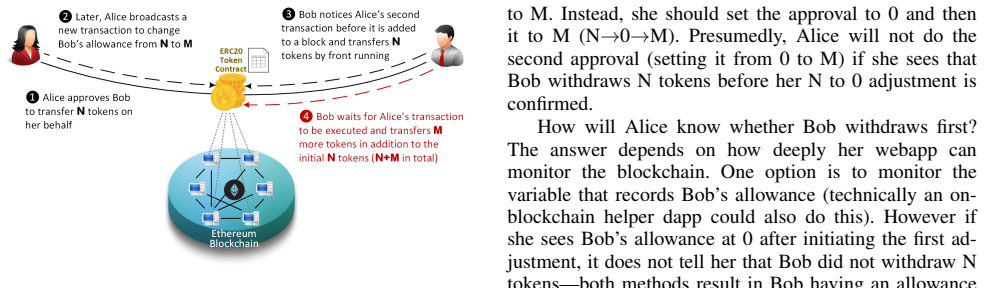
The ERC20 approve() method, which sets an allowance that can be front-run during changes from one value to another.
If this is right
- Tokens using the first proposed solution allow safe changes to approval amounts without double withdrawal risk.
- The first solution preserves compatibility with current ERC20 dapps, UIs, and web applications.
- The second solution shows that adjustments to the approve method alone cannot fully close the vulnerability.
- Both solutions stop the attacker from withdrawing both the prior and updated allowance amounts.
Where Pith is reading between the lines
- Token developers may shift toward standards that mandate separate increase and decrease allowance functions.
- This attack type points to wider risks from transaction reordering in permission systems on public blockchains.
- Similar front-running issues could appear in other smart contract mechanisms that rely on mutable approvals or permissions.
Load-bearing premise
The front-running attack on approval changes is realistic in practice and the proposed mitigations prevent it without introducing new attack vectors or breaking interoperability with existing dapps and UIs.
What would settle it
A working demonstration of the multiple withdrawal attack succeeding on a token that implements either of the two proposed mitigations.
Figures





read the original abstract
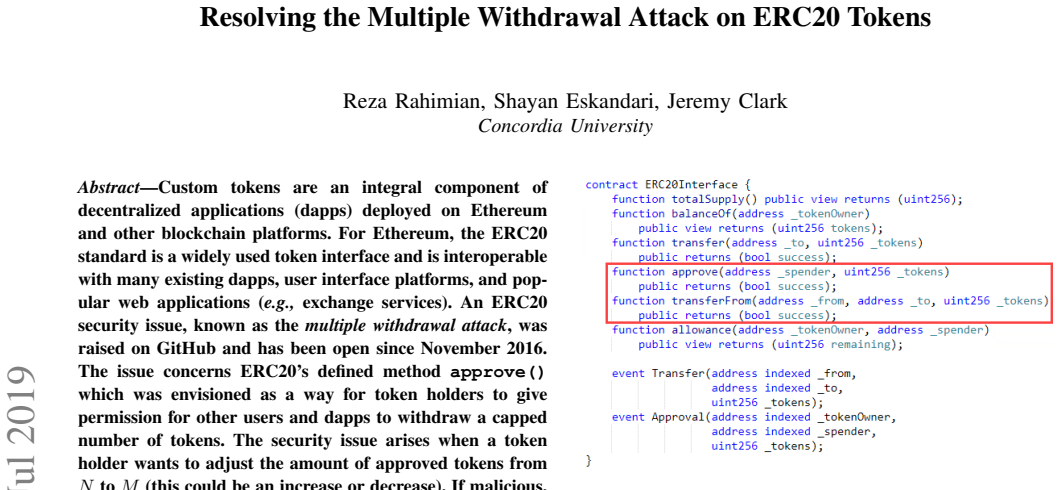
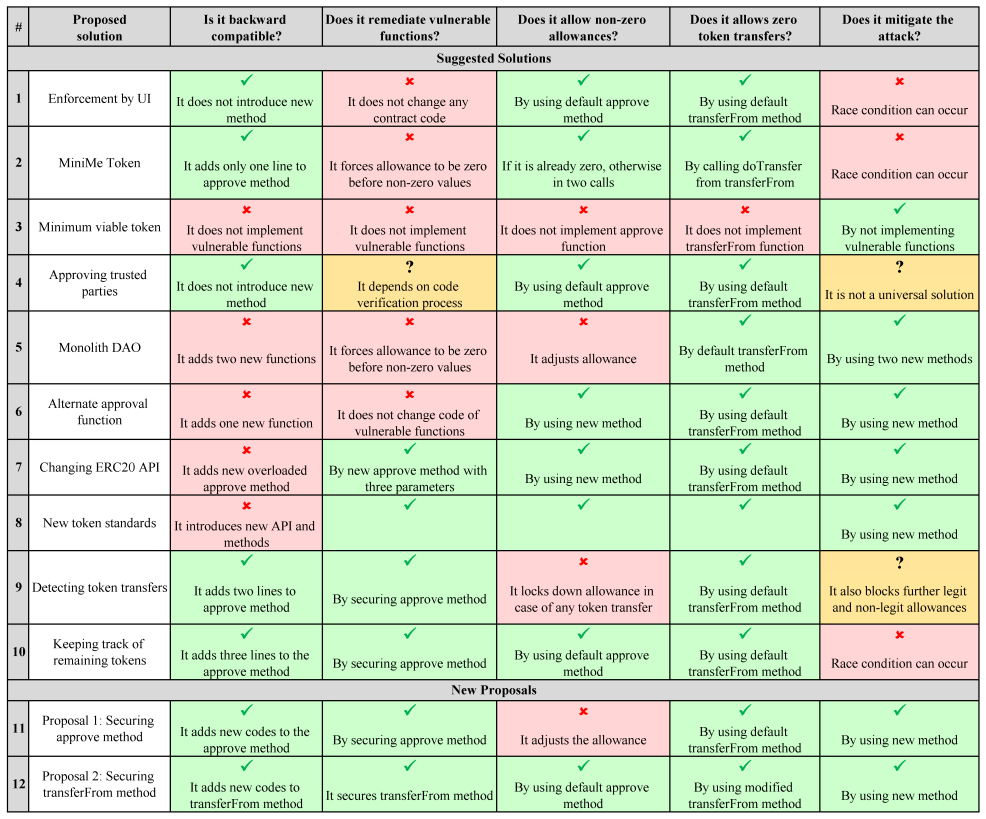
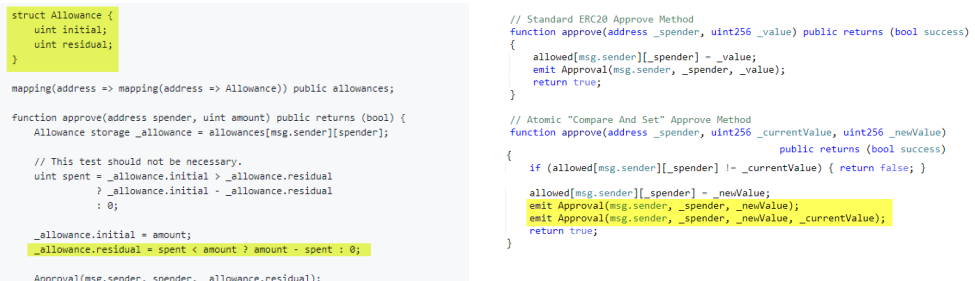
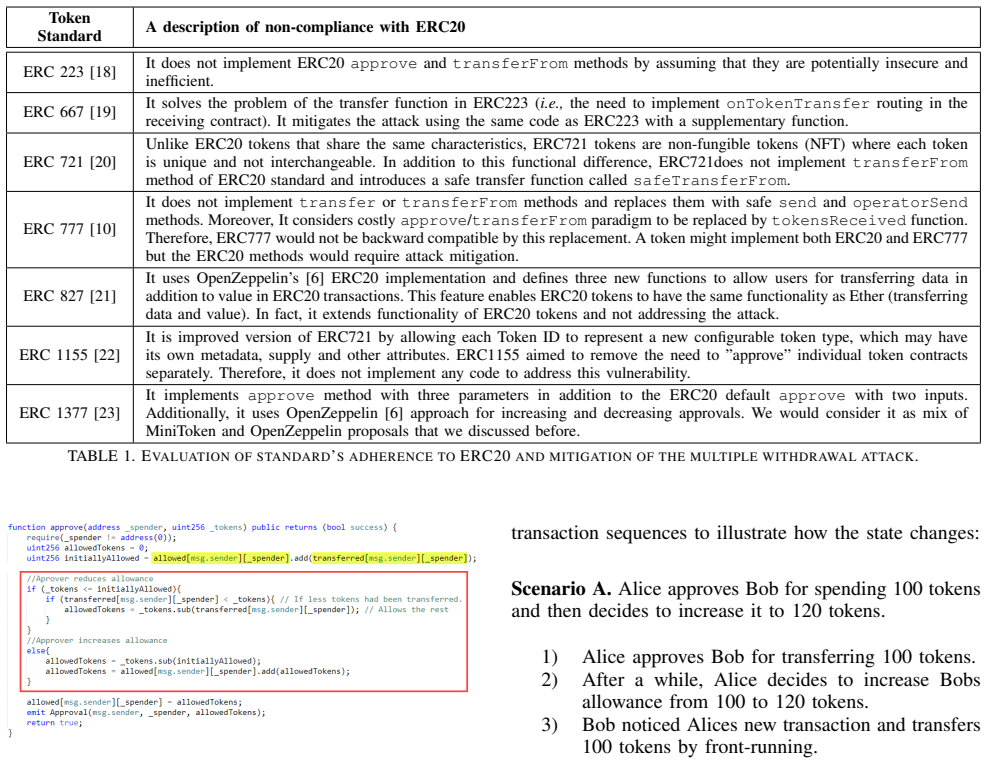
Custom tokens are an integral component of decentralized applications (dapps) deployed on Ethereum and other blockchain platforms. For Ethereum, the ERC20 standard is a widely used token interface and is interoperable with many existing dapps, user interface platforms, and popular web applications (e.g., exchange services). An ERC20 security issue, known as the "multiple withdrawal attack", was raised on GitHub and has been open since November 2016. The issue concerns ERC20's defined method approve() which was envisioned as a way for token holders to give permission for other users and dapps to withdraw a capped number of tokens. The security issue arises when a token holder wants to adjust the amount of approved tokens from N to M (this could be an increase or decrease). If malicious, a user or dapp who is approved for N tokens can front-run the adjustment transaction to first withdraw N tokens, then allow the approval to be confirmed, and withdraw an additional M tokens. In this paper, we evaluate 10 proposed mitigations for this issues and find that no solution is fully satisfactory. We then propose 2 new solutions that mitigate the attack, one of which fully fulfills constraints of the standard, and the second one shows a general limitation in addressing this issue from ERC20's approve method.
Editorial analysis
A structured set of objections, weighed in public.
Referee Report
Summary. The manuscript evaluates ten existing mitigations for the multiple-withdrawal (front-running) attack on ERC20's approve() method, in which an approved party can withdraw both the old and new allowance amounts by ordering transactions appropriately. It concludes that none of the ten is fully satisfactory under the authors' criteria. The authors then present two new proposals: one that remains compliant with the ERC20 interface and a second that demonstrates an inherent limitation when attempting to solve the problem solely through modifications to approve().
Significance. If the case-by-case analysis is accurate, the paper supplies a useful consolidation of a long-standing ERC20 security issue first noted in 2016. By enumerating shortcomings of prior patches and offering concrete alternatives, it can inform token developers and future token standards. The work is an external security analysis rather than a formal proof or empirical measurement study; its value therefore lies in the clarity of the enumeration and the identification of a general limitation in the approve() design.
major comments (2)
- [Section 4] The central claim that 'no solution is fully satisfactory' rests on the evaluation of the ten mitigations (Section 4). The manuscript does not supply the concrete test scenarios, code snippets, or decision criteria used to reach that verdict for each mitigation; without these details the conclusion cannot be independently verified.
- [Section 5.2] Proposed Solution 2 (Section 5.2) is presented as exposing a general limitation of the approve() method, yet the text does not demonstrate that the new proposal itself avoids introducing fresh front-running vectors or breaking existing dApp integrations—the two assumptions identified as weakest in the analysis.
minor comments (2)
- [Abstract / Introduction] The abstract and introduction should include the URL or issue number of the original GitHub discussion referenced in November 2016.
- [Section 4 / Section 5] A summary table listing all twelve approaches (ten existing + two new) together with the authors' pass/fail verdict on each would improve readability.
Simulated Author's Rebuttal
We thank the referee for the constructive feedback on our analysis of the ERC20 multiple-withdrawal attack. The comments highlight areas where additional detail will improve verifiability and completeness. We address each major comment below and will incorporate the suggested clarifications in the revised manuscript.
read point-by-point responses
-
Referee: [Section 4] The central claim that 'no solution is fully satisfactory' rests on the evaluation of the ten mitigations (Section 4). The manuscript does not supply the concrete test scenarios, code snippets, or decision criteria used to reach that verdict for each mitigation; without these details the conclusion cannot be independently verified.
Authors: We agree that the evaluation in Section 4 would benefit from greater explicitness to support independent verification. The original analysis applied a consistent set of criteria (compliance with the ERC20 interface, resistance to the described front-running attack, and preservation of existing dApp behavior) across all ten mitigations, but these were not enumerated with per-mitigation test cases. In the revision we will add a dedicated subsection listing the precise decision criteria, one or more concrete transaction-ordering test scenarios for each mitigation, and pseudocode or Solidity snippets illustrating the attack surface where relevant. This will make the conclusion that none of the ten mitigations is fully satisfactory directly checkable. revision: yes
-
Referee: [Section 5.2] Proposed Solution 2 (Section 5.2) is presented as exposing a general limitation of the approve() method, yet the text does not demonstrate that the new proposal itself avoids introducing fresh front-running vectors or breaking existing dApp integrations—the two assumptions identified as weakest in the analysis.
Authors: We accept that the current text of Section 5.2 does not contain an explicit argument that Solution 2 introduces no new front-running vectors and maintains dApp compatibility. Solution 2 is intentionally non-compliant with the ERC20 interface precisely to illustrate the inherent limitation of working only inside approve(); its design therefore trades interface compatibility for attack resistance. In the revision we will add a short subsection that (a) enumerates why the new call pattern cannot be front-run in the same manner and (b) discusses the resulting breakage of existing dApp integrations, thereby making the trade-off explicit rather than implicit. revision: yes
Circularity Check
No significant circularity
full rationale
The paper performs an external security analysis of the ERC20 multiple-withdrawal attack and evaluates ten prior mitigations plus two new proposals through case-by-case reasoning. No equations, fitted parameters, predictions, or self-citation chains appear in the argument structure; the claims rest on direct examination of the ERC20 interface and documented attack scenarios rather than any reduction of results to the paper's own inputs by construction.
Axiom & Free-Parameter Ledger
axioms (2)
- domain assumption The ERC20 approve() function behaves as specified in the standard and is used by existing dapps and UIs without modification.
- domain assumption Front-running of transactions is possible on Ethereum due to public mempool visibility.
Reference graph
Works this paper leans on
-
[1]
Ethereum. Ethereum project repository. https://github.com/ ethereum, May 2014. [Online; accessed 10-Nov-2018]
work page 2014
-
[2]
Fabian V ogelsteller and Vitalik Buterin. ERC-20 Token Stan- dard. https://github.com/ethereum/EIPs/blob/master/EIPS/eip-20. md, November 2015. [Online; accessed 2-Dec-2018]
work page 2015
-
[3]
Attack vector on ERC20 API (approve/transferFrom methods) and suggested improvements
Mikhail Vladimirov. Attack vector on ERC20 API (approve/transferFrom methods) and suggested improvements. https://github.com/ethereum/EIPs/issues/20#issuecomment- 263524729, November 2016. [Online; accessed 18-Dec-2018]
work page 2016
-
[4]
Resolution on the EIP20 API Approve / TransferFrom multiple withdrawal attack #738
Tom Hale. Resolution on the EIP20 API Approve / TransferFrom multiple withdrawal attack #738. https://github.com/ethereum/ EIPs/issues/738, October 2017. [Online; accessed 5-Dec-2018]
work page 2017
-
[5]
Sok: Transparent dishonesty: front-running attacks on blockchain
Shayan Eskandari, Seyedehmahsa Moosavi, and Jeremy Clark. Sok: Transparent dishonesty: front-running attacks on blockchain
-
[6]
https://rinkeby.etherscan.io/address/0x5d148c948c01e1a61e280c8 b2ac39fd49ee6d9c6 International Conference on Financial Cryptography and Data Security, 2019
work page 2019
-
[7]
OpenZeppelin. openzeppelin-solidity. https://github.com/ OpenZeppelin/openzeppelin-solidity/blob/master/contracts/ token/ERC20/ERC20.sol, December 2018. [Online; accessed 23-Dec-2018]
work page 2018
-
[8]
ConsenSys. ConsenSys/Tokens. https://github.com/ConsenSys/ Tokens/blob/fdf687c69d998266a95f15216b1955a4965a0a6d/ contracts/eip20/EIP20.sol, April 2018. [Online; accessed 24-Dec-2018]
work page 2018
-
[9]
Wikipedia. Compare-and-swap. https://en.wikipedia.org/wiki/ Compare-and-swap, July 2018. [Online; accessed 10-Dec-2018]
work page 2018
-
[10]
Measuring ethereum-based erc20 token networks
Friedhelm Victor and Bianca Katharina L ¨uders. Measuring ethereum-based erc20 token networks. In International Confer- ence on Financial Cryptography and Data Security , 2019
work page 2019
-
[11]
EIP 777: A New Advanced Token Standard
Jacques Dafflon, Jordi Baylina, and Thomas Shababi. EIP 777: A New Advanced Token Standard. https://eips.ethereum.org/EIPS/ eip-777, November 2017. [Online; accessed 12-Jan-2019]
work page 2017
-
[12]
Detecting Token Systems on Ethereum
Michael Fr ¨owis, Andreas Fuchs, and Rainer B ¨ohme. Detecting token systems on ethereum. arXiv preprint arXiv:1811.11645 , 2018
work page internal anchor Pith review Pith/arXiv arXiv 2018
-
[13]
minime/con- tracts/MiniMeToken.sol
Jordi Baylina, Danil Nemirovsky, and sophiii. minime/con- tracts/MiniMeToken.sol. https://github.com/Giveth/minime/blob/ master/contracts/MiniMeToken.sol#L225, December 2017. [On- line; accessed 23-Dec-2018]
work page 2017
-
[14]
Peter Vessenes. MonolithDAO/token. https://github.com/ MonolithDAO/token/blob/master/src/Token.sol, April 2017. [On- line; accessed 23-Dec-2018]
work page 2017
-
[15]
flygoing/BackwardsCompatibleApprove.sol
Nate Welch. flygoing/BackwardsCompatibleApprove.sol. https: //gist.github.com/flygoing/2956f0d3b5e662a44b83b8e4bec6cca6, February 2018. [Online; accessed 23-Dec-2018]
work page 2018
-
[16]
outofgas. outofgas comment. https://github.com/ethereum/EIPs/ issues/738#issuecomment-373935913, March 2018. [Online; ac- cessed 25-Dec-2018]
work page 2018
-
[17]
M. Vladimirov and D. Khovratovich. ERC20 API: An Attack Vector on Approve/TransferFrom Methods. https://docs.google.com/document/d/ 1YLPtQxZu1UAvO9cZ1O2RPXBbT0mooh4DYKjA jp- RLM/edit#heading=h.m9fhqynw2xvt, November 2016. [Online; accessed 25-Nov-2018]
work page 2016
-
[18]
Enrique Chavez. StandardToken.sol. https://github.com/kindads/erc20-token/blob/ 40d796627a2edd6387bdeb9df71a8209367a7ee9/contracts/ zeppelin-solidity/contracts/token/StandardToken.sol, March 2018. [Online; accessed 23-Dec-2018]
work page 2018
-
[19]
Dexaran. ERC223 token standard. https://github.com/ethereum/ EIPs/issues/223, March 2017. [Online; accessed 12-Jan-2019]
work page 2017
-
[20]
transferAndCall Token Standard
Steve Ellis. transferAndCall Token Standard. https://github.com/ ethereum/EIPs/issues/677, July 2017. [Online; accessed 12-Jan- 2019]
work page 2017
-
[21]
ERC-721 Non-Fungible Token Standard
William Entriken, Dieter Shirley, Jacob Evans, and Nastassia Sachs. ERC-721 Non-Fungible Token Standard. https://github. com/ethereum/EIPs/blob/master/EIPS/eip-721.md, January 2018. [Online; accessed 12-Jan-2019]
work page 2018
-
[22]
ERC827 Token Standard (ERC20 Extension)
Augusto Lemble. ERC827 Token Standard (ERC20 Extension). https://github.com/ethereum/eips/issues/827, January 2018. [On- line; accessed 12-Jan-2019]
work page 2018
-
[23]
Witek Radomski, Cooke Andrew, Philippe Castonguay, James Therien, and Eric Binet. ERC-1155 Multi Token Standard. https: //github.com/ethereum/EIPs/blob/master/EIPS/eip-1155.md, June
-
[24]
[Online; accessed 12-Jan-2019]
work page 2019
-
[25]
Service-Friendly Token Standard
Atkins Chang, Noel Bao, Jack Chu, Leo Chou, and Darren Goh. Service-Friendly Token Standard. https://github.com/fstnetwork/ EIPs/blob/master/EIPS/eip-1376.md, September 2018. [Online; accessed 12-Jan-2019]
work page 2018
-
[26]
The ico phenomenon and its relationships with ethereum smart contract environment
Gianni Fenu, Lodovica Marchesi, Michele Marchesi, and Roberto Tonelli. The ico phenomenon and its relationships with ethereum smart contract environment. In 2018 International Workshop on Blockchain Oriented Software Engineering (IWBOSE) , pages 26–
work page 2018
discussion (0)
Sign in with ORCID, Apple, or X to comment. Anyone can read and Pith papers without signing in.