Probing discontinuous precipitation in U-Nb
Pith reviewed 2026-05-25 11:47 UTC · model grok-4.3
The pith
Local misfit strain at grain boundaries controls gamma-prime composition trends in U-Nb discontinuous precipitation.
A machine-rendered reading of the paper's core claim, the machinery that carries it, and where it could break.
Core claim
Local misfit strain tends to play a crucial role in the formation and growth of the discontinuous precipitation. Depending on the magnitude of strain developed at grain boundaries, either an increasing gamma-prime composition or a random distribution of gamma-prime composition around the equiatomic value with respect to increasing temperature could be expected.
What carries the argument
Phase-field model whose free-energy functional includes both the double-well potential for the gamma phase and an explicit elastic strain-energy term evaluated at grain boundaries.
If this is right
- Larger grain-boundary misfit strains produce gamma-prime compositions that remain randomly distributed near 50 at percent niobium at all temperatures.
- Smaller grain-boundary misfit strains recover the classic common-tangent prediction of steadily rising gamma-prime niobium content with temperature.
- Strain energy can therefore decide whether the precipitation follows a purely thermodynamic path or a strain-dominated path.
- The same strain term also supplies a kinetic driving force that favors cellular growth along high-strain boundaries.
Where Pith is reading between the lines
- Alloy processing routes that alter grain-boundary character or residual stress could be used to select between the two composition regimes.
- Comparable strain-controlled selection may appear in other systems that show discontinuous precipitation of metastable phases.
- Atomistic calculations that supply temperature-dependent misfit strains could be fed directly into the phase-field model to remove one fitting parameter.
Load-bearing premise
The chosen phase-field parameters and energy expressions, including the double-well potential and the strain term, are accurate enough that simulated strain effects dominate all other unmodeled factors in real U-Nb.
What would settle it
Direct measurement showing that gamma-prime compositions inside cellular structures bear no systematic relation to independently quantified local misfit strains at the originating grain boundaries.
Figures


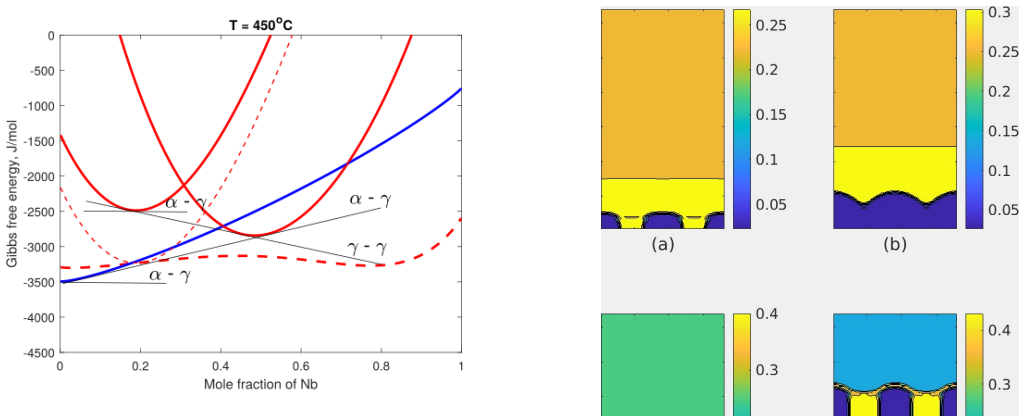

read the original abstract
U-Nb's discontinuous precipitation, $\gamma^{bcc}_{matrix} \rightarrow \alpha^{orth}_{cellular} + \gamma'^{bcc}_{cellular}$, is intriguing in the sense that it allows formation and growth of the metastable $\gamma'$ phase during the course of its occurrence. Previous attempts to explain the thermodynamic origin of U-Nb's discontinuous precipitation hypothesized that the energy of $\alpha$ forms an intermediate common tangent with the first potential of the double-well energy of $\gamma$ at the $\gamma'$ composition. While this hypothesis is eligible and consistent with the experimental observation of gradual increase in $\gamma'$ composition at increasing temperature, it is in conflict with recent experiments whose results indicated a distribution of $\gamma'$ compositions in the vicinity of 50 at\%Nb. To shed some light onto this issue, the current work investigates the origin of U-Nb's discontinuous precipitation in view of fundamental thermodynamics and kinetics, taken from the perspective of phase-field theory. It has been showed that local misfit strain tends to play a crucial role in the formation and growth the discontinuous precipitation. Depending on the magnitude of strain developed at grain boundaries, either an increasing $\gamma'$ composition or a random distribution of $\gamma'$ composition around the equiatomic value with respect to increasing temperature could be expected.
Editorial analysis
A structured set of objections, weighed in public.
Referee Report
Summary. The manuscript applies phase-field theory to U-Nb discontinuous precipitation (γ_bcc_matrix → α_orth_cellular + γ'_bcc_cellular) and concludes that local misfit strain at grain boundaries plays a crucial role in forming and growing the metastable γ' phase. It argues that the magnitude of this strain can produce either an increasing γ' composition with temperature or a random distribution around the equiatomic (50 at% Nb) value, thereby reconciling conflicting experimental observations that previous common-tangent hypotheses could not.
Significance. If the strain-energy coupling to the double-well potential is shown to control the outcomes after proper calibration, the work would offer a mechanistic explanation for variable γ' compositions in U-Nb and highlight strain effects in discontinuous precipitation more broadly. The phase-field approach that simultaneously treats thermodynamics and kinetics is a positive feature, though the absence of reported parameter validation or quantitative experimental comparisons limits the immediate impact.
major comments (2)
- [Abstract] Abstract: the central claim that 'local misfit strain tends to play a crucial role' and can produce either increasing or random γ' compositions with temperature is load-bearing for the entire argument, yet the abstract (and the description of the modeling perspective) supplies no equations for the strain-energy term, no values for the misfit strain magnitude or double-well coefficients, and no simulation outputs or direct comparison to measured γ' composition histograms near 50 at% Nb.
- [Abstract] Abstract: without calibration of the strain energy and double-well parameters against experimental U-Nb lattice parameters, formation energies, or the observed distribution of γ' compositions, it remains unclear whether the simulated strain effects dominate over unmodeled factors such as boundary diffusion or kinetics, undermining the assertion that strain explains the experimental variability.
minor comments (1)
- [Abstract] The abstract refers to 'the first potential of the double-well energy of γ' without defining the functional form or referencing the prior hypothesis it critiques; adding a brief equation or citation would improve clarity.
Simulated Author's Rebuttal
We thank the referee for the constructive feedback and the recommendation for major revision. We agree that the abstract requires expansion to better convey the model details and will revise it accordingly. The full manuscript already contains the strain-energy formulation, parameter values drawn from literature, and simulation results; we will make these connections more explicit in the abstract and add a parameter discussion section. We believe the strain-based explanation remains a valid mechanistic account of the observed variability.
read point-by-point responses
-
Referee: [Abstract] Abstract: the central claim that 'local misfit strain tends to play a crucial role' and can produce either increasing or random γ' compositions with temperature is load-bearing for the entire argument, yet the abstract (and the description of the modeling perspective) supplies no equations for the strain-energy term, no values for the misfit strain magnitude or double-well coefficients, and no simulation outputs or direct comparison to measured γ' composition histograms near 50 at% Nb.
Authors: We acknowledge that the abstract prioritizes brevity and therefore omits explicit equations and numerical values. The strain-energy term appears in the Methods (elastic energy coupled to the double-well potential, Eq. 3), misfit strains are taken from measured U-Nb lattice parameters (typically 0.8–1.5 %), double-well coefficients are set to reproduce formation energies from the literature, and the resulting γ' composition histograms are shown in Figs. 4 and 6 together with experimental data points near 50 at% Nb. We will revise the abstract to include a concise statement of the strain-energy form, representative parameter values, and a reference to the histogram figures. revision: yes
-
Referee: [Abstract] Abstract: without calibration of the strain energy and double-well parameters against experimental U-Nb lattice parameters, formation energies, or the observed distribution of γ' compositions, it remains unclear whether the simulated strain effects dominate over unmodeled factors such as boundary diffusion or kinetics, undermining the assertion that strain explains the experimental variability.
Authors: Parameters were chosen to be consistent with published U-Nb lattice constants and formation energies (cited in the manuscript). The model reproduces both the temperature-dependent and the near-equiatomic random distributions simply by varying the grain-boundary misfit magnitude within the experimentally reported range. A full quantitative least-squares fit to every published histogram was not performed because of scatter among experimental reports; however, we will add an explicit parameter-selection subsection and a brief sensitivity analysis showing that the strain-driven outcomes persist when modest changes are made to kinetic coefficients. This will clarify that strain remains a dominant factor within the explored regime. revision: partial
Circularity Check
No circularity: standard phase-field application to strain effects in U-Nb precipitation
full rationale
The paper applies established phase-field theory, including double-well potentials and strain-energy terms, to explore misfit strain's role in U-Nb discontinuous precipitation. The central claim—that local misfit strain can produce either increasing or randomly distributed γ' compositions with temperature—follows directly from varying the strain magnitude in the model and comparing outcomes to experimental observations. No load-bearing steps reduce predictions to fitted inputs by construction, no self-citations justify uniqueness theorems, and no ansatzes are smuggled via prior work. The derivation is self-contained within standard phase-field methods and does not equate any result to its own inputs.
Axiom & Free-Parameter Ledger
axioms (1)
- domain assumption Phase-field theory provides a valid framework for modeling the thermodynamics and kinetics of discontinuous precipitation including misfit strain.
Lean theorems connected to this paper
-
IndisputableMonolith/Cost/FunctionalEquation.leanwashburn_uniqueness_aczel unclear?
unclearRelation between the paper passage and the cited Recognition theorem.
local misfit strain tends to play a crucial role... elasto-chemical energies... harmonic approximation felas = E/2(1-ν)∫(εxx² + εyy²)dV
-
IndisputableMonolith/Foundation/AbsoluteFloorClosure.leanreality_from_one_distinction unclear?
unclearRelation between the paper passage and the cited Recognition theorem.
phase-field model with finite interface dissipation... diffusion-couple simulations... two LE between α and γ
What do these tags mean?
- matches
- The paper's claim is directly supported by a theorem in the formal canon.
- supports
- The theorem supports part of the paper's argument, but the paper may add assumptions or extra steps.
- extends
- The paper goes beyond the formal theorem; the theorem is a base layer rather than the whole result.
- uses
- The paper appears to rely on the theorem as machinery.
- contradicts
- The paper's claim conflicts with a theorem or certificate in the canon.
- unclear
- Pith found a possible connection, but the passage is too broad, indirect, or ambiguous to say the theorem truly supports the claim.
Reference graph
Works this paper leans on
-
[1]
R. Vandermeer, Phase transformations in a uranium-14 at.% niobium alloy, Acta Metallurgica 28 (3) (1980) 383–393
work page 1980
-
[2]
K. Eckelmeyer, A. Romig, L. Weirick, The effect of quench rate on the microstructure, mechanical properties, and corro- sion behavior of U-6 wt pct Nb, Metallurgical Transactions A 15 (7) (1984) 1319–1330
work page 1984
-
[3]
H. M. Volz, R. E. Hackenberg, A. M. Kelly, W. Hults, A. Law- son, R. Field, D. Teter, D. Thoma, X-ray diffraction analyses of aged U-Nb alloys, Journal of Alloys and Compounds 444- 445 (2007) 217–225
work page 2007
- [4]
-
[5]
D. Williams, E. Butler, Grain boundary discontinuous precip- itation reactions, International Metals Reviews 26 (1) (1981) 153–183
work page 1981
- [6]
-
[7]
R. E. Hackenberg, H. M. Volz, P. A. Papin, A. M. Kelly, R. T. Forsyth, T. J. Tucker, K. D. Clarke, Kinetics of lamellar de- composition reactions in U-Nb alloys, Solid State Phenomena 172 (2011) 555–560
work page 2011
-
[8]
B. Djuri ´c, Decomposition of gamma phase in a uranium- 9.5 wt% niobium alloy, Journal of Nuclear Materials 44 (2) (1972) 207–214
work page 1972
-
[9]
Hackenberg RE, Yablinsky CA, Llobet A, Volz HM, Papin PA, Tucker TJ, Clarke KD, Emigh MG., Lamellar and non- lamellar decomposition in U-Nb: Energy sinks and approach to equilibrium, in: Proc. of the Int. Conf. On Solid-Solid Phase Transformations in Inorganic Materials, M. Millitzer, et al. -ed. TMS Warrendale, PA, PTM, 2015, pp. 211–218
work page 2015
- [10]
-
[11]
X. Liu, Z. Li, J. Wang, C. Wang, Thermodynamic modeling of the U-Mn and U-Nb systems, Journal of Nuclear Materials 380 (1) (2008) 99–104
work page 2008
-
[12]
T. C. Duong, R. E. Hackenberg, A. Landa, P. Honarmandi, A. Talapatra, H. M. Volz, A. Llobet, A. I. Smith, G. King, S. Bajaj, et al., Revisiting thermodynamics and kinetic diffu- sivities of uranium–niobium with bayesian uncertainty anal- ysis, Calphad 55 (2016) 219–230
work page 2016
-
[13]
L.-Q. Chen, Phase-field models for microstructure evolution, Annual review of materials research 32 (1) (2002) 113–140
work page 2002
-
[14]
N. Moelans, B. Blanpain, P. Wollants, An introduction to phase-field modeling of microstructure evolution, Calphad 32 (2) (2008) 268–294
work page 2008
-
[15]
I. Steinbach, Phase-field models in materials science, Mod- elling and Simulation in Materials Science and Engineering 17 (7) (2009) 073001
work page 2009
- [16]
- [17]
-
[18]
I. Steinbach, L. Zhang, M. Plapp, Phase-field model with finite interface dissipation, Acta Materialia 60 (6) (2012) 2689–2701
work page 2012
- [19]
-
[20]
L. Amirouche, M. Plapp, Phase-field modeling of the discon- tinuous precipitation reaction, Acta Materialia 57 (1) (2009) 237–247
work page 2009
-
[21]
L. Amirouche, M. Plapp, On the effect of bulk diffusion on the initiation of the discontinuous precipitation reaction: phase- field simulations, in: Solid State Phenomena, Vol. 172, Trans Tech Publ, 2011, pp. 549–554
work page 2011
-
[22]
Turnbull, Theory of cellular precipitation, Acta Metallur- gica 3 (1) (1955) 55–63
D. Turnbull, Theory of cellular precipitation, Acta Metallur- gica 3 (1) (1955) 55–63
work page 1955
-
[23]
J. W. Cahn, The kinetics of cellular segregation reactions, Acta Metallurgica 7 (1) (1959) 18–28
work page 1959
-
[24]
R. Fournelle, J. Clark, The genesis of the cellular precipita- tion reaction, Metallurgical Transactions 3 (11) (1972) 2757– 2767
work page 1972
-
[25]
R. Fournelle, On the thermodynamic driving force for diffusion-induced grain boundary migration, discontinuous precipitation and liquid film migration in binary alloys, Ma- terials Science and Engineering: A 138 (1) (1991) 133–145
work page 1991
-
[26]
M. Hillert, On theories of growth during discontinuous pre- cipitation, Metallurgical Transactions 3 (11) (1972) 2729– 2741
work page 1972
-
[27]
M. Hillert, An improved model for discontinuous precipita- tion, Acta Metallurgica 30 (8) (1982) 1689–1696
work page 1982
-
[28]
B. E. Sundquist, Cellular precipitation, Metallurgical Trans- actions 4 (8) (1973) 1919–1934
work page 1973
-
[29]
L. Klinger, Y. Brechet, G. Purdy, On velocity and spacing se- lection in discontinuous precipitation-I. simplified analytical approach, Acta materialia 45 (12) (1997) 5005–5013
work page 1997
-
[30]
G. R. Purdy, Interface migration in diffusional phase trans- formations: Thermodynamic and kinetic aspects, in: Defect and Diffusion Forum, Vol. 194, Trans Tech Publ, 2001, pp. 1745–1758
work page 2001
-
[31]
J. Robson, Modeling competitive continuous and discontinu- ous precipitation, Acta Materialia 61 (20) (2013) 7781–7790
work page 2013
-
[32]
N. L. Peterson, R. E. Ogilvie, Diffusion studies in the uranium-niobium (columbium) system, Trans. Met. Soc. AIME 218 (1960) 439–444
work page 1960
-
[33]
N. Peterson, R. Ogilvie, Diffusion in the uranium-niobium (columbium) system, Trans. AIME 227 (1963) 1083–1087
work page 1963
- [34]
-
[35]
R. W. Balluffi, S. Allen, W. C. Carter, Kinetics of materials, John Wiley & Sons, 2005
work page 2005
-
[36]
J. W. Cahn, On spinodal decomposition, Acta metallurgica 9 (9) (1961) 795–801
work page 1961
-
[37]
S.-i. Yi, V. Attari, M. Jeong, J. Jian, S. Xue, H. Wang, R. Ar- royave, C. Yu, Strain-induced suppression of the miscibility gap in nanostructured Mg2Si–Mg2Sn solid solutions, Journal of Materials Chemistry A 6 (36) (2018) 17559–17570
work page 2018
- [38]
-
[39]
L. Vitos, Computational quantum mechanics for materials en- gineers: the EMTO method and applications, Springer Sci- ence & Business Media, 2007
work page 2007
-
[40]
A. Couterne, C. Collot, C. Guillaume, Etude de l’alliage mul- berry [u-7, 5 nb-2, 5 zr (% ponderaux)]. diagramme de trans- formation en refroidissement continu-structures et proprietes mecaniques, Journal of Nuclear Materials 56 (2) (1975) 169– 194
work page 1975
-
[41]
Dahmen, Orientation relationships in precipitation sys- tems, Acta Metallurgica 30 (1) (1982) 63–73
U. Dahmen, Orientation relationships in precipitation sys- tems, Acta Metallurgica 30 (1) (1982) 63–73
work page 1982
-
[42]
R. J. Jackson, Reversible martensitic transformation between transition phases of uranium-base niobium alloys., Tech. Rep. RFP-1535, Dow Chemical Co., Golden, Colo. Rocky Flats Div. (1970)
work page 1970
- [43]
-
[44]
Cverna, et al., ASM ready reference: thermal properties of metals, ASM International, 2002
F. Cverna, et al., ASM ready reference: thermal properties of metals, ASM International, 2002
work page 2002
-
[45]
R. Jackson, J. Burke, Elastic, plastic, and strength properties of U–Nb and U–Nb–Zr alloys, in: Physical metallurgy of ura- nium alloys, Brook Hill Publishing Co., 1976, pp. 611–656
work page 1976
-
[46]
A. Jain, S. P. Ong, G. Hautier, W. Chen, W. D. Richards, S. Dacek, S. Cholia, D. Gunter, D. Skinner, G. Ceder, K. a. Persson, The Materials Project: A materials genome ap- proach to accelerating materials innovation, APL Materials 1 (1) (2013) 011002
work page 2013
-
[47]
M. Korchynsky, R. Fountain, Precipitation phenomena in cobalt-tantalum alloys, Trans. Met. Soc. AIME 215 (1959) 1033–1093
work page 1959
-
[48]
M. Tałach-Duma ´nska, P. Zieba, A. Pawłowski, J. Wojewoda, W. Gust, Practical aspects of discontinuous precipitation and dissolution, Materials chemistry and physics 80 (2) (2003) 476–481. 14
work page 2003
discussion (0)
Sign in with ORCID, Apple, or X to comment. Anyone can read and Pith papers without signing in.