Trading Off Computation with Transmission in Status Update Systems
Pith reviewed 2026-05-25 11:30 UTC · model grok-4.3
The pith
Tandem queues with dependent service times yield closed-form expressions for average age of information and peak age of information.
A machine-rendered reading of the paper's core claim, the machinery that carries it, and where it could break.
Core claim
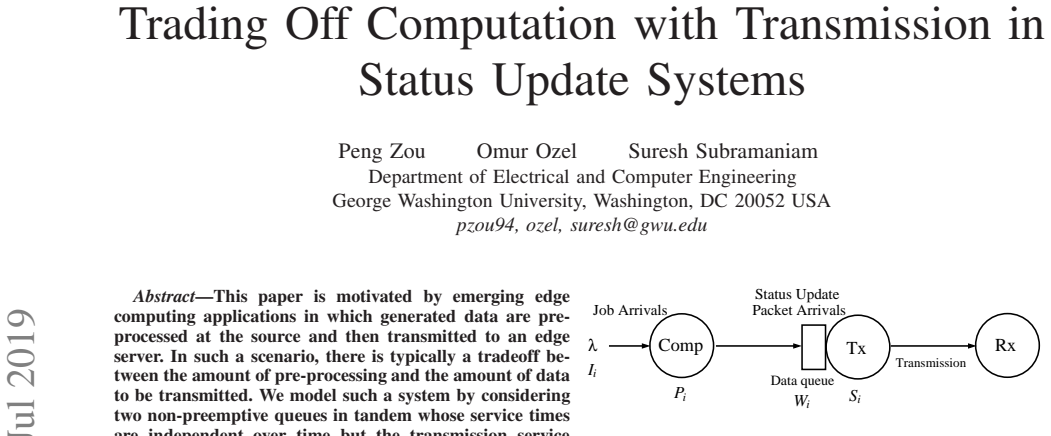
For the tandem system consisting of an M/GI/1/1 queue followed by a GI/M/1/2* queue whose mean service times are related by a deterministic monotonic function, stationary distribution analysis produces closed-form expressions for both the average age of information and the average peak age of information; numerical evaluation of these expressions confirms the existence of a tradeoff generated by the tandem structure and the service-time dependence.
What carries the argument
The tandem non-preemptive queue pair (M/GI/1/1 followed by GI/M/1/2*) whose mean service times are linked by a deterministic monotonic function, together with the stationary distribution analysis that converts this linkage into explicit AoI formulas.
If this is right
- The average AoI and peak AoI can each be written as explicit functions of the monotonic dependence parameter.
- Numerical minimization of either metric over the dependence parameter identifies an optimal operating point between computation and transmission.
- The tandem structure causes average AoI and peak AoI to respond differently to changes in the dependence parameter.
- The closed forms remain valid for any monotonic function relating the two mean service times.
Where Pith is reading between the lines
- The same stationary-distribution technique could be applied to multi-hop status-update paths that also contain computation stages.
- Relaxing the deterministic monotonic dependence to a stochastic one would require a different analysis but could still be compared against the closed forms derived here.
- The tradeoff surface obtained from the expressions supplies a benchmark for heuristic policies that adapt computation effort on the fly.
Load-bearing premise
The mean service times of the computation queue and the transmission queue are connected by a deterministic monotonic function.
What would settle it
Simulations of the two-queue system that use a monotonic deterministic mapping between the two mean service times produce average AoI values that deviate from the derived closed-form expressions.
Figures


read the original abstract
This paper is motivated by emerging edge computing applications in which generated data are pre-processed at the source and then transmitted to an edge server. In such a scenario, there is typically a tradeoff between the amount of pre-processing and the amount of data to be transmitted. We model such a system by considering two non-preemptive queues in tandem whose service times are independent over time but the transmission service time is dependent on the computation service time in mean value. The first queue is in M/GI/1/1 form with a single server, memoryless exponential arrivals, general independent service and no extra buffer to save incoming status update packets. The second queue is in GI/M/1/2* form with a single server receiving packets from the first queue, memoryless service and a single data buffer to save incoming packets. Additionally, mean service times of the first and second queues are dependent through a deterministic monotonic function. We perform stationary distribution analysis in this system and obtain closed form expressions for average age of information (AoI) and average peak AoI. Our numerical results illustrate the analytical findings and highlight the tradeoff between average AoI and average peak AoI generated by the tandem nature of the queueing system with dependent service times.
Editorial analysis
A structured set of objections, weighed in public.
Referee Report
Summary. The paper models status update systems in edge computing via a tandem queue: an M/GI/1/1 computation queue followed by a GI/M/1/2* transmission queue, with mean service times linked by a deterministic monotonic function to capture the computation-transmission tradeoff. Stationary distribution analysis yields closed-form expressions for average AoI and average peak AoI; numerical results illustrate the resulting tradeoff.
Significance. If the derivations hold, the closed-form AoI expressions constitute a useful analytical contribution to the AoI literature by extending standard tandem-queue models to include mean-dependent service times without introducing state-dependent rates. This enables direct optimization of the tradeoff parameter rather than relying exclusively on simulation.
minor comments (3)
- [§II] §II (Model): the precise definition of the monotonic function relating the two mean service times and the range of admissible parameters should be stated explicitly, as it parameterizes all subsequent expressions.
- The notation 'GI/M/1/2*' for the second queue is non-standard; a footnote or sentence clarifying the buffer semantics and the '*' would improve readability.
- [Numerical Results] Numerical results: the specific functional forms chosen for the monotonic link (e.g., linear, exponential) and the numerical values of the free parameters should be listed in a table for reproducibility.
Simulated Author's Rebuttal
We thank the referee for the careful reading and positive assessment of our contribution. The recommendation for minor revision is noted. No specific major comments were raised in the report.
Circularity Check
No significant circularity; derivation is standard stationary analysis
full rationale
The paper models a tandem queue (M/GI/1/1 followed by GI/M/1/2*) with independent realizations but means linked by a fixed monotonic function, then applies standard balance-equation methods to obtain closed-form AoI expressions. This is a direct, self-contained queueing-theoretic derivation with no reduction of outputs to fitted inputs, no self-definitional steps, and no load-bearing self-citations. The monotonic link parameterizes the tradeoff but does not create state-dependent rates that would invalidate the stationary analysis or force the result by construction.
Axiom & Free-Parameter Ledger
free parameters (1)
- monotonic function relating mean service times
axioms (1)
- domain assumption Stationary distribution exists for the described tandem non-preemptive queues
Lean theorems connected to this paper
-
IndisputableMonolith/Cost/FunctionalEquation.leanwashburn_uniqueness_aczel unclear?
unclearRelation between the paper passage and the cited Recognition theorem.
mean service times of the first and second queues are dependent through a deterministic monotonic function... We perform stationary distribution analysis... closed form expressions for average age of information (AoI) and average peak AoI
-
IndisputableMonolith/Foundation/AbsoluteFloorClosure.leanreality_from_one_distinction unclear?
unclearRelation between the paper passage and the cited Recognition theorem.
two non-preemptive queues in tandem... M/GI/1/1 ... GI/M/1/2*
What do these tags mean?
- matches
- The paper's claim is directly supported by a theorem in the formal canon.
- supports
- The theorem supports part of the paper's argument, but the paper may add assumptions or extra steps.
- extends
- The paper goes beyond the formal theorem; the theorem is a base layer rather than the whole result.
- uses
- The paper appears to rely on the theorem as machinery.
- contradicts
- The paper's claim conflicts with a theorem or certificate in the canon.
- unclear
- Pith found a possible connection, but the passage is too broad, indirect, or ambiguous to say the theorem truly supports the claim.
Forward citations
Cited by 1 Pith paper
-
Timely Cloud Computing: Preemption and Waiting
In cloud status updates with i.i.d. random service times, the optimal deterministic policy minimizing long-run average AoI uses a threshold on current age to decide when to upload and a fixed cutoff to preempt long co...
Reference graph
Works this paper leans on
- [1]
-
[2]
S. Kaul, R. Y ates, and M. Gruteser. Real-time status: How often should one update ? In INFOCOM, pages 2731–2735. IEEE, 2012
work page 2012
- [3]
-
[4]
C. Kam, S. Kompella, G.D. Nguyen, J.E. Wieselthier, and A. Ephremides. On the age of information with packet deadlin es. IEEE Transactions on Information Theory , 2018
work page 2018
- [5]
-
[6]
E. Najm and R. Nasser. Age of information: The gamma awak- ening. In Information Theory (ISIT), 2016 IEEE International Symposium on , pages 2574–2578. Ieee, 2016
work page 2016
-
[7]
E. Najm, R. Y ates, and E. Soljanin. Status updates throug h M/G/1/1 queues with HARQ. In IEEE ISIT , 2017
work page 2017
-
[8]
A. Baknina, O. Ozel, J. Y ang, S. Ulukus, and A. Y ener. Send ing information through status updates. In IEEE ISIT , 2018
work page 2018
-
[9]
B. T. Bacinoglu, E. T. Ceran, and E. Uysal-Biyikoglu. Age of information under energy replenishment constraints. In USCD ITA, February 2015
work page 2015
-
[10]
R. Y ates. Lazy is timely: Status updates by an energy har vesting source. In IEEE ISIT , June 2015
work page 2015
-
[11]
X. Wu, J. Y ang, and J. Wu. Optimal status update for age of information minimization with an energy harvesting source . IEEE Trans. on Green Communications and Networking , 2(1), March 2018
work page 2018
-
[12]
A. Arafa and S. Ulukus. Age-minimal transmission in ene rgy harvesting two-hop networks. In IEEE Globecom , December 2017
work page 2017
-
[13]
B.T. Bacinoglu and E. Uysal-Biyikoglu. Scheduling sta tus updates to minimize age of information with an energy harves ting sensor. In IEEE ISIT , pages 1122–1126. IEEE, 2017
work page 2017
-
[14]
S. Farazi, A.G. Klein, and D.R. Brown. Average age of inf orma- tion for status update systems with an energy harvesting ser ver. In IEEE INFOCOM WORKSHPS , pages 112–117, 2018
work page 2018
-
[15]
B.T. Bacinoglu, Y . Sun, E. Uysal-Bivikoglu, and V . Mutl u. Achieving the age-energy tradeoff with a finite-battery ene rgy harvesting source. In IEEE ISIT , pages 876–880. IEEE, 2018
work page 2018
-
[16]
S. Feng and J. Y ang. Age of information minimization for an energy harvesting source with updating erasures: With an d without feedback. arXiv preprint arXiv:1808.05141 , 2018
work page internal anchor Pith review Pith/arXiv arXiv 2018
-
[17]
Using Erasure Feedback for Online Timely Updating with an Energy Harvesting Sensor
Ahmed Arafa, Jing Y ang, Sennur Ulukus, and H Vincent Poo r. Using erasure feedback for online timely updating with an en ergy harvesting sensor. arXiv preprint arXiv:1901.08577 , 2019
work page internal anchor Pith review Pith/arXiv arXiv 1901
-
[18]
A. M. Bedewy, Y . Sun, and N. B. Shroff. Age-optimal information updates in multihop networks. Available at arXiv:1701.05711, 2017
work page internal anchor Pith review Pith/arXiv arXiv 2017
- [19]
- [20]
-
[21]
R.D. Y ates. Status updates through networks of paralle l servers. In 2018 IEEE International Symposium on Information Theory (ISIT), pages 2281–2285. IEEE, 2018
work page 2018
-
[22]
The Age of Updates in a Simple Relay Network
A. Maatouk, M. Assaad, and A. Ephremides. The age of upda tes in a simple relay network. arXiv preprint arXiv:1805.11720 , 2018
work page internal anchor Pith review Pith/arXiv arXiv 2018
-
[23]
Age of Information and Throughput in a Shared Access Network with Heterogeneous Traffic
A. Kosta, N. Pappas, A. Ephremides, and V . Angelakis. Ag e of information and throughput in a shared access network wit h heterogeneous traffic. arXiv preprint arXiv:1806.08776 , 2018
work page internal anchor Pith review Pith/arXiv arXiv 2018
- [24]
-
[25]
Adaptive Coding for Information Freshness in a Two-user Broadcast Erasure Channel
Songtao Feng and Jing Y ang. Adaptive coding for informa tion freshness in a two-user broadcast erasure channel. arXiv preprint arXiv:1905.00521, 2019
work page internal anchor Pith review Pith/arXiv arXiv 1905
-
[26]
Joint Information Freshness and Completion Time Optimization for Vehicular Networks
A. Alabbasi and V . Aggarwal. Joint information freshne ss and completion time optimization for vehicular networks. CoRR, abs/1811.12924, 2018
work page internal anchor Pith review Pith/arXiv arXiv 2018
-
[27]
J. Gong, Q. Kuang, X. Chen, and X. Ma. Reducing age- of-information for computation-intensive messages via pa cket replacement. CoRR, abs/1901.04654, 2019
work page internal anchor Pith review Pith/arXiv arXiv 1901
-
[28]
C. Xu, H. H. Y ang, X. Wang, and T.Q.S Quek. On peak age of information in data preprocessing enabled IoT networks. arXiv preprint arXiv:1901.09376 , 2019
work page internal anchor Pith review Pith/arXiv arXiv 1901
-
[29]
P . Zou, O. Ozel, and S. Subramaniam. On the benefits of wai ting in status update systems. In IEEE INFOCOM AoI WORKSHOP , April 2019
work page 2019
-
[30]
P . Zou, O. Ozel, and S. Subramaniam. Waiting before serv ing: A companion to packet management in status update systems. arXiv preprint arXiv:1901.02873 , 2019
work page internal anchor Pith review Pith/arXiv arXiv 1901
-
[31]
P . Zou, O. Ozel, and S. Subramaniam. Relative age of in- formation: A new metric for status update systems. preprint arXiv:1901.05428, 2019
work page internal anchor Pith review Pith/arXiv arXiv 1901
-
[32]
Can Determinacy Minimize Age of Information?
R. Talak, S. Karaman, and E. Modiano. Can determinacy minimize age of information? preprint arXiv:1810.04371 , 2018. 7
work page internal anchor Pith review Pith/arXiv arXiv 2018
discussion (0)
Sign in with ORCID, Apple, or X to comment. Anyone can read and Pith papers without signing in.