A Simple Evaluation for the Secrecy Outage Probability Over Generalized-K Fading Channels
Pith reviewed 2026-05-25 10:06 UTC · model grok-4.3
The pith
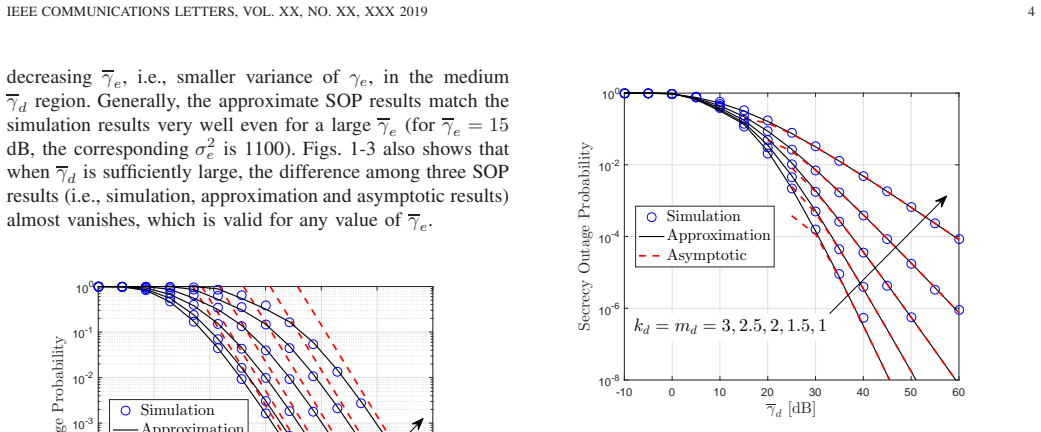
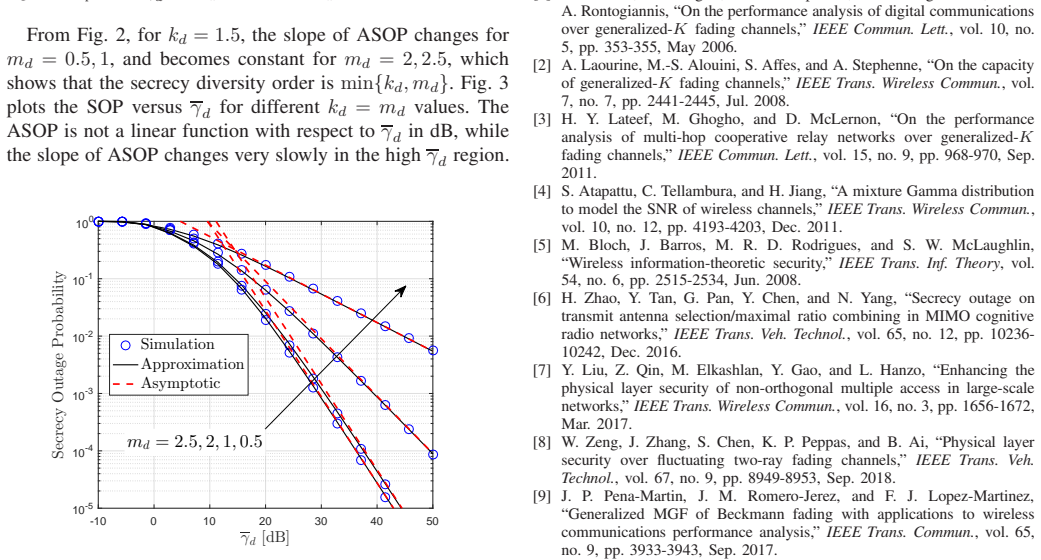
A simple approximation for secrecy outage probability over generalized-K fading channels tightens as wiretap SNR decreases and reveals the secrecy diversity order.
A machine-rendered reading of the paper's core claim, the machinery that carries it, and where it could break.
Core claim
A simple approximation for the secrecy outage probability (SOP) over generalized-K fading channels is developed. This approximation becomes tighter as the average SNR of the wiretap channel decreases. Based on this simple expression, the asymptotic SOP in the high SNR region of the main channel is analyzed, revealing the secrecy diversity order in a general case.
What carries the argument
The asymptotic SOP approximation obtained by exploiting the series expansion properties of the generalized-K distribution under the independence assumption between main and wiretap channels.
If this is right
- SOP evaluation reduces from a double integral to a single elementary expression.
- The secrecy diversity order is obtained in closed form for arbitrary generalized-K parameters.
- The approximation error vanishes in the regime of practical interest for physical-layer security.
Where Pith is reading between the lines
- The same expansion technique may apply to other composite fading models that admit similar series representations.
- System designers could use the diversity-order formula to set target SNR margins without Monte-Carlo simulation.
Load-bearing premise
The main and wiretap channels are statistically independent and each follows a generalized-K distribution whose parameters allow the series expansion to be truncated without losing the leading term.
What would settle it
Direct numerical comparison of the proposed closed-form SOP against the exact integral expression at successively lower wiretap SNR values, or measurement of the slope of log(SOP) versus log(SNR_main) to check the predicted diversity order.
Figures

read the original abstract
A simple approximation for the secrecy outage probability (SOP) over generalized-K fading channels is developed. This approximation becomes tighter as the average signal-to-noise ratio (SNR) of the wiretap channel decreases. Based on this simple expression, we also analyze the asymptotic SOP in the high SNR region of the main channel. Besides simplifying the SOP expression significantly, this asymptotic SOP expression reveals the secrecy diversity order in a general case. Numerical results demonstrate the high accuracy of our proposed approximation results.
Editorial analysis
A structured set of objections, weighed in public.
Referee Report
Summary. The manuscript develops a simple closed-form approximation to the secrecy outage probability (SOP) integral over generalized-K fading channels for the main and wiretap links. The approximation is shown to tighten as the average SNR of the wiretap channel decreases; an asymptotic high-SNR expansion of the main-channel link is then used to extract the secrecy diversity order in closed form as a function of the generalized-K parameters. Monte-Carlo simulations are provided to illustrate accuracy.
Significance. If the derivation and error bounds hold, the work supplies a practical simplification of the SOP expression together with an explicit secrecy-diversity-order formula that is parameter-free once the fading parameters are fixed. This is useful for physical-layer security analysis in composite fading environments and is strengthened by the explicit derivation steps and numerical validation supplied in the manuscript.
major comments (2)
- [§III, Eq. (14)] §III, Eq. (14): the series truncation used to obtain the simple SOP approximation is presented without an explicit remainder bound; because the claim that the approximation becomes arbitrarily tight for low wiretap SNR rests on this step, a uniform error estimate (or at least the truncation order) should be stated for the full range of generalized-K parameters (k,m).
- [§IV, Eq. (22)] §IV, Eq. (22): the asymptotic SOP expression that yields the secrecy diversity order assumes independence of the main and wiretap channels; the manuscript should confirm that the diversity-order result continues to hold (or state the modification) when the two links experience correlated shadowing, as this is a common practical case not covered by the independence assumption.
minor comments (3)
- [Notation] The notation for the generalized-K parameters (shape and scale) should include a brief reference to the standard definition in the literature (e.g., Shankar 2004) to avoid ambiguity.
- [Figure 2] Figure 2 caption: the curves labeled “approx.” and “asymp.” should explicitly state the SNR regime (wiretap vs. main) to which each corresponds.
- [§IV] A short table summarizing the diversity-order expressions for the special cases (K, Nakagami-m, Rayleigh) would improve readability.
Simulated Author's Rebuttal
We thank the referee for the constructive comments and positive evaluation. We address each major comment below and indicate the revisions we will make.
read point-by-point responses
-
Referee: [§III, Eq. (14)] §III, Eq. (14): the series truncation used to obtain the simple SOP approximation is presented without an explicit remainder bound; because the claim that the approximation becomes arbitrarily tight for low wiretap SNR rests on this step, a uniform error estimate (or at least the truncation order) should be stated for the full range of generalized-K parameters (k,m).
Authors: We agree that an explicit remainder bound strengthens the presentation. In the revised manuscript we will add a short derivation of the truncation error for the series in Eq. (14), showing that the remainder is bounded uniformly for all k,m>0 and vanishes as the wiretap SNR tends to zero. This bound follows directly from the alternating-series test applied to the generalized-K PDF expansion and confirms the claimed tightness without altering the main result. revision: yes
-
Referee: [§IV, Eq. (22)] §IV, Eq. (22): the asymptotic SOP expression that yields the secrecy diversity order assumes independence of the main and wiretap channels; the manuscript should confirm that the diversity-order result continues to hold (or state the modification) when the two links experience correlated shadowing, as this is a common practical case not covered by the independence assumption.
Authors: The secrecy-diversity-order derivation in §IV explicitly uses the independence assumption stated in the system model. Under correlated shadowing the joint distribution changes and the diversity order would in general be modified. Because the manuscript does not claim the result for the correlated case, we will insert a brief remark noting this scope limitation while leaving the independent-channel analysis unchanged. revision: partial
Circularity Check
No significant circularity; derivation self-contained from channel statistics
full rationale
The paper derives the SOP approximation and asymptotic diversity order directly from the generalized-K PDF (Meijer-G form), joint statistics under channel independence, and standard high-SNR series expansion. No equation reduces by construction to a fitted parameter or self-citation; Monte-Carlo curves serve as external validation. The result is therefore independent of its own outputs.
Axiom & Free-Parameter Ledger
Reference graph
Works this paper leans on
-
[1]
On the performance analysis of digital co mmunications over generalized-K fading channels,
P . S. Bithas, N. C. Sagias, P . T. Mathiopoulos, G. K. Karag iannidis, and A. A. Rontogiannis, “On the performance analysis of digital co mmunications over generalized-K fading channels,” IEEE Commun. Lett. , vol. 10, no. 5, pp. 353-355, May 2006
work page 2006
-
[2]
On the capacity of generalized-K fading channels,
A. Laourine, M.-S. Alouini, S. Affes, and A. Stephenne, “ On the capacity of generalized-K fading channels,” IEEE Trans. Wireless Commun. , vol. 7, no. 7, pp. 2441-2445, Jul. 2008
work page 2008
-
[3]
H. Y . Lateef, M. Ghogho, and D. McLernon, “On the performa nce analysis of multi-hop cooperative relay networks over gene ralized-K fading channels,” IEEE Commun. Lett. , vol. 15, no. 9, pp. 968-970, Sep. 2011
work page 2011
-
[4]
A mixture Gamm a distribution to model the SNR of wireless channels,
S. Atapattu, C. Tellambura, and H. Jiang, “A mixture Gamm a distribution to model the SNR of wireless channels,” IEEE Trans. Wireless Commun., vol. 10, no. 12, pp. 4193-4203, Dec. 2011
work page 2011
-
[5]
Wireless information-theoretic security,
M. Bloch, J. Barros, M. R. D. Rodrigues, and S. W. McLaughl in, “Wireless information-theoretic security,” IEEE Trans. Inf. Theory , vol. 54, no. 6, pp. 2515-2534, Jun. 2008
work page 2008
-
[6]
H. Zhao, Y . Tan, G. Pan, Y . Chen, and N. Y ang, “Secrecy outa ge on transmit antenna selection/maximal ratio combining in MIM O cognitive radio networks,” IEEE Trans. V eh. Technol., vol. 65, no. 12, pp. 10236- 10242, Dec. 2016
work page 2016
-
[7]
Enhanc ing the physical layer security of non-orthogonal multiple access in large-scale networks,
Y . Liu, Z. Qin, M. Elkashlan, Y . Gao, and L. Hanzo, “Enhanc ing the physical layer security of non-orthogonal multiple access in large-scale networks,” IEEE Trans. Wireless Commun., vol. 16, no. 3, pp. 1656-1672, Mar. 2017
work page 2017
-
[8]
Physic al layer security over fluctuating two-ray fading channels,
W. Zeng, J. Zhang, S. Chen, K. P . Peppas, and B. Ai, “Physic al layer security over fluctuating two-ray fading channels,” IEEE Trans. V eh. Technol., vol. 67, no. 9, pp. 8949-8953, Sep. 2018
work page 2018
-
[9]
J. P . Pena-Martin, J. M. Romero-Jerez, and F. J. Lopez-Ma rtinez, “Generalized MGF of Beckmann fading with applications to wi reless communications performance analysis,” IEEE Trans. Commun. , vol. 65, no. 9, pp. 3933-3943, Sep. 2017
work page 2017
-
[10]
Outage probability of secrecy capacity over co rrelated log- normal fading channels,
X. Liu, “Outage probability of secrecy capacity over co rrelated log- normal fading channels,” IEEE. Commun. Lett. , vol. vol. 17, no. 2, pp. 289-292, Feb. 2013
work page 2013
-
[11]
Secrecy outag e analysis over correlated composite Nakagami- m/Gamma fading channels,
G. C. Alexandropoulos, and K. P . Peppas, “Secrecy outag e analysis over correlated composite Nakagami- m/Gamma fading channels,” IEEE. Commun. Lett. , vol. 22. no. 1, pp. 77-80, Jan. 2018
work page 2018
-
[12]
H. Lei, H. Zhang, I. S. Ansari, C. Gao, Y . Guo, G. Pan, and K . A. Qaraqe, “Performance analysis of physical layer security over gene ralized-K fading channels using a mixture Gamma distribution,” IEEE. Commun. Lett., vol. 20, no. 2, pp. 408-411, Feb. 2016
work page 2016
-
[13]
Secrecy performance analysis of single-input multiple-output gen eralized-K fad- ing channels,
H. Lei, I. S. Ansari, C. Gao, Y . Guo, G. Pan, and K. A. Qaraq e, “Secrecy performance analysis of single-input multiple-output gen eralized-K fad- ing channels,” Front. Inform. Technol. Electron. Eng. , vol. 17, no. 10, pp. 1074-1084, Oct. 2016. IEEE COMMUNICA TIONS LETTERS, VOL. XX, NO. XX, XXX 2019 5
work page 2016
-
[14]
Physical lay er security for cooperative relaying over generalized- K fading channels,
L. Wu, L. Y ang, J. Chen, and M.-S. Alouini, “Physical lay er security for cooperative relaying over generalized- K fading channels,” IEEE Wireless Commun. Lett. , vol. 7, no. 4, pp. 606-609, Aug. 2018
work page 2018
-
[15]
S ecrecy analysis in SWIPT systems over generalized- K fading channels,
Z. Wang, H. Zhao, S. Wang, J. Zhang, and M.-S. Alouini, “S ecrecy analysis in SWIPT systems over generalized- K fading channels,” IEEE Commun. Lett. , vol. 23, no. 5, pp. 834-837, May 2019
work page 2019
-
[16]
Secrecy characteristics with assistance of mixture Gamma distribution,
L. Kong, and G. Kaddoum, “Secrecy characteristics with assistance of mixture Gamma distribution,” IEEE Wireless Commun. Lett., accepted for publication. DOI: 10.1109/LWC.2019.2907083
-
[17]
Physical-layer security over generalised- K fading channels,
H. Lei, I. S. Ansari, C. Gao, Y . Guo, G. Pan, and K. A. Qaraq e, “Physical-layer security over generalised- K fading channels,” IET Com- mun., vol. 10, no. 16, pp. 2233-2237, Nov. 2016
work page 2016
-
[18]
On physical-layer security over SIMO generalized- K fading channels,
H. Lei C. Gao, I. S. Ansari, Y . Guo, G. Pan, and K. A. Qaraqe , “On physical-layer security over SIMO generalized- K fading channels,” IEEE Trans. V eh. Technol., vol. 65, no. 9, pp. 7780-7785, Sep. 2016
work page 2016
-
[19]
Phy sical- layer security over non-small-scale fading channels,
G. Pan, C. Tang, X. Zhang, T. Li, Y . Weng, and Y . Chen, “Phy sical- layer security over non-small-scale fading channels,” IEEE Trans. V eh. Technol., vol. 65, no. 3, pp. 1326-1339, Mar. 2016
work page 2016
-
[20]
A simple, accurate method to calculate spread multiple access error probabilities,
J. M. Holtzman, “A simple, accurate method to calculate spread multiple access error probabilities,” IEEE Trans. Commun., vol. 40, no. 3, pp. 461- 464, Mar. 1992
work page 1992
-
[21]
I. S. Gradshteyn, I. M. Ryzhik, Table of Integrals, Series, and Products , 7th edition. Academic Press, 2007
work page 2007
-
[22]
“Wolfram Functions.” Available: http://functions.w olfram.com/07.34.20.0012.02
-
[23]
Ergodi c capacity under power adaption over Fisher-Snedecor F fading channels,
H. Zhao, L. Y ang, A. S. Salem, and M.-S. Alouini, “Ergodi c capacity under power adaption over Fisher-Snedecor F fading channels,” IEEE Commun. Lett. , vol. 23, no. 3, pp. 546-549, Mar. 2019
work page 2019
discussion (0)
Sign in with ORCID, Apple, or X to comment. Anyone can read and Pith papers without signing in.