The Effects of Spatial Curvature on Cosmic Evolution
Pith reviewed 2026-05-24 20:15 UTC · model grok-4.3
The pith
Non-flat universes alter the timing of cosmic expansion transitions in dynamical dark energy models.
A machine-rendered reading of the paper's core claim, the machinery that carries it, and where it could break.
Core claim
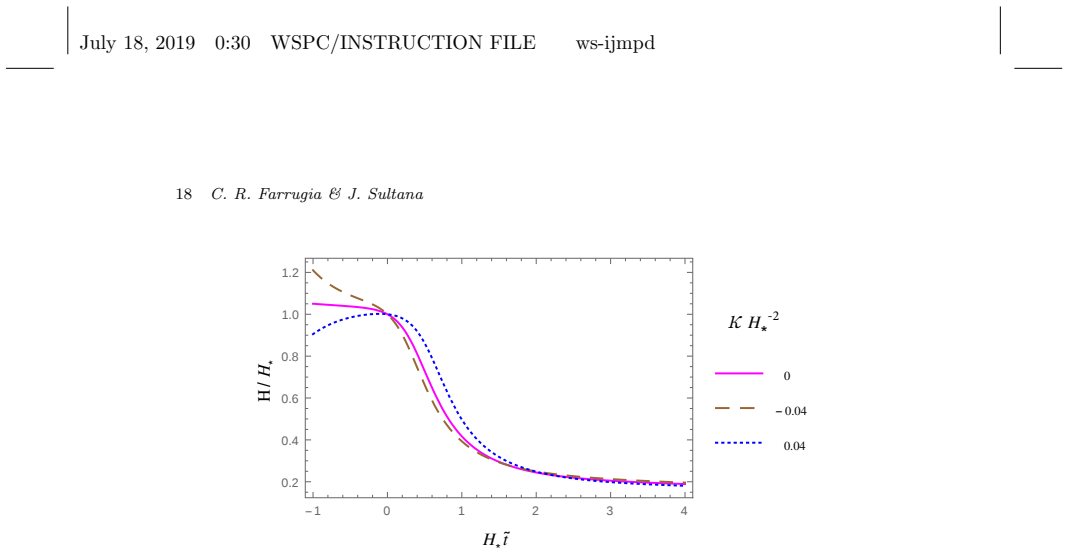
For a closed Universe, the transition to the epoch of decelerated expansion would be delayed with respect to the flat case. So would the start of the current dark energy-dominated era. This would be accompanied by a larger inflationary acceleration, as well as a larger subsequent deceleration. The opposite behavior is observed if the Universe is open.
What carries the argument
The curvature density parameter inserted into the Friedmann equations for non-flat FLRW metrics within time-varying dark energy models.
If this is right
- Transition to decelerated expansion occurs later in closed universes than in flat ones.
- Onset of dark energy domination is postponed in closed universes relative to flat ones.
- Inflationary acceleration reaches higher values in closed universes.
- Subsequent deceleration is stronger in closed universes than in the flat case.
- Open universes produce earlier transitions and smaller acceleration or deceleration magnitudes.
Where Pith is reading between the lines
- Model-fitting pipelines for dark energy parameters may need explicit curvature terms to avoid systematic offsets when curvature is small but nonzero.
- High-redshift expansion-history data could separate curvature-induced timing shifts from changes in the dark energy equation of state.
- Re-analysis of existing supernova or CMB datasets with curvature-allowed dynamical models might alter inferred transition redshifts.
Load-bearing premise
That the chosen alternative dynamical dark energy models with time-varying equation of state fully represent the cosmological scenario and that data fitting to these models can accommodate non-flat geometries without introducing other systematic biases.
What would settle it
A measurement of the redshift at which the deceleration parameter changes sign that exactly matches the flat-model prediction across multiple parametrizations of the dark energy equation of state.
Figures




read the original abstract
As evidenced by a great number of works, it is common practice to assume that the Universe is flat. However, the majority of studies which make use of observational data to constrain the curvature density parameter are premised on the $\Lambda$CDM cosmology, or extensions thereof. On the other hand, fitting the data to models with a time-varying dark energy equation of state can, in some cases, accommodate a non-flat Universe. Several authors caution that if the assumption of spatial flatness is wrong, it could veer any efforts to construct a dark energy model completely off course, even if the curvature is in reality very small. We thus consider a number of alternative dynamical dark energy models that represent the complete cosmological scenario, and investigate the effects of spatial curvature on the evolution. We find that for a closed Universe, the transition to the epoch of decelerated expansion would be delayed with respect to the flat case. So would the start of the current dark energy-dominated era. This would be accompanied by a larger inflationary acceleration, as well as a larger subsequent deceleration. The opposite behavior is observed if the Universe is open.
Editorial analysis
A structured set of objections, weighed in public.
Referee Report
Summary. The manuscript investigates the effects of spatial curvature on cosmic evolution within several dynamical dark energy models featuring time-varying equations of state. It reports that, relative to the flat case, a closed universe delays the transition to decelerated expansion and the onset of dark-energy domination, while exhibiting larger inflationary acceleration and subsequent deceleration; an open universe shows the opposite behavior. These conclusions are drawn from data-constrained model fits that allow non-flat geometries.
Significance. If the reported epoch shifts survive joint fits that include curvature, the work usefully illustrates how even small departures from flatness can alter the timing and magnitude of acceleration phases in dynamical DE scenarios, reinforcing cautions against assuming flatness a priori when constructing DE models. No machine-checked proofs or parameter-free derivations are present, but the qualitative predictions are falsifiable with future curvature-sensitive data.
major comments (2)
- [Abstract] Abstract: the directional claims (delayed deceleration transition, delayed DE domination, altered acceleration magnitudes) are stated without any equations, explicit w(z) parametrizations, datasets, likelihood construction, or integration method, rendering it impossible to verify that the behaviors survive a joint fit with free Omega_k.
- The central claim presupposes that the selected dynamical DE models accommodate non-flat geometries in data fits without systematic biases or compensating shifts in w0/wa parameters that would erase the reported curvature-induced effects; the manuscript provides no explicit demonstration that the curved Friedmann equation is solved consistently or that parameter posteriors remain stable when curvature is freed.
minor comments (1)
- [Abstract] The abstract would be clearer if it named the specific alternative models (e.g., CPL, JBP) considered and the observational datasets employed.
Simulated Author's Rebuttal
We thank the referee for the detailed review and constructive suggestions. We address the major comments point by point below, clarifying the content of the manuscript while noting where expansions may improve clarity.
read point-by-point responses
-
Referee: [Abstract] Abstract: the directional claims (delayed deceleration transition, delayed DE domination, altered acceleration magnitudes) are stated without any equations, explicit w(z) parametrizations, datasets, likelihood construction, or integration method, rendering it impossible to verify that the behaviors survive a joint fit with free Omega_k.
Authors: The abstract provides a concise qualitative summary of the main findings, as is standard. The full manuscript details the curved Friedmann equation (Section 2), the specific w(z) parametrizations (e.g., CPL and other forms in Section 3), the datasets (Planck CMB, BAO, SNIa), the likelihood construction, and the numerical integration of the background equations allowing free Omega_k. The reported epoch shifts are extracted from the posterior samples of those joint fits. We can revise the abstract to briefly reference the methodology and datasets for improved verifiability. revision: partial
-
Referee: The central claim presupposes that the selected dynamical DE models accommodate non-flat geometries in data fits without systematic biases or compensating shifts in w0/wa parameters that would erase the reported curvature-induced effects; the manuscript provides no explicit demonstration that the curved Friedmann equation is solved consistently or that parameter posteriors remain stable when curvature is freed.
Authors: Section 2 explicitly states and solves the Friedmann equation with the curvature term for each dynamical DE model. The MCMC fits (Section 4) treat Omega_k as a free parameter jointly with w0 and wa; the resulting posteriors show that curvature-induced shifts in transition epochs and acceleration magnitudes persist and are not fully compensated by adjustments in the DE parameters. Figures in the results section display the relevant derived quantities (e.g., q(z), Omega_DE(z)) for flat vs. curved cases. If additional degeneracy plots are desired, they can be added. revision: no
Circularity Check
No significant circularity detected
full rationale
The abstract describes an investigation of curvature effects on transition epochs and acceleration phases within chosen dynamical dark-energy models. No equations, parameter-fitting steps, or self-citations are supplied that would reduce any reported qualitative shift (delayed deceleration, altered acceleration magnitude) to a fitted input or self-referential definition by construction. The derivation chain therefore remains independent of the target claims and is evaluated against external data benchmarks.
Axiom & Free-Parameter Ledger
free parameters (2)
- curvature density parameter
- time-varying dark energy equation-of-state parameters
axioms (1)
- standard math FLRW metric with constant curvature parameter describes the universe
Reference graph
Works this paper leans on
-
[1]
C. L. Bennett et al. , Astrophys. J. Suppl. S. 208 (2013) 20
work page 2013
- [2]
-
[3]
C. J. MacTavish et al. , Astrophys. J. 647 (2006) 799
work page 2006
- [4]
-
[5]
Planck Collab. (P. A. R. Ade et al. ), Astron. Astrophys. 594 (2016) A13
work page 2016
- [6]
-
[7]
D. J. Eisenstein et al. , Astrophys. J. 633 (2005) 560
work page 2005
- [8]
- [9]
-
[10]
X. Wang, M. Tegmark and M. Zaldarriaga, Phys. Rev. D 65 (2002) 123001
work page 2002
- [11]
-
[12]
M. Tegmark, M. Zaldarriaga and A. J. S. Hamilton, Phys. Rev. D 63 (2001) 043007
work page 2001
- [13]
- [14]
- [15]
- [16]
-
[17]
G. B. Zhao et al. , Phys. Lett. B 648 (2007) 8
work page 2007
- [18]
-
[19]
A. Bonilla Rivera and J. Garc´ ıa Farieta, arXiv:1605.01984v1
work page internal anchor Pith review Pith/arXiv arXiv
- [20]
- [21]
-
[22]
J. M. Virey et al. , J. Cosmol. Astropart. P. 2008 (12) 008
work page 2008
-
[23]
S. Del Campo, M. Cataldo and F. Pe˜ na, Gen. Relativ. Gravit. 37 (2005) 675
work page 2005
- [24]
- [25]
-
[26]
A. R. Liddle and M. Cortˆ es, Phys. Rev. Lett. 111 (2013) 111302
work page 2013
- [27]
- [28]
-
[29]
A. D. Linde, Phys. Lett. B 108 (1982) 389
work page 1982
-
[30]
G. M. Kremer, Phys. Rev. D 68 (2003) 123507
work page 2003
-
[31]
M. A. Caprio, Comput. Phys. Commun. 171 (2005) 107. http://scidraw.nd.edu/ levelscheme
work page 2005
-
[32]
S. Carroll, Spacetime and Geometry – An Introduction to General Relativity (Addison Wesley, San Francisco, 2004)
work page 2004
-
[33]
D. C. Johnston, Advances in Thermodynamics of the van der Waals Fluid (Morgan & Claypool, San Rafael, CA, 2014)
work page 2014
-
[34]
H. B. Callen, Thermodynamics and an Introduction to Thermostatistics , 2nd edn. (John Wiley & Sons, New York, 1985)
work page 1985
-
[35]
G. M. Kremer, Gen. Relativ. Gravit. 36 (2004) 1423
work page 2004
-
[36]
M. P. Hobson, G. Efstathiou and A. N. Lasenby, General Relativity: An Introduction for Physicists (Cambridge University Press, New York, 2006)
work page 2006
-
[37]
A. H. Guth, Phys. Rev. D 23 (1981) 347. July 18, 2019 0:30 WSPC/INSTRUCTION FILE ws-ijmpd 30 C. R. Farrugia & J. Sultana
work page 1981
- [38]
-
[39]
M. S. Turner and A. G. Riess, Astrophys. J. 569 (2002) 18
work page 2002
- [40]
-
[41]
A. G. Riess et al. , Astron. J. 116 (1998) 1009
work page 1998
-
[42]
The Supernova Cosmology Project (S. Perlmutter et al. ), Astrophys. J. 517 (1999) 565
work page 1999
- [43]
-
[44]
R. R. Caldwell and M. Kamionkowski, Annu. Rev. Nucl. Part. S. 59 (2009) 397
work page 2009
-
[45]
C. Cercignani and G. M. Kremer, The Relativistic Boltzmann Equation: Theory and Applications (Birkh¨ auser, Basel, 2002)
work page 2002
- [46]
- [47]
-
[48]
G. L. Murphy, Phys. Rev. D 8 (1973) 4231
work page 1973
-
[49]
V. A. Belinski ˇi, E. S. Nikomarov and I. M. Khalatnikov, Sov. Phys. JETP 50 (2) (1979) 213
work page 1979
- [50]
-
[51]
G. M. Kremer and M. C. N. Teixeira da Silva, Braz. J. Phys. 34 (3b) (2004) 1204
work page 2004
-
[52]
M. A. Jafarizadeh et al. , Phys. Rev. D 60 (1999) 063514
work page 1999
-
[53]
J. A. S. Lima, E. L. D. Perico and G. J. M. Zilioti, Int. J. Mod. Phys. D. 24 (4) (2015) 1541006
work page 2015
-
[54]
E. L. D. Perico et al. , Phys. Rev. D 88 (2013) 063531
work page 2013
-
[55]
J. A. S. Lima, S. Basilakos and J. Sol` a, Mon. Not. R. Astron. Soc. 431 (2013) 923
work page 2013
-
[56]
J. A. S. Lima and M. Trodden, Phys. Rev. D 53 (1996) 4280
work page 1996
-
[57]
C. Moreno and J. E. Madriz Aguilar, J. Phys. Conf. Ser. 545 (2014) 012010
work page 2014
-
[58]
C. Clarkson, M. Cortˆ es and B. Bassett, J. Cosmol. Astropart. P. 2007 (08) 011
work page 2007
- [59]
discussion (0)
Sign in with ORCID, Apple, or X to comment. Anyone can read and Pith papers without signing in.