Commissioning and Performance of CHEC-S -- a compact high-energy camera for the Cherenkov Telescope Array
Pith reviewed 2026-05-24 18:04 UTC · model grok-4.3
The pith
CHEC-S camera meets CTA performance criteria using silicon photomultipliers for small-sized telescopes.
A machine-rendered reading of the paper's core claim, the machinery that carries it, and where it could break.
Core claim
CHEC-S utilises silicon photomultipliers in a compact curved focal plane paired with TARGET modules for nanosecond waveform sampling and flexible triggering. Commissioning and test-bench measurements confirm that the camera meets the performance criteria required for a CTA camera, while highlighting optical crosstalk in the SiPMs as the primary limitation and demonstrating expected gains from more recent photosensor iterations.
What carries the argument
The CHEC-S compact high-energy camera with its curved focal plane of tightly-packed SiPM pixels and attached TARGET modules for full-waveform readout.
If this is right
- The camera design supports the 70 SSTs needed to detect rare bright Cherenkov showers from gamma rays above 300 TeV.
- Full-waveform readout at nanosecond resolution provides improved photoelectron counting across a large dynamic range.
- Compatibility is maintained with the dual-mirror Schwarzschild-Couder telescope proposals for the SSTs.
- Performance in photon number resolution improves when optical crosstalk is reduced in updated SiPM technology.
Where Pith is reading between the lines
- If deployed, CHEC-S would contribute directly to pushing CTA's energy frontier for gamma-ray observations.
- The SiPM crosstalk limitation identified here may apply to other compact camera designs using similar photosensors.
- Field tests over multiple seasons would be required to confirm that lab commissioning results hold under continuous array operation.
Load-bearing premise
Laboratory and test-bench conditions accurately represent the long-term operational environment on the telescope array including temperature variations and night-sky background.
What would settle it
Deployment of CHEC-S on an SST followed by sustained on-telescope measurements showing photon resolution degraded beyond lab predictions due to crosstalk or environmental factors.
Figures
read the original abstract
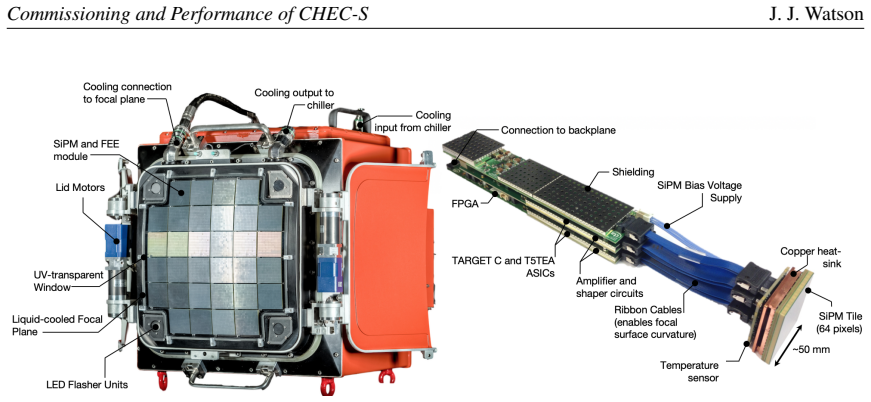
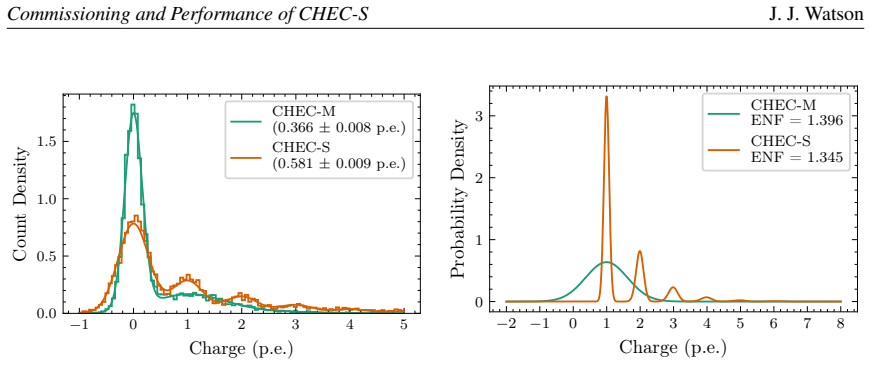
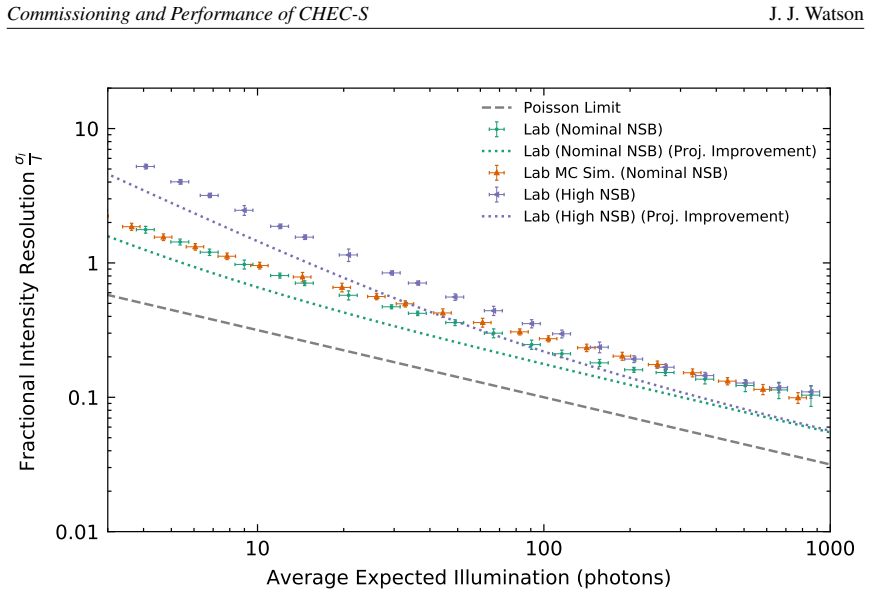
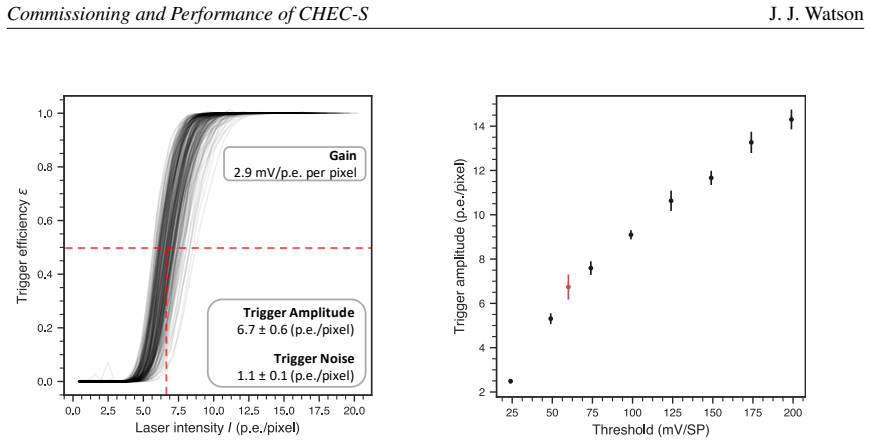
The Cherenkov Telescope Array (CTA) will present the next leap forward in gamma-ray astronomy, pushing beyond the present energy frontier to probe beyond 300 TeV. This capability is provided by the 70 Small Sized Telescopes (SSTs). The SSTs are spread across the four square kilometres of the array to detect the rare, but bright, Cherenkov showers produced by the highest-energy gamma rays. One proposed camera design for the SSTs is the Compact High Energy Camera (CHEC). Its compact and curved focal plane design is tailored for dual-mirror Schwarzschild-Couder telescopes, making it compatible with two of the three telescope proposals for the SSTs. The latest design of CHEC (known as CHEC-S) utilises silicon photomultipliers (SiPMs); an attractive alternative to traditional photomultiplier tubes, offering improved photon detection efficiency and photoelectron counting resolution for a large dynamic range, across tightly-packed pixels. However, SiPMs suffer from the phenomena of optical crosstalk, which degrades the ability to resolve the number of photons incident on the photosensor. CHEC-S also features full-waveform readout at nanosecond sampling resolution with a flexible trigger scheme. This is facilitated by the TARGET (TeV Array Read-out with GSa/s sampling and Event Trigger) modules attached to the SiPMs. This contribution describes the concept and technical design of CHEC-S and displays the key performance results, matched against the criteria required for a CTA camera. The limitation caused by the optical crosstalk of the SiPM is highlighted, and the expected performance with more recent iterations of the photosensor technology is also demonstrated.
Editorial analysis
A structured set of objections, weighed in public.
Referee Report
Summary. The manuscript describes the design and commissioning of the CHEC-S compact camera prototype for the Small-Sized Telescopes of the Cherenkov Telescope Array. It details the SiPM-based focal plane and TARGET readout modules enabling nanosecond waveform sampling and flexible triggering, then reports measured performance metrics (photon detection efficiency, optical crosstalk, dynamic range, trigger efficiency) obtained in laboratory and test-bench setups and compares them directly to CTA camera requirements, while noting the crosstalk limitation and projecting gains from newer SiPM iterations.
Significance. If the reported metrics remain valid under array conditions, the work supplies essential empirical validation for a curved-focal-plane SiPM camera architecture compatible with Schwarzschild-Couder SST designs. The explicit matching against external CTA specifications rather than internally fitted quantities, together with the clear identification of the crosstalk bottleneck and forward-looking sensor projections, strengthens the paper's utility for technology down-selection.
major comments (1)
- [Performance results / commissioning sections] The central claim that CHEC-S meets CTA criteria rests on laboratory and test-bench measurements. The manuscript does not contain a dedicated discussion (e.g., in the performance or commissioning sections) quantifying how these metrics are expected to shift under realistic array conditions such as temperature excursions of tens of degrees, variable night-sky background rates, mechanical vibration, or long-term SiPM aging; without such analysis the transfer of the reported compliance to deployed operation remains unverified.
minor comments (2)
- Figure captions and axis labels should explicitly state the temperature and NSB conditions under which each data set was acquired.
- A short table summarizing the key measured values against the corresponding CTA requirement numbers would improve readability.
Simulated Author's Rebuttal
We thank the referee for the positive assessment and for highlighting the need to bridge laboratory results to array operation. We address the single major comment below.
read point-by-point responses
-
Referee: [Performance results / commissioning sections] The central claim that CHEC-S meets CTA criteria rests on laboratory and test-bench measurements. The manuscript does not contain a dedicated discussion (e.g., in the performance or commissioning sections) quantifying how these metrics are expected to shift under realistic array conditions such as temperature excursions of tens of degrees, variable night-sky background rates, mechanical vibration, or long-term SiPM aging; without such analysis the transfer of the reported compliance to deployed operation remains unverified.
Authors: We agree that an explicit discussion of environmental and operational factors would improve the manuscript. In the revised version we have inserted a new paragraph in Section 5 that (i) quantifies the expected PDE and gain shift for temperature excursions of ±20 °C using the measured temperature coefficients of the SiPMs and the camera’s thermal-control system, (ii) summarises test-bench runs performed with variable pulsed illumination rates that simulate the range of night-sky background expected at the CTA sites, and (iii) notes that mechanical-vibration and long-term-aging studies are reported in separate qualification documents (referenced) and lie outside the scope of the present commissioning paper. These additions make the transferability of the reported metrics to array conditions more transparent without altering the central laboratory results. revision: yes
Circularity Check
No circularity: empirical performance report against external requirements
full rationale
The paper is a commissioning report presenting measured lab/test-bench metrics (PDE, crosstalk, trigger rates, dynamic range) for CHEC-S against pre-existing CTA camera requirements. No equations, fitted parameters, or predictions are claimed; results are direct measurements. No self-citation chains, ansatzes, or renamings reduce any claim to its own inputs. The derivation chain is absent; the work is self-contained empirical validation.
Axiom & Free-Parameter Ledger
Reference graph
Works this paper leans on
-
[1]
B. Acharya, M. Actis, T. Aghajani, G. Agnetta, J. Aguilar, F. Aharonian et al., Introducing the CTA concept, Astroparticle Physics 43 (2013) 3
work page 2013
-
[2]
V . Vassiliev, S. Fegan and P. Brousseau,Wide field aplanatic two-mirror telescopes for ground-based γ-ray astronomy, Astroparticle Physics 28 (2007) 10
work page 2007
-
[3]
R. White and H. Schoorlemmer, A Compact High Energy Camera (CHEC) for the Gamma-ray Cherenkov Telescope of the Cherenkov Telescope Array, in Proceedings of 35th International Cosmic Ray Conference – PoS(ICRC2017), (2017), p. 817, DOI: 10.22323/1.301.0817
-
[4]
H. Sol, T. Greenshaw, O. Le Blanc and R. White, Observing the sky at extremely high energies with CTA: Status of the GCT project, in Proceedings of 35th International Cosmic Ray Conference – PoS(ICRC2017), (2017), p. 822, DOI: 10.22323/1.301.0822
-
[5]
M. C. Maccarone, ASTRI for the Cherenkov Telescope Array, in Proceedings of 35th International Cosmic Ray Conference – PoS(ICRC2017), (2017), p. 855, DOI: 10.22323/1.301.0855
-
[6]
E. Giro, R. Canestrari, G. Sironi, E. Antolini, P. Conconi, C. E. Fermino et al., First optical validation of a Schwarzschild Couder telescope: the ASTRI SST-2M Cherenkov telescope, Astronomy & Astrophysics 608 (2017) A86
work page 2017
-
[7]
J. J. Watson, Calibration and Analysis of the GCT Camera for the Cherenkov Telescope Array, Ph.D. thesis, University of Oxford, (2018), https://ora.ox.ac.uk/objects/uuid:1794e10a-12b1-4f48-84df-582f48b0e702
work page 2018
-
[8]
J. Zorn, R. White, J. J. Watson, T. P. Armstrong, A. Balzer, M. Barcelo et al., Characterisation and testing of CHEC-M – A camera prototype for the small-sized telescopes of the Cherenkov telescope array, Nuclear Instruments and Methods in Physics Research, Section A: Accelerators, Spectrometers, Detectors and Associated Equipment 904 (2018) 44
work page 2018
-
[9]
A. Asano, D. Berge, G. Bonanno, M. Bryan, B. Gebhardt, A. Grillo et al., Evaluation of silicon photomultipliers for dual-mirror Small-Sized Telescopes of Cherenkov Telescope Array, Nuclear Instruments and Methods in Physics Research Section A: Accelerators, Spectrometers, Detectors and Associated Equipment 912 (2018) 177
work page 2018
-
[10]
A. Ghassemi, K. Sato and K. Kobayashi, MPPC, technical note, accessed 20/09/2018, https://www.hamamatsu.com/resources/pdf/ssd/mppc_kapd9005e.pdf
work page 2018
- [11]
-
[12]
S. Funk, D. Jankowsky, H. Katagiri, M. Kraus, A. Okumura, H. Schoorlemmer et al., TARGET: A digitizing and trigger ASIC for the Cherenkov telescope array, in AIP Conference Proceedings, vol. 1792, (2017), p. 080012, DOI: 10.1063/1.4969033
-
[13]
J. Zorn, CHEC – A compact high energy camera for the Cherenkov Telescope Array, Nuclear Instruments and Methods in Physics Research Section A: Accelerators, Spectrometers, Detectors and Associated Equipment 936 (2019) 229. 7
work page 2019
discussion (0)
Sign in with ORCID, Apple, or X to comment. Anyone can read and Pith papers without signing in.