Dielectron production in pion-nucleon reactions and form factor of baryon transition within the time-like region
Pith reviewed 2026-05-24 17:03 UTC · model grok-4.3
The pith
Theoretical predictions of dielectron mass and angular distributions in low-energy pion-nucleon reactions enable extraction of the baryon transition electromagnetic form factor in the time-like region from HADES data.
A machine-rendered reading of the paper's core claim, the machinery that carries it, and where it could break.
Core claim
Assuming electron-positron pair production occurs via the virtual time-like photon splitting process, the paper calculates the effective mass distribution of dielectrons and their angular dependence in the specified pion-nucleon reactions below 1 GeV, and shows that these observables permit extraction of the electromagnetic form factor of the baryon transition in the time-like region from upcoming HADES data.
What carries the argument
The virtual time-like photon splitting process that generates the electron-positron pairs and carries the dependence on the baryon transition form factor.
If this is right
- The predicted mass distributions provide a baseline for comparing to experimental yields in the two reactions.
- Angular dependence supplies an independent observable that constrains the form factor.
- Successful extraction would yield the first direct information on the baryon transition form factor in the time-like domain from these channels.
- The framework can be applied directly to planned HADES runs without additional model parameters.
Where Pith is reading between the lines
- Comparison of the extracted time-like form factor with space-like data could reveal differences in resonance contributions.
- The same splitting mechanism might be tested in related reactions such as photoproduction of dileptons.
- Discrepancies between predicted and measured distributions could indicate additional production channels beyond photon splitting.
Load-bearing premise
Electron-positron pair production occurs via the virtual time-like photon splitting process in the reactions at energies less than 1 GeV.
What would settle it
A HADES measurement of the dielectron effective mass spectrum or angular distribution in π⁻p collisions below 1 GeV that cannot be reproduced by any reasonable variation of the time-like baryon form factor.
Figures


read the original abstract
Dielectron production in reactions $\pi^- p \rightarrow n e^+e^-$ and $\pi^- p \rightarrow n e^+e^- \gamma$ at energies less than 1 GeV is studied assuming electron-positron pair production to occur in the virtual time-like photon splitting process. Theoretical predictions of the effective mass distribution of dielectrons and their angular dependence are presented. Extraction of the electromagnetic form factor of baryon transition in the time-like region from future experiments of the HADES Collaboration is discussed.
Editorial analysis
A structured set of objections, weighed in public.
Referee Report
Summary. The manuscript studies dielectron production in the reactions π⁻p → n e⁺e⁻ and π⁻p → n e⁺e⁻γ at beam energies below 1 GeV under the assumption that pairs arise exclusively from virtual time-like photon splitting (γ* → e⁺e⁻). It presents theoretical predictions for the dielectron effective-mass distribution and angular dependence, and discusses extraction of the electromagnetic transition form factor in the time-like region from future HADES data.
Significance. If the virtual-photon dominance assumption is validated and the calculations are shown to be robust against backgrounds, the work could provide testable predictions for low-energy dielectron spectra and a concrete procedure for form-factor extraction where data are scarce. No machine-checked proofs, reproducible code, or parameter-free derivations are identified.
major comments (1)
- [Abstract] Abstract and introduction: the central assumption that e⁺e⁻ pairs are produced exclusively via γ* splitting at E < 1 GeV is stated without any quantitative estimate or suppression argument for competing channels (direct pair production, multi-pion intermediates, or non-resonant backgrounds). Because this assumption underpins both the predicted mass and angular distributions and the proposed HADES form-factor extraction, its validity must be demonstrated before the results can be used.
Simulated Author's Rebuttal
We thank the referee for the detailed review and the opportunity to clarify the central assumption of virtual-photon dominance. We address the major comment below and will incorporate additional discussion in a revised version.
read point-by-point responses
-
Referee: [Abstract] Abstract and introduction: the central assumption that e⁺e⁻ pairs are produced exclusively via γ* splitting at E < 1 GeV is stated without any quantitative estimate or suppression argument for competing channels (direct pair production, multi-pion intermediates, or non-resonant backgrounds). Because this assumption underpins both the predicted mass and angular distributions and the proposed HADES form-factor extraction, its validity must be demonstrated before the results can be used.
Authors: We agree that a more explicit justification of the virtual-photon dominance assumption is warranted, particularly given its role in the predicted distributions and form-factor extraction procedure. In the revised manuscript we will expand the introduction with a dedicated paragraph providing order-of-magnitude estimates for the competing channels at beam energies below 1 GeV. Specifically, we will note that (i) direct (non-resonant) pair production is suppressed by an additional electromagnetic vertex relative to the resonant γ* channel, (ii) multi-pion intermediate states are phase-space limited below the two-pion threshold and further suppressed by the small branching ratios into e⁺e⁻, and (iii) non-resonant backgrounds have been shown in related HADES analyses to be small in the same kinematic region. These arguments will be supported by references to existing literature on low-energy dielectron production. We believe this addition will make the assumption’s domain of applicability transparent without altering the core calculations. revision: yes
Circularity Check
No significant circularity; predictions are forward model calculations under explicit assumption
full rationale
The paper states predictions of dielectron mass and angular distributions under the assumption that pairs arise exclusively via virtual photon splitting in the listed reactions. Form-factor extraction is presented only as a discussion of future HADES data analysis, not as a completed result. No equations, fits, or self-citations are shown that reduce any claimed prediction to an input parameter or prior result by construction. The derivation chain consists of standard model-based calculations whose validity rests on the stated assumption rather than on any self-referential loop.
Axiom & Free-Parameter Ledger
axioms (1)
- domain assumption Electron-positron pair production occurs in the virtual time-like photon splitting process
Lean theorems connected to this paper
-
IndisputableMonolith/Cost/FunctionalEquation.leanwashburn_uniqueness_aczel unclear?
unclearRelation between the paper passage and the cited Recognition theorem.
Dielectron production ... assuming electron-positron pair production to occur in the virtual time-like photon splitting process. ... form factor FF(q^{2}) = Λ^{2}/(Λ^{2} - q^{2}) and exp(R^{2} q^{2})
-
IndisputableMonolith/Foundation/RealityFromDistinction.leanreality_from_one_distinction unclear?
unclearRelation between the paper passage and the cited Recognition theorem.
We analyze the reaction ... within the unified model ... one-photon approximation
What do these tags mean?
- matches
- The paper's claim is directly supported by a theorem in the formal canon.
- supports
- The theorem supports part of the paper's argument, but the paper may add assumptions or extra steps.
- extends
- The paper goes beyond the formal theorem; the theorem is a base layer rather than the whole result.
- uses
- The paper appears to rely on the theorem as machinery.
- contradicts
- The paper's claim conflicts with a theorem or certificate in the canon.
- unclear
- Pith found a possible connection, but the passage is too broad, indirect, or ambiguous to say the theorem truly supports the claim.
Reference graph
Works this paper leans on
- [1]
- [2]
-
[3]
Akhmetshin, et al., CMD2 Collaboration, Phys.Lett
R.R. Akhmetshin, et al., CMD2 Collaboration, Phys.Lett. B 578, 285 (2004). 9 * γ * Θcos -1 -0.5 0 0.5 1 [mb/sterad]Ω/dσd 0 0.1 0.2 0.3 0.4 0.5 0.6 0.7 Graph )γ + (-e+ n e→p -π =683 MeV/cinP Figure 7: Angular distribution dσ/d cos θγ∗, where θγ∗ is the angle of the virtual photon γ∗. The calculations were performed at Pin = 683 MeV /c and R = 1.6 (GeV−1 =) 0.32 fm
work page 2004
-
[4]
Akhmetshin, et al., CMD2 Collaboration, Phys.Lett
R.R. Akhmetshin, et al., CMD2 Collaboration, Phys.Lett. B 648, 28 (2007)
work page 2007
-
[5]
Babusci, et al., KLOE collaboration, Phys.Lett
D. Babusci, et al., KLOE collaboration, Phys.Lett. B 720, 336 (2013)
work page 2013
-
[6]
Aubert, et al., BABAR Collaboration, Phys.Rev.Lett
B. Aubert, et al., BABAR Collaboration, Phys.Rev.Lett. 103, 231801 (2009)
work page 2009
-
[7]
Less, et al., BABAR Collaboration, Phys.Rev
J.P. Less, et al., BABAR Collaboration, Phys.Rev. D 86, 032013 (2012)
work page 2012
-
[8]
Ablikim et al., BESIII Collaboration, Phys.Lett
M. Ablikim et al., BESIII Collaboration, Phys.Lett. B 753, 629 (2016)
work page 2016
-
[9]
Agakishev et al., HADES Collaboration, Eur.Phys.J
G. Agakishev et al., HADES Collaboration, Eur.Phys.J. A 41, 243 (2009)
work page 2009
-
[10]
Agakishev et al., HADES Collaboration, Phys.Lett
G. Agakishev et al., HADES Collaboration, Phys.Lett. B 690, 118 (2010)
work page 2010
-
[11]
Agakishev et al., HADES Collaboration, Eur.Phys.J
G. Agakishev et al., HADES Collaboration, Eur.Phys.J. A 53, 149 (2017)
work page 2017
- [12]
- [13]
-
[14]
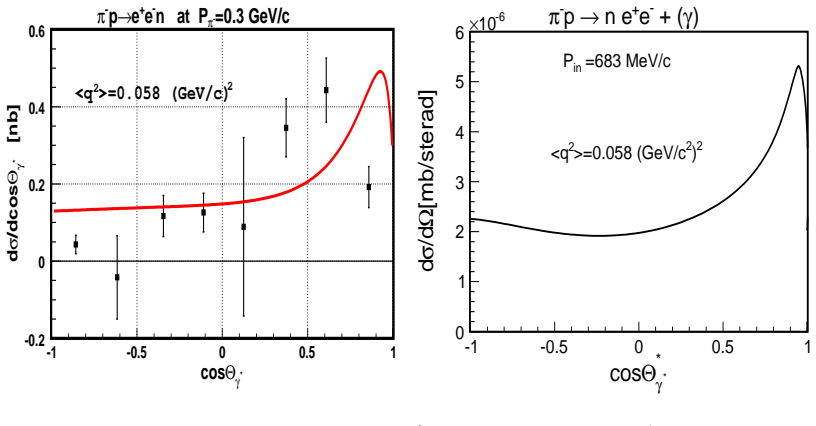
E.L. Bratkovskaya, W. Cassing and U. Mosel, Nucl.Phys. A 686, 568 (2001). 10 * γΘcos -1 -0.5 0 0.5 1 [nb]*γΘ/dcosσd -0.2 0 0.2 0.4 0.6 =0.3 GeV/c-πn at P-e+e→p-π 2>=0.058 (GeV/c)2<q * γ * Θcos -1 -0.5 0 0.5 1 [mb/sterad]Ω/dσd 0 1 2 3 4 5 6 -610× Graph )γ + (-e+ n e→p -π =683 MeV/cinP 2)2>=0.058 (GeV/c2<q Figure 8: Left: angular distribution dσ/d cos θγ∗ f...
work page 2001
- [15]
- [16]
- [17]
- [18]
-
[19]
A 32, 01031 (2017); arXiv:1704,00311 [hep-ph]
A.P.Jerusalimov, G.I.Lykasov, Int.J.Mod.Phys. A 32, 01031 (2017); arXiv:1704,00311 [hep-ph]
work page 2017
-
[20]
A.P.Jerusalimov, G.I.Lykasov, Phys.Part.Nucl. Lett. 15, 457 (2018)
work page 2018
- [21]
-
[22]
Yu.S. Surovtsev, T.D. Blokhintseva, P. Bydzˆ ovsky, N. Nagy, Phys.Rev. C 71, 055205 (2005)
work page 2005
- [23]
-
[24]
Web Conferen ces, 199, 01008 (2019)
B.Ramstein et al., HADES Collaboration, Eur.Phys.J. Web Conferen ces, 199, 01008 (2019)
work page 2019
- [25]
- [26]
-
[27]
A.F.Krutov, R.G.Polegaev? V.E.Troitsky, Phys.Rev. D93, 036007 ( 2016)
work page 2016
- [28]
-
[29]
Berezhnev, et.al., Sov.J.Nucl.Phys
S.Ph. Berezhnev, et.al., Sov.J.Nucl.Phys. 24, 591 (1976)
work page 1976
- [30]
discussion (0)
Sign in with ORCID, Apple, or X to comment. Anyone can read and Pith papers without signing in.