On Calibration of a Nominal Structure-Property Relationship Model for Chiral Sculptured Thin Films by Axial Transmittance Measurements
Pith reviewed 2026-05-24 16:22 UTC · model grok-4.3
The pith
Non-axial transmittance measurements resolve calibration ambiguity in models for chiral sculptured thin films.
A machine-rendered reading of the paper's core claim, the machinery that carries it, and where it could break.
Core claim
The authors fabricate a chiral sculptured thin film from patinal titanium oxide using the serial bideposition technique. They measure axial transmittance spectra over a spectral region that encompasses the Bragg regime for axial excitation. The same spectra are calculated with a nominal structure-property relationship model, and the model's parameter space is explored to obtain best fits. Ambiguity arises when calibration relies solely on axial transmittance measurements, but this ambiguity is shown to be resolvable by also using non-axial transmittance measurements.
What carries the argument
The nominal structure-property relationship model that links film structural parameters to computed transmittance spectra for both axial and non-axial light excitation, with parameter-space search used to match calculated and measured data.
If this is right
- A unique set of model parameters is obtained only when both axial and non-axial transmittance data are used together.
- The calibrated model then correctly predicts transmittance spectra at arbitrary angles of incidence.
- Structural parameters extracted from the fit can be used with greater to design optical elements based on the film.
- The same calibration procedure applies to other sculptured thin films whose optical response is described by the nominal model.
Where Pith is reading between the lines
- Routine characterization of sculptured thin films may need to include a range of incidence angles rather than axial measurements alone.
- Device fabrication tolerances could be tightened if the model is calibrated this way, because parameter uncertainty is reduced.
- The method could be tested on films made from other materials to see whether the resolution of ambiguity is material-independent.
Load-bearing premise
The nominal structure-property relationship model accurately represents the film's optical response and the fabricated film is uniform enough for the model to apply without extra defects.
What would settle it
Finding two or more distinct parameter sets in the model that match both the axial and non-axial transmittance spectra to the same accuracy would show that non-axial data does not resolve the ambiguity.
Figures


read the original abstract
A chiral sculptured thin film is fabricated from patinal titanium oxide using the serial bideposition technique. Axial transmittance spectrums are measured over a spectral region encompassing the Bragg regime for axial excitation. The same spectrums are calculated using a nominal structure-property relationship model and the parameter space of the model is explored for best fits of the calculated and measured transmittances. Ambiguity arising on calibrating the model against axial transmittance measurements is shown to be resolvable using non--axial transmittance measurements.
Editorial analysis
A structured set of objections, weighed in public.
Referee Report
Summary. The manuscript reports fabrication of a chiral sculptured thin film from patinal titanium oxide via serial bideposition. Axial transmittance spectra are measured across the Bragg regime and compared to predictions from a nominal structure-property relationship model whose parameters are varied to obtain best fits. The central claim is that parameter ambiguity encountered when fitting only axial data is resolved by incorporating non-axial transmittance measurements.
Significance. If the resolution of the fitting ambiguity is demonstrated with quantitative error metrics, explicit parameter ranges, and direct comparison of axial-only versus axial-plus-non-axial fits, the work would provide a practical route to more unique calibration of the nominal model for chiral sculptured films. The absence of such quantitative support in the abstract, however, leaves the practical significance currently unassessed.
major comments (2)
- Abstract: the assertion that ambiguity 'is shown to be resolvable' is made without any reported quantitative measure (e.g., reduction in parameter uncertainty, change in fit residual, or explicit comparison of posterior volumes), error analysis, or description of the parameter-space search method. This absence prevents evaluation of whether the non-axial data actually constrain the model beyond what axial data alone achieve.
- No section or equation is supplied that defines the nominal structure-property relationship model, the free parameters, or the objective function used for fitting. Without these, it is impossible to verify that the reported resolution is not an artifact of the particular parameterization or of unstated constraints.
minor comments (1)
- The abstract refers to 'spectrums' (plural); standard usage is 'spectra'.
Simulated Author's Rebuttal
We thank the referee for their careful reading of the manuscript and for identifying areas where additional quantitative detail and model specification would strengthen the presentation. We respond to each major comment below.
read point-by-point responses
-
Referee: Abstract: the assertion that ambiguity 'is shown to be resolvable' is made without any reported quantitative measure (e.g., reduction in parameter uncertainty, change in fit residual, or explicit comparison of posterior volumes), error analysis, or description of the parameter-space search method. This absence prevents evaluation of whether the non-axial data actually constrain the model beyond what axial data alone achieve.
Authors: We agree that the abstract would be strengthened by explicit quantitative support. In the revised manuscript we will update the abstract to report specific metrics, including the reduction in the volume of acceptable parameter space and the change in the minimum value of the objective function achieved when non-axial transmittance data are added to the axial data set. We will also state that the parameter space was explored by systematic sampling within physically admissible bounds. revision: yes
-
Referee: No section or equation is supplied that defines the nominal structure-property relationship model, the free parameters, or the objective function used for fitting. Without these, it is impossible to verify that the reported resolution is not an artifact of the particular parameterization or of unstated constraints.
Authors: The manuscript as submitted indeed lacks a dedicated section that explicitly defines the nominal structure-property relationship model, enumerates the free parameters, and states the objective function. We will insert a new section in the revised manuscript that supplies the governing equations, lists the adjustable parameters together with their physical ranges, and defines the objective function used to quantify the mismatch between measured and calculated spectra. revision: yes
Circularity Check
No significant circularity identified
full rationale
The paper's central procedure fabricates a film, acquires axial transmittance spectra over the Bragg regime, explores the parameter space of a nominal structure-property model to fit the measured data, notes resulting ambiguity, and shows that non-axial spectra resolve it. All load-bearing steps compare independent experimental spectra to forward-computed model outputs; no equation reduces to a fitted parameter by definition, no prediction is statistically forced by the fit itself, and no uniqueness theorem or ansatz is imported via self-citation to close the argument. The derivation therefore remains self-contained against external measurements.
Axiom & Free-Parameter Ledger
Lean theorems connected to this paper
-
IndisputableMonolith/Cost/FunctionalEquation.leanwashburn_uniqueness_aczel unclear?
unclearRelation between the paper passage and the cited Recognition theorem.
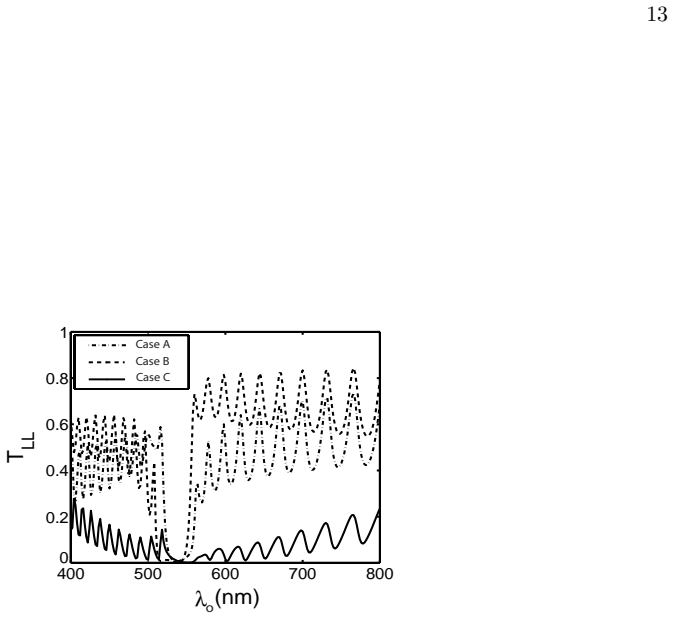
The Bruggeman formalism is then used to estimate a reference permittivity dyadic in terms of two shape factors of the ellipsoids, the bulk constitutive properties of the deposited material, and the porosity... The parameters f, χ and γ2 were varied so that the calculated transmittances TRR, TLL, TRL and TLR would best fit the measured data
-
IndisputableMonolith/Foundation/AlexanderDuality.leanalexander_duality_circle_linking unclear?
unclearRelation between the paper passage and the cited Recognition theorem.
Axial transmittance data can not completely resolve ambiguities in the calibration of the model. Non-axial transmittance data appears crucial to the resolution of the ambiguities.
What do these tags mean?
- matches
- The paper's claim is directly supported by a theorem in the formal canon.
- supports
- The theorem supports part of the paper's argument, but the paper may add assumptions or extra steps.
- extends
- The paper goes beyond the formal theorem; the theorem is a base layer rather than the whole result.
- uses
- The paper appears to rely on the theorem as machinery.
- contradicts
- The paper's claim conflicts with a theorem or certificate in the canon.
- unclear
- Pith found a possible connection, but the passage is too broad, indirect, or ambiguous to say the theorem truly supports the claim.
Reference graph
Works this paper leans on
-
[1]
A. Lakhtakia, R. Messier, M. J. Brett, K. Robbie, Innovat . Mater. Res. 1 (1996) 165
work page 1996
- [2]
-
[3]
R. Messier, V.C. Venugopal, P.D. Sunal, J. Vac. Sci. Tech nol. A 18 (2000) 1538
work page 2000
- [4]
-
[5]
O.R. Monteiro, A. Vizir, I.G. Brown, J. Phys. D: Appl. Phy s. 31 (1998) 3188
work page 1998
- [6]
-
[7]
K.D. Harris, M.J. Brett, T.J. Smy, C. Backhouse, J. Elect rochem. Soc. 147 (2000) 2002
work page 2000
- [8]
-
[9]
V.C. Venugopal, A. Lakhtakia in: O.N. Singh and A. Lakhta kia (Editors), Electro- magnetic fields in unconventional materials and structures , Wiley, New York, 2000 (Chapter 5)
work page 2000
-
[10]
A. Lakhtakia, M.W. McCall, J.A. Sherwin, Q. Wu, I.J. Hod gkinson, Opt. Commun. 194 (2001) 33
work page 2001
-
[11]
I.J. Hodgkinson, Q. Wu, B. Knight, A. Lakhtakia, K. Robb ie, Appl. Opt. 39 (2000) 642
work page 2000
- [12]
-
[13]
J.A. Sherwin, A. Lakhtakia, Math. Comput. Model. 34 (20 01) 1499; erratums: 35 (2002) in press
work page 2002
- [14]
-
[15]
W.S. Weiglhofer, A. Lakhtakia, B. Michel, Microw. Opt. Technol. Lett. 15 (1997) 263; erratum: 22 (1999) 221
work page 1997
-
[16]
Q. Wu, I.J. Hodgkinson, A. Lakhtakia, Opt. Engg. 39 (200 0)1863
-
[17]
I. J. Hodgkinson, Q. Wu, S. Collett, Appl. Opt. 40 (2001) 452
work page 2001
- [18]
- [19]
-
[20]
http://www.emicoe.com, EM Industries Inc., Darmstad t, Germany, consulted: March 5, 2002
work page 2002
- [21]
-
[22]
V. C. Venugopal, A. Lakhtakia, Proc. R. Soc. Lond. A 456 ( 2000) 125. 10 Figure Captions Figure 1. Computed and measured spectrums of the axial trasnmittance s of a chiral STF: (a) TLL, (b) TRR, (c) TLR, and (d) TRL. Computations were carried out with γ3 = 20, γ2 = 1. 06, Ω = 173nm, L = 30Ω, f = 0. 579, χ = 47◦, and εs = 6. 3 + 0. 012i. Figure 2. Regions ...
work page 2000
discussion (0)
Sign in with ORCID, Apple, or X to comment. Anyone can read and Pith papers without signing in.